ELI LILLY IN INDIA
RETHINKING THE JOINT VENTURE STRATEGY
Abhay Kishore – 01
Abhishek Kunal – 05
Anil Kumar Jadli – 11
J.Harish – 25
Khushal Malik – 28
Sharad Singh – 49
PHARMACEUTICAL INDUSTRY – Global Trend
•
•
•
•

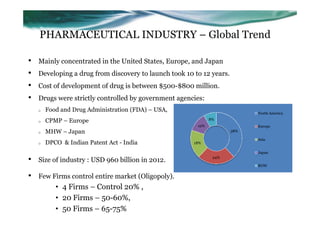
Mainly concentrated in the United States, Europe, and Japan
Developing a drug from discovery to launch took 10 to 12 years.
Cost of development of drug is between $500-$800 million.
Drugs were strictly controlled by government agencies:
o

Food and Drug Administration (FDA) – USA,

o

CPMP – Europe

North America
8%
12%

o

MHW – Japan

o

DPCO & Indian Patent Act - India

Europe
38%
Asia

18%

Japan

•

Size of industry : USD 960 billion in 2012.

24%
ROW

•

Few Firms control entire market (Oligopoly).

• 4 Firms – Control 20% ,
• 20 Firms – 50-60%,
• 50 Firms – 65-75%
PHARMACEUTICAL INDUSTRY – Global Trend

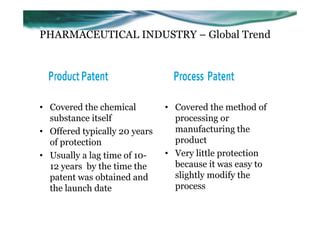
• Covered the chemical
substance itself
• Offered typically 20 years
of protection
• Usually a lag time of 1012 years by the time the
patent was obtained and
the launch date

• Covered the method of
processing or
manufacturing the
product
• Very little protection
because it was easy to
slightly modify the
process
Global Issues in Pharma Sector
•

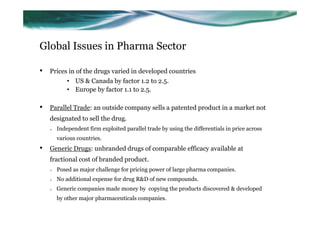
Prices in of the drugs varied in developed countries
• US & Canada by factor 1.2 to 2.5.
• Europe by factor 1.1 to 2.5.

•

Parallel Trade: an outside company sells a patented product in a market not
designated to sell the drug.
o

Independent firm exploited parallel trade by using the differentials in price across
various countries.

•

Generic Drugs: unbranded drugs of comparable efficacy available at
fractional cost of branded product.
o

Posed as major challenge for pricing power of large pharma companies.

o

No additional expense for drug R&D of new compounds.

o

Generic companies made money by copying the products discovered & developed
by other major pharmaceuticals companies.
Issues in Indian Pharma Sector
•
•

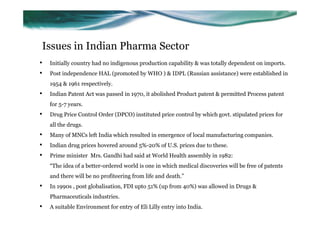
Initially country had no indigenous production capability & was totally dependent on imports.
Post independence HAL (promoted by WHO ) & IDPL (Russian assistance) were established in
1954 & 1961 respectively.

•

Indian Patent Act was passed in 1970, it abolished Product patent & permitted Process patent
for 5-7 years.

•

Drug Price Control Order (DPCO) instituted price control by which govt. stipulated prices for
all the drugs.

•
•
•

Many of MNCs left India which resulted in emergence of local manufacturing companies.
Indian drug prices hovered around 5%-20% of U.S. prices due to these.
Prime minister Mrs. Gandhi had said at World Health assembly in 1982:
“The idea of a better-ordered world is one in which medical discoveries will be free of patents
and there will be no profiteering from life and death.”

•

In 1990s , post globalisation, FDI upto 51% (up from 40%) was allowed in Drugs &
Pharmaceuticals industries.

•

A suitable Environment for entry of Eli Lilly entry into India.
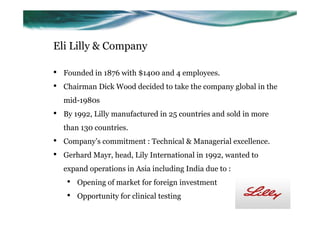
Eli Lilly & Company
•
•

Founded in 1876 with $1400 and 4 employees.
Chairman Dick Wood decided to take the company global in the
mid-1980s

•

By 1992, Lilly manufactured in 25 countries and sold in more
than 130 countries.

•
•

Company’s commitment : Technical & Managerial excellence.
Gerhard Mayr, head, Lily International in 1992, wanted to
expand operations in Asia including India due to :

•
•

Opening of market for foreign investment
Opportunity for clinical testing
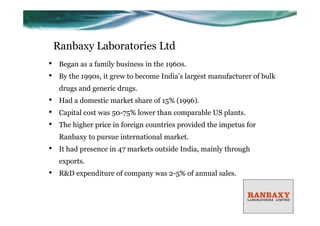
Ranbaxy Laboratories Ltd
•
•

Began as a family business in the 1960s.
By the 1990s, it grew to become India’s largest manufacturer of bulk
drugs and generic drugs.

•
•
•

Had a domestic market share of 15% (1996).
Capital cost was 50-75% lower than comparable US plants.
The higher price in foreign countries provided the impetus for
Ranbaxy to pursue international market.

•

It had presence in 47 markets outside India, mainly through
exports.

•

R&D expenditure of company was 2-5% of annual sales.
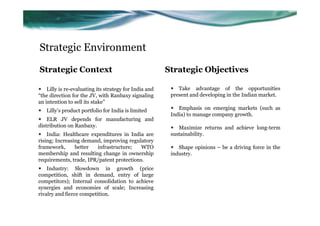
Strategic Environment
Strategic Context

Strategic Objectives

Lilly is re-evaluating its strategy for India and
“the direction for the JV, with Ranbaxy signaling
an intention to sell its stake”

Take advantage of the opportunities
present and developing in the Indian market.

Lilly’s product portfolio for India is limited

Emphasis on emerging markets (such as
India) to manage company growth.

ELR JV depends for manufacturing and
distribution on Ranbaxy.
India: Healthcare expenditures in India are
rising; Increasing demand, improving regulatory
framework,
better
infrastructure;
WTO
membership and resulting change in ownership
requirements, trade, IPR/patent protections.
Industry: Slowdown in growth (price
competition, shift in demand, entry of large
competitors); Internal consolidation to achieve
synergies and economies of scale; Increasing
rivalry and fierce competition.

Maximize returns and achieve long-term
sustainability.
Shape opinions – be a driving force in the
industry.
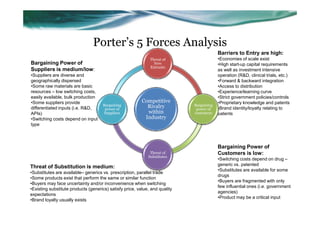
Porter’s 5 Forces Analysis
Barriers to Entry are high:
Threat of
New
Entrants

Bargaining Power of
Suppliers is medium/low:
•Suppliers are diverse and
geographically dispersed
•Some raw materials are basic
resources – low switching costs,
easily available, bulk production
•Some suppliers provide
differentiated inputs (i.e. R&D,
APIs)
•Switching costs depend on input
type

Bargaining
power of
Suppliers

Competitive
Rivalry
within
Industry

Threat of
Substitutes

Threat of Substitution is medium:
•Substitutes are available– generics vs. prescription, parallel trade
•Some products exist that perform the same or similar function
•Buyers may face uncertainty and/or inconvenience when switching
•Existing substitute products (generics) satisfy price, value, and quality
expectations
•Brand loyalty usually exists

Bargaining
power of
customers

•Economies of scale exist
•High start-up capital requirements
as well as investment intensive
operation (R&D, clinical trials, etc.)
•Forward & backward integration
•Access to distribution
•Experience/learning curve
•Strict government policies/controls
•Proprietary knowledge and patents
•Brand identity/loyalty relating to
patents

Bargaining Power of
Customers is low:
•Switching costs depend on drug –
generic vs. patented
•Substitutes are available for some
drugs
•Buyers are fragmented with only
few influential ones (i.e. government
agencies)
•Product may be a critical input
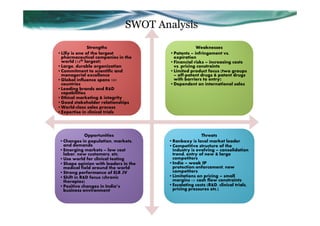
SWOT Analysis
Strengths
•Lilly is one of the largest
pharmaceutical companies in the
world (12th largest)
•Large, durable organization
•Commitment to scientific and
managerial excellence
•Global influence spans 151
countries
•Leading brands and R&D
capabilities
•Ethical marketing & integrity
•Good stakeholder relationships
•World-class sales process
•Expertise in clinical trials

Opportunities
•Changes in population, markets,
and demands
•Emerging markets – low cost
labor, new customers, etc.
•Use world for clinical testing
•Shape opinion with leaders in the
medical field around the world
•Strong performance of ELR JV
•Shift in R&D focus (chronic
therapies)
•Positive changes in India’s
business environment

Weaknesses
•Patents – infringement vs.
expiration
•Financial risks – increasing costs
vs. pricing constraints
•Limited product focus (two groups
– off-patent drugs & patent drugs
with barriers to entry)
•Dependent on international sales

Threats
•Ranbaxy is local market leader
•Competitive structure of the
industry is evolving – consolidation
trend, entry of new & large
competitors
•India – weak IP
protection/enforcement, new
competitors
•Limitations on pricing – small
margins -> cash flow constraints
•Escalating costs (R&D, clinical trials,
pricing pressures etc.)
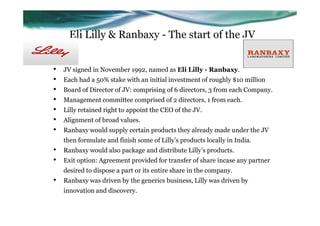
Eli Lilly & Ranbaxy - The start of the JV
•
•
•
•
•
•
•

JV signed in November 1992, named as Eli Lilly - Ranbaxy.
Each had a 50% stake with an initial investment of roughly $10 million
Board of Director of JV: comprising of 6 directors, 3 from each Company.
Management committee comprised of 2 directors, 1 from each.
Lilly retained right to appoint the CEO of the JV.
Alignment of broad values.
Ranbaxy would supply certain products they already made under the JV
then formulate and finish some of Lilly’s products locally in India.

•
•

Ranbaxy would also package and distribute Lilly’s products.
Exit option: Agreement provided for transfer of share incase any partner
desired to dispose a part or its entire share in the company.

•

Ranbaxy was driven by the generics business, Lilly was driven by
innovation and discovery.
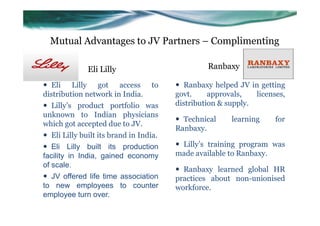
Mutual Advantages to JV Partners – Complimenting
Eli Lilly

Ranbaxy

Eli Lilly got access to
distribution network in India.
Lilly’s product portfolio was
unknown to Indian physicians
which got accepted due to JV.
Eli Lilly built its brand in India.

Ranbaxy helped JV in getting
govt.
approvals,
licenses,
distribution & supply.

Eli Lilly built its production
facility in India, gained economy
of scale.
JV offered life time association
to new employees to counter
employee turn over.

Lilly’s training program was
made available to Ranbaxy.

Technical
Ranbaxy.

learning

for

Ranbaxy learned global HR
practices about non-unionised
workforce.
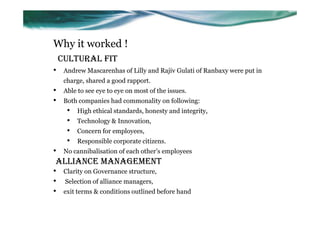
Why it worked !
CULTURAL FIT
•

Andrew Mascarenhas of Lilly and Rajiv Gulati of Ranbaxy were put in
charge, shared a good rapport.

•
•

Able to see eye to eye on most of the issues.
Both companies had commonality on following:

•
•
•
•
•

High ethical standards, honesty and integrity,
Technology & Innovation,
Concern for employees,
Responsible corporate citizens.

No cannibalisation of each other’s employees

ALLIANCE MANAGEMENT
•
•
•

Clarity on Governance structure,
Selection of alliance managers,
exit terms & conditions outlined before hand
Alliance Performance …..
•
•
•
•
•
•

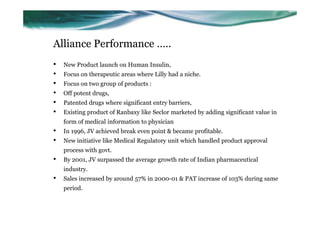
New Product launch on Human Insulin,
Focus on therapeutic areas where Lilly had a niche.
Focus on two group of products :
Off potent drugs,
Patented drugs where significant entry barriers,
Existing product of Ranbaxy like Seclor marketed by adding significant value in
form of medical information to physician

•
•

In 1996, JV achieved break even point & became profitable.
New initiative like Medical Regulatory unit which handled product approval
process with govt.

•

By 2001, JV surpassed the average growth rate of Indian pharmaceutical
industry.

•

Sales increased by around 57% in 2000-01 & PAT increase of 103% during same
period.
Changing World Order …..
•

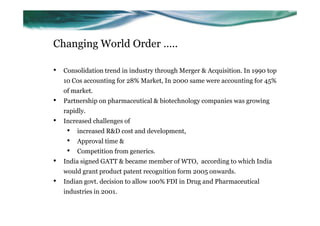
Consolidation trend in industry through Merger & Acquisition. In 1990 top
10 Cos accounting for 28% Market, In 2000 same were accounting for 45%
of market.

•

Partnership on pharmaceutical & biotechnology companies was growing
rapidly.

•

Increased challenges of

•
•
•
•

increased R&D cost and development,
Approval time &
Competition from generics.

India signed GATT & became member of WTO, according to which India
would grant product patent recognition form 2005 onwards.

•

Indian govt. decision to allow 100% FDI in Drug and Pharmaceutical
industries in 2001.
Change in Order …..
•

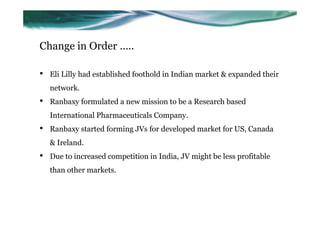
Eli Lilly had established foothold in Indian market & expanded their
network.

•

Ranbaxy formulated a new mission to be a Research based
International Pharmaceuticals Company.

•

Ranbaxy started forming JVs for developed market for US, Canada
& Ireland.

•

Due to increased competition in India, JV might be less profitable
than other markets.
Strategy Alternatives

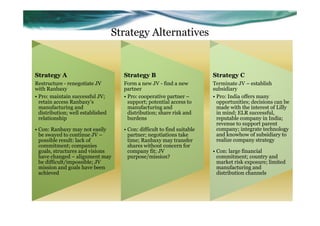
Strategy A

Strategy B

Strategy C

Restructure - renegotiate JV
with Ranbaxy
• Pro: maintain successful JV;
retain access Ranbaxy’s
manufacturing and
distribution; well established
relationship

Form a new JV - find a new
partner
• Pro: cooperative partner –
support; potential access to
manufacturing and
distribution; share risk and
burdens

• Con: Ranbaxy may not easily
be swayed to continue JV –
possible result: lack of
commitment; companies
goals, structures and visions
have changed – alignment may
be difficult/impossible; JV
mission and goals have been
achieved

• Con: difficult to find suitable
partner; negotiations take
time; Ranbaxy may transfer
shares without concern for
company fit; JV
purpose/mission?

Terminate JV – establish
subsidiary
• Pro: India offers many
opportunities; decisions can be
made with the interest of Lilly
in mind; ELR successful,
reputable company in India;
revenue to support parent
company; integrate technology
and knowhow of subsidiary to
realize company strategy
• Con: large financial
commitment; country and
market risk exposure; limited
manufacturing and
distribution channels
Conclusion:

Strategy C is suitable for Eli Lilly as well as
Ranbaxy in prevailing business scenario

•

Eli Lilly had established foothold in Indian market & expanded their
network. It may pursue its focus on innovation & discovery.

•

Ranbaxy formulated a new mission to be a Research based
International Pharmaceuticals Company. It may pursue its focus on
generics.

•

Due to increased competition in India JV might be less profitable
than other markets.

•

Ranbaxy started forming JVs for developed market for US, Canada
& Ireland. Ranbaxy was experiencing cash flow difficulties due to its
network of international sales and selling its share would give a
chance to improve its financial situation.
Conclusion:

Strategy C is suitable for Eli Lilly as well as
Ranbaxy in prevailing business scenario

•The strategy

will help Lilly to increase and strengthen its foothold in India which it

has gained over the years from the JV

•Enable

the company to take advantage of recent positive market developments

(economic and political).

• Address

key issues and concerns faced by Lilly, while allowing the company to

respond to global as well as local industry changes.

•Will

be able to utilize its core competencies to take advantage of the many

opportunities present in the Indian market.

•To use India for clinical testing through ELR’s medical infrastructure and expertise in
clinical trials. It will allow the company “to provide clinical trial data to support global
registrations” as well as proactively manage costs which is a global concern.

• Help

to returns will be maximized and profitability increased, thus meeting Lilly’s

strategic objectives .
Thank you