PRESENTAION
NAME: MUHAMMAD ISMAIL
CLASS NO: 196
SECTION: E
PRESNTAION TOPIC: HOT WEATHER CONCRETING
OUTLINES:
Hot weather definition
Hot weather problems
Temperature and graph
Pre-caution (planning)
Preparation before placing
Transporting , mixing and finishing
Curing in hot weather
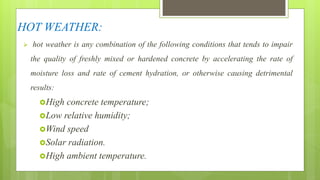
HOT WEATHER:
 hot weather is any combination of the following conditions that tends to impair
the quality of freshly mixed or hardened concrete by accelerating the rate of
moisture loss and rate of cement hydration, or otherwise causing detrimental
results:
High concrete temperature;
Low relative humidity;
Wind speed
Solar radiation.
High ambient temperature.
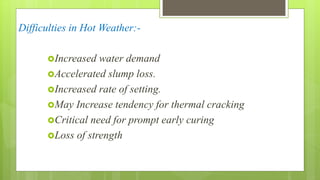
Difficulties in Hot Weather:-
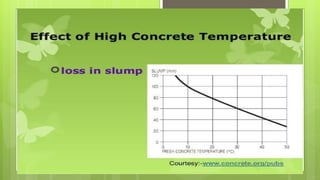
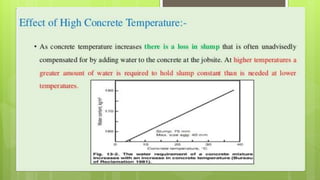
Increased water demand
Accelerated slump loss.
Increased rate of setting.
May Increase tendency for thermal cracking
Critical need for prompt early curing
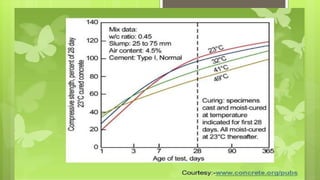
Loss of strength
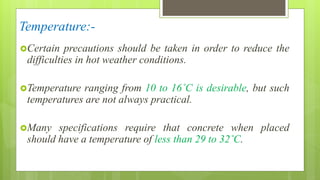
Temperature:-
Certain precautions should be taken in order to reduce the
difficulties in hot weather conditions.
Temperature ranging from 10 to 16˚C is desirable, but such
temperatures are not always practical.
Many specifications require that concrete when placed
should have a temperature of less than 29 to 32˚C.
Precautions Depends on:-
Type of construction.
Characteristics of the materials being used.
The experience of placing and finishing crew in
dealing with the atmospheric conditions in the site.
Precautions:-
Use materials and mix proportions that have a good record
in hot weather conditions.
Cool the concrete by cooling one or more of its ingredients.
Reduce the time of transporting, placing, and finishing as
possible.
Schedule concrete placements to avoid extreme weather,
during favorable weather conditions.
Consider the methods to limit moisture loss during placing
and finishing such as sunshades, wind screens, fogging, and
spraying.
Cooling Concrete Materials:-
Lower the temperature of concrete materials before
mixing.
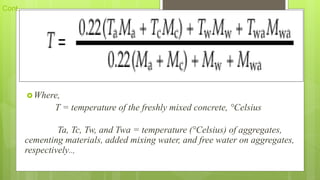
The contribution of each material is related to the
concrete temperature by:
Specific heat.
Quantity of each material.
Cont..,
Where,
T = temperature of the freshly mixed concrete, °Celsius
Ta, Tc, Tw, and Twa = temperature (°Celsius) of aggregates,
cementing materials, added mixing water, and free water on aggregates,
respectively..,
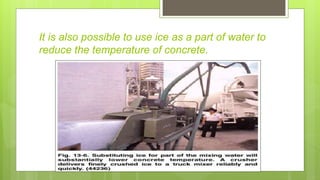
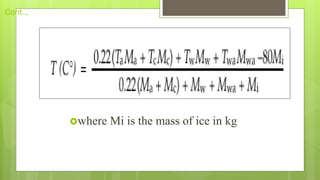
It is also possible to use ice as a part of water to
reduce the temperature of concrete.
Cont..,
where Mi is the mass of ice in kg
Cont..,
 Adding liquid nitrogen
Supplementary Cementitious Materials:-
The use of supplementary materials (fly ash, ground
granulated blast furnace slag) can help in hot weather
conditions.
These material slow the rate of setting as well as the
rate of slump loss.
Preparation Before Placing:-
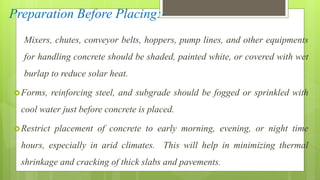
Mixers, chutes, conveyor belts, hoppers, pump lines, and other equipments
for handling concrete should be shaded, painted white, or covered with wet
burlap to reduce solar heat.
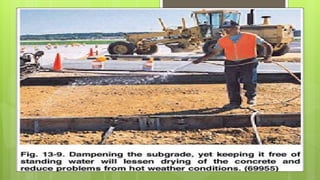
Forms, reinforcing steel, and subgrade should be fogged or sprinkled with
cool water just before concrete is placed.
Restrict placement of concrete to early morning, evening, or night time
hours, especially in arid climates. This will help in minimizing thermal
shrinkage and cracking of thick slabs and pavements.
Transporting, Placing, and Finishing:-
Should be done as quickly as practical during hot weather.
Delays contribute to the loss of slump and increase in concrete
temperature.
Prolonged mixing should be avoided.
Extra care must be taken with placement technique to avoid
cold joints.
Temporary sunshades and windbreaks help to minimize the cold
joints.
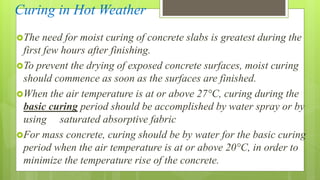
Curing in Hot Weather
The need for moist curing of concrete slabs is greatest during the
first few hours after finishing.
To prevent the drying of exposed concrete surfaces, moist curing
should commence as soon as the surfaces are finished.
When the air temperature is at or above 27°C, curing during the
basic curing period should be accomplished by water spray or by
using saturated absorptive fabric
For mass concrete, curing should be by water for the basic curing
period when the air temperature is at or above 20°C, in order to
minimize the temperature rise of the concrete.
Thank you

Presentation on hot weather concreting

  • 1.
    PRESENTAION NAME: MUHAMMAD ISMAIL CLASSNO: 196 SECTION: E PRESNTAION TOPIC: HOT WEATHER CONCRETING
  • 2.
    OUTLINES: Hot weather definition Hotweather problems Temperature and graph Pre-caution (planning) Preparation before placing Transporting , mixing and finishing Curing in hot weather
  • 3.
    HOT WEATHER:  hotweather is any combination of the following conditions that tends to impair the quality of freshly mixed or hardened concrete by accelerating the rate of moisture loss and rate of cement hydration, or otherwise causing detrimental results: High concrete temperature; Low relative humidity; Wind speed Solar radiation. High ambient temperature.
  • 4.
    Difficulties in HotWeather:- Increased water demand Accelerated slump loss. Increased rate of setting. May Increase tendency for thermal cracking Critical need for prompt early curing Loss of strength
  • 5.
    Temperature:- Certain precautions shouldbe taken in order to reduce the difficulties in hot weather conditions. Temperature ranging from 10 to 16˚C is desirable, but such temperatures are not always practical. Many specifications require that concrete when placed should have a temperature of less than 29 to 32˚C.
  • 9.
    Precautions Depends on:- Typeof construction. Characteristics of the materials being used. The experience of placing and finishing crew in dealing with the atmospheric conditions in the site.
  • 10.
    Precautions:- Use materials andmix proportions that have a good record in hot weather conditions. Cool the concrete by cooling one or more of its ingredients. Reduce the time of transporting, placing, and finishing as possible. Schedule concrete placements to avoid extreme weather, during favorable weather conditions. Consider the methods to limit moisture loss during placing and finishing such as sunshades, wind screens, fogging, and spraying.
  • 12.
    Cooling Concrete Materials:- Lowerthe temperature of concrete materials before mixing. The contribution of each material is related to the concrete temperature by: Specific heat. Quantity of each material.
  • 13.
    Cont.., Where, T = temperatureof the freshly mixed concrete, °Celsius Ta, Tc, Tw, and Twa = temperature (°Celsius) of aggregates, cementing materials, added mixing water, and free water on aggregates, respectively..,
  • 14.
    It is alsopossible to use ice as a part of water to reduce the temperature of concrete.
  • 15.
    Cont.., where Mi isthe mass of ice in kg
  • 16.
  • 17.
    Supplementary Cementitious Materials:- Theuse of supplementary materials (fly ash, ground granulated blast furnace slag) can help in hot weather conditions. These material slow the rate of setting as well as the rate of slump loss.
  • 18.
    Preparation Before Placing:- Mixers,chutes, conveyor belts, hoppers, pump lines, and other equipments for handling concrete should be shaded, painted white, or covered with wet burlap to reduce solar heat. Forms, reinforcing steel, and subgrade should be fogged or sprinkled with cool water just before concrete is placed. Restrict placement of concrete to early morning, evening, or night time hours, especially in arid climates. This will help in minimizing thermal shrinkage and cracking of thick slabs and pavements.
  • 20.
    Transporting, Placing, andFinishing:- Should be done as quickly as practical during hot weather. Delays contribute to the loss of slump and increase in concrete temperature. Prolonged mixing should be avoided. Extra care must be taken with placement technique to avoid cold joints. Temporary sunshades and windbreaks help to minimize the cold joints.
  • 21.
    Curing in HotWeather The need for moist curing of concrete slabs is greatest during the first few hours after finishing. To prevent the drying of exposed concrete surfaces, moist curing should commence as soon as the surfaces are finished. When the air temperature is at or above 27°C, curing during the basic curing period should be accomplished by water spray or by using saturated absorptive fabric For mass concrete, curing should be by water for the basic curing period when the air temperature is at or above 20°C, in order to minimize the temperature rise of the concrete.
  • 22.