DORMITORY/STUDENT
RESIDENCE HALL
INT 401: Fourth Year Studio Project I
Spring 2015
Student Name: Naveen Jamal
Student Id: 201110147
Advisor: Miss. Zeineb Naouar
Content
• Introduction
• Problem Statement
• Research Methodology
• Program
• History
• International Case Study
1. Tietgen Dormitory, Denmark
2. Simmons Hall Residence at MIT, USA
• Local Case Study
1. Abu Dhabi University Dorm
Introduction
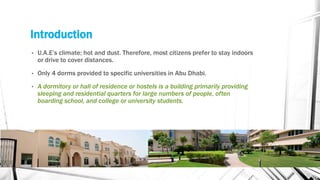
• U.A.E’s climate; hot and dust. Therefore, most citizens prefer to stay indoors
or drive to cover distances.
• Only 4 dorms provided to specific universities in Abu Dhabi.
• A dormitory or hall of residence or hostels is a building primarily providing
sleeping and residential quarters for large numbers of people, often
boarding school, and college or university students.
Problem Statement
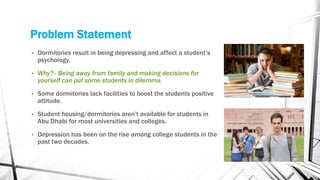
• Dormitories result in being depressing and affect a student’s
psychology.
• Why? - Being away from family and making decisions for
yourself can put some students in dilemma.
• Some dormitories lack facilities to boost the students positive
attitude.
• Student housing/dormitories aren’t available for students in
Abu Dhabi for most universities and colleges.
• Depression has been on the rise among college students in the
past two decades.
Research Methodology
• Referred book: Collaboration in Architecture & Engineering by Claire Olsen,
Sinead Mac Namara.
• Internet; Official websites.
• Interviewed existing and past dormitory students.
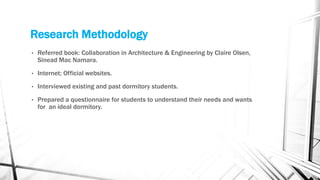
• Prepared a questionnaire for students to understand their needs and wants
for an ideal dormitory.
Research Methodology
Survey Results
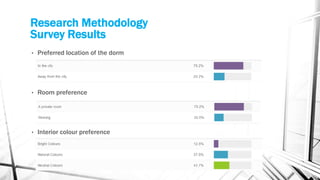
• Preferred location of the dorm
• Room preference
• Interior colour preference
Research Methodology
Survey Results
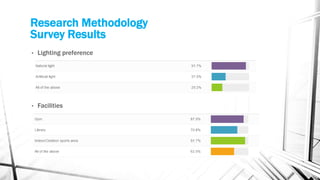
• Lighting preference
• Facilities
•
Research Methodology
Survey Results
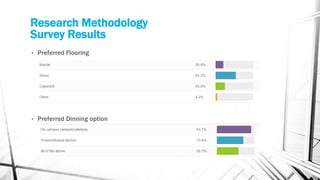
• Preferred Flooring
• Preferred Dinning option
Research Methodology
Survey Results
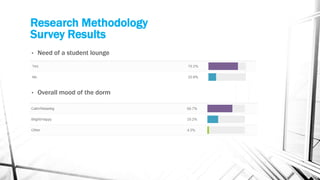
• Need of a student lounge
• Overall mood of the dorm
Program
• Reception/Lobby
• Unit (Rooms, kitchen & bathroom)
• Activity room (clubs)/ Lounge
• Library
• Canteen/ Common kitchen
• Gym
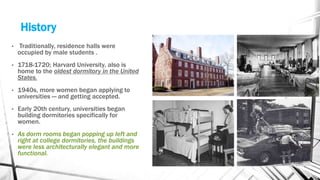
History
• Traditionally, residence halls were
occupied by male students .
• 1718-1720; Harvard University, also is
home to the oldest dormitory in the United
States.
• 1940s, more women began applying to
universities — and getting accepted.
• Early 20th century, universities began
building dormitories specifically for
women.
• As dorm rooms began popping up left and
right at college dormitories, the buildings
were less architecturally elegant and more
functional.
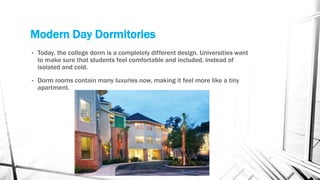
Modern Day Dormitories
• Today, the college dorm is a completely different design. Universities want
to make sure that students feel comfortable and included, instead of
isolated and cold.
• Dorm rooms contain many luxuries now, making it feel more like a tiny
apartment.
International Case
Study
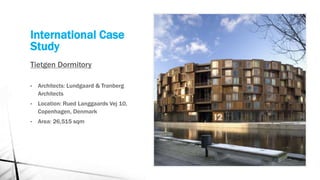
Tietgen Dormitory
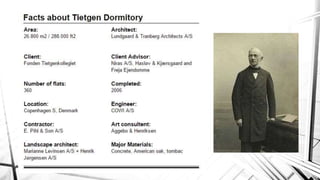
• Architects: Lundgaard & Tranberg
Architects
• Location: Rued Langgaards Vej 10,
Copenhagen, Denmark
• Area: 26,515 sqm
Tietgen Dormitory
The Architecture
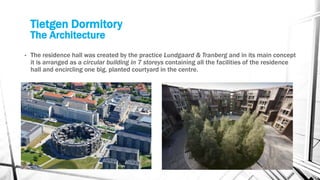
• The residence hall was created by the practice Lundgaard & Tranberg and in its main concept
it is arranged as a circular building in 7 storeys containing all the facilities of the residence
hall and encircling one big, planted courtyard in the centre.
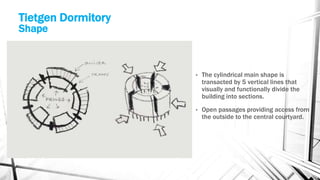
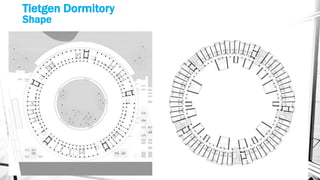
• The cylindrical main shape is
transacted by 5 vertical lines that
visually and functionally divide the
building into sections.
• Open passages providing access from
the outside to the central courtyard.
Tietgen Dormitory
Shape
Tietgen Dormitory
Shape
Tietgen Dormitory
Shape
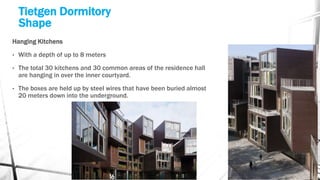
Hanging Kitchens
• With a depth of up to 8 meters
• The total 30 kitchens and 30 common areas of the residence hall
are hanging in over the inner courtyard.
• The boxes are held up by steel wires that have been buried almost
20 meters down into the underground.
Tietgen Dormitory
Spaces
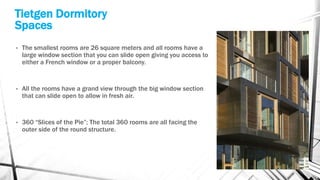
• The smallest rooms are 26 square meters and all rooms have a
large window section that you can slide open giving you access to
either a French window or a proper balcony.
• All the rooms have a grand view through the big window section
that can slide open to allow in fresh air.
• 360 “Slices of the Pie”; The total 360 rooms are all facing the
outer side of the round structure.
Tietgen Dormitory
Spaces
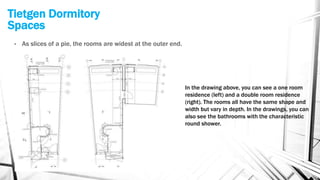
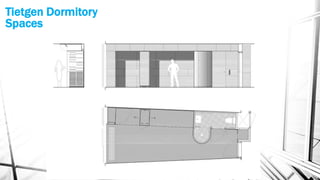
• As slices of a pie, the rooms are widest at the outer end.
In the drawing above, you can see a one room
residence (left) and a double room residence
(right). The rooms all have the same shape and
width but vary in depth. In the drawings, you can
also see the bathrooms with the characteristic
round shower.
Tietgen Dormitory
Spaces
Tietgen Dormitory
Spaces
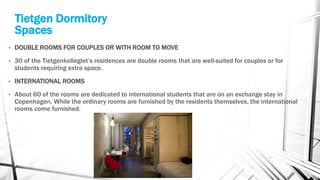
• DOUBLE ROOMS FOR COUPLES OR WITH ROOM TO MOVE
• 30 of the Tietgenkollegiet’s residences are double rooms that are well-suited for couples or for
students requiring extra space.
• INTERNATIONAL ROOMS
• About 60 of the rooms are dedicated to international students that are on an exchange stay in
Copenhagen. While the ordinary rooms are furnished by the residents themselves, the international
rooms come furnished.
Tietgen Dormitory
Spaces
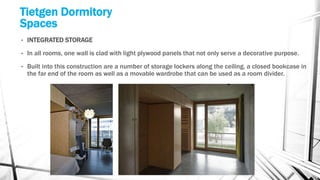
• INTEGRATED STORAGE
• In all rooms, one wall is clad with light plywood panels that not only serve a decorative purpose.
• Built into this construction are a number of storage lockers along the ceiling, a closed bookcase in
the far end of the room as well as a movable wardrobe that can be used as a room divider.
Tietgen Dormitory
Spaces
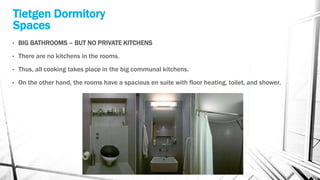
• BIG BATHROOMS – BUT NO PRIVATE KITCHENS
• There are no kitchens in the rooms.
• Thus, all cooking takes place in the big communal kitchens.
• On the other hand, the rooms have a spacious en suite with floor heating, toilet, and shower.
Tietgen Dormitory
Spaces
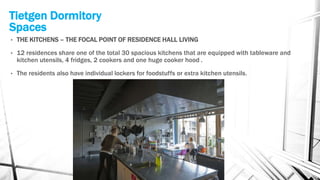
• THE KITCHENS – THE FOCAL POINT OF RESIDENCE HALL LIVING
• 12 residences share one of the total 30 spacious kitchens that are equipped with tableware and
kitchen utensils, 4 fridges, 2 cookers and one huge cooker hood .
• The residents also have individual lockers for foodstuffs or extra kitchen utensils.
Tietgen Dormitory
Spaces
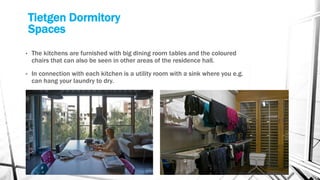
• The kitchens are furnished with big dining room tables and the coloured
chairs that can also be seen in other areas of the residence hall.
• In connection with each kitchen is a utility room with a sink where you e.g.
can hang your laundry to dry.
Tietgen Dormitory
Spaces
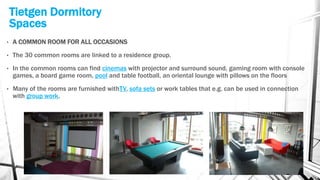
• A COMMON ROOM FOR ALL OCCASIONS
• The 30 common rooms are linked to a residence group.
• In the common rooms can find cinemas with projector and surround sound, gaming room with console
games, a board game room, pool and table football, an oriental lounge with pillows on the floors
• Many of the rooms are furnished withTV, sofa sets or work tables that e.g. can be used in connection
with group work.
Tietgen Dormitory
Spaces
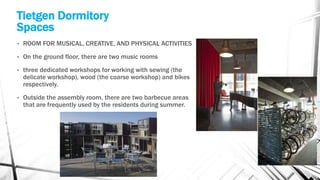
• ROOM FOR MUSICAL, CREATIVE, AND PHYSICAL ACTIVITIES
• On the ground floor, there are two music rooms
• three dedicated workshops for working with sewing (the
delicate workshop), wood (the coarse workshop) and bikes
respectively.
• Outside the assembly room, there are two barbecue areas
that are frequently used by the residents during summer.
Tietgen Dormitory
Material
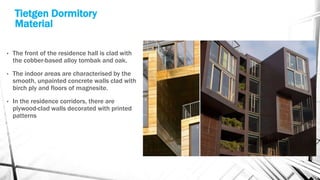
• The front of the residence hall is clad with
the cobber-based alloy tombak and oak.
• The indoor areas are characterised by the
smooth, unpainted concrete walls clad with
birch ply and floors of magnesite.
• In the residence corridors, there are
plywood-clad walls decorated with printed
patterns
Tietgen Dormitory
Colour
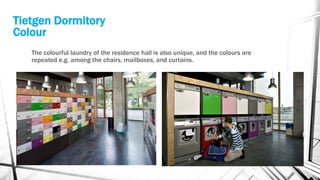
The colourful laundry of the residence hall is also unique, and the colours are
repeated e.g. among the chairs, mailboxes, and curtains.
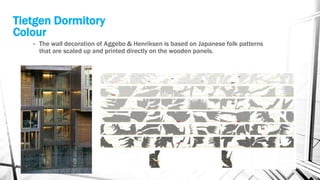
• The wall decoration of Aggebo & Henriksen is based on Japanese folk patterns
that are scaled up and printed directly on the wooden panels.
Tietgen Dormitory
Colour
International Case
Study
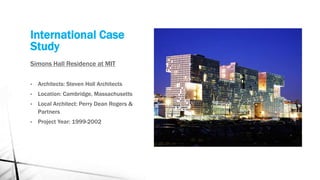
Simons Hall Residence at MIT
• Architects: Steven Holl Architects
• Location: Cambridge, Massachusetts
• Local Architect: Perry Dean Rogers &
Partners
• Project Year: 1999-2002
Simmons Hall
The Building
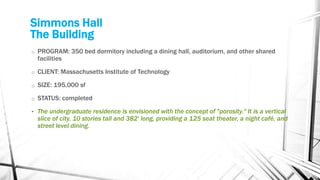
o PROGRAM: 350 bed dormitory including a dining hall, auditorium, and other shared
facilities
o CLIENT: Massachusetts Institute of Technology
o SIZE: 195,000 sf
o STATUS: completed
• The undergraduate residence is envisioned with the concept of "porosity." It is a vertical
slice of city, 10 stories tall and 382' long, providing a 125 seat theater, a night café, and
street level dining.
Simmons Hall
The Shape
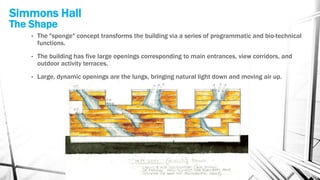
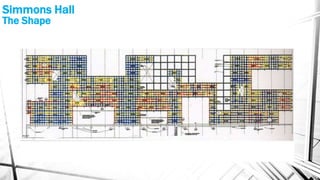
• The "sponge" concept transforms the building via a series of programmatic and bio-technical
functions.
• The building has five large openings corresponding to main entrances, view corridors, and
outdoor activity terraces.
• Large, dynamic openings are the lungs, bringing natural light down and moving air up.
Simmons Hall
The Shape
Simmons Hall
The Space
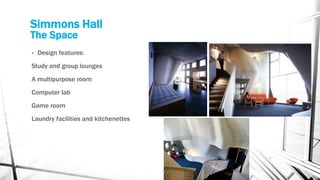
• Design features:
Study and group lounges
A multipurpose room
Computer lab
Game room
Laundry facilities and kitchenettes
Simmons Hall
The Space
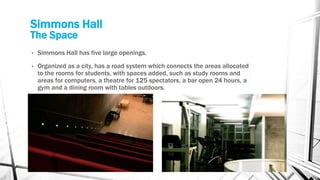
• Simmons Hall has five large openings.
• Organized as a city, has a road system which connects the areas allocated
to the rooms for students, with spaces added, such as study rooms and
areas for computers, a theatre for 125 spectators, a bar open 24 hours, a
gym and a dining room with tables outdoors.
Simmons Hall
The Space
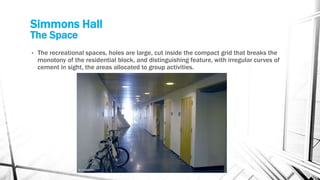
• The recreational spaces, holes are large, cut inside the compact grid that breaks the
monotony of the residential block, and distinguishing feature, with irregular curves of
cement in sight, the areas allocated to group activities.
Simmons Hall
The Space
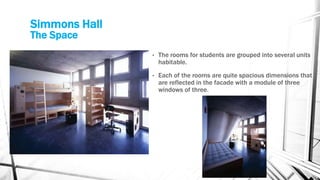
• The rooms for students are grouped into several units
habitable.
• Each of the rooms are quite spacious dimensions that
are reflected in the facade with a module of three
windows of three.
Simmons Hall
The Space
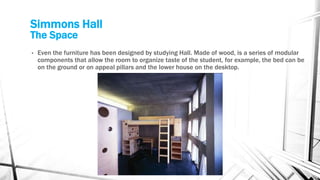
• Even the furniture has been designed by studying Hall. Made of wood, is a series of modular
components that allow the room to organize taste of the student, for example, the bed can be
on the ground or on appeal pillars and the lower house on the desktop.
Simmons Hall
The Space
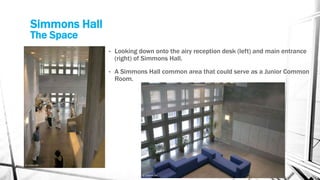
• Looking down onto the airy reception desk (left) and main entrance
(right) of Simmons Hall.
• A Simmons Hall common area that could serve as a Junior Common
Room.
Simmons Hall
The Space
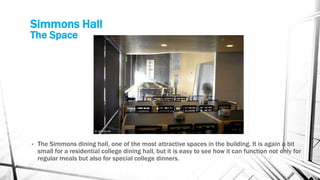
• The Simmons dining hall, one of the most attractive spaces in the building. It is again a bit
small for a residential college dining hall, but it is easy to see how it can function not only for
regular meals but also for special college dinners.
Simmons Hall
The Space
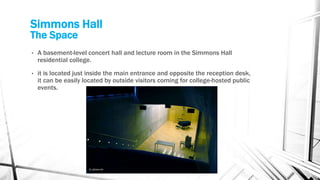
• A basement-level concert hall and lecture room in the Simmons Hall
residential college.
• it is located just inside the main entrance and opposite the reception desk,
it can be easily located by outside visitors coming for college-hosted public
events.
Simmons Hall
The Space
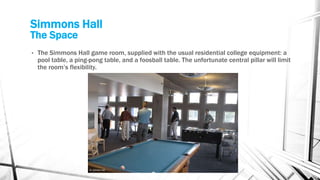
• The Simmons Hall game room, supplied with the usual residential college equipment: a
pool table, a ping-pong table, and a foosball table. The unfortunate central pillar will limit
the room’s flexibility.
Simmons Hall
The Space
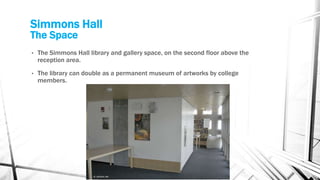
• The Simmons Hall library and gallery space, on the second floor above the
reception area.
• The library can double as a permanent museum of artworks by college
members.
Simmons Hall
Color
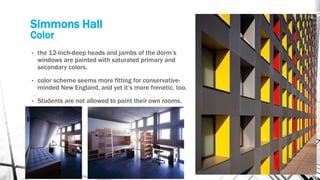
• the 12-inch-deep heads and jambs of the dorm’s
windows are painted with saturated primary and
secondary colors.
• color scheme seems more fitting for conservative-
minded New England, and yet it’s more frenetic, too.
• Students are not allowed to paint their own rooms.
Simmons Hall
Material
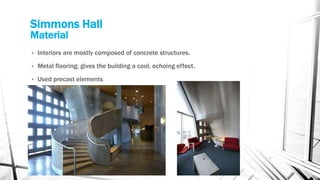
• Interiors are mostly composed of concrete structures.
• Metal flooring; gives the building a cool, echoing effect.
• Used precast elements
Simmons Hall
Lighting
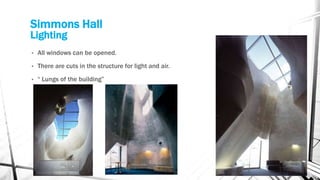
• All windows can be opened.
• There are cuts in the structure for light and air.
• “ Lungs of the building”
Simmons Hall
Lighting
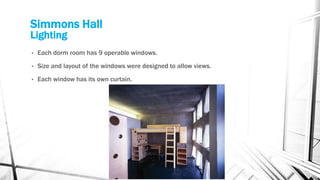
• Each dorm room has 9 operable windows.
• Size and layout of the windows were designed to allow views.
• Each window has its own curtain.
Local Case Study
Abu Dhabi University
Dorm
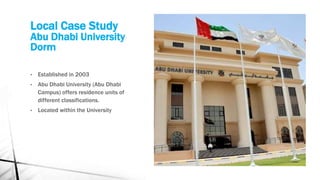
• Established in 2003
• Abu Dhabi University (Abu Dhabi
Campus) offers residence units of
different classifications.
• Located within the University
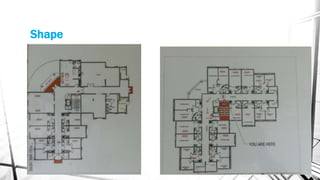
Shape
Spaces
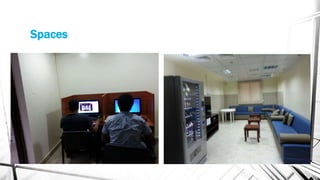
• 1. Common kitchen
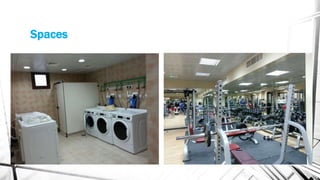
• 2. Laundry rooms
• 3. Common washrooms
• 4. TV room
• 5. Computer areas with PC and wired internet connections
• 6. Wireless Internet connection
• 7. Gym
• 8. Sports Facilities (football, basketbal, volleyball, tennis courts)
• 9. Supermarket
• 10. Transportation to and from the airport and shopping areas
Spaces
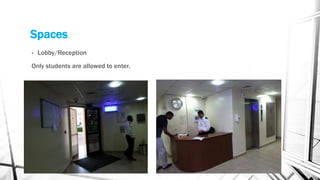
• Lobby/Reception
Only students are allowed to enter.
Spaces
Unit system
• Private Room
Single unit with individual kitchen and bath (1 person/unit)
• Semi-Private
Single Occupancy with Shared Bath and Kitchen(2 persons/unit)
• Double-Sharing
One-bedroom unit with 2 beds with shared kitchen and bath (2 persons/unit)
• Double-Occupancy with Shared Bath and Kitchen
Two-bedroom unit with 2 beds in each room and shared kitchen and bath (4
persons/unit)
Spaces
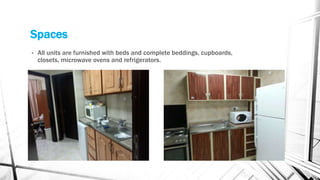
• All units are furnished with beds and complete beddings, cupboards,
closets, microwave ovens and refrigerators.
Spaces
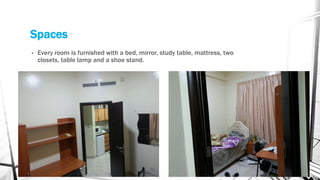
• Every room is furnished with a bed, mirror, study table, mattress, two
closets, table lamp and a shoe stand.
Spaces
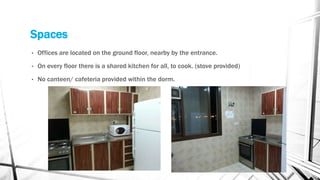
• Offices are located on the ground floor, nearby by the entrance.
• On every floor there is a shared kitchen for all, to cook. (stove provided)
• No canteen/ cafeteria provided within the dorm.
Spaces
Spaces
Material
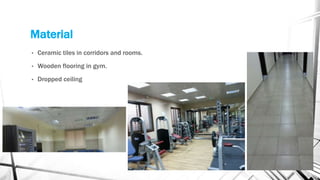
• Ceramic tiles in corridors and rooms.
• Wooden flooring in gym.
• Dropped ceiling
Lighting
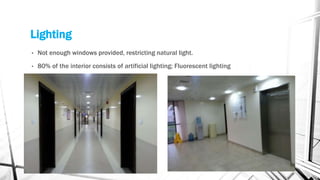
• Not enough windows provided, restricting natural light.
• 80% of the interior consists of artificial lighting; Fluorescent lighting
Reference
• http://web.mit.edu/facilities/construction/completed/simmons.html
• http://www.archnewsnow.com/features/Feature86.htm
• http://www.stevenholl.com/project-detail.php?id=47
• http://www.archdaily.com/65172/simmons-hall-at-mit-steven-holl/
• http://en.wikiarquitectura.com/index.php/Simmons_Hall_Residence
• http://www.archdaily.com/474237/tietgen-dormitory-lundgaard-and-
tranberg-architects/
• http://www.arcspace.com/features/lundgaard--tranberg-/tietgen-
dormitory/
• http://tietgenkollegiet.dk/en/the-building/
Reference
• https://books.google.ae/books?id=3xSLAwAAQBAJ&pg=PT113&lpg=PT113&dq=simmons
+hall+interior+color&source=bl&ots=oXRuZUL1IN&sig=7jhEcXUPy-
u02GBWccYkt2W__3E&hl=en&sa=X&ei=1jH8VOCAMcbIyAPSg4GQAw&ved=0CFEQ6AEwC
w#v=onepage&q=simmons%20hall%20interior%20color&f=false
• http://www.payette.com/post/1789308-tour-of-simmons-hall-at-mit
• http://www.nytimes.com/2003/05/18/magazine/big-sponge-on-campus.html
• http://www.galinsky.com/buildings/simmons/
• https://couplarchideas.wordpress.com/2012/11/18/the-phenomenological-approach/
• http://architizer.com/projects/mit-simmons-hall/
• http://www.archnewsnow.com/features/Feature86.htm

Dormitory case studies

  • 1.
    DORMITORY/STUDENT RESIDENCE HALL INT 401:Fourth Year Studio Project I Spring 2015 Student Name: Naveen Jamal Student Id: 201110147 Advisor: Miss. Zeineb Naouar
  • 2.
    Content • Introduction • ProblemStatement • Research Methodology • Program • History • International Case Study 1. Tietgen Dormitory, Denmark 2. Simmons Hall Residence at MIT, USA • Local Case Study 1. Abu Dhabi University Dorm
  • 3.
    Introduction • U.A.E’s climate;hot and dust. Therefore, most citizens prefer to stay indoors or drive to cover distances. • Only 4 dorms provided to specific universities in Abu Dhabi. • A dormitory or hall of residence or hostels is a building primarily providing sleeping and residential quarters for large numbers of people, often boarding school, and college or university students.
  • 4.
    Problem Statement • Dormitoriesresult in being depressing and affect a student’s psychology. • Why? - Being away from family and making decisions for yourself can put some students in dilemma. • Some dormitories lack facilities to boost the students positive attitude. • Student housing/dormitories aren’t available for students in Abu Dhabi for most universities and colleges. • Depression has been on the rise among college students in the past two decades.
  • 5.
    Research Methodology • Referredbook: Collaboration in Architecture & Engineering by Claire Olsen, Sinead Mac Namara. • Internet; Official websites. • Interviewed existing and past dormitory students. • Prepared a questionnaire for students to understand their needs and wants for an ideal dormitory.
  • 6.
    Research Methodology Survey Results •Preferred location of the dorm • Room preference • Interior colour preference
  • 7.
    Research Methodology Survey Results •Lighting preference • Facilities •
  • 8.
    Research Methodology Survey Results •Preferred Flooring • Preferred Dinning option
  • 9.
    Research Methodology Survey Results •Need of a student lounge • Overall mood of the dorm
  • 10.
    Program • Reception/Lobby • Unit(Rooms, kitchen & bathroom) • Activity room (clubs)/ Lounge • Library • Canteen/ Common kitchen • Gym
  • 11.
    History • Traditionally, residencehalls were occupied by male students . • 1718-1720; Harvard University, also is home to the oldest dormitory in the United States. • 1940s, more women began applying to universities — and getting accepted. • Early 20th century, universities began building dormitories specifically for women. • As dorm rooms began popping up left and right at college dormitories, the buildings were less architecturally elegant and more functional.
  • 12.
    Modern Day Dormitories •Today, the college dorm is a completely different design. Universities want to make sure that students feel comfortable and included, instead of isolated and cold. • Dorm rooms contain many luxuries now, making it feel more like a tiny apartment.
  • 13.
    International Case Study Tietgen Dormitory •Architects: Lundgaard & Tranberg Architects • Location: Rued Langgaards Vej 10, Copenhagen, Denmark • Area: 26,515 sqm
  • 15.
    Tietgen Dormitory The Architecture •The residence hall was created by the practice Lundgaard & Tranberg and in its main concept it is arranged as a circular building in 7 storeys containing all the facilities of the residence hall and encircling one big, planted courtyard in the centre.
  • 16.
    • The cylindricalmain shape is transacted by 5 vertical lines that visually and functionally divide the building into sections. • Open passages providing access from the outside to the central courtyard. Tietgen Dormitory Shape
  • 17.
  • 18.
    Tietgen Dormitory Shape Hanging Kitchens •With a depth of up to 8 meters • The total 30 kitchens and 30 common areas of the residence hall are hanging in over the inner courtyard. • The boxes are held up by steel wires that have been buried almost 20 meters down into the underground.
  • 19.
    Tietgen Dormitory Spaces • Thesmallest rooms are 26 square meters and all rooms have a large window section that you can slide open giving you access to either a French window or a proper balcony. • All the rooms have a grand view through the big window section that can slide open to allow in fresh air. • 360 “Slices of the Pie”; The total 360 rooms are all facing the outer side of the round structure.
  • 20.
    Tietgen Dormitory Spaces • Asslices of a pie, the rooms are widest at the outer end. In the drawing above, you can see a one room residence (left) and a double room residence (right). The rooms all have the same shape and width but vary in depth. In the drawings, you can also see the bathrooms with the characteristic round shower.
  • 21.
  • 22.
    Tietgen Dormitory Spaces • DOUBLEROOMS FOR COUPLES OR WITH ROOM TO MOVE • 30 of the Tietgenkollegiet’s residences are double rooms that are well-suited for couples or for students requiring extra space. • INTERNATIONAL ROOMS • About 60 of the rooms are dedicated to international students that are on an exchange stay in Copenhagen. While the ordinary rooms are furnished by the residents themselves, the international rooms come furnished.
  • 23.
    Tietgen Dormitory Spaces • INTEGRATEDSTORAGE • In all rooms, one wall is clad with light plywood panels that not only serve a decorative purpose. • Built into this construction are a number of storage lockers along the ceiling, a closed bookcase in the far end of the room as well as a movable wardrobe that can be used as a room divider.
  • 24.
    Tietgen Dormitory Spaces • BIGBATHROOMS – BUT NO PRIVATE KITCHENS • There are no kitchens in the rooms. • Thus, all cooking takes place in the big communal kitchens. • On the other hand, the rooms have a spacious en suite with floor heating, toilet, and shower.
  • 25.
    Tietgen Dormitory Spaces • THEKITCHENS – THE FOCAL POINT OF RESIDENCE HALL LIVING • 12 residences share one of the total 30 spacious kitchens that are equipped with tableware and kitchen utensils, 4 fridges, 2 cookers and one huge cooker hood . • The residents also have individual lockers for foodstuffs or extra kitchen utensils.
  • 26.
    Tietgen Dormitory Spaces • Thekitchens are furnished with big dining room tables and the coloured chairs that can also be seen in other areas of the residence hall. • In connection with each kitchen is a utility room with a sink where you e.g. can hang your laundry to dry.
  • 27.
    Tietgen Dormitory Spaces • ACOMMON ROOM FOR ALL OCCASIONS • The 30 common rooms are linked to a residence group. • In the common rooms can find cinemas with projector and surround sound, gaming room with console games, a board game room, pool and table football, an oriental lounge with pillows on the floors • Many of the rooms are furnished withTV, sofa sets or work tables that e.g. can be used in connection with group work.
  • 28.
    Tietgen Dormitory Spaces • ROOMFOR MUSICAL, CREATIVE, AND PHYSICAL ACTIVITIES • On the ground floor, there are two music rooms • three dedicated workshops for working with sewing (the delicate workshop), wood (the coarse workshop) and bikes respectively. • Outside the assembly room, there are two barbecue areas that are frequently used by the residents during summer.
  • 29.
    Tietgen Dormitory Material • Thefront of the residence hall is clad with the cobber-based alloy tombak and oak. • The indoor areas are characterised by the smooth, unpainted concrete walls clad with birch ply and floors of magnesite. • In the residence corridors, there are plywood-clad walls decorated with printed patterns
  • 30.
    Tietgen Dormitory Colour The colourfullaundry of the residence hall is also unique, and the colours are repeated e.g. among the chairs, mailboxes, and curtains.
  • 31.
    • The walldecoration of Aggebo & Henriksen is based on Japanese folk patterns that are scaled up and printed directly on the wooden panels. Tietgen Dormitory Colour
  • 32.
    International Case Study Simons HallResidence at MIT • Architects: Steven Holl Architects • Location: Cambridge, Massachusetts • Local Architect: Perry Dean Rogers & Partners • Project Year: 1999-2002
  • 33.
    Simmons Hall The Building oPROGRAM: 350 bed dormitory including a dining hall, auditorium, and other shared facilities o CLIENT: Massachusetts Institute of Technology o SIZE: 195,000 sf o STATUS: completed • The undergraduate residence is envisioned with the concept of "porosity." It is a vertical slice of city, 10 stories tall and 382' long, providing a 125 seat theater, a night café, and street level dining.
  • 34.
    Simmons Hall The Shape •The "sponge" concept transforms the building via a series of programmatic and bio-technical functions. • The building has five large openings corresponding to main entrances, view corridors, and outdoor activity terraces. • Large, dynamic openings are the lungs, bringing natural light down and moving air up.
  • 35.
  • 36.
    Simmons Hall The Space •Design features: Study and group lounges A multipurpose room Computer lab Game room Laundry facilities and kitchenettes
  • 37.
    Simmons Hall The Space •Simmons Hall has five large openings. • Organized as a city, has a road system which connects the areas allocated to the rooms for students, with spaces added, such as study rooms and areas for computers, a theatre for 125 spectators, a bar open 24 hours, a gym and a dining room with tables outdoors.
  • 38.
    Simmons Hall The Space •The recreational spaces, holes are large, cut inside the compact grid that breaks the monotony of the residential block, and distinguishing feature, with irregular curves of cement in sight, the areas allocated to group activities.
  • 39.
    Simmons Hall The Space •The rooms for students are grouped into several units habitable. • Each of the rooms are quite spacious dimensions that are reflected in the facade with a module of three windows of three.
  • 40.
    Simmons Hall The Space •Even the furniture has been designed by studying Hall. Made of wood, is a series of modular components that allow the room to organize taste of the student, for example, the bed can be on the ground or on appeal pillars and the lower house on the desktop.
  • 41.
    Simmons Hall The Space •Looking down onto the airy reception desk (left) and main entrance (right) of Simmons Hall. • A Simmons Hall common area that could serve as a Junior Common Room.
  • 42.
    Simmons Hall The Space •The Simmons dining hall, one of the most attractive spaces in the building. It is again a bit small for a residential college dining hall, but it is easy to see how it can function not only for regular meals but also for special college dinners.
  • 43.
    Simmons Hall The Space •A basement-level concert hall and lecture room in the Simmons Hall residential college. • it is located just inside the main entrance and opposite the reception desk, it can be easily located by outside visitors coming for college-hosted public events.
  • 44.
    Simmons Hall The Space •The Simmons Hall game room, supplied with the usual residential college equipment: a pool table, a ping-pong table, and a foosball table. The unfortunate central pillar will limit the room’s flexibility.
  • 45.
    Simmons Hall The Space •The Simmons Hall library and gallery space, on the second floor above the reception area. • The library can double as a permanent museum of artworks by college members.
  • 46.
    Simmons Hall Color • the12-inch-deep heads and jambs of the dorm’s windows are painted with saturated primary and secondary colors. • color scheme seems more fitting for conservative- minded New England, and yet it’s more frenetic, too. • Students are not allowed to paint their own rooms.
  • 47.
    Simmons Hall Material • Interiorsare mostly composed of concrete structures. • Metal flooring; gives the building a cool, echoing effect. • Used precast elements
  • 48.
    Simmons Hall Lighting • Allwindows can be opened. • There are cuts in the structure for light and air. • “ Lungs of the building”
  • 49.
    Simmons Hall Lighting • Eachdorm room has 9 operable windows. • Size and layout of the windows were designed to allow views. • Each window has its own curtain.
  • 50.
    Local Case Study AbuDhabi University Dorm • Established in 2003 • Abu Dhabi University (Abu Dhabi Campus) offers residence units of different classifications. • Located within the University
  • 51.
  • 52.
    Spaces • 1. Commonkitchen • 2. Laundry rooms • 3. Common washrooms • 4. TV room • 5. Computer areas with PC and wired internet connections • 6. Wireless Internet connection • 7. Gym • 8. Sports Facilities (football, basketbal, volleyball, tennis courts) • 9. Supermarket • 10. Transportation to and from the airport and shopping areas
  • 53.
  • 54.
    Spaces Unit system • PrivateRoom Single unit with individual kitchen and bath (1 person/unit) • Semi-Private Single Occupancy with Shared Bath and Kitchen(2 persons/unit) • Double-Sharing One-bedroom unit with 2 beds with shared kitchen and bath (2 persons/unit) • Double-Occupancy with Shared Bath and Kitchen Two-bedroom unit with 2 beds in each room and shared kitchen and bath (4 persons/unit)
  • 55.
    Spaces • All unitsare furnished with beds and complete beddings, cupboards, closets, microwave ovens and refrigerators.
  • 56.
    Spaces • Every roomis furnished with a bed, mirror, study table, mattress, two closets, table lamp and a shoe stand.
  • 57.
    Spaces • Offices arelocated on the ground floor, nearby by the entrance. • On every floor there is a shared kitchen for all, to cook. (stove provided) • No canteen/ cafeteria provided within the dorm.
  • 58.
  • 59.
  • 60.
    Material • Ceramic tilesin corridors and rooms. • Wooden flooring in gym. • Dropped ceiling
  • 61.
    Lighting • Not enoughwindows provided, restricting natural light. • 80% of the interior consists of artificial lighting; Fluorescent lighting
  • 62.
    Reference • http://web.mit.edu/facilities/construction/completed/simmons.html • http://www.archnewsnow.com/features/Feature86.htm •http://www.stevenholl.com/project-detail.php?id=47 • http://www.archdaily.com/65172/simmons-hall-at-mit-steven-holl/ • http://en.wikiarquitectura.com/index.php/Simmons_Hall_Residence • http://www.archdaily.com/474237/tietgen-dormitory-lundgaard-and- tranberg-architects/ • http://www.arcspace.com/features/lundgaard--tranberg-/tietgen- dormitory/ • http://tietgenkollegiet.dk/en/the-building/
  • 63.
    Reference • https://books.google.ae/books?id=3xSLAwAAQBAJ&pg=PT113&lpg=PT113&dq=simmons +hall+interior+color&source=bl&ots=oXRuZUL1IN&sig=7jhEcXUPy- u02GBWccYkt2W__3E&hl=en&sa=X&ei=1jH8VOCAMcbIyAPSg4GQAw&ved=0CFEQ6AEwC w#v=onepage&q=simmons%20hall%20interior%20color&f=false • http://www.payette.com/post/1789308-tour-of-simmons-hall-at-mit •http://www.nytimes.com/2003/05/18/magazine/big-sponge-on-campus.html • http://www.galinsky.com/buildings/simmons/ • https://couplarchideas.wordpress.com/2012/11/18/the-phenomenological-approach/ • http://architizer.com/projects/mit-simmons-hall/ • http://www.archnewsnow.com/features/Feature86.htm

Editor's Notes

  • #12 Early dorms were imposing, monastic structures meant to separate students from the outside world, providing more privacy for classes and introspection. Since the early 20th century, universities began building dormitories specifically for women. The University of Michigan opened the Martha Cook Building, which was designed at first to hold 115 women. As time moved on, universities across the country began building women's buildings and before anyone could stop it from happening, women and men were living in the same dormitories together. One wing of the dorm for women and another wing of the dorm for men
  • #13 The average dorm room included a bed and a small desk for each roommate.  You might even find a chair or a futon, but most of the living furniture was reserved for the lounge areas.
  • #25 Because we at Tietgenkollegiet want to encourage the residents to be part of the community, there are no kitchens in the rooms
  • #30 Tombak is an alloy consisting of cobber with added zinc. The zinc ensures that the material will not become coated with verdigris to the same extent as cobber. Instead the material will over timer develop dark, warm, brown tones.
  • #48 Insulating. Helps to keep building cool in summer and warm in winter./ largely cooled through passive measn. Fire resistant and sound insulating. Tried to play with opacity and transparency. Aluminium panels.
  • #49 Large, dynamic openings are the lungs, bringing natural light down and moving air up. Each of the dormitory's single rooms has nine operable windows. An 18" wall depth shades out the summer sun while allowing the low angled winter sun to help heat the building. At night, light from these windows is rhythmic and magical.
  • #50 The strategy permits a student’s privacy without sacrificing daylight, or can optimize lighting for different functions (think computer glare)