Hospitality Skill Development Courseware
Interact with us at: https://www.facebook.com/TrainingInc.in
Mail us at: asktraininginc@gmail.com
Tweet us @LnD4U
Connect on LinkedIn: https://in.linkedin.com/in/lnd4u
Explore ||Engage || Learn
Hospitality Skill Development Courseware
Interact with us at: https://www.facebook.com/TrainingInc.in
Mail us at: asktraininginc@gmail.com
Tweet us @LnD4U
Connect on LinkedIn: https://in.linkedin.com/in/lnd4u
Explore ||Engage || Learn
Innovations in Training solutions take the drudgery out of everyday work and gives a
morale boost for employees in this service sector.
In modern hospitality business, it is all about competence of people. The modern consumers
demand a high level of service. Employees thus have to be on the top to ensure the survival
and development of the hospitality establishment. Hence, staff training is essential in this
sector. It increases productivity by developing professional knowledge, experienced skills
and valid thoughts of the employees. Employee training also motivates and inspires
employees by providing information and helping them realize the importance of their jobs.
Thus successful hotels always include staff training as their important development strategy.
Training in the industry includes a lot of different types of learning events . Apprentice
training, certification programs, process trainings and so on. A lot of training is done on-the-
job which is a time consuming task and also affects productivity as more trained employees
have to don the cap of trainers. Employees also take time to practice and perfect skills.
Hence their productivity is also lessened. By adopting newer ways of learning like
simulation based learning, employees can be provided a better and faster way of learning
as it allows ample opportunities of making mistakes and learning from the mistakes and of
course, a whole lot of practice!
CHALLENGES
Employees in this industry have to be on their toes and provide the best experience to the
clients. It is a daunting work on a daily basis. Thus training employees on improving service
quality and to comply with all standards is a huge challenge.
Hospitality is a very competitive industry. With newer players in the market
everyday- employees have to be continually driven to do better than their best.
Within employee training, development of Soft Skills plays a key role in the
growth of the organization.
It is a challenge to make trainings interesting for the already exhausted
workforce, specially courses which are information extensive.
End-clients i.e. tourists have a diverse background and it is imperative for
hospitality staff to understand cultural nuances of various geographies.
Training has to be conducted keeping in mind the daily operations of the
establishment. It is a challenge to assemble employees for training sessions.
The industry also sees an extremely high attrition rate, and it is difficult to get
new recruits trained on a continuous basis.
|
|
|
|
|
|
Hospitality Skill Development Courseware
Interact with us at: https://www.facebook.com/TrainingInc.in
Mail us at: asktraininginc@gmail.com
Tweet us @LnD4U
Connect on LinkedIn: https://in.linkedin.com/in/lnd4u
Explore ||Engage || Learn
OUR APPROACH
Training INC by virtue of its vast experience on Hospitality sector has developed well
defined approach for designing solutions for this industry. We consider organization
specific conditions while designing these-Learning solutions.
Learning Design
Boredom is often a deterrent to learning in the industry, so we create learning solutions that
are engaging with simulations and other experiential mediums.
Organization Research
We make sure that our learning solutions include the History, USP, Culture, Vision of the
establishment to make sure that employees are aligned to the same.
Mobile Strategy
Newer methods of learning like Motion-based learning are being utilized in a bid to make
training more effective for the industry.
Competency Mapping
We Conduct Competency Analysis/ Skill Mapping to ascertain skills gaps and create
learning solutions.
Assessment Strategy
Learner assessments are a priority and we make sure that our learning solutions are
accompanied by adequate assessment tools that can be taken as per the convenience of the
learner, within prior commitments of work.
Need Identification
Stringent process of Training needs Identification, Analysis & Development. It makes sure
that the learning solution is developed as per the needs within the establishment.
FACILITATING HOSPITALITY FINESSE
(Hospitality Training & Development Program)
Our tailor-made courses are apt for the requirements of the industry. Our innovative
learning solutions that make learning fun and enjoyable!
CHECK-IN – CHECK-OUT
Target Audience: Front Office Line Level and
Supervisory Staff, Reservationist, Receptionist,
Front Desk Employee, Valet Attendant, Bell
Attendant, Door Attendant, Concierge, PBX
Operator
Duration: 8 Hours
Focus of the Program
 Prepare for the arrival of your guests
 Guest Check in
 Communication with arriving guests
 Determination of payment method
 Guest check out
 Payment of invoice
 Communication with leaving guests
 Enquire about guest satisfaction
 The guest is your bottom line
Hospitality Skill Development Courseware
Interact with us at: https://www.facebook.com/TrainingInc.in
Mail us at: asktraininginc@gmail.com
Tweet us @LnD4U
Connect on LinkedIn: https://in.linkedin.com/in/lnd4u
Explore ||Engage || Learn
Learning Outcome
At the end of the course, active participants
will be able to
 Pre-register guest for fast check-in and by
limiting time guests must spend at the front
 Desk
 Keep guests at ease and not to put them on
the defensive
 Handle guest requests during the check-in
or check-out period
 Respond to guest requests during the
period of stay
 Handle the settlement of the invoice by
using the correct and appropriate method
of
 Payment
 Enquire about guest satisfaction and take
follow-up action if necessary
 Handle disputed guest charges by
following the correct procedures
THE ART OF UP-SELLING AND HOW IT INCREASES REVENUE
Target Audience: Front Desk Employee, Valet
Attendant, Bell Attendant, Door Attendant,
Concierge, PBX Operator, Reservationist,
Supervisory Level Staff, Training Managers,
Front Office Department Heads, Sales Staff
Duration: 8 Hours Cost per person:
Focus of the Program
 What is up-selling?
 Sell the room’s benefits, not the features
 Appeal to emotions, not intellect
 It’s all in the attitude – you are here to help
 What the guest expects
 Three ways to make up-selling automatic
 Up-selling - to it at the right time and made
easy
 Taboo’s of up-selling
 Add-on sales and back-up sales
 Check back for success
 Up-selling vs. over-selling
Learning Outcome
At the end of the course, active participants
will be able to
 explain the basic idea and benefits of up-
selling, add-on selling and back-up selling
 identify the right time for up-selling
 propose alternate rooms and suites to
arriving and staying guests
 make the guest buy a more profitable
room and/or service
 provide guest satisfaction by suggesting
alternatives
 Improve sales in a competitive
environment.
REVENUE MANAGEMENT (YIELD MANAGEMENT)
Target Audience: Front Desk Employee,
Night Auditor, Concierge, Reservationist,
Supervisory Level Staff, Training Managers,
Front Office Department Heads, Sales Staff
Duration: 24 Hours
Focus of the Program
 Definition and use
 When does yield management work?
 Room rates, average rates and yield
management
 Putting yield management in action
 Yield management system measurements
 Are your rooms configured for the best
and highest use?
 Know your target market
 Quantify the mix of business
 Case study yield management application
 Ideas to increase business
Learning Outcome
At the end of the course, active participants
will be able to
 Explain The Intended End Result Of The
Process
 Co-Ordinate On Room Rates And Offering
Through All Of The Revenue Drivers
 Learn What Are The Consequences When
The Rate Posted Is Lower Than What Has
Been
 Negotiated, Or Does Not Match The One
Quoted In The Central Reservation System
 Understand The Meaning Of Product/Rate
Positioning As Part Of The Marketing Plan
 Identify The Configuration Of Highest And
Best Use For Every Room
 Quantify The Mix Of Business And To Know
The Property’s Target Markets
 Measure The Impact Of The System
GUEST RELATIONS CO-ORDINATOR
Target Audience: Guest Relations Staff, Lobby
Supervisors and Managers, Uniformed
Services Support, Communications
Supervisor, Front Desk Supervisor,
Reservations Supervisor, Bell Captain, Shift
Supervisor, Sales Professional, Night Auditor,
Front Desk Employee, Concierge, PBX
Operator, Reservationist, Supervisory Level
Staff, Training Managers
Duration: 16 Hours
Focus of the Program
 Definition, purpose and standards of Guest
Relations
 Grooming and appearance
 Duties and responsibilities
 Cooperation with other departments, the
role of the duty manager
 Development and follow-up of guest
recognition programs
 “At your service” – the multiple role of a
GRO
 Feedback from guests to check on guest
satisfaction
 Dealing with Guest complaints and angry
guests (short resume)
 Track guest complains until their return
 Attention to little details
 Create your own thing to be remembered
and go the extra mile
 Service matters most
 Special care of VIP
Learning Outcome
At the end of the course, active participants
will be able to
 Describe The Functions And The Position
Of A GRO In The Day-To-Day Operation
 Design And Apply A Guest Recognition
Program
 Evaluate And Follow Up Guest
Questionnaires
 Apply Customer Service Across The
Property
 Oversee The Day-To-Day Customer
Contact Process To Ensure Customer
Expectations Are Met
 Go That Extra Mile To Be Remembered.
SOCIAL SKILLS AT THE RECEPTION
Target Audience: Guest Relations Staff, Lobby
Supervisors and Managers, Uniformed
Services Support, Communications
Supervisor, Front Desk Supervisor,
Reservations Supervisor, Bell Captain, Shift
Supervisor, Sales Professional, Night Auditor,
Front Desk Employee, Concierge, PBX
Operator, Reservationist, Supervisory Level
Staff, Training Managers, Guestroom
Attendant, Public Space Cleaner, Laundry
Attendant, House Person, Maintenance
Worker, Van Driver, Supervisory Level Staff,
Training Managers
Duration: 8 Hours
Focus of the Program
 Discuss the need for social skills
 How to make a great first impression on
your customers
 Understand your customer and make sure
they know it
 Body language and non-verbal
communication
 What you say isn’t that important
 Becoming a great listener
 Awareness of your own interaction with
others
 Accepting responsibility
 Maximizing positive personality traits
 The process to change
Learning Outcome
At the end of the course, active participants
will be able to
 Describe and demonstrate courteous
behavior in the work place towards
customers
 Identify commonly used behavior and
manners at the Front Desk
 Understand the guest and assess situations
related to guest’s request
 Listen to guests and apply common sense
and judgment when answering
 Demonstrate an understanding of others in
daily interactions
 Process changes for an improved guest
service
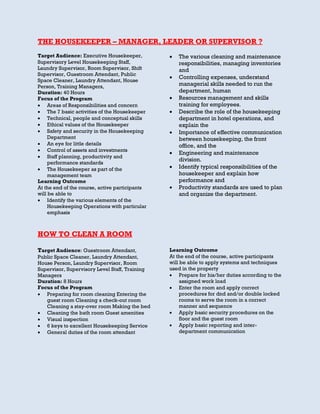
THE HOUSEKEEPER – MANAGER, LEADER OR SUPERVISOR ?
Target Audience: Executive Housekeeper,
Supervisory Level Housekeeping Staff,
Laundry Supervisor, Room Supervisor, Shift
Supervisor, Guestroom Attendant, Public
Space Cleaner, Laundry Attendant, House
Person, Training Managers,
Duration: 40 Hours
Focus of the Program
 Areas of Responsibilities and concern
 The 7 basic activities of the Housekeeper
 Technical, people and conceptual skills
 Ethical values of the Housekeeper
 Safety and security in the Housekeeping
Department
 An eye for little details
 Control of assets and investments
 Staff planning, productivity and
performance standards
 The Housekeeper as part of the
management team
Learning Outcome
At the end of the course, active participants
will be able to
 Identify the various elements of the
Housekeeping Operations with particular
emphasis
 The various cleaning and maintenance
responsibilities, managing inventories
and
 Controlling expenses, understand
managerial skills needed to run the
department, human
 Resources management and skills
training for employees.
 Describe the role of the housekeeping
department in hotel operations, and
explain the
 Importance of effective communication
between housekeeping, the front
office, and the
 Engineering and maintenance
division.
 Identify typical responsibilities of the
housekeeper and explain how
performance and
 Productivity standards are used to plan
and organize the department.
HOW TO CLEAN A ROOM
Target Audience: Guestroom Attendant,
Public Space Cleaner, Laundry Attendant,
House Person, Laundry Supervisor, Room
Supervisor, Supervisory Level Staff, Training
Managers
Duration: 8 Hours
Focus of the Program
 Preparing for room cleaning Entering the
guest room Cleaning a check-out room
Cleaning a stay-over room Making the bed
 Cleaning the bath room Guest amenities
 Visual inspection
 6 keys to excellent Housekeeping Service
 General duties of the room attendant
Learning Outcome
At the end of the course, active participants
will be able to apply systems and techniques
used in the property
 Prepare for his/her duties according to the
assigned work load
 Enter the room and apply correct
procedures for dnd and/or double locked
rooms to serve the room in a correct
manner and sequence
 Apply basic security procedures on the
floor and the guest room
 Apply basic reporting and inter-
department communication
Hospitality Skill Development Courseware
Interact with us at: https://www.facebook.com/TrainingInc.in
Mail us at: asktraininginc@gmail.com
Tweet us @LnD4U
Connect on LinkedIn: https://in.linkedin.com/in/lnd4u
Explore ||Engage || Learn
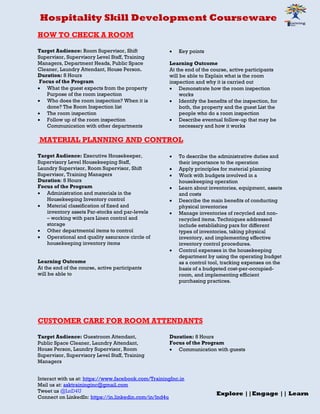
HOW TO CHECK A ROOM
Target Audience: Room Supervisor, Shift
Supervisor, Supervisory Level Staff, Training
Managers, Department Heads, Public Space
Cleaner, Laundry Attendant, House Person.
Duration: 8 Hours
Focus of the Program
 What the guest expects from the property
Purpose of the room inspection
 Who does the room inspection? When it is
done? The Room Inspection list
 The room inspection
 Follow up of the room inspection
Communication with other departments
 Key points
Learning Outcome
At the end of the course, active participants
will be able to Explain what is the room
inspection and why it is carried out
 Demonstrate how the room inspection
works
 Identify the benefits of the inspection, for
both, the property and the guest List the
people who do a room inspection
 Describe eventual follow-up that may be
necessary and how it works
MATERIAL PLANNING AND CONTROL
Target Audience: Executive Housekeeper,
Supervisory Level Housekeeping Staff,
Laundry Supervisor, Room Supervisor, Shift
Supervisor, Training Managers
Duration: 8 Hours
Focus of the Program
 Administration and materials in the
Housekeeping Inventory control
 Material classification of fixed and
inventory assets Par-stocks and par-levels
– working with pars Linen control and
storage
 Other departmental items to control
 Operational and quality assurance circle of
housekeeping inventory items
Learning Outcome
At the end of the course, active participants
will be able to
 To describe the administrative duties and
their importance to the operation
 Apply principles for material planning
 Work with budgets involved in a
housekeeping operation
 Learn about inventories, equipment, assets
and costs
 Describe the main benefits of conducting
physical inventories
 Manage inventories of recycled and non-
recycled items. Techniques addressed
include establishing pars for different
types of inventories, taking physical
inventory, and implementing effective
inventory control procedures.
 Control expenses in the housekeeping
department by using the operating budget
as a control tool, tracking expenses on the
basis of a budgeted cost-per-occupied-
room, and implementing efficient
purchasing practices.
CUSTOMER CARE FOR ROOM ATTENDANTS
Target Audience: Guestroom Attendant,
Public Space Cleaner, Laundry Attendant,
House Person, Laundry Supervisor, Room
Supervisor, Supervisory Level Staff, Training
Managers
Duration: 8 Hours
Focus of the Program
 Communication with guests
Hospitality Skill Development Courseware
Interact with us at: https://www.facebook.com/TrainingInc.in
Mail us at: asktraininginc@gmail.com
Tweet us @LnD4U
Connect on LinkedIn: https://in.linkedin.com/in/lnd4u
Explore ||Engage || Learn
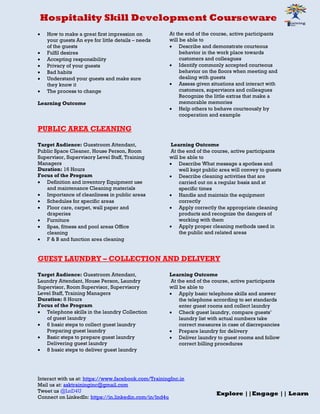
 How to make a great first impression on
your guests An eye for little details – needs
of the guests
 Fulfil desires
 Accepting responsibility
 Privacy of your guests
 Bad habits
 Understand your guests and make sure
they know it
 The process to change
Learning Outcome
At the end of the course, active participants
will be able to
 Describe and demonstrate courteous
behavior in the work place towards
customers and colleagues
 Identify commonly accepted courteous
behavior on the floors when meeting and
dealing with guests
 Assess given situations and interact with
customers, supervisors and colleagues
Recognize the little extras that make a
memorable memories
 Help others to behave courteously by
cooperation and example
PUBLIC AREA CLEANING
Target Audience: Guestroom Attendant,
Public Space Cleaner, House Person, Room
Supervisor, Supervisory Level Staff, Training
Managers
Duration: 16 Hours
Focus of the Program
 Definition and inventory Equipment use
and maintenance Cleaning materials
 Importance of cleanliness in public areas
 Schedules for specific areas
 Floor care, carpet, wall paper and
draperies
 Furniture
 Spas, fitness and pool areas Office
cleaning
 F & B and function area cleaning
Learning Outcome
At the end of the course, active participants
will be able to
 Describe What message a spotless and
well kept public area will convey to guests
 Describe cleaning activities that are
carried out on a regular basis and at
specific times
 Handle and maintain the equipment
correctly
 Apply correctly the appropriate cleaning
products and recognize the dangers of
working with them
 Apply proper cleaning methods used in
the public and related areas
GUEST LAUNDRY – COLLECTION AND DELIVERY
Target Audience: Guestroom Attendant,
Laundry Attendant, House Person, Laundry
Supervisor, Room Supervisor, Supervisory
Level Staff, Training Managers
Duration: 8 Hours
Focus of the Program
 Telephone skills in the laundry Collection
of guest laundry
 6 basic steps to collect guest laundry
Preparing guest laundry
 Basic steps to prepare guest laundry
Delivering guest laundry
 8 basic steps to deliver guest laundry
Learning Outcome
At the end of the course, active participants
will be able to
 Apply basic telephone skills and answer
the telephone according to set standards
enter guest rooms and collect laundry
 Check guest laundry, compare guests’
laundry list with actual numbers take
correct measures in case of discrepancies
 Prepare laundry for delivery
 Deliver laundry to guest rooms and follow
correct billing procedures
Hospitality Skill Development Courseware
Interact with us at: https://www.facebook.com/TrainingInc.in
Mail us at: asktraininginc@gmail.com
Tweet us @LnD4U
Connect on LinkedIn: https://in.linkedin.com/in/lnd4u
Explore ||Engage || Learn
WELCOME TO MY RESTAURANT!
(Greeting, Escorting And Presenting The
Menu Card)
Target Audience: Supervisory Level Staff,
Department Heads, Food & Beverage
Manager, Service Manager, Restaurant
Supervisor, Dining Room Supervisor, Maitre’d
Hotel, Restaurant Server, Banquet Server, Bus
Person, Counter Server, Host
Duration: 8 Hours
Focus of the Program
 What the guest expects The arrival
 At the table
 The menu as a communication tool and as
advertisement The objective of the menu
 Contact with guests What happens next?
Learning Outcome
At the end of the course, active participants
will be able to
 Demonstrate proper greeting procedures
for arriving guests
 Seat guests according to their preference
and to availability of tables available
demonstrate how to deal with guests
within one minute of arrival
 Describe the importance of the menu as
advertising and communication tool
demonstrate and apply proper
presentation of menu cards
 Use proper sequence in presenting the
menu card
 Recommend daily special or other dishes
to be pushed
 Successful with the customer and get
things right as from the beginning.
SOCIAL SKILLS FOR RESTAURANT EMPLOYEES
Target Audience: Supervisory Level Staff,
Department Heads, Food & Beverage
Manager, Service Manager, Restaurant
Supervisor, Dining Room Supervisor, Maitre’d
Hotel, Restaurant Server, Banquet Server, Bus
Person, Counter Server, Host
Duration: 8 Hours
Focus of the Program
 Definition and need of social skills
 Guests come to the restaurant! They bring
business! Welcoming your guests Thank
you! The magic words
 Appreciate your customers and make sure
they know it!
 Maximize your selling skills
 Accepting compliments, expressing
success Accepting criticism, apologizing
Punctuality and team work
 Bad habits and things not to do
 The process of change
Learning Outcome
At the end of the course, active participants
will be able to
 Describe and demonstrate courteous
behavior in the restaurant towards
customers Be alert and judge individual
situations and interact with customers
accordingly Be available to all guests
 Respond quickly to guests’ requests
 Demonstrate an understanding of others in
daily interactions
 Help others to behave courteously through
modeled behavior.
WAITER TRAINING (SETTING & CLEARING TABLES,
MISE-EN-PLACE, ORDER TAKING, FOOD & BEVERAGE SERVICE)
Target Audience: Supervisory Level Staff,
Department Heads, Food & Beverage
Manager, Service Manager, Restaurant
Supervisor, Dining Room Supervisor, Maitre’d
Hotel, Restaurant Server, Banquet Server, Bus
Person, Counter Server, Host, Bartender,
Cocktail Server, Banquet Set-Up Employee,
Room Service Attendant, Training Managers
Duration: 16 Hours
Focus of the Program
 Attributes of service personnel
 Basic and extended table settings
Hospitality Skill Development Courseware
Interact with us at: https://www.facebook.com/TrainingInc.in
Mail us at: asktraininginc@gmail.com
Tweet us @LnD4U
Connect on LinkedIn: https://in.linkedin.com/in/lnd4u
Explore ||Engage || Learn
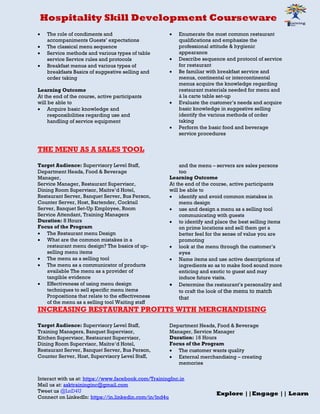
 The role of condiments and
accompaniments Guests’ expectations
 The classical menu sequence
 Service methods and various types of table
service Service rules and protocols
 Breakfast menus and various types of
breakfasts Basics of suggestive selling and
order taking
Learning Outcome
At the end of the course, active participants
will be able to
 Acquire basic knowledge and
responsibilities regarding use and
handling of service equipment
 Enumerate the most common restaurant
qualifications and emphasize the
professional attitude & hygienic
appearance
 Describe sequence and protocol of service
for restaurant
 Be familiar with breakfast service and
menus, continental or intercontinental
menus acquire the knowledge regarding
restaurant materials needed for menu and
à la carte table set-up
 Evaluate the customer’s needs and acquire
basic knowledge in suggestive selling
identify the various methods of order
taking
 Perform the basic food and beverage
service procedures
THE MENU AS A SALES TOOL
Target Audience: Supervisory Level Staff,
Department Heads, Food & Beverage
Manager,
Service Manager, Restaurant Supervisor,
Dining Room Supervisor, Maitre’d Hotel,
Restaurant Server, Banquet Server, Bus Person,
Counter Server, Host, Bartender, Cocktail
Server, Banquet Set-Up Employee, Room
Service Attendant, Training Managers
Duration: 8 Hours
Focus of the Program
 The Restaurant menu Design
 What are the common mistakes in a
restaurant menu design? The basics of up-
selling menu items
 The menu as a selling tool
 The menu as a communicator of products
available The menu as a provider of
tangible evidence
 Effectiveness of using menu design
techniques to sell specific menu items
Propositions that relate to the effectiveness
of the menu as a selling tool Waiting staff
and the menu – servers are sales persons
too
Learning Outcome
At the end of the course, active participants
will be able to
 identify and avoid common mistakes in
menu design
 use and design a menu as a selling tool
communicating with guests
 to identify and place the best selling items
on prime locations and sell them get a
better feel for the sense of value you are
promoting
 look at the menu through the customer’s
eyes
 Name items and use active descriptions of
ingredients so as to make food sound more
enticing and exotic to guest and may
induce future visits.
 Determine the restaurant’s personality and
to craft the look of the menu to match
that
INCREASING RESTAURANT PROFITS WITH MERCHANDISING
Target Audience: Supervisory Level Staff,
Training Managers, Banquet Supervisor,
Kitchen Supervisor, Restaurant Supervisor,
Dining Room Supervisor, Maitre’d Hotel,
Restaurant Server, Banquet Server, Bus Person,
Counter Server, Host, Supervisory Level Staff,
Department Heads, Food & Beverage
Manager, Service Manager
Duration: 16 Hours
Focus of the Program
 The customer wants quality
 External merchandising – creating
memories
Hospitality Skill Development Courseware
Interact with us at: https://www.facebook.com/TrainingInc.in
Mail us at: asktraininginc@gmail.com
Tweet us @LnD4U
Connect on LinkedIn: https://in.linkedin.com/in/lnd4u
Explore ||Engage || Learn
 Internal merchandising – creating revenue
opportunities Don’t let it sit there – sell it –
turn it into profits
 The 11 “P”s of merchandising and display
 Buffet Concept with show cooking –
bringing a higher level of creativity The
chefs as performers – innovation with a
dash of drama
 Maximize menu merchandising power
 Signature products – is it worthwhile?
 Case study merchandising –
merchandising opportunities
Learning Outcome
At the end of the course, active participants
will be able to
 List the essential points of external and
internal merchandising
 Explain the difference between
restaurant/property merchandising and
food merchandising
 Describe how the property wins by
merchandising
 List what does it need to sell more
 Identify and apply merchandising
opportunities
UP-SELLING, ADD-ON SELLING, SUGGESTIVE SELLING
Target Audience: Supervisory Level Staff,
Training Managers, Banquet Supervisor,
Kitchen Supervisor, Restaurant Supervisor,
Dining Room Supervisor, Maitre’d Hotel,
Restaurant Server, Banquet Server, Bus Person,
Counter Server, Host, Supervisory Level Staff,
Department Heads, Food & Beverage
Manager, Service Manager
Duration: 8 Hours
Focus of the Program
 What the guest expects
 What is up-selling and add-on selling in
the restaurant? Appeal to emotions, not
intellect
 It’s all in the attitude – are you a sales
person?
 When to up-sell and when to add-sell?
 Do’s and don’ts of up-selling
 The key effects of good up-selling
 Questions and point-outs to use during the
sales conversation Make sure it is perfect
 Check back for success
 Up-selling, add-on selling vs. over-selling
 How to get there?
Learning Outcome
At the end of the course, active participants
will be able to
 Propose what the customer wants to buy
 Act as an advisor / sales person and meet
guest expectations
 Suggest alternates if a dish is not available
make the guest buy a more profitable dish
use tact and good judgment when up-
selling develop their own personal sales
attitude
 Use the right expressions to make up-
selling or add-on selling easier
 Use close questions to sell or point-outs
during the sales conversation
 Offer a service to the guests for a
memorable dining experience and
 then turn it into sales.
Hospitality Skill Development Courseware
Interact with us at: https://www.facebook.com/TrainingInc.in
Mail us at: asktraininginc@gmail.com
Tweet us @LnD4U
Connect on LinkedIn: https://in.linkedin.com/in/lnd4u
Explore ||Engage || Learn
BASIC COLD KITCHEN
Target Audience: Garde-manger Cook and
Commi, and entry level positions
Duration: Varies
Focus of the Program
The following are examples of daily programs
for the cold kitchen module. The daily
programs can be arranged as per
requirement. Modules covering other topics of
the cold kitchen can be conducted too.
1 day Salads and salad dressings 8 Hrs
 Vegetarian salads
 The right dressing for the right salad
1 day Salads and salad dressings 8 Hrs
 Salads with meat and seafood
 The right dressing for the right salad
1 day Cold sauces 8 Hrs
 Basic sauces
 Variations from basic sauces
 The right sauce with the right dish
1 day Tapas and Canapés 8 Hrs
 Cold canapés
 Pain
 Tapas
1 day Food decoration 8 Hrs
 Before carving
 Food carving
 Specific preparations and treatment
 Carrot, turnip potatoes
 Leek asters
 Roses – radish, tomato, water
chestnuts, carrot
 Bushels
 Cucumber lotus
1 day Buffet presentations 8 Hrs
 Salad buffets
 Cocktail and tapa buffets
 Decoration and garnishes
Learning Outcome
At the end of the course, active participants
will be able to prepare mise en place for the
topics covered
 Produce dishes as demonstrated during
the program
 Listing and describing different variations
that can be made from basic recipes
covered during the program
 Define and describe different methods by
which products are made (covered during
the program)
BASIC HOT KITCHEN
Target Audience: Short Order Cook, Hot
Kitchen Cook and Commi, and entry level
positions
Duration: Various
Focus of the Program The following are
examples of daily programs for the hot
module. The daily programs can be arranged
as per requirement. Modules covering other
topics of the hot kitchen can be conducted too.
More intensive modules can be conducted by
covering one topic over several days, instead
of a single day.
1 day Pasta 8 Hrs
 Making fresh pasta
 Pasta dishes in different variations
 Variety of pasta sauces
1 day Focus on fish and seafood 8 Hrs
 Preparing fish and seafood
 Handling fish and seafood
 Different cuts
 Preparation of fish and seafood
1 day working with poultry 8 Hrs
 Preparation and Deboning of poultry
 Handling poultry
 Different cuts
 Preparation of poultry
1 day Vegetables 8hrs
 Product knowledge
 Vegetable cuts
 Preparation methods for vegetables
1 day Stocks and sauces 8hrs
 Different types of stocks and sauces
 Preparation of a variety of stock
 Consommé
 Different sauces and their variation
1 day Focus on beef 8 Hrs
 Product knowledge
 Different cuts of beef and their use
 Preparation of beef dishes
Learning Outcome:
At the end of the course, active participants
will be able to
Hospitality Skill Development Courseware
Interact with us at: https://www.facebook.com/TrainingInc.in
Mail us at: asktraininginc@gmail.com
Tweet us @LnD4U
Connect on LinkedIn: https://in.linkedin.com/in/lnd4u
Explore ||Engage || Learn
 Prepare mise-en-place for the dishes
demonstrated during the program
 Produce dishes as demonstrated
during the program
 Listing and describing different
variations that can be made from basic
recipes covered during the program
 Define and describe different methods
by which products are made (covered
during the program)
BASIC PASTRY
Target Audience: Bakery and Pastry entry
level positions
Duration: 6 days at 8 hours
Focus of the Program
The following are examples of daily programs
for the pastry module. The daily programs can
be arranged as per requirement. Modules
covering other topics of the pastry kitchen can
be conducted too.
1 day Working with creams 8 Hrs
 Fresh cream Imitation cream
 Sweetened whipped cream (crème
chantilly)
 Butter creams Pastry creams
Frangipane (almond cream)
 Ganache
1 day Bavaroise and Charlottes 8 Hrs
 Bavaroise (Bavarian cream)
 Custard based Bavaroise
 Syrup based Bavaroise
 Charlottes
 Mousses
 Ingredients used
1 day Working with puff pastry 8 Hrs
 Puff pastry production (French
method, English method)
 Basic sweet recipe
 Basic non-sweet recipe
 Key points
 Problem solving
 Working with puff pastry
1 day Sugar pastry and short pastry items 8
Hrs
 Ingredients used to make short and
sugar pastry
 Methods of producing short and sweet
pastries
 Equipment used when working with
short and sugar pastry
1 day Sauces, glazes and coulis 8 Hrs
 Mise-en-place
 Preparation of sauces, glazes and
coulis
 Rules for handling short pastry
1 day Food decoration 8 Hrs
 Use of colors
 Simple decorations
 Templates
 Butter cream
 Fondant
 Icing
Learning Outcome
At the end of the course, active participants
will be able
 To prepare mise-en-place for the
topics covered
 Produce dishes as demonstrated
during the program
 Listing and describing different
variations that can be made from basic
recipes covered during the program
 Define and describe different methods
by which products are made (covered
during the program
FUNDAMENTAL KITCHEN SKILLS
Target Audience: Kitchen Staff in Food
Service and hospitality organizations
Duration: 40 Hours
Focus of the Program
 Preparing the work place
 Your appearance
 Culinary terms
 Knife skills
 Washing food
 Basic cuts of vegetables and fruits
Basic cuts of poultry, meat and seafood
The 7 methods of cooking
Learning Outcome
Hospitality Skill Development Courseware
Interact with us at: https://www.facebook.com/TrainingInc.in
Mail us at: asktraininginc@gmail.com
Tweet us @LnD4U
Connect on LinkedIn: https://in.linkedin.com/in/lnd4u
Explore ||Engage || Learn
At the end of the course, active participants
will be able to
 Describe how the working area is
prepared for work
 Explain the basics of personal hygiene
and chef’s grooming
 Use and explain the mostly used
culinary terms
 Start to develop a comprehensive food
preparation vocabulary
 Explain and observe the safety rules
concerning knives
 Describe the use of various types
of knife
 Name and describe various cuts of
vegetables and fruits
 Select appropriate methods for
different cuts of meat and poultry.
SAFE FOOD HANDLING
Target Audience: Food Handlers- Kitchen
Staff, Food Servers, Food Processing
Personnel Duration: 16 Hours
Focus of the Program
 Providing safe food
 The micro world Contamination,
 Food allergies and food borne
illnesses
 The safe food handler
 Purchasing and receiving safe food
 Keeping food safe in storage
 Protecting food during preparation
 Protecting food during service
Learning Outcome At the end of the course,
active participants will be able to
 Explain the dangers of food borne
illness
 Identify potentially hazardous foods
 Identify the microbial risks associated
with various types of food.
 Identify ways in which food can
become contaminated and methods to
prevent contamination Determine
when to accept or reject different
types of foods during receiving
 Label and store specific types of
refrigerated and frozen food Properly
store raw foods to prevent cross-
contamination Properly thaw frozen
foods
 Identify the minimum internal cooking
temperatures of foods Cool, store, and
reheat cooked foods properly
 Safely set up buffets and food bars and
replenish them List and apply the eight
rules of safe food handling
EXECUTIVE COACHING
Executive or 1:1 Coaching is a confidential, highly personal learning process. Typically, the coaching
is designed to bring about effective action, performance improvement and personal growth for the
individual, as well as better business results for the organization. It is individualized and is a one-on-
one process, which recognizes that no two people are alike. Each person has a unique knowledge
base, learning pace, learning style and set of objectives. The individual is held accountable for
his/her own progress and is challenged by the coach to uncover “blind spots” and change behaviors,
which are critical for success.
Every coach has a unique approach or style.
Our Executive Coaching Program supports the
development and integration of the following
Management Practices:
• Personal Awareness
• Developing Skills for Fostering Diversity
• Clarifying and Declaring Commitments
• Developing Personal Presence
Hospitality Skill Development Courseware
Interact with us at: https://www.facebook.com/TrainingInc.in
Mail us at: asktraininginc@gmail.com
Tweet us @LnD4U
Connect on LinkedIn: https://in.linkedin.com/in/lnd4u
Explore ||Engage || Learn
• Discovering Personal and Professional
Values
• Becoming a more Compelling Communicator
• Creating Compelling Visions
• Being Recognized as a Natural Leader
• Creating an Accountability Mentality
• Fostering Trust
• Making Powerful Choices
• Creating a High performance Team
• Being Results focused & Creating Action
Plans
• Creating a Coaching and Mentoring Culture
• Coaching and Developing Others
• Discovering Your Higher Purpose
• Fostering Great Relationships
• Building on individual and team Stren
Executive Coaching Packages:
6, 9 or 12 months in duration
 Individuals will receive (2), one-hour coaching sessions per month. These sessions will
focus on key results and individual goals. Initial session will provide an overview and
context, discuss process, objective, timing and additional requirements for the Coaching
Program
 Typically, in month one participants will focus on goal setting, planning and objectives for
ongoing individual development will be created out of these sessions.
 Month 2-6 - in addition to ongoing goal setting (as required) and tracking the focus of the
coaching will be on targeted coaching conversations and follow-up on any related
assignments
 Participants will have unlimited e-mail access to their coach
Learning Content as well as Teaching Tools for an effective and impactful Classroom
learning delivery
Our ILT division helps training organizations create instructionally richer, visually appealing,
technology driven and interactive learning solutions. For the learning needs of an organizations, we
create instructor-led learning material including Presentations, Instructor & Participant Guides, User
Manuals, Job Aid, Video, Audio and other multimedia content. Our content design team makes sure
that the learning content is logically sound and has high sensory appeal for the modern audiences.
We develop ILT material keeping in mind both the principles of instructional design and the needs of
the learners. Our strength lies in our extensive experience which enables us to provide the right kind
of consulting for ILT trainings.

Hospitality Skill Development Courseware

  • 1.
    Hospitality Skill DevelopmentCourseware Interact with us at: https://www.facebook.com/TrainingInc.in Mail us at: asktraininginc@gmail.com Tweet us @LnD4U Connect on LinkedIn: https://in.linkedin.com/in/lnd4u Explore ||Engage || Learn
  • 2.
    Hospitality Skill DevelopmentCourseware Interact with us at: https://www.facebook.com/TrainingInc.in Mail us at: asktraininginc@gmail.com Tweet us @LnD4U Connect on LinkedIn: https://in.linkedin.com/in/lnd4u Explore ||Engage || Learn Innovations in Training solutions take the drudgery out of everyday work and gives a morale boost for employees in this service sector. In modern hospitality business, it is all about competence of people. The modern consumers demand a high level of service. Employees thus have to be on the top to ensure the survival and development of the hospitality establishment. Hence, staff training is essential in this sector. It increases productivity by developing professional knowledge, experienced skills and valid thoughts of the employees. Employee training also motivates and inspires employees by providing information and helping them realize the importance of their jobs. Thus successful hotels always include staff training as their important development strategy. Training in the industry includes a lot of different types of learning events . Apprentice training, certification programs, process trainings and so on. A lot of training is done on-the- job which is a time consuming task and also affects productivity as more trained employees have to don the cap of trainers. Employees also take time to practice and perfect skills. Hence their productivity is also lessened. By adopting newer ways of learning like simulation based learning, employees can be provided a better and faster way of learning as it allows ample opportunities of making mistakes and learning from the mistakes and of course, a whole lot of practice! CHALLENGES Employees in this industry have to be on their toes and provide the best experience to the clients. It is a daunting work on a daily basis. Thus training employees on improving service quality and to comply with all standards is a huge challenge. Hospitality is a very competitive industry. With newer players in the market everyday- employees have to be continually driven to do better than their best. Within employee training, development of Soft Skills plays a key role in the growth of the organization. It is a challenge to make trainings interesting for the already exhausted workforce, specially courses which are information extensive. End-clients i.e. tourists have a diverse background and it is imperative for hospitality staff to understand cultural nuances of various geographies. Training has to be conducted keeping in mind the daily operations of the establishment. It is a challenge to assemble employees for training sessions. The industry also sees an extremely high attrition rate, and it is difficult to get new recruits trained on a continuous basis. | | | | | |
  • 3.
    Hospitality Skill DevelopmentCourseware Interact with us at: https://www.facebook.com/TrainingInc.in Mail us at: asktraininginc@gmail.com Tweet us @LnD4U Connect on LinkedIn: https://in.linkedin.com/in/lnd4u Explore ||Engage || Learn OUR APPROACH Training INC by virtue of its vast experience on Hospitality sector has developed well defined approach for designing solutions for this industry. We consider organization specific conditions while designing these-Learning solutions. Learning Design Boredom is often a deterrent to learning in the industry, so we create learning solutions that are engaging with simulations and other experiential mediums. Organization Research We make sure that our learning solutions include the History, USP, Culture, Vision of the establishment to make sure that employees are aligned to the same. Mobile Strategy Newer methods of learning like Motion-based learning are being utilized in a bid to make training more effective for the industry. Competency Mapping We Conduct Competency Analysis/ Skill Mapping to ascertain skills gaps and create learning solutions. Assessment Strategy Learner assessments are a priority and we make sure that our learning solutions are accompanied by adequate assessment tools that can be taken as per the convenience of the learner, within prior commitments of work. Need Identification Stringent process of Training needs Identification, Analysis & Development. It makes sure that the learning solution is developed as per the needs within the establishment. FACILITATING HOSPITALITY FINESSE (Hospitality Training & Development Program) Our tailor-made courses are apt for the requirements of the industry. Our innovative learning solutions that make learning fun and enjoyable! CHECK-IN – CHECK-OUT Target Audience: Front Office Line Level and Supervisory Staff, Reservationist, Receptionist, Front Desk Employee, Valet Attendant, Bell Attendant, Door Attendant, Concierge, PBX Operator Duration: 8 Hours Focus of the Program  Prepare for the arrival of your guests  Guest Check in  Communication with arriving guests  Determination of payment method  Guest check out  Payment of invoice  Communication with leaving guests  Enquire about guest satisfaction  The guest is your bottom line
  • 4.
    Hospitality Skill DevelopmentCourseware Interact with us at: https://www.facebook.com/TrainingInc.in Mail us at: asktraininginc@gmail.com Tweet us @LnD4U Connect on LinkedIn: https://in.linkedin.com/in/lnd4u Explore ||Engage || Learn Learning Outcome At the end of the course, active participants will be able to  Pre-register guest for fast check-in and by limiting time guests must spend at the front  Desk  Keep guests at ease and not to put them on the defensive  Handle guest requests during the check-in or check-out period  Respond to guest requests during the period of stay  Handle the settlement of the invoice by using the correct and appropriate method of  Payment  Enquire about guest satisfaction and take follow-up action if necessary  Handle disputed guest charges by following the correct procedures THE ART OF UP-SELLING AND HOW IT INCREASES REVENUE Target Audience: Front Desk Employee, Valet Attendant, Bell Attendant, Door Attendant, Concierge, PBX Operator, Reservationist, Supervisory Level Staff, Training Managers, Front Office Department Heads, Sales Staff Duration: 8 Hours Cost per person: Focus of the Program  What is up-selling?  Sell the room’s benefits, not the features  Appeal to emotions, not intellect  It’s all in the attitude – you are here to help  What the guest expects  Three ways to make up-selling automatic  Up-selling - to it at the right time and made easy  Taboo’s of up-selling  Add-on sales and back-up sales  Check back for success  Up-selling vs. over-selling Learning Outcome At the end of the course, active participants will be able to  explain the basic idea and benefits of up- selling, add-on selling and back-up selling  identify the right time for up-selling  propose alternate rooms and suites to arriving and staying guests  make the guest buy a more profitable room and/or service  provide guest satisfaction by suggesting alternatives  Improve sales in a competitive environment. REVENUE MANAGEMENT (YIELD MANAGEMENT) Target Audience: Front Desk Employee, Night Auditor, Concierge, Reservationist, Supervisory Level Staff, Training Managers, Front Office Department Heads, Sales Staff Duration: 24 Hours Focus of the Program  Definition and use  When does yield management work?  Room rates, average rates and yield management  Putting yield management in action  Yield management system measurements  Are your rooms configured for the best and highest use?  Know your target market  Quantify the mix of business  Case study yield management application  Ideas to increase business Learning Outcome At the end of the course, active participants will be able to  Explain The Intended End Result Of The Process  Co-Ordinate On Room Rates And Offering Through All Of The Revenue Drivers  Learn What Are The Consequences When The Rate Posted Is Lower Than What Has Been  Negotiated, Or Does Not Match The One Quoted In The Central Reservation System  Understand The Meaning Of Product/Rate Positioning As Part Of The Marketing Plan  Identify The Configuration Of Highest And Best Use For Every Room  Quantify The Mix Of Business And To Know The Property’s Target Markets  Measure The Impact Of The System
  • 5.
    GUEST RELATIONS CO-ORDINATOR TargetAudience: Guest Relations Staff, Lobby Supervisors and Managers, Uniformed Services Support, Communications Supervisor, Front Desk Supervisor, Reservations Supervisor, Bell Captain, Shift Supervisor, Sales Professional, Night Auditor, Front Desk Employee, Concierge, PBX Operator, Reservationist, Supervisory Level Staff, Training Managers Duration: 16 Hours Focus of the Program  Definition, purpose and standards of Guest Relations  Grooming and appearance  Duties and responsibilities  Cooperation with other departments, the role of the duty manager  Development and follow-up of guest recognition programs  “At your service” – the multiple role of a GRO  Feedback from guests to check on guest satisfaction  Dealing with Guest complaints and angry guests (short resume)  Track guest complains until their return  Attention to little details  Create your own thing to be remembered and go the extra mile  Service matters most  Special care of VIP Learning Outcome At the end of the course, active participants will be able to  Describe The Functions And The Position Of A GRO In The Day-To-Day Operation  Design And Apply A Guest Recognition Program  Evaluate And Follow Up Guest Questionnaires  Apply Customer Service Across The Property  Oversee The Day-To-Day Customer Contact Process To Ensure Customer Expectations Are Met  Go That Extra Mile To Be Remembered. SOCIAL SKILLS AT THE RECEPTION Target Audience: Guest Relations Staff, Lobby Supervisors and Managers, Uniformed Services Support, Communications Supervisor, Front Desk Supervisor, Reservations Supervisor, Bell Captain, Shift Supervisor, Sales Professional, Night Auditor, Front Desk Employee, Concierge, PBX Operator, Reservationist, Supervisory Level Staff, Training Managers, Guestroom Attendant, Public Space Cleaner, Laundry Attendant, House Person, Maintenance Worker, Van Driver, Supervisory Level Staff, Training Managers Duration: 8 Hours Focus of the Program  Discuss the need for social skills  How to make a great first impression on your customers  Understand your customer and make sure they know it  Body language and non-verbal communication  What you say isn’t that important  Becoming a great listener  Awareness of your own interaction with others  Accepting responsibility  Maximizing positive personality traits  The process to change Learning Outcome At the end of the course, active participants will be able to  Describe and demonstrate courteous behavior in the work place towards customers  Identify commonly used behavior and manners at the Front Desk  Understand the guest and assess situations related to guest’s request  Listen to guests and apply common sense and judgment when answering  Demonstrate an understanding of others in daily interactions  Process changes for an improved guest service
  • 6.
    THE HOUSEKEEPER –MANAGER, LEADER OR SUPERVISOR ? Target Audience: Executive Housekeeper, Supervisory Level Housekeeping Staff, Laundry Supervisor, Room Supervisor, Shift Supervisor, Guestroom Attendant, Public Space Cleaner, Laundry Attendant, House Person, Training Managers, Duration: 40 Hours Focus of the Program  Areas of Responsibilities and concern  The 7 basic activities of the Housekeeper  Technical, people and conceptual skills  Ethical values of the Housekeeper  Safety and security in the Housekeeping Department  An eye for little details  Control of assets and investments  Staff planning, productivity and performance standards  The Housekeeper as part of the management team Learning Outcome At the end of the course, active participants will be able to  Identify the various elements of the Housekeeping Operations with particular emphasis  The various cleaning and maintenance responsibilities, managing inventories and  Controlling expenses, understand managerial skills needed to run the department, human  Resources management and skills training for employees.  Describe the role of the housekeeping department in hotel operations, and explain the  Importance of effective communication between housekeeping, the front office, and the  Engineering and maintenance division.  Identify typical responsibilities of the housekeeper and explain how performance and  Productivity standards are used to plan and organize the department. HOW TO CLEAN A ROOM Target Audience: Guestroom Attendant, Public Space Cleaner, Laundry Attendant, House Person, Laundry Supervisor, Room Supervisor, Supervisory Level Staff, Training Managers Duration: 8 Hours Focus of the Program  Preparing for room cleaning Entering the guest room Cleaning a check-out room Cleaning a stay-over room Making the bed  Cleaning the bath room Guest amenities  Visual inspection  6 keys to excellent Housekeeping Service  General duties of the room attendant Learning Outcome At the end of the course, active participants will be able to apply systems and techniques used in the property  Prepare for his/her duties according to the assigned work load  Enter the room and apply correct procedures for dnd and/or double locked rooms to serve the room in a correct manner and sequence  Apply basic security procedures on the floor and the guest room  Apply basic reporting and inter- department communication
  • 7.
    Hospitality Skill DevelopmentCourseware Interact with us at: https://www.facebook.com/TrainingInc.in Mail us at: asktraininginc@gmail.com Tweet us @LnD4U Connect on LinkedIn: https://in.linkedin.com/in/lnd4u Explore ||Engage || Learn HOW TO CHECK A ROOM Target Audience: Room Supervisor, Shift Supervisor, Supervisory Level Staff, Training Managers, Department Heads, Public Space Cleaner, Laundry Attendant, House Person. Duration: 8 Hours Focus of the Program  What the guest expects from the property Purpose of the room inspection  Who does the room inspection? When it is done? The Room Inspection list  The room inspection  Follow up of the room inspection Communication with other departments  Key points Learning Outcome At the end of the course, active participants will be able to Explain what is the room inspection and why it is carried out  Demonstrate how the room inspection works  Identify the benefits of the inspection, for both, the property and the guest List the people who do a room inspection  Describe eventual follow-up that may be necessary and how it works MATERIAL PLANNING AND CONTROL Target Audience: Executive Housekeeper, Supervisory Level Housekeeping Staff, Laundry Supervisor, Room Supervisor, Shift Supervisor, Training Managers Duration: 8 Hours Focus of the Program  Administration and materials in the Housekeeping Inventory control  Material classification of fixed and inventory assets Par-stocks and par-levels – working with pars Linen control and storage  Other departmental items to control  Operational and quality assurance circle of housekeeping inventory items Learning Outcome At the end of the course, active participants will be able to  To describe the administrative duties and their importance to the operation  Apply principles for material planning  Work with budgets involved in a housekeeping operation  Learn about inventories, equipment, assets and costs  Describe the main benefits of conducting physical inventories  Manage inventories of recycled and non- recycled items. Techniques addressed include establishing pars for different types of inventories, taking physical inventory, and implementing effective inventory control procedures.  Control expenses in the housekeeping department by using the operating budget as a control tool, tracking expenses on the basis of a budgeted cost-per-occupied- room, and implementing efficient purchasing practices. CUSTOMER CARE FOR ROOM ATTENDANTS Target Audience: Guestroom Attendant, Public Space Cleaner, Laundry Attendant, House Person, Laundry Supervisor, Room Supervisor, Supervisory Level Staff, Training Managers Duration: 8 Hours Focus of the Program  Communication with guests
  • 8.
    Hospitality Skill DevelopmentCourseware Interact with us at: https://www.facebook.com/TrainingInc.in Mail us at: asktraininginc@gmail.com Tweet us @LnD4U Connect on LinkedIn: https://in.linkedin.com/in/lnd4u Explore ||Engage || Learn  How to make a great first impression on your guests An eye for little details – needs of the guests  Fulfil desires  Accepting responsibility  Privacy of your guests  Bad habits  Understand your guests and make sure they know it  The process to change Learning Outcome At the end of the course, active participants will be able to  Describe and demonstrate courteous behavior in the work place towards customers and colleagues  Identify commonly accepted courteous behavior on the floors when meeting and dealing with guests  Assess given situations and interact with customers, supervisors and colleagues Recognize the little extras that make a memorable memories  Help others to behave courteously by cooperation and example PUBLIC AREA CLEANING Target Audience: Guestroom Attendant, Public Space Cleaner, House Person, Room Supervisor, Supervisory Level Staff, Training Managers Duration: 16 Hours Focus of the Program  Definition and inventory Equipment use and maintenance Cleaning materials  Importance of cleanliness in public areas  Schedules for specific areas  Floor care, carpet, wall paper and draperies  Furniture  Spas, fitness and pool areas Office cleaning  F & B and function area cleaning Learning Outcome At the end of the course, active participants will be able to  Describe What message a spotless and well kept public area will convey to guests  Describe cleaning activities that are carried out on a regular basis and at specific times  Handle and maintain the equipment correctly  Apply correctly the appropriate cleaning products and recognize the dangers of working with them  Apply proper cleaning methods used in the public and related areas GUEST LAUNDRY – COLLECTION AND DELIVERY Target Audience: Guestroom Attendant, Laundry Attendant, House Person, Laundry Supervisor, Room Supervisor, Supervisory Level Staff, Training Managers Duration: 8 Hours Focus of the Program  Telephone skills in the laundry Collection of guest laundry  6 basic steps to collect guest laundry Preparing guest laundry  Basic steps to prepare guest laundry Delivering guest laundry  8 basic steps to deliver guest laundry Learning Outcome At the end of the course, active participants will be able to  Apply basic telephone skills and answer the telephone according to set standards enter guest rooms and collect laundry  Check guest laundry, compare guests’ laundry list with actual numbers take correct measures in case of discrepancies  Prepare laundry for delivery  Deliver laundry to guest rooms and follow correct billing procedures
  • 9.
    Hospitality Skill DevelopmentCourseware Interact with us at: https://www.facebook.com/TrainingInc.in Mail us at: asktraininginc@gmail.com Tweet us @LnD4U Connect on LinkedIn: https://in.linkedin.com/in/lnd4u Explore ||Engage || Learn WELCOME TO MY RESTAURANT! (Greeting, Escorting And Presenting The Menu Card) Target Audience: Supervisory Level Staff, Department Heads, Food & Beverage Manager, Service Manager, Restaurant Supervisor, Dining Room Supervisor, Maitre’d Hotel, Restaurant Server, Banquet Server, Bus Person, Counter Server, Host Duration: 8 Hours Focus of the Program  What the guest expects The arrival  At the table  The menu as a communication tool and as advertisement The objective of the menu  Contact with guests What happens next? Learning Outcome At the end of the course, active participants will be able to  Demonstrate proper greeting procedures for arriving guests  Seat guests according to their preference and to availability of tables available demonstrate how to deal with guests within one minute of arrival  Describe the importance of the menu as advertising and communication tool demonstrate and apply proper presentation of menu cards  Use proper sequence in presenting the menu card  Recommend daily special or other dishes to be pushed  Successful with the customer and get things right as from the beginning. SOCIAL SKILLS FOR RESTAURANT EMPLOYEES Target Audience: Supervisory Level Staff, Department Heads, Food & Beverage Manager, Service Manager, Restaurant Supervisor, Dining Room Supervisor, Maitre’d Hotel, Restaurant Server, Banquet Server, Bus Person, Counter Server, Host Duration: 8 Hours Focus of the Program  Definition and need of social skills  Guests come to the restaurant! They bring business! Welcoming your guests Thank you! The magic words  Appreciate your customers and make sure they know it!  Maximize your selling skills  Accepting compliments, expressing success Accepting criticism, apologizing Punctuality and team work  Bad habits and things not to do  The process of change Learning Outcome At the end of the course, active participants will be able to  Describe and demonstrate courteous behavior in the restaurant towards customers Be alert and judge individual situations and interact with customers accordingly Be available to all guests  Respond quickly to guests’ requests  Demonstrate an understanding of others in daily interactions  Help others to behave courteously through modeled behavior. WAITER TRAINING (SETTING & CLEARING TABLES, MISE-EN-PLACE, ORDER TAKING, FOOD & BEVERAGE SERVICE) Target Audience: Supervisory Level Staff, Department Heads, Food & Beverage Manager, Service Manager, Restaurant Supervisor, Dining Room Supervisor, Maitre’d Hotel, Restaurant Server, Banquet Server, Bus Person, Counter Server, Host, Bartender, Cocktail Server, Banquet Set-Up Employee, Room Service Attendant, Training Managers Duration: 16 Hours Focus of the Program  Attributes of service personnel  Basic and extended table settings
  • 10.
    Hospitality Skill DevelopmentCourseware Interact with us at: https://www.facebook.com/TrainingInc.in Mail us at: asktraininginc@gmail.com Tweet us @LnD4U Connect on LinkedIn: https://in.linkedin.com/in/lnd4u Explore ||Engage || Learn  The role of condiments and accompaniments Guests’ expectations  The classical menu sequence  Service methods and various types of table service Service rules and protocols  Breakfast menus and various types of breakfasts Basics of suggestive selling and order taking Learning Outcome At the end of the course, active participants will be able to  Acquire basic knowledge and responsibilities regarding use and handling of service equipment  Enumerate the most common restaurant qualifications and emphasize the professional attitude & hygienic appearance  Describe sequence and protocol of service for restaurant  Be familiar with breakfast service and menus, continental or intercontinental menus acquire the knowledge regarding restaurant materials needed for menu and à la carte table set-up  Evaluate the customer’s needs and acquire basic knowledge in suggestive selling identify the various methods of order taking  Perform the basic food and beverage service procedures THE MENU AS A SALES TOOL Target Audience: Supervisory Level Staff, Department Heads, Food & Beverage Manager, Service Manager, Restaurant Supervisor, Dining Room Supervisor, Maitre’d Hotel, Restaurant Server, Banquet Server, Bus Person, Counter Server, Host, Bartender, Cocktail Server, Banquet Set-Up Employee, Room Service Attendant, Training Managers Duration: 8 Hours Focus of the Program  The Restaurant menu Design  What are the common mistakes in a restaurant menu design? The basics of up- selling menu items  The menu as a selling tool  The menu as a communicator of products available The menu as a provider of tangible evidence  Effectiveness of using menu design techniques to sell specific menu items Propositions that relate to the effectiveness of the menu as a selling tool Waiting staff and the menu – servers are sales persons too Learning Outcome At the end of the course, active participants will be able to  identify and avoid common mistakes in menu design  use and design a menu as a selling tool communicating with guests  to identify and place the best selling items on prime locations and sell them get a better feel for the sense of value you are promoting  look at the menu through the customer’s eyes  Name items and use active descriptions of ingredients so as to make food sound more enticing and exotic to guest and may induce future visits.  Determine the restaurant’s personality and to craft the look of the menu to match that INCREASING RESTAURANT PROFITS WITH MERCHANDISING Target Audience: Supervisory Level Staff, Training Managers, Banquet Supervisor, Kitchen Supervisor, Restaurant Supervisor, Dining Room Supervisor, Maitre’d Hotel, Restaurant Server, Banquet Server, Bus Person, Counter Server, Host, Supervisory Level Staff, Department Heads, Food & Beverage Manager, Service Manager Duration: 16 Hours Focus of the Program  The customer wants quality  External merchandising – creating memories
  • 11.
    Hospitality Skill DevelopmentCourseware Interact with us at: https://www.facebook.com/TrainingInc.in Mail us at: asktraininginc@gmail.com Tweet us @LnD4U Connect on LinkedIn: https://in.linkedin.com/in/lnd4u Explore ||Engage || Learn  Internal merchandising – creating revenue opportunities Don’t let it sit there – sell it – turn it into profits  The 11 “P”s of merchandising and display  Buffet Concept with show cooking – bringing a higher level of creativity The chefs as performers – innovation with a dash of drama  Maximize menu merchandising power  Signature products – is it worthwhile?  Case study merchandising – merchandising opportunities Learning Outcome At the end of the course, active participants will be able to  List the essential points of external and internal merchandising  Explain the difference between restaurant/property merchandising and food merchandising  Describe how the property wins by merchandising  List what does it need to sell more  Identify and apply merchandising opportunities UP-SELLING, ADD-ON SELLING, SUGGESTIVE SELLING Target Audience: Supervisory Level Staff, Training Managers, Banquet Supervisor, Kitchen Supervisor, Restaurant Supervisor, Dining Room Supervisor, Maitre’d Hotel, Restaurant Server, Banquet Server, Bus Person, Counter Server, Host, Supervisory Level Staff, Department Heads, Food & Beverage Manager, Service Manager Duration: 8 Hours Focus of the Program  What the guest expects  What is up-selling and add-on selling in the restaurant? Appeal to emotions, not intellect  It’s all in the attitude – are you a sales person?  When to up-sell and when to add-sell?  Do’s and don’ts of up-selling  The key effects of good up-selling  Questions and point-outs to use during the sales conversation Make sure it is perfect  Check back for success  Up-selling, add-on selling vs. over-selling  How to get there? Learning Outcome At the end of the course, active participants will be able to  Propose what the customer wants to buy  Act as an advisor / sales person and meet guest expectations  Suggest alternates if a dish is not available make the guest buy a more profitable dish use tact and good judgment when up- selling develop their own personal sales attitude  Use the right expressions to make up- selling or add-on selling easier  Use close questions to sell or point-outs during the sales conversation  Offer a service to the guests for a memorable dining experience and  then turn it into sales.
  • 12.
    Hospitality Skill DevelopmentCourseware Interact with us at: https://www.facebook.com/TrainingInc.in Mail us at: asktraininginc@gmail.com Tweet us @LnD4U Connect on LinkedIn: https://in.linkedin.com/in/lnd4u Explore ||Engage || Learn BASIC COLD KITCHEN Target Audience: Garde-manger Cook and Commi, and entry level positions Duration: Varies Focus of the Program The following are examples of daily programs for the cold kitchen module. The daily programs can be arranged as per requirement. Modules covering other topics of the cold kitchen can be conducted too. 1 day Salads and salad dressings 8 Hrs  Vegetarian salads  The right dressing for the right salad 1 day Salads and salad dressings 8 Hrs  Salads with meat and seafood  The right dressing for the right salad 1 day Cold sauces 8 Hrs  Basic sauces  Variations from basic sauces  The right sauce with the right dish 1 day Tapas and Canapés 8 Hrs  Cold canapés  Pain  Tapas 1 day Food decoration 8 Hrs  Before carving  Food carving  Specific preparations and treatment  Carrot, turnip potatoes  Leek asters  Roses – radish, tomato, water chestnuts, carrot  Bushels  Cucumber lotus 1 day Buffet presentations 8 Hrs  Salad buffets  Cocktail and tapa buffets  Decoration and garnishes Learning Outcome At the end of the course, active participants will be able to prepare mise en place for the topics covered  Produce dishes as demonstrated during the program  Listing and describing different variations that can be made from basic recipes covered during the program  Define and describe different methods by which products are made (covered during the program) BASIC HOT KITCHEN Target Audience: Short Order Cook, Hot Kitchen Cook and Commi, and entry level positions Duration: Various Focus of the Program The following are examples of daily programs for the hot module. The daily programs can be arranged as per requirement. Modules covering other topics of the hot kitchen can be conducted too. More intensive modules can be conducted by covering one topic over several days, instead of a single day. 1 day Pasta 8 Hrs  Making fresh pasta  Pasta dishes in different variations  Variety of pasta sauces 1 day Focus on fish and seafood 8 Hrs  Preparing fish and seafood  Handling fish and seafood  Different cuts  Preparation of fish and seafood 1 day working with poultry 8 Hrs  Preparation and Deboning of poultry  Handling poultry  Different cuts  Preparation of poultry 1 day Vegetables 8hrs  Product knowledge  Vegetable cuts  Preparation methods for vegetables 1 day Stocks and sauces 8hrs  Different types of stocks and sauces  Preparation of a variety of stock  Consommé  Different sauces and their variation 1 day Focus on beef 8 Hrs  Product knowledge  Different cuts of beef and their use  Preparation of beef dishes Learning Outcome: At the end of the course, active participants will be able to
  • 13.
    Hospitality Skill DevelopmentCourseware Interact with us at: https://www.facebook.com/TrainingInc.in Mail us at: asktraininginc@gmail.com Tweet us @LnD4U Connect on LinkedIn: https://in.linkedin.com/in/lnd4u Explore ||Engage || Learn  Prepare mise-en-place for the dishes demonstrated during the program  Produce dishes as demonstrated during the program  Listing and describing different variations that can be made from basic recipes covered during the program  Define and describe different methods by which products are made (covered during the program) BASIC PASTRY Target Audience: Bakery and Pastry entry level positions Duration: 6 days at 8 hours Focus of the Program The following are examples of daily programs for the pastry module. The daily programs can be arranged as per requirement. Modules covering other topics of the pastry kitchen can be conducted too. 1 day Working with creams 8 Hrs  Fresh cream Imitation cream  Sweetened whipped cream (crème chantilly)  Butter creams Pastry creams Frangipane (almond cream)  Ganache 1 day Bavaroise and Charlottes 8 Hrs  Bavaroise (Bavarian cream)  Custard based Bavaroise  Syrup based Bavaroise  Charlottes  Mousses  Ingredients used 1 day Working with puff pastry 8 Hrs  Puff pastry production (French method, English method)  Basic sweet recipe  Basic non-sweet recipe  Key points  Problem solving  Working with puff pastry 1 day Sugar pastry and short pastry items 8 Hrs  Ingredients used to make short and sugar pastry  Methods of producing short and sweet pastries  Equipment used when working with short and sugar pastry 1 day Sauces, glazes and coulis 8 Hrs  Mise-en-place  Preparation of sauces, glazes and coulis  Rules for handling short pastry 1 day Food decoration 8 Hrs  Use of colors  Simple decorations  Templates  Butter cream  Fondant  Icing Learning Outcome At the end of the course, active participants will be able  To prepare mise-en-place for the topics covered  Produce dishes as demonstrated during the program  Listing and describing different variations that can be made from basic recipes covered during the program  Define and describe different methods by which products are made (covered during the program FUNDAMENTAL KITCHEN SKILLS Target Audience: Kitchen Staff in Food Service and hospitality organizations Duration: 40 Hours Focus of the Program  Preparing the work place  Your appearance  Culinary terms  Knife skills  Washing food  Basic cuts of vegetables and fruits Basic cuts of poultry, meat and seafood The 7 methods of cooking Learning Outcome
  • 14.
    Hospitality Skill DevelopmentCourseware Interact with us at: https://www.facebook.com/TrainingInc.in Mail us at: asktraininginc@gmail.com Tweet us @LnD4U Connect on LinkedIn: https://in.linkedin.com/in/lnd4u Explore ||Engage || Learn At the end of the course, active participants will be able to  Describe how the working area is prepared for work  Explain the basics of personal hygiene and chef’s grooming  Use and explain the mostly used culinary terms  Start to develop a comprehensive food preparation vocabulary  Explain and observe the safety rules concerning knives  Describe the use of various types of knife  Name and describe various cuts of vegetables and fruits  Select appropriate methods for different cuts of meat and poultry. SAFE FOOD HANDLING Target Audience: Food Handlers- Kitchen Staff, Food Servers, Food Processing Personnel Duration: 16 Hours Focus of the Program  Providing safe food  The micro world Contamination,  Food allergies and food borne illnesses  The safe food handler  Purchasing and receiving safe food  Keeping food safe in storage  Protecting food during preparation  Protecting food during service Learning Outcome At the end of the course, active participants will be able to  Explain the dangers of food borne illness  Identify potentially hazardous foods  Identify the microbial risks associated with various types of food.  Identify ways in which food can become contaminated and methods to prevent contamination Determine when to accept or reject different types of foods during receiving  Label and store specific types of refrigerated and frozen food Properly store raw foods to prevent cross- contamination Properly thaw frozen foods  Identify the minimum internal cooking temperatures of foods Cool, store, and reheat cooked foods properly  Safely set up buffets and food bars and replenish them List and apply the eight rules of safe food handling EXECUTIVE COACHING Executive or 1:1 Coaching is a confidential, highly personal learning process. Typically, the coaching is designed to bring about effective action, performance improvement and personal growth for the individual, as well as better business results for the organization. It is individualized and is a one-on- one process, which recognizes that no two people are alike. Each person has a unique knowledge base, learning pace, learning style and set of objectives. The individual is held accountable for his/her own progress and is challenged by the coach to uncover “blind spots” and change behaviors, which are critical for success. Every coach has a unique approach or style. Our Executive Coaching Program supports the development and integration of the following Management Practices: • Personal Awareness • Developing Skills for Fostering Diversity • Clarifying and Declaring Commitments • Developing Personal Presence
  • 15.
    Hospitality Skill DevelopmentCourseware Interact with us at: https://www.facebook.com/TrainingInc.in Mail us at: asktraininginc@gmail.com Tweet us @LnD4U Connect on LinkedIn: https://in.linkedin.com/in/lnd4u Explore ||Engage || Learn • Discovering Personal and Professional Values • Becoming a more Compelling Communicator • Creating Compelling Visions • Being Recognized as a Natural Leader • Creating an Accountability Mentality • Fostering Trust • Making Powerful Choices • Creating a High performance Team • Being Results focused & Creating Action Plans • Creating a Coaching and Mentoring Culture • Coaching and Developing Others • Discovering Your Higher Purpose • Fostering Great Relationships • Building on individual and team Stren Executive Coaching Packages: 6, 9 or 12 months in duration  Individuals will receive (2), one-hour coaching sessions per month. These sessions will focus on key results and individual goals. Initial session will provide an overview and context, discuss process, objective, timing and additional requirements for the Coaching Program  Typically, in month one participants will focus on goal setting, planning and objectives for ongoing individual development will be created out of these sessions.  Month 2-6 - in addition to ongoing goal setting (as required) and tracking the focus of the coaching will be on targeted coaching conversations and follow-up on any related assignments  Participants will have unlimited e-mail access to their coach Learning Content as well as Teaching Tools for an effective and impactful Classroom learning delivery Our ILT division helps training organizations create instructionally richer, visually appealing, technology driven and interactive learning solutions. For the learning needs of an organizations, we create instructor-led learning material including Presentations, Instructor & Participant Guides, User Manuals, Job Aid, Video, Audio and other multimedia content. Our content design team makes sure that the learning content is logically sound and has high sensory appeal for the modern audiences. We develop ILT material keeping in mind both the principles of instructional design and the needs of the learners. Our strength lies in our extensive experience which enables us to provide the right kind of consulting for ILT trainings.