Hospital
Redesign
by:-
Mahmoud shaqria
Out lines:-
1. Introduction
2. Importance of hospital redesign
3. Definition of terms
4. Components of hospital redesign
a) Job redesigning
b) Organizational structures
c) Environmental redesign
(A) Job redesigning
1. Definition of job redesigning
2. Goals of job redesigning
3. Approaches of job redesigning
4. Advantages of job redesigning
5. Disadvantages of job redesigning
6. Barriers of job redesigning
7. Japanese techniques of job redesigning
(B)Organizational structures
1. Definition of restructuring
2. Examples of restructuring
3. Advantages of restructuring
4. Barriers of restructuring
(C)-Environmental redesign
-Features of hospital redesign
(5)-Outcomes of hospital redesign
Introduction:
 Redesigning health care environments has occurred in response to
cost and quality pressures.
 Efforts to redesign the nursing practice environment have focused
on the structure and process of nursing care delivery.
Importance of hospital redesign
 Increases organization’s and Employees’ Productivity.
 Enhances the Quality of Work-Life.
 Better use of existing resources.
 Better financial performance & patient access to services.
 Improved relationships (both between staff and with patients).
 Higher patients& employees satisfaction.
 Creates a Right Person-Job Fit.
Definition of terms:-
- Redesigning:
 A technique that examine the tasks within each job with the goal of
combining appropriate tasks to improve efficiency.
-Reengineering:
 It is the systematic transformation of an existing system into a new
form to realize quality improvement in operation, system
capability, functionality, performance, or resolvability at a lower
cost, schedule, or risk to the customer.
Components of hospital redesign:
(A) Job redesigning:
Definition of job redesigning
 It is a continuous process of reorganizing of tasks and
responsibilities, which fully involves employers and employees in
designing work to complete jobs and to provide the job satisfaction
as well as increase the performance and efficiency.
Goals of job redesigning:
1- To make the work more efficient, effective, and rewarding .
2- To provide a high degree of job satisfaction, higher quality work,
lower absenteeism and less turnover.
3- To reduce the cost of delivering health care and maintaining market
positions.
4- To design each job according to appropriate task and necessary
qualifications to have all jobs
Approaches of job redesigning
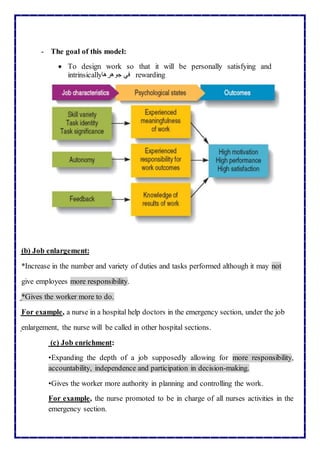
(a)The Job Characteristics Model (Hackman & Oldham (1980)
They suggest that three psychological states are necessary for high
levels of work quality and propose that five core job dimensions are
instrumental in producing these psychological states.
*These 5 core dimensions : affect the outcome of work by
influencing three psychological states: experienced meaningfulness
‫ذوي‬‫الخبرة‬ , responsibility, and knowledge of results.
- The goal of this model:
 To design work so that it will be personally satisfying and
intrinsically ‫في‬‫جوهرها‬ rewarding
(b) Job enlargement:
*Increase in the number and variety of duties and tasks performed although it may not
give employees more responsibility.
*Gives the worker more to do.
For example, a nurse in a hospital help doctors in the emergency section, under the job
enlargement, the nurse will be called in other hospital sections.
(c) Job enrichment:
•Expanding the depth of a job supposedly allowing for more responsibility,
accountability, independence and participation in decision-making.
•Gives the worker more authority in planning and controlling the work.
For example, the nurse promoted to be in charge of all nurses activities in the
emergency section.
-It is not possible to enrich all jobs because of technological
limitations.
For example, managers can use these five factors to enrich the
jobs of employees by;-
-Increasing the level of difficulty and responsibility of the job.
-Allowing employees to retain more authority and control over work
outcomes.
-Providing unit or individual job performance reports directly to
employees.
-Adding new tasks to the job that require training and growth.
-Assigning individuals specific tasks, thus enabling them to become
experts.
Advantages of job redesigning:
(1) Decrease the cost
(2) Decrease the turn over
(3) Decrease duplication among workers
(4) Higher level of job satisfaction
(5) Lower level of absenteeism
(6) Reduce repetitive work
(7) Increase productivity of employee
(8) Provide opportunities for employee growth such as increase skills
and knowledge without job promotion
(9) Higher level of quality work products
Disadvantages of job redesigning:
1. Jobs must be reviewed, and a list of enrichment options developed and
analyzed for each position.
2. Needs to be analyzed, and it may be necessary to change many positions
at once to reallocate the work in a more enriching manner.
3. Require additional training for staff, and may change work flows and
procedures, which increase cost of the effort.
4. Job enrichment is dependent on job enlargement.
5. Job enlargement means taking charge of more duties and responsibilities
which are not mentioned in the job description.
6. Job enrichment gives more control and managerial access to perform tasks
and responsibilities.
7. Job enlargement is horizontal, whereas job enrichment is vertical
expansion.
8. Job enlargement and job enrichment are tools for motivation and growth.
Barriers of job redesigning:
1- The stereotype of leadership, power and effective leadership may not
accept the change.
2- The value implicit ‫القيمة‬‫الضةميي‬ in job redesign may be at odds with
those of the organization administration.
3- Staff members are reluctant‫ممانع‬ to engage in job redesigning
4- Not everyone desires change or growth in his or her job.
Japanese techniques of job redesigning
 Japanese techniques are important because of the great success of
Japanese mass production that began in the late 1970s.
 There are several key components:
1-Flexibility:
 Frequently seen in the concept of cellular manufacturing in which a
team of workers is responsible for the production of complete
items.
 The employees are in semi-autonomous, multi-skilled teams and
instead of the production machinery being arranged linearly, it will
often be in ‘U’ shape to allow workers to be involved in variety of
tasks.
 These arrangements promote better job-design in terms of Hack
man's and Old man's core job characteristics.
 The group of employees working in a cell is semi-autonomous so
that they can be flexible in their approach – provided targets for
quality and quantities are met.
2-Quality control:
 Quality is promoted by identification with the final product, peer
pressure and the concept of Kaizen in which continuous small
improvements are sought.
 Quality control circles (QCC) are an important aspect of the
Japanese approach as workers meet regularly (for example, at the
start of each day) and discuss work-related problems such as
quality, productivity and safety.
 Recommendations for changes can be referred to more senior
managers.
 QCCs can greatly enrich jobs by providing outlets for higher skills,
variety, task significance and feedback.
3-Minimum waste:
 Flowing naturally from quality control and flexibility but also
promoted by technologies such as just-in-time inventory
management.
(B)Organizational restructures:
Definition of restructuring
 It is the examination of a health care organization of patient care in
which new relationships and expectation are adopted.
Examples of restructuring:
1- Differentiate practice:
 A nursing care delivery system that maximizes nursing
resources by focusing on the structure of nursing roles
according to education, experience and competency.
2- Shared governance:
 An organizational paradigm based on the values of
interdependence and accountability that allows nurses to make
decisions in a decentralized environment.
 EX .nursing staff and nursing management are both involved in
making decisions.
3- Downsizing ‫تقليص‬ or right-sizing:
 Cutting the number of position in an organization.
Advantages of restructuring:
1. Reduces duplication among the net workers.
2. Coordination of work efforts is stressed and interdependence
valued.
3. Downsizing encourages self-promotion, and consumes inordinate
amounts of the time and energy of the staff and management.
Barriers of restructuring:
 In downsizing: Mortality and malpractice increase
 The organization operates in a continuous crisis mode.
 Reducing the number and qualifications of the staff in outpatient
setting.
 Responsibilities of the nurse manager expanded causing work
overload.
(c) Environmental redesign:
 Features of hospital redesign include the following:
- Easy to navigate hospital entry:
Nonthreatening as possible through use of the
following elements:
-Easy, pleasant parking
-Warm, inviting ‫جذاب‬ lobby ‫مدخل‬
-Welcoming staff
-Library: includes “lay” publications as well as a
comprehensive medical library with clinical publications.
- Comforting transition to patient units:
 The hallways are designed to be warm, soft paint colors, carpeting,
artwork, soft lighting, and large windows that allow for natural
lighting wherever possible.
- Patient-friendly units: Patientunits incorporate a number
of patient-centered design features, as follows:
• Receptionists:
-Reception desks are located outside elevator doors on every
floor so that all patients and visitors are greeted and assisted if
necessary.
• Warm design:
-Patient unit hallways have natural lighting, carpeting, artwork, and
soft colors, with soft music piped in as well.
-Top-floor patient units have skylights.
-Acoustical ceiling tiles reduce sound levels.
• Decentralized nursing stations:
- One nurse to be stationed directly outside of patient
rooms, ensuring quick and easy access to patients.
- Units have one nursing station for every four beds.
- Nursing stations house medical records and basic medical/surgical
supplies.
• (Mostly) private patient rooms:
- Approximately two-thirds of patient rooms are private, and even
semiprivate rooms are designed for maximum privacy via bathroom and
cabinetry placement.
- All beds have a view of the window, while air filtration systems
enhance infection control.
• Unit-based resource centers:
- Health resource center should located on every unit, with
Internet access and educational books and materials
relevant to the conditions treated on the unit.
• Kitchens, lounges‫الصاالت‬ , and entertainment:
- Each floor has a home-style kitchen, a quiet lounge with
comfortable furniture and a fish tank, and an entertainment lounge
with a piano where pianists and other musicians come to entertain
ambulatory patients and visitors.
• Equipment storage:
- Each unit has an equipment corridor so that equipment normally
stored in hallways is tucked away from patient view.
• Open medical record:
- Encourage patients to read and make notations on their
medical record.
- On request, the nurse will review the medical record with
the patient.
• Patient- and family-friendly critical care unit:
-The critical care unit is designed in a unique horseshoe shape, with
private rooms forming the horseshoe, an outer ring that serves as the
visitor corridor ‫الرواق‬ and a center area for professionals.
-Patient rooms have doors that access both the visitor and professional
areas.
-Each room has a private, handicapped-accessible bathroom, which
improves infection control.
-Visitors can stay around the clock; multiple visitor lounges are located
around the outside ring, some with sleeping accommodations and shower
facilities.
 Ambulatory care/cancer center:
- It has an outside waterfall and reflecting pool, which infusion
and chemotherapy patients can view while receiving
treatment.
Outcome of hospital redesign:
1. Low infection rates
2. Fewer calls to the nurse
3. Higher patient satisfaction
4. Effective nurse communication
5. Responsiveness of nursing services
6.Willingness to recommend the hospital
7. Reduction in malpractice claims
8. More patients
9. Better financial performance
10. Recognition as an excellent work environment

Hospital redesign

  • 1.
    Hospital Redesign by:- Mahmoud shaqria Out lines:- 1.Introduction 2. Importance of hospital redesign 3. Definition of terms 4. Components of hospital redesign a) Job redesigning b) Organizational structures c) Environmental redesign (A) Job redesigning 1. Definition of job redesigning 2. Goals of job redesigning 3. Approaches of job redesigning 4. Advantages of job redesigning 5. Disadvantages of job redesigning
  • 2.
    6. Barriers ofjob redesigning 7. Japanese techniques of job redesigning (B)Organizational structures 1. Definition of restructuring 2. Examples of restructuring 3. Advantages of restructuring 4. Barriers of restructuring (C)-Environmental redesign -Features of hospital redesign (5)-Outcomes of hospital redesign Introduction:  Redesigning health care environments has occurred in response to cost and quality pressures.  Efforts to redesign the nursing practice environment have focused on the structure and process of nursing care delivery. Importance of hospital redesign  Increases organization’s and Employees’ Productivity.  Enhances the Quality of Work-Life.  Better use of existing resources.  Better financial performance & patient access to services.  Improved relationships (both between staff and with patients).  Higher patients& employees satisfaction.  Creates a Right Person-Job Fit. Definition of terms:- - Redesigning:  A technique that examine the tasks within each job with the goal of combining appropriate tasks to improve efficiency. -Reengineering:  It is the systematic transformation of an existing system into a new form to realize quality improvement in operation, system capability, functionality, performance, or resolvability at a lower cost, schedule, or risk to the customer.
  • 3.
    Components of hospitalredesign: (A) Job redesigning: Definition of job redesigning  It is a continuous process of reorganizing of tasks and responsibilities, which fully involves employers and employees in designing work to complete jobs and to provide the job satisfaction as well as increase the performance and efficiency. Goals of job redesigning: 1- To make the work more efficient, effective, and rewarding . 2- To provide a high degree of job satisfaction, higher quality work, lower absenteeism and less turnover. 3- To reduce the cost of delivering health care and maintaining market positions. 4- To design each job according to appropriate task and necessary qualifications to have all jobs Approaches of job redesigning (a)The Job Characteristics Model (Hackman & Oldham (1980) They suggest that three psychological states are necessary for high levels of work quality and propose that five core job dimensions are instrumental in producing these psychological states. *These 5 core dimensions : affect the outcome of work by influencing three psychological states: experienced meaningfulness ‫ذوي‬‫الخبرة‬ , responsibility, and knowledge of results.
  • 4.
    - The goalof this model:  To design work so that it will be personally satisfying and intrinsically ‫في‬‫جوهرها‬ rewarding (b) Job enlargement: *Increase in the number and variety of duties and tasks performed although it may not give employees more responsibility. *Gives the worker more to do. For example, a nurse in a hospital help doctors in the emergency section, under the job enlargement, the nurse will be called in other hospital sections. (c) Job enrichment: •Expanding the depth of a job supposedly allowing for more responsibility, accountability, independence and participation in decision-making. •Gives the worker more authority in planning and controlling the work. For example, the nurse promoted to be in charge of all nurses activities in the emergency section.
  • 5.
    -It is notpossible to enrich all jobs because of technological limitations. For example, managers can use these five factors to enrich the jobs of employees by;- -Increasing the level of difficulty and responsibility of the job. -Allowing employees to retain more authority and control over work outcomes. -Providing unit or individual job performance reports directly to employees. -Adding new tasks to the job that require training and growth. -Assigning individuals specific tasks, thus enabling them to become experts. Advantages of job redesigning: (1) Decrease the cost (2) Decrease the turn over (3) Decrease duplication among workers (4) Higher level of job satisfaction (5) Lower level of absenteeism (6) Reduce repetitive work (7) Increase productivity of employee (8) Provide opportunities for employee growth such as increase skills and knowledge without job promotion (9) Higher level of quality work products Disadvantages of job redesigning: 1. Jobs must be reviewed, and a list of enrichment options developed and analyzed for each position. 2. Needs to be analyzed, and it may be necessary to change many positions at once to reallocate the work in a more enriching manner. 3. Require additional training for staff, and may change work flows and procedures, which increase cost of the effort.
  • 6.
    4. Job enrichmentis dependent on job enlargement. 5. Job enlargement means taking charge of more duties and responsibilities which are not mentioned in the job description. 6. Job enrichment gives more control and managerial access to perform tasks and responsibilities. 7. Job enlargement is horizontal, whereas job enrichment is vertical expansion. 8. Job enlargement and job enrichment are tools for motivation and growth. Barriers of job redesigning: 1- The stereotype of leadership, power and effective leadership may not accept the change. 2- The value implicit ‫القيمة‬‫الضةميي‬ in job redesign may be at odds with those of the organization administration. 3- Staff members are reluctant‫ممانع‬ to engage in job redesigning 4- Not everyone desires change or growth in his or her job. Japanese techniques of job redesigning  Japanese techniques are important because of the great success of Japanese mass production that began in the late 1970s.  There are several key components: 1-Flexibility:  Frequently seen in the concept of cellular manufacturing in which a team of workers is responsible for the production of complete items.  The employees are in semi-autonomous, multi-skilled teams and instead of the production machinery being arranged linearly, it will often be in ‘U’ shape to allow workers to be involved in variety of tasks.  These arrangements promote better job-design in terms of Hack man's and Old man's core job characteristics.
  • 7.
     The groupof employees working in a cell is semi-autonomous so that they can be flexible in their approach – provided targets for quality and quantities are met. 2-Quality control:  Quality is promoted by identification with the final product, peer pressure and the concept of Kaizen in which continuous small improvements are sought.  Quality control circles (QCC) are an important aspect of the Japanese approach as workers meet regularly (for example, at the start of each day) and discuss work-related problems such as quality, productivity and safety.  Recommendations for changes can be referred to more senior managers.  QCCs can greatly enrich jobs by providing outlets for higher skills, variety, task significance and feedback. 3-Minimum waste:  Flowing naturally from quality control and flexibility but also promoted by technologies such as just-in-time inventory management. (B)Organizational restructures: Definition of restructuring  It is the examination of a health care organization of patient care in which new relationships and expectation are adopted. Examples of restructuring: 1- Differentiate practice:  A nursing care delivery system that maximizes nursing resources by focusing on the structure of nursing roles according to education, experience and competency. 2- Shared governance:  An organizational paradigm based on the values of interdependence and accountability that allows nurses to make decisions in a decentralized environment.
  • 8.
     EX .nursingstaff and nursing management are both involved in making decisions. 3- Downsizing ‫تقليص‬ or right-sizing:  Cutting the number of position in an organization. Advantages of restructuring: 1. Reduces duplication among the net workers. 2. Coordination of work efforts is stressed and interdependence valued. 3. Downsizing encourages self-promotion, and consumes inordinate amounts of the time and energy of the staff and management. Barriers of restructuring:  In downsizing: Mortality and malpractice increase  The organization operates in a continuous crisis mode.  Reducing the number and qualifications of the staff in outpatient setting.  Responsibilities of the nurse manager expanded causing work overload. (c) Environmental redesign:  Features of hospital redesign include the following: - Easy to navigate hospital entry: Nonthreatening as possible through use of the following elements: -Easy, pleasant parking -Warm, inviting ‫جذاب‬ lobby ‫مدخل‬ -Welcoming staff -Library: includes “lay” publications as well as a comprehensive medical library with clinical publications. - Comforting transition to patient units:
  • 9.
     The hallwaysare designed to be warm, soft paint colors, carpeting, artwork, soft lighting, and large windows that allow for natural lighting wherever possible. - Patient-friendly units: Patientunits incorporate a number of patient-centered design features, as follows: • Receptionists: -Reception desks are located outside elevator doors on every floor so that all patients and visitors are greeted and assisted if necessary. • Warm design: -Patient unit hallways have natural lighting, carpeting, artwork, and soft colors, with soft music piped in as well. -Top-floor patient units have skylights. -Acoustical ceiling tiles reduce sound levels. • Decentralized nursing stations: - One nurse to be stationed directly outside of patient rooms, ensuring quick and easy access to patients. - Units have one nursing station for every four beds. - Nursing stations house medical records and basic medical/surgical supplies. • (Mostly) private patient rooms: - Approximately two-thirds of patient rooms are private, and even semiprivate rooms are designed for maximum privacy via bathroom and cabinetry placement. - All beds have a view of the window, while air filtration systems enhance infection control. • Unit-based resource centers: - Health resource center should located on every unit, with Internet access and educational books and materials relevant to the conditions treated on the unit. • Kitchens, lounges‫الصاالت‬ , and entertainment:
  • 10.
    - Each floorhas a home-style kitchen, a quiet lounge with comfortable furniture and a fish tank, and an entertainment lounge with a piano where pianists and other musicians come to entertain ambulatory patients and visitors. • Equipment storage: - Each unit has an equipment corridor so that equipment normally stored in hallways is tucked away from patient view. • Open medical record: - Encourage patients to read and make notations on their medical record. - On request, the nurse will review the medical record with the patient. • Patient- and family-friendly critical care unit: -The critical care unit is designed in a unique horseshoe shape, with private rooms forming the horseshoe, an outer ring that serves as the visitor corridor ‫الرواق‬ and a center area for professionals. -Patient rooms have doors that access both the visitor and professional areas. -Each room has a private, handicapped-accessible bathroom, which improves infection control. -Visitors can stay around the clock; multiple visitor lounges are located around the outside ring, some with sleeping accommodations and shower facilities.  Ambulatory care/cancer center: - It has an outside waterfall and reflecting pool, which infusion and chemotherapy patients can view while receiving treatment. Outcome of hospital redesign:
  • 11.
    1. Low infectionrates 2. Fewer calls to the nurse 3. Higher patient satisfaction 4. Effective nurse communication 5. Responsiveness of nursing services 6.Willingness to recommend the hospital 7. Reduction in malpractice claims 8. More patients 9. Better financial performance 10. Recognition as an excellent work environment