

“The compounding specialists”


W elc o me
Hormones
Hormones
   Powerful chemical messengers
Hormones
   Powerful chemical messengers
   Derived from cholesterol
Hormones
   Powerful chemical messengers
   Derived from cholesterol
   Made in the brain, ovaries, testicles, adrenal
    glands and body fat
Hormones
   Powerful chemical messengers
   Derived from cholesterol
   Made in the brain, ovaries, testicles, adrenal
    glands and body fat
   Affect every tissue in the body
Hormones
   Powerful chemical messengers
   Derived from cholesterol
   Made in the brain, ovaries, testicles, adrenal
    glands and body fat
   Affect every tissue in the body
   Overall effect depends on the balance between
    various hormones
Hormones
   Powerful chemical messengers
   Derived from cholesterol
   Made in the brain, ovaries, testicles, adrenal
    glands and body fat
   Affect every tissue in the body
   Overall effect depends on the balance between
    various hormones
   Duration of exposure is as important as dose
Bio-Identical Hormones
   Bio-Identical Hormones are chemically identical
    to those in the human body
      Derived from cholesterol-like molecules called
       saponins (extracted from soybeans and yams)
           Plants do not make hormones (only precursors)
     Some available without prescription (ProGest)
     Others require prescription
         a few manufactured products (eg: Vivelle, Estrace,
          Prometrium)
         custom compounded medications
Estrogens
Estriol, Estradiol, Estrone
Estrogens
          Estriol, Estradiol, Estrone
   Exert a stimulating effect on breast, uterus
    and brain
Estrogens
          Estriol, Estradiol, Estrone
   Exert a stimulating effect on breast, uterus
    and brain
   Prevent bone loss by osteoclasts
Estrogens
          Estriol, Estradiol, Estrone
   Exert a stimulating effect on breast, uterus
    and brain
   Prevent bone loss by osteoclasts
   Involved in vasodilation and improved
    blood flow
Estrogens
          Estriol, Estradiol, Estrone
   Exert a stimulating effect on breast, uterus
    and brain
   Prevent bone loss by osteoclasts
   Involved in vasodilation and improved
    blood flow
   Promote fat storage at hips
Estrogens
          Estriol, Estradiol, Estrone
   Exert a stimulating effect on breast, uterus
    and brain
   Prevent bone loss by osteoclasts
   Involved in vasodilation and improved
    blood flow
   Promote fat storage at hips
   Maintain integrity of urogenital tract
Progesterone
Progesterone
   There is only ONE progesterone
Progesterone
   There is only ONE progesterone
   Works synergistically with estrogens
       Balances effect of estrogens in many cases
            slows cell growth
            normalizes blood clotting
            enhances estrogen’s cardiovascular benefits
            decreases fluid retention (bloating)
            improved fat metabolism
Progesterone
   There is only ONE progesterone
   Works synergistically with estrogens
       Balances effect of estrogens in many cases
            slows cell growth
            normalizes blood clotting
            enhances estrogen’s cardiovascular benefits
            decreases fluid retention (bloating)
            improved fat metabolism
   Progesterone levels drop at peri-menopause
Testosterone
Testosterone
   Anabolic hormone
       builds and strengthens tissue, bone,
        urogenital tract, muscle
Testosterone
   Anabolic hormone
       builds and strengthens tissue, bone,
        urogenital tract, muscle
   Declines with age
Testosterone
   Anabolic hormone
       builds and strengthens tissue, bone,
        urogenital tract, muscle
   Declines with age
   Vasodilator
Testosterone
   Anabolic hormone
       builds and strengthens tissue, bone,
        urogenital tract, muscle
   Declines with age
   Vasodilator
   Balances effects of estrogen and cortisol
Testosterone
   Anabolic hormone
       builds and strengthens tissue, bone,
        urogenital tract, muscle
   Declines with age
   Vasodilator
   Balances effects of estrogen and cortisol
   Important for sex drive/sexual response
Dehydroepiandrosterone
       (DHEA)
Dehydroepiandrosterone
             (DHEA)
   Made in the adrenal glands
Dehydroepiandrosterone
             (DHEA)
   Made in the adrenal glands
   Declines steadily with age
Dehydroepiandrosterone
             (DHEA)
   Made in the adrenal glands
   Declines steadily with age
   Has important roles in immune function,
    ability to handle stress, and glucose
    disposal
Dehydroepiandrosterone
             (DHEA)
   Made in the adrenal glands
   Declines steadily with age
   Has important roles in immune function,
    ability to handle stress, and glucose
    disposal
   Balances cortisol
Dehydroepiandrosterone
             (DHEA)
   Made in the adrenal glands
   Declines steadily with age
   Has important roles in immune function,
    ability to handle stress, and glucose
    disposal
   Balances cortisol
   Can convert into testosterone and
    estradiol
Cortisol
Cortisol
   Made in the adrenal glands
Cortisol
   Made in the adrenal glands
   Catabolic hormone: breaks down tissue
    (part of the normal cycle of remodeling)
Cortisol
   Made in the adrenal glands
   Catabolic hormone: breaks down tissue
    (part of the normal cycle of remodeling)
   Balances testosterone
Cortisol
   Made in the adrenal glands
   Catabolic hormone: breaks down tissue
    (part of the normal cycle of remodeling)
   Balances testosterone
   Stress hormone: modulates immune
    function, raises blood glucose, stores fat
    for energy
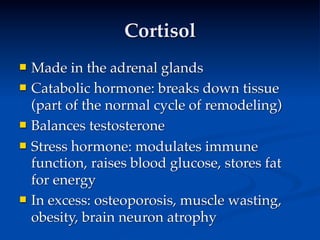
Cortisol
   Made in the adrenal glands
   Catabolic hormone: breaks down tissue
    (part of the normal cycle of remodeling)
   Balances testosterone
   Stress hormone: modulates immune
    function, raises blood glucose, stores fat
    for energy
   In excess: osteoporosis, muscle wasting,
    obesity, brain neuron atrophy
Thyroid Hormone
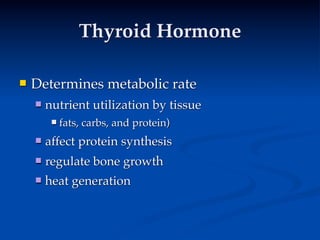
Thyroid Hormone

   Determines metabolic rate
       nutrient utilization by tissue
            fats, carbs, and protein)
       affect protein synthesis
       regulate bone growth
       heat generation
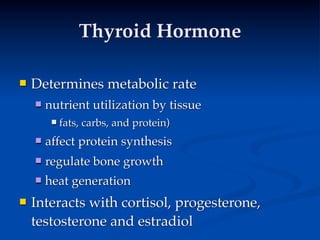
Thyroid Hormone

   Determines metabolic rate
       nutrient utilization by tissue
            fats, carbs, and protein)
       affect protein synthesis
       regulate bone growth
       heat generation
   Interacts with cortisol, progesterone,
    testosterone and estradiol
Female Hormone Patterns
 Menarche to Menopause
Female Hormone Patterns
         Menarche to Menopause

   Teens
       Anovulatory cycles are common
       Low Progesterone


       Estrogen Dominance
Female Hormone Patterns
 Menarche to Menopause
Female Hormone Patterns
         Menarche to Menopause

   20 to 30 years old
       May have regular monthly bleeding but may
        not be ovulating
       if stressed: PMS
       unbalanced hormone levels affect fertility and
        pregnancy
Female Hormone Patterns
 Menarche to Menopause
Female Hormone Patterns
         Menarche to Menopause
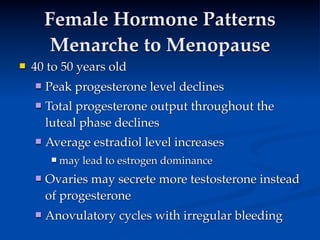
   40 to 50 years old
       Peak progesterone level declines
       Total progesterone output throughout the
        luteal phase declines
 
     
       Average estradiol level increases
            may lead to estrogen dominance
       Ovaries may secrete more testosterone instead
        of progesterone
       Anovulatory cycles with irregular bleeding
Female Hormone Patterns
 Menarche to Menopause
Female Hormone Patterns
         Menarche to Menopause
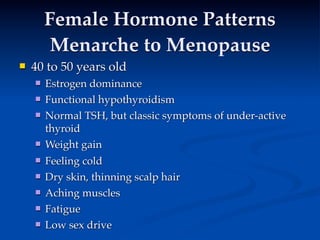
   40 to 50 years old
       Estrogen dominance
       Functional hypothyroidism 
     
       Normal TSH, but classic symptoms of under-active
        thyroid
       Weight gain
       Feeling cold
       Dry skin, thinning scalp hair
       Aching muscles
       Fatigue
       Low sex drive
Female Hormone Patterns
 Menarche to Menopause
Female Hormone Patterns
         Menarche to Menopause
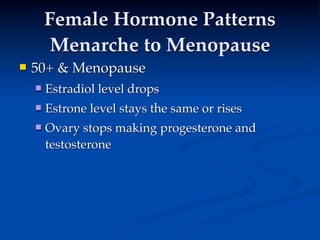
   50+ & Menopause
       Estradiol level drops


       Estrone level stays the same or rises
       Ovary stops making progesterone and
        testosterone
Symptoms of Hormone
     Imbalance
Symptoms of Hormone
               Imbalance
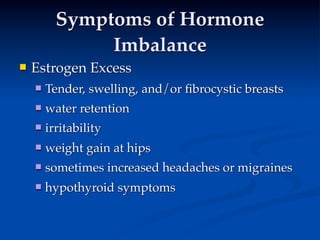
   Estrogen Excess


       Tender, swelling, and/or fibrocystic breasts
       water retention
       irritability
       weight gain at hips
       sometimes increased headaches or migraines
       hypothyroid symptoms
Symptoms of Hormone
     Imbalance
Symptoms of Hormone
               Imbalance
   Estrogen Deficiency


       Hot flashes & night sweats
       vaginal dryness (also lips, skin, eyes...)
       “brain fog” & memory problems
       urinary incontinence (stress incontinence)
       depression
       bone loss
Symptoms of Hormone
     Imbalance
Symptoms of Hormone
              Imbalance
   Estrogen Deficiency 
       Low percent of body fat = at risk for low
        estrogen
            estrogen CAN be made in body fat...if you have
             enough!
            women with enough body fat may not need
             estrogen supplementation for menopause
            women with low body fat may need extra estrogen
Symptoms of Hormone
     Imbalance
Symptoms of Hormone
                Imbalance
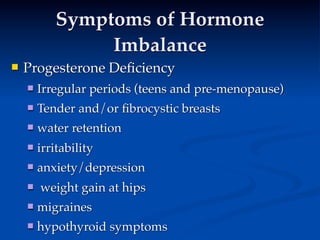
   Progesterone Deficiency


       Irregular periods (teens and pre-menopause)
       Tender and/or fibrocystic breasts
       water retention
       irritability
       anxiety/depression
       weight gain at hips
       migraines
       hypothyroid symptoms
Symptoms of Hormone
     Imbalance
Symptoms of Hormone
                 Imbalance
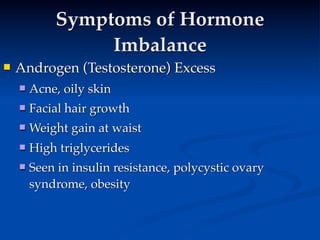
   Androgen (Testosterone) Excess
 
       Acne, oily skin
       Facial hair growth
       Weight gain at waist
       High triglycerides
       Seen in insulin resistance, polycystic ovary
        syndrome, obesity
Symptoms of Hormone
     Imbalance
Symptoms of Hormone
              Imbalance

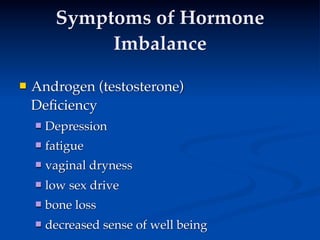
   Androgen (testosterone)
    Deficiency
 
       Depression
       fatigue
       vaginal dryness
       low sex drive
       bone loss
       decreased sense of well being
Symptoms of Hormone
     Imbalance
Symptoms of Hormone
               Imbalance
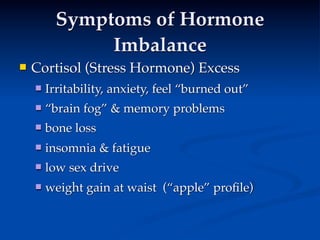
   Cortisol (Stress Hormone) Excess
       Irritability, anxiety, feel “burned out”
       “brain fog” & memory problems
       bone loss
       insomnia & fatigue
       low sex drive
       weight gain at waist (“apple” profile)
Symptoms of Hormone
     Imbalance
Symptoms of Hormone
             Imbalance
   Cortisol Deficiency “Adrenal Fatigue”
     Usually preceded by prolonged stress/
      chronic illness
    
     Fatigue, feel “flat” or “burned out”

     Allergies; immune function low

     Feel cold all the time

     Can’t get started in the morning

     Low sex drive

     Depression

     Unstable blood sugar
Approach to Female Hormone
        Imbalances
Approach to Female Hormone
        Imbalances
   The solution isn’t always HRT
       Stress reduction (good diet, sleep, exercise,
        relaxation training)
   
       Weight loss


       Address insulin resistance
    
     
       Nutrients 


       Herbs
Male Hormone Patterns

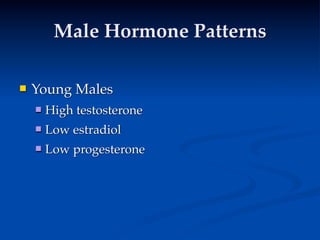
   Young Males
       High testosterone


       Low estradiol


       Low progesterone
Male Hormone Patterns
   35 + years old
Male Hormone Patterns
   35 + years old


   Testosterone drops about 1% per year
Male Hormone Patterns
   35 + years old


   Testosterone drops about 1% per year

   Estradiol and estrone may rise; Prog stays low
Male Hormone Patterns
   35 + years old


   Testosterone drops about 1% per year

   Estradiol and estrone may rise; Prog stays low
   Gain weight around middle
Male Hormone Patterns
   35 + years old


   Testosterone drops about 1% per year

   Estradiol and estrone may rise; Prog stays low
   Gain weight around middle
       
     
   Sleep problems associated with excess weight
    may lead to increased cortisol
Male Hormone Patterns
   35 + years old


   Testosterone drops about 1% per year

   Estradiol and estrone may rise; Prog stays low
   Gain weight around middle
       
     
   Sleep problems associated with excess weight
    may lead to increased cortisol
   Abdominal fat converts testosterone to estradiol
    under the influence of cortisol
Male Hormone Patterns
   35 + years old


   Testosterone drops about 1% per year

   Estradiol and estrone may rise; Prog stays low
   Gain weight around middle
        
    
   Sleep problems associated with excess weight
    may lead to increased cortisol
   Abdominal fat converts testosterone to estradiol
    under the influence of cortisol
   Cortisol and estradiol directly oppose the action
    of testosterone
Approach to Male Hormone
       Imbalances
Approach to Male Hormone
           Imbalances
   Weight loss
Approach to Male Hormone
           Imbalances
   Weight loss
   Weight training
Approach to Male Hormone
           Imbalances
   Weight loss
   Weight training
   Reduce dietary estrogen burden
Approach to Male Hormone
           Imbalances
   Weight loss
   Weight training
   Reduce dietary estrogen burden
   Testosterone supplementation
Approach to Male Hormone
           Imbalances
   Weight loss
   Weight training
   Reduce dietary estrogen burden
   Testosterone supplementation
   Aromatase inhibitors
Solving Hormone Problems
   History 85%
Solving Hormone Problems
   History 85%
   Physical examination 10%
Solving Hormone Problems
   History 85%
   Physical examination 10%
   Lab tests 5%
Solving Hormone Problems
   History 85%
   Physical examination 10%
   Lab tests 5%
   Respect individual differences
Solving Hormone Problems
   History 85%
   Physical examination 10%
   Lab tests 5%
   Respect individual differences
   Endocrinology will always be somewhat
    of an art, not an exact science
Role of Testing
Role of Testing


   Symptoms help us reach a tentative
    diagnosis
Role of Testing


   Symptoms help us reach a tentative
    diagnosis
   Lab testing confirms or refutes the
    diagnosis
Role of Testing


   Symptoms help us reach a tentative
    diagnosis
   Lab testing confirms or refutes the
    diagnosis
   Need to do comprehensive testing
Thank You
       John C. Richards Pharm.D.
         Barbara Dace Pharm.D.
        Debby DeJager Pharm.D.


P ro f es s i o n al Village Pharmacy
         91 6 - 4 8 3 - 3 4 5 5
    www.professionalvillagerx.com

Hormone seminar (3 24 10).key,bio-identical hormone replacement,Professional Village Pharmacy,compounding pharmacy

  • 1.
  • 2.
  • 3.
    Hormones  Powerful chemical messengers
  • 4.
    Hormones  Powerful chemical messengers  Derived from cholesterol
  • 5.
    Hormones  Powerful chemical messengers  Derived from cholesterol  Made in the brain, ovaries, testicles, adrenal glands and body fat
  • 6.
    Hormones  Powerful chemical messengers  Derived from cholesterol  Made in the brain, ovaries, testicles, adrenal glands and body fat  Affect every tissue in the body
  • 7.
    Hormones  Powerful chemical messengers  Derived from cholesterol  Made in the brain, ovaries, testicles, adrenal glands and body fat  Affect every tissue in the body  Overall effect depends on the balance between various hormones
  • 8.
    Hormones  Powerful chemical messengers  Derived from cholesterol  Made in the brain, ovaries, testicles, adrenal glands and body fat  Affect every tissue in the body  Overall effect depends on the balance between various hormones  Duration of exposure is as important as dose
  • 9.
  • 10.
    Bio-Identical Hormones  Bio-Identical Hormones are chemically identical to those in the human body  Derived from cholesterol-like molecules called saponins (extracted from soybeans and yams)  Plants do not make hormones (only precursors)  Some available without prescription (ProGest)  Others require prescription  a few manufactured products (eg: Vivelle, Estrace, Prometrium)  custom compounded medications
  • 11.
  • 12.
    Estrogens Estriol, Estradiol, Estrone  Exert a stimulating effect on breast, uterus and brain
  • 13.
    Estrogens Estriol, Estradiol, Estrone  Exert a stimulating effect on breast, uterus and brain  Prevent bone loss by osteoclasts
  • 14.
    Estrogens Estriol, Estradiol, Estrone  Exert a stimulating effect on breast, uterus and brain  Prevent bone loss by osteoclasts  Involved in vasodilation and improved blood flow
  • 15.
    Estrogens Estriol, Estradiol, Estrone  Exert a stimulating effect on breast, uterus and brain  Prevent bone loss by osteoclasts  Involved in vasodilation and improved blood flow  Promote fat storage at hips
  • 16.
    Estrogens Estriol, Estradiol, Estrone  Exert a stimulating effect on breast, uterus and brain  Prevent bone loss by osteoclasts  Involved in vasodilation and improved blood flow  Promote fat storage at hips  Maintain integrity of urogenital tract
  • 17.
  • 18.
    Progesterone  There is only ONE progesterone
  • 19.
    Progesterone  There is only ONE progesterone  Works synergistically with estrogens  Balances effect of estrogens in many cases  slows cell growth  normalizes blood clotting  enhances estrogen’s cardiovascular benefits  decreases fluid retention (bloating)  improved fat metabolism
  • 20.
    Progesterone  There is only ONE progesterone  Works synergistically with estrogens  Balances effect of estrogens in many cases  slows cell growth  normalizes blood clotting  enhances estrogen’s cardiovascular benefits  decreases fluid retention (bloating)  improved fat metabolism  Progesterone levels drop at peri-menopause
  • 21.
  • 22.
    Testosterone  Anabolic hormone  builds and strengthens tissue, bone, urogenital tract, muscle
  • 23.
    Testosterone  Anabolic hormone  builds and strengthens tissue, bone, urogenital tract, muscle  Declines with age
  • 24.
    Testosterone  Anabolic hormone  builds and strengthens tissue, bone, urogenital tract, muscle  Declines with age  Vasodilator
  • 25.
    Testosterone  Anabolic hormone  builds and strengthens tissue, bone, urogenital tract, muscle  Declines with age  Vasodilator  Balances effects of estrogen and cortisol
  • 26.
    Testosterone  Anabolic hormone  builds and strengthens tissue, bone, urogenital tract, muscle  Declines with age  Vasodilator  Balances effects of estrogen and cortisol  Important for sex drive/sexual response
  • 27.
  • 28.
    Dehydroepiandrosterone (DHEA)  Made in the adrenal glands
  • 29.
    Dehydroepiandrosterone (DHEA)  Made in the adrenal glands  Declines steadily with age
  • 30.
    Dehydroepiandrosterone (DHEA)  Made in the adrenal glands  Declines steadily with age  Has important roles in immune function, ability to handle stress, and glucose disposal
  • 31.
    Dehydroepiandrosterone (DHEA)  Made in the adrenal glands  Declines steadily with age  Has important roles in immune function, ability to handle stress, and glucose disposal  Balances cortisol
  • 32.
    Dehydroepiandrosterone (DHEA)  Made in the adrenal glands  Declines steadily with age  Has important roles in immune function, ability to handle stress, and glucose disposal  Balances cortisol  Can convert into testosterone and estradiol
  • 33.
  • 34.
    Cortisol  Made in the adrenal glands
  • 35.
    Cortisol  Made in the adrenal glands  Catabolic hormone: breaks down tissue (part of the normal cycle of remodeling)
  • 36.
    Cortisol  Made in the adrenal glands  Catabolic hormone: breaks down tissue (part of the normal cycle of remodeling)  Balances testosterone
  • 37.
    Cortisol  Made in the adrenal glands  Catabolic hormone: breaks down tissue (part of the normal cycle of remodeling)  Balances testosterone  Stress hormone: modulates immune function, raises blood glucose, stores fat for energy
  • 38.
    Cortisol  Made in the adrenal glands  Catabolic hormone: breaks down tissue (part of the normal cycle of remodeling)  Balances testosterone  Stress hormone: modulates immune function, raises blood glucose, stores fat for energy  In excess: osteoporosis, muscle wasting, obesity, brain neuron atrophy
  • 39.
  • 40.
    Thyroid Hormone  Determines metabolic rate  nutrient utilization by tissue  fats, carbs, and protein)  affect protein synthesis  regulate bone growth  heat generation
  • 41.
    Thyroid Hormone  Determines metabolic rate  nutrient utilization by tissue  fats, carbs, and protein)  affect protein synthesis  regulate bone growth  heat generation  Interacts with cortisol, progesterone, testosterone and estradiol
  • 42.
    Female Hormone Patterns Menarche to Menopause
  • 43.
    Female Hormone Patterns Menarche to Menopause  Teens  Anovulatory cycles are common  Low Progesterone  Estrogen Dominance
  • 44.
    Female Hormone Patterns Menarche to Menopause
  • 45.
    Female Hormone Patterns Menarche to Menopause  20 to 30 years old  May have regular monthly bleeding but may not be ovulating  if stressed: PMS  unbalanced hormone levels affect fertility and pregnancy
  • 46.
    Female Hormone Patterns Menarche to Menopause
  • 47.
    Female Hormone Patterns Menarche to Menopause  40 to 50 years old  Peak progesterone level declines  Total progesterone output throughout the luteal phase declines  Average estradiol level increases  may lead to estrogen dominance  Ovaries may secrete more testosterone instead of progesterone  Anovulatory cycles with irregular bleeding
  • 48.
    Female Hormone Patterns Menarche to Menopause
  • 49.
    Female Hormone Patterns Menarche to Menopause  40 to 50 years old  Estrogen dominance  Functional hypothyroidism  Normal TSH, but classic symptoms of under-active thyroid  Weight gain  Feeling cold  Dry skin, thinning scalp hair  Aching muscles  Fatigue  Low sex drive
  • 50.
    Female Hormone Patterns Menarche to Menopause
  • 51.
    Female Hormone Patterns Menarche to Menopause  50+ & Menopause  Estradiol level drops  Estrone level stays the same or rises  Ovary stops making progesterone and testosterone
  • 52.
  • 53.
    Symptoms of Hormone Imbalance  Estrogen Excess  Tender, swelling, and/or fibrocystic breasts  water retention  irritability  weight gain at hips  sometimes increased headaches or migraines  hypothyroid symptoms
  • 54.
  • 55.
    Symptoms of Hormone Imbalance  Estrogen Deficiency  Hot flashes & night sweats  vaginal dryness (also lips, skin, eyes...)  “brain fog” & memory problems  urinary incontinence (stress incontinence)  depression  bone loss
  • 56.
  • 57.
    Symptoms of Hormone Imbalance  Estrogen Deficiency  Low percent of body fat = at risk for low estrogen  estrogen CAN be made in body fat...if you have enough!  women with enough body fat may not need estrogen supplementation for menopause  women with low body fat may need extra estrogen
  • 58.
  • 59.
    Symptoms of Hormone Imbalance  Progesterone Deficiency  Irregular periods (teens and pre-menopause)  Tender and/or fibrocystic breasts  water retention  irritability  anxiety/depression  weight gain at hips  migraines  hypothyroid symptoms
  • 60.
  • 61.
    Symptoms of Hormone Imbalance  Androgen (Testosterone) Excess  Acne, oily skin  Facial hair growth  Weight gain at waist  High triglycerides  Seen in insulin resistance, polycystic ovary syndrome, obesity
  • 62.
  • 63.
    Symptoms of Hormone Imbalance  Androgen (testosterone) Deficiency  Depression  fatigue  vaginal dryness  low sex drive  bone loss  decreased sense of well being
  • 64.
  • 65.
    Symptoms of Hormone Imbalance  Cortisol (Stress Hormone) Excess  Irritability, anxiety, feel “burned out”  “brain fog” & memory problems  bone loss  insomnia & fatigue  low sex drive  weight gain at waist (“apple” profile)
  • 66.
  • 67.
    Symptoms of Hormone Imbalance  Cortisol Deficiency “Adrenal Fatigue”  Usually preceded by prolonged stress/ chronic illness  Fatigue, feel “flat” or “burned out”  Allergies; immune function low  Feel cold all the time  Can’t get started in the morning  Low sex drive  Depression  Unstable blood sugar
  • 68.
    Approach to FemaleHormone Imbalances
  • 69.
    Approach to FemaleHormone Imbalances  The solution isn’t always HRT  Stress reduction (good diet, sleep, exercise, relaxation training)  Weight loss  Address insulin resistance  Nutrients  Herbs
  • 70.
  • 71.
    Male Hormone Patterns  Young Males  High testosterone  Low estradiol  Low progesterone
  • 72.
  • 73.
  • 74.
    Male Hormone Patterns  35 + years old  Testosterone drops about 1% per year
  • 75.
    Male Hormone Patterns  35 + years old  Testosterone drops about 1% per year  Estradiol and estrone may rise; Prog stays low
  • 76.
    Male Hormone Patterns  35 + years old  Testosterone drops about 1% per year  Estradiol and estrone may rise; Prog stays low  Gain weight around middle
  • 77.
    Male Hormone Patterns  35 + years old  Testosterone drops about 1% per year  Estradiol and estrone may rise; Prog stays low  Gain weight around middle  Sleep problems associated with excess weight may lead to increased cortisol
  • 78.
    Male Hormone Patterns  35 + years old  Testosterone drops about 1% per year  Estradiol and estrone may rise; Prog stays low  Gain weight around middle  Sleep problems associated with excess weight may lead to increased cortisol  Abdominal fat converts testosterone to estradiol under the influence of cortisol
  • 79.
    Male Hormone Patterns  35 + years old  Testosterone drops about 1% per year  Estradiol and estrone may rise; Prog stays low  Gain weight around middle  Sleep problems associated with excess weight may lead to increased cortisol  Abdominal fat converts testosterone to estradiol under the influence of cortisol  Cortisol and estradiol directly oppose the action of testosterone
  • 80.
    Approach to MaleHormone Imbalances
  • 81.
    Approach to MaleHormone Imbalances  Weight loss
  • 82.
    Approach to MaleHormone Imbalances  Weight loss  Weight training
  • 83.
    Approach to MaleHormone Imbalances  Weight loss  Weight training  Reduce dietary estrogen burden
  • 84.
    Approach to MaleHormone Imbalances  Weight loss  Weight training  Reduce dietary estrogen burden  Testosterone supplementation
  • 85.
    Approach to MaleHormone Imbalances  Weight loss  Weight training  Reduce dietary estrogen burden  Testosterone supplementation  Aromatase inhibitors
  • 86.
  • 87.
  • 88.
    Solving Hormone Problems  History 85%  Physical examination 10%
  • 89.
    Solving Hormone Problems  History 85%  Physical examination 10%  Lab tests 5%
  • 90.
    Solving Hormone Problems  History 85%  Physical examination 10%  Lab tests 5%  Respect individual differences
  • 91.
    Solving Hormone Problems  History 85%  Physical examination 10%  Lab tests 5%  Respect individual differences  Endocrinology will always be somewhat of an art, not an exact science
  • 92.
  • 93.
    Role of Testing  Symptoms help us reach a tentative diagnosis
  • 94.
    Role of Testing  Symptoms help us reach a tentative diagnosis  Lab testing confirms or refutes the diagnosis
  • 95.
    Role of Testing  Symptoms help us reach a tentative diagnosis  Lab testing confirms or refutes the diagnosis  Need to do comprehensive testing
  • 96.
    Thank You John C. Richards Pharm.D. Barbara Dace Pharm.D. Debby DeJager Pharm.D. P ro f es s i o n al Village Pharmacy 91 6 - 4 8 3 - 3 4 5 5 www.professionalvillagerx.com