Background to the Problem of Israel and Palestine
God’s covenant with Abraham “ You shall be the father of many nations” “ I will establish my covenant between me and you and your descendants for ever” “ I will give to you, and to your descendants, all the land of Canaan, for an everlasting possession; and I will be their God” Genesis 17:4-8
Questions Who are the descendants of Abraham? What is the land of Canaan? To whom should the land belong? What authority does such a promise made 4000 years ago have today?
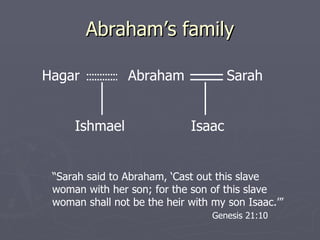
Abraham’s family
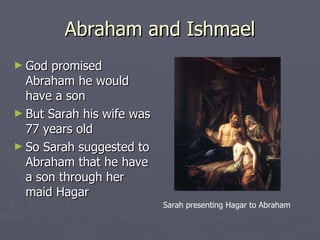
Abraham and Ishmael God promised Abraham he would have a son But Sarah his wife was 77 years old So Sarah suggested to Abraham that he have a son through her maid Hagar Sarah presenting Hagar to Abraham
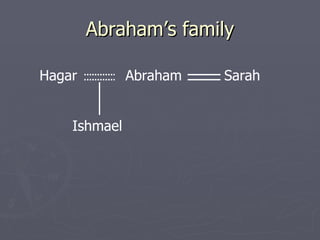
Abraham’s family Abraham Hagar Sarah Ishmael
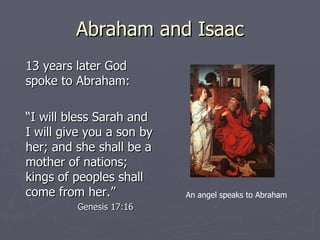
Abraham and Isaac 13 years later God spoke to Abraham: “ I will bless Sarah and I will give you a son by her; and she shall be a mother of nations; kings of peoples shall come from her.” Genesis 17:16 An angel speaks to Abraham
Abraham’s family Abraham Hagar Sarah Ishmael Isaac “ Sarah said to Abraham, ‘Cast out this slave woman with her son; for the son of this slave woman shall not be the heir with my son Isaac.’” Genesis 21:10
God’s promises about Ishmael “ I will bless [Ishmael] and make him fruitful and he shall be the father of 12 princes and I will make him a great nation. But I will establish my covenant with Isaac.” Genesis 17:20-21 Abraham sending Hagar and Ishmael away
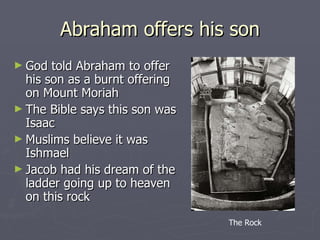
Abraham offers his son God told Abraham to offer his son as a burnt offering on Mount Moriah The Bible says this son was Isaac Muslims believe it was Ishmael Jacob had his dream of the ladder going up to heaven on this rock The Rock
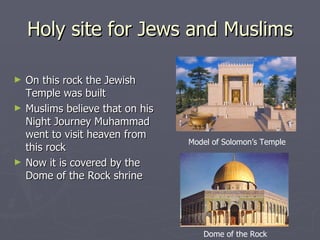
Holy site for Jews and Muslims On this rock the Jewish Temple was built  Muslims believe that on his Night Journey Muhammad went to visit heaven from this rock  Now it is covered by the Dome of the Rock shrine Model of Solomon’s Temple Dome of the Rock
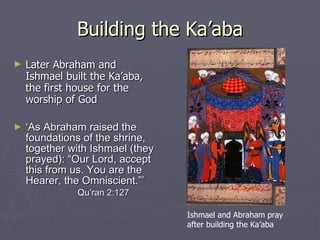
Building the Ka’aba Later Abraham and Ishmael built the Ka’aba, the first house for the worship of God ‘ As Abraham raised the foundations of the shrine, together with Ishmael (they prayed): “Our Lord, accept this from us. You are the Hearer, the Omniscient.”’  Qu’ran 2:127 Ishmael and Abraham pray after building the Ka’aba
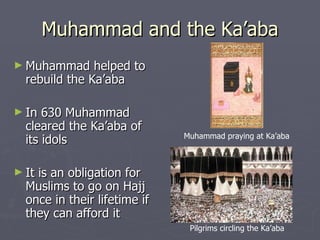
Muhammad and the Ka’aba Muhammad helped to rebuild the Ka’aba In 630 Muhammad cleared the Ka’aba of its idols It is an obligation for Muslims to go on Hajj once in their lifetime if they can afford it  Muhammad praying at Ka’aba Pilgrims circling the Ka’aba
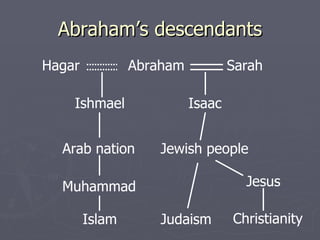
Abraham’s descendants Abraham Hagar Sarah Ishmael Isaac Arab nation Muhammad Islam Jewish people Judaism Christianity Jesus
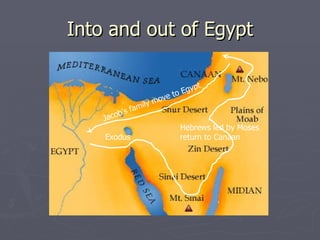
Into and out of Egypt Jacob’s family move to Egypt Exodus  Hebrews led by Moses return to Canaan
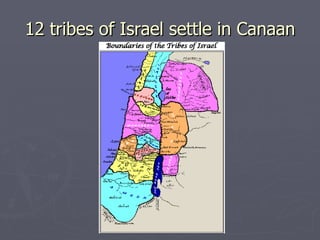
12 tribes of Israel settle in Canaan
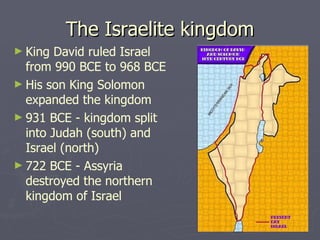
The Israelite kingdom King David ruled Israel from 990 BCE to 968 BCE His son King Solomon expanded the kingdom 931 BCE - kingdom split into Judah (south) and Israel (north) 722 BCE - Assyria destroyed the northern kingdom of Israel
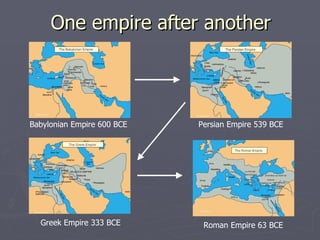
One empire after another Babylonian Empire 600 BCE  Persian Empire 539 BCE Greek Empire 333 BCE Roman Empire 63 BCE
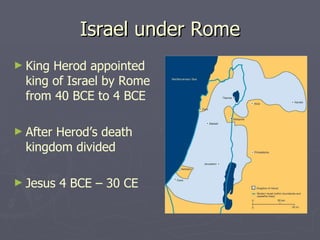
Israel under Rome King Herod appointed king of Israel by Rome from 40 BCE to 4 BCE After Herod’s death kingdom divided Jesus 4 BCE – 30 CE
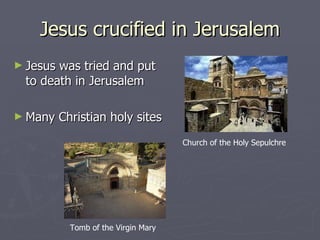
Jesus crucified in Jerusalem Jesus was tried and put to death in Jerusalem Many Christian holy sites Church of the Holy Sepulchre Tomb of the Virgin Mary
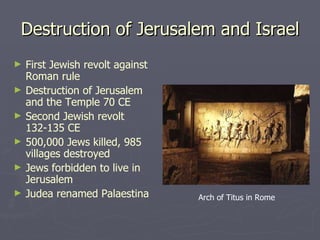
Destruction of Jerusalem and Israel First Jewish revolt against Roman rule Destruction of Jerusalem and the Temple 70 CE Second Jewish revolt 132-135 CE 500,000 Jews killed, 985 villages destroyed Jews forbidden to live in Jerusalem Judea renamed Palaestina Arch of Titus in Rome
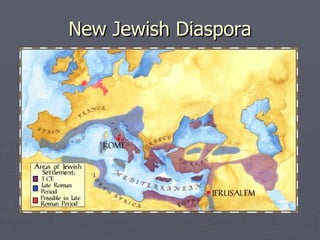
New Jewish Diaspora
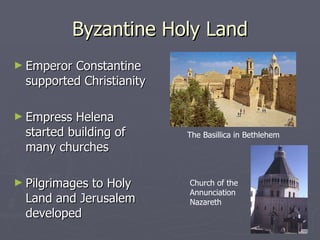
Byzantine Holy Land Emperor Constantine supported Christianity Empress Helena started building of many churches Pilgrimages to Holy Land and Jerusalem developed Church of the Annunciation Nazareth The Basillica in Bethlehem
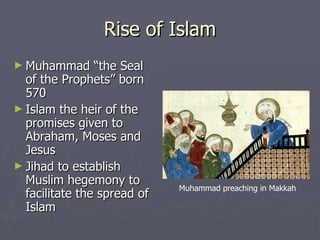
Rise of Islam Muhammad “the Seal of the Prophets” born 570 Islam the heir of the promises given to Abraham, Moses and Jesus Jihad to establish Muslim hegemony to facilitate the spread of Islam Muhammad preaching in Makkah
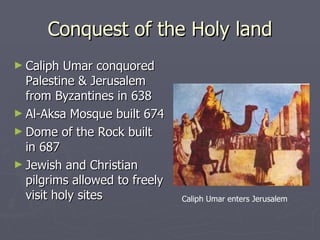
Conquest of the Holy land Caliph Umar conquored Palestine & Jerusalem from Byzantines in 638 Al-Aksa Mosque built 674 Dome of the Rock built in 687  Jewish and Christian pilgrims allowed to freely visit holy sites Caliph Umar enters Jerusalem
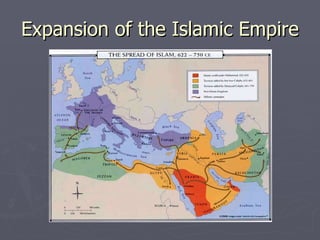
Expansion of the Islamic Empire
New rulers, new policies  Fatimid dynasty established in Egypt in 969 Caliph Al-Hakim bi-Amr   destroyed Church of the Holy Sepulchre in 1009  Seljuk Turks defeated Byzantines at Battle of Manzikert in 1071 and seized Anatolia Christian pilgrim routes threatened Crusade to retake Jerusalem and protect pilgrims preached by Pope Urban II in 1095
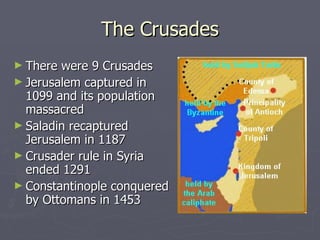
The Crusades There were 9 Crusades Jerusalem captured in 1099 and its population massacred Saladin recaptured Jerusalem in 1187 Crusader rule in Syria ended 1291 Constantinople conquered  by Ottomans in 1453
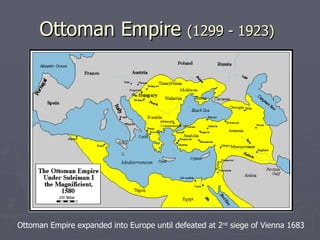
Ottoman Empire  (1299 - 1923)   Ottoman Empire expanded into Europe until defeated at 2 nd  siege of Vienna 1683
Recent Jewish history
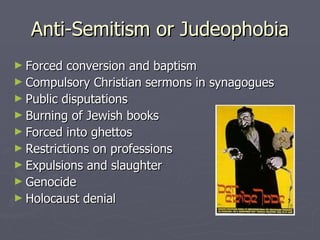
Anti-Semitism or Judeophobia Forced conversion and baptism Compulsory Christian sermons in synagogues Public disputations Burning of Jewish books Forced into ghettos Restrictions on professions Expulsions and slaughter Genocide Holocaust denial
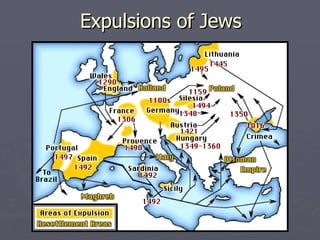
Expulsions of Jews
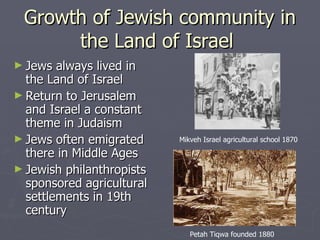
Growth of Jewish community in the Land of Israel  Jews always lived in the Land of Israel Return to Jerusalem and Israel a constant theme in Judaism Jews often emigrated there in Middle Ages Jewish philanthropists sponsored agricultural settlements in 19th century Mikveh Israel agricultural school 1870 Petah Tiqwa founded 1880
Growth of Zionism Movement to support a Jewish homeland in the Biblical Land of Israel  Response to rampant anti-Semitism of 19th century Europe Russian pogroms and expulsions of 1880s Dreyfus Affair in France in 1890s Persecution 1930s and Holocaust 1940s Secular but with religious roots Desire for a refuge from persecution Desire to be self-governing independent nation  1st Zionist Congress 1897
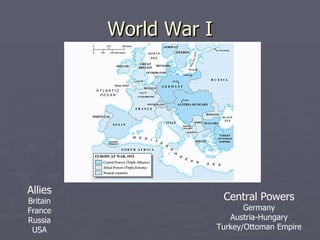
World War I Allies Britain France Russia USA Central Powers Germany Austria-Hungary Turkey/Ottoman Empire
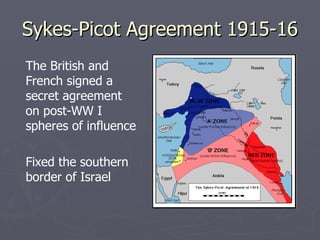
Sykes-Picot Agreement 1915-16 The British and French signed a secret agreement on post-WW I spheres of influence Fixed the southern border of Israel
Britain’s agreement with the Arabs In 1916 Britain promised the Sharif of Mecca it would support Arab independence if they revolted against the Ottomans except in these areas: The districts of Mersin and Alexandretta, and portions of Syria lying to the west of the districts of Damascus, Homs, Hama and Aleppo, cannot be said to be purely Arab, and must on that account be excepted from the proposed delimitation. Sir Henry MacMahon 1915
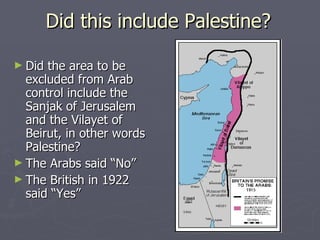
Did this include Palestine? Did the area to be excluded from Arab control include the Sanjak of Jerusalem and the Vilayet of Beirut, in other words Palestine? The Arabs said “No” The British in 1922 said “Yes”
Balfour Declaration 1917 "His Majesty's Government view with favour the establishment in Palestine of a  national home for the Jewish people , and will use their best endeavours to facilitate the achievement of this object, it being clearly understood that  nothing shall be done which may prejudice the civil and religious rights of existing non-Jewish communities in Palestine , or the rights and political status enjoyed by Jews in any other country."
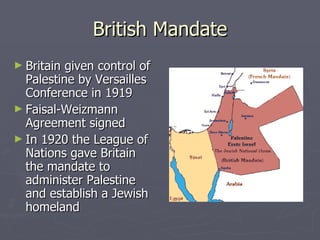
British Mandate Britain given control of Palestine by Versailles Conference in 1919 Faisal-Weizmann Agreement signed In 1920 the League of Nations gave Britain the mandate to administer Palestine and establish a Jewish homeland
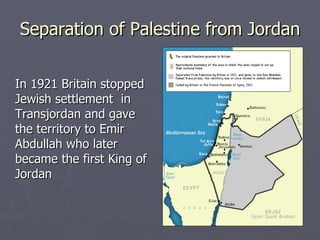
Separation of Palestine from Jordan In 1921 Britain stopped Jewish settlement  in Transjordan and gave the territory to Emir Abdullah who later became the first King of Jordan
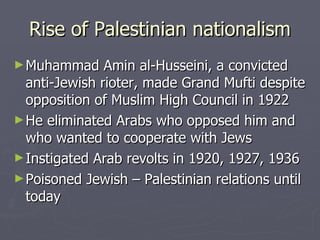
Rise of Palestinian nationalism Muhammad Amin al-Husseini, a convicted anti-Jewish rioter, made Grand Mufti despite opposition of Muslim High Council in 1922 He eliminated Arabs who opposed him and who wanted to cooperate with Jews  Instigated Arab revolts in 1920, 1927, 1936 Poisoned Jewish – Palestinian relations until today
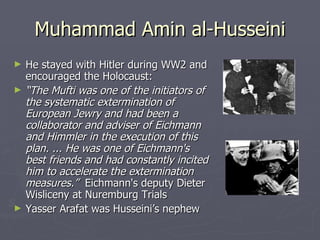
Muhammad Amin al-Husseini He stayed with Hitler during WW2 and encouraged the Holocaust: “ The Mufti was one of the initiators of the systematic extermination of European Jewry and had been a collaborator and adviser of Eichmann and Himmler in the execution of this plan. ... He was one of Eichmann's best friends and had constantly incited him to accelerate the extermination measures.”   Eichmann's deputy Dieter Wisliceny at Nuremburg Trials Yasser Arafat was Husseini’s nephew
Between a rock and a hard place Jews wanted unlimited emigration to Palestine to escape persecution in Europe and verbally and violently rejected British attempts to limit immigration Arabs opposed Jewish immigration as they saw it would lead to a Jewish majority and the loss of their country. So they verbally and violently attacked Britain for allowing it
Inconsistent British policy British Zionists versus British Arabists Arabists – Jewish emigration wrong: threatened British interests in Arab world namely oil & India Zionists – Supported Jewish emigration due to mandate obligations and for humanitarian and sometimes religious reasons British policy fluctuated, giving in to the community which used the most violence
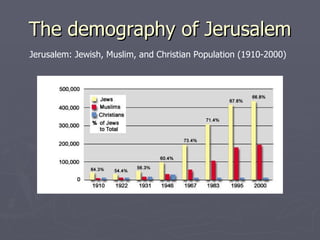
The demography of Jerusalem Jerusalem: Jewish, Muslim, and Christian Population (1910-2000)
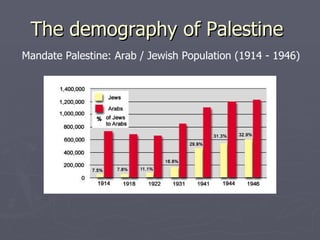
The demography of Palestine  Mandate Palestine: Arab / Jewish Population (1914 - 1946)
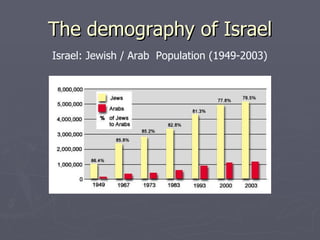
The demography of Israel Israel: Jewish / Arab  Population (1949-2003)
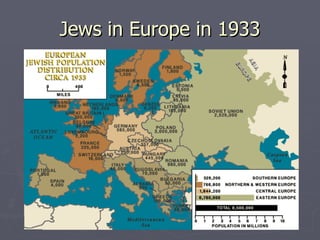
Jews in Europe in 1933
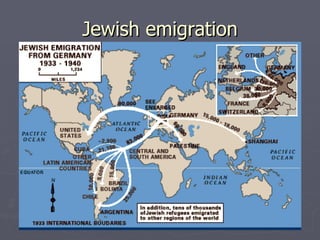
Jewish emigration
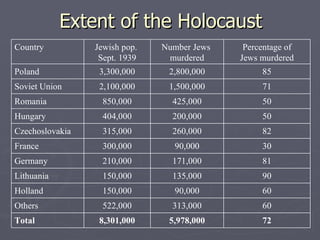
Extent of the Holocaust 72 5,978,000 8,301,000 Total 60 313,000 522,000 Others 60 90,000 150,000 Holland 90 135,000 150,000 Lithuania 81 171,000 210,000 Germany 30 90,000 300,000 France 82 260,000 315,000 Czechoslovakia 50 200,000 404,000 Hungary 50 425,000 850,000 Romania 71 1,500,000 2,100,000 Soviet Union 85 2,800,000 3,300,000 Poland Percentage of Jews murdered Number Jews  murdered Jewish pop.  Sept. 1939 Country
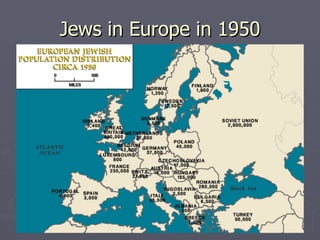
Jews in Europe in 1950
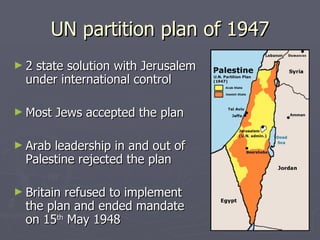
UN partition plan of 1947 2 state solution with Jerusalem under international control Most Jews accepted the plan  Arab leadership in and out of Palestine rejected the plan Britain refused to implement the plan and ended mandate on 15 th  May 1948
Arab-Israeli war of 1948 April 9 th  Deir Yassin massacre of 107 Arabs prompted many Arab villagers to flee April 13 th  Jewish medical convoy attacked killing 77 medical staff and civilians  May 14 th  Israel declaration of independence May 15 th  Arab declaration to create a  United State of Palestine  Israel invaded by 5 Arab armies
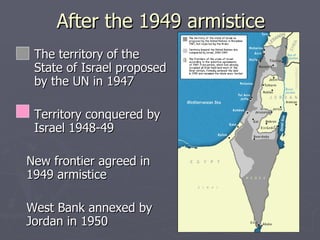
After the 1949 armistice   The territory of the   State of Israel proposed   by the UN in 1947   Territory conquered by   Israel 1948-49 New frontier agreed in 1949 armistice West Bank annexed by Jordan in 1950
Refugees, refugees 600,000 Jews expelled/encouraged to leave Iraq, Syria, Lebanon, Libya, Egypt etc. They left behind houses, businesses, possessions They fled to Israel where they settled 720,000 Palestinians fled to Egypt, Jordan, Lebanon, West Bank, Gaza They were not given citizenship but kept in refugee camps until today
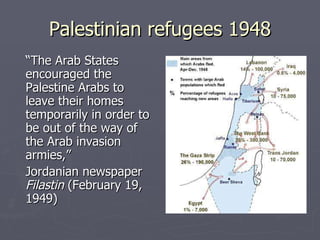
Palestinian refugees 1948 “ The Arab States encouraged the Palestine Arabs to leave their homes temporarily in order to be out of the way of the Arab invasion armies,”  Jordanian newspaper  Filastin  (February 19, 1949)
Refugee problem perpetuated Egypt, Syria, Lebanon, Iraq, Saudi Arabia all refuse to grant citizenship to Palestinians or allow them to settle or take up employment Only Jordan welcomed Palestinians and granted them citizenship on the basis that Jordanians and Palestinians were both Arabs In 1952 the UN set up a $200m fund to resettle the refugees but it was left untouched
Insistence on a ‘right of return’ “Any discussion aimed at a solution of the Palestine problem which will not be based on ensuring the refugees' right to annihilate Israel will be regarded as a desecration of the Arab people and an act of treason.”  Resolution passed at the Refugee Conference at Homs, Syria in 1957
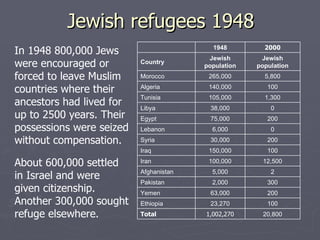
Jewish refugees 1948 In 1948 800,000 Jews  were encouraged or  forced to leave Muslim  countries where their  ancestors had lived for  up to 2500 years. Their  possessions were seized without compensation. About 600,000 settled  in Israel and were  given citizenship.  Another 300,000 sought refuge elsewhere.  20,800 1,002,270 Total 100 23,270 Ethiopia 200 63,000 Yemen 300 2,000 Pakistan 2 5,000 Afghanistan 12,500 100,000 Iran 100 150,000 Iraq 200 30,000 Syria 0 6,000 Lebanon 200 75,000 Egypt 0 38,000 Libya 1,300 105,000 Tunisia 100 140,000 Algeria 5,800 265,000 Morocco Jewish population Jewish population Country 2000 1948
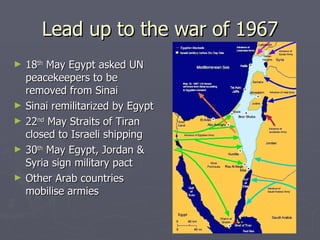
Lead up to the war of 1967 18 th  May Egypt asked UN peacekeepers to be removed from Sinai Sinai remilitarized by Egypt 22 nd  May Straits of Tiran closed to Israeli shipping 30 th  May Egypt, Jordan & Syria sign military pact Other Arab countries mobilise armies
Arab declarations of intent "If Israel embarks on an aggression against Syria or Egypt...The battle will be a general one and our basic objective will be to destroy Israel."  President Nasser of Egypt 26 th  May 1967 "The existence of Israel is an error which must be rectified. This is our opportunity to wipe out the ignominy which has been with us since 1948. Our goal is clear - to wipe Israel off the map."  President Aref of Iraq 4 th  June 1967
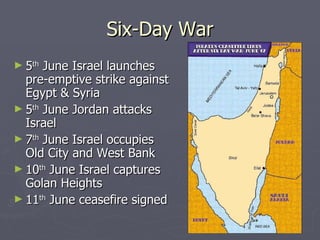
Six-Day War 5 th  June Israel launches pre-emptive strike against Egypt & Syria 5 th  June Jordan attacks Israel 7 th  June Israel occupies Old City and West Bank 10 th  June Israel captures Golan Heights 11 th  June ceasefire signed
Khartoum Resolution On September 1 st  1967 8 Arab countries met and declared: No peace with Israel  No recognition of Israel  No negotiations with Israel
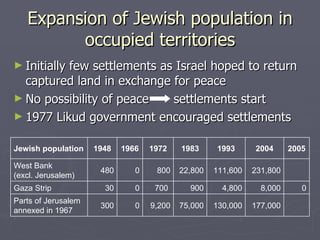
Expansion of Jewish population in occupied territories Initially few settlements as Israel hoped to return captured land in exchange for peace No possibility of peace  settlements start 1977 Likud government encouraged settlements 177,000 130,000 75,000 9,200 0 300 Parts of Jerusalem  annexed in 1967 0 8,000 4,800 900 700  0 30 Gaza Strip 231,800 111,600 22,800 800 0 480 West Bank  (excl. Jerusalem) 2005 2004 1993 1983 1972 1966 1948 Jewish population
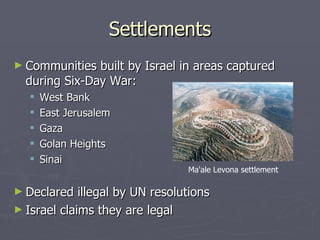
Settlements Communities built by Israel in areas captured during Six-Day War: West Bank East Jerusalem Gaza Golan Heights Sinai  Declared illegal by UN resolutions Israel claims they are legal Ma ' ale Levona settlement
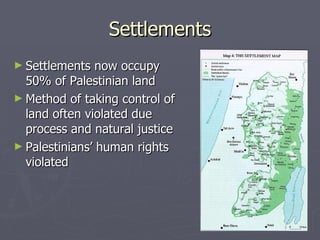
Settlements Settlements now occupy 50% of Palestinian land Method of taking control of land often violated due process and natural justice Palestinians’ human rights violated
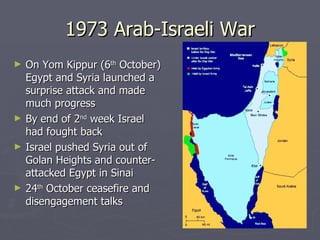
1973 Arab-Israeli War On Yom Kippur (6 th  October) Egypt and Syria launched a surprise attack and made much progress By end of 2 nd  week Israel had fought back Israel pushed Syria out of Golan Heights and counter-attacked Egypt in Sinai 24 th  October ceasefire and disengagement talks
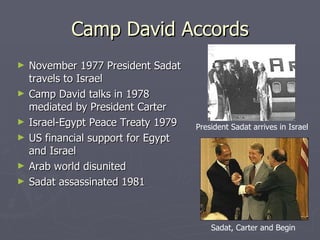
Camp David Accords November 1977 President Sadat travels to Israel Camp David talks in 1978 mediated by President Carter Israel-Egypt Peace Treaty 1979 US financial support for Egypt and Israel Arab world disunited Sadat assassinated 1981 President Sadat arrives in Israel Sadat, Carter and Begin
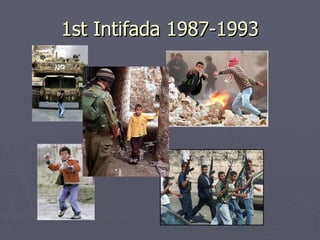
1st Intifada  1987-1993
Causes of Intifada 1987-1993 Growing Palestinian frustration at lack of progress towards a settlement Lack of support from Egypt or Jordan Worsening Israeli oppression Jewish settlements increasing Growing population and unemployment Spontaneous uprising led by community councils
Results of Intifada 1,612 Palestinians killed including 241 children. 100s informers killed by militia 160 Israelis killed Embittered Israeli-Palestinian relations Palestinian self-identity strengthened Israel criticised by international community Damaged both economies esp. tourism Led to Madrid Conference and Oslo Accords
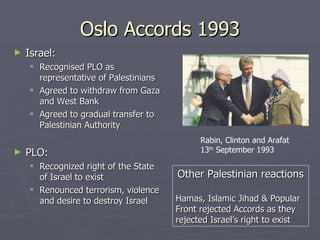
Oslo Accords 1993 Israel: Recognised PLO as representative of Palestinians Agreed to withdraw from Gaza and West Bank Agreed to gradual transfer to Palestinian Authority PLO: Recognized right of the State of Israel to exist Renounced terrorism, violence and desire to destroy Israel Rabin, Clinton and Arafat 13 th  September 1993 Other Palestinian reactions Hamas, Islamic Jihad & Popular Front rejected Accords as they  rejected Israel’s right to exist
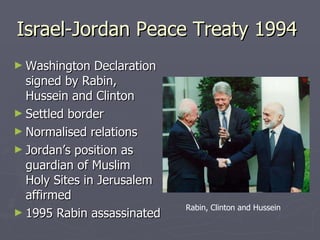
Israel-Jordan Peace Treaty 1994  Washington Declaration signed by Rabin,  Hussein and Clinton Settled border Normalised relations Jordan’s position as guardian of Muslim  Holy Sites in Jerusalem affirmed 1995 Rabin assassinated Rabin, Clinton and Hussein
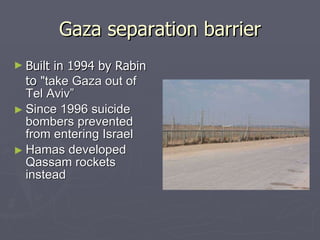
Gaza separation barrier Built in 1994 by Rabin to  "take Gaza out of Tel Aviv” Since 1996 suicide bombers prevented from entering Israel Hamas developed Qassam rockets instead
Camp David 2000 Clinton, Barak and Arafat to negotiate “final status settlement” No agreement reached over 3 issues Territory Jerusalem and the Temple Mount Refugees and the 'right of return'  Arafat blamed for failure of the summit
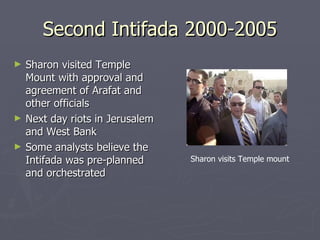
Second Intifada 2000-2005 Sharon visited Temple Mount with approval and agreement of Arafat and other officials Next day riots in Jerusalem and West Bank Some analysts believe the Intifada was pre-planned and orchestrated Sharon visits Temple mount
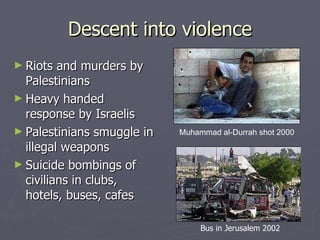
Descent into violence Riots and murders by Palestinians Heavy handed response by Israelis Palestinians smuggle in illegal weapons Suicide bombings of civilians in clubs, hotels, buses, cafes Bus in Jerusalem 2002 Muhammad al-Durrah shot 2000
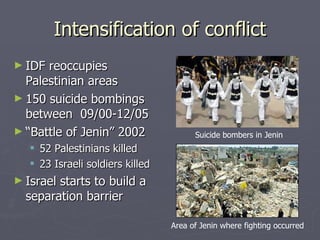
Intensification of conflict IDF reoccupies Palestinian areas 150 suicide bombings between  09/00-12/05 “ Battle of Jenin” 2002 52 Palestinians killed 23 Israeli soldiers killed Israel starts to build a separation barrier Area of Jenin where fighting occurred Suicide bombers in Jenin
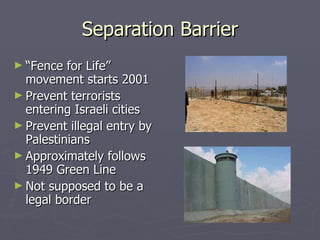
Separation Barrier “ Fence for Life” movement starts 2001 Prevent terrorists entering Israeli cities Prevent illegal entry by Palestinians Approximately follows 1949 Green Line Not supposed to be a legal border
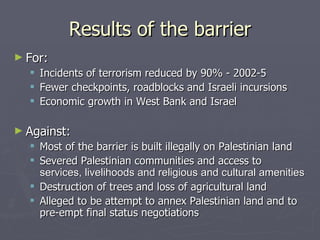
Results of the barrier For: Incidents of terrorism reduced by 90% - 2002-5 Fewer checkpoints, roadblocks and Israeli incursions Economic growth in West Bank and Israel Against: Most of the barrier is built illegally on Palestinian land Severed Palestinian communities and access to  services, livelihoods and religious and cultural amenities   Destruction of trees and loss of agricultural land  Alleged to be attempt to annex Palestinian land and to pre-empt final status negotiations
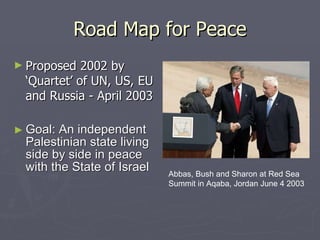
Road Map for Peace Proposed 2002 by ‘Quartet’ of UN, US, EU and Russia - April 2003 Goal: An independent Palestinian state living side by side in peace with the State of Israel Abbas, Bush and Sharon at Red Sea Summit in Aqaba, Jordan June 4 2003
Phase 1 End to Palestinian violence Suicide bombings and missile attacks continue Palestinian political reform Prime Minister appointed Israeli withdrawal and freeze on settlement expansion Israel leaves Bethlehem (2003), unilaterally leaves Gaza (2005) and closes some settlements in West Bank Palestinian elections Mahmoud Abbas elected President  January 2005 Hamas win parliamentary elections  January 2006
Phase 2 International Conference to support Palestinian economic recovery and launch a process, leading to establishment of an independent Palestinian state with provisional borders  Revival of multilateral engagement on issues including regional water resources, environment, economic development, refugees, and arms control issues Arab states restore pre-Intifada links to Israel (trade offices, etc.)
Hostilities resume 2006 The “Road Map for Peace” broke down  Hamas elected in Palestine on platform of destroying the State of Israel Hizbollah attacks Israel as part of its goal of eliminating Israel Iran declares that it will eliminate Israel
What is required? A Spiritual Road Map for Peace
 
 
Development of Judeophobic mythology Antiquity – Jews accused of being: Lepars Misogynists Lazy Middle Ages – Jews accused of being: God - killers Drinkers of Christian blood Partners of Satan Modern – Jews accused of: Trying to take over the world Racial pollution Money grabbers
Lebanon In 1970 PLO expelled from Jordan and moved to Lebanon PLO attacked Israel from Lebanon Delicate Christian-Muslim balance upset and led to Lebanese civil war in 1975 Syria sent in peace-keeping force which sided with the Muslims PLO controlled South Lebanon
Sunni-Shia division Disagreement about who should have inherited authority and leadership  Shia  believed ruler should be from family of the Prophet. Mostly in Persia/Iran & Iraq Sunni  believed ruler could be any qualified person. Arabs and most Muslim countries Some differences in practice and belief
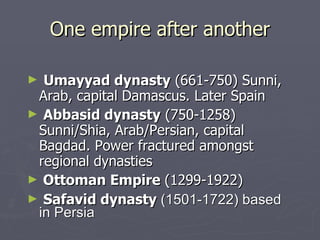
One empire after another Umayyad dynasty  (661-750) Sunni, Arab, capital Damascus. Later Spain Abbasid dynasty  (750-1258) Sunni/Shia, Arab/Persian, capital Bagdad. Power fractured amongst regional dynasties Ottoman Empire  (1299-1922) Safavid dynasty  (1501-1722) based in Persia
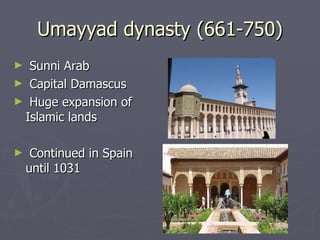
Umayyad dynasty (661-750) Sunni Arab Capital Damascus Huge expansion of Islamic lands Continued in Spain until 1031
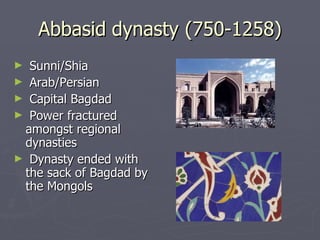
Abbasid   dynasty (750-1258) Sunni/Shia Arab/Persian Capital Bagdad Power fractured amongst regional dynasties Dynasty ended with the sack of Bagdad by the Mongols

Israel and Palestine conflict powerpoint

  • 1.
    Background to theProblem of Israel and Palestine
  • 2.
    God’s covenant withAbraham “ You shall be the father of many nations” “ I will establish my covenant between me and you and your descendants for ever” “ I will give to you, and to your descendants, all the land of Canaan, for an everlasting possession; and I will be their God” Genesis 17:4-8
  • 3.
    Questions Who arethe descendants of Abraham? What is the land of Canaan? To whom should the land belong? What authority does such a promise made 4000 years ago have today?
  • 4.
  • 5.
    Abraham and IshmaelGod promised Abraham he would have a son But Sarah his wife was 77 years old So Sarah suggested to Abraham that he have a son through her maid Hagar Sarah presenting Hagar to Abraham
  • 6.
    Abraham’s family AbrahamHagar Sarah Ishmael
  • 7.
    Abraham and Isaac13 years later God spoke to Abraham: “ I will bless Sarah and I will give you a son by her; and she shall be a mother of nations; kings of peoples shall come from her.” Genesis 17:16 An angel speaks to Abraham
  • 8.
    Abraham’s family AbrahamHagar Sarah Ishmael Isaac “ Sarah said to Abraham, ‘Cast out this slave woman with her son; for the son of this slave woman shall not be the heir with my son Isaac.’” Genesis 21:10
  • 9.
    God’s promises aboutIshmael “ I will bless [Ishmael] and make him fruitful and he shall be the father of 12 princes and I will make him a great nation. But I will establish my covenant with Isaac.” Genesis 17:20-21 Abraham sending Hagar and Ishmael away
  • 10.
    Abraham offers hisson God told Abraham to offer his son as a burnt offering on Mount Moriah The Bible says this son was Isaac Muslims believe it was Ishmael Jacob had his dream of the ladder going up to heaven on this rock The Rock
  • 11.
    Holy site forJews and Muslims On this rock the Jewish Temple was built Muslims believe that on his Night Journey Muhammad went to visit heaven from this rock Now it is covered by the Dome of the Rock shrine Model of Solomon’s Temple Dome of the Rock
  • 12.
    Building the Ka’abaLater Abraham and Ishmael built the Ka’aba, the first house for the worship of God ‘ As Abraham raised the foundations of the shrine, together with Ishmael (they prayed): “Our Lord, accept this from us. You are the Hearer, the Omniscient.”’ Qu’ran 2:127 Ishmael and Abraham pray after building the Ka’aba
  • 13.
    Muhammad and theKa’aba Muhammad helped to rebuild the Ka’aba In 630 Muhammad cleared the Ka’aba of its idols It is an obligation for Muslims to go on Hajj once in their lifetime if they can afford it Muhammad praying at Ka’aba Pilgrims circling the Ka’aba
  • 14.
    Abraham’s descendants AbrahamHagar Sarah Ishmael Isaac Arab nation Muhammad Islam Jewish people Judaism Christianity Jesus
  • 15.
    Into and outof Egypt Jacob’s family move to Egypt Exodus Hebrews led by Moses return to Canaan
  • 16.
    12 tribes ofIsrael settle in Canaan
  • 17.
    The Israelite kingdomKing David ruled Israel from 990 BCE to 968 BCE His son King Solomon expanded the kingdom 931 BCE - kingdom split into Judah (south) and Israel (north) 722 BCE - Assyria destroyed the northern kingdom of Israel
  • 18.
    One empire afteranother Babylonian Empire 600 BCE Persian Empire 539 BCE Greek Empire 333 BCE Roman Empire 63 BCE
  • 19.
    Israel under RomeKing Herod appointed king of Israel by Rome from 40 BCE to 4 BCE After Herod’s death kingdom divided Jesus 4 BCE – 30 CE
  • 20.
    Jesus crucified inJerusalem Jesus was tried and put to death in Jerusalem Many Christian holy sites Church of the Holy Sepulchre Tomb of the Virgin Mary
  • 21.
    Destruction of Jerusalemand Israel First Jewish revolt against Roman rule Destruction of Jerusalem and the Temple 70 CE Second Jewish revolt 132-135 CE 500,000 Jews killed, 985 villages destroyed Jews forbidden to live in Jerusalem Judea renamed Palaestina Arch of Titus in Rome
  • 22.
  • 23.
    Byzantine Holy LandEmperor Constantine supported Christianity Empress Helena started building of many churches Pilgrimages to Holy Land and Jerusalem developed Church of the Annunciation Nazareth The Basillica in Bethlehem
  • 24.
    Rise of IslamMuhammad “the Seal of the Prophets” born 570 Islam the heir of the promises given to Abraham, Moses and Jesus Jihad to establish Muslim hegemony to facilitate the spread of Islam Muhammad preaching in Makkah
  • 25.
    Conquest of theHoly land Caliph Umar conquored Palestine & Jerusalem from Byzantines in 638 Al-Aksa Mosque built 674 Dome of the Rock built in 687 Jewish and Christian pilgrims allowed to freely visit holy sites Caliph Umar enters Jerusalem
  • 26.
    Expansion of theIslamic Empire
  • 27.
    New rulers, newpolicies Fatimid dynasty established in Egypt in 969 Caliph Al-Hakim bi-Amr destroyed Church of the Holy Sepulchre in 1009 Seljuk Turks defeated Byzantines at Battle of Manzikert in 1071 and seized Anatolia Christian pilgrim routes threatened Crusade to retake Jerusalem and protect pilgrims preached by Pope Urban II in 1095
  • 28.
    The Crusades Therewere 9 Crusades Jerusalem captured in 1099 and its population massacred Saladin recaptured Jerusalem in 1187 Crusader rule in Syria ended 1291 Constantinople conquered by Ottomans in 1453
  • 29.
    Ottoman Empire (1299 - 1923) Ottoman Empire expanded into Europe until defeated at 2 nd siege of Vienna 1683
  • 30.
  • 31.
    Anti-Semitism or JudeophobiaForced conversion and baptism Compulsory Christian sermons in synagogues Public disputations Burning of Jewish books Forced into ghettos Restrictions on professions Expulsions and slaughter Genocide Holocaust denial
  • 32.
  • 33.
    Growth of Jewishcommunity in the Land of Israel Jews always lived in the Land of Israel Return to Jerusalem and Israel a constant theme in Judaism Jews often emigrated there in Middle Ages Jewish philanthropists sponsored agricultural settlements in 19th century Mikveh Israel agricultural school 1870 Petah Tiqwa founded 1880
  • 34.
    Growth of ZionismMovement to support a Jewish homeland in the Biblical Land of Israel Response to rampant anti-Semitism of 19th century Europe Russian pogroms and expulsions of 1880s Dreyfus Affair in France in 1890s Persecution 1930s and Holocaust 1940s Secular but with religious roots Desire for a refuge from persecution Desire to be self-governing independent nation 1st Zionist Congress 1897
  • 35.
    World War IAllies Britain France Russia USA Central Powers Germany Austria-Hungary Turkey/Ottoman Empire
  • 36.
    Sykes-Picot Agreement 1915-16The British and French signed a secret agreement on post-WW I spheres of influence Fixed the southern border of Israel
  • 37.
    Britain’s agreement withthe Arabs In 1916 Britain promised the Sharif of Mecca it would support Arab independence if they revolted against the Ottomans except in these areas: The districts of Mersin and Alexandretta, and portions of Syria lying to the west of the districts of Damascus, Homs, Hama and Aleppo, cannot be said to be purely Arab, and must on that account be excepted from the proposed delimitation. Sir Henry MacMahon 1915
  • 38.
    Did this includePalestine? Did the area to be excluded from Arab control include the Sanjak of Jerusalem and the Vilayet of Beirut, in other words Palestine? The Arabs said “No” The British in 1922 said “Yes”
  • 39.
    Balfour Declaration 1917"His Majesty's Government view with favour the establishment in Palestine of a national home for the Jewish people , and will use their best endeavours to facilitate the achievement of this object, it being clearly understood that nothing shall be done which may prejudice the civil and religious rights of existing non-Jewish communities in Palestine , or the rights and political status enjoyed by Jews in any other country."
  • 40.
    British Mandate Britaingiven control of Palestine by Versailles Conference in 1919 Faisal-Weizmann Agreement signed In 1920 the League of Nations gave Britain the mandate to administer Palestine and establish a Jewish homeland
  • 41.
    Separation of Palestinefrom Jordan In 1921 Britain stopped Jewish settlement in Transjordan and gave the territory to Emir Abdullah who later became the first King of Jordan
  • 42.
    Rise of Palestiniannationalism Muhammad Amin al-Husseini, a convicted anti-Jewish rioter, made Grand Mufti despite opposition of Muslim High Council in 1922 He eliminated Arabs who opposed him and who wanted to cooperate with Jews Instigated Arab revolts in 1920, 1927, 1936 Poisoned Jewish – Palestinian relations until today
  • 43.
    Muhammad Amin al-HusseiniHe stayed with Hitler during WW2 and encouraged the Holocaust: “ The Mufti was one of the initiators of the systematic extermination of European Jewry and had been a collaborator and adviser of Eichmann and Himmler in the execution of this plan. ... He was one of Eichmann's best friends and had constantly incited him to accelerate the extermination measures.” Eichmann's deputy Dieter Wisliceny at Nuremburg Trials Yasser Arafat was Husseini’s nephew
  • 44.
    Between a rockand a hard place Jews wanted unlimited emigration to Palestine to escape persecution in Europe and verbally and violently rejected British attempts to limit immigration Arabs opposed Jewish immigration as they saw it would lead to a Jewish majority and the loss of their country. So they verbally and violently attacked Britain for allowing it
  • 45.
    Inconsistent British policyBritish Zionists versus British Arabists Arabists – Jewish emigration wrong: threatened British interests in Arab world namely oil & India Zionists – Supported Jewish emigration due to mandate obligations and for humanitarian and sometimes religious reasons British policy fluctuated, giving in to the community which used the most violence
  • 46.
    The demography ofJerusalem Jerusalem: Jewish, Muslim, and Christian Population (1910-2000)
  • 47.
    The demography ofPalestine Mandate Palestine: Arab / Jewish Population (1914 - 1946)
  • 48.
    The demography ofIsrael Israel: Jewish / Arab Population (1949-2003)
  • 49.
  • 50.
  • 51.
    Extent of theHolocaust 72 5,978,000 8,301,000 Total 60 313,000 522,000 Others 60 90,000 150,000 Holland 90 135,000 150,000 Lithuania 81 171,000 210,000 Germany 30 90,000 300,000 France 82 260,000 315,000 Czechoslovakia 50 200,000 404,000 Hungary 50 425,000 850,000 Romania 71 1,500,000 2,100,000 Soviet Union 85 2,800,000 3,300,000 Poland Percentage of Jews murdered Number Jews murdered Jewish pop. Sept. 1939 Country
  • 52.
  • 53.
    UN partition planof 1947 2 state solution with Jerusalem under international control Most Jews accepted the plan Arab leadership in and out of Palestine rejected the plan Britain refused to implement the plan and ended mandate on 15 th May 1948
  • 54.
    Arab-Israeli war of1948 April 9 th Deir Yassin massacre of 107 Arabs prompted many Arab villagers to flee April 13 th Jewish medical convoy attacked killing 77 medical staff and civilians May 14 th Israel declaration of independence May 15 th Arab declaration to create a United State of Palestine Israel invaded by 5 Arab armies
  • 55.
    After the 1949armistice The territory of the State of Israel proposed by the UN in 1947 Territory conquered by Israel 1948-49 New frontier agreed in 1949 armistice West Bank annexed by Jordan in 1950
  • 56.
    Refugees, refugees 600,000Jews expelled/encouraged to leave Iraq, Syria, Lebanon, Libya, Egypt etc. They left behind houses, businesses, possessions They fled to Israel where they settled 720,000 Palestinians fled to Egypt, Jordan, Lebanon, West Bank, Gaza They were not given citizenship but kept in refugee camps until today
  • 57.
    Palestinian refugees 1948“ The Arab States encouraged the Palestine Arabs to leave their homes temporarily in order to be out of the way of the Arab invasion armies,” Jordanian newspaper Filastin (February 19, 1949)
  • 58.
    Refugee problem perpetuatedEgypt, Syria, Lebanon, Iraq, Saudi Arabia all refuse to grant citizenship to Palestinians or allow them to settle or take up employment Only Jordan welcomed Palestinians and granted them citizenship on the basis that Jordanians and Palestinians were both Arabs In 1952 the UN set up a $200m fund to resettle the refugees but it was left untouched
  • 59.
    Insistence on a‘right of return’ “Any discussion aimed at a solution of the Palestine problem which will not be based on ensuring the refugees' right to annihilate Israel will be regarded as a desecration of the Arab people and an act of treason.” Resolution passed at the Refugee Conference at Homs, Syria in 1957
  • 60.
    Jewish refugees 1948In 1948 800,000 Jews were encouraged or forced to leave Muslim countries where their ancestors had lived for up to 2500 years. Their possessions were seized without compensation. About 600,000 settled in Israel and were given citizenship. Another 300,000 sought refuge elsewhere. 20,800 1,002,270 Total 100 23,270 Ethiopia 200 63,000 Yemen 300 2,000 Pakistan 2 5,000 Afghanistan 12,500 100,000 Iran 100 150,000 Iraq 200 30,000 Syria 0 6,000 Lebanon 200 75,000 Egypt 0 38,000 Libya 1,300 105,000 Tunisia 100 140,000 Algeria 5,800 265,000 Morocco Jewish population Jewish population Country 2000 1948
  • 61.
    Lead up tothe war of 1967 18 th May Egypt asked UN peacekeepers to be removed from Sinai Sinai remilitarized by Egypt 22 nd May Straits of Tiran closed to Israeli shipping 30 th May Egypt, Jordan & Syria sign military pact Other Arab countries mobilise armies
  • 62.
    Arab declarations ofintent "If Israel embarks on an aggression against Syria or Egypt...The battle will be a general one and our basic objective will be to destroy Israel." President Nasser of Egypt 26 th May 1967 "The existence of Israel is an error which must be rectified. This is our opportunity to wipe out the ignominy which has been with us since 1948. Our goal is clear - to wipe Israel off the map." President Aref of Iraq 4 th June 1967
  • 63.
    Six-Day War 5th June Israel launches pre-emptive strike against Egypt & Syria 5 th June Jordan attacks Israel 7 th June Israel occupies Old City and West Bank 10 th June Israel captures Golan Heights 11 th June ceasefire signed
  • 64.
    Khartoum Resolution OnSeptember 1 st 1967 8 Arab countries met and declared: No peace with Israel No recognition of Israel No negotiations with Israel
  • 65.
    Expansion of Jewishpopulation in occupied territories Initially few settlements as Israel hoped to return captured land in exchange for peace No possibility of peace settlements start 1977 Likud government encouraged settlements 177,000 130,000 75,000 9,200 0 300 Parts of Jerusalem annexed in 1967 0 8,000 4,800 900 700 0 30 Gaza Strip 231,800 111,600 22,800 800 0 480 West Bank (excl. Jerusalem) 2005 2004 1993 1983 1972 1966 1948 Jewish population
  • 66.
    Settlements Communities builtby Israel in areas captured during Six-Day War: West Bank East Jerusalem Gaza Golan Heights Sinai Declared illegal by UN resolutions Israel claims they are legal Ma ' ale Levona settlement
  • 67.
    Settlements Settlements nowoccupy 50% of Palestinian land Method of taking control of land often violated due process and natural justice Palestinians’ human rights violated
  • 68.
    1973 Arab-Israeli WarOn Yom Kippur (6 th October) Egypt and Syria launched a surprise attack and made much progress By end of 2 nd week Israel had fought back Israel pushed Syria out of Golan Heights and counter-attacked Egypt in Sinai 24 th October ceasefire and disengagement talks
  • 69.
    Camp David AccordsNovember 1977 President Sadat travels to Israel Camp David talks in 1978 mediated by President Carter Israel-Egypt Peace Treaty 1979 US financial support for Egypt and Israel Arab world disunited Sadat assassinated 1981 President Sadat arrives in Israel Sadat, Carter and Begin
  • 70.
    1st Intifada 1987-1993
  • 71.
    Causes of Intifada1987-1993 Growing Palestinian frustration at lack of progress towards a settlement Lack of support from Egypt or Jordan Worsening Israeli oppression Jewish settlements increasing Growing population and unemployment Spontaneous uprising led by community councils
  • 72.
    Results of Intifada1,612 Palestinians killed including 241 children. 100s informers killed by militia 160 Israelis killed Embittered Israeli-Palestinian relations Palestinian self-identity strengthened Israel criticised by international community Damaged both economies esp. tourism Led to Madrid Conference and Oslo Accords
  • 73.
    Oslo Accords 1993Israel: Recognised PLO as representative of Palestinians Agreed to withdraw from Gaza and West Bank Agreed to gradual transfer to Palestinian Authority PLO: Recognized right of the State of Israel to exist Renounced terrorism, violence and desire to destroy Israel Rabin, Clinton and Arafat 13 th September 1993 Other Palestinian reactions Hamas, Islamic Jihad & Popular Front rejected Accords as they rejected Israel’s right to exist
  • 74.
    Israel-Jordan Peace Treaty1994 Washington Declaration signed by Rabin, Hussein and Clinton Settled border Normalised relations Jordan’s position as guardian of Muslim Holy Sites in Jerusalem affirmed 1995 Rabin assassinated Rabin, Clinton and Hussein
  • 75.
    Gaza separation barrierBuilt in 1994 by Rabin to "take Gaza out of Tel Aviv” Since 1996 suicide bombers prevented from entering Israel Hamas developed Qassam rockets instead
  • 76.
    Camp David 2000Clinton, Barak and Arafat to negotiate “final status settlement” No agreement reached over 3 issues Territory Jerusalem and the Temple Mount Refugees and the 'right of return' Arafat blamed for failure of the summit
  • 77.
    Second Intifada 2000-2005Sharon visited Temple Mount with approval and agreement of Arafat and other officials Next day riots in Jerusalem and West Bank Some analysts believe the Intifada was pre-planned and orchestrated Sharon visits Temple mount
  • 78.
    Descent into violenceRiots and murders by Palestinians Heavy handed response by Israelis Palestinians smuggle in illegal weapons Suicide bombings of civilians in clubs, hotels, buses, cafes Bus in Jerusalem 2002 Muhammad al-Durrah shot 2000
  • 79.
    Intensification of conflictIDF reoccupies Palestinian areas 150 suicide bombings between 09/00-12/05 “ Battle of Jenin” 2002 52 Palestinians killed 23 Israeli soldiers killed Israel starts to build a separation barrier Area of Jenin where fighting occurred Suicide bombers in Jenin
  • 80.
    Separation Barrier “Fence for Life” movement starts 2001 Prevent terrorists entering Israeli cities Prevent illegal entry by Palestinians Approximately follows 1949 Green Line Not supposed to be a legal border
  • 81.
    Results of thebarrier For: Incidents of terrorism reduced by 90% - 2002-5 Fewer checkpoints, roadblocks and Israeli incursions Economic growth in West Bank and Israel Against: Most of the barrier is built illegally on Palestinian land Severed Palestinian communities and access to services, livelihoods and religious and cultural amenities Destruction of trees and loss of agricultural land Alleged to be attempt to annex Palestinian land and to pre-empt final status negotiations
  • 82.
    Road Map forPeace Proposed 2002 by ‘Quartet’ of UN, US, EU and Russia - April 2003 Goal: An independent Palestinian state living side by side in peace with the State of Israel Abbas, Bush and Sharon at Red Sea Summit in Aqaba, Jordan June 4 2003
  • 83.
    Phase 1 Endto Palestinian violence Suicide bombings and missile attacks continue Palestinian political reform Prime Minister appointed Israeli withdrawal and freeze on settlement expansion Israel leaves Bethlehem (2003), unilaterally leaves Gaza (2005) and closes some settlements in West Bank Palestinian elections Mahmoud Abbas elected President January 2005 Hamas win parliamentary elections January 2006
  • 84.
    Phase 2 InternationalConference to support Palestinian economic recovery and launch a process, leading to establishment of an independent Palestinian state with provisional borders Revival of multilateral engagement on issues including regional water resources, environment, economic development, refugees, and arms control issues Arab states restore pre-Intifada links to Israel (trade offices, etc.)
  • 85.
    Hostilities resume 2006The “Road Map for Peace” broke down Hamas elected in Palestine on platform of destroying the State of Israel Hizbollah attacks Israel as part of its goal of eliminating Israel Iran declares that it will eliminate Israel
  • 86.
    What is required?A Spiritual Road Map for Peace
  • 87.
  • 88.
  • 89.
    Development of Judeophobicmythology Antiquity – Jews accused of being: Lepars Misogynists Lazy Middle Ages – Jews accused of being: God - killers Drinkers of Christian blood Partners of Satan Modern – Jews accused of: Trying to take over the world Racial pollution Money grabbers
  • 90.
    Lebanon In 1970PLO expelled from Jordan and moved to Lebanon PLO attacked Israel from Lebanon Delicate Christian-Muslim balance upset and led to Lebanese civil war in 1975 Syria sent in peace-keeping force which sided with the Muslims PLO controlled South Lebanon
  • 91.
    Sunni-Shia division Disagreementabout who should have inherited authority and leadership Shia believed ruler should be from family of the Prophet. Mostly in Persia/Iran & Iraq Sunni believed ruler could be any qualified person. Arabs and most Muslim countries Some differences in practice and belief
  • 92.
    One empire afteranother Umayyad dynasty (661-750) Sunni, Arab, capital Damascus. Later Spain Abbasid dynasty (750-1258) Sunni/Shia, Arab/Persian, capital Bagdad. Power fractured amongst regional dynasties Ottoman Empire (1299-1922) Safavid dynasty (1501-1722) based in Persia
  • 93.
    Umayyad dynasty (661-750)Sunni Arab Capital Damascus Huge expansion of Islamic lands Continued in Spain until 1031
  • 94.
    Abbasid dynasty (750-1258) Sunni/Shia Arab/Persian Capital Bagdad Power fractured amongst regional dynasties Dynasty ended with the sack of Bagdad by the Mongols

Editor's Notes

  • #3 4000 years ago. Accepted by Jews, Christians and Muslims
  • #8 Abraham 99 years old and Sarah 90 years old
  • #12 The reason for the Muslim veneration of this particular site: Qu’ran links the Prophet Muhammad with Jerusalem and the Temple Mount. The 17th Sura, entitled 'The Night Journey', relates that Muhammad was carried by night ' from the sacred temple to the temple that is most remote, whose precinct we have blessed, that we might show him our signs...' Muslim belief identifies the two temples as being in Mecca and Jerusalem. According to tradition, Muhammad's mystic night journey was in the company of the Archangel Gabriel, and they rode on a winged steed called El Burak (meaning `lightning'), which according to Islamic Hadith tradition was a winged, horse-like creature that was "smaller than a mule, but larger than a donkey." Stopping briefly at Mt. Sinai and Bethlehem, they finally alighted at Temple Mount in Jerusalem, and there encountered Abraham, Moses, Jesus and other prophets, whom Muhammad led in prayers. Gabriel then escorted Muhammad to the pinnacle of the rock, which the Arabs call as-Sakhra , where a ladder of golden light materialized. On this glittering shaft, Muhammad ascended through the 7 heavens into the presence of Allah, from whom he received instructions for himself and his followers. Following his divine meeting, Muhammad was flown back to Mecca by Gabriel and the winged horse, arriving there before dawn. At this hallowed site, known in Arabic as Haram al Sharif , the 9th Caliph, Abd al-Malik, built the great Dome of the Rock between 687 and 691. Often incorrectly called the Mosque of Umar, the Dome of the Rock, known in Arabic as Qubbat As-Sakhrah , is not a mosque for public worship but rather a mashhad , a shrine for pilgrims. Adjacent to the Dome is the Al-Aqsa Mosque wherein Muslims make their prayers.
  • #19 First Diaspora. Jews settled throughout Babylonian, Persian, Roman empires. Jews settled in Babylon (Iraq) up until today. Emperor Pompey conquered Jerusalem in 63 BC. Jews made up 10% of the population of the Roman Empire
  • #22 Picture – relief from Arch of Titus in Rome built to celebrate Titus’ conquest of Judea 66-70
  • #25 Muhammad saw himself as the successor to Abraham, Moses, David and Jesus and the inheritor of their legacy and position. Thus he expected Jews and Christians to recognise the legitimacy of his revelation and authority as a prophet. By building the Dome of the Rock Muslims were claiming the legacy of Abraham and the Temple. The Qu’ran teaches Muslims to respect Jews and Christians and their scriptures Ibn Khaldun, the greatest of all Islamic historians and a key witness from the period just after the Crusades, compares Islam with Christianity and Judaism in this respect: In the Muslim community, the holy war is a religious duty, because of the universalism of the Muslim mission and the obligation to convert everybody to Islam either by persuasion or force . . . The other religious groups did not have a universal mission, and the holy war was not a religious duty to them, save only for purposes of defence.
  • #27 Spain invaded in 711. Muslim expansion into Europe halted in 732 at the Battle of Tours by Charles Martel Huge expansion in very short time. Pressure on Europe from east and west. Jihad for 1000 years until temporary stop after defeat at gates of Vienna in 1683 Muslim sharia law has concept of waqf – any land conquered by Muslims has been consecrated as belonging to all future generations of Muslims until day of resurrection and can never be relinquished.
  • #28 Fatimid caliphs were Ismailis opposed by Sunnis in Baghdad. Al-Hakim bi-Amr was regarded as mad – (totally in MHO) His followers thought he was the incarnation of God. After he disappeared proclaimed founder of Druze religion The Fatimids, however, were the heads of a rival religious movement—the Isma'ili sect of the Shi'i branch—and dedicated to the overthrow of the existing religious and political order in all Islam. Unlike their predecessors, they refused to offer even nominal recognition to the 'Abbasid caliphs, whom they rejected as usurpers. They themselves—as Isma'ili imam s (spiritual leaders), descendants of the Prophet through his daughter Fatimah and his kinsman 'Ali—were, in the eyes of their followers, the rightful caliphs, both by descent and by divine choice the custodians of the true faith and the legitimate heads of the universal Islamic state and community.
  • #30 Ottoman expansion into Europe for 300 years. 1683 Ottomans besieged Vienna for 2 nd time – a long term target for conquest. Many countries answered Pope’s call to defend Christian Europe. Holy League led by King Sobieski of Poland defeated Ottomans. (French didn’t help but attacked the Germans from the rear)
  • #32 Root of hatred of Jews is envy and thus ultimately irrational. Better to say judeophobia, Judeophobia is: Oldest hatred Universal Permanent Deep Obsessive Dangerous Based on fantasy Sermons 820 – 1850 Disputations – forced to defend their faith in set piece ‘dialogues’ Book burning 1236 - Last burning of Talmud 1757 in Poland Ghettos 1516 (Venice) – 1796 Expulsions 1290 – No matter how intently and desperately individual Jews tried to de-emphasize these confrontational aspects of their religion, and sought to identify themselves with the imperial powers and their values, the spirit of independence and freedom made the Jews the most rebellious People of the ancient world. The Jews were the group that rebelled against Hellenistic and then Roman rule with greater ferocity and tenacity than any other. Jews differed from other people precisely because they followed norms that seemed subversive to the established order. Jews seemed unwilling to accept "reality" and subordinate themselves to imperial powers. This made them seem threatening to the ruling elites, who sought to make their subjects distrust Jews before they got too friendly with them and heard the Jews' ideals of egalitarian society. Maurice Samuel wrote a series of books between 1924 and 1950 in which Judeophobia is not a Jewish problem, but an affliction of the Gentiles to which Jews had to accustom themselves. Western man hates the Jew because he is the jailer who had bound the world with fetters of moral law. This is "the great hatred" in the amoral pagan soul. A not very different position was taken by Prager and Telushkin in their 1983- Why the Jews? where the higher quality of Jewish life arouses continuous and uncompromising envy of the non-Jewish world. Eliane Amado Levy-Valensi offered her interpretation during the 1960s: Judeophobia is the result of the Gentiles' failure in stealing Jewish history for themselves. "Judaism was already an ancient religion, possessed of a great literature, with great heroes and wise men in its past, and a divine promise of an even more glorious future. Christianity possessed none of these. From the very outset, therefore, the Christians laid claim to the Bible, at first merely as predicting Jesus and later as being exclusively their own." Also the plight of the Palestinians could be explained from the same perspective. Even Jesus is presented by them as "a Palestinian." The lack of a long history of their own, brings other peoples to hate Jewish ownership of a past.
  • #34 Jews generally settled where Arabs didn’t live. Jews attitude to Arabs was arrogant and overbearing.
  • #37 Break up of Ottoman Empire. Agreement negotiated in November 1915 and signed May 16 1916.
  • #38 24 October 1915. MacMahon was British High Commissioner in Egypt. He was not aware of Sykes-Picot agreement. Agreement made with Hussein ibn Ali, Sahrif of Mecca
  • #40 The conflicting agreements are partly the result of changing progress during the war, switching in the earlier correspondence from needing Arab help to subsequently trying to enlist the help of Jews in the United States in getting the US to join the First World War , in conjunction with the Balfour Declaration, 1917 .
  • #41 Faisal-Weizmann Agreement was signed on January 3 , 1919 . The agreement committed both parties to conducting all relations between the groups by the most cordial goodwill and understanding, to work together to encourage immigration of Jews into Palestine on a large scale while protecting the rights of the Arab peasants and tenant farmers, and to safeguard the free practice of religious observances. The Muslim Holy Places were to be under Muslim control. The Zionist movement undertook to assist the Arab residents of Palestine and the future Arab state to develop their natural resources and establish a growing economy. Early on seemed to have been real possibility of Jews being welcomed by Arabs. British contributed to bad feeling
  • #42 Due to Arab unhappiness at idea of Jewish homeland Britain restricted Jewish immigration to Palestine and set up beginning of Hashemite Kingdom. Zionists not happy as regarded whole area as future Jewish homeland
  • #43 Amin al-Husseini studied religious law at al-Azhar University, Cairo, and attended the Istanbul School of Administration. In 1913 he went to Mecca on a pilgrimage, earning the honorary title of "Hajji". He voluntarily joined the Ottoman Turkish army in World War I but returned to Jerusalem in 1917 and expediently switched sides to aid the victorious British. He acquired the reputation as a violent, fanatical anti-Zionist zealot and was jailed by the British for instigating a 1920 Arab attack against Jews who were praying at the Western Wall. The first Palestine High Commissioner. Sir Herbert Samuel arrived in Palestine on July 1, 1920. He was a weak administrator who was too ready to compromise and appease the extremist, nationalistic Arab minority led by Haj Amin al-Husseini. When the existing Arab Mufti of Jerusalem (religious leader) died in 1921, Samuels was influenced by anti-Zionist British officials on his staff. He pardoned al-Husseini and, in January 1922, appointed him as the new Mufti, and even invented a new title of Grand Mufti. He was simultaneously made President of a newly created Supreme Muslim Council. Al-Husseini thereby became the religious and political leader of the Arabs. The appointment of the young al-Husseini as Mufti was a seminal event. Prior to his rise to power, there were active Arab factions supporting cooperative development of Palestine involving Arabs and Jews. But al-Husseini would have none of that; he was devoted to driving Jews out of Palestine, without compromise, even if it set back the Arabs 1000 years. Al-Husseini represented newly emerging proponents of militant, Palestinian Arab nationalism, a previously unknown concept. Once he was in power, he began a campaign of terror and intimidation against anyone opposed to his rule and policies. He killed Jews at every opportunity, but also eliminated Arabs who did not support his campaign of violence. Husseini was not willing to negotiate or make any kind of compromise for the sake of peace. According to documentation from the Nuremberg and Eichmann trials, the Nazi Germany SS helped finance al-Husseini's efforts in the 1936-39 revolt in Palestine. Adolf Eichmann actually visited Palestine and met with al-Husseini at that time and subsequently maintained regular contact with him later in Berlin. In 1940, al-Husseini requested the Axis powers to acknowledge the Arab right: ... to settle the question of Jewish elements in Palestine and other Arab countries in accordance with the national and racial interests of the Arabs and along the lines similar to those used to solve the Jewish question in Germany and Italy. While in Baghdad, Syria al-Husseini aided the pro-Nazi revolt of 1941. He then spent the rest of World War II as Hitler's special guest in Berlin , advocating the extermination of Jews in radio broadcasts back to the Middle East and recruiting Balkan Muslims for infamous SS "mountain divisions" that tried to wipe out Jewish communities throughout the region. At the Nuremberg Trials, Eichmann's deputy Dieter Wisliceny (subsequently executed as a war criminal) testified: The Mufti was one of the initiators of the systematic extermination of European Jewry and had been a collaborator and adviser of Eichmann and Himmler in the execution of this plan. ... He was one of Eichmann's best friends and had constantly incited him to accelerate the extermination measures. I heard him say, accompanied by Eichmann, he had visited incognito the gas chamber of Auschwitz. From Egypt al-Husseini was among the sponsors of the 1948 war against the new State of Israel . Spurned by the Jordanian monarch, who gave the position of Grand Mufti of Jerusalem to someone else, Haj Amin al-Husseini arranged King Abdullah's assassination in 1951 , while still living in exile in Egypt. King Tallal followed Abdullah as king of Jordan, and he refused to give permission to Amin al-Husseini to come into Jordanian Jerusalem. After one year, King Tallal was declared incompetent; the new King Hussein also refused to give al-Husseini permission to enter Jerusalem. King Hussein recognized that the former Grand Mufti would only stir up trouble and was a danger to peace in the region.
  • #45 British practiced divide and rule and didn’t try to bring the Jews and Arabs together
  • #46 Winston Churchill was a prominent Zionist
  • #47 Always been Jewish people living in area especially in Jerusalem.
  • #50 After
  • #51 After Hitler came to power many Jews left Germany
  • #52 Source: Cited in Landau, The Nazi Holocaust, Chicago: Ivan R. Dee, 1994. These data originally appeared in Poliakov and Wulf (eds), Das Dritte Reich und die Juden: Documente und Aufsatze (Arani Verlag, GmbH, Berlin, 1955)
  • #53 After the Holocaust many Jews wanted to go to Israel. They were not welcome and had no desire to go back to their homes which had often been confiscated and the new inhabitants would not give them back.
  • #54 Important point. Palestine had already been divided into 2. The East Bank - Jordan - was for Palestinan Arabs.
  • #55 The April 9 Deir Yassin massacre , by Irgun and Lehi forces, of at least 107 Arabs was denounced by Ben Gurion .
  • #56 The 1949 border is result of armistice - not a border fixed by treaty
  • #57 Many leaders on both sides Arab and Israeli saw in terms of population exchange as happened between Greece and Turkey in 1920s and India and Pakistan in 1947.
  • #58 Grand mufti also encouraged Palestinians to leave so wouldn’t be in the way during battle. Jews tried to persuade Arabs to stay
  • #61 Around 758,000 to 866,000 of the Jews living in Arab countries and territories left or were forced to leave their countries of birth; 600,000 of these people fled or emigrated to Israel , with another 300,000 seeking refuge in various Western countries, primarily France .
  • #62 UN peace keepers there after 1956 Suez crisis
  • #69 1967-1973 Soviet Union rearmed Egypt, Syria and Iraq for free as part of their geopolitical strategy. Gave Arabs back self respect. Big shock to Israeli self-esteem
  • #77 Barak offered 94% of territory excl. greater Jerusalem. Wanted road to Dead Sea from Jersualem which Arafat rejected Palestinians offered custodianship over temple mount but demanded sovereignty -> loss of Western Wall Palestinians want right to return to Israel. Israel says should be able to go to Palestine not Israel
  • #79 Actually death of al-Durrah is disputed. Could have been staged.
  • #80 The second largest refugee camp in the West Bank, and lying close to Israeli settlements and the green line , the Jenin camp had come under Palestinian civil and security control in 1995. According to Israeli and Palestinian observers who gave information to the UN, 200 armed men from the Al-Aqsa Martyrs Brigades , Tanzim, Palestinian Islamic Jihad, and Hamas had been using the camp as a base, and of the 100 suicide bombers who had launched attacks since the intifada began in October 2000, 23 [5] or 28 [6] attacks had been launched from the Jenin camp. [7]From the beginning of March until the first week in May 2002, there were approximately 16 bombings in Israel, mostly suicide attacks. More than 100 civilians were killed and scores wounded. 18 Israelis were killed in two separate Palestinian attacks on March 8 and March 9, and a terrorist attack in Netanya killed 30 and injured 140 on March 27. [8]When Jenin came under Palestinian Authority control in 1995 per the Oslo Accords, it was under an agreement to protect Israeli civilians from attacks, including suicide bombings, emanating from areas under its security control. Liberal media claimed a massacre of 100s or 1000s. Led to disbelief in similar Arab claims
  • #81 In June 2001 a grass roots organization called " Fence for Life - The Public Movement for The Security Fence" [11] began the grassroots effort for the construction of a continuous security fence. The movement was founded by people from all over Israel following the Dolphinarium terror attack . Barriers not unusual. Exist is China, N. Ireland, Morocco, India, Cyprus, Saudi Arabia, Spain, Thailand, Korea, USA. They exist for a variety of reasons. Usually to keep undesirables/illegals (for whatever reason) out. Rarely to keep people in - Berlin Wall.
  • #91 PLO tried to take over Jordan and get rid of monarchy
  • #95 Reaction against Arab domination. Appealed to non Arab Muslim converts. Rule by Persian bureaucracy replaced Arab aristocracy. Weakened by decentralising power.