PRESENTED BY;
PRAKASH MANI KUMAR
M.Sc. (Ag.)
(Deptt. of Plant Pathology)
RPCAU, PUSA
REPRODUCTION
IN
PLANT PATHOGENIC FUNGI
Fungi are eukaryotic, spore bearing,
achlorophyllous, heterotrophic organisms
that generally reproduce sexually and
asexually and whose filamentous,
branched somatic structures are typically
surrounded by cell walls containing chitin
or cellulose or both with many organic
molecules and exhibiting absorptive
nutrition.
GENERAL CHARACTERISTICS OF FUNGI
1.Holocarpic (holos=whole+karpos=fruit):
If the thallus is entirely converted into one or more reproductive
structures, such thallus is called holocarpic thallus.
Eg.Synchytrium
2.Eucarpic(Eu=good+karpos=fruit):
If the thallus is differentiated into a vegetative part which absorbs
nutrients and a reproductive part which forms reproductive
structures, such thallus is called eucarpic thallus.
Eg.Pythium
Fungi based on reproductive structures
3.Endophytic fungus:
If the fungus penetrates into the host cell / present inside the host,
it is called endophytic.
Eg. Puccinia sp.
4.Ectophytic fungus:
If the fungal thallus is present on the surface of the host plant, it is
called ectophytic.
Eg. Oidium sp.
Reproduction is the formation of new individuals having all the
characteristics of the species.
Types of reproduction
1. Asexual /non-sexual / vegetative / somatic reproduction
2. Sexual reproduction
REPRODUCTION IN FUNGI
Asexual reproduction stage is also known as imperfect
stage and technically called as anamorphic stage.
It is repeated several times during the life span of a
fungus producing numerous asexual spores.
Hence, it is more important for fungi than sexual
reproduction.
1.ASEXUAL REPRODUCTION :
1. Fragmentation
2. Fission.
3. Budding
4. Sporulation (production of spores)
Methods of asexual reproduction
1. Fragmentation :
It is the most common method. Hypha of fungus
breaks into small pieces, each broken piece is called
a fragment, which function as a propagating unit
and grows into a new mycelium. The spores
produced by fragmentation are called arthrospores
(arthron=joint) (spora=seed) or oidia.
Eg. Geotrichum.
2. Fission / Transverse fission:
The parent cell elongates, nucleus
under go mitotic division and forms
two nuclei, then the contents divide
into equal halves by the formation of a
transverse septum and separates into
two daughter
cells.
Eg.Saccharomyces cerevisiae.
3.Budding:
The spores formed through budding are
called blastospores. The parent cell puts out
initially a small out growth called bud/
blastos ie., sprout .
Later, the bud increases in size and a
constriction is formed at the base of bud,
cutting off completely from parent cell. Bud,
can function as an independent propagating
unit. Sometimes multiple buds are also seen
i.e., bud over bud and looks like
pseudomycelium.
Eg. Saccharomyces cerevisiae
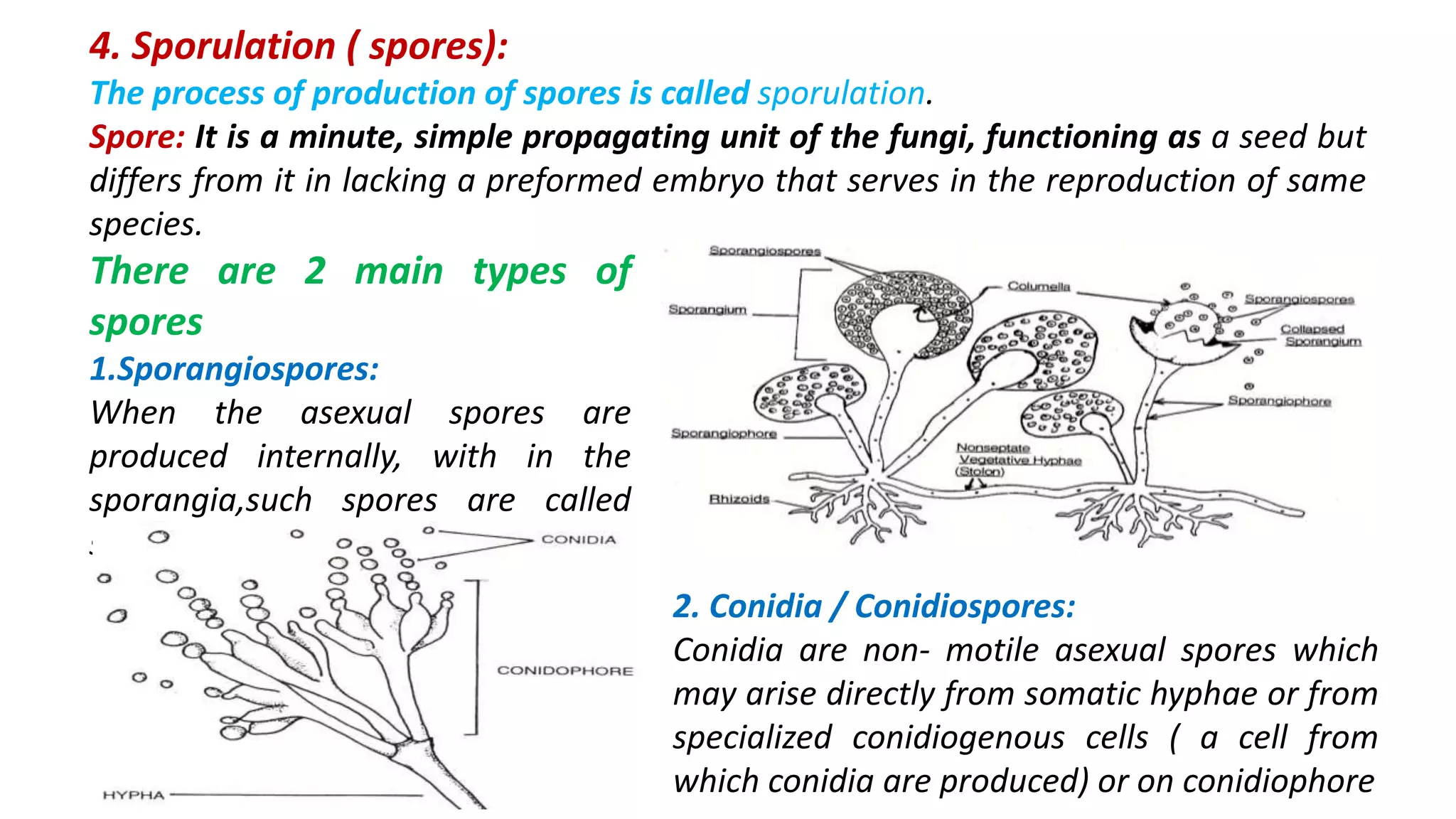
4. Sporulation ( spores):
The process of production of spores is called sporulation.
Spore: It is a minute, simple propagating unit of the fungi, functioning as a seed but
differs from it in lacking a preformed embryo that serves in the reproduction of same
species.
There are 2 main types of
spores
1.Sporangiospores:
When the asexual spores are
produced internally, with in the
sporangia,such spores are called
sporangiospores
2. Conidia / Conidiospores:
Conidia are non- motile asexual spores which
may arise directly from somatic hyphae or from
specialized conidiogenous cells ( a cell from
which conidia are produced) or on conidiophore
 Sexual reproduction involves union of two compatible nuclei or sex cells or
sex organs or somatic cells or somatic hyphae for the formation of new
individuls.
 Sexual stage is perfect stage and technically called as teleomorphic stage.
Sexual cycle normally occurs once in the life span of the fungus
2. SEXUAL REPRODUCTION :
1. Planogametic copulation
1. Gametangial contact
1. Gametangial copulation
4. Spermatisation
4. Somatogamy
Methods of sexual reproduction
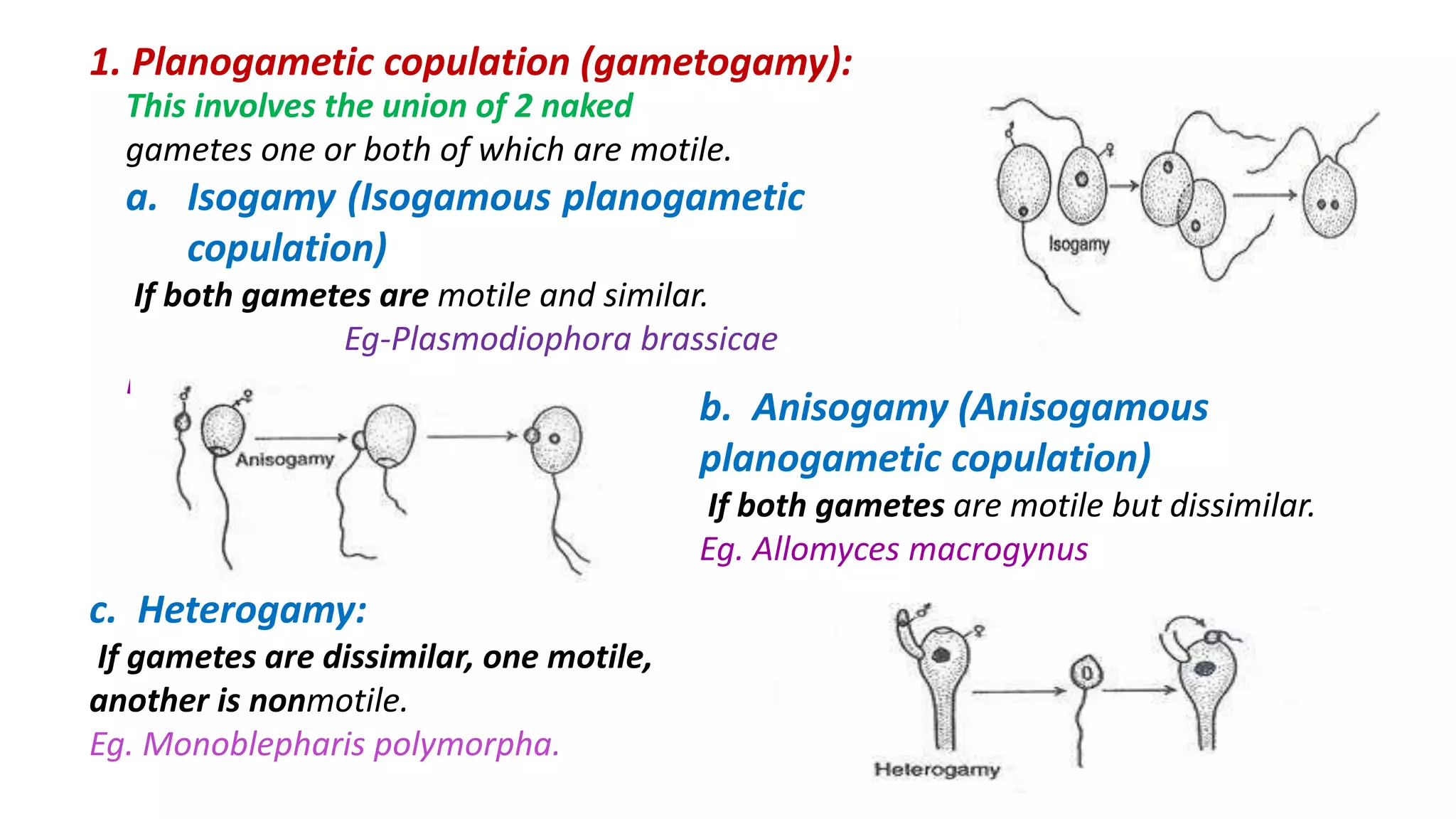
This involves the union of 2 naked
gametes one or both of which are motile.
a. Isogamy (Isogamous planogametic
copulation)
If both gametes are motile and similar.
Eg-Plasmodiophora brassicae
Eg. Plasmodiopassicae.
1. Planogametic copulation (gametogamy):
b. Anisogamy (Anisogamous
planogametic copulation)
If both gametes are motile but dissimilar.
Eg. Allomyces macrogynus
c. Heterogamy:
If gametes are dissimilar, one motile,
another is nonmotile.
Eg. Monoblepharis polymorpha.
Male and female gametangia come in contact
At the place of contact, dissolution of wall
occurs and a fertilization tube is formed. The
contents of male gametangium migrate into
female gametangium through a pore or
fertilization tube developed at the point of
contact.
The gametangia do not loose their identity.
Eg. Pythium aphanidermatum
2.Gametangial contact (gametangy/oogamy):
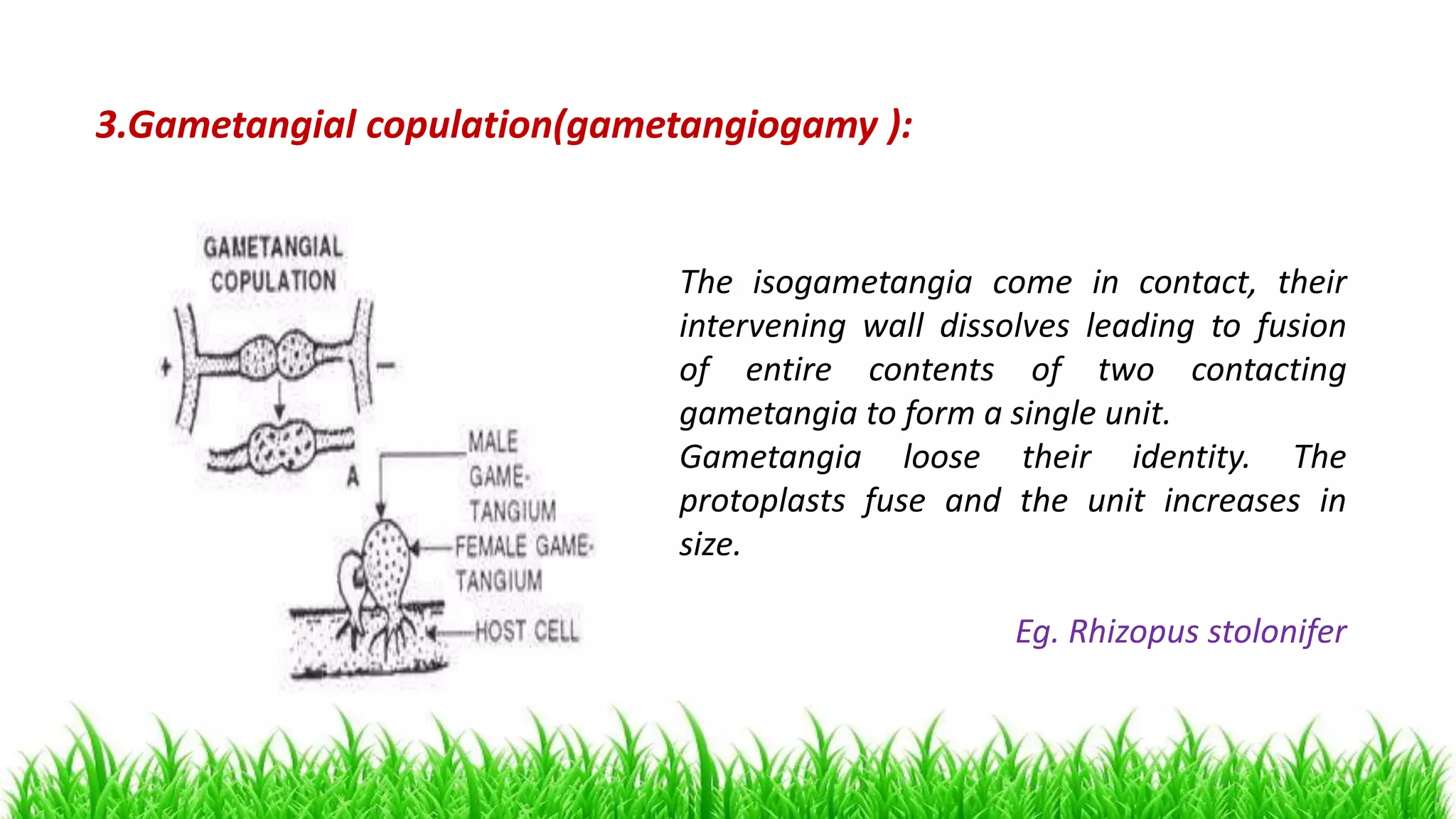
The isogametangia come in contact, their
intervening wall dissolves leading to fusion
of entire contents of two contacting
gametangia to form a single unit.
Gametangia loose their identity. The
protoplasts fuse and the unit increases in
size.
Eg. Rhizopus stolonifer
3.Gametangial copulation(gametangiogamy ):
Minute, uninucleate male cells called as
spermatia which are produced on
spermatiophores in a fruiting body (pycnium)
are carried to female reproductive structures
called receptive hyphae. Spermatia and
receptive hyphae come in contact and contents
of male spermatium migrate into female
receptive hypha, thus making the cell
binucleate. This process is called
dikaryotization.
Eg.Puccinia graminis tritici
4. Spermatization:
Many higher fungi do not produce
sex organs. In such cases
somatogamy takes place.
It is the union of 2 somatic hyphae
or somatic cells representing
opposite sexes to form sexual
spores.
Eg. Agaricus campestris
5. Somatogamy:
REPRODUCTION IN PLANT PATHOGENIC FUNGI

REPRODUCTION IN PLANT PATHOGENIC FUNGI

  • 1.
    PRESENTED BY; PRAKASH MANIKUMAR M.Sc. (Ag.) (Deptt. of Plant Pathology) RPCAU, PUSA REPRODUCTION IN PLANT PATHOGENIC FUNGI
  • 2.
    Fungi are eukaryotic,spore bearing, achlorophyllous, heterotrophic organisms that generally reproduce sexually and asexually and whose filamentous, branched somatic structures are typically surrounded by cell walls containing chitin or cellulose or both with many organic molecules and exhibiting absorptive nutrition. GENERAL CHARACTERISTICS OF FUNGI
  • 3.
    1.Holocarpic (holos=whole+karpos=fruit): If thethallus is entirely converted into one or more reproductive structures, such thallus is called holocarpic thallus. Eg.Synchytrium 2.Eucarpic(Eu=good+karpos=fruit): If the thallus is differentiated into a vegetative part which absorbs nutrients and a reproductive part which forms reproductive structures, such thallus is called eucarpic thallus. Eg.Pythium Fungi based on reproductive structures
  • 4.
    3.Endophytic fungus: If thefungus penetrates into the host cell / present inside the host, it is called endophytic. Eg. Puccinia sp. 4.Ectophytic fungus: If the fungal thallus is present on the surface of the host plant, it is called ectophytic. Eg. Oidium sp.
  • 5.
    Reproduction is theformation of new individuals having all the characteristics of the species. Types of reproduction 1. Asexual /non-sexual / vegetative / somatic reproduction 2. Sexual reproduction REPRODUCTION IN FUNGI
  • 6.
    Asexual reproduction stageis also known as imperfect stage and technically called as anamorphic stage. It is repeated several times during the life span of a fungus producing numerous asexual spores. Hence, it is more important for fungi than sexual reproduction. 1.ASEXUAL REPRODUCTION :
  • 7.
    1. Fragmentation 2. Fission. 3.Budding 4. Sporulation (production of spores) Methods of asexual reproduction 1. Fragmentation : It is the most common method. Hypha of fungus breaks into small pieces, each broken piece is called a fragment, which function as a propagating unit and grows into a new mycelium. The spores produced by fragmentation are called arthrospores (arthron=joint) (spora=seed) or oidia. Eg. Geotrichum.
  • 8.
    2. Fission /Transverse fission: The parent cell elongates, nucleus under go mitotic division and forms two nuclei, then the contents divide into equal halves by the formation of a transverse septum and separates into two daughter cells. Eg.Saccharomyces cerevisiae.
  • 9.
    3.Budding: The spores formedthrough budding are called blastospores. The parent cell puts out initially a small out growth called bud/ blastos ie., sprout . Later, the bud increases in size and a constriction is formed at the base of bud, cutting off completely from parent cell. Bud, can function as an independent propagating unit. Sometimes multiple buds are also seen i.e., bud over bud and looks like pseudomycelium. Eg. Saccharomyces cerevisiae
  • 10.
    4. Sporulation (spores): The process of production of spores is called sporulation. Spore: It is a minute, simple propagating unit of the fungi, functioning as a seed but differs from it in lacking a preformed embryo that serves in the reproduction of same species. There are 2 main types of spores 1.Sporangiospores: When the asexual spores are produced internally, with in the sporangia,such spores are called sporangiospores 2. Conidia / Conidiospores: Conidia are non- motile asexual spores which may arise directly from somatic hyphae or from specialized conidiogenous cells ( a cell from which conidia are produced) or on conidiophore
  • 11.
     Sexual reproductioninvolves union of two compatible nuclei or sex cells or sex organs or somatic cells or somatic hyphae for the formation of new individuls.  Sexual stage is perfect stage and technically called as teleomorphic stage. Sexual cycle normally occurs once in the life span of the fungus 2. SEXUAL REPRODUCTION :
  • 12.
    1. Planogametic copulation 1.Gametangial contact 1. Gametangial copulation 4. Spermatisation 4. Somatogamy Methods of sexual reproduction
  • 13.
    This involves theunion of 2 naked gametes one or both of which are motile. a. Isogamy (Isogamous planogametic copulation) If both gametes are motile and similar. Eg-Plasmodiophora brassicae Eg. Plasmodiopassicae. 1. Planogametic copulation (gametogamy): b. Anisogamy (Anisogamous planogametic copulation) If both gametes are motile but dissimilar. Eg. Allomyces macrogynus c. Heterogamy: If gametes are dissimilar, one motile, another is nonmotile. Eg. Monoblepharis polymorpha.
  • 14.
    Male and femalegametangia come in contact At the place of contact, dissolution of wall occurs and a fertilization tube is formed. The contents of male gametangium migrate into female gametangium through a pore or fertilization tube developed at the point of contact. The gametangia do not loose their identity. Eg. Pythium aphanidermatum 2.Gametangial contact (gametangy/oogamy):
  • 15.
    The isogametangia comein contact, their intervening wall dissolves leading to fusion of entire contents of two contacting gametangia to form a single unit. Gametangia loose their identity. The protoplasts fuse and the unit increases in size. Eg. Rhizopus stolonifer 3.Gametangial copulation(gametangiogamy ):
  • 16.
    Minute, uninucleate malecells called as spermatia which are produced on spermatiophores in a fruiting body (pycnium) are carried to female reproductive structures called receptive hyphae. Spermatia and receptive hyphae come in contact and contents of male spermatium migrate into female receptive hypha, thus making the cell binucleate. This process is called dikaryotization. Eg.Puccinia graminis tritici 4. Spermatization:
  • 17.
    Many higher fungido not produce sex organs. In such cases somatogamy takes place. It is the union of 2 somatic hyphae or somatic cells representing opposite sexes to form sexual spores. Eg. Agaricus campestris 5. Somatogamy: