Back 2The Future Night
What does “study” or
“homework” look like
in an IDEAL WORLD?
Think-Pair-Share
Arguments Against:
 “Quality” time between parents and children
is significantly impacted.
 Questions about the educational merit of
(some) homework tasks.
 When things go wrong the parent-child
relationship is strained; anxiety increases,
and both the educational and family domains
are negatively affected.
Arguments for:
 Consolidates the day’s learning and allows
students to practice key concepts.
 Develops a child’s self-efficacy: their belief
that they are able to perform academic tasks
at a certain level.
 Develops a child’s self-regulatory skills, goal
setting, time management and delaying
gratification.
 Research suggests that:
 There is a weak relationship between homework and
academic achievement in primary school. However, a
longitudinal study ofYear 5 students showed that
completion of homework developed the key skill of
academic self-efficacy which is most important for
secondary education and beyond.
 Academic outcomes improve for secondary students who
complete homework.
 Homework can be very beneficial for students who are
considered at-risk educationally.
 Giving students choice in the homework process increases
their motivation to complete the assigned tasks.
1. Be a Stage Manager
 What type of learner is your child
(Auditory, Kinaesthetic,Visual, Social,Verbal,Solitary)
 Make sure your child has access to an environment
which is conducive to good study.
 Separate (where possible) study and sleep areas.
 Ensure computers are either in an office or in a shared
space in the home.
 Your child should hand in their mobile phone.
 Timetable your child’s life to within an inch of it!
(Routine, Routine, Routine).
2. Be a Motivator:
 Homework provides parents with the
opportunity to communicate to their child
the importance of school.
 The attitude the parent has to homework is
the attitude the child will acquire.
3. Be a Role Model.
 Allow your child to see you doing similar
tasks that they are required to complete
during homework (e.g. Reading, rather than
watchingTV while children are completing
homework).
 Where possible, connect key tasks in the
home with learning undertaken at school.
4. Be a Monitor
 Check your child for signs of failure or
frustration.
 Provide guidance, not answers.
 If things start to go wrong, suggest a break
and come back to it.
5. Be a Mentor:
 If a teacher asks a parent to be involved in the
homework, then it is recommended they do
so.
 If the homework is intended to be completed
alone, parents should leave their child alone.
 The wrong message is received by children
whose parents “solve the problems” and
“provide the answers”. Getting it wrong is just
as important as getting it right.
The Response: “Learning only stops when
you’re unconscious.”
The Practice:
 Primary Students:
- number facts and times tables.
- Household problem-solving.
- Reading aloud.
- Comprehension of text – news, magazine
article.
The Practice:
 Secondary Students:
- Be conversant with the SemesterAssessment
Calendar and request a copy of your child’s
timetable.
- Understand the secondary homework
expectations and challenge your child when
they claim that they have no homework.
- Contact your child’s teacher the very next day
via email.
The Practice:
Secondary Students (Cont...)
- Give your child a newspaper and ask them to provide a written summary of the
day’s news or do some research on a story they were interested in.
- Ask your child to write the next episode of their favouriteTV show – check it for
spelling & punctuation if written or pick up the use of ‘ummmm...’ if oral.*
- Have your child create a series of journal entries based on a character from their
favouriteTV show*
- Read out your shopping list, ask them to record it and check for spelling.*
- Ask your child to estimate the cost of certain shopping items.
- Have them calculate how much of a specific item the family will require based on
the consumption of each member of the household (washing detergent is a good
one here).
- Have your child tell you an impromptu story.
- Ask them to double check addition of receipts and invoices.
*Older children may be able to review, check and correct younger children’s work.
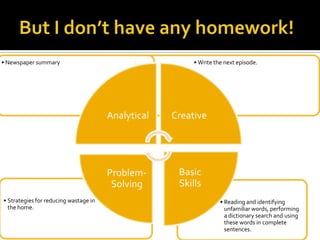
• Reading and identifying
unfamiliar words, performing
a dictionary search and using
these words in complete
sentences.
• Strategies for reducing wastage in
the home.
• Write the next episode.• Newspaper summary
Analytical Creative
Basic
Skills
Problem-
Solving
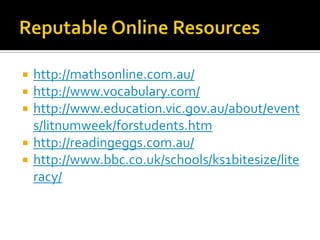
 http://mathsonline.com.au/
 http://www.vocabulary.com/
 http://www.education.vic.gov.au/about/event
s/litnumweek/forstudents.htm
 http://readingeggs.com.au/
 http://www.bbc.co.uk/schools/ks1bitesize/lite
racy/
 http://www.pascalpress.com.au/
 Email michael.mccarth@twb.catholic.edu.au

Study skills & homework

  • 1.
  • 2.
    What does “study”or “homework” look like in an IDEAL WORLD? Think-Pair-Share
  • 3.
    Arguments Against:  “Quality”time between parents and children is significantly impacted.  Questions about the educational merit of (some) homework tasks.  When things go wrong the parent-child relationship is strained; anxiety increases, and both the educational and family domains are negatively affected.
  • 4.
    Arguments for:  Consolidatesthe day’s learning and allows students to practice key concepts.  Develops a child’s self-efficacy: their belief that they are able to perform academic tasks at a certain level.  Develops a child’s self-regulatory skills, goal setting, time management and delaying gratification.
  • 5.
     Research suggeststhat:  There is a weak relationship between homework and academic achievement in primary school. However, a longitudinal study ofYear 5 students showed that completion of homework developed the key skill of academic self-efficacy which is most important for secondary education and beyond.  Academic outcomes improve for secondary students who complete homework.  Homework can be very beneficial for students who are considered at-risk educationally.  Giving students choice in the homework process increases their motivation to complete the assigned tasks.
  • 6.
    1. Be aStage Manager  What type of learner is your child (Auditory, Kinaesthetic,Visual, Social,Verbal,Solitary)  Make sure your child has access to an environment which is conducive to good study.  Separate (where possible) study and sleep areas.  Ensure computers are either in an office or in a shared space in the home.  Your child should hand in their mobile phone.  Timetable your child’s life to within an inch of it! (Routine, Routine, Routine).
  • 7.
    2. Be aMotivator:  Homework provides parents with the opportunity to communicate to their child the importance of school.  The attitude the parent has to homework is the attitude the child will acquire.
  • 8.
    3. Be aRole Model.  Allow your child to see you doing similar tasks that they are required to complete during homework (e.g. Reading, rather than watchingTV while children are completing homework).  Where possible, connect key tasks in the home with learning undertaken at school.
  • 9.
    4. Be aMonitor  Check your child for signs of failure or frustration.  Provide guidance, not answers.  If things start to go wrong, suggest a break and come back to it.
  • 10.
    5. Be aMentor:  If a teacher asks a parent to be involved in the homework, then it is recommended they do so.  If the homework is intended to be completed alone, parents should leave their child alone.  The wrong message is received by children whose parents “solve the problems” and “provide the answers”. Getting it wrong is just as important as getting it right.
  • 11.
    The Response: “Learningonly stops when you’re unconscious.” The Practice:  Primary Students: - number facts and times tables. - Household problem-solving. - Reading aloud. - Comprehension of text – news, magazine article.
  • 12.
    The Practice:  SecondaryStudents: - Be conversant with the SemesterAssessment Calendar and request a copy of your child’s timetable. - Understand the secondary homework expectations and challenge your child when they claim that they have no homework. - Contact your child’s teacher the very next day via email.
  • 13.
    The Practice: Secondary Students(Cont...) - Give your child a newspaper and ask them to provide a written summary of the day’s news or do some research on a story they were interested in. - Ask your child to write the next episode of their favouriteTV show – check it for spelling & punctuation if written or pick up the use of ‘ummmm...’ if oral.* - Have your child create a series of journal entries based on a character from their favouriteTV show* - Read out your shopping list, ask them to record it and check for spelling.* - Ask your child to estimate the cost of certain shopping items. - Have them calculate how much of a specific item the family will require based on the consumption of each member of the household (washing detergent is a good one here). - Have your child tell you an impromptu story. - Ask them to double check addition of receipts and invoices. *Older children may be able to review, check and correct younger children’s work.
  • 14.
    • Reading andidentifying unfamiliar words, performing a dictionary search and using these words in complete sentences. • Strategies for reducing wastage in the home. • Write the next episode.• Newspaper summary Analytical Creative Basic Skills Problem- Solving
  • 15.
     http://mathsonline.com.au/  http://www.vocabulary.com/ http://www.education.vic.gov.au/about/event s/litnumweek/forstudents.htm  http://readingeggs.com.au/  http://www.bbc.co.uk/schools/ks1bitesize/lite racy/
  • 16.
  • 17.