Home medication review program
A.U COLLEGE OF PHARMACEUTICAL SCIENCES
Presented by:
M.Pharm ( Pharmacy Practice)
Іst semester
Pharmacology Division
A.U COLLEGE OF PHARMACEUTICAL SCIENCES
CONTENTS:
♦ INTRODUCTION
♦ OBJECTIVE
♦ GUIDELINES OF HMR
♦ METHOD/PROCESS OF HMR
♦ OUTCOMES OF HMR
♦ RESEARCH IN COMMUNITY PHARMACY
PRACTICE
A.U COLLEGE OF PHARMACEUTICAL SCIENCES
Introduction:
Home Medication Review (HMR) is ‘ a service designed to
assist consumers living at home maximize the benefit of their
medication regimen & prevent medication related problems.’
It is a consumer focused , structured and collaborative
service offered to consumers living at home in the
community . HMR involves a team approach, with the
consumer, their general practitioner, their pharmacy, and
other relevant members of the health care team in a
comprehensive review of medications in the home setting.
A.U COLLEGE OF PHARMACEUTICAL SCIENCES
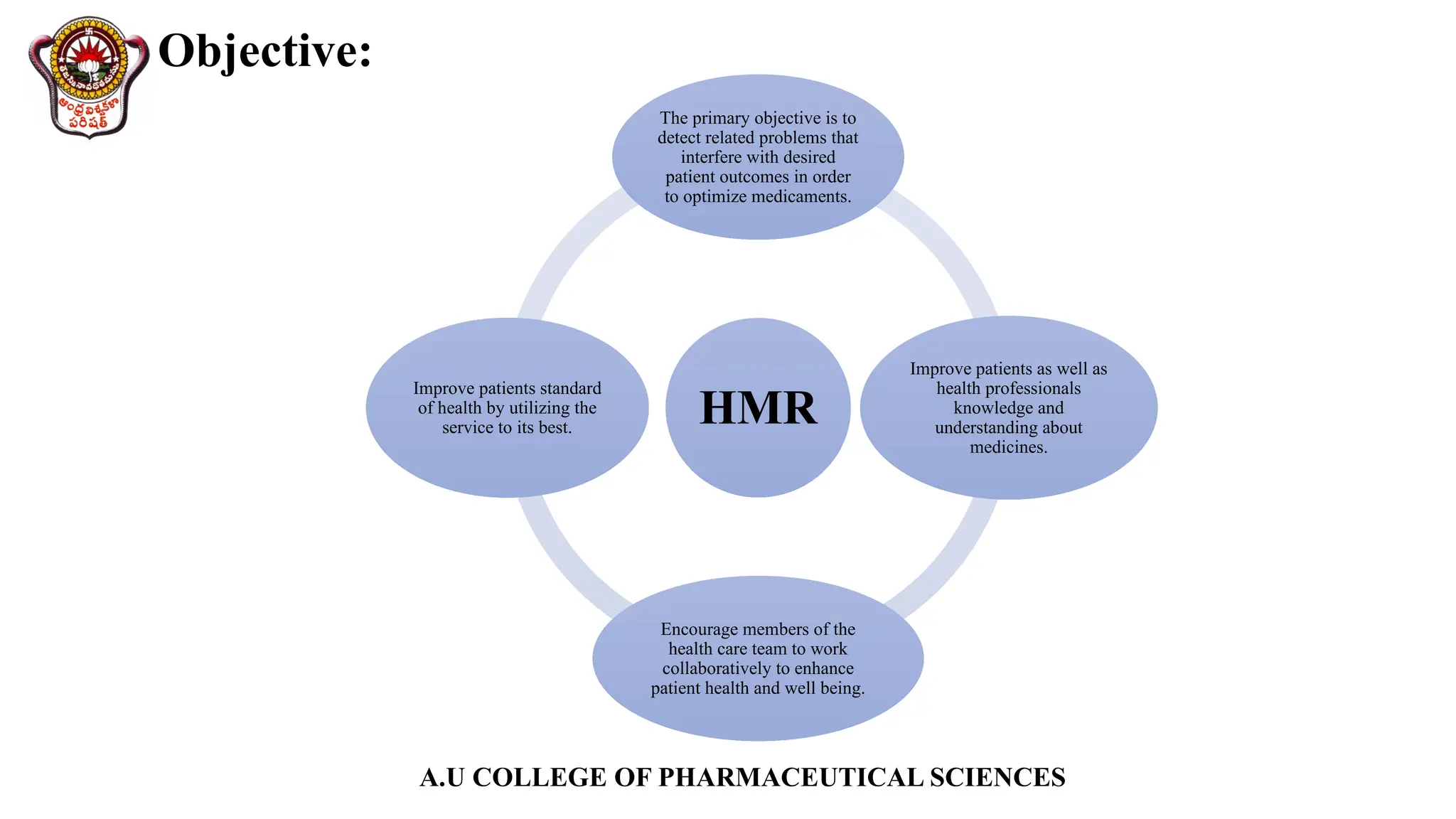
Objective:
HMR
The primary objective is to
detect related problems that
interfere with desired
patient outcomes in order
to optimize medicaments.
Improve patients as well as
health professionals
knowledge and
understanding about
medicines.
Encourage members of the
health care team to work
collaboratively to enhance
patient health and well being.
Improve patients standard
of health by utilizing the
service to its best.
A.U COLLEGE OF PHARMACEUTICAL SCIENCES
Guidelines of HMR :
HMR Guidelines have been developed for pharmacists providing HMR services in the
community.
1.The pharmacist maintains the relevant level of competency necessary to undertake the
specific medication review service.
2.The pharmacist works collaboratively with the consumer and other health care providers.
3.The pharmacist follows a systematic procedure for conducting the medication review.
4.The pharmacist conducts the medication review and reports findings, where relevant, in a
timely manner.
5.The pharmacist maintains accurate documentation for the medication review service
provided.
6.The pharmacist addresses and follows up any issues arising from the medication review.
7.The pharmacist creates and maintains a comprehensive medication profile with
involvement from the consumer and their other health care providers.
8.The pharmacist provides the consumer and other health care providers with relevant
information to optimize health outcomes.
A.U COLLEGE OF PHARMACEUTICAL SCIENCES
Process of HMR :
Process of HMR involves following steps:
●Consumer identification
● General Practitioner (GP) assessment
● Consumer consent
● HMR Interview
● HMR Report
● Medication Management Plan
● Follow up
A.U COLLEGE OF PHARMACEUTICAL SCIENCES
●Consumer identification:
The patient's regular general practitioner must assess that a review is clinically
necessary to ensure quality use of medicines or to address the needs of patients
living at home. The criterion required for HMR are: taking more than five regular
medicines, 12 doses of medicine per day or being treated for three medical
conditions;
significant changes to their medication regimen in past 3 months ;
♦taking a medicine with narrow therapeutic index or requiring therapeutic
drug monitoring ;
♦ symptoms suggestive of adverse drug reaction (ADR );
♦ sub-therapeutic response to treatment ;
♦ suspected non-compliance/problems managing medication-related
therapeutic devices ;
♦ risk due to language/literacy difficulties ;
♦ impaired sight and cognitive functions patients attending a number of
different doctors.
A.U COLLEGE OF PHARMACEUTICAL SCIENCES
● General Practitioner (GP) assessment:
After clinical need is determined, the GP provides a written referral to
either an accredited pharmacist or the consumer’s nominated
community pharmacy. The community pharmacy and/or the accredited
pharmacist must be approved by Medicare to provide HMR services.
The referral should be accompanied by appropriate and relevant clinical
information such as the reason for the referral, past medical and social
history, current medicines and relevant laboratory results.
● Consumer consent :
After the need for a HMR has been clinically identified, the consumer’s
GP obtains consent from the consumer to participate in the HMR.
A.U COLLEGE OF PHARMACEUTICAL SCIENCES
● HMR Interview:
♦ The HMR interview should be conducted in the consumer’s home. The HMR
interview is an opportunity to provide counseling and education to the consumer, their
career and/or family, about their medicines by an accredited pharmacist.
♦ The HMR interview requires the accredited pharmacist to demonstrate effective
communication skills which need to be accompanied by clinical competence, empathy,
understanding, and ethical conduct.
♦ The type and range of information gathered should include: demographic and/or
personal information relevant social history medical history consumer assessment.
♦ Consumer information is gathered and collated in a comprehensive medication
profile which includes: all current medicines, complementary medicines, compliance
aids, therapeutic devices and appliances; dose, strength, dose form, directions, route of
administration and duration of therapy for each medicine; SOS medicines short term
medicines (e.g. antibiotic courses); medicine administration instructions.
A.U COLLEGE OF PHARMACEUTICAL SCIENCES
♦ The accredited pharmacist identifies any actual or potential medication-related
problems after review of all information gathered from the consumer.
♦ The problems may include: medicine use without indication untreated indication
improper drug selection sub-therapeutic dosage over dosage adverse drug reactions
drug interactions failure to receive medicine continued use of medicine for a
condition that has resolved.
● HMR Report:
In the HMR Report, the accredited pharmacist suggests recommendations to the GP
that address the consumer’s medication-related problems and a summary of actual
or potential impact on the consumer.
The accredited pharmacist provides a report to the GP for consideration and, if
consent is granted by the consumer at the interview, to the consumer’s nominated
community pharmacy.
A.U COLLEGE OF PHARMACEUTICAL SCIENCES
The HMR Report should include the date, time and place of the consumer
interview; the name of the referring GP and HMR service provider; details of the
consumer’s nominated community pharmacy, if consent granted; details of other
health care providers contacted as part of the HMR process; advice and resources
provided to the consumer during the HMR interview; general comments of the
consumer’s ability to manage and administer all medicines; and details of any
assessments conducted during the HMR Interview.
● Medication Management Plan:
The medication management plan aims to address any clinical and medication
management issues identified by the accredited pharmacist during the HMR. The
medication management plan should be documented by the GP and forms
the basis for ongoing discussion and follow-up with the consumer. The GP provides
a copy of the medication management plan to the consumer and forwards a copy to
the consumer’s nominated community pharmacy
A.U COLLEGE OF PHARMACEUTICAL SCIENCES
● Follow up:
The medication management plan will contain actions
resulting from interventions and recommendations
from the HMR. The consumer’s nominated community
pharmacy should use the medication management plan
as a basis to provide ongoing care to the consumer.
A.U COLLEGE OF PHARMACEUTICAL SCIENCES
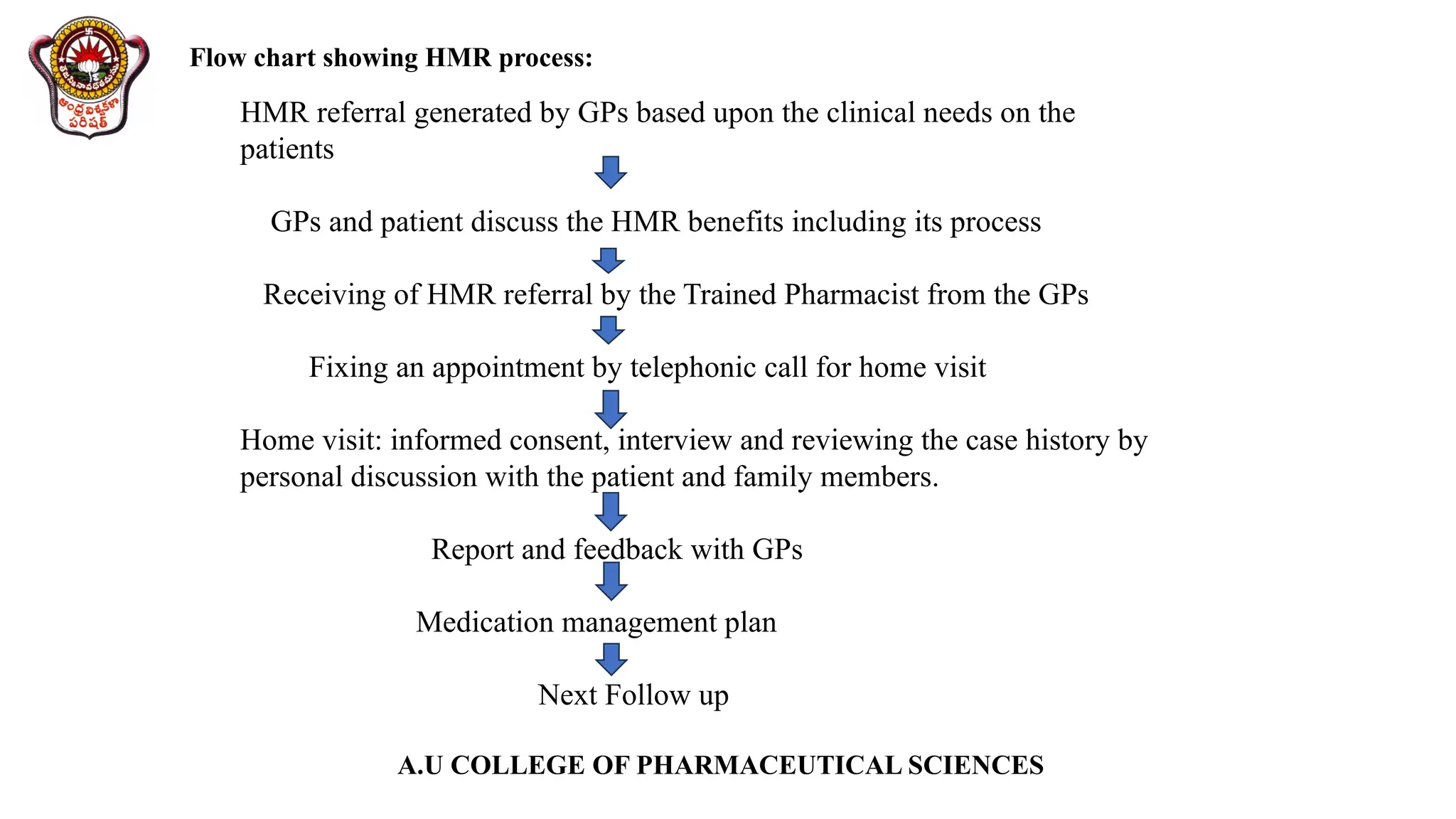
HMR referral generated by GPs based upon the clinical needs on the
patients
GPs and patient discuss the HMR benefits including its process
Receiving of HMR referral by the Trained Pharmacist from the GPs
Fixing an appointment by telephonic call for home visit
Home visit: informed consent, interview and reviewing the case history by
personal discussion with the patient and family members.
Report and feedback with GPs
Medication management plan
Next Follow up
Flow chart showing HMR process:
A.U COLLEGE OF PHARMACEUTICAL SCIENCES
OUTCOMES OF HMR:
1.Identify the potential drug related problems( DRPs):HMR service helps in
identifying various potential DRPs which is ultimately beneficial for the patients.
Adverse drug reactions, drug interactions, untreated indications, drug use without
indication, sub therapeutic dose, improper drug selection, alternative dosage forms,
drug duplication are the DRPs which are addressed in HMR and suggestions are given
to the GPs for any changes in drug therapy management (if required).
This will help to improve medication adherence behavior and health related quality of
life of the patients.
2.Rational use of medicine
3.Maximize health outcomes : Identifying and addressing DRPs helps in maximizing
the health outcomes from the treatment.
4.Enhance the communication between the GPs and pharmacist : The GPs and
pharmacists work together for HMR. The pharmacist helps in the areas of all drug
related issues including dose adjustment and the GPs can help with the diagnosis part.
5.Minimize medication misadventure by the patient
A.U COLLEGE OF PHARMACEUTICAL SCIENCES
Research in community pharmacy practice:
1.Optimising the use of medicine:
-Pharma epidemiology and pharmacoeconomic study.
-KAP study
-Medication use review ( MUR)
-Medication treatment assessment ( MTA)
2.Supporting people to self care:
-STARZ –DRP model ( A clinical tool for self care consultation)
3.Supporting people to live healthier lives/public health:
- Smoking cessation
-health screening
-Immunization
-HIV testing
-Early detection of cancer.
4.Supporting people to live independently:
-Home health care.
-Chronic medication management( CMM)

Home Medication Program And Health Management.

  • 1.
    Home medication reviewprogram A.U COLLEGE OF PHARMACEUTICAL SCIENCES Presented by: M.Pharm ( Pharmacy Practice) Іst semester Pharmacology Division
  • 2.
    A.U COLLEGE OFPHARMACEUTICAL SCIENCES CONTENTS: ♦ INTRODUCTION ♦ OBJECTIVE ♦ GUIDELINES OF HMR ♦ METHOD/PROCESS OF HMR ♦ OUTCOMES OF HMR ♦ RESEARCH IN COMMUNITY PHARMACY PRACTICE
  • 3.
    A.U COLLEGE OFPHARMACEUTICAL SCIENCES Introduction: Home Medication Review (HMR) is ‘ a service designed to assist consumers living at home maximize the benefit of their medication regimen & prevent medication related problems.’ It is a consumer focused , structured and collaborative service offered to consumers living at home in the community . HMR involves a team approach, with the consumer, their general practitioner, their pharmacy, and other relevant members of the health care team in a comprehensive review of medications in the home setting.
  • 4.
    A.U COLLEGE OFPHARMACEUTICAL SCIENCES Objective: HMR The primary objective is to detect related problems that interfere with desired patient outcomes in order to optimize medicaments. Improve patients as well as health professionals knowledge and understanding about medicines. Encourage members of the health care team to work collaboratively to enhance patient health and well being. Improve patients standard of health by utilizing the service to its best.
  • 5.
    A.U COLLEGE OFPHARMACEUTICAL SCIENCES Guidelines of HMR : HMR Guidelines have been developed for pharmacists providing HMR services in the community. 1.The pharmacist maintains the relevant level of competency necessary to undertake the specific medication review service. 2.The pharmacist works collaboratively with the consumer and other health care providers. 3.The pharmacist follows a systematic procedure for conducting the medication review. 4.The pharmacist conducts the medication review and reports findings, where relevant, in a timely manner. 5.The pharmacist maintains accurate documentation for the medication review service provided. 6.The pharmacist addresses and follows up any issues arising from the medication review. 7.The pharmacist creates and maintains a comprehensive medication profile with involvement from the consumer and their other health care providers. 8.The pharmacist provides the consumer and other health care providers with relevant information to optimize health outcomes.
  • 6.
    A.U COLLEGE OFPHARMACEUTICAL SCIENCES Process of HMR : Process of HMR involves following steps: ●Consumer identification ● General Practitioner (GP) assessment ● Consumer consent ● HMR Interview ● HMR Report ● Medication Management Plan ● Follow up
  • 7.
    A.U COLLEGE OFPHARMACEUTICAL SCIENCES ●Consumer identification: The patient's regular general practitioner must assess that a review is clinically necessary to ensure quality use of medicines or to address the needs of patients living at home. The criterion required for HMR are: taking more than five regular medicines, 12 doses of medicine per day or being treated for three medical conditions; significant changes to their medication regimen in past 3 months ; ♦taking a medicine with narrow therapeutic index or requiring therapeutic drug monitoring ; ♦ symptoms suggestive of adverse drug reaction (ADR ); ♦ sub-therapeutic response to treatment ; ♦ suspected non-compliance/problems managing medication-related therapeutic devices ; ♦ risk due to language/literacy difficulties ; ♦ impaired sight and cognitive functions patients attending a number of different doctors.
  • 8.
    A.U COLLEGE OFPHARMACEUTICAL SCIENCES ● General Practitioner (GP) assessment: After clinical need is determined, the GP provides a written referral to either an accredited pharmacist or the consumer’s nominated community pharmacy. The community pharmacy and/or the accredited pharmacist must be approved by Medicare to provide HMR services. The referral should be accompanied by appropriate and relevant clinical information such as the reason for the referral, past medical and social history, current medicines and relevant laboratory results. ● Consumer consent : After the need for a HMR has been clinically identified, the consumer’s GP obtains consent from the consumer to participate in the HMR.
  • 9.
    A.U COLLEGE OFPHARMACEUTICAL SCIENCES ● HMR Interview: ♦ The HMR interview should be conducted in the consumer’s home. The HMR interview is an opportunity to provide counseling and education to the consumer, their career and/or family, about their medicines by an accredited pharmacist. ♦ The HMR interview requires the accredited pharmacist to demonstrate effective communication skills which need to be accompanied by clinical competence, empathy, understanding, and ethical conduct. ♦ The type and range of information gathered should include: demographic and/or personal information relevant social history medical history consumer assessment. ♦ Consumer information is gathered and collated in a comprehensive medication profile which includes: all current medicines, complementary medicines, compliance aids, therapeutic devices and appliances; dose, strength, dose form, directions, route of administration and duration of therapy for each medicine; SOS medicines short term medicines (e.g. antibiotic courses); medicine administration instructions.
  • 10.
    A.U COLLEGE OFPHARMACEUTICAL SCIENCES ♦ The accredited pharmacist identifies any actual or potential medication-related problems after review of all information gathered from the consumer. ♦ The problems may include: medicine use without indication untreated indication improper drug selection sub-therapeutic dosage over dosage adverse drug reactions drug interactions failure to receive medicine continued use of medicine for a condition that has resolved. ● HMR Report: In the HMR Report, the accredited pharmacist suggests recommendations to the GP that address the consumer’s medication-related problems and a summary of actual or potential impact on the consumer. The accredited pharmacist provides a report to the GP for consideration and, if consent is granted by the consumer at the interview, to the consumer’s nominated community pharmacy.
  • 11.
    A.U COLLEGE OFPHARMACEUTICAL SCIENCES The HMR Report should include the date, time and place of the consumer interview; the name of the referring GP and HMR service provider; details of the consumer’s nominated community pharmacy, if consent granted; details of other health care providers contacted as part of the HMR process; advice and resources provided to the consumer during the HMR interview; general comments of the consumer’s ability to manage and administer all medicines; and details of any assessments conducted during the HMR Interview. ● Medication Management Plan: The medication management plan aims to address any clinical and medication management issues identified by the accredited pharmacist during the HMR. The medication management plan should be documented by the GP and forms the basis for ongoing discussion and follow-up with the consumer. The GP provides a copy of the medication management plan to the consumer and forwards a copy to the consumer’s nominated community pharmacy
  • 12.
    A.U COLLEGE OFPHARMACEUTICAL SCIENCES ● Follow up: The medication management plan will contain actions resulting from interventions and recommendations from the HMR. The consumer’s nominated community pharmacy should use the medication management plan as a basis to provide ongoing care to the consumer.
  • 13.
    A.U COLLEGE OFPHARMACEUTICAL SCIENCES HMR referral generated by GPs based upon the clinical needs on the patients GPs and patient discuss the HMR benefits including its process Receiving of HMR referral by the Trained Pharmacist from the GPs Fixing an appointment by telephonic call for home visit Home visit: informed consent, interview and reviewing the case history by personal discussion with the patient and family members. Report and feedback with GPs Medication management plan Next Follow up Flow chart showing HMR process:
  • 14.
    A.U COLLEGE OFPHARMACEUTICAL SCIENCES OUTCOMES OF HMR: 1.Identify the potential drug related problems( DRPs):HMR service helps in identifying various potential DRPs which is ultimately beneficial for the patients. Adverse drug reactions, drug interactions, untreated indications, drug use without indication, sub therapeutic dose, improper drug selection, alternative dosage forms, drug duplication are the DRPs which are addressed in HMR and suggestions are given to the GPs for any changes in drug therapy management (if required). This will help to improve medication adherence behavior and health related quality of life of the patients. 2.Rational use of medicine 3.Maximize health outcomes : Identifying and addressing DRPs helps in maximizing the health outcomes from the treatment. 4.Enhance the communication between the GPs and pharmacist : The GPs and pharmacists work together for HMR. The pharmacist helps in the areas of all drug related issues including dose adjustment and the GPs can help with the diagnosis part. 5.Minimize medication misadventure by the patient
  • 15.
    A.U COLLEGE OFPHARMACEUTICAL SCIENCES Research in community pharmacy practice: 1.Optimising the use of medicine: -Pharma epidemiology and pharmacoeconomic study. -KAP study -Medication use review ( MUR) -Medication treatment assessment ( MTA) 2.Supporting people to self care: -STARZ –DRP model ( A clinical tool for self care consultation) 3.Supporting people to live healthier lives/public health: - Smoking cessation -health screening -Immunization -HIV testing -Early detection of cancer. 4.Supporting people to live independently: -Home health care. -Chronic medication management( CMM)