COMMUNITY PHARMACY
FOR PHARMD 2ND
YEAR
PRESENTED
BY :
MANSI
PANCHAL
OUTLINES :
Definitions
Scope of community pharmacy
Roles and responsibilities of community
pharmacist
DEFINITIONS :
COMMUNITY PHARMACY : means any place under direct supervision of a
pharmacist where the practice of pharmacy occurs or where prescription orders
are compounded and dispensed other than a hospital pharmacy or a limited
service pharmacy.
HOSPITAL PHARMACY : is the organization or department of the hospital to
manage the procurement, storage, preservation, packaging, sterilization,
compounding, preparation, dispensing or distribution of medicine in the hospital.
A community pharmacy is a pharmacy that deals directly with the people in
the local area. It has responsibilities including compounding, counseling,
checking and dispensing of prescription drugs to the patients with cure, accuracy
and legibility.
SCOPE OF CP :
1. DRUG INFORMATION ABOUT THEIR ACTION : Besides proper
understanding of biological and physical science, CP also provides grasp on
chemistry, pharmacology, toxicology, routes of administration, stability and other
information regarding drug.
2. DRUG UTILIZATION : Stock control reports on prescription and controlled
drug dispense, drug purchases, inspection and improvement in operation and such
other aspects which demand attention.
3. DRUG DISTRIBUTION : Quantities of drugs are legalized physically outside
of the pharmacy to have control for the internal distribution of patients.
4. DRUG SELECTION : In the field of CP, the “Rational drug therapy” plays an
important role for the selection of drugs which will be given to the patients to
encounter the disease.
5. PATIENT COUNSELLING AND EVALUATING :
Educating and counselling by a community pharmacist
and evaluating the drugs ( prescribed and non-prescribed )
are really helpful in minimizing any serious effects.
RATIONAL DRUG THERAPY
The use of an appropriate efficacious, safe and cost-effective drug given for the right
indication in the right dose and at the right interval of time and for the right duration
of time ( dosage regimen).
It involves various types of activities like :
a. Adoption of essential drug concept.
b. Training of health professionals ( counselling of health in rational drug therapy )
c. Maintenance of data based on clinical guidelines.
d. ESSENTIAL DRUG CONCEPT : consumer education and regulating
strategies, if the drug therapy is not proper, it leads to illness, ADRs, increased
cost of medication and treatment to the patient is k/a essential drug concept.
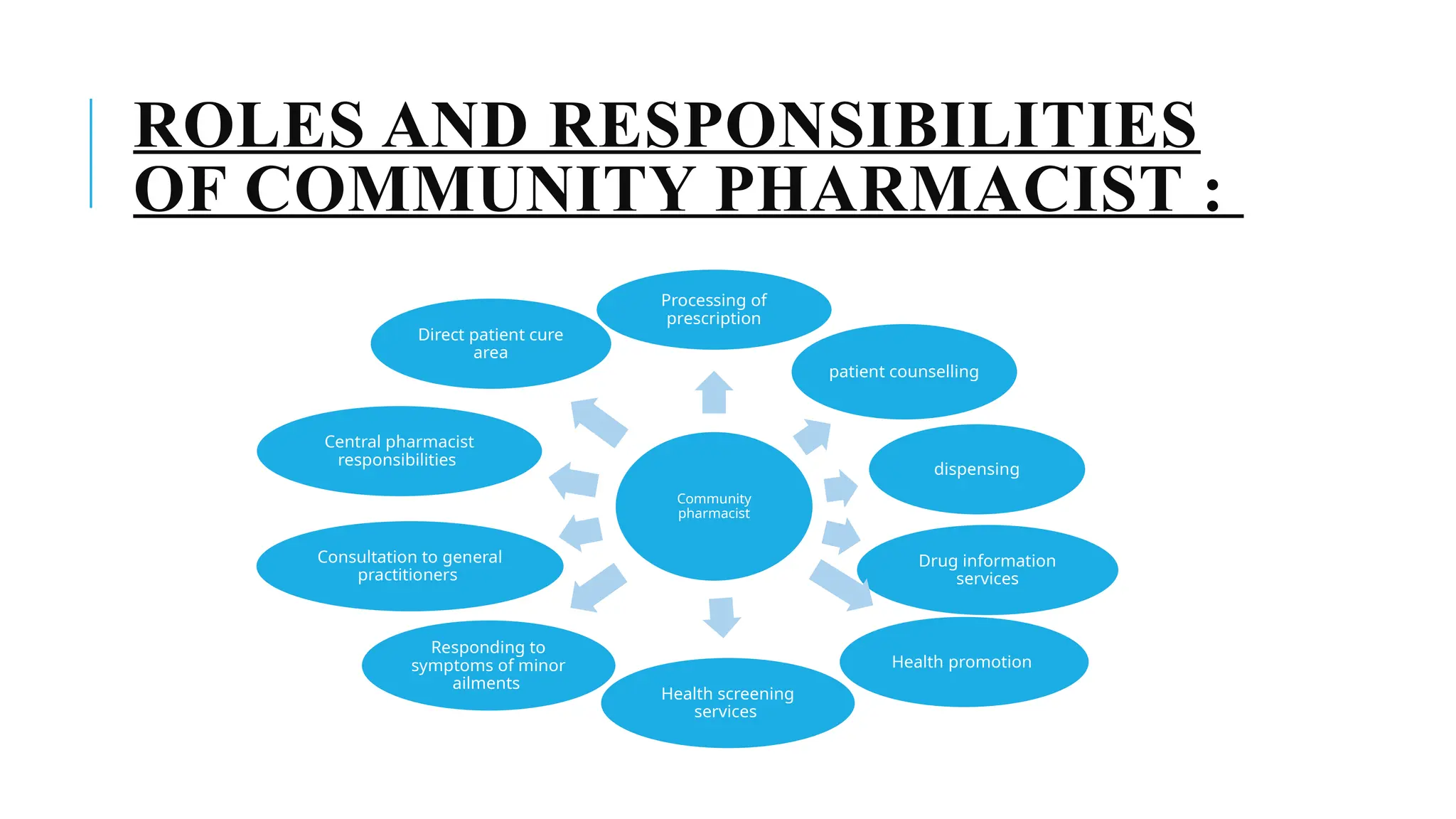
ROLES AND RESPONSIBILITIES
OF COMMUNITY PHARMACIST :
Community
pharmacist
Processing of
prescription
patient counselling
dispensing
Drug information
services
Health promotion
Health screening
services
Responding to
symptoms of minor
ailments
Consultation to general
practitioners
Central pharmacist
responsibilities
Direct patient cure
area
1. PROCESSING OF
PRESCRIPTION
Review and check the prescription for the legality, appropriateness and
potential drug related problems in the prescription.
2. DISPENSING : Makeup and give out medicines on prescription.
In early days, pharmacist had to compound and dispense the prescribed
medication to patients, but nowadays prepackaged medicines are available,
thus the dispensing activities become more easy.
The pharmacist has to label each item prescribed as :
1) name of patient 2) age and gender 3) name of drug 4) instruction
for proper use of drug 5) name of prescriber 6) seal of pharmacy
3.PATIENT COUNSELLING :
Majority of patients may not have proper idea about the correct usage of their
drugs. Due to busy schedules and over-load, often prescribers only give brief
information. Research studies have confirmed that the positive influence of
counselling in disease management and improved medication adherence.
Thus, proper counselling improves therapeutic outcomes and quality of life.
4. DRUG INFORMATION SERVICES : is defined as the systemic
approach of reviewing various sources or published literature, evaluating the
published information and provide the suitable answer for requester.
Pharmacists can use :
1) Primary sources : peer-reviewed journals. Eg, BMJ, LANCET
2) Secondary sources : databases, Eg, Micromedex
3) Tertiary sources : textbooks
5.HEALTH SCREENING
SERVICES :
Monitoring and managing the chronic diseases : hypertension, diabetes
mellitus, asthma, etc. This will minimize the disease burden of patient..
6. HEALTH PROMOTIONS : Smoking cessation programs ,
family planning, participation in vaccination program, education about
balanced diet, etc.
7. RESPONDING TO SYMPTOMS OF MINOR
AILMENTS : Diseases like common colds, diarrhea , sprains, simple
body aches, etc. Pharmacists will be able to give suitable medications.
8)CONSULTATION TO GENERAL
PRACTITIONERS :
Pharmacist by virtue of their professional liaison, they can guide
patients to the general practitioners for management of medical
condition. If required, pharmacist will provide the drug
information doctors, supply emergency drugs to clinics and
nursing homes. In Australia, in consultation with general
practitioner, participate in HOME MEDICINE REVIEW
PROGRAMME (HMR).
9) CENTRAL PHARMACIST RESPONSIBILITIES :
-Checkup for accuracy of dosage prepared.
-Unit dosage formulation.
-IV mixtures.
-Provide proper drug control.
- Ensure that drugs are stored and dispensed properly. Eg,
investigational drugs.
- provide proper record keeping and billing.
- patient medication records.
- IV mixture record billing.
- IV drug records.
- Reports ( monthly loaded reports )
10) DIRECT PATIENT CARE AREA :
- side effects
- effectiveness/ ineffectiveness of drugs.
- toxicity of drugs
- allergic drug reactions ( ADRs )
- drug interactions
- appropriate therapeutic outcomes.

a presentation on the community pharmacy

  • 1.
    COMMUNITY PHARMACY FOR PHARMD2ND YEAR PRESENTED BY : MANSI PANCHAL
  • 2.
    OUTLINES : Definitions Scope ofcommunity pharmacy Roles and responsibilities of community pharmacist
  • 3.
    DEFINITIONS : COMMUNITY PHARMACY: means any place under direct supervision of a pharmacist where the practice of pharmacy occurs or where prescription orders are compounded and dispensed other than a hospital pharmacy or a limited service pharmacy. HOSPITAL PHARMACY : is the organization or department of the hospital to manage the procurement, storage, preservation, packaging, sterilization, compounding, preparation, dispensing or distribution of medicine in the hospital. A community pharmacy is a pharmacy that deals directly with the people in the local area. It has responsibilities including compounding, counseling, checking and dispensing of prescription drugs to the patients with cure, accuracy and legibility.
  • 4.
    SCOPE OF CP: 1. DRUG INFORMATION ABOUT THEIR ACTION : Besides proper understanding of biological and physical science, CP also provides grasp on chemistry, pharmacology, toxicology, routes of administration, stability and other information regarding drug. 2. DRUG UTILIZATION : Stock control reports on prescription and controlled drug dispense, drug purchases, inspection and improvement in operation and such other aspects which demand attention. 3. DRUG DISTRIBUTION : Quantities of drugs are legalized physically outside of the pharmacy to have control for the internal distribution of patients. 4. DRUG SELECTION : In the field of CP, the “Rational drug therapy” plays an important role for the selection of drugs which will be given to the patients to encounter the disease.
  • 5.
    5. PATIENT COUNSELLINGAND EVALUATING : Educating and counselling by a community pharmacist and evaluating the drugs ( prescribed and non-prescribed ) are really helpful in minimizing any serious effects.
  • 6.
    RATIONAL DRUG THERAPY Theuse of an appropriate efficacious, safe and cost-effective drug given for the right indication in the right dose and at the right interval of time and for the right duration of time ( dosage regimen). It involves various types of activities like : a. Adoption of essential drug concept. b. Training of health professionals ( counselling of health in rational drug therapy ) c. Maintenance of data based on clinical guidelines. d. ESSENTIAL DRUG CONCEPT : consumer education and regulating strategies, if the drug therapy is not proper, it leads to illness, ADRs, increased cost of medication and treatment to the patient is k/a essential drug concept.
  • 7.
    ROLES AND RESPONSIBILITIES OFCOMMUNITY PHARMACIST : Community pharmacist Processing of prescription patient counselling dispensing Drug information services Health promotion Health screening services Responding to symptoms of minor ailments Consultation to general practitioners Central pharmacist responsibilities Direct patient cure area
  • 8.
    1. PROCESSING OF PRESCRIPTION Reviewand check the prescription for the legality, appropriateness and potential drug related problems in the prescription. 2. DISPENSING : Makeup and give out medicines on prescription. In early days, pharmacist had to compound and dispense the prescribed medication to patients, but nowadays prepackaged medicines are available, thus the dispensing activities become more easy. The pharmacist has to label each item prescribed as : 1) name of patient 2) age and gender 3) name of drug 4) instruction for proper use of drug 5) name of prescriber 6) seal of pharmacy
  • 9.
    3.PATIENT COUNSELLING : Majorityof patients may not have proper idea about the correct usage of their drugs. Due to busy schedules and over-load, often prescribers only give brief information. Research studies have confirmed that the positive influence of counselling in disease management and improved medication adherence. Thus, proper counselling improves therapeutic outcomes and quality of life. 4. DRUG INFORMATION SERVICES : is defined as the systemic approach of reviewing various sources or published literature, evaluating the published information and provide the suitable answer for requester. Pharmacists can use : 1) Primary sources : peer-reviewed journals. Eg, BMJ, LANCET 2) Secondary sources : databases, Eg, Micromedex 3) Tertiary sources : textbooks
  • 10.
    5.HEALTH SCREENING SERVICES : Monitoringand managing the chronic diseases : hypertension, diabetes mellitus, asthma, etc. This will minimize the disease burden of patient.. 6. HEALTH PROMOTIONS : Smoking cessation programs , family planning, participation in vaccination program, education about balanced diet, etc. 7. RESPONDING TO SYMPTOMS OF MINOR AILMENTS : Diseases like common colds, diarrhea , sprains, simple body aches, etc. Pharmacists will be able to give suitable medications.
  • 11.
    8)CONSULTATION TO GENERAL PRACTITIONERS: Pharmacist by virtue of their professional liaison, they can guide patients to the general practitioners for management of medical condition. If required, pharmacist will provide the drug information doctors, supply emergency drugs to clinics and nursing homes. In Australia, in consultation with general practitioner, participate in HOME MEDICINE REVIEW PROGRAMME (HMR). 9) CENTRAL PHARMACIST RESPONSIBILITIES : -Checkup for accuracy of dosage prepared. -Unit dosage formulation. -IV mixtures.
  • 12.
    -Provide proper drugcontrol. - Ensure that drugs are stored and dispensed properly. Eg, investigational drugs. - provide proper record keeping and billing. - patient medication records. - IV mixture record billing. - IV drug records. - Reports ( monthly loaded reports )
  • 13.
    10) DIRECT PATIENTCARE AREA : - side effects - effectiveness/ ineffectiveness of drugs. - toxicity of drugs - allergic drug reactions ( ADRs ) - drug interactions - appropriate therapeutic outcomes.