A
Project Report Presentation
On
HOME AUTOMATION THROUGH ANDROID MOBILE
Under The Guidance Of:
Mr. O.P.Yadav
Presented By:
Mohit Kumar
Lavish Kumar
Anuj Patel
Dhirendra Ram
Chandrakant
What is Home Automation?
 Home automation involves introducing a degree of
computerized or automatic control to certain
electrical and electronics system in a building.
 These lighting, temperature control, etc.., this paper
demonstrate a simple home automation system which
contains a remote mobile host controller and several
client module (home appliances).
 The client modules communicate with host
controllers through a wireless device such as a
Bluetooth enabled mobile phone, in this case, an
android based smart phone.
 This has revolutionized the area of home automation with
respect to an increased level of affordability and
simplicity through the integration of home appliances
with smart phone and tablet connectivity.
 Smart phones are already feature-perfect and can be made
to communicate to any other devices in an ad hoc
network with a connectivity options like Bluetooth . With
the advent of mobile phones, Mobile applications
development has seen a major outbreak.
 Utilizing the opportunity of automating tasks for a smart
home, mobile phone commonly found in normal
household can be joined in a temporary network inside a
home with the electronic equipments.
 Home automation system is a mobile application developed
using Android targeting its vast market which will be
beneficial for the masses.
 According to the International Data Corporation (IDC)
Worldwide Quarterly Mobile Phone Tracker, Android
maintained its leadership position in global market share
Bluetooth is a short-range wireless communication
technology that comes in handy as the solution while
communicating over an ad hoc network environment like the
home environment for connecting the home appliances with
the mobile phones
 Bluetooth works over 2.4 GHz frequency range up to the
range of 100 m with 1 Mbps speed, providing a safe and
efficient solution for controlling home automation
REQUIRE COMPONENTS
1. ANDROID PHONE
2. MICROCONTROLLER (ATM89S52)
3. BLUETOOTH (HC-05 MODULE)
4. RELAY
5. RELAY IC (ULN2003)
6. TRANSFORMER (220V/12V)
7. VOLTAGE REGULATOR IC 7805
8. DIODE BRIDGE
9. LED’S AND BULB’S
10. RESISTOR,CAPICTOR AND CONNCETING WIRES
11. SUPPLY BOARD
ANDROID
 Android has an active community of developers and enthusiasts
who use the Android Open Source Project (AOSP) source code to
develop and distribute their own modified versions of the
operating system.
 Android is everywhere. Present days Phones, Tablets, TVs and
set-top boxes powered by Google TV.
 Android was originally created by Andy Rubin as an operating
system for mobile phone twenty-first century. In 2005, Google
acquired Android Inc., and made Andy Rubin the Director of
Mobile Platforms for Google. Many think the acquisition was
largely in response to the emergence of the Apple iPhone around
that time.
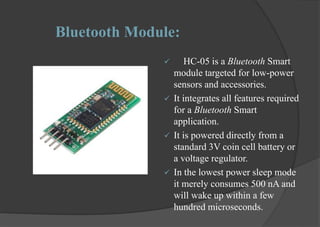
Bluetooth Module:
 HC-05 is a Bluetooth Smart
module targeted for low-power
sensors and accessories.
 It integrates all features required
for a Bluetooth Smart
application.
 It is powered directly from a
standard 3V coin cell battery or
a voltage regulator.
 In the lowest power sleep mode
it merely consumes 500 nA and
will wake up within a few
hundred microseconds.
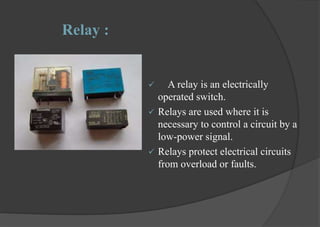
Relay :
 A relay is an electrically
operated switch.
 Relays are used where it is
necessary to control a circuit by a
low-power signal.
 Relays protect electrical circuits
from overload or faults.
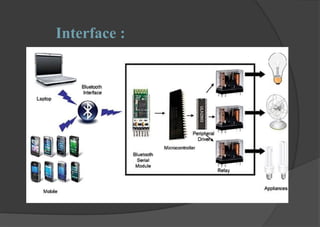
Interface :
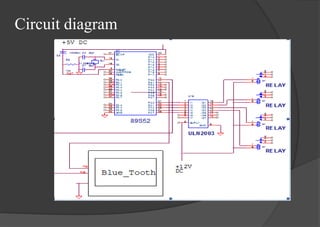
Circuit diagram
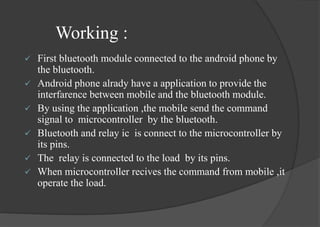
Working :
 First bluetooth module connected to the android phone by
the bluetooth.
 Android phone alrady have a application to provide the
interfarence between mobile and the bluetooth module.
 By using the application ,the mobile send the command
signal to microcontroller by the bluetooth.
 Bluetooth and relay ic is connect to the microcontroller by
its pins.
 The relay is connected to the load by its pins.
 When microcontroller recives the command from mobile ,it
operate the load.
 This wireless technology is especially useful in home
environment, where there exists hardly any
infrastructure to interconnect intelligent appliances.
 It could be suitably used for home automation in a
cost-effective manner. Operating over unlicensed,
universally available frequency of 2.4 GHz, it can link
digital devices within a range of 10 m (expandable to
100 m, by increasing the transmitted power) at the
speed of 1 Mbps.
 Building upon this theme; we propose a home
automation system based on Bluetooth technology.
 The overall system should be fast enough to realize
the true power of wireless technology.
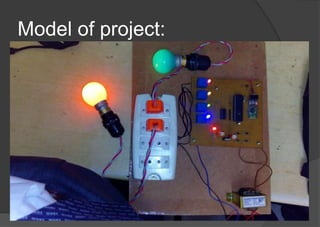
Model of project:
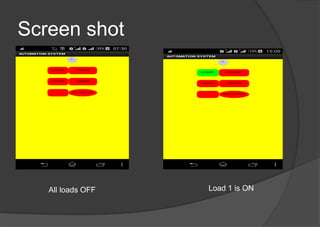
Screen shot
All loads OFF Load 1 is ON
SOFTWARE DESIGN:
 Android uses Bionic in place of a standard C library,
originally developed by Google specifically for Android,
as a derivation of theBSD's standard C library code.
 Bionic has several major features specific to the Linux
kernel, and its development continues independently of
other Android's source code bases.
 The main benefits of using Bionic instead of the GNU C
Library (glibc) oruClibc are its different licensing
model, smaller runtime footprint, and optimization for
low-frequency CPUs.
Applications :
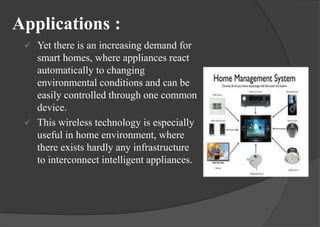
 Yet there is an increasing demand for
smart homes, where appliances react
automatically to changing
environmental conditions and can be
easily controlled through one common
device.
 This wireless technology is especially
useful in home environment, where
there exists hardly any infrastructure
to interconnect intelligent appliances.
Advantages :
 The main advantage of “Home Automation through
Android Mobile” is that the “Physically Challenged
and Disabled People” .
 Replace television, air conditioner etc., remotes for
sleep mode.
 Smart Home.
Conclusion :
 Home Automation is undeniably a resource which
can make a home environment automated. People
can control their electrical devices via these
Home Automation devices and set up controlling
actions through Mobile.
 In future this product may have high potential for
marketing.
THANK YOU . . .
REFERENCE
S:
[1] Heidi Monson (1999)Bluetooth Technology and Implications,
John Wiley & Sons.
[2] Cano, J.-C., Manzoni,P. and Toh, C.K. (2006). “UbiqMuseum: A
Bluetooth and Java Based
Context-Aware System for Ubiquitous Computing”, Wireless
Personal Communications, Vol.38,
pp.187-202.
[3] Dimitrakopoulos,G., Tsagkaris,K., Stavroulaki,V., Katidiotis,A.,
Koutsouris,N., Demestichas, P.,
Merat,V. and Walter,S. (2008) "A Management Framework for
Ambient Systems Operating in
Wireless B3G Environments", Springer Mobile Networks and
Applications, Vol. 13 , No. 6, pp.
555-568.
[4] Savic, S. and Shi, H. (2011) An Intelligent Object Framework for Smart
Living, Procedia
Computer Science 5 (2011) 386–393.
[5] Adams, C. and Millard, P. (2003) "Personal Trust Space and Devices:
"Geography will not be
History" in the m-commerce future". HawaiiInternational Conference on
Business (HICB2003),
18-21 June 2003, Sheraton Waikiki Hotel, Honolulu, Hawaii, USA.
[6] Chung, C.-C., Wang, S.-C., Huang, C. Y., and Lin, C.-M.(2011) "Bluetooth-
based Android
Interactive Applications for Smart Living", 2011 Second International
Conference on Innovations
in Bio-inspired Computing and Applications (IBICA-2011), Shenzhen, China,
16-18December
2011,pp.309-312.
[7] The Android open source project, http://source.android.com/.
[8] Tom, M. and Sitte, J. (2006) "Family System: A Reference Model for
Developing Home
Automation Applications", IEEE International Conference on Systems, Man,
and Cybernetics, 8-
11October 2006, Taipei, Taiwan, pp. 32-37.

Home automisation finalppt

  • 1.
    A Project Report Presentation On HOMEAUTOMATION THROUGH ANDROID MOBILE Under The Guidance Of: Mr. O.P.Yadav Presented By: Mohit Kumar Lavish Kumar Anuj Patel Dhirendra Ram Chandrakant
  • 2.
    What is HomeAutomation?  Home automation involves introducing a degree of computerized or automatic control to certain electrical and electronics system in a building.  These lighting, temperature control, etc.., this paper demonstrate a simple home automation system which contains a remote mobile host controller and several client module (home appliances).  The client modules communicate with host controllers through a wireless device such as a Bluetooth enabled mobile phone, in this case, an android based smart phone.
  • 3.
     This hasrevolutionized the area of home automation with respect to an increased level of affordability and simplicity through the integration of home appliances with smart phone and tablet connectivity.  Smart phones are already feature-perfect and can be made to communicate to any other devices in an ad hoc network with a connectivity options like Bluetooth . With the advent of mobile phones, Mobile applications development has seen a major outbreak.  Utilizing the opportunity of automating tasks for a smart home, mobile phone commonly found in normal household can be joined in a temporary network inside a home with the electronic equipments.
  • 4.
     Home automationsystem is a mobile application developed using Android targeting its vast market which will be beneficial for the masses.  According to the International Data Corporation (IDC) Worldwide Quarterly Mobile Phone Tracker, Android maintained its leadership position in global market share Bluetooth is a short-range wireless communication technology that comes in handy as the solution while communicating over an ad hoc network environment like the home environment for connecting the home appliances with the mobile phones  Bluetooth works over 2.4 GHz frequency range up to the range of 100 m with 1 Mbps speed, providing a safe and efficient solution for controlling home automation
  • 5.
    REQUIRE COMPONENTS 1. ANDROIDPHONE 2. MICROCONTROLLER (ATM89S52) 3. BLUETOOTH (HC-05 MODULE) 4. RELAY 5. RELAY IC (ULN2003) 6. TRANSFORMER (220V/12V) 7. VOLTAGE REGULATOR IC 7805 8. DIODE BRIDGE 9. LED’S AND BULB’S 10. RESISTOR,CAPICTOR AND CONNCETING WIRES 11. SUPPLY BOARD
  • 6.
    ANDROID  Android hasan active community of developers and enthusiasts who use the Android Open Source Project (AOSP) source code to develop and distribute their own modified versions of the operating system.  Android is everywhere. Present days Phones, Tablets, TVs and set-top boxes powered by Google TV.  Android was originally created by Andy Rubin as an operating system for mobile phone twenty-first century. In 2005, Google acquired Android Inc., and made Andy Rubin the Director of Mobile Platforms for Google. Many think the acquisition was largely in response to the emergence of the Apple iPhone around that time.
  • 7.
    Bluetooth Module:  HC-05is a Bluetooth Smart module targeted for low-power sensors and accessories.  It integrates all features required for a Bluetooth Smart application.  It is powered directly from a standard 3V coin cell battery or a voltage regulator.  In the lowest power sleep mode it merely consumes 500 nA and will wake up within a few hundred microseconds.
  • 8.
    Relay :  Arelay is an electrically operated switch.  Relays are used where it is necessary to control a circuit by a low-power signal.  Relays protect electrical circuits from overload or faults.
  • 9.
  • 10.
  • 11.
    Working :  Firstbluetooth module connected to the android phone by the bluetooth.  Android phone alrady have a application to provide the interfarence between mobile and the bluetooth module.  By using the application ,the mobile send the command signal to microcontroller by the bluetooth.  Bluetooth and relay ic is connect to the microcontroller by its pins.  The relay is connected to the load by its pins.  When microcontroller recives the command from mobile ,it operate the load.
  • 12.
     This wirelesstechnology is especially useful in home environment, where there exists hardly any infrastructure to interconnect intelligent appliances.  It could be suitably used for home automation in a cost-effective manner. Operating over unlicensed, universally available frequency of 2.4 GHz, it can link digital devices within a range of 10 m (expandable to 100 m, by increasing the transmitted power) at the speed of 1 Mbps.  Building upon this theme; we propose a home automation system based on Bluetooth technology.  The overall system should be fast enough to realize the true power of wireless technology.
  • 13.
  • 14.
    Screen shot All loadsOFF Load 1 is ON
  • 15.
    SOFTWARE DESIGN:  Androiduses Bionic in place of a standard C library, originally developed by Google specifically for Android, as a derivation of theBSD's standard C library code.  Bionic has several major features specific to the Linux kernel, and its development continues independently of other Android's source code bases.  The main benefits of using Bionic instead of the GNU C Library (glibc) oruClibc are its different licensing model, smaller runtime footprint, and optimization for low-frequency CPUs.
  • 16.
    Applications :  Yetthere is an increasing demand for smart homes, where appliances react automatically to changing environmental conditions and can be easily controlled through one common device.  This wireless technology is especially useful in home environment, where there exists hardly any infrastructure to interconnect intelligent appliances.
  • 17.
    Advantages :  Themain advantage of “Home Automation through Android Mobile” is that the “Physically Challenged and Disabled People” .  Replace television, air conditioner etc., remotes for sleep mode.  Smart Home.
  • 18.
    Conclusion :  HomeAutomation is undeniably a resource which can make a home environment automated. People can control their electrical devices via these Home Automation devices and set up controlling actions through Mobile.  In future this product may have high potential for marketing.
  • 19.
  • 20.
    REFERENCE S: [1] Heidi Monson(1999)Bluetooth Technology and Implications, John Wiley & Sons. [2] Cano, J.-C., Manzoni,P. and Toh, C.K. (2006). “UbiqMuseum: A Bluetooth and Java Based Context-Aware System for Ubiquitous Computing”, Wireless Personal Communications, Vol.38, pp.187-202. [3] Dimitrakopoulos,G., Tsagkaris,K., Stavroulaki,V., Katidiotis,A., Koutsouris,N., Demestichas, P., Merat,V. and Walter,S. (2008) "A Management Framework for Ambient Systems Operating in Wireless B3G Environments", Springer Mobile Networks and Applications, Vol. 13 , No. 6, pp. 555-568.
  • 21.
    [4] Savic, S.and Shi, H. (2011) An Intelligent Object Framework for Smart Living, Procedia Computer Science 5 (2011) 386–393. [5] Adams, C. and Millard, P. (2003) "Personal Trust Space and Devices: "Geography will not be History" in the m-commerce future". HawaiiInternational Conference on Business (HICB2003), 18-21 June 2003, Sheraton Waikiki Hotel, Honolulu, Hawaii, USA. [6] Chung, C.-C., Wang, S.-C., Huang, C. Y., and Lin, C.-M.(2011) "Bluetooth- based Android Interactive Applications for Smart Living", 2011 Second International Conference on Innovations in Bio-inspired Computing and Applications (IBICA-2011), Shenzhen, China, 16-18December 2011,pp.309-312. [7] The Android open source project, http://source.android.com/. [8] Tom, M. and Sitte, J. (2006) "Family System: A Reference Model for Developing Home Automation Applications", IEEE International Conference on Systems, Man, and Cybernetics, 8- 11October 2006, Taipei, Taiwan, pp. 32-37.