Contents
• Introduction
• Satellite Internet & Airborne Internet
• Airborne Internet Architecture
• Halo Architecture
• Implementation
• Helios
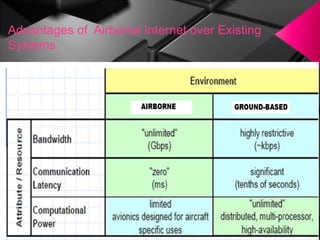
• Advantages of Airborne Internet
• Conclusion
Airborne Internet aims at providing communication link between
aircraft - ground, ground - ground and aircraft – aircraft.
This is one of the major achievements in the aviation history by
NASA. It is undertaking the development of the Small Aircraft
Transportation System (SATS). .
The network is intended for use in aviation Communications,
navigation, and surveillance (CNS) and would also be useful to
businesses, private Internet users, and government agencies,
especially the military.
 It is an internet broadband which Provide high-
speed wireless internet connection by placing
aircraft in fixed path over hundreds of cities
 (AI) deliver high-speed internet :
Around 25Mb/s for business users
And around 5 Mb/s for home users
 (AI) uses a network called High Altitude Long
Operation (HALO)
 Airborne Internet is a private, secure and reliable peer-
to-peer aircraft communications network that uses the
same technology as the commercial Internet.
 Land-based lines are limited physically in how much
data they can deliver because of the diameter of the
cable or phone line.
 In an airborne internet, there is no such physical
limitation, enabling a broader capacity.
 It is convenient and has several uses like flight planning,
security planning en route reservations, travel
arrangements.
•The security applications including flight
tracking/deviation monitoring, in-flight video
monitoring, cockpit voice/video recording.
•This airborne internet is an approach to provide
a general purpose, multi application data
channel to aviation.
•A primary application for A.I. is to track aircraft
for the air traffic control system.
•The principle behind the A.I. is to establish a
robust, reliable, and available digital data
channel to aircraft.
Applications and principle
 Increase productivity and
economic growth
 Increase security, reliability,
and scalability
 Lower cost
 Increase innovation
 Increase flexibility
 Reduce risk
The Airborne Internet Consortium (AIC) is a
non profit research organization
composed of aviation sector participants
that collaboratively research, develop,
and promote open standards and Internet
protocols for aviation digital
communications
 AI does not need frequency bands
license
 Can service hundred-thousand of
broadband subscribers
 Single link delays range from ~60 msec
under the airplane to ~200 msec at the
edge of the signal
The Airborne Internet
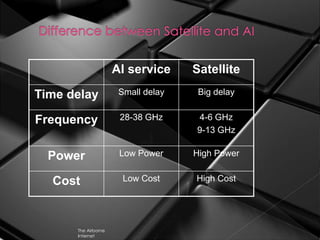
AI service Satellite
Time delay Small delay Big delay
Frequency 28-38 GHz 4-6 GHz
9-13 GHz
Power Low Power High Power
Cost Low Cost High Cost
The Airborne
Internet
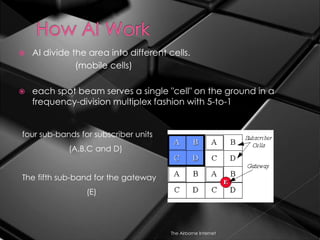
 AI divide the area into different cells.
(mobile cells)
 each spot beam serves a single "cell" on the ground in a
frequency-division multiplex fashion with 5-to-1
The Airborne Internet
four sub-bands for subscriber units
(A,B,C and D)
The fifth sub-band for the gateway
(E)
The Airborne Internet
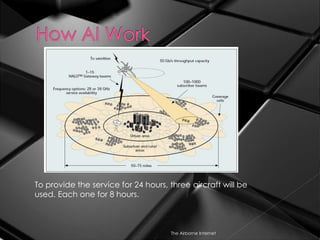
To provide the service for 24 hours, three aircraft will be
used. Each one for 8 hours.
 This service can cover cities
area around 75 mile in diameter
 The aircraft will fly at altitude 51,000 ft
(15,500 m)
 It use high-frequency.
between 28-38 GHz
The Airborne Internet
Airborne Internet Architecture
Airborne-Internet systems will require that an antenna be attached to
the side of your house or work place
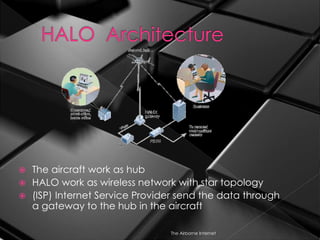
 The aircraft work as hub
 HALO work as wireless network with star topology
 (ISP) Internet Service Provider send the data through
a gateway to the hub in the aircraft
The Airborne Internet
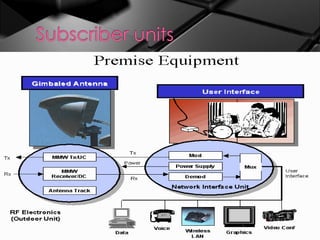
 The user terminal consists of three main parts:
1 The radio frequency unit (RU)
a) MMW Antenna
b) MMW Transceiver
c) An antenna tracking unit
An antenna tracking unit uses a pilot tone transmitted from
the HALO aircraft to point its antenna at the airplane
2- The Network Interface Unit (NIU)
3- the application terminals such as PCs, telephones, video
servers, etc.
The Airborne Internet
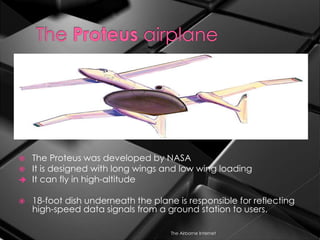
 The Proteus was developed by NASA
 It is designed with long wings and low wing loading
 It can fly in high-altitude
 18-foot dish underneath the plane is responsible for reflecting
high-speed data signals from a ground station to users.
The Airborne Internet
Implementation
The Helios aircraft will be equipped with telecommunications
equipment and stay airborne for six months straight.
Advantages of Airborne Internet over Existing
Systems
Conclusion
Thus this airborne internet technology has a
wide range of utilities in the field of aviation
services like aircraft monitoring and air traffic
management, weather information etc.,
and also provides an opportunity for the
passengers to access the internet at very high
altitudes that is, in the aero planes and other
conventional services.
Thus it is a further new trend in this mobile
world which is establishing the connectivity by
building network in the air.
ANY
QUERIES
????
Airborne Internet

Airborne Internet

  • 2.
    Contents • Introduction • SatelliteInternet & Airborne Internet • Airborne Internet Architecture • Halo Architecture • Implementation • Helios • Advantages of Airborne Internet • Conclusion
  • 3.
    Airborne Internet aimsat providing communication link between aircraft - ground, ground - ground and aircraft – aircraft. This is one of the major achievements in the aviation history by NASA. It is undertaking the development of the Small Aircraft Transportation System (SATS). . The network is intended for use in aviation Communications, navigation, and surveillance (CNS) and would also be useful to businesses, private Internet users, and government agencies, especially the military.
  • 4.
     It isan internet broadband which Provide high- speed wireless internet connection by placing aircraft in fixed path over hundreds of cities  (AI) deliver high-speed internet : Around 25Mb/s for business users And around 5 Mb/s for home users  (AI) uses a network called High Altitude Long Operation (HALO)
  • 5.
     Airborne Internetis a private, secure and reliable peer- to-peer aircraft communications network that uses the same technology as the commercial Internet.  Land-based lines are limited physically in how much data they can deliver because of the diameter of the cable or phone line.  In an airborne internet, there is no such physical limitation, enabling a broader capacity.  It is convenient and has several uses like flight planning, security planning en route reservations, travel arrangements.
  • 6.
    •The security applicationsincluding flight tracking/deviation monitoring, in-flight video monitoring, cockpit voice/video recording. •This airborne internet is an approach to provide a general purpose, multi application data channel to aviation. •A primary application for A.I. is to track aircraft for the air traffic control system. •The principle behind the A.I. is to establish a robust, reliable, and available digital data channel to aircraft. Applications and principle
  • 7.
     Increase productivityand economic growth  Increase security, reliability, and scalability  Lower cost  Increase innovation  Increase flexibility  Reduce risk
  • 8.
    The Airborne InternetConsortium (AIC) is a non profit research organization composed of aviation sector participants that collaboratively research, develop, and promote open standards and Internet protocols for aviation digital communications
  • 9.
     AI doesnot need frequency bands license  Can service hundred-thousand of broadband subscribers  Single link delays range from ~60 msec under the airplane to ~200 msec at the edge of the signal The Airborne Internet
  • 10.
    AI service Satellite Timedelay Small delay Big delay Frequency 28-38 GHz 4-6 GHz 9-13 GHz Power Low Power High Power Cost Low Cost High Cost The Airborne Internet
  • 11.
     AI dividethe area into different cells. (mobile cells)  each spot beam serves a single "cell" on the ground in a frequency-division multiplex fashion with 5-to-1 The Airborne Internet four sub-bands for subscriber units (A,B,C and D) The fifth sub-band for the gateway (E)
  • 12.
    The Airborne Internet Toprovide the service for 24 hours, three aircraft will be used. Each one for 8 hours.
  • 13.
     This servicecan cover cities area around 75 mile in diameter  The aircraft will fly at altitude 51,000 ft (15,500 m)  It use high-frequency. between 28-38 GHz The Airborne Internet
  • 14.
    Airborne Internet Architecture Airborne-Internetsystems will require that an antenna be attached to the side of your house or work place
  • 15.
     The aircraftwork as hub  HALO work as wireless network with star topology  (ISP) Internet Service Provider send the data through a gateway to the hub in the aircraft The Airborne Internet
  • 16.
     The userterminal consists of three main parts: 1 The radio frequency unit (RU) a) MMW Antenna b) MMW Transceiver c) An antenna tracking unit An antenna tracking unit uses a pilot tone transmitted from the HALO aircraft to point its antenna at the airplane 2- The Network Interface Unit (NIU) 3- the application terminals such as PCs, telephones, video servers, etc. The Airborne Internet
  • 17.
  • 18.
     The Proteuswas developed by NASA  It is designed with long wings and low wing loading  It can fly in high-altitude  18-foot dish underneath the plane is responsible for reflecting high-speed data signals from a ground station to users. The Airborne Internet
  • 19.
    Implementation The Helios aircraftwill be equipped with telecommunications equipment and stay airborne for six months straight.
  • 20.
    Advantages of AirborneInternet over Existing Systems
  • 21.
    Conclusion Thus this airborneinternet technology has a wide range of utilities in the field of aviation services like aircraft monitoring and air traffic management, weather information etc., and also provides an opportunity for the passengers to access the internet at very high altitudes that is, in the aero planes and other conventional services. Thus it is a further new trend in this mobile world which is establishing the connectivity by building network in the air.
  • 22.