Holter Monitors, Implantable &
External Loop Recorders
Holter Monitors
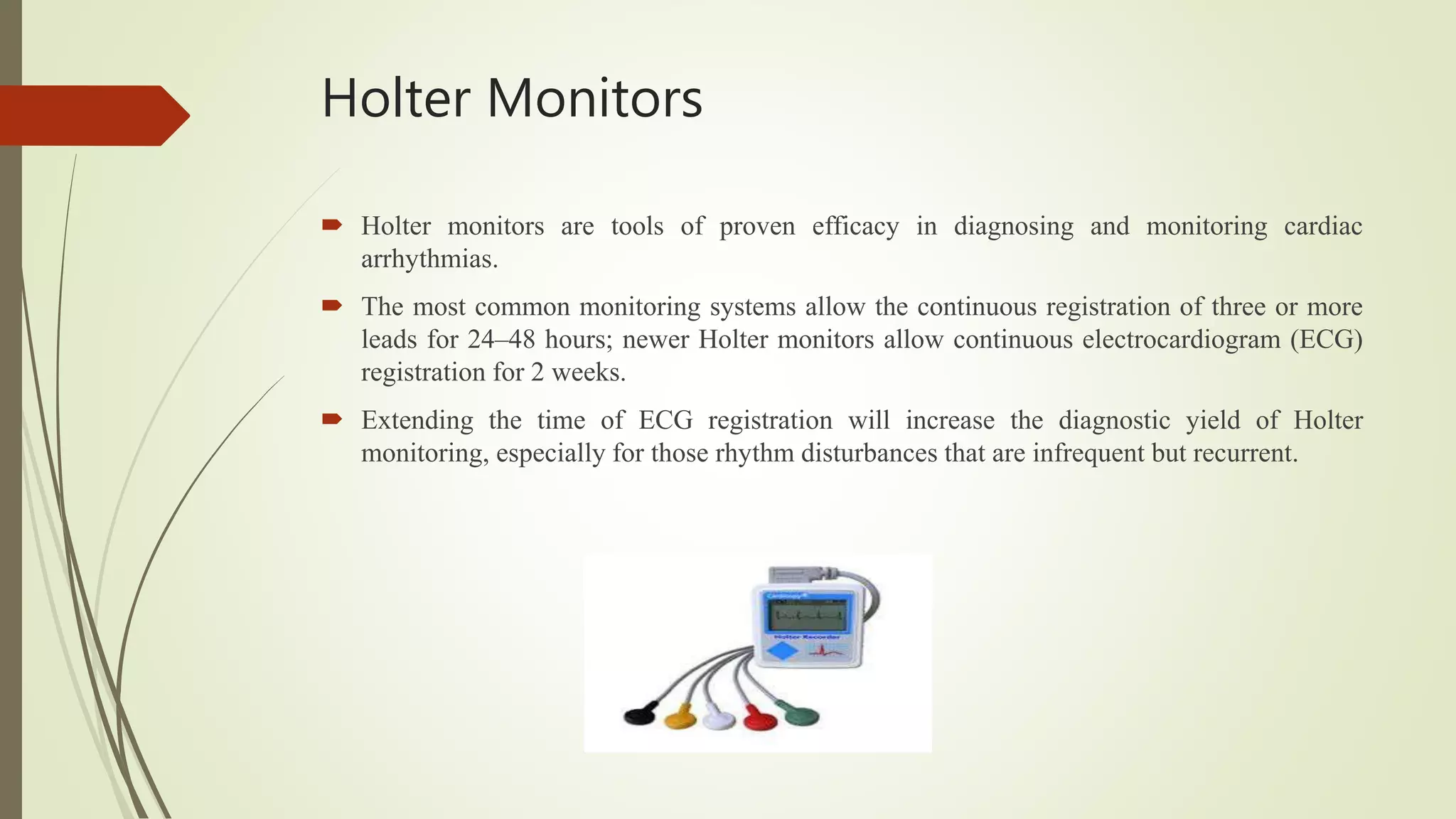
 Holter monitors are tools of proven efficacy in diagnosing and monitoring cardiac
arrhythmias.
 The most common monitoring systems allow the continuous registration of three or more
leads for 24–48 hours; newer Holter monitors allow continuous electrocardiogram (ECG)
registration for 2 weeks.
 Extending the time of ECG registration will increase the diagnostic yield of Holter
monitoring, especially for those rhythm disturbances that are infrequent but recurrent.
Advantages
Advantages
 The possibility of quantifying the real burden of an arrhythmia
 The detection of rhythm disturbances outside the limits set by an algorithm
 or memory.
 Low cost
 Continuous monitoring
Limitations
 A relatively brief duration of monitoring
 The impossibility of transmitting real-time data to the attending cardiac unit
 The need for close collaboration between the patient and health professionals.
 Compliant patients.
Loop Recorders and Post-event Recorders
 Newer generation monitors are the so-called event recorders
 Two categories
 Loop recorders: External loop recorders (ELRs) and Implantable loop recorders
(ILRs)
 Post-event recorders
External Loop Recorders
 ELRs can monitor the ECG for a maximum of 30 days
 An ELR can be connected to a belt around the chest, without the need for
traditional electrodes
 An ELR has a higher chance of providing a diagnosis to patients whose symptoms
occur infrequently.
Advantages and Limitations
 Advantages
 The diagnostic value of ELR is higher than that of Holter
 All modern ELRs have features which allow transmission of stored ECG tracing
directly .
 Limitations
 Poor recordings
 Poor patient compliance to wearing device.
 Continuous device maintenance required
Implantable Loop Recoders
 The implantable loop recorder (ILR) is a subcutaneous, single-lead,
electrocardiographic (ECG) monitoring device.
 The device is capable of storing ECG data automatically in response to a
significant bradyarrhythmia or tachyarrhythmia or in response to patient
activation.
 ILRs have a significantly greater diagnostic yield than 24-hour Holter, 30-day
event, or 30-day mobile cardiovascular telemetry monitoring.
Advantages
 ILRs are safe.
 They have a low rate of infection
 ILRs offer the best opportunity for diagnosis
 ILRs are designed to transmit data to a distant diagnostic station.
Limitations
 High cost
 ILRs allow the registration of only one lead, rendering the interpretation of the
ECG difficult in some cases.
 ECG storage limits
 Need for a minor surgical procedure
Post Event Recorders
 Post-event recorders can be used for 14–30 days
 The monitoring function starts when the patient puts the device on his or her chest
as symptoms commence
 The diagnostic yield of post-event recorders is limited by the potential loss of
events causing disabling symptoms that prevent patients from activating the
device.
 There is also the risk that patients may forget to activate the device.
Advantages and Limitations
 Advantages
 Duration of monitoring up to 1 month
 The device need not be worn 24hrs.
 Remote monitoring possible.
 Limitations
 Non continuous monitoring
 Does not register asymptotic arrhythmias and heart rhythm during disabling
symptoms that prevents patients from activating the device
 ECG storage limits

Holter,ilr,elr

  • 1.
    Holter Monitors, Implantable& External Loop Recorders
  • 2.
    Holter Monitors  Holtermonitors are tools of proven efficacy in diagnosing and monitoring cardiac arrhythmias.  The most common monitoring systems allow the continuous registration of three or more leads for 24–48 hours; newer Holter monitors allow continuous electrocardiogram (ECG) registration for 2 weeks.  Extending the time of ECG registration will increase the diagnostic yield of Holter monitoring, especially for those rhythm disturbances that are infrequent but recurrent.
  • 3.
    Advantages Advantages  The possibilityof quantifying the real burden of an arrhythmia  The detection of rhythm disturbances outside the limits set by an algorithm  or memory.  Low cost  Continuous monitoring
  • 4.
    Limitations  A relativelybrief duration of monitoring  The impossibility of transmitting real-time data to the attending cardiac unit  The need for close collaboration between the patient and health professionals.  Compliant patients.
  • 5.
    Loop Recorders andPost-event Recorders  Newer generation monitors are the so-called event recorders  Two categories  Loop recorders: External loop recorders (ELRs) and Implantable loop recorders (ILRs)  Post-event recorders
  • 6.
    External Loop Recorders ELRs can monitor the ECG for a maximum of 30 days  An ELR can be connected to a belt around the chest, without the need for traditional electrodes  An ELR has a higher chance of providing a diagnosis to patients whose symptoms occur infrequently.
  • 7.
    Advantages and Limitations Advantages  The diagnostic value of ELR is higher than that of Holter  All modern ELRs have features which allow transmission of stored ECG tracing directly .  Limitations  Poor recordings  Poor patient compliance to wearing device.  Continuous device maintenance required
  • 8.
    Implantable Loop Recoders The implantable loop recorder (ILR) is a subcutaneous, single-lead, electrocardiographic (ECG) monitoring device.  The device is capable of storing ECG data automatically in response to a significant bradyarrhythmia or tachyarrhythmia or in response to patient activation.  ILRs have a significantly greater diagnostic yield than 24-hour Holter, 30-day event, or 30-day mobile cardiovascular telemetry monitoring.
  • 9.
    Advantages  ILRs aresafe.  They have a low rate of infection  ILRs offer the best opportunity for diagnosis  ILRs are designed to transmit data to a distant diagnostic station.
  • 10.
    Limitations  High cost ILRs allow the registration of only one lead, rendering the interpretation of the ECG difficult in some cases.  ECG storage limits  Need for a minor surgical procedure
  • 11.
    Post Event Recorders Post-event recorders can be used for 14–30 days  The monitoring function starts when the patient puts the device on his or her chest as symptoms commence  The diagnostic yield of post-event recorders is limited by the potential loss of events causing disabling symptoms that prevent patients from activating the device.  There is also the risk that patients may forget to activate the device.
  • 12.
    Advantages and Limitations Advantages  Duration of monitoring up to 1 month  The device need not be worn 24hrs.  Remote monitoring possible.  Limitations  Non continuous monitoring  Does not register asymptotic arrhythmias and heart rhythm during disabling symptoms that prevents patients from activating the device  ECG storage limits