CV
Holistic Admissions:
Why It Matters and How
Programs Are Addressing
It Now
Julie Shurts
Global Education, ETS
June 7, 2019
CV
2
Today, I will share
• Benefits of holistic
admissions
• Promising practices that
institutions are using now.
• Resources that can help.
Copyright © 2019 by Educational Testing Service. All rights reserved. ETS, the ETS logo, MEASURING THE POWER OF LEARNING and GRE are
registered trademarks of Educational Testing Service (ETS). 43006
3
What is holistic admissions?
A process that:
• Considers all available
information about an applicant
to get the fullest picture possible
of everything he or she can bring
to a program.
• Ensures that all applicants are
considered.
• Is intentional about the order in
which components are reviewed.
4
Benefits of holistic
admissions
• It is fairer to the applicant.
• It enables programs to gain a
clearer picture of an applicant’s
potential fit.
• It supports achieving program
and institutional enrollment
goals, as well as outcomes goals.
5
How to move toward a
holistic admissions process
• We don’t know of a “best way,” but
we can share “promising practices.”
• ETS’s research
 71 on-campus interviews with deans
and faculty to learn about current
admissions practices and challenges
 These interviews and extensive
literature review informed the
curation and development of 12
promising practices
6
• Agree upon goals early on and
structure entire admissions process
(recruitment to enrollment) to
achieve them
• Be explicit about plans to identify and
recruit desired populations and how
to assess desired attributes
• Determine the role and importance of
each component of an applicant’s file
Promising Practices: Goal Setting
Work together to set goals
and strategies to achieve them
7
What can help: Discussion Guide
Available at holisticadmissions.org
Promising Practices: Goal Setting
Determine and communicate the
application review and selection
process so all decision makers
understand:
8
 Enrollment goals, strategy and process
 How to evaluate each component of
the application
̶ Role and importance
̶ Order of review
̶ What inferences can be made
 How to mitigate unconscious bias
 How disagreements will be resolved
Promising Practices: Increasing Understanding
9
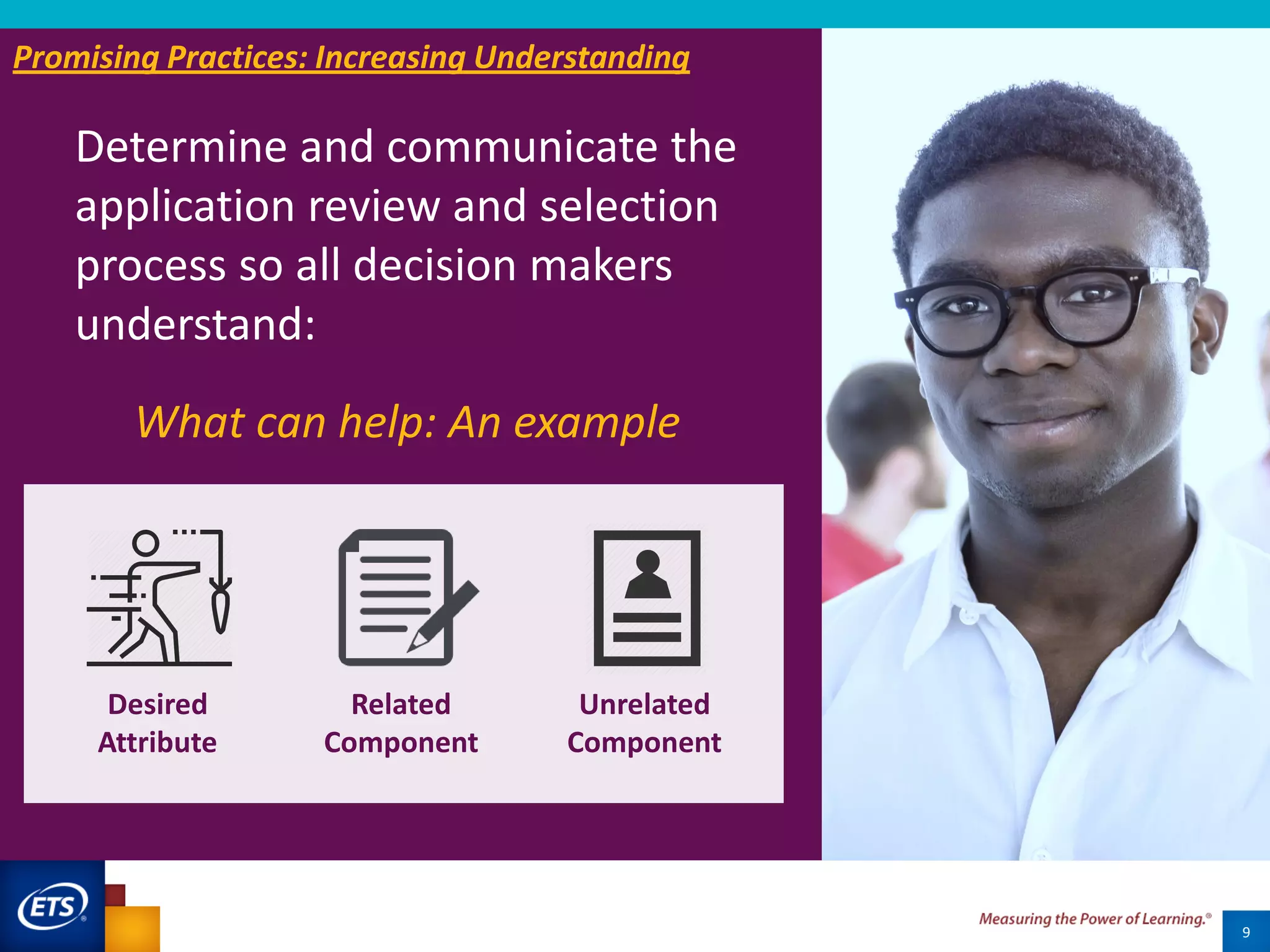
Promising Practice #2
What can help: An example
Desired
Attribute
Related
Component
Unrelated
Component
Promising Practices: Increasing Understanding
Determine and communicate the
application review and selection
process so all decision makers
understand:
Faculty opportunities to:
• Learn about less familiar
undergraduate schools,
especially minority-serving
institutions and those with
large first-generation student
populations.
• Work with undergraduate
students from
underrepresented groups.
10
Promising Practices: Diversify the
Admissions Committee
Institutions that make a
commitment to diversity and
inclusion could consider the
composition of the admissions
committee so that diverse
perspectives and experiences
are represented and reflected.
11
Promising Practices: Diversify the
Admissions Committee
12
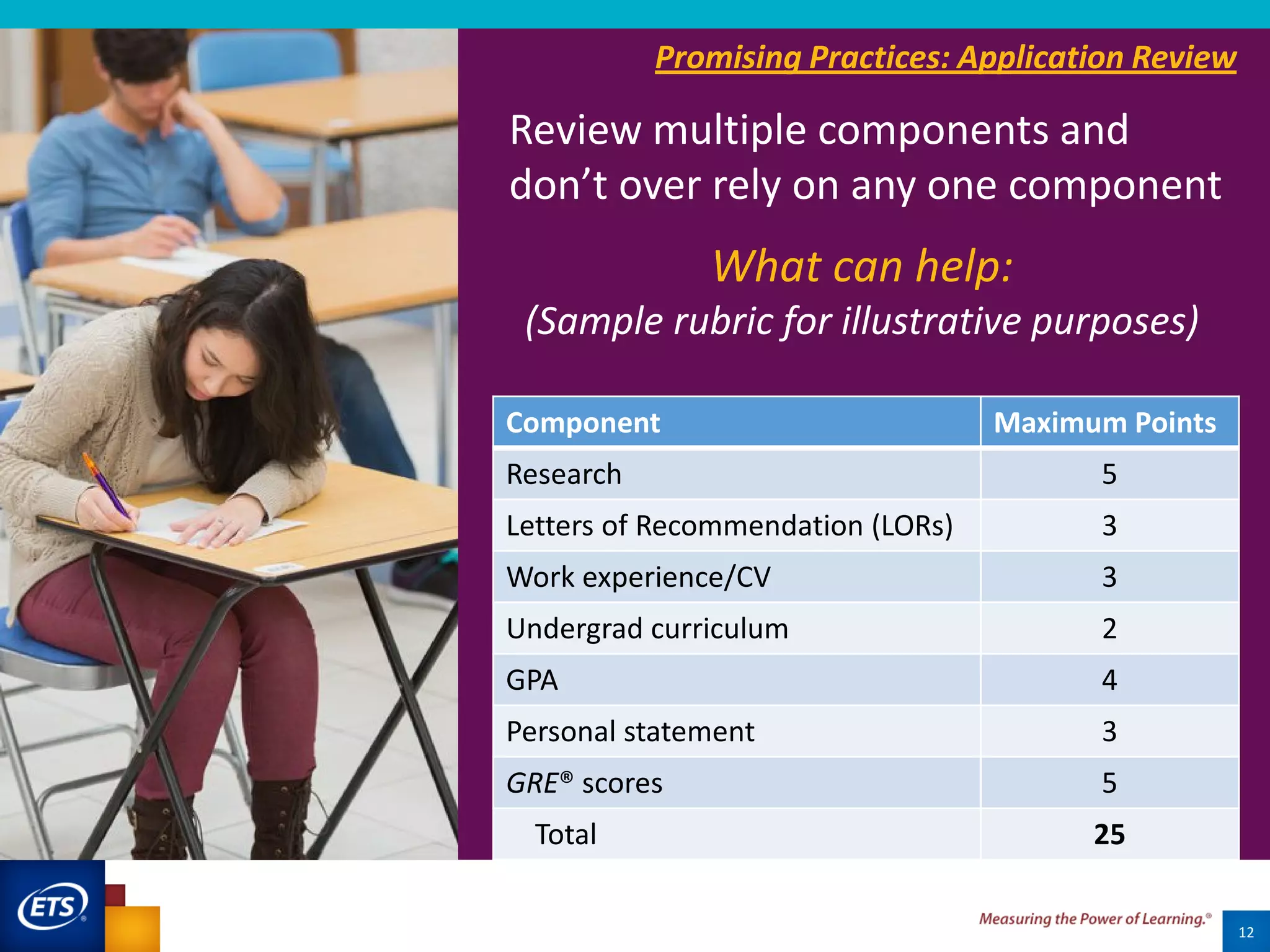
What can help:
(Sample rubric for illustrative purposes)
Component Maximum Points
Research 5
Letters of Recommendation (LORs) 3
Work experience/CV 3
Undergrad curriculum 2
GPA 4
Personal statement 3
GRE® scores 5
Total 25
Review multiple components and
don’t over rely on any one component
Promising Practices: Application Review
13
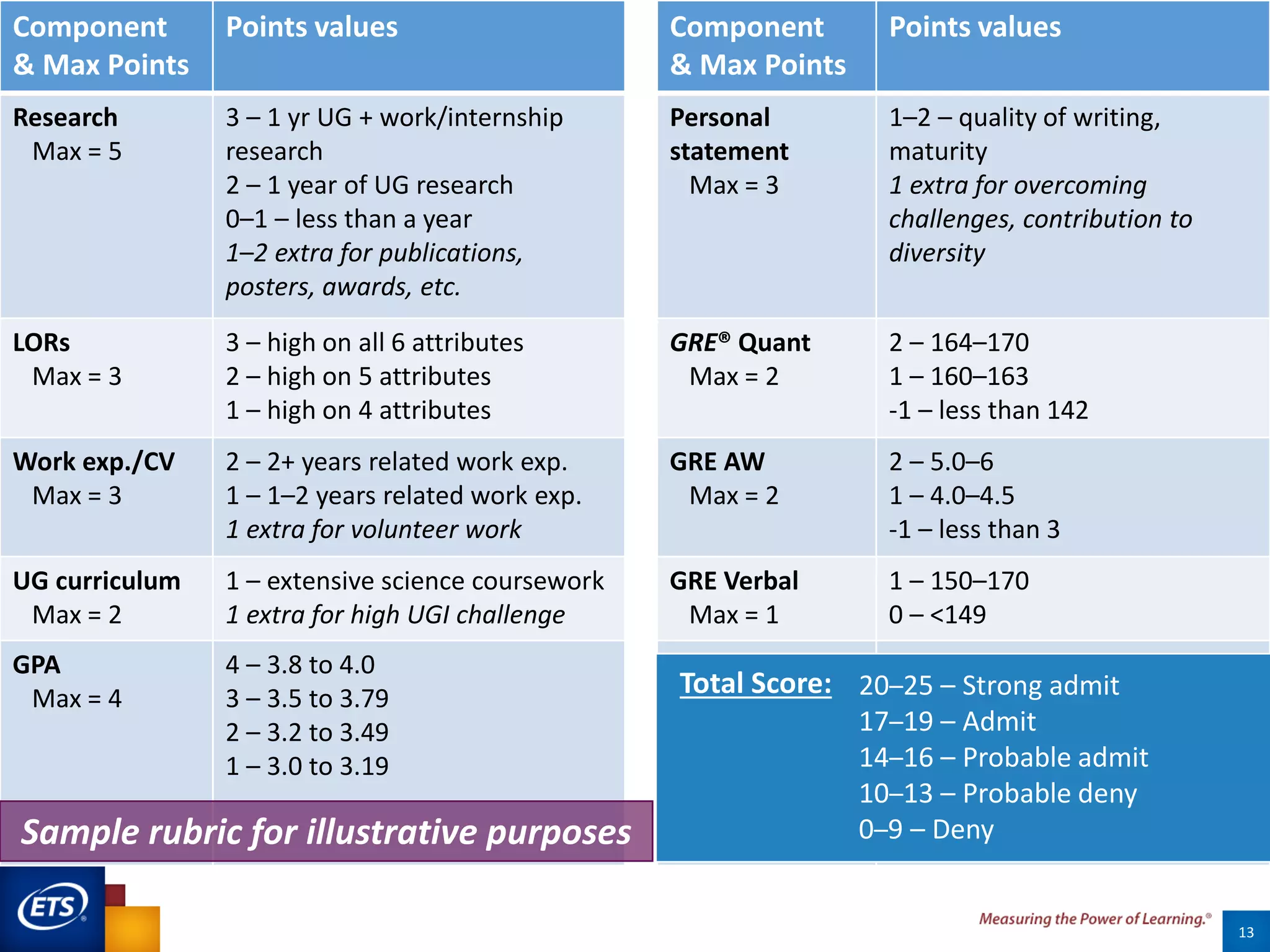
Component
& Max Points
Points values Component
& Max Points
Points values
Research
Max = 5
3 – 1 yr UG + work/internship
research
2 – 1 year of UG research
0–1 – less than a year
1–2 extra for publications,
posters, awards, etc.
Personal
statement
Max = 3
1–2 – quality of writing,
maturity
1 extra for overcoming
challenges, contribution to
diversity
LORs
Max = 3
3 – high on all 6 attributes
2 – high on 5 attributes
1 – high on 4 attributes
GRE® Quant
Max = 2
2 – 164–170
1 – 160–163
-1 – less than 142
Work exp./CV
Max = 3
2 – 2+ years related work exp.
1 – 1–2 years related work exp.
1 extra for volunteer work
GRE AW
Max = 2
2 – 5.0–6
1 – 4.0–4.5
-1 – less than 3
UG curriculum
Max = 2
1 – extensive science coursework
1 extra for high UGI challenge
GRE Verbal
Max = 1
1 – 150–170
0 – <149
GPA
Max = 4
4 – 3.8 to 4.0
3 – 3.5 to 3.79
2 – 3.2 to 3.49
1 – 3.0 to 3.19
20–25 – Strong admit
17–19 – Admit
14–16 – Probable admit
10–13 – Probable deny
0–9 – Deny
Total Score:
Sample rubric for illustrative purposes
14
What can help:
Alternate review processes
Multistage Two Pool Separate and
Convene
Review multiple components and
don’t over rely on any one
component
Promising Practices: Application Review
15
• Ask programs to focus on at least
three screen-in criteria. If using
GRE® scores and GPA to make first
cut, add at least one more criteria.
• Each applicant, then, has at least
three opportunities to be placed
into the review pool, helping to
ensure that qualified applicants
aren’t overlooked due to
performance on just one measure.
Promising Practices: Screen In
Consider ways to set criteria that
would allow applicants to be included
in the review, rather than excluded.
16
What can help:
An example
Promising Practices: Screen In
• One graduate school made two
changes to their application:
 Request applicants provide
information about specific
educational experiences.
 Request recommenders rate
applicants on a specific set of skills
and applicants.
• This information can be used in the
screen-in process to create the
applicant pool for review.
Consider GRE® scores a useful, positive
indicator of an applicant’s
preparedness for graduate study.
17
• Scores should only be used in
consultation with other materials.
• Consider the amount of emphasis placed
on scores if GRE scores are not consistent
with other materials.
• GRE scores provide the most valuable
information when they are required of all
applicants and can be especially helpful
when the undergraduate institution is
unfamiliar to reviewers.
Promising Practices: GRE Scores as a Positive
Indicator
18
Public support for using GRE® scores as part
of holistic admissions
9
Coming from an undistinguished
college where I lacked access to
famous letter-writers, I hoped the GRE
would be an equalizer for me … it's not clear
to me that, on balance, the GRE confers
significant advantages to high-income
students, given that (i) high-income
students are more likely than low-income
students to attend [liberal arts colleges] or
well-regarded research schools, which
already serve as proxies for excellence; (ii)
because high-income students are more
likely to attend selective schools, they're
more likely to have famous letter-writers…
Undergraduate student
“
”
variety of good and bad reasons. I think I
had somewhat strong letters from
somewhat known people. I also had
notably strong GRE scores. My impression
is that the scores helped significantly
when applying to grad school, since
without them the strong letters and the
poor grades would have sort of cancelled
each other out. I think I was a relatively
strong grad student and, in any case, I
now have tenure.
“I had somewhat poor grades
as an undergraduate for a
”Faculty member
www.insidehighered.com/admissions/article/2018/09/17/decision-
penns-philosophy-department-renews-debate-about-gre
19
Holistic admissions is about being
inclusive, not exclusive
9
• Test scores are essential because they:
 Support institutions’ efforts to identify which applicants are
academically prepared for graduate-level study.
 Provide a common, objective measure to help programs
compare applicants from different backgrounds.
• However, they are just one piece of the puzzle and should
always be considered along with other pieces of information.
20
Public support for using GRE® scores as part
of holistic admissions
9
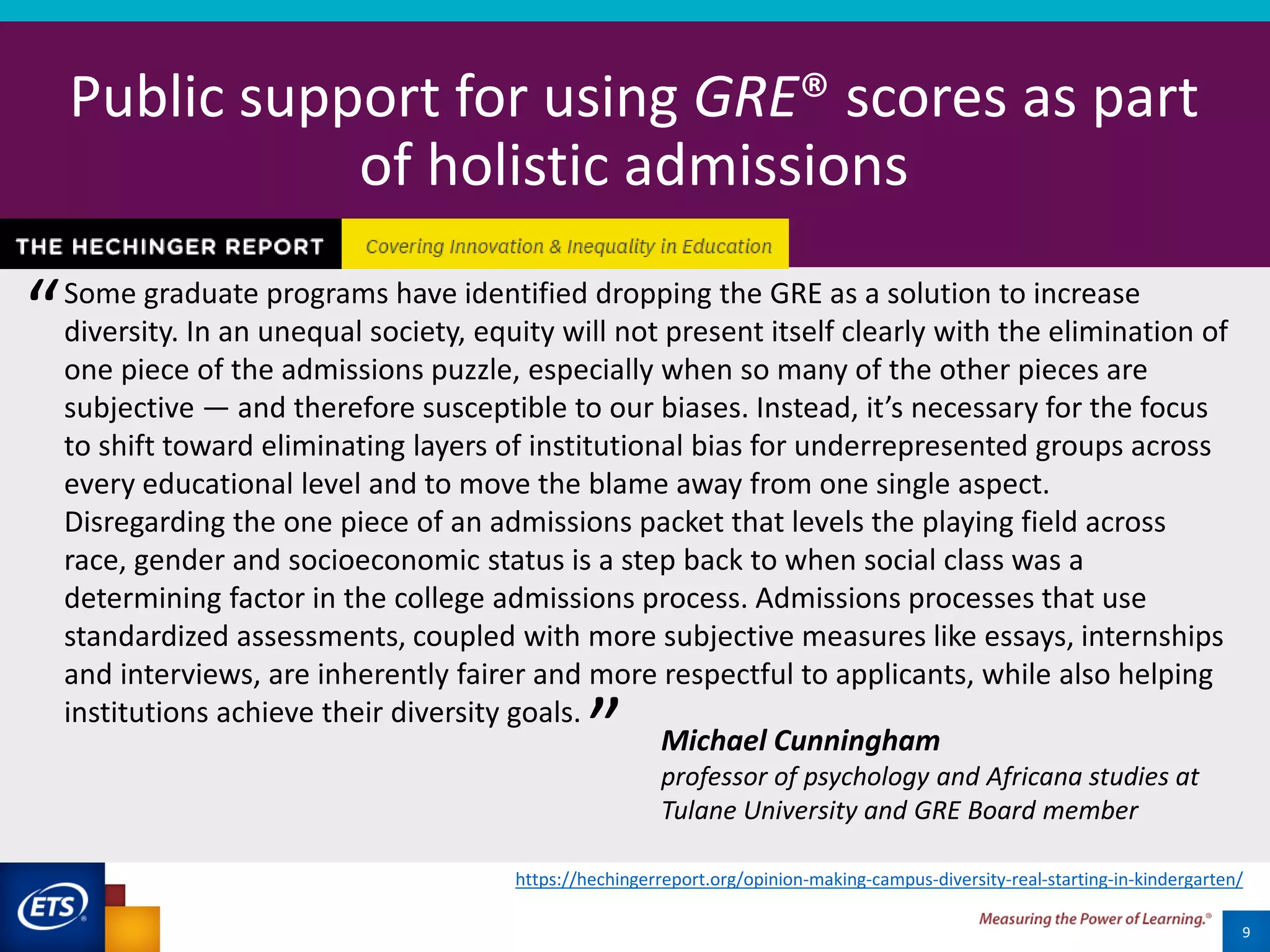
Some graduate programs have identified dropping the GRE as a solution to increase
diversity. In an unequal society, equity will not present itself clearly with the elimination of
one piece of the admissions puzzle, especially when so many of the other pieces are
subjective — and therefore susceptible to our biases. Instead, it’s necessary for the focus
to shift toward eliminating layers of institutional bias for underrepresented groups across
every educational level and to move the blame away from one single aspect.
Disregarding the one piece of an admissions packet that levels the playing field across
race, gender and socioeconomic status is a step back to when social class was a
determining factor in the college admissions process. Admissions processes that use
standardized assessments, coupled with more subjective measures like essays, internships
and interviews, are inherently fairer and more respectful to applicants, while also helping
institutions achieve their diversity goals.
Michael Cunningham
professor of psychology and Africana studies at
Tulane University and GRE Board member
“
”
https://hechingerreport.org/opinion-making-campus-diversity-real-starting-in-kindergarten/
21
Resources to help you get started – original
presentation deck
21
Available at www.holisticadmissions.org
22
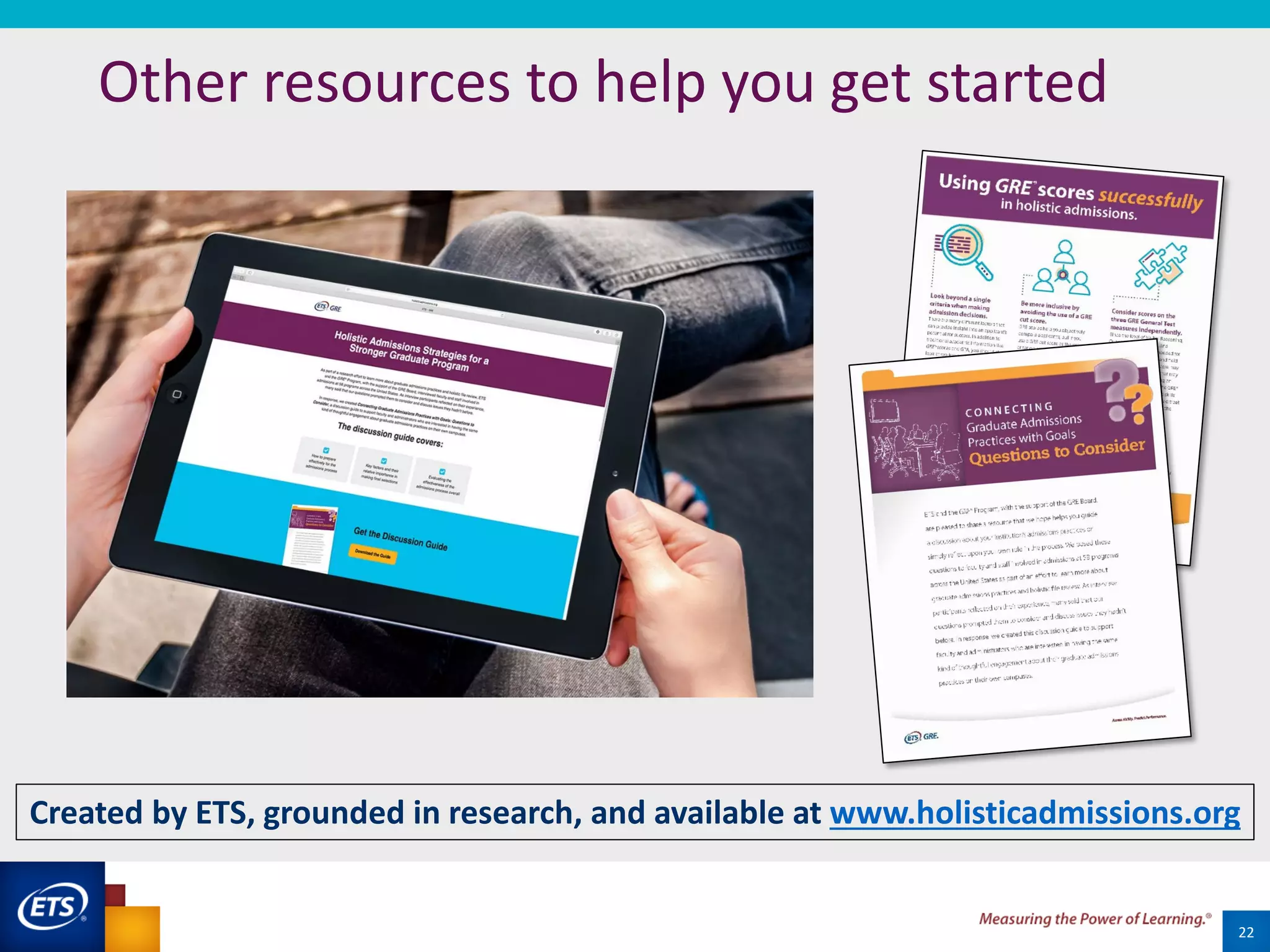
Other resources to help you get started
22
Created by ETS, grounded in research, and available at www.holisticadmissions.org
CV
Thank you!
Julie Shurts
Email: jshurts@ets.org
Phone: 1-609-252-8475
CV Copyright © 2019 by Educational Testing Service. All rights reserved. ETS, the ETS logo, MEASURING THE POWER OF LEARNING and GRE are
registered trademarks of Educational Testing Service (ETS). 43006

Holistic Admissions: Why it Matters

  • 1.
    CV Holistic Admissions: Why ItMatters and How Programs Are Addressing It Now Julie Shurts Global Education, ETS June 7, 2019 CV
  • 2.
    2 Today, I willshare • Benefits of holistic admissions • Promising practices that institutions are using now. • Resources that can help. Copyright © 2019 by Educational Testing Service. All rights reserved. ETS, the ETS logo, MEASURING THE POWER OF LEARNING and GRE are registered trademarks of Educational Testing Service (ETS). 43006
  • 3.
    3 What is holisticadmissions? A process that: • Considers all available information about an applicant to get the fullest picture possible of everything he or she can bring to a program. • Ensures that all applicants are considered. • Is intentional about the order in which components are reviewed.
  • 4.
    4 Benefits of holistic admissions •It is fairer to the applicant. • It enables programs to gain a clearer picture of an applicant’s potential fit. • It supports achieving program and institutional enrollment goals, as well as outcomes goals.
  • 5.
    5 How to movetoward a holistic admissions process • We don’t know of a “best way,” but we can share “promising practices.” • ETS’s research  71 on-campus interviews with deans and faculty to learn about current admissions practices and challenges  These interviews and extensive literature review informed the curation and development of 12 promising practices
  • 6.
    6 • Agree upongoals early on and structure entire admissions process (recruitment to enrollment) to achieve them • Be explicit about plans to identify and recruit desired populations and how to assess desired attributes • Determine the role and importance of each component of an applicant’s file Promising Practices: Goal Setting Work together to set goals and strategies to achieve them
  • 7.
    7 What can help:Discussion Guide Available at holisticadmissions.org Promising Practices: Goal Setting
  • 8.
    Determine and communicatethe application review and selection process so all decision makers understand: 8  Enrollment goals, strategy and process  How to evaluate each component of the application ̶ Role and importance ̶ Order of review ̶ What inferences can be made  How to mitigate unconscious bias  How disagreements will be resolved Promising Practices: Increasing Understanding
  • 9.
    9 Promising Practice #2 Whatcan help: An example Desired Attribute Related Component Unrelated Component Promising Practices: Increasing Understanding Determine and communicate the application review and selection process so all decision makers understand:
  • 10.
    Faculty opportunities to: •Learn about less familiar undergraduate schools, especially minority-serving institutions and those with large first-generation student populations. • Work with undergraduate students from underrepresented groups. 10 Promising Practices: Diversify the Admissions Committee
  • 11.
    Institutions that makea commitment to diversity and inclusion could consider the composition of the admissions committee so that diverse perspectives and experiences are represented and reflected. 11 Promising Practices: Diversify the Admissions Committee
  • 12.
    12 What can help: (Samplerubric for illustrative purposes) Component Maximum Points Research 5 Letters of Recommendation (LORs) 3 Work experience/CV 3 Undergrad curriculum 2 GPA 4 Personal statement 3 GRE® scores 5 Total 25 Review multiple components and don’t over rely on any one component Promising Practices: Application Review
  • 13.
    13 Component & Max Points Pointsvalues Component & Max Points Points values Research Max = 5 3 – 1 yr UG + work/internship research 2 – 1 year of UG research 0–1 – less than a year 1–2 extra for publications, posters, awards, etc. Personal statement Max = 3 1–2 – quality of writing, maturity 1 extra for overcoming challenges, contribution to diversity LORs Max = 3 3 – high on all 6 attributes 2 – high on 5 attributes 1 – high on 4 attributes GRE® Quant Max = 2 2 – 164–170 1 – 160–163 -1 – less than 142 Work exp./CV Max = 3 2 – 2+ years related work exp. 1 – 1–2 years related work exp. 1 extra for volunteer work GRE AW Max = 2 2 – 5.0–6 1 – 4.0–4.5 -1 – less than 3 UG curriculum Max = 2 1 – extensive science coursework 1 extra for high UGI challenge GRE Verbal Max = 1 1 – 150–170 0 – <149 GPA Max = 4 4 – 3.8 to 4.0 3 – 3.5 to 3.79 2 – 3.2 to 3.49 1 – 3.0 to 3.19 20–25 – Strong admit 17–19 – Admit 14–16 – Probable admit 10–13 – Probable deny 0–9 – Deny Total Score: Sample rubric for illustrative purposes
  • 14.
    14 What can help: Alternatereview processes Multistage Two Pool Separate and Convene Review multiple components and don’t over rely on any one component Promising Practices: Application Review
  • 15.
    15 • Ask programsto focus on at least three screen-in criteria. If using GRE® scores and GPA to make first cut, add at least one more criteria. • Each applicant, then, has at least three opportunities to be placed into the review pool, helping to ensure that qualified applicants aren’t overlooked due to performance on just one measure. Promising Practices: Screen In Consider ways to set criteria that would allow applicants to be included in the review, rather than excluded.
  • 16.
    16 What can help: Anexample Promising Practices: Screen In • One graduate school made two changes to their application:  Request applicants provide information about specific educational experiences.  Request recommenders rate applicants on a specific set of skills and applicants. • This information can be used in the screen-in process to create the applicant pool for review.
  • 17.
    Consider GRE® scoresa useful, positive indicator of an applicant’s preparedness for graduate study. 17 • Scores should only be used in consultation with other materials. • Consider the amount of emphasis placed on scores if GRE scores are not consistent with other materials. • GRE scores provide the most valuable information when they are required of all applicants and can be especially helpful when the undergraduate institution is unfamiliar to reviewers. Promising Practices: GRE Scores as a Positive Indicator
  • 18.
    18 Public support forusing GRE® scores as part of holistic admissions 9 Coming from an undistinguished college where I lacked access to famous letter-writers, I hoped the GRE would be an equalizer for me … it's not clear to me that, on balance, the GRE confers significant advantages to high-income students, given that (i) high-income students are more likely than low-income students to attend [liberal arts colleges] or well-regarded research schools, which already serve as proxies for excellence; (ii) because high-income students are more likely to attend selective schools, they're more likely to have famous letter-writers… Undergraduate student “ ” variety of good and bad reasons. I think I had somewhat strong letters from somewhat known people. I also had notably strong GRE scores. My impression is that the scores helped significantly when applying to grad school, since without them the strong letters and the poor grades would have sort of cancelled each other out. I think I was a relatively strong grad student and, in any case, I now have tenure. “I had somewhat poor grades as an undergraduate for a ”Faculty member www.insidehighered.com/admissions/article/2018/09/17/decision- penns-philosophy-department-renews-debate-about-gre
  • 19.
    19 Holistic admissions isabout being inclusive, not exclusive 9 • Test scores are essential because they:  Support institutions’ efforts to identify which applicants are academically prepared for graduate-level study.  Provide a common, objective measure to help programs compare applicants from different backgrounds. • However, they are just one piece of the puzzle and should always be considered along with other pieces of information.
  • 20.
    20 Public support forusing GRE® scores as part of holistic admissions 9 Some graduate programs have identified dropping the GRE as a solution to increase diversity. In an unequal society, equity will not present itself clearly with the elimination of one piece of the admissions puzzle, especially when so many of the other pieces are subjective — and therefore susceptible to our biases. Instead, it’s necessary for the focus to shift toward eliminating layers of institutional bias for underrepresented groups across every educational level and to move the blame away from one single aspect. Disregarding the one piece of an admissions packet that levels the playing field across race, gender and socioeconomic status is a step back to when social class was a determining factor in the college admissions process. Admissions processes that use standardized assessments, coupled with more subjective measures like essays, internships and interviews, are inherently fairer and more respectful to applicants, while also helping institutions achieve their diversity goals. Michael Cunningham professor of psychology and Africana studies at Tulane University and GRE Board member “ ” https://hechingerreport.org/opinion-making-campus-diversity-real-starting-in-kindergarten/
  • 21.
    21 Resources to helpyou get started – original presentation deck 21 Available at www.holisticadmissions.org
  • 22.
    22 Other resources tohelp you get started 22 Created by ETS, grounded in research, and available at www.holisticadmissions.org
  • 23.
    CV Thank you! Julie Shurts Email:jshurts@ets.org Phone: 1-609-252-8475 CV Copyright © 2019 by Educational Testing Service. All rights reserved. ETS, the ETS logo, MEASURING THE POWER OF LEARNING and GRE are registered trademarks of Educational Testing Service (ETS). 43006