Developing a Holistic Admissions Strategy
First We Need to Define! Holistic –  Emphasizing the importance of the whole and the interdependence of its parts; Concerned with wholes rather than analysis or separation into parts. The American Heritage Dictionary - 2000
Defining Holistic Admissions Holistic Admissions: 1) The use of  all  available information for the  purposes of making informed and responsible  admissions, advising and placement decisions; 2) Recognition of the importance and value of all  information and data available to admissions  professionals, and their interdependence on each other ,  in informing recruitment, admissions, advising,  placement and retention strategies
Holistic Admissions Holistic Admissions requires: The use of all available data and information A more responsible application review  process Admissions Officers have the final decision making power for student admissions More than just admissions (advising, placement, retention, student support services – i.e. Enrollment Management)
What is Holistic Admissions Holistic Admissions High School GPA High School Coursework (Core, AP/IB, etc.) ACT/SAT Scores Essay Family income  Identifying first generation students 89.4% of colleges consider standardized tests as moderate to considerate of importance in the admissions decision* Overall goal: Use all information possible to help make an informed admission decision *NACAC State of College Admissions Report 2008
Why Holistic Admissions? Use of all information gives admissions professionals the ‘whole picture’ of student’s: abilities readiness  interests  needs … and whether the college/university has the services/opportunities available to ensure greater likelihood of success for each and every student
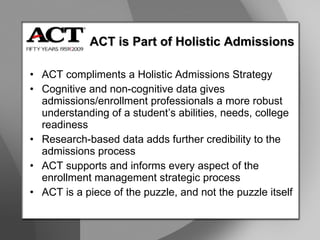
ACT is Part of Holistic Admissions ACT compliments a Holistic Admissions Strategy Cognitive and non-cognitive data gives admissions/enrollment professionals a more robust understanding of a student’s abilities, needs, college readiness Research-based data adds further credibility to the admissions process ACT supports and informs every aspect of the enrollment management strategic process ACT is a piece of the puzzle, and not the puzzle itself
Skills vs. Scores Skills vs. Scores Scores are not the ‘end game’ College Readiness Standards College Readiness Benchmarks
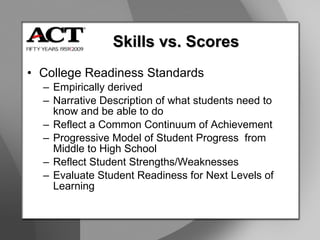
College Readiness Standards Empirically derived Narrative Description of what students need to know and be able to do Reflect a Common Continuum of Achievement Progressive Model of Student Progress  from Middle to High School Reflect Student Strengths/Weaknesses Evaluate Student Readiness for Next Levels of Learning Skills vs. Scores
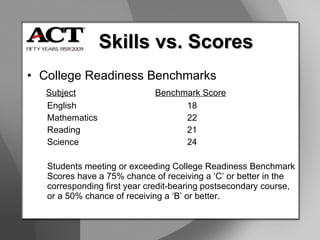
College Readiness Benchmarks   Subject Benchmark Score English 18 Mathematics 22 Reading  21 Science 24 Students meeting or exceeding College Readiness Benchmark Scores have a 75% chance of receiving a ‘C’ or better in the corresponding first year credit-bearing postsecondary course,  or a 50% chance of receiving a ‘B’ or better. Skills vs. Scores
Cognitive Data Provides a strong compliment to a holistic admissions process Informs administrators and educators as to student proficiency in core subject areas Impacts a data-driven admissions strategy Skills vs. Scores
Cognitive Data Informs more effective and data-driven advising, placement and retention strategies Provides greater insight as to student academic strengths and weaknesses, and informs student support services in being more effective in student interventions Skills vs. Scores
Non-Cognitive Data ACT collects over 200 points of data related to non-cognitive information  provided by the student themselves : School Type/Size School Choice Academic and Non-Academic Needs Extracurricular Interests Degree/Program Interest Career Interests
ACT and Holistic Admissions Cognitive and Non-Cognitive data from ACT provide a more in-depth view of student proficiency and needs Perfectly compliments and adds to an effective holistic admissions strategy Provides supporting information for a true Enrollment Management System (Admissions, Advising and Placement, Retention)
Holistic Admissions and Test Use
Holistic Admissions and Test Use Review: Holistic Admissions provides institutions with : Full compliment of data to make an informed and responsible decision in several areas: Admissions Advising Placement Student Support Services Retention
Holistic Admissions: Informs institutions on how to effectively: Admit students Provide meaningful academic and non-academic support to students Place students and their best interests at the center of the process Strengthens student support services and therefore student  access and success initiatives Holistic Admissions and Test Use
Test Optional initiatives – while promoting a more  holistic approach – may limit holistic practices by: Decreasing access to all data for informed enrollment  management decisions Removing the ‘true’ definition of ‘holistic admissions’ Requiring institutions to make decisions based on fewer facts Suppressing data that can assist in effective and informed  intervention and student support services activities/initiatives that: Increase student access to higher education Promote retention, persistence to degree and success in  postsecondary education Holistic Admissions and Test Use
A Recent article suggests that test optional decision policies maybe made due to several factors : “ Evidence suggests there are also marketing and competitive issues at play” “ Schools are saying we want to count your test scores when we like your test scores” “ Colleges making the switch usually see an immediate 10% to 20% application bump; the bigger pile of rejection letters could give the illusion that the college is more selective” “ reported average test scores…increased in recent years…because colleges are not plugging in the results of freshmen who do not submit scores” Holistic Admissions and Test Use New York Times “ The Other Side of ‘Test Optional’” July 26, 2009
NACAC Journal of College Admission Summer 2009 “ How can an ethical institution that distrusts the (test) validity or perceives it to be biased continue to evaluate any applicants using the test?” “ How can scores be meaningful in evaluating a student’s abilities when they are submitted, but irrelevant when they are withheld?” “ ..results suggest that despite the proud statements of some adopters, (test) optional admission policies are more than purely a philosophical stance.” “ results imply that 31 of the 32 institutions (top 100 Liberal Arts Colleges in US News that are Test Optional) in question are the beneficiaries of (test score) average boosts.” Holistic Admissions and Test Use
Problems “ Game the system” Lack of information to provide students with proper services and support Hinge on incomplete information to make important admissions, advising, placement and retention/persistence decisions Holistic Admissions and Test Use
Issues: #1 HS GPA alone in informing effective admissions, placement and advising practices In last ten years: 400% increase in students reporting a 4.0 GPA* Only a 24% increase in student population over same period Grade Inflation and Informed and Responsible Admissions From 1991 – 2003: grade inflation rose 6.5%** ACT scores rose by less than 1% (20.6 to 20.8) * ACT Research, 2008 ** High School Grade Inflation from 1991 to 2003 Ziomek and Woodruff 2004 Holistic Admissions and Test Use
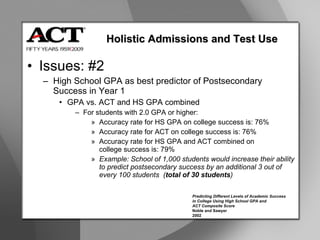
Issues: #2 High School GPA as best predictor of Postsecondary Success in Year 1 GPA vs. ACT and HS GPA combined For students with 2.0 GPA or higher:  Accuracy rate for HS GPA on college success is: 76% Accuracy rate for ACT on college success is: 76% Accuracy rate for HS GPA and ACT combined on  college success is: 79% Example: School of 1,000 students would increase their ability to predict postsecondary success by an additional 3 out of every 100 students  ( total of 30 students ) Holistic Admissions and Test Use Predicting Different Levels of Academic Success in College Using High School GPA and ACT Composite Score Noble and Sawyer 2002
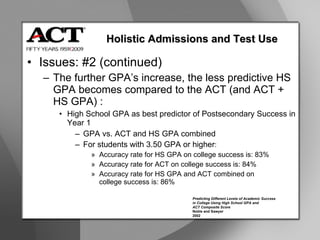
Issues: #2 (continued) The further GPA’s increase, the less predictive HS GPA becomes compared to the ACT (and ACT + HS GPA) : High School GPA as best predictor of Postsecondary Success in Year 1 GPA vs. ACT and HS GPA combined For students with 3.50 GPA or higher :  Accuracy rate for HS GPA on college success is: 83% Accuracy rate for ACT on college success is: 84% Accuracy rate for HS GPA and ACT combined on  college success is: 86% Holistic Admissions and Test Use Predicting Different Levels of Academic Success in College Using High School GPA and ACT Composite Score Noble and Sawyer 2002
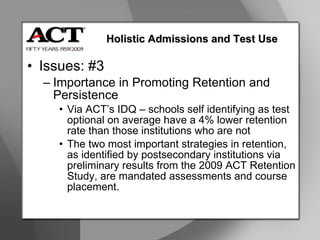
Issues: #3 Importance in Promoting Retention and Persistence Via ACT’s IDQ – schools self identifying as test optional on average have a 4% lower retention rate than those institutions who are not The two most important strategies in retention, as identified by postsecondary institutions via preliminary results from the 2009 ACT Retention Study, are mandated assessments and course placement. Holistic Admissions and Test Use
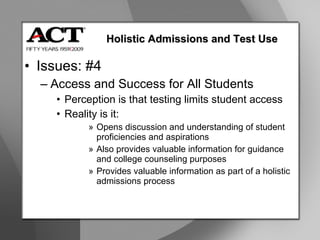
Issues: #4 Access and Success for All Students Perception is that testing limits student access Reality is it: Opens discussion and understanding of student proficiencies and aspirations Also provides valuable information for guidance and college counseling purposes Provides valuable information as part of a holistic admissions process Holistic Admissions and Test Use
What works: Use of all available data Data informs effective and student centered strategies in: Admissions Advising and Placement Retention and Persistence Predictive Modeling  Holistic Admissions and Test Use
Avoid: Limited or Purposeful lack of data  Not fully informed student support services process and or strategies Misinformed marketing practices to students and families based on selected data rather than all data Holistic Admissions and Test Use
Holistic admissions and Test Optional policy may be exclusive Both practices are not one in the same Holistic Admissions and Test Use

Holistic Admissions

  • 1.
  • 2.
    Developing a HolisticAdmissions Strategy
  • 3.
    First We Needto Define! Holistic – Emphasizing the importance of the whole and the interdependence of its parts; Concerned with wholes rather than analysis or separation into parts. The American Heritage Dictionary - 2000
  • 4.
    Defining Holistic AdmissionsHolistic Admissions: 1) The use of all available information for the purposes of making informed and responsible admissions, advising and placement decisions; 2) Recognition of the importance and value of all information and data available to admissions professionals, and their interdependence on each other , in informing recruitment, admissions, advising, placement and retention strategies
  • 5.
    Holistic Admissions HolisticAdmissions requires: The use of all available data and information A more responsible application review process Admissions Officers have the final decision making power for student admissions More than just admissions (advising, placement, retention, student support services – i.e. Enrollment Management)
  • 6.
    What is HolisticAdmissions Holistic Admissions High School GPA High School Coursework (Core, AP/IB, etc.) ACT/SAT Scores Essay Family income Identifying first generation students 89.4% of colleges consider standardized tests as moderate to considerate of importance in the admissions decision* Overall goal: Use all information possible to help make an informed admission decision *NACAC State of College Admissions Report 2008
  • 7.
    Why Holistic Admissions?Use of all information gives admissions professionals the ‘whole picture’ of student’s: abilities readiness interests needs … and whether the college/university has the services/opportunities available to ensure greater likelihood of success for each and every student
  • 8.
    ACT is Partof Holistic Admissions ACT compliments a Holistic Admissions Strategy Cognitive and non-cognitive data gives admissions/enrollment professionals a more robust understanding of a student’s abilities, needs, college readiness Research-based data adds further credibility to the admissions process ACT supports and informs every aspect of the enrollment management strategic process ACT is a piece of the puzzle, and not the puzzle itself
  • 9.
    Skills vs. ScoresSkills vs. Scores Scores are not the ‘end game’ College Readiness Standards College Readiness Benchmarks
  • 10.
    College Readiness StandardsEmpirically derived Narrative Description of what students need to know and be able to do Reflect a Common Continuum of Achievement Progressive Model of Student Progress from Middle to High School Reflect Student Strengths/Weaknesses Evaluate Student Readiness for Next Levels of Learning Skills vs. Scores
  • 11.
    College Readiness Benchmarks Subject Benchmark Score English 18 Mathematics 22 Reading 21 Science 24 Students meeting or exceeding College Readiness Benchmark Scores have a 75% chance of receiving a ‘C’ or better in the corresponding first year credit-bearing postsecondary course, or a 50% chance of receiving a ‘B’ or better. Skills vs. Scores
  • 12.
    Cognitive Data Providesa strong compliment to a holistic admissions process Informs administrators and educators as to student proficiency in core subject areas Impacts a data-driven admissions strategy Skills vs. Scores
  • 13.
    Cognitive Data Informsmore effective and data-driven advising, placement and retention strategies Provides greater insight as to student academic strengths and weaknesses, and informs student support services in being more effective in student interventions Skills vs. Scores
  • 14.
    Non-Cognitive Data ACTcollects over 200 points of data related to non-cognitive information provided by the student themselves : School Type/Size School Choice Academic and Non-Academic Needs Extracurricular Interests Degree/Program Interest Career Interests
  • 15.
    ACT and HolisticAdmissions Cognitive and Non-Cognitive data from ACT provide a more in-depth view of student proficiency and needs Perfectly compliments and adds to an effective holistic admissions strategy Provides supporting information for a true Enrollment Management System (Admissions, Advising and Placement, Retention)
  • 16.
  • 17.
    Holistic Admissions andTest Use Review: Holistic Admissions provides institutions with : Full compliment of data to make an informed and responsible decision in several areas: Admissions Advising Placement Student Support Services Retention
  • 18.
    Holistic Admissions: Informsinstitutions on how to effectively: Admit students Provide meaningful academic and non-academic support to students Place students and their best interests at the center of the process Strengthens student support services and therefore student access and success initiatives Holistic Admissions and Test Use
  • 19.
    Test Optional initiatives– while promoting a more holistic approach – may limit holistic practices by: Decreasing access to all data for informed enrollment management decisions Removing the ‘true’ definition of ‘holistic admissions’ Requiring institutions to make decisions based on fewer facts Suppressing data that can assist in effective and informed intervention and student support services activities/initiatives that: Increase student access to higher education Promote retention, persistence to degree and success in postsecondary education Holistic Admissions and Test Use
  • 20.
    A Recent articlesuggests that test optional decision policies maybe made due to several factors : “ Evidence suggests there are also marketing and competitive issues at play” “ Schools are saying we want to count your test scores when we like your test scores” “ Colleges making the switch usually see an immediate 10% to 20% application bump; the bigger pile of rejection letters could give the illusion that the college is more selective” “ reported average test scores…increased in recent years…because colleges are not plugging in the results of freshmen who do not submit scores” Holistic Admissions and Test Use New York Times “ The Other Side of ‘Test Optional’” July 26, 2009
  • 21.
    NACAC Journal ofCollege Admission Summer 2009 “ How can an ethical institution that distrusts the (test) validity or perceives it to be biased continue to evaluate any applicants using the test?” “ How can scores be meaningful in evaluating a student’s abilities when they are submitted, but irrelevant when they are withheld?” “ ..results suggest that despite the proud statements of some adopters, (test) optional admission policies are more than purely a philosophical stance.” “ results imply that 31 of the 32 institutions (top 100 Liberal Arts Colleges in US News that are Test Optional) in question are the beneficiaries of (test score) average boosts.” Holistic Admissions and Test Use
  • 22.
    Problems “ Gamethe system” Lack of information to provide students with proper services and support Hinge on incomplete information to make important admissions, advising, placement and retention/persistence decisions Holistic Admissions and Test Use
  • 23.
    Issues: #1 HSGPA alone in informing effective admissions, placement and advising practices In last ten years: 400% increase in students reporting a 4.0 GPA* Only a 24% increase in student population over same period Grade Inflation and Informed and Responsible Admissions From 1991 – 2003: grade inflation rose 6.5%** ACT scores rose by less than 1% (20.6 to 20.8) * ACT Research, 2008 ** High School Grade Inflation from 1991 to 2003 Ziomek and Woodruff 2004 Holistic Admissions and Test Use
  • 24.
    Issues: #2 HighSchool GPA as best predictor of Postsecondary Success in Year 1 GPA vs. ACT and HS GPA combined For students with 2.0 GPA or higher: Accuracy rate for HS GPA on college success is: 76% Accuracy rate for ACT on college success is: 76% Accuracy rate for HS GPA and ACT combined on college success is: 79% Example: School of 1,000 students would increase their ability to predict postsecondary success by an additional 3 out of every 100 students ( total of 30 students ) Holistic Admissions and Test Use Predicting Different Levels of Academic Success in College Using High School GPA and ACT Composite Score Noble and Sawyer 2002
  • 25.
    Issues: #2 (continued)The further GPA’s increase, the less predictive HS GPA becomes compared to the ACT (and ACT + HS GPA) : High School GPA as best predictor of Postsecondary Success in Year 1 GPA vs. ACT and HS GPA combined For students with 3.50 GPA or higher : Accuracy rate for HS GPA on college success is: 83% Accuracy rate for ACT on college success is: 84% Accuracy rate for HS GPA and ACT combined on college success is: 86% Holistic Admissions and Test Use Predicting Different Levels of Academic Success in College Using High School GPA and ACT Composite Score Noble and Sawyer 2002
  • 26.
    Issues: #3 Importancein Promoting Retention and Persistence Via ACT’s IDQ – schools self identifying as test optional on average have a 4% lower retention rate than those institutions who are not The two most important strategies in retention, as identified by postsecondary institutions via preliminary results from the 2009 ACT Retention Study, are mandated assessments and course placement. Holistic Admissions and Test Use
  • 27.
    Issues: #4 Accessand Success for All Students Perception is that testing limits student access Reality is it: Opens discussion and understanding of student proficiencies and aspirations Also provides valuable information for guidance and college counseling purposes Provides valuable information as part of a holistic admissions process Holistic Admissions and Test Use
  • 28.
    What works: Useof all available data Data informs effective and student centered strategies in: Admissions Advising and Placement Retention and Persistence Predictive Modeling Holistic Admissions and Test Use
  • 29.
    Avoid: Limited orPurposeful lack of data Not fully informed student support services process and or strategies Misinformed marketing practices to students and families based on selected data rather than all data Holistic Admissions and Test Use
  • 30.
    Holistic admissions andTest Optional policy may be exclusive Both practices are not one in the same Holistic Admissions and Test Use

Editor's Notes

  • #4 - Important to first define ‘holistic’
  • #5 From that definition – What is holistic admissions?
  • #6 Want to identify what is required for a true holistic admissions process Multiple parts that help make an informed decision Student Centered….fits the values of the profession
  • #7 All factors together help inform admissions officers, advising personnel, and others in determining admissions/advising/placement/retention policy.
  • #8 Having all information gives a strong picture of student abilities and needs Informs effective recruitment practices, admissions decisions, and student support initiatives
  • #10 Norms and Standards based Highlight the importance of ACT as part of Holistic Admissions Hit on Skills vs. Scores – not just a score Empirically derived College Readiness Standards Empirically derived College Readiness Benchmarks Help in determine college readiness, proficiency in core subjects, intervention strategies at postsecondary level
  • #12 National Norms, may not be exact to each institution, but ACT can work with institution to come up with more institutionally based benchmarks
  • #13 Cognitive data is a compliment to holistic admissions and data driven decisions at all levels of postsecondary ed.
  • #15 - Non cognitive data also provides great compliment to holistic admissions Provided by students themselves Gives insight as to student background, needs, interests, school choice
  • #18 Recap in order to connect holistic admissions to the lack of info/data from T.O.
  • #22 Test scores can also be used for recruitment advantages - EOS
  • #25 Correlations!!
  • #26 -
  • #27 Not cause and effect, but interesting observation
  • #28 - Growth in all student test taking from states to districts - - 25% over last 5 years - - increase spread evenly among all states. Increase in test takers is at faster rate than student grad. Population Fosters more students entering the postsec. pipeline. Between 2002 and 2006, Chicago students increased their college readiness by 9 percent in English, 3 percent in Reading, 2 percent in Mathematics, and 2 percent in Science. There was also a 1-percent increase in the number of students who met or exceeded all four ACT College Readiness Benchmarks. This means that an additional 305 Chicago students met all four College Readiness Benchmarks in 2006 compared to 2002. 􀂃 Most students are planning to enter some form of postsecondary education. − The number of students requesting assistance with educational or occupational plans increased by 900 between 2002 and 2006, showing increased awareness and valuing of post-high school planning. − In 2006, 61 percent of Chicago students indicated a desire to attend some form of postsecondary education: 32 percent said they aspire to graduate study or a professional-level degree, 19 percent said they aspire to a bachelor’s degree, and 10 percent said they aspire to a vocational/technical or 2-year college degree.
  • #30 - If institutions decide on Test Optional, there should be a full commitment to such a policy without exception