©2013LandesBioscience.Donotdistribute.
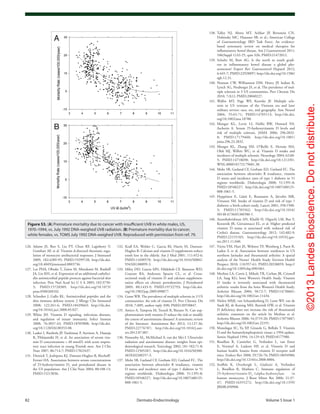
www.landesbioscience.com	Dermato-Endocrinology	 51
Dermato-Endocrinology 5:1, 51–108; January/February/March 2013; © 2013 Landes Bioscience
review REVIEW
Prehistoric Perspective
Life forms began to evolve in the oceans over 1 billion years
ago. They took advantage of sunlight and used it as an energy
source to generate carbohydrates. Curiously some of the earli-
est phytoplankton including Emiliania huxleyi (which is a coc-
colithophore, i.e., has a calcium carbonate exoskeleton) which
has existed unchanged in the Sargasso Sea (Atlantic Ocean) for
more than 500 million years when exposed to sunlight not only
*Correspondence to: Michael F. Holick; Email: mfholick@bu.edu
Submitted: 03/15/13; Accepted: 03/28/13
http://dx.doi.org/10.4161/derm.24476
Vitamin D is the sunshine vitamin that has been produced on
this earth for more than 500 million years. During exposure to
sunlight7-dehydrocholesterolintheskinabsorbsUVBradiation
and is converted to previtamin D3
which in turn isomerizes
into vitamin D3
. Previtamin D3
and vitamin D3
also absorbsUV
B radiation and are converted into a variety of photoproducts
some of which have unique biologic properties. Sun induced
vitamin D synthesis is greatly influenced by season, time
of day, latitude, altitude, air pollution, skin pigmentation,
sunscreen use, passing through glass and plastic, and aging.
Vitamin D is metabolized sequentially in the liver and kidneys
into 25-hydroxyvitamin D which is a major circulating form
and 1,25-dihydroxyvitamin D which is the biologically active
form respectively. 1,25-dihydroxyvitamin D plays an important
role in regulating calcium and phosphate metabolism
for maintenance of metabolic functions and for skeletal
health. Most cells and organs in the body have a vitamin
D receptor and many cells and organs are able to produce
1,25-dihydroxyvitamin D. As a result 1,25-dihydroxyvitamin
D influences a large number of biologic pathways which
may help explain association studies relating vitamin D
deficiency and living at higher latitudes with increased risk
for many chronic diseases including autoimmune diseases,
some cancers, cardiovascular disease, infectious disease,
schizophrenia and type 2 diabetes. A three-part strategy of
increasing food fortification programs with vitamin D, sensible
sun exposure recommendations and encouraging ingestion of
a vitamin D supplement when needed should be implemented
to prevent global vitamin D deficiency and its negative health
consequences.
Sunlight and Vitamin D
A global perspective for health
Matthias Wacker and Michael F. Holick*
Department of Medicine; Section of Endocrinology, Nutrition, and Diabetes; Vitamin D, Skin and Bone Research Laboratory; Boston University Medical Center;
Boston, MA USA
Keywords: sunlight, vitamin D, UV radiation, UVB, rickets, 25-hydroxyvitamin D, latitude, cancer, autoimmune, UV lamp
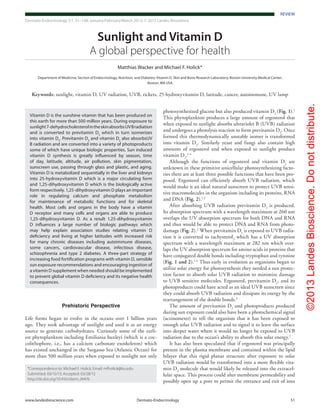
photosynthesized glucose but also produced vitamin D2
(Fig. 1).1
This phytoplankton produces a large amount of ergosterol that
when exposed to sunlight absorbs ultraviolet B (UVB) radiation
and undergoes a photolysis reaction to form previtamin D2
. Once
formed this thermodynamically unstable isomer is transformed
into vitamin D2
. Similarly yeast and fungi also contain high
amounts of ergosterol and when exposed to sunlight produce
vitamin D2
.1-4
Although the functions of ergosterol and vitamin D2
are
unknown in these primitive unicellular photosynthesizing facto-
ries there are at least three possible functions that have been pro-
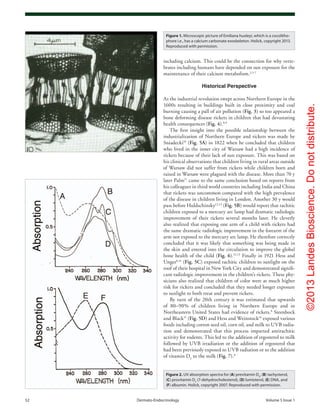
posed. Ergosterol can efficiently absorb UVB radiation, which
would make it an ideal natural sunscreen to protect UVB sensi-
tive macromolecules in the organism including its proteins, RNA
and DNA (Fig. 2).1,2
After absorbing UVB radiation previtamin D2
is produced.
Its absorption spectrum with a wavelength maximum at 260 nm
overlaps the UV absorption spectrum for both DNA and RNA
and thus would be able to protect DNA and RNA from photo-
damage (Fig. 2).2
When previtamin D2
is exposed to UVB radia-
tion it is converted to tachysterol2
which has a UV absorption
spectrum with a wavelength maximum at 282 nm which over-
laps the UV absorption spectrum for amino acids in proteins that
have conjugated double bonds including tryptophan and tyrosine
(Fig. 1 and 2).1-4
Thus early in evolution as organisms began to
utilize solar energy for photosynthesis they needed a sun protec-
tion factor to absorb solar UVB radiation to minimize damage
to UVB sensitive molecules. Ergosterol, previtamin D2
, and its
photoproducts could have acted as an ideal UVB sunscreen since
they could absorb UVB radiation and dissipate its energy by the
rearrangement of the double bonds.2
The amount of previtamin D2
and photoproducts produced
during sun exposure could also have been a photochemical signal
(actinometer) to tell the organism that it has been exposed to
enough solar UVB radiation and to signal it to leave the surface
into deeper water where it would no longer be exposed to UVB
radiation due to the ocean’s ability to absorb this solar energy.2
It has also been speculated that if ergosterol was principally
present in the plasma membrane and contained within the lipid
bilayer that this rigid planar structure after exposure to solar
UVB radiation would be transformed into a more flexible vita-
min D2
molecule that would likely be released into the extracel-
lular space. This process could alter membrane permeability and
possibly open up a pore to permit the entrance and exit of ions
©2013LandesBioscience.Donotdistribute.
52	 Dermato-Endocrinology	Volume 5 Issue 1
including calcium. This could be the connection for why verte-
brates including humans have depended on sun exposure for the
maintenance of their calcium metabolism.2,5-7
Historical Perspective
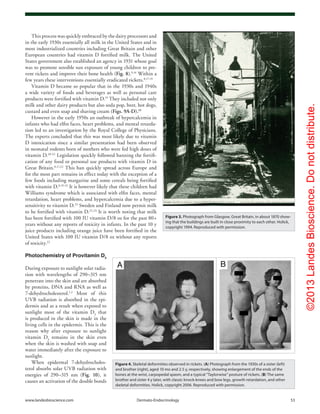
As the industrial revolution swept across Northern Europe in the
1600s resulting in buildings built in close proximity and coal
burning causing a pall of air pollution (Fig. 3) so too appeared a
bone deforming disease rickets in children that had devastating
health consequences (Fig. 4).8,9
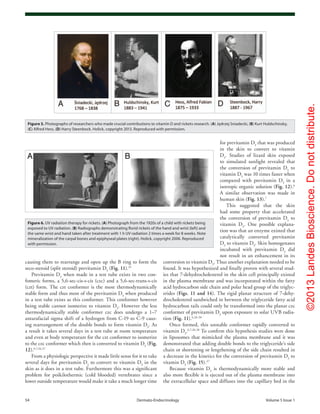
The first insight into the possible relationship between the
industrialization of Northern Europe and rickets was made by
Sniadecki10
(Fig. 5A) in 1822 when he concluded that children
who lived in the inner city of Warsaw had a high incidence of
rickets because of their lack of sun exposure. This was based on
his clinical observations that children living in rural areas outside
of Warsaw did not suffer from rickets while children born and
raised in Warsaw were plagued with the disease. More than 70 y
later Palm11
came to the same conclusion based on reports from
his colleagues in third world countries including India and China
that rickets was uncommon compared with the high prevalence
of the disease in children living in London. Another 30 y would
pass before Huldschinsky12,13
(Fig. 5B) would report that rachitic
children exposed to a mercury arc lamp had dramatic radiologic
improvement of their rickets several months later. He cleverly
also realized that exposing one arm of a child with rickets had
the same dramatic radiologic improvement in the forearm of the
arm not exposed to the mercury arc lamp. He therefore correctly
concluded that it was likely that something was being made in
the skin and entered into the circulation to improve the global
bone health of the child (Fig. 6).12,13
Finally in 1921 Hess and
Unger8,14
(Fig. 5C) exposed rachitic children to sunlight on the
roof of their hospital in New York City and demonstrated signifi-
cant radiologic improvement in the children’s rickets. These phy-
sicians also realized that children of color were at much higher
risk for rickets and concluded that they needed longer exposure
to sunlight to both treat and prevent rickets.
By turn of the 20th century it was estimated that upwards
of 80–90% of children living in Northern Europe and in
Northeastern United States had evidence of rickets.8
Steenbock
and Black15
(Fig. 5D) and Hess and Weinstock16
exposed various
foods including cotton seed oil, corn oil, and milk to UVB radia-
tion and demonstrated that this process imparted antirachitic
activity for rodents. This led to the addition of ergosterol to milk
followed by UVB irradiation or the addition of ergosterol that
had been previously exposed to UVB radiation or to the addition
of vitamin D2
to the milk (Fig. 7).8
Figure 1. Microscopic picture of Emiliana huxleyi, which is a cocolitho-
phore i.e., has a calcium carbonate exoskeleton. Holick, copyright 2013.
Reproduced with permission.
Figure 2. UV absorption spectra for (A) previtamin D3
, (B) tachysterol,
(C) provitamin D3
(7-dehydrocholesterol), (D) lumisterol, (E) DNA, and
(F) albumin. Holick, copyright 2007. Reproduced with permission.
©2013LandesBioscience.Donotdistribute.
www.landesbioscience.com	Dermato-Endocrinology	 53
This process was quickly embraced by the dairy processors and
in the early 1930s essentially all milk in the United States and in
most industrialized countries including Great Britain and other
European countries had vitamin D fortified milk. The United
States government also established an agency in 1931 whose goal
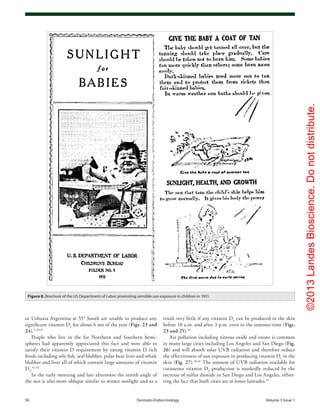
was to promote sensible sun exposure of young children to pre-
vent rickets and improve their bone health (Fig. 8).9,14
Within a
few years these interventions essentially eradicated rickets.8,17-19
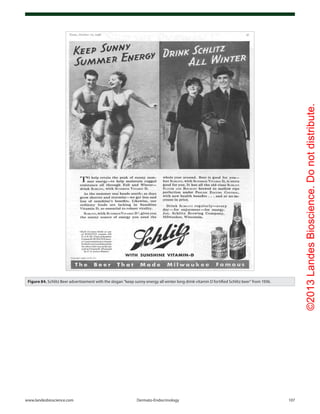
Vitamin D became so popular that in the 1930s and 1940s
a wide variety of foods and beverages as well as personal care
products were fortified with vitamin D.19
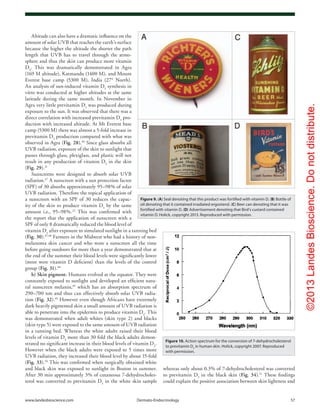
They included not only
milk and other dairy products but also soda pop, beer, hot dogs,
custard and even soap and shaving cream (Figs. 9A-D).19
However in the early 1950s an outbreak of hypercalcemia in
infants who had elfin faces, heart problems, and mental retarda-
tion led to an investigation by the Royal College of Physicians.
The experts concluded that this was most likely due to vitamin
D intoxication since a similar presentation had been observed
in neonatal rodents born of mothers who were fed high doses of
vitamin D.20-22
Legislation quickly followed banning the fortifi-
cation of any food or personal use products with vitamin D in
Great Britain.8,17,22
This ban quickly spread across Europe and
for the most part remains in effect today with the exception of a
few foods including margarine and some cereals being fortified
with vitamin D.8,19-22
It is however likely that these children had
Williams syndrome which is associated with elfin faces, mental
retardation, heart problems, and hypercalcemia due to a hyper-
sensitivity to vitamin D.23
Sweden and Finland now permit milk
to be fortified with vitamin D.22,24
It is worth noting that milk
has been fortified with 100 IU vitamin D/8 oz for the past 80+
years without any reports of toxicity in infants. In the past 10 y
juice products including orange juice have been fortified in the
United States with 100 IU vitamin D/8 oz without any reports
of toxicity.22
Photochemistry of Provitamin D3
During exposure to sunlight solar radia-
tion with wavelengths of 290–315 nm
penetrate into the skin and are absorbed
by proteins, DNA and RNA as well as
7-dehydrocholesterol.1,2
Most of this
UVB radiation is absorbed in the epi-
dermis and as a result when exposed to
sunlight most of the vitamin D3
that
is produced in the skin is made in the
living cells in the epidermis. This is the
reason why after exposure to sunlight
vitamin D3
remains in the skin even
when the skin is washed with soap and
water immediately after the exposure to
sunlight.
When epidermal 7-dehydrocholes-
terol absorbs solar UVB radiation with
energies of 290–315 nm (Fig. 10), it
causes an activation of the double bonds
Figure 3. Photograph from Glasgow, Great Britain, in about 1870 show-
ing that the buildings are built in close proximity to each other. Holick,
copyright 1994. Reproduced with permission.
Figure 4. Skeletal deformities observed in rickets. (A) Photograph from the 1930s of a sister (left)
and brother (right), aged 10 mo and 2.5 y, respectively, showing enlargement of the ends of the
bones at the wrist, carpopedal spasm, and a typical “Taylorwise” posture of rickets. (B) The same
brother and sister 4 y later, with classic knock-knees and bow legs, growth retardation, and other
skeletal deformities. Holick, copyright 2006. Reproduced with permission.
©2013LandesBioscience.Donotdistribute.
54	 Dermato-Endocrinology	Volume 5 Issue 1
for previtamin D3
that was produced
in the skin to convert to vitamin
D3
. Studies of lizard skin exposed
to simulated sunlight revealed that
the conversion of previtamin D3
to
vitamin D3
was 10 times faster when
compared with previtamin D3
in a
isotropic organic solution (Fig. 12).6
A similar observation was made in
human skin (Fig. 13).7
This suggested that the skin
had some property that accelerated
the conversion of previtamin D3
to
vitamin D3
. One possible explana-
tion was that an enzyme existed that
catalytically converted previtamin
D3
to vitamin D3
. Skin homogenates
incubated with previtamin D3
did
not result in an enhancement in its
conversion to vitamin D3
. Thus another explanation needed to be
found. It was hypothesized and finally proven with several stud-
ies that 7-dehydrocholesterol in the skin cell principally existed
in the plasma membrane and was incorporated within the fatty
acid hydrocarbon side chain and polar head group of the triglyc-
erides (Figs. 11 and 14). The rigid planar structure of 7-dehy-
drocholesterol sandwiched in between the triglyceride fatty acid
hydrocarbon tails could only be transformed into the planar czc
conformer of previtamin D3
upon exposure to solar UVB radia-
tion (Fig. 11).6,26-28
Once formed, this unstable conformer rapidly converted to
vitamin D3
.6,7,26-28
To confirm this hypothesis studies were done
in liposomes that mimicked the plasma membrane and it was
demonstrated that adding double bonds to the triglyceride’s side
chain or shortening or lengthening of the side chain resulted in
a decrease in the kinetics for the conversion of previtamin D3
to
vitamin D3
(Fig. 15).27
Because vitamin D3
is thermodynamically more stable and
also more flexible it is ejected out of the plasma membrane into
the extracellular space and diffuses into the capillary bed in the
causing them to rearrange and open up the B ring to form the
seco-steroid (split steroid) previtamin D3
(Fig. 11).25
Previtamin D3
when made in a test tube exists in two con-
fomeric forms, a 5,6-sec-cis-s-cis (czc) and a 5,6-sec-trans-s-cis
(czt) form. The czt conformer is the most thermodynamically
stable form and thus most of the previtamin D3
when produced
in a test tube exists as this conformer. This conformer however
being stable cannot isomerize to vitamin D3
. However the less
thermodynamically stable conformer czc does undergo a 1–7
antarafacial sigma shift of a hydrogen from C-19 to C-9 caus-
ing rearrangement of the double bonds to form vitamin D3
. As
a result it takes several days in a test tube at room temperature
and even at body temperature for the czt conformer to isomerize
to the czc conformer which then is converted to vitamin D3
(Fig.
12).6,7,26,27
From a physiologic perspective it made little sense for it to take
several days for previtamin D3
to convert to vitamin D3
in the
skin as it does in a test tube. Furthermore this was a significant
problem for poikilothermic (cold blooded) vertebrates since a
lower outside temperature would make it take a much longer time
Figure 5. Photographs of researchers who made crucial contributions to vitamin D and rickets research. (A) Jędrzej Sniadecki, (B) Kurt Huldschinsky,
(C) Alfred Hess, (D) Harry Steenbock. Holick, copyright 2013. Reproduced with permission.
Figure 6. UV radiation therapy for rickets. (A) Photograph from the 1920s of a child with rickets being
exposed to UV radiation. (B) Radiographs demonstrating florid rickets of the hand and wrist (left) and
the same wrist and hand taken after treatment with 1 h UV radiation 2 times a week for 8 weeks. Note
mineralization of the carpal bones and epiphyseal plates (right). Holick, copyright 2006. Reproduced
with permission.
©2013LandesBioscience.Donotdistribute.
www.landesbioscience.com	Dermato-Endocrinology	 55
Therefore sensible sun exposure to produce previtamin D3
, vita-
min D3
and its photoproducts may have some additional ben-
efits above and beyond simply taking a vitamin D3
supplement or
ingesting vitamin D3
from dietary sources.
Factors that Influence Cutaneous
Vitamin D3
Synthesis
a) Zenith angle. Only about one percent of solar UVB radia-
tion ever reaches the earth’s surface even in the summer at noon
time.38
The reason is that all of the UV C (200–280 nm) and all
of the UVB radiation up to approximately 290 nm is efficiently
absorbed by the stratospheric ozone layer.38,39
In addition the
ozone layer absorbs approximately 99% of the UVB radiation
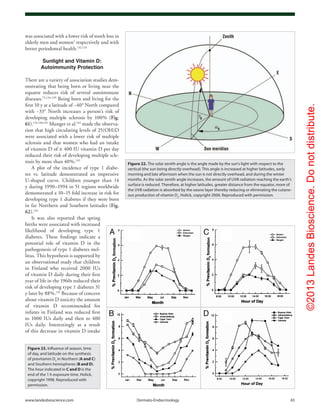
with wavelengths 291–320 nm. Therefore increasing the path
length by which solar UVB has to travel through the ozone
layer will result in a decrease in the number of UVB photons
that reach the earth’s surface (Fig. 22).40
This is the explana-
tion for why during the winter when living above and below
approximately 33° latitude very little if any vitamin D3
can be
produced in the skin from sun exposure. People who live far-
ther North and South often cannot make any vitamin D3
in
their skin for up to 6 mo of the year.41
For example in Boston
at 42° North essentially no vitamin D3
can be produced in the
skin from November through February. Inhabitants living in
Edmonton Canada at 52° North, Bergen Norway at 60° North,
dermis where it is bound to the vitamin
D binding protein (DBP) for transport to
the liver.2,5,6,22,29,30
There has been a lot of discussion as
to whether ingesting vitamin D from
the diet or from a supplement is the
same as producing vitamin D3
in the
skin. Because it takes approximately 8
h for previtamin D3
in the skin to fully
convert to vitamin D3
26,27
and it takes
additional time for the vitamin D3
to
enter the dermal capillary bed there are
at least 2 of the explanations for why it
was observed that vitamin D3
produced
in the skin last 2–3 times longer in the
circulation when compared with ingest-
ing it orally (Fig. 16).29,30
Furthermore
when vitamin D3
is produced in the skin
100% of it is potentially bound to the
vitamin D binding protein (Fig. 17).
When vitamin D3
is ingested from the
diet or supplement it gets incorporated
into chylomicrons which are transported
into the lymphatic system and then into
the venous system were approximately
60% of the vitamin D3
is bound to the
vitamin D binding protein and 40% is
rapidly cleared in the lipoprotein bound
fraction.29
Sun Controlled Cutaneous Production of Vitamin D3
During exposure to sunlight after previtamin D3
is produced it
will absorb solar UVB radiation and isomerize into two major
photoproducts, lumisterol3
and tachysterol3
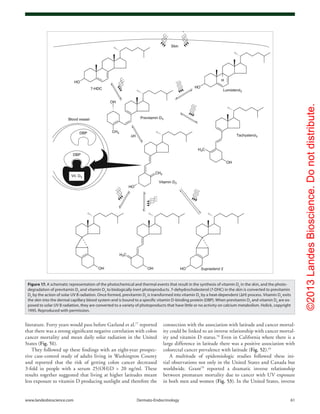
(Fig. 17).31,32
Neither of these two photoproducts has any effect on cal-
cium metabolism.32
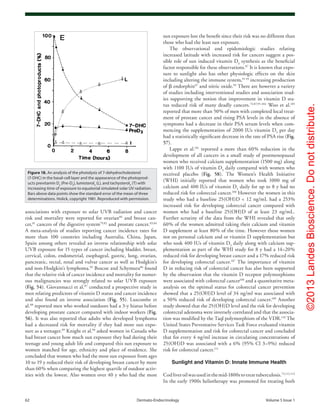
Thus when the skin is exposed to sunlight
it can only convert approximately 15% of 7-dehydrocholesterol
to previtamin D3
(Fig. 18).32
Any further exposure will result
in a photoequilibrium whereby previtamin D3
is converted into
lumisterol3
and tachysterol3
as well as revert back to 7-dehydro-
cholesterol (Fig. 17). In addition when vitamin D3
is made from
previtamin D3
in the skin if it is exposed to solar UVB radia-
tion it will absorb UVB radiation and be converted into several
suprasterols and 5,6-trans-vitamin D3
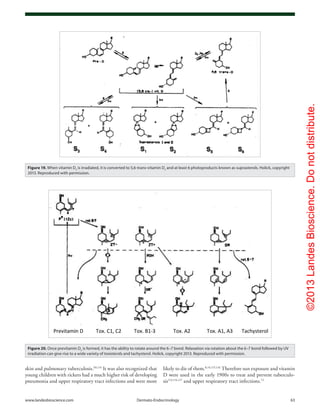
(Figs. 17, 19). In addition
previtamin D3
can also be converted to several toxisterols (Fig.
20).33-36
Therefore no matter how much sun a human is exposed
to vitamin D intoxication will not occur because any excess pre-
vitamin D3
and vitamin D3
is photodegraded into products that
have no calcemic activity.31,32
Thishoweverdoesnotmeanthatthesemyriadofphotoproducts
don’t have other biologic effects such as regulating epidermal cell
growth and reducing risk of skin cancer. One product, lumisterol3
,
if converted to 1,25-dihydroxylumisterol3
may have anti-tumor
effects in the skin.37
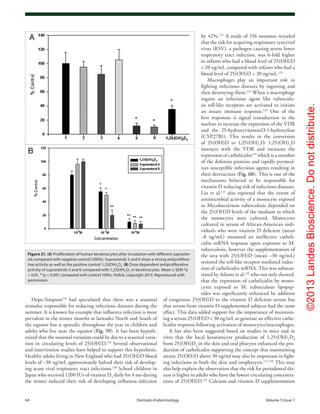
Some of the suprasterols also have antip-
roliferative activity in cultured human keratinocytes (Fig. 21).
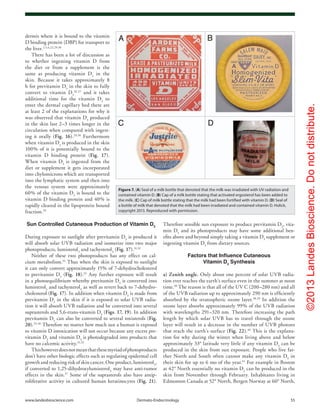
Figure 7. (A) Seal of a milk bottle that denoted that the milk was irradiated with UV radiation and
contained vitamin D. (B) Cap of a milk bottle stating that activated ergosterol has been added to
the milk. (C) Cap of milk bottle stating that the milk had been fortified with vitamin D. (D) Seal of
a bottle of milk that denoted that the milk had been irradiated and contained vitamin D. Holick,
copyright 2013. Reproduced with permission.
©2013LandesBioscience.Donotdistribute.
56	 Dermato-Endocrinology	Volume 5 Issue 1
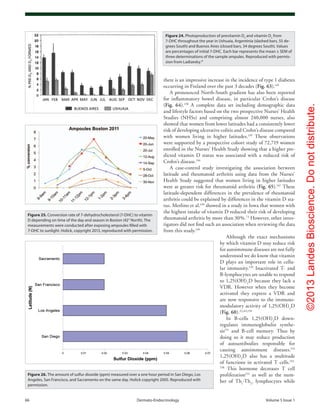
result very little if any vitamin D3
can be produced in the skin
before 10 a.m. and after 3 p.m. even in the summer time (Figs.
23 and 25).44
Air pollution including nitrous oxide and ozone is common
in many large cities including Los Angeles and San Diego (Fig.
26) and will absorb solar UVB radiation and therefore reduce
the effectiveness of sun exposure in producing vitamin D3
in the
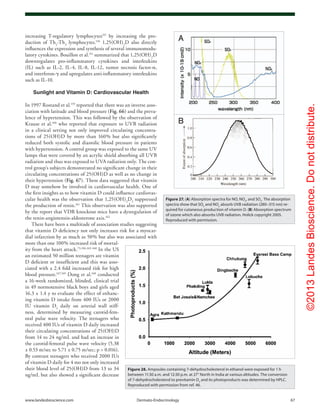
skin (Fig. 27).40,45
The amount of UVB radiation available for
cutaneous vitamin D3
production is markedly reduced by the
increase of sulfur dioxide in San Diego and Los Angeles, offset-
ting the fact that both cities are at lower latitudes.45
or Ushuaia Argentina at 55° South are unable to produce any
significant vitamin D3
for about 6 mo of the year (Figs. 23 and
24).2,39,41
People who live in the far Northern and Southern hemi-
spheres had apparently appreciated this fact and were able to
satisfy their vitamin D requirement by eating vitamin D rich
foods including oily fish, seal blubber, polar bear liver and whale
blubber and liver all of which contain large amounts of vitamin
D3
.42,43
In the early morning and late afternoon the zenith angle of
the sun is also more oblique similar to winter sunlight and as a
Figure 8. Brochure of the US Department of Labor promoting sensible sun exposure in children in 1931.
©2013LandesBioscience.Donotdistribute.
www.landesbioscience.com	Dermato-Endocrinology	 57
whereas only about 0.3% of 7-dehydrocholesterol was converted
to previtamin D3
in the black skin (Fig. 34).51
These findings
could explain the positive association between skin lightness and
Altitude can also have a dramatic influence on the
amount of solar UVB that reaches the earth’s surface
because the higher the altitude the shorter the path
length that UVB has to travel through the atmo-
sphere and thus the skin can produce more vitamin
D3
. This was dramatically demonstrated in Agra
(169 M altitude), Katmandu (1400 M), and Mount
Everest base camp (5300 M), India (27° North).
An analysis of sun-induced vitamin D3
synthesis in
vitro was conducted at higher altitudes at the same
latitude during the same month. In November in
Agra very little previtamin D3
was produced during
exposure to the sun. It was observed that there was a
direct correlation with increased previtamin D3
pro-
duction with increased altitude. At Mt Everest base
camp (5300 M) there was almost a 5-fold increase in
previtamin D3
production compared with what was
observed in Agra (Fig. 28).46
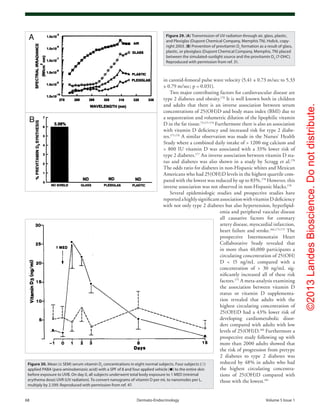
Since glass absorbs all
UVB radiation, exposure of the skin to sunlight that
passes through glass, plexiglass, and plastic will not
result in any production of vitamin D3
in the skin
(Fig. 29).31
Sunscreens were designed to absorb solar UVB
radiation.47
A sunscreen with a sun protection factor
(SPF) of 30 absorbs approximately 95–98% of solar
UVB radiation. Therefore the topical application of
a sunscreen with an SPF of 30 reduces the capac-
ity of the skin to produce vitamin D3
by the same
amount i.e., 95–98%.22
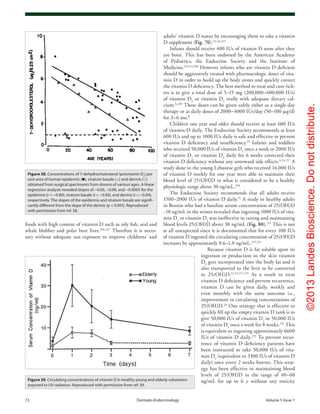
This was confirmed with
the report that the application of sunscreen with a
SPF of only 8 dramatically reduced the blood level of
vitamin D3
after exposure to simulated sunlight in a tanning bed
(Fig. 30).47,48
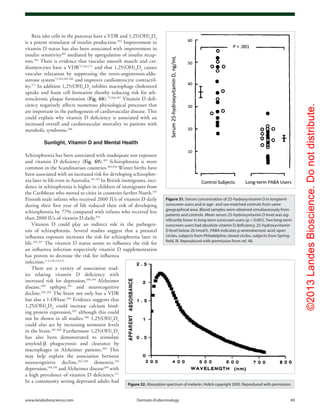
Farmers in the Midwest who had a history of non-
melanoma skin cancer and who wore a sunscreen all the time
before going outdoors for more than a year demonstrated that at
the end of the summer their blood levels were significantly lower
(most were vitamin D deficient) than the levels of the control
group (Fig. 31).48
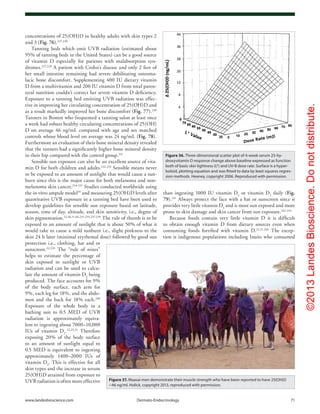
b) Skin pigment. Humans evolved at the equator. They were
constantly exposed to sunlight and developed an efficient natu-
ral sunscreen melanin,49
which has an absorption spectrum of
290–700 nm and thus can effectively absorb solar UVB radia-
tion (Fig. 32).45
However even though Africans have extremely
dark heavily pigmented skin a small amount of UVB radiation is
able to penetrate into the epidermis to produce vitamin D3
. This
was demonstrated when adult whites (skin type 2) and blacks
(skin type 5) were exposed to the same amount of UVB radiation
in a tanning bed. Whereas the white adults raised their blood
levels of vitamin D3
more than 30 fold the black adults demon-
strated no significant increase in their blood levels of vitamin D3
.
However when the black adults were exposed to 5 times more
UVB radiation, they increased their blood level by about 15-fold
(Fig. 33).50
This was confirmed when surgically obtained white
and black skin was exposed to sunlight in Boston in summer.
After 30 min approximately 3% of cutaneous 7-dehydrocholes-
terol was converted to previtamin D3
in the white skin sample
Figure 9. (A) Seal denoting that this product was fortified with vitamin D. (B) Bottle of
oil denoting that it contained irradiated ergosterol. (C) Beer can denoting that it was
fortified with vitamin D. (D) Advertisement denoting that Bird’s custard contained
vitamin D. Holick, copyright 2013. Reproduced with permission.
Figure 10. Action spectrum for the conversion of 7-dehydrocholesterol
to previtamin D3
in human skin. Holick, copyright 2007. Reproduced
with permission.
©2013LandesBioscience.Donotdistribute.
58	 Dermato-Endocrinology	Volume 5 Issue 1
Skin pigmentation or the lack
thereof was important in the evo-
lution of humans as they migrated
North and South of the equator.
Africans such as the Maasai (Fig.
37) living outdoors exposed to sun-
light daily throughout the year have
robust circulating concentrations of
the major circulating form of vita-
min D, 25(OH)D, in the range of
46 ng/mL.53
Although there have been sev-
eral explanations for why skin pig-
ment devolved as humans migrated
North and South of the equator one
of the most likely explanations is
as humans migrated farther North
and South of the equator the zenith
angle of the sun increased resulting
in a decrease in the amount of solar
UVB radiation reaching the earth
thereby reducing vitamin D3
synthe-
sis. A decrease in the amount of skin
pigment resulted in a decrease in the
sun screening protection permitting
more of the UVB radiation to reach
the epidermal cells. This provided
an evolutionary advantage by being
more efficient in producing vitamin
D3
.49
It had long been speculated
that our Neanderthal ancestors were
heavily pigmented hairy creatures.
This however did not make a lot of
sense since having heavy pigmenta-
tion and excessive hair would markedly reduce cutaneous produc-
tion of vitamin D3
which was essential for maximizing skeletal
health throughout life thereby reducing risk of life-threatening
fractures. However, more important is the fact that vitamin D
deficiency in utero and during the first few years of life would
have caused infantile rickets resulting in a flat deformed pelvis
with a small pelvic outlet. Furthermore vitamin D is important
for muscle function which is also crucial for birthing.22,54
These
conditions caused by vitamin D deficiency would have made it
difficult for females to give birth. Therefore in order to survive
and procreate skin pigmentation had to markedly decrease in
order to permit more UVB photons to enter the skin to produce
sufficient amounts of previtamin D3
.54,55
Recent evidence has
suggested that Neanderthals had a mutation of their melanocyte
stimulating hormone receptor resulting in them being redheaded
and having Celtic-like fair skin.56,57
This is the likely explanation
for why people in Northern Europe have skin types 1 and 2.
c) Aging. It was observed that 7-dehydrocholesterol concen-
trations in human epidermis were inversely related to age (Fig.
38).58
The effect of aging on the cutaneous production of vita-
min D3
was demonstrated in a study that exposed healthy young
adults and older adults to the same amount of UVB radiation
25-hydroxyvitamin D [25(OH)D] levels as found by Armas et
al.52
(Fig. 35). The associations between skin lightness, UVB
dose and 25(OH)D are documented in Figure 36.
Figure 11. Photolysis of provitamin D3
(pro-D3
, 7-dehydrocholesterol) into previtamin D3
(pre-D3
) and its
thermal isomerization to vitamin D3
in hexane and in lizard skin at 25°C. In hexane pro-D3
is photolyzed
to s-cis,s-cis-pre-D3
. Once formed, this energetically unstable conformation undergoes a conformational
change to the s-trans,s-cis-pre-D3
. Only the s-cis,s-cis-pre-D3
can undergo thermal isomerization to
vitamin D3
. The s-cis,s-cis conformer of pre-D3
is stabilized in the phospholipid bilayer by hydrophilic
interactions between the 3β-hydroxl group and the polar head of the lipids, as well as by the van der
Waals interactions between the steroid ring and side-chain structure and the hydrophobic tail of the lip-
ids. These interactions significantly decrease the conversion of the s-cis,s-cis conformer to the s-trans,s-
cis conformer, thereby facilitating the thermal isomerization of s-cis,s-cis-pre-D3
to vitamin D3
. Holick,
copyright 1995. Reproduced with permission.
Figure 12. Thermal isomerization of previtamin D3
to vitamin D3
as a
function of time in lizard skin (●) and in hexane (□) at 25°C (left) and
5°C (right). Each point represents the mean value from three separate
analyses. Holick, copyright 1995. Reproduced with permission.
©2013LandesBioscience.Donotdistribute.
www.landesbioscience.com	Dermato-Endocrinology	 59
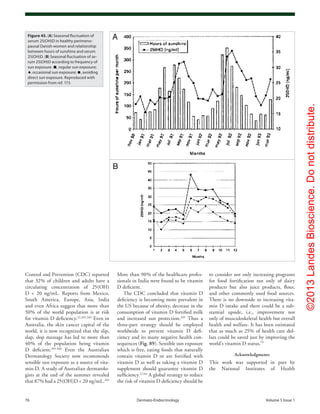
(~30 ng/mL) and the nadir was observed in February (~14 ng/mL)
(Fig. 44).61
A similar observation was made in postmenopausal
women in Denmark. Those who had regular sun exposure
achieved a blood level of 25(OH)D of ~45 ng/mL compared
with women who avoided direct sun exposure had a 25(OH)D
of ~23 ng/mL. This was also supported by the fact that hours of
sun exposure was directly related to circulating concentrations of
25(OH)D (Fig. 45).62
in a tanning bed. The increase in
the blood level of vitamin D3
in six
young adults aged 20–30 was at least
3-fold higher compared with the six
older adults aged 62–80 demonstrat-
ing that aging significantly decreased
the capacity of the skin to produce
vitamin D3
(Fig. 39).59
With this
marked age-related decrease in the
cutaneous production of vitamin D3
could the elderly benefit from being
exposed to sunlight or UVB radia-
tion? The skin has a large capacity
to produce vitamin D3
. Exposure of
a young adult in a bathing suit to one
minimal erythemal dose (MED) of
UV radiation in a tanning bed was
equivalent to ingesting approxi-
mately 20,000 IUs of vitamin D2
(Fig. 40).25
When a healthy 75 y old
male in a bathing suit was exposed
to UVB radiation in a tanning bed
three times a week for 7 weeks he was
able to raise and maintain his blood
levels of 25(OH)D into the healthy
normal range of ~50 ng/ml (Fig.
41C). The percent increase in circu-
lating 25(OH)D concentrations was
similar to what was observed in healthy young adults (Fig. 41B).
Ampoules containing 7-DHC that were also irradiated served to
demonstrate the efficacy of the tanning bed in producing previ-
tamin D3
(Fig. 41A).5
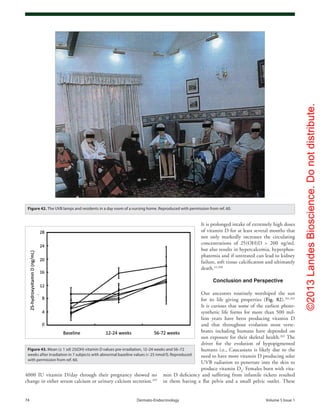
A study in elderly in a nursing home that
had an activity room with an UVB emitting lamps on the ceiling
(Fig. 42) reported that this was effective in raising and maintain-
ing 25(OH)D levels in these residents (Fig. 43).60
Influence of Latitude and Season
on Vitamin D Status
It is well documented that seasonal differences in cutaneous
vitamin D3
production have a dramatic influence on both chil-
dren’s and adults’ vitamin D status (D represents vitamin D2
or vitamin D3
).22
A study of 7437 Caucasian men and women
from the 1958 British birth cohort at age 45 y revealed that the
peak blood levels for 25(OH)D were observed in September
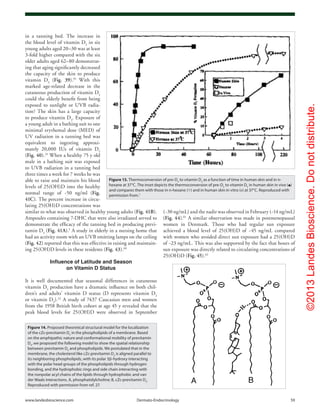
Figure 13. Thermoconversion of pre-D3
to vitamin D3
as a function of time in human skin and in n-
hexane at 37°C. The inset depicts the thermoconversion of pre-D3
to vitamin D3
in human skin in vivo (◼)
and compares them with those in n-hexane (▽) and in human skin in vitro (ν) at 37°C. Reproduced with
permission from.7
Figure 14. Proposed theoretical structural model for the localization
of the cZc-previtamin D3
in the phospholipids of a membrane. Based
on the amphipathic nature and conformational mobility of previtamin
D3
, we proposed the following model to show the spatial relationship
between previtamin D3
and phospholipids. We postulated that in the
membrane, the cholesterol like cZc-previtamin D3
is aligned parallel to
its neighboring phospholipids, with its polar 3β-hydroxy interacting
with the polar head groups of the phospholipids through hydrogen
bonding, and the hydrophobic rings and side chain interacting with
the nonpolar acyl chains of the lipids through hydrophobic and van
der Waals interactions. A, phosphatidylcholine; B, cZc-previtamin D3
.
Reproduced with permission from ref. 27.
©2013LandesBioscience.Donotdistribute.
60	 Dermato-Endocrinology	Volume 5 Issue 1
Sunlight and Non-Calcemic Health Benefits
Historical perspective. People have a feeling of wellbeing when
exposed to sunlight. This may be due to the fact that kerati-
nocytes produce β-endorphin when exposed to UV radiation.67
In the early 1900s Finsen (Fig. 47) observed that exposure to
sunlight (Fig. 48) dramatically improved cutaneous skin lesions
caused by a tuberculosis infection (lupus vulgaris) and received
the Nobel Prize in 1903 for his enlightening observations.
This led to the use of solariums as a way to treat patients with
tuberculosis and gave rise to the use of heliotherapy to improve
health.19,68,69
Heliotherapy was used to treat a wide variety
of chronic illnesses in the early 1900s and it is still practiced
throughout the world and especially in Northern Europe.19,70-72
The rise in the use of pharmaceuticals to treat acute and chronic
diseases led to the demise of heliotherapy especially in United
States.19,68,69,73
Sunlight and Vitamin D:
The Cancer Connection
One of the first association studies
relating sun exposure with reduced
risk for cancer was reported in 1916
by Hoffman,74
who found that liv-
ing at a higher latitude was asso-
ciated with an increased risk for
mortality from cancer. He com-
pared cancer mortality between
1908 and 1912 and observed that
cancer mortality increased with
increasing distance from the equa-
tor (Fig. 49). In 1937 Peller and
Stephenson75
analyzed the inci-
dence of cancer in navy personnel
in the United States Navy who
were documented to have increased
exposure to solar UV radiation with age matched controls and
reported that the rate of skin cancer was eight times higher in
the navy personnel while the total number of deaths from other
cancers was 60% less than the civilian population.75
Four years later, Apperly76
compared total cancer mortality in
the populations studied with the percentage of Americans and
Canadians in the same population who were engaged in agricul-
ture. He concluded that cancer mortality was highest in farmers
living in the Northeast compared with those living in the South
(Fig. 50).76
He also reported that farmers living in the South
exposed to more sunlight were at a higher risk for nonmelanoma
skin cancer which he noted was easy to detect and easy to treat.
He concluded that the fact that these Southern farmers had non-
melanoma skin cancer resulted in them developing an immunity
to the skin cancer which also resulted in an immunity to all can-
cers including those with high mortality rate.76
These observations essentially went unnoticed and the curi-
ous relationship of increased sun exposure and living at a lower
latitude reducing risk of cancer mortality was buried in the
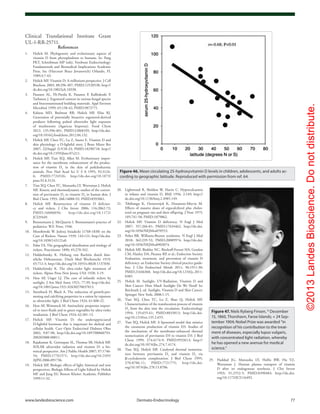
Latitude also has a dramatic influence on the cutaneous produc-
tion of vitamin D3
and therefore on a person’s vitamin D status
(Fig. 46).39,63
Mean circulating 25(OH)D in children, adolescents
and adults at various latitudes revealed that there was a significant
inverse relationship with the highest levels for those living near the
equator with blood levels of 25(OH)D ~40 ng/mL compared with
those living far North and South of the equator with blood levels of
25(OH)D ~15 ng/mL (Fig. 46).64
However another study reported that those living at the high-
est latitudes in Europe had higher circulating concentrations of
25(OH)D.65
The likely explanation is that some people living far North and
South of the equator who could not make any significant amount
of vitamin D3
in their skin for more than half of the year (Fig. 24)
adapted by eating foods rich in vitamin D including oily fish22,42,43
while others did not.39,44,66
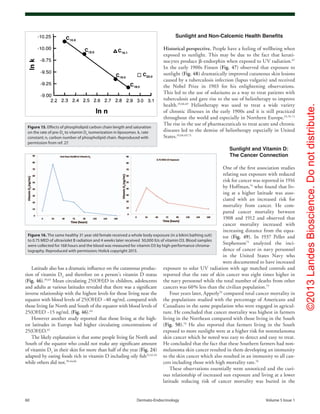
Figure 16. The same healthy 31 year old female received a whole body exposure (in a bikini bathing suit)
to 0.75 MED of ultraviolet B radiation and 4 weeks later received 50,000 IUs of vitamin D3. Blood samples
were collected for 168 hours and the blood was measured for vitamin D3 by high-performance chroma-
tography. Reproduced with permission; Holick copyright 2013.
Figure 15. Effects of phospholipid carbon chain length and saturation
on the rate of pre-D3
to vitamin D3
isomerization in liposomes. k, rate
constant; n, carbon number of phospholipid chain. Reproduced with
permission from ref. 27.
©2013LandesBioscience.Donotdistribute.
www.landesbioscience.com	Dermato-Endocrinology	 61
connection with the association with latitude and cancer mortal-
ity could be linked to an inverse relationship with cancer mortal-
ity and vitamin D status.78
Even in California where there is a
large difference in latitude there was a positive association with
colorectal cancer prevalence with latitude (Fig. 52).45
A multitude of epidemiologic studies followed these ini-
tial observations not only in the United States and Canada but
worldwide. Grant79
reported a dramatic inverse relationship
between premature mortality due to cancer with UV exposure
in both men and women (Fig. 53). In the United States, inverse
literature. Forty years would pass before Garland et al.77
reported
that there was a strong significant negative correlation with colon
cancer mortality and mean daily solar radiation in the United
States (Fig. 51).
They followed up these findings with an eight-year prospec-
tive case-control study of adults living in Washington County
and reported that the risk of getting colon cancer decreased
3-fold in people with a serum 25(OH)D > 20 ng/ml. These
results together suggested that living at higher latitudes meant
less exposure to vitamin D producing sunlight and therefore the
Figure 17. A schematic representation of the photochemical and thermal events that result in the synthesis of vitamin D3
in the skin, and the photo-
degradation of previtamin D3
and vitamin D3
to biologically inert photoproducts. 7-dehydrocholesterol (7-DHC) in the skin is converted to previtamin
D3
by the action of solar UV B radiation. Once formed, previtamin D3
is transformed into vitamin D3
by a heat-dependent (ΔH) process. Vitamin D3
exits
the skin into the dermal capillary blood system and is bound to a specific vitamin D-binding protein (DBP). When previtamin D3
and vitamin D3
are ex-
posed to solar UV B radiation, they are converted to a variety of photoproducts that have little or no activity on calcium metabolism. Holick, copyright
1995. Reproduced with permission.
©2013LandesBioscience.Donotdistribute.
62	 Dermato-Endocrinology	Volume 5 Issue 1
sun exposure lost the benefit since their risk was no different than
those who had the least sun exposure.
The observational and epidemiologic studies relating
increased latitude with increased risk for cancers suggest a pos-
sible role of sun induced vitamin D3
synthesis as the beneficial
factor responsible for these observations.87
It is known that expo-
sure to sunlight also has other physiologic effects on the skin
including altering the immune system,91-93
increasing production
of β endorphin67
and nitric oxide.94
There are however a variety
of studies including interventional studies and association stud-
ies supporting the notion that improvement in vitamin D sta-
tus reduced risk of many deadly cancers.73,87,95-104
Woo et al.105
reported that more than 50% of men with completed local treat-
ment of prostate cancer and rising PSA levels in the absence of
symptoms had a decrease in their PSA serum levels when com-
mencing the supplementation of 2000 IUs vitamin D3
per day
had a statistically significant decrease in the rate of PSA rise (Fig.
57).
Lappe et al.101
reported a more than 60% reduction in the
development of all cancers in a small study of postmenopausal
women who received calcium supplementation (1500 mg) along
with 1100 IUs of vitamin D3
daily compared with women who
received placebo (Fig. 58). The Women’s Health Initiative
(WHI) initially reported that women who took 1000 mg of
calcium and 400 IUs of vitamin D3
daily for up to 8 y had no
reduced risk for colorectal cancer.106
However the women in this
study who had a baseline 25(OH)D < 12 ng/mL had a 253%
increased risk for developing colorectal cancer compared with
women who had a baseline 25(OH)D of at least 23 ng/mL.
Further scrutiny of the data from the WHI revealed that only
60% of the women admitted taking their calcium and vitamin
D supplement at least 80% of the time. However those women
not on personal calcium and or vitamin D supplementation but
who took 400 IUs of vitamin D3
daily along with calcium sup-
plementation as part of the WHI study for 8 y had a 14–20%
reduced risk for developing breast cancer and a 17% reduced risk
for developing colorectal cancer.107
The importance of vitamin
D in reducing risk of colorectal cancer has also been supported
by the observation that the vitamin D receptor polymorphisms
were associated with colorectal cancer108
and a quantitative meta-
analysis on the optimal status for colorectal cancer prevention
showed that a 25(OH)D level of 34 ng/ml was associated with
a 50% reduced risk of developing colorectal cancer.109
Another
study showed that the 25(OH)D level and the risk for developing
colorectal adenoma were inversely correlated and that the associa-
tion was modified by the Taql polymorphism of the VDR.110
The
United States Preventative Services Task Force evaluated vitamin
D supplementation and risk for colorectal cancer and concluded
that for every 4 ng/ml increase in circulating concentrations of
25(OH)D was associated with a 6% (95% Cl 3–9%) reduced
risk for colorectal cancer.111
Sunlight and Vitamin D: Innate Immune Health
Codliveroilwasusedinthemid-1800stotreattuberculosis.73,112,113
In the early 1900s heliotherapy was promoted for treating both
associations with exposure to solar UVB radiation and cancer
risk and mortality were reported for ovarian80
and breast can-
cer,81
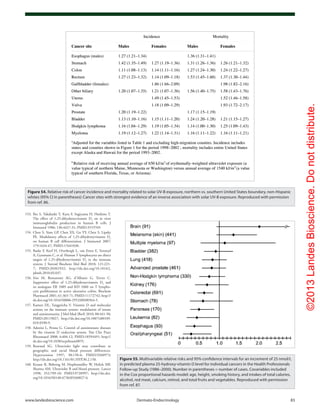
cancers of the digestive system79,82
and prostate cancer.83,84
A meta-analysis of studies reporting cancer incidence rates for
more than 100 countries including Australia, China, Japan,
Spain among others revealed an inverse relationship with solar
UVB exposure for 15 types of cancer including bladder, breast,
cervical, colon, endometrial, esophageal, gastric, lung, ovarian,
pancreatic, rectal, renal and vulvar cancer as well as Hodgkin’s
and non-Hodgkin’s lymphoma.85
Boscoe and Schymura86
found
that the relative risk of cancer incidence and mortality for numer-
ous malignancies was strongly related to solar UVB exposure
(Fig. 54). Giovannucci et al.87
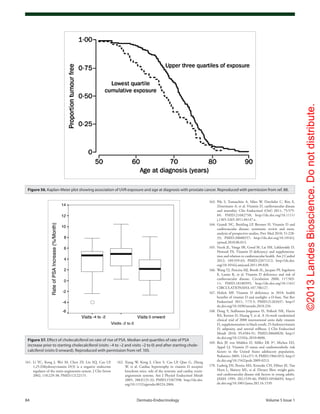
conducted a prospective study in
men relating predictors of vitamin D status and cancer incidence
and also found an inverse association (Fig. 55). Luscombe et
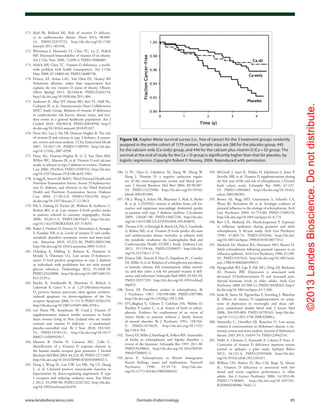
al.88
reported men who worked outdoors had a 3-y hiatus before
developing prostate cancer compared with indoor workers (Fig.
56). It was also reported that adults who developed lymphoma
had a decreased risk for mortality if they had more sun expo-
sure as a teenager.89
Knight et al.90
asked women in Canada who
had breast cancer how much sun exposure they had during their
teenage and young adult life and compared this sun exposure to
women matched for age, ethnicity and place of residence. She
concluded that women who had the most sun exposure from ages
10 to 19 y reduced their risk of developing breast cancer by more
than 60% when comparing the highest quartile of outdoor activ-
ities with the lowest. Also women over 40 y who had the most
Figure 18. An analysis of the photolysis of 7-dehydrocholesterol
(7-DHC) in the basal-cell layer and the appearance of the photoprod-
ucts previtamin D3
(Pre-D3
), lumisterol3
(L), and tachysterol3
(T) with
increasing time of exposure to equatorial simulated solar UV radiation.
Bars above data points show the standard error of the mean of three
determinations. Holick, copyright 1981. Reproduced with permission.
©2013LandesBioscience.Donotdistribute.
www.landesbioscience.com	Dermato-Endocrinology	 63
likely to die of them.8,14,115,116
Therefore sun exposure and vitamin
D were used in the early 1900s to treat and prevent tuberculo-
sis113,114,117
and upper respiratory tract infections.72
skin and pulmonary tuberculosis.69,114
It was also recognized that
young children with rickets had a much higher risk of developing
pneumonia and upper respiratory tract infections and were more
Figure 19. When vitamin D3
is irradiated, it is converted to 5,6-trans-vitamin D3
and at least 6 photoproducts known as suprasterols. Holick, copyright
2013. Reproduced with permission.
Figure 20. Once previtamin D3
is formed, it has the ability to rotate around the 6–7 bond. Relaxation via rotation about the 6–7 bond followed by UV
irradiation can give rise to a wide variety of toxisterols and tachysterol. Holick, copyright 2013. Reproduced with permission.
©2013LandesBioscience.Donotdistribute.
64	 Dermato-Endocrinology	Volume 5 Issue 1
by 42%.121
A study of 156 neonates revealed
that the risk for acquiring respiratory syncytial
virus (RSV), a pathogen causing severe lower
respiratory tract infection, was 6-fold higher
in infants who had a blood level of 25(OH)D
< 20 ng/mL compared with infants who had a
blood level of 25(OH)D > 30 ng/mL.122
Macrophages play an important role in
fighting infectious diseases by ingesting and
then destroying them.123
When a macrophage
ingests an infectious agent like tuberculo-
sis toll-like receptors are activated to initiate
an innate immune response.124
One of the
first responses is signal transduction to the
nucleus to increase the expression of the VDR
and the 25-hydroxyvitaminD-1-hydroxylase
(CYP27B1). This results in the conversion
of 25(OH)D to 1,25(OH)2
D. 1,25(OH)2
D
interacts with the VDR and increases the
expression of cathelicidin125
which is a member
of the defensin proteins and rapidly permeal-
izes susceptible infectious agents resulting in
their destruction (Fig. 60). This is one of the
mechanisms believed to be responsible for
vitamin D reducing risk of infectious diseases.
Liu et al.125
also reported that the extent of
antimicrobial activity of a monocyte exposed
to Mycobacterium tuberculosis depended on
the 25(OH)D levels of the medium in which
the monocytes were cultured. Monocytes
cultured in serum of African-American indi-
viduals who were vitamin D deficient (mean
~8 ng/mL) mounted an ineffective catheli-
cidin mRNA response upon exposure to M.
tuberculosis, however the supplementation of
the sera with 25(OH)D (mean ~30 ng/mL)
restored the toll-like receptor mediated induc-
tion of cathelicidin mRNA. This was substan-
tiated by Adams et al.126
who not only showed,
that the expression of cathelicidin by mono-
cytes exposed to M. tuberculosis lipopep-
tides was significantly enhanced by addition
of exogenous 25(OH)D to the vitamin D deficient serum but
that serum from vitamin D-supplemented subjects had the same
effect. This data added support for the importance of maintain-
ing a serum 25(OH)D > 30 ng/mL to generate an effective cathe-
licidin response following activation of monocytes/macrophages.
It has also been suggested based on studies in mice and in
vitro that the local keratinocyte production of 1,25(OH)2
D3
from 25(OH)D3
in the skin and oral pharynx enhanced the pro-
duction of cathelicidin supporting the concept that maintaining
serum 25(OH)D above 30 ng/ml may also be important in fight-
ing infections in both the skin and oropharynx.127-130
This may
also help explain the observation that the risk for periodontal dis-
ease is higher in adults who have the lowest circulating concentra-
tions of 25(OH)D.131
Calcium and vitamin D supplementation
Hope-Simpson118
had speculated that there was a seasonal
stimulus responsible for reducing infectious diseases during the
summer. It is known for example that influenza infection is most
prevalent in the winter months at latitudes North and South of
the equator but is sporadic throughout the year in children and
adults who live near the equator (Fig. 59). It has been hypoth-
esized that the seasonal variation could be due to a seasonal varia-
tion in circulating levels of 25(OH)D.119
Several observational
and intervention studies have helped to support this hypothesis.
Healthy adults living in New England who had 25(OH)D blood
levels of ~38 ng/mL approximately halved their risk of develop-
ing acute viral respiratory tract infections.120
School children in
Japan who received 1200 IUs of vitamin D3
daily for 4 mo during
the winter reduced their risk of developing influenza infection
Figure 21. (A) Proliferation of human keratinocytes after incubation with different supraster-
ols compared with negative control (100%). Suprasterols 5 and 6 show a strong antiprolifera-
tive activity as well as the positive control 1,25(OH)2
D3
. (B) Dose dependent antiproliferative
activity of suprasterols 5 and 6 compared with 1,25(OH)2
D3
in keratinocytes. Mean ± SEM *p
< 0.01, **p < 0.001 compared with control 100%. Holick, copyright 2013. Reproduced with
permission.
©2013LandesBioscience.Donotdistribute.
www.landesbioscience.com	Dermato-Endocrinology	 65
was associated with a lower risk of tooth loss in
elderly men and women1
respectively and with
better periodontal health.132,133
Sunlight and Vitamin D:
Autoimmunity Protection
There are a variety of association studies dem-
onstrating that being born or living near the
equator reduces risk of several autoimmune
diseases.73,134-139
Being born and living for the
first 10 y at a latitude of ~40° North compared
with ~33° North increases a person’s risk of
developing multiple sclerosis by 100% (Fig.
61).134,140,141
Munger et al.142
made the observa-
tion that high circulating levels of 25(OH)D
were associated with a lower risk of multiple
sclerosis and that women who had an intake
of vitamin D of ≥ 400 IU vitamin D per day
reduced their risk of developing multiple scle-
rosis by more than 40%.143
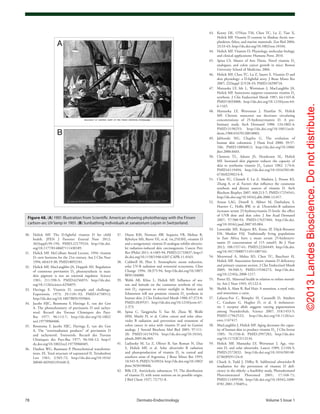
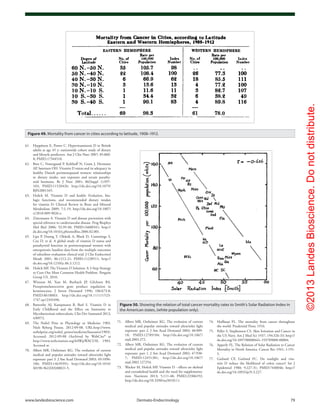
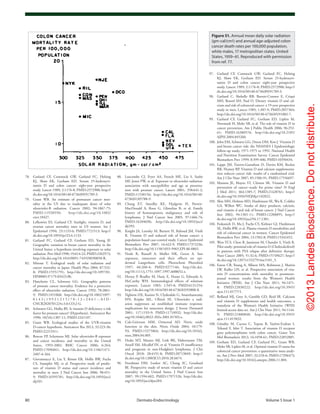
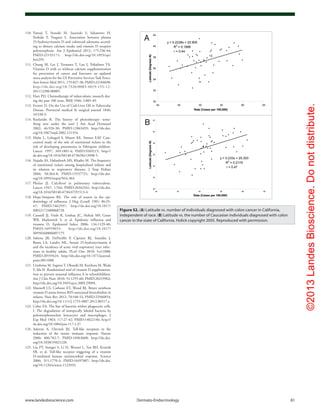
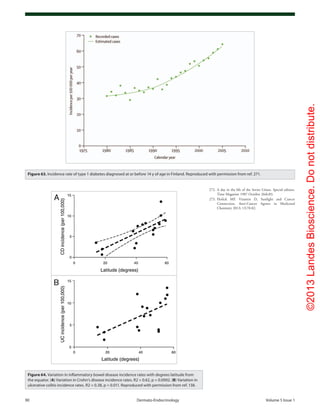
A plot of the incidence of type 1 diabe-
tes vs. latitude demonstrated an impressive
U-shaped curve. Children younger than 14
y during 1990–1994 in 51 regions worldwide
demonstrated a 10–15 fold increase in risk for
developing type 1 diabetes if they were born
in far Northern and Southern latitudes (Fig.
62).144
It was also reported that spring
births were associated with increased
likelihood of developing type 1
diabetes. These findings indicate a
potential role of vitamin D in the
pathogenesis of type 1 diabetes mel-
litus. This hypothesis is supported by
an observational study that children
in Finland who received 2000 IUs
of vitamin D daily during their first
year of life in the 1960s reduced their
risk of developing type 1 diabetes 31
y later by 88%.145
Because of concern
about vitamin D toxicity the amount
of vitamin D recommended for
infants in Finland was reduced first
to 1000 IUs daily and then to 400
IUs daily. Interestingly as a result
of this decrease in vitamin D intake
Figure 22. The solar zenith angle is the angle made by the sun’s light with respect to the
vertical (the sun being directly overhead). This angle is increased at higher latitudes, early
morning and late afternoon when the sun is not directly overhead, and during the winter
months. As the solar zenith angle increases, the amount of UVB radiation reaching the earth’s
surface is reduced. Therefore, at higher latitudes, greater distance from the equator, more of
the UVB radiation is absorbed by the ozone layer thereby reducing or eliminating the cutane-
ous production of vitamin D3
. Holick, copyright 2006. Reproduced with permission.
Figure 23. Influence of season, time
of day, and latitude on the synthesis
of previtamin D3
in Northern (A and C)
and Southern hemispheres (B and D).
The hour indicated in C and D is the
end of the 1 h exposure time. Holick,
copyright 1998. Reproduced with
permission.
©2013LandesBioscience.Donotdistribute.
66	 Dermato-Endocrinology	Volume 5 Issue 1
there is an impressive increase in the incidence of type 1 diabetes
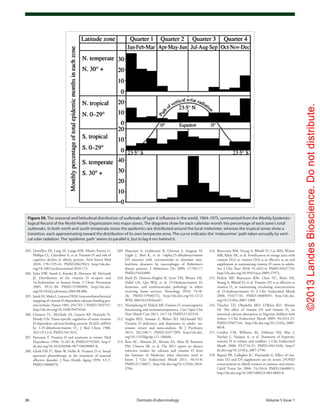
occurring in Finland over the past 3 decades (Fig. 63).145
A pronounced North-South gradient has also been reported
for inflammatory bowel disease, in particular Crohn’s disease
(Fig. 64).138
A complete data set including demographic data
and lifestyle factors based on the two prospective Nurses’ Health
Studies (NHSs) and comprising almost 240,000 nurses, also
showed that women from lower latitudes had a consistently lower
risk of developing ulcerative colitis and Crohn’s disease compared
with women living in higher latitudes.139
These observations
were supported by a prospective cohort study of 72,719 women
enrolled in the Nurses’ Health Study showing that a higher pre-
dicted vitamin D status was associated with a reduced risk of
Crohn’s disease.146
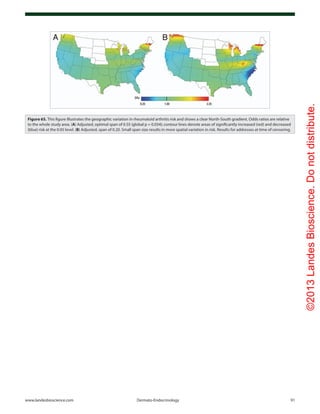
A case-control study investigating the association between
latitude and rheumatoid arthritis using data from the Nurses’
Health Study suggested that women living in higher latitudes
were at greater risk for rheumatoid arthritis (Fig. 65).147
These
latitude-dependent differences in the prevalence of rheumatoid
arthritis could be explained by differences in the vitamin D sta-
tus. Merlino et al.148
showed in a study in Iowa that women with
the highest intake of vitamin D reduced their risk of developing
rheumatoid arthritis by more than 30%.73
However, other inves-
tigators did not find such an association when reviewing the data
from this study.149
Although the exact mechanisms
by which vitamin D may reduce risk
for autoimmune diseases are not fully
understood we do know that vitamin
D plays an important role in cellu-
lar immunity.135
Inactivated T- and
B-lymphocytes are unable to respond
to 1,25(OH)2
D because they lack a
VDR. However when they become
activated they express a VDR and
are now responsive to the immuno-
modulatory activity of 1,25(OH)2
D
(Fig. 60).22,63,150
In B-cells 1,25(OH)2
D down-
regulates immunoglobulin synthe-
sis151
and B-cell memory. Thus by
doing so it may reduce production
of autoantibodies responsible for
causing autoimmune diseases.152
1,25(OH)2
D also has a multitude
of functions in activated T cells.153-
158
This hormone decreases T cell
proliferation154
as well as the num-
ber of Th1
-Th17
lymphocytes while
Figure 24. Photoproduction of previtamin D3
and vitamin D3
from
7-DHC throughout the year in Ushuaia, Argentinia (slashed bars, 55 de-
grees South) and Buenos Aires (closed bars, 34 degrees South). Values
are percentages of initial 7-DHC. Each bar represents the mean ± SEM of
three determinations of the sample ampules. Reproduced with permis-
sion from Ladizesky.41
Figure 25. Conversion rate of 7-dehydrocholesterol (7-DHC) to vitamin
D depending on time of the day and season in Boston (42° North). The
measurements were conducted after exposing ampoules filled with
7-DHC to sunlight. Holick, copyright 2013, reproduced with permission.
Figure 26. The amount of sulfur dioxide (ppm) measured over a one hour period in San Diego, Los
Angeles, San Francisco, and Sacramento on the same day. Holick copyright 2005. Reproduced with
permission.
©2013LandesBioscience.Donotdistribute.
www.landesbioscience.com	Dermato-Endocrinology	 67
increasing T-regulatory lymphocytes155
by increasing the pro-
duction of Th2
-Th3
lymphocytes.156
1,25(OH)2
D also directly
influences the expression and synthesis of several immunomodu-
latory cytokines. Bouillon et al.151
summarized that 1,25(OH)2
D
downregulates pro-inflammatory cytokines and interleukins
(IL) such as IL-2, IL-4, IL-8, IL-12, tumor necrosis factor-α,
and interferon-γ and upregulates anti-inflammatory interleukins
such as IL-10.
Sunlight and Vitamin D: Cardiovascular Health
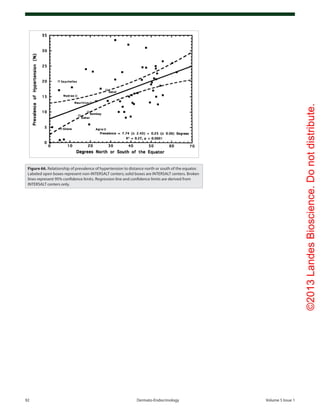
In 1997 Rostand et al.159
reported that there was an inverse asso-
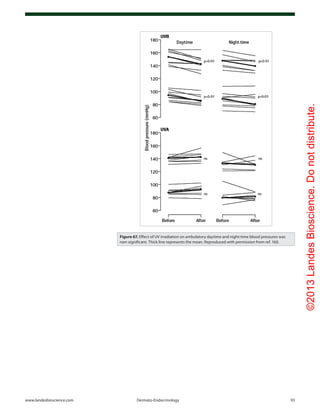
ciation with latitude and blood pressure (Fig. 66) and the preva-
lence of hypertension. This was followed by the observation of
Krause et al.160
who reported that exposure to UVB radiation
in a clinical setting not only improved circulating concentra-
tions of 25(OH)D by more than 160% but also significantly
reduced both systolic and diastolic blood pressure in patients
with hypertension. A control group was exposed to the same UV
lamps that were covered by an acrylic shield absorbing all UVB
radiation and thus was exposed to UVA radiation only. The con-
trol group’s subjects demonstrated no significant change in their
circulating concentrations of 25(OH)D as well as no change in
their hypertension (Fig. 67). These data suggested that vitamin
D may somehow be involved in cardiovascular health. One of
the first insights as to how vitamin D could influence cardiovas-
cular health was the observation that 1,25(OH)2
D3
suppressed
the production of renin.161
This observation was also supported
by the report that VDR knockout mice have a dysregulation of
the renin-angiotensin-aldosterone axis.162
There have been a multitude of association studies suggesting
that vitamin D deficiency not only increases risk for a myocar-
dial infarction by as much as 50% but also was associated with
more than one 100% increased risk of mortal-
ity from the heart attack.73,106,163-168
In the US
an estimated 50 million teenagers are vitamin
D deficient or insufficient and this was asso-
ciated with a 2.4 fold increased risk for high
blood pressure.167,169
Dong et al.168
conducted
a 16-week randomized, blinded, clinical trial
in 49 normotensive black boys and girls aged
16.3 ± 1.4 y to evaluate the effect of enhanc-
ing vitamin D intake from 400 IUs or 2000
IU vitamin D3
daily on arterial wall stiff-
ness, determined by measuring carotid-fem-
oral pulse wave velocity. The teenagers who
received 400 IUs of vitamin D daily increased
their circulating concentrations of 25(OH)D
from 14 to 24 ng/mL and had an increase in
the carotid-femoral pulse wave velocity (5.38
± 0.53 m/sec to 5.71 ± 0.75 m/sec; p = 0.016).
By contrast teenagers who received 2000 IUs
of vitamin D daily for 4 mo not only increased
their blood level of 25(OH)D from 13 to 34
ng/mL but also showed a significant decrease
Figure 27. (A) Absorption spectra for NO, NO2
, and SO2
. The absorption
spectra show that SO2
and NO2
absorb UVB radiation (280–315 nm) re-
quired for cutaneous production of vitamin D. (B) Absorption spectrum
of ozone which also absorbs UVB radiation. Holick copyright 2005.
Reproduced with permission.
Figure 28. Ampoules containing 7-dehydrocholesterol in ethanol were exposed for 1 h
between 11:30 a.m. and 12:30 p.m. at 27° North in India at various altitudes. The conversion
of 7-dehydrocholesterol to previtamin D3
and its photoproducts was determined by HPLC.
Reproduced with permission from ref. 46.
©2013LandesBioscience.Donotdistribute.
68	 Dermato-Endocrinology	Volume 5 Issue 1
in carotid-femoral pulse wave velocity (5.41 ± 0.73 m/sec to 5.33
± 0.79 m/sec; p = 0.031).
Two major contributing factors for cardiovascular disease are
type 2 diabetes and obesity.170
It is well known both in children
and adults that there is an inverse association between serum
concentrations of 25(OH)D and body mass index (BMI) due to
a sequestration and volumetric dilution of the lipophilic vitamin
D in the fat tissue.73,171-174
Furthermore there is also an association
with vitamin D deficiency and increased risk for type 2 diabe-
tes.175,176
A similar observation was made in the Nurses’ Health
Study where a combined daily intake of > 1200 mg calcium and
> 800 IU vitamin D was associated with a 33% lower risk of
type 2 diabetes.177
An inverse association between vitamin D sta-
tus and diabetes was also shown in a study by Scragg et al.178
The odds ratio for diabetes in non-Hispanic whites and Mexican
Americans who had 25(OH)D levels in the highest quartile com-
pared with the lowest was reduced by up to 83%.178
However, this
inverse association was not observed in non-Hispanic blacks.178
Several epidemiologic studies and prospective studies have
reportedahighlysignificantassociationwithvitaminDdeficiency
with not only type 2 diabetes but also hypertension, hyperlipid-
emia and peripheral vascular disease
all causative factors for coronary
artery disease, myocardial infarction,
heart failure and stroke.166,175,179
The
prospective Intermountain Heart
Collaborative Study revealed that
in more than 40,000 participants a
circulating concentration of 25(OH)
D < 15 ng/mL compared with a
concentration of > 30 ng/mL sig-
nificantly increased all of these risk
factors.175
A meta-analysis examining
the association between vitamin D
status or vitamin D supplementa-
tion revealed that adults with the
highest circulating concentration of
25(OH)D had a 43% lower risk of
developing cardiometabolic disor-
ders compared with adults with low
levels of 25(OH)D.180
Furthermore a
prospective study following up with
more than 2000 adults showed that
the risk of progression from pretype
2 diabetes to type 2 diabetes was
reduced by 48% in adults who had
the highest circulating concentra-
tions of 25(OH)D compared with
those with the lowest.181
Figure 29. (A) Transmission of UV radiation through air, glass, plastic,
and Plexiglas (Dupont Chemical Company, Memphis TN). Holick, copy-
right 2003. (B) Prevention of previtamin D3
formation as a result of glass,
plastic, or plexiglass (Dupont Chemical Company, Memphis, TN) placed
between the simulated-sunlight source and the provitamin D3
(7-DHC).
Reproduced with permission from ref. 31.
Figure 30. Mean (± SEM) serum vitamin D3
concentrations in eight normal subjects. Four subjects (○)
applied PABA (para-aminobenzoic acid) with a SPF of 8 and four applied vehicle (●) to the entire skin
before exposure to UVB. On day 0, all subjects underwent total body exposure to 1 MED (minimal
erythema dose) UVR (UV radiation). To convert nanograms of vitamin D per mL to nanomoles per L,
multiply by 2.599. Reproduced with permission from ref. 47.
©2013LandesBioscience.Donotdistribute.
www.landesbioscience.com	Dermato-Endocrinology	 69
Beta islet cells in the pancreas have a VDR and 1,25(OH)2
D3
is a potent stimulator of insulin production.182
Improvement in
vitamin D status has also been associated with improvement in
insulin sensitivity183
mediated by upregulation of insulin recep-
tors.184
There is evidence that vascular smooth muscle and car-
diomyocytes have a VDR73,166,171
and that 1,25(OH)2
D3
causes
vascular relaxation by suppressing the renin-angiotensin-aldo-
sterone system73,163,185,186
and improves cardiomyocyte contractil-
ity.171
In addition 1,25(OH)2
D3
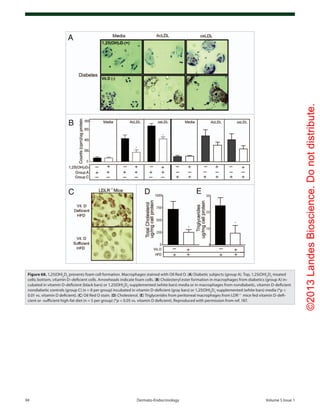
inhibits macrophage cholesterol
uptake and foam cell formation thereby reducing risk for ath-
erosclerotic plaque formation (Fig. 68).73,166,187
Vitamin D defi-
ciency negatively affects numerous physiological processes that
are important in the pathogenesis of cardiovascular disease. This
could explain why vitamin D deficiency is associated with an
increased overall and cardiovascular mortality in patients with
metabolic syndrome.188
Sunlight, Vitamin D and Mental Health
Schizophrenia has been associated with inadequate sun exposure
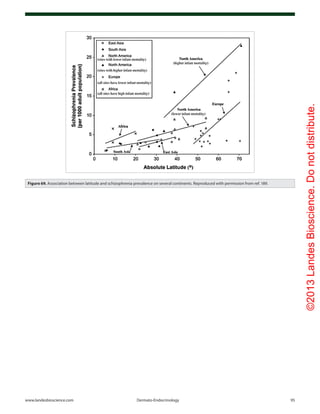
and vitamin D deficiency (Fig. 69).189
Schizophrenia is more
common in the Scandinavian countries.189,190
Winter births have
been associated with an increased risk for developing schizophre-
nia later in life even in Australia.191,192
In British immigrants, inci-
dence in schizophrenia is higher in children of immigrants from
the Caribbean who moved to cities in countries farther North.193
Finnish male infants who received 2000 IUs of vitamin D daily
during their first year of life reduced their risk of developing
schizophrenia by 77% compared with infants who received less
than 2000 IUs of vitamin D daily.194
Vitamin D could play an indirect role in the pathogen-
esis of schizophrenia. Several studies suggest that a prenatal
influenza exposure increases the risk for schizophrenia later in
life.195-197
The vitamin D status seems to influence the risk for
an influenza infection respectively vitamin D supplementation
has proven to decrease the risk for influenza
infection.2-4,118,119,121
There are a variety of association stud-
ies relating vitamin D deficiency with
increased risk for depression,198,199
Alzheimer
disease,200
epilepsy,201
and neurocognitive
decline.202,203
The brain not only has a VDR
but also a 1-OHase.204
Evidence suggests that
1,25(OH)2
D3
could increase calcium bind-
ing protein expression,205
although this could
not be shown in all studies.206
1,25(OH)2
D3
could also act by increasing serotonin levels
in the brain.207,208
Furthermore 1,25(OH)2
D3
has also been demonstrated to stimulate
amyloid-β phagocytosis and clearance by
macrophages in Alzheimer patients.209
This
may help explain the association between
neurocognitive decline,202,203
dementia,210
depression,198,199
and Alzheimer disease200
with
a high prevalence of vitamin D deficiency.211
In a community setting depressed adults had
Figure 31. Serum concentration of 25-hydroxyvitamin D in longterm
sunscreen users and in age- and sex-matched controls from same
geographical area. Blood samples were obtained simultaneously from
patients and controls. Mean serum 25-hydroxyvitamin D level was sig-
nificantly lower in long-term sunscreen users (p < 0.001). Two long-term
sunscreen users had absolute vitamin D deficiency, 25-hydroxyvitamin
D level below 20 nmol/L. PABA indicates p-aminobenzoic acid; open
circles, subjects from Philadelphia; closed circles, subjects from Spring-
field, III. Reproduced with permission from ref. 48.
Figure 32. Absorption spectrum of melanin. Holick copyright 2005. Reproduced with permission.
©2013LandesBioscience.Donotdistribute.
70	 Dermato-Endocrinology	Volume 5 Issue 1
significantly lower serum concentrations of 25(OH)D than those
without depression.212
Approaches for Preventing and Treating
Vitamin D Deficiency
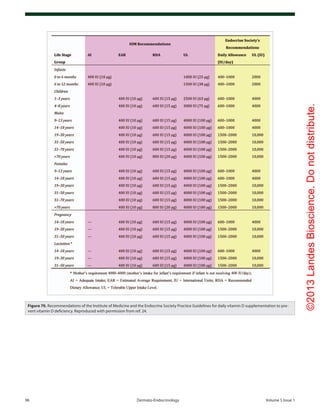
The Institute of Medicine using a population model defined vita-
min D deficiency for bone health as a circulating concentration
of 25(OH)D < 20 ng/mL. They recommended that to satisfy
97.5% of the United States population’s needs for vitamin D that
children 0–1 y, and adults 1–70 y and 70+ years require 400, 600
and 800 IUs of vitamin D daily respectively (Fig. 70).213
The
Endocrine Society used a medical model to make recommenda-
tions for the prevention and treatment of vitamin D deficiency
[25(OH)D < 20 ng/mL] and vitamin D insufficiency [25(OH)
D of 21–29 ng/mL] and concluded that a range rather than an
absolute amount of vitamin D could be recommended for chil-
dren 0–1 y, children 1–18 y and all adults of 400–1000 IUs,
600–1000 IUs and 1500–2000 IUs of vitamin D daily respec-
tively (Fig. 70).24
Both the IOM213
and The Endocrine Society24
concluded that
a circulating concentration of 25(OH)D up to 100 ng/mL was
safe. They also found that most but not all of the literature sup-
ports the concept that vitamin D2
is as effective as vitamin D3
in maintaining circulating concentrations of 25(OH)D.24,73,213-221
For almost 100 y a variety of strategies have been used to treat
and prevent vitamin D deficiency especially in children.5,68,73,114
From 1930 through 1950s parents purchased a lamp at their local
pharmacy that emitted vitamin D3
producing UVB radiation
(Fig. 71).70,222,223
Children wearing eye protection had their arms,
abdomen and legs were routinely exposed to a UV emitting lamp
several times a week (Fig. 6).12,13
In Russia children in school in
wintertime were routinely exposed to a mercury arc lamp placed
in the center of the school room that emitted UVB radiation to
prevent vitamin D deficiency rickets (Fig. 72).224
The Sperti lamp which originally was designed with a sin-
gle mercury arc lamp225,226
was commonly used in the United
States in the 1940s and 1950s to prevent rickets and children
(Fig. 71).8,70,114
This lamp was also effective in improving the
circulating concentrations of 25(OH)D in individuals who had
cystic fibrosis and who were unable to absorb vitamin D from
dietary and supplemental sources (Fig. 73A and B).227,228
Because
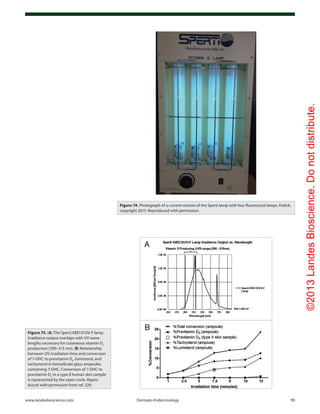
the lamp produced a lot of heat the Sperti lamp was redesigned
and the mercury arc lamp was replaced with 4 fluorescent lamps
(Fig. 74) that emitted UVB radiation and produced previtamin
D3
(Fig. 75).229
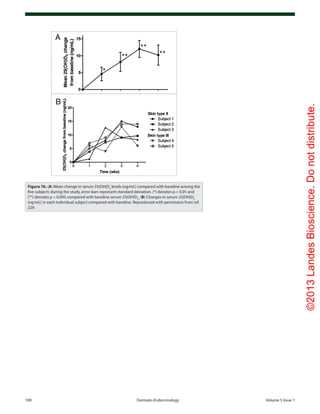
This lamp was effective in raising circulating
Figure 33. In two lightly pigmented Caucasian (A) and three heavily
pigmented Afroamerican subjects (B) after total body exposure to
0.054 J/cm2
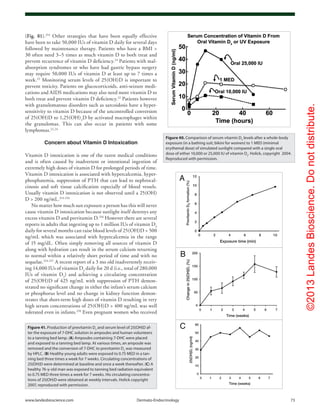
of UVR. (C) Serial change in circulating vitamin D after re-
exposure of on Afroamerican subject (● in panel B) to a 0.32 J/cm2
dose
of UVR. Reproduced with permission from ref. 50.
Figure 34. The conversion of 7-dehydrocholesterol to previtamin D3
in an ampoule model, Type II and Type V skin after exposing to noon
sunlight in June at Boston (42°N), Massachusetts. The data represent the
means ± SEM of duplicate determinations. Reproduced with permission
from ref. 51.
Figure 35. Scatter plot of baseline serum 25-hydroxyvitamin D (25-OH-
D) on skin lightness (L*) score for unexposed skin, showing significant
positive correlation of serum 25-OH-D and L* (r2 = 0.1856). Heaney,
copyright 2006. Reproduced with permission.
©2013LandesBioscience.Donotdistribute.
www.landesbioscience.com	Dermato-Endocrinology	 71
than ingesting 1000 IU vitamin D2
or vitamin D3
daily (Fig.
79).241
Always protect the face with a hat or sunscreen since it
provides very little vitamin D3
and is most sun exposed and more
prone to skin damage and skin cancer from sun exposure.242-244
Because foods contain very little vitamin D it is difficult
to obtain enough vitamin D from dietary sources even when
consuming foods fortified with vitamin D.22,51,246
The excep-
tion is indigenous populations including Inuits who consumed
concentrations of 25(OH)D in healthy adults with skin types 2
and 3 (Fig. 76).227,228
Tanning beds which emit UVB radiation (estimated about
95% of tanning beds in the United States) can be a good source
of vitamin D especially for patients with malabsorption syn-
dromes.227,228
A patient with Crohn’s disease and only 2 feet of
her small intestine remaining had severe debilitating osteoma-
lacic bone discomfort. Supplementing 400 IU dietary vitamin
D from a multivitamin and 200 IU vitamin D from total paren-
teral nutrition couldn’t correct her severe vitamin D deficiency.
Exposure to a tanning bed emitting UVB radiation was effec-
tive in improving her circulating concentration of 25(OH)D and
as a result markedly improved her bone discomfort (Fig. 77).230
Tanners in Boston who frequented a tanning salon at least once
a week had robust healthy circulating concentrations of 25(OH)
D on average 46 ng/mL compared with age and sex matched
controls whose blood level on average was 24 ng/mL (Fig. 78).
Furthermore an evaluation of their bone mineral density revealed
that the tanners had a significantly higher bone mineral density
in their hip compared with the control group.231
Sensible sun exposure can also be an excellent source of vita-
min D for both children and adults.232,233
Sensible means never
to be exposed to an amount of sunlight that would cause a sun-
burn since this is the major cause for both melanoma and non-
melanoma skin cancer.234-237
Studies conducted worldwide using
the in vitro ampule model39
and measuring 25(OH)D levels after
quantitative UVB exposure in a tanning bed have been used to
develop guidelines for sensible sun exposure based on latitude,
season, time of day, altitude, and skin sensitivity, i.e., degree of
skin pigmentation.22,46,51,66,231-233,237-239
The rule of thumb is to be
exposed to an amount of sunlight that is about 50% of what it
would take to cause a mild sunburn i.e., slight pinkness to the
skin 24 h later (minimal erythemal dose) followed by good sun
protection i.e., clothing, hat and or
sunscreen.22,239
The “rule of nines”
helps to estimate the percentage of
skin exposed to sunlight or UVB
radiation and can be used to calcu-
late the amount of vitamin D3
being
produced. The face accounts for 9%
of the body surface, each arm for
9%, each leg for 18%, and the abdo-
men and the back for 18% each.240
Exposure of the whole body in a
bathing suit to 0.5 MED of UVB
radiation is approximately equiva-
lent to ingesting about 7000–10,000
IUs of vitamin D2
.22,25,31
Therefore
exposing 20% of the body surface
to an amount of sunlight equal to
0.5 MED is equivalent to ingesting
approximately 1400–2000 IUs of
vitamin D3
. This is effective for all
skin types and the increase in serum
25(OH)D attained from exposure to
UVB radiation is often more effective
Figure 36. Three-dimensional scatter plot of 4-week serum 25-hy-
droxyvitamin D response change above baseline expressed as function
both of basic skin lightness (L*) and UV-B dose rate. Surface is a hyper-
boloid, plotting equation and was fitted to data by least squares regres-
sion methods. Heaney, copyright 2006. Reproduced with permission.
Figure 37. Maasai men demonstrate their muscle strength who have been reported to have 25(OH)D
~46 ng/ml. Holick, copyright 2013, reproduced with permission.
©2013LandesBioscience.Donotdistribute.
72	 Dermato-Endocrinology	Volume 5 Issue 1
adults’ vitamin D status by encouraging them to take a vitamin
D supplement (Fig. 70).22,24,213
Infants should receive 400 IUs of vitamin D soon after they
are born. This has been endorsed by the American Academy
of Pediatrics, the Endocrine Society and the Institute of
Medicine.24,213,248
However infants who are vitamin D deficient
should be aggressively treated with pharmacologic doses of vita-
min D in order to build up the body stores and quickly correct
the vitamin D deficiency. The best method to treat and cure rick-
ets is to give a total dose of 5–15 mg (200,000–600,000 IUs)
of vitamin D2
or vitamin D3
orally with adequate dietary cal-
cium.8,249
These doses can be given safely either as a single-day
therapy or as daily doses of 2000–4000 IUs/day (50–100 μg/d)
for 3–6 mo.8
Children one year and older should receive at least 600 IUs
of vitamin D daily. The Endocrine Society recommends at least
600 IUs and up to 1000 IUs daily is safe and effective to prevent
vitamin D deficiency and insufficiency.24
Infants and toddlers
who received 50,000 IUs of vitamin D2
once a week or 2000 IUs
of vitamin D2
or vitamin D3
daily for 6 weeks corrected their
vitamin D deficiency without any untoward side effects.8,24,217
A
study done in the young Lebanese girls who received 14,000 IUs
of vitamin D weekly for one year were able to maintain their
blood level of 25(OH)D in what is considered to be a healthy
physiologic range above 30 ng/mL.250
The Endocrine Society recommends that all adults receive
1500–2000 IUs of vitamin D daily.15
A study in healthy adults
in Boston who had a baseline serum concentration of 25(OH)D
~18 ng/mL in the winter revealed that ingesting 1000 IUs of vita-
min D2
or vitamin D3
was ineffective in raising and maintaining
blood levels 25(OH)D above 30 ng/mL (Fig. 80).215
This is not
at all unexpected since it is documented that for every 100 IUs
of vitamin D ingested the circulating concentration of 25(OH)D
increases by approximately 0.6–1.0 ng/mL.215,251
Because vitamin D is fat soluble upon its
ingestion or production in the skin vitamin
D3
gets incorporated into the body fat and is
also transported to the liver to be converted
to 25(OH)D.22,73,171-174
As a result to treat
vitamin D deficiency and prevent recurrence,
vitamin D can be given daily, weekly and
even monthly with the same outcome i.e.,
improvement in circulating concentrations of
25(OH)D.24
One strategy that is effective to
quickly fill up the empty vitamin D tank is to
give 50,000 IUs of vitamin D2
or 50,000 IUs
of vitamin D3
once a week for 8 weeks.252
This
is equivalent to ingesting approximately 6600
IUs of vitamin D daily.253
To prevent recur-
rence of vitamin D deficiency patients have
been instructed to take 50,000 IUs of vita-
min D2
(equivalent to 3300 IUs of vitamin D
daily) once every 2 weeks forever. This strat-
egy has been effective in maintaining blood
levels of 25(OH)D in the range of 40–60
ng/mL for up to 6 y without any toxicity
foods with high content of vitamin D such as oily fish, seal and
whale blubber and polar bear liver.246,247
Therefore it is neces-
sary without adequate sun exposure to improve childrens’ and
Figure 38. Concentrations of 7-dehydrocholesterol (provitamin D3
) per
unit area of human epidermis (●), stratum basale (△) and dermis (○)
obtained from surgical speciments from donors of various ages. A linear
regression analysis revealed slopes of −0.05, −0.06, and −0.0005 for the
epidermis (r = −0.89), stratum basale (r = −0.92), and dermis (r = −0.04),
respectively. The slopes of the epidermis and stratum basale are signifi-
cantly different from the slope of the dermis (p < 0.001). Reproduced
with permission from ref. 58.
Figure 39. Circulating concentrations of vitamin D in healthy young and elderly volunteers
exposed to UV radiation. Reproduced with permission from ref. 59.
©2013LandesBioscience.Donotdistribute.
www.landesbioscience.com	Dermato-Endocrinology	 73
(Fig. 81).253
Other strategies that have been equally effective
have been to take 50,000 IUs of vitamin D daily for several days
followed by maintenance therapy. Patients who have a BMI >
30 often need 3–5 times as much vitamin D to both treat and
prevent recurrence of vitamin D deficiency.24
Patients with mal-
absorption syndromes or who have had gastric bypass surgery
may require 50,000 IUs of vitamin D at least up to 7 times a
week.22
Monitoring serum levels of 25(OH)D is important to
prevent toxicity. Patients on glucocorticoids, anti-seizure medi-
cations and AIDS medications may also need more vitamin D to
both treat and prevent vitamin D deficiency.22
Patients however
with granulomatous disorders such as sarcoidosis have a hyper-
sensitivity to vitamin D because of the uncontrolled conversion
of 25(OH)D to 1,25(OH)2
D by activated macrophages within
the granulomas. This can also occur in patients with some
lymphomas.22,24
Concern about Vitamin D Intoxication
Vitamin D intoxication is one of the rarest medical conditions
and is often caused by inadvertent or intentional ingestion of
extremely high doses of vitamin D for prolonged periods of time.
Vitamin D intoxication is associated with hypercalcemia, hyper-
phosphatemia, suppression of PTH that can lead to nephrocal-
cinosis and soft tissue calcification especially of blood vessels.
Usually vitamin D intoxication is not observed until a 25(OH)
D > 200 ng/mL.254-256
No matter how much sun exposure a person has this will never
cause vitamin D intoxication because sunlight itself destroys any
excess vitamin D and previtamin D.256
However there are several
reports in adults that ingesting up to 1 million IUs of vitamin D3
daily for several months can raise blood levels of 25(OH)D > 500
ng/mL which was associated with hypercalcemia in the range
of 15 mg/dL. Often simply removing all sources of vitamin D
along with hydration can result in the serum calcium returning
to normal within a relatively short period of time and with no
sequelae.254-257
A recent report of a 3 mo old inadvertently receiv-
ing 14,000 IUs of vitamin D3
daily for 20 d (i.e., total of 280,000
IUs of vitamin D3
) and achieving a circulating concentration
of 25(OH)D of 425 ng/mL with suppression of PTH demon-
strated no significant change in either the infant’s serum calcium
or phosphorus level and no change in kidney function demon-
strates that short-term high doses of vitamin D resulting in very
high serum concentrations of 25(OH)D > 400 ng/mL was well
tolerated even in infants.258
Even pregnant women who received
Figure 40. Comparison of serum vitamin D3
levels after a whole-body
exposure (in a bathing suit; bikini for women) to 1 MED (minimal
erythemal dose) of simulated sunlight compared with a single oral
dose of either 10,000 or 25,000 IU of vitamin D2
. Holick, copyright 2004.
Reproduced with permission.
Figure 41. Production of previtamin D3
and serum level of 25(OH)D af-
ter the exposure of 7-DHC solution in ampoules and human volunteers
to a tanning bed lamp. (A) Ampoules containing 7-DHC were placed
and exposed to a tanning bed lamp. At various times, an ampoule was
removed and the conversion of 7-DHC to previtamin D3
was measured
by HPLC. (B) Healthy young adults were exposed to 0.75 MED in a tan-
ning bed three times a week for 7 weeks. Circulating concentrations of
25(OH)D were determined at baseline and once a week thereafter. (C) A
healthy 76-y-old man was exposed to tanning bed radiation equivalent
to 0.75 MED three times a week for 7 weeks. His circulating concentra-
tions of 25(OH)D were obtained at weekly intervals. Holick copyright
2007, reproduced with permission.
©2013LandesBioscience.Donotdistribute.
74	 Dermato-Endocrinology	Volume 5 Issue 1
It is prolonged intake of extremely high doses
of vitamin D for at least several months that
not only markedly increases the circulating
concentrations of 25(OH)D > 200 ng/mL
but also results in hypercalcemia, hyperphos-
phatemia and if untreated can lead to kidney
failure, soft tissue calcification and ultimately
death.22,260
Conclusion and Perspective
Our ancestors routinely worshiped the sun
for its life giving properties (Fig. 82).261,262
It is curious that some of the earliest photo-
synthetic life forms for more than 500 mil-
lion years have been producing vitamin D
and that throughout evolution most verte-
brates including humans have depended on
sun exposure for their skeletal health.263
The
driver for the evolution of hypopigmented
humans i.e., Caucasians is likely due to the
need to have more vitamin D producing solar
UVB radiation to penetrate into the skin to
produce vitamin D3
. Females born with vita-
min D deficiency and suffering from infantile rickets resulted
in them having a flat pelvis and a small pelvic outlet. These
4000 IU vitamin D/day through their pregnancy showed no
change in either serum calcium or urinary calcium secretion.259
Figure 42. The UVB lamps and residents in a day room of a nursing home. Reproduced with permission from ref. 60.
Figure 43. Mean (± 1 sd) 25(OH) vitamin D values pre-irradiation, 12–24 weeks and 56–72
weeks after irradiation in 7 subjects with abnormal baseline values (< 25 nmol/l). Reproduced
with permission from ref. 60.
©2013LandesBioscience.Donotdistribute.
www.landesbioscience.com	Dermato-Endocrinology	 75
Clearly the paranoia about food fortification with vitamin D
causing toxicity needs to be reconsidered in light of observations
that infants who consumed 2000 IU vitamin D per day during
their first year of life not only did not have any evidence of toxicity
but for the ensuing 31 y markedly decreased their risk for type 1
diabetes.145
In the 1970s sunscreens were first introduced as a way to
prevent sunburning. The sunscreens contained UVB absorbing
chemicals such as paraaminobezoic acid because it was believed
that only UVB radiation damaged the skin and caused skin
cancer. It is now realized that UVA radiation not only alters
the immune system making it more immunotolerant but also
increases risk for non-melanoma and melanoma skin cancers.
Over the past four decades with very little thought as to its con-
sequences, several national and international health organiza-
tions have condemned any direct sun exposure. The American
Academy of Dermatology has taken the extreme position of rec-
ommending that no one should ever be exposed to direct sunlight
without sun protection. This radical view of sunlight and UVB
radiation has led to its designation as a carcinogen. To suggest
that one should never be exposed to sunlight because excessive
exposure to sunlight is linked to an increased risk for non-mela-
noma skin cancer is like suggesting that because breathing 100%
oxygen can cause lung damage and death, that no one should
breath an atmosphere that contains 20% oxygen.
The lack of appreciation of the importance of sensible sun
exposure for providing children and adults with their vitamin
D requirement has led to a worldwide vitamin D deficiency
pandemic.22,173
In the United States the Center for Disease
females although fertile would have
had a difficult time, if not impos-
sible, to give vaginal birth resulting
in both maternal and fetal death.54,55
Indeed it was because of the vitamin
D deficiency pandemic in late 1800s
that Cesarean sectioning became
common practice for the delivery of
healthy children of mothers who had
suffered from vitamin D deficiency
in utero and during their first few
years of life.8,54,55
Vitamin D defi-
ciency in pregnant women today is
still associated with a 400% increase
in the predicted probability for a
Cesarean section (Fig. 83).54
It is remarkable that for more
than 100 y investigators have been
reporting an inverse association with
latitude and many chronic illnesses
including common cancers,85
sev-
eral autoimmune diseases including
type 1 diabetes and multiple sclero-
sis73,134-139
as well as hypertension.159
In addition the revelation that expo-
sure to sunlight or UV radiation
could cure and prevent rickets12,13
led
to the widespread recommendation by health regulators and gov-
ernment agencies to encourage sensible sun exposure, i.e., amount
of sun that would be beneficial for producing vitamin D and
reducing risk for rickets while preventing sunburning (Fig. 8).
The global appreciation of the beneficial effects of vitamin D
for health lead to widespread vitamin D fortification throughout
Europe and the United States in the 1930s-1940s. Not only milk
but hot dogs, soda, custard, bread, cereals and even beer was forti-
fied with vitamin D (Fig. 9). Schlitz even promoted their vitamin
D fortified beer in the winter with the slogan “if you want to keep
sunnyenergyallwinterlongdrinkvitaminDfortifiedSchlitzbeer”
(Fig. 84). They may have been correct now with the revelation
that vitamin D deficiency was associated with depression, seasonal
affective disorder and neurocognitive dysfunction.198-200,202,203,210
Unfortunately in the early 1950s the outbreak of hypercalce-
mia in British infants, who also had birth defects which included
altered facial features, mental retardation, and heart problems, was
incorrectly attributed to be over fortification of milk with vitamin
D since it was believed that these were signs of vitamin D intoxi-
cation.20,22
The more likely explanation is that these children had
a syndrome which is associated with a hypersensitivity to vitamin
D causing hypercalcemia and also with an elfin appearance and
heart problems.20
However because this “outbreak” was associated
with infants who had birth defects and mental retardation laws
were quickly passed forbidding the fortification of not only foods
but any consumer product including skin cream with vitamin D.
This legislation was quickly adopted in most European countries
and was used as a reason by other countries not to fortify milk
with vitamin D.
Figure 44. Geometric mean (95% CI) monthly variation in serum 25-hydroxyvitamin D [25(OH)D]
concentrations in men (■; n = 3725) and women (□; n = 3712) in the 1958 British birth cohort at age 45
y. The interaction between sex and month was significant [p = 0.02, linear regression analyses on log
25(OH)D]. n per sex and month ranged from 17 to 340: 98 in December 2003 for women and < 100 for
both sexes in December 2002 (n = 40 M, 37 F), January 2004 (n = 95 M, 75 F), February 2004 (n = 58 M, 70
F), and March 2004 (n = 22 M, 17 F). Reproduced with permission from ref. 61.
©2013LandesBioscience.Donotdistribute.
76	 Dermato-Endocrinology	Volume 5 Issue 1
Figure 45. (A) Seasonal fluctuation of
serum 25(OH)D in healthy perimeno-
pausal Danish women and relationship
between hours of sunshine and serum
25(OH)D. (B) Seasonal fluctuation of se-
rum 25(OH)D according to frequency of
sun exposure. ■, regular sun exposure;
◆, occasional sun exposure; ●, avoiding
direct sun exposure. Reproduced with
permission from ref. 173.
Control and Prevention (CDC) reported
that 32% of children and adults have a
circulating concentration of 25(OH)
D < 20 ng/mL. Reports from Mexico,
South America, Europe, Asia, India
and even Africa suggest that more than
50% of the world population is at risk
for vitamin D deficiency.22,265,266
Even in
Australia, the skin cancer capital of the
world, it is now recognized that the slip,
slap, slop message has led to more than
40% of the population being vitamin
D deficient.265-268
Even the Australian
Dermatology Society now recommends
sensible sun exposure as a source of vita-
min D. A study of Australian dermatolo-
gists at the end of the summer revealed
that 87% had a 25(OH)D < 20 ng/mL.269
More than 90% of the healthcare profes-
sionals in India were found to be vitamin
D deficient.
The CDC concluded that vitamin D
deficiency is becoming more prevalent in
the US because of obesity, decrease in the
consumption of vitamin D fortified milk
and increased sun protection.269
Thus a
three-part strategy should be employed
worldwide to prevent vitamin D defi-
ciency and its many negative health con-
sequences (Fig. 89). Sensible sun exposure
which is free, eating foods that naturally
contain vitamin D or are fortified with
vitamin D as well as taking a vitamin D
supplement should guarantee vitamin D
sufficiency.22,66
A global strategy to reduce
the risk of vitamin D deficiency should be
to consider not only increasing programs
for food fortification not only of dairy
products but also juice products, flour,
and other commonly used food sources.
There is no downside to increasing vita-
min D intake and there could be a sub-
stantial upside, i.e., improvement not
only of musculoskeletal health but overall
health and welfare. It has been estimated
that as much as 25% of health care dol-
lars could be saved just by improving the
world’s vitamin D status.79
Acknowledgments
This work was supported in part by
the National Institutes of Health
©2013LandesBioscience.Donotdistribute.
www.landesbioscience.com	Dermato-Endocrinology	 77
29.	 Haddad JG, Matsuoka LY, Hollis BW, Hu YZ,
Wortsman J. Human plasma transport of vitamin
D after its endogenous synthesis. J Clin Invest
1993; 91:2552-5; PMID:8390483; http://dx.doi.
org/10.1172/JCI116492.
20.	 Lightwood R, Sheldon W, Harris C. Hypercalcaemia
in infants and vitamin D. BMJ 1956; 2:149; http://
dx.doi.org/10.1136/bmj.2.4985.149.
21.	 Tshibangu K, Oosterwijck K, Doumont-Meyvis M.
Effects of massive doses of ergocalciferol plus choles-
terol on pregnant rats and their offspring. J Nutr 1975;
105:741-58; PMID:1079862.
22.	 Holick MF. Vitamin D deficiency. N Engl J Med
2007; 357:266-81; PMID:17634462; http://dx.doi.
org/10.1056/NEJMra070553.
23.	 Pober BR. Williams-Beuren syndrome. N Engl J Med
2010; 362:239-52; PMID:20089974; http://dx.doi.
org/10.1056/NEJMra0903074.
24.	 Holick MF, Binkley NC, Bischoff-Ferrari HA, Gordon
CM, Hanley DA, Heaney RP, et al.; Endocrine Society.
Evaluation, treatment, and prevention of vitamin D
deficiency: an Endocrine Society clinical practice guide-
line. J Clin Endocrinol Metab 2011; 96:1911-30;
PMID:21646368; http://dx.doi.org/10.1210/jc.2011-
0385.
25.	 Holick M. Sunlight, UV-Radiation, Vitamin D and
Skin Cancer: How Much Sunlight Do We Need? In:
Reichrath J, ed. Sunlight, Vitamin D and Skin Cancer:
Springer New York; 2008:1-15.
26.	 Tian XQ, Chen TC, Lu Z, Shao Q, Holick MF.
Characterization of the translocation process of vitamin
D3
from the skin into the circulation. Endocrinology
1994; 135:655-61; PMID:8033813; http://dx.doi.
org/10.1210/en.135.2.655.
27.	 Tian XQ, Holick MF. A liposomal model that mimics
the cutaneous production of vitamin D3. Studies of
the mechanism of the membrane-enhanced thermal
isomerization of previtamin D3 to vitamin D3. J Biol
Chem 1999; 274:4174-9; PMID:9933613; http://
dx.doi.org/10.1074/jbc.274.7.4174.
28.	 Tian XQ, Holick MF. Catalyzed thermal isomeriza-
tion between previtamin D3
and vitamin D3
via
β-cyclodextrin complexation. J Biol Chem 1995;
270:8706-11; PMID:7721775; http://dx.doi.
org/10.1074/jbc.270.15.8706.
Clinical Translational Institute Grant
UL-1-RR-25711.
References
1.	 Holick M. Phylogenetic and evolutionary aspects of
vitamin D from phytoplankton to humans. In: Pang
PKT, Schreibman MP (eds), Verebrate Endocrinology:
Fundamentals and Biomedical Implications Academic
Press, Inc (Harcourt Brace Jovanovich) Orlando, FL
1989;3:7-43.
2.	 Holick MF. Vitamin D: A millenium perspective. J Cell
Biochem 2003; 88:296-307; PMID:12520530; http://
dx.doi.org/10.1002/jcb.10338.
3.	 Pasanen AL, Yli-Pietila K, Pasanen P, Kalliokoski P,
Tarhanen J. Ergosterol content in various fungal species
and biocontaminated building materials. Appl Environ
Microbiol 1999; 65:138-42; PMID:9872771.
4.	 Kalaras MD, Beelman RB, Holick MF, Elias RJ.
Generation of potentially bioactive ergosterol-derived
products following pulsed ultraviolet light exposure
of mushrooms (Agaricus bisporus). Food Chem
2012; 135:396-401; PMID:22868105; http://dx.doi.
org/10.1016/j.foodchem.2012.04.132.
5.	 Holick MF, Chen TC, Lu Z, Sauter E. Vitamin D and
skin physiology: a D-lightful story. J Bone Miner Res
2007; 22(Suppl 2):V28-33; PMID:18290718; http://
dx.doi.org/10.1359/jbmr.07s211.
6.	 Holick MF, Tian XQ, Allen M. Evolutionary impor-
tance for the membrane enhancement of the produc-
tion of vitamin D3
in the skin of poikilothermic
animals. Proc Natl Acad Sci U S A 1995; 92:3124-
6; PMID:7724526; http://dx.doi.org/10.1073/
pnas.92.8.3124.
7.	 Tian XQ, Chen TC, Matsuoka LY, Wortsman J, Holick
MF. Kinetic and thermodynamic studies of the conver-
sion of previtamin D3
to vitamin D3
in human skin. J
Biol Chem 1993; 268:14888-92; PMID:8392061.
8.	 Holick MF. Resurrection of vitamin D deficien-
cy and rickets. J Clin Invest 2006; 116:2062-72;
PMID:16886050; http://dx.doi.org/10.1172/
JCI29449.
9.	 Brennemann J, McQuarrie I. Brennemann’s practice of
pediatrics: W.F. Prior; 1946.
10.	 Mozołowski W. Jedrzej Sniadecki (1768-1838) on the
Cure of Rickets. Nature 1939; 143:121; http://dx.doi.
org/10.1038/143121a0.
11.	 Palm TA. The geographical distribution and etiology of
rickets. Practitioner 1890; 45:270-342.
12.	 Huldschinsky K. Heilung von Rachitis durch kün-
stliche Höhensonne. Dtsch Med Wochenschr 1919;
45:712-3; http://dx.doi.org/10.1055/s-0028-1137830.
13.	 Huldschinsky K. The ultra-violet light treatment of
rickets. Alpine Press New Jersey, USA 1928; 3-19.
14.	 Hess AF, Unger LJ. The cure of infantile rickets by
sunlight. J Am Med Assoc 1921; 77:39; http://dx.doi.
org/10.1001/jama.1921.02630270037013.
15.	 Steenbock H, Black A. The reduction of growth-pro-
moting and calcifying properties in a ration by exposure
to ultraviolet light. J Biol Chem 1924; 61:408-22.
16.	 Hess AF, Weinstock M. Antirachitic properties impart-
ed to inert fluids and to green vegetables by ultra-violet
irradiation. J Biol Chem 1924; 62:301-13.
17.	Holick MF. Vitamin D: the underappreciated
D-lightful hormone that is important for skeletal and
cellular health. Curr Opin Endocrinol Diabetes Obes
2002; 9:87-98; http://dx.doi.org/10.1097/00060793-
200202000-00011.
18.	 Rajakumar K, Greenspan SL, Thomas SB, Holick MF.
SOLAR ultraviolet radiation and vitamin D: a his-
torical perspective. Am J Public Health 2007; 97:1746-
54; PMID:17761571; http://dx.doi.org/10.2105/
AJPH.2006.091736.
19.	 Holick MF. Biologic effects of light: historical and new
perspectives. Biologic Effects of Light Edited by Holick
MF and Jung EG Boston Kluwer Academic Publisher
1999:11-32.
Figure 46. Mean circulating 25-hydroxyvitamin D levels in children, adolescents, and adults ac-
cording to geographic latitude. Reproduced with permission from ref. 64.
Figure 47. Niels Ryberg Finsen, * December
15, 1860, Thorshavn, Faroe Islands; + 24 Sep-
tember 1904; Nobel Prize was awarded “in
recognition of his contribution to the treat-
ment of diseases, especially lupus vulgaris,
with concentrated light radiation, whereby
he has opened a new avenue for medical
science.”
©2013LandesBioscience.Donotdistribute.
78	 Dermato-Endocrinology	Volume 5 Issue 1
43.	 Kenny DE, O’Hara TM, Chen TC, Lu Z, Tian X,
Holick MF. Vitamin D content in Alaskan Arctic zoo-
plankton, fishes, and marine mammals. Zoo Biol 2004;
23:33-43; http://dx.doi.org/10.1002/zoo.10104.
44.	 Holick MF. Vitamin D: Physiology, molecular biology,
and clinical applications: Humana Press; 2010.
45.	 Spina CS. Master of Arts Thesis. Novel vitamin D3
analogues, and colon cancer growth in mice: Boston
University School of Medicine; 2004.
46.	 Holick MF, Chen TC, Lu Z, Sauter E. Vitamin D and
skin physiology: a D-lightful story. J Bone Miner Res
2007; 22(Suppl 2):V28-33; PMID:18290718.
47.	 Matsuoka LY, Ide L, Wortsman J, MacLaughlin JA,
Holick MF. Sunscreens suppress cutaneous vitamin D3
synthesis. J Clin Endocrinol Metab 1987; 64:1165-8;
PMID:3033008; http://dx.doi.org/10.1210/jcem-64-
6-1165.
48.	 Matsuoka LY, Wortsman J, Hanifan N, Holick
MF. Chronic sunscreen use decreases circulating
concentrations of 25-hydroxyvitamin D. A pre-
liminary study. Arch Dermatol 1988; 124:1802-4;
PMID:3190255; http://dx.doi.org/10.1001/arch-
derm.1988.01670120018003.
49.	Jablonski NG, Chaplin G. The evolution of
human skin coloration. J Hum Evol 2000; 39:57-
106; PMID:10896812; http://dx.doi.org/10.1006/
jhev.2000.0403.
50.	 Clemens TL, Adams JS, Henderson SL, Holick
MF. Increased skin pigment reduces the capacity of
skin to synthesise vitamin D3
. Lancet 1982; 1:74-6;
PMID:6119494; http://dx.doi.org/10.1016/S0140-
6736(82)90214-8.
51.	 Chen TC, Chimeh F, Lu Z, Mathieu J, Person KS,
Zhang A, et al. Factors that influence the cutaneous
synthesis and dietary sources of vitamin D. Arch
Biochem Biophys 2007; 460:213-7; PMID:17254541;
http://dx.doi.org/10.1016/j.abb.2006.12.017.
52.	 Armas LAG, Dowell S, Akhter M, Duthuluru S,
Huerter C, Hollis BW, et al. Ultraviolet-B radiation
increases serum 25-hydroxyvitamin D levels: the effect
of UVB dose and skin color. J Am Acad Dermatol
2007; 57:588-93; PMID:17637484; http://dx.doi.
org/10.1016/j.jaad.2007.03.004.
53.	 Luxwolda MF, Kuipers RS, Kema IP, Dijck-Brouwer
DA, Muskiet FAJ. Traditionally living populations
in East Africa have a mean serum 25-hydroxyvi-
tamin D concentration of 115 nmol/l. Br J Nutr
2012; 108:1557-61; PMID:22264449; http://dx.doi.
org/10.1017/S0007114511007161.
54.	 Merewood A, Mehta SD, Chen TC, Bauchner H,
Holick MF. Association between vitamin D deficiency
and primary cesarean section. J Clin Endocrinol Metab
2009; 94:940-5; PMID:19106272; http://dx.doi.
org/10.1210/jc.2008-1217.
55.	 Potter EL. Maternal health in relation to infant mortal-
ity. Am J Nurs 1945; 45:122-4.
56.	 Sheikh A, Alam R. Red Hair: A mutation, a royal trait,
and sometimes a curse.
57.	 Lalueza-Fox C, Römpler H, Caramelli D, Stäubert
C, Catalano G, Hughes D, et al. A melanocor-
tin 1 receptor allele suggests varying pigmentation
among Neanderthals. Science 2007; 318:1453-5;
PMID:17962522; http://dx.doi.org/10.1126/sci-
ence.1147417.
58.	 MacLaughlin J, Holick MF. Aging decreases the capac-
ity of human skin to produce vitamin D3
. J Clin Invest
1985; 76:1536-8; PMID:2997282; http://dx.doi.
org/10.1172/JCI112134.
59.	 Holick MF, Matsuoka LY, Wortsman J. Age, vita-
min D, and solar ultraviolet. Lancet 1989; 2:1104-5;
PMID:2572832; http://dx.doi.org/10.1016/S0140-
6736(89)91124-0.
60.	 Chuck A, Todd J, Diffey B. Subliminal ultraviolet-B
irradiation for the prevention of vitamin D defi-
ciency in the elderly: a feasibility study. Photodermatol
Photoimmunol Photomed 2001; 17:168-71;
PMID:11499538; http://dx.doi.org/10.1034/j.1600-
0781.2001.170405.x.
37.	 Dixon KM, Norman AW, Sequeira VB, Mohan R,
Rybchyn MS, Reeve VE, et al. 1α,25(OH)2
-vitamin D
and a nongenomic vitamin D analogue inhibit ultravio-
let radiation-induced skin carcinogenesis. Cancer Prev
Res (Phila) 2011; 4:1485-94; PMID:21733837; http://
dx.doi.org/10.1158/1940-6207.CAPR-11-0165.
38.	 Caldwell M, Flint S. Stratospheric ozone reduction,
solar UV-B radiation and terrestrial ecosystems. Clim
Change 1994; 28:375-94; http://dx.doi.org/10.1007/
BF01104080.
39.	 Webb AR, Kline L, Holick MF. Influence of sea-
son and latitude on the cutaneous synthesis of vita-
min D3
: exposure to winter sunlight in Boston and
Edmonton will not promote vitamin D3
synthesis in
human skin. J Clin Endocrinol Metab 1988; 67:373-8;
PMID:2839537; http://dx.doi.org/10.1210/jcem-67-
2-373.
40.	 Spina C, Tangpricha V, Yao M, Zhou W, Wolfe
MM, Maehr H, et al. Colon cancer and solar ultra-
violet B radiation and prevention and treatment of
colon cancer in mice with vitamin D and its Gemini
analogs. J Steroid Biochem Mol Biol 2005; 97:111-
20; PMID:16154354; http://dx.doi.org/10.1016/j.
jsbmb.2005.06.003.
41.	 Ladizesky M, Lu Z, Oliveri B, San Roman N, Diaz
S, Holick MF, et al. Solar ultraviolet B radiation
and photoproduction of vitamin D3
in central and
southern areas of Argentina. J Bone Miner Res 1995;
10:545-9; PMID:7610924; http://dx.doi.org/10.1002/
jbmr.5650100406.
42.	 Bills CE. Antiricketic substances: VI. The distribution
of vitamin D, with some notions on its possible origin.
J Biol Chem 1927; 72:751-8.
30.	 Holick MF. The D-lightful vitamin D for child
health. JPEN J Parenter Enteral Nutr 2012;
36(Suppl):9S-19S; PMID:22179524; http://dx.doi.
org/10.1177/0148607111430189.
31.	 Holick MF. McCollum Award Lecture, 1994: vitamin
D--new horizons for the 21st century. Am J Clin Nutr
1994; 60:619-30; PMID:8092101.
32.	 Holick MF, MacLaughlin JA, Doppelt SH. Regulation
of cutaneous previtamin D3
photosynthesis in man:
skin pigment is not an essential regulator. Science
1981; 211:590-3; PMID:6256855; http://dx.doi.
org/10.1126/science.6256855.
33.	 Havinga E. Vitamin D, example and challenge.
Experientia 1973; 29:1181-93; PMID:4758912;
http://dx.doi.org/10.1007/BF01935064.
34.	 Jacobs HJC, Boomsma F, Havinga E, van der Gen
A. The photochemistry of previtamin D and tachys-
terol. Recueil des Travaux Chimiques des Pays-
Bas 1977; 96:113-7; http://dx.doi.org/10.1002/
recl.19770960406.
35.	 Boomsma F, Jacobs HJC, Havinga E, van der Gen
A. The “overirradiation products” of previtamin D
and tachysterol: Toxisterols. Recueil des Travaux
Chimiques des Pays-Bas 1977; 96:104-12; http://
dx.doi.org/10.1002/recl.19770960405.
36.	 Dauben WG, Baumann P. Photochemical transforma-
tions. IX. Total structure of suprasterol II. Tetrahedron
Lett 1961; 2:565-72; http://dx.doi.org/10.1016/
S0040-4039(01)91648-X.
Figure 48. (A) 1901 Illustration from Scientific American showing phototherapy with the Finsen
carbon-arc UV lamp in 1901. (B) Sunbathing individuals at sanatorium Leysin in Switzerland.
©2013LandesBioscience.Donotdistribute.
www.landesbioscience.com	Dermato-Endocrinology	 79
74.	 Hoffman FL. The mortality from cancer throughout
the world: Prudential Press; 1916.
75.	 Peller S, Stephenson CS. Skin Irritation and Cancer in
the US Navy. Am J Med Sci 1937; 194:326-33; http://
dx.doi.org/10.1097/00000441-193709000-00004.
76.	 Apperly FL. The Relation of Solar Radiation to Cancer
Mortality in North America. Cancer Res 1941; 1:191-
5.
77.	 Garland CF, Garland FC. Do sunlight and vita-
min D reduce the likelihood of colon cancer? Int J
Epidemiol 1980; 9:227-31; PMID:7440046; http://
dx.doi.org/10.1093/ije/9.3.227.
71.	 Albert MR, Ostheimer KG. The evolution of current
medical and popular attitudes toward ultraviolet light
exposure: part 2. J Am Acad Dermatol 2003; 48:909-
18; PMID:12789184; http://dx.doi.org/10.1067/
mjd.2003.272.
72.	 Albert MR, Ostheimer KG. The evolution of current
medical and popular attitudes toward ultraviolet light
exposure: part 1. J Am Acad Dermatol 2002; 47:930-
7; PMID:12451381; http://dx.doi.org/10.1067/
mjd.2002.127254.
73.	 Wacker M, Holick MF. Vitamin D - effects on skeletal
and extraskeletal health and the need for supplementa-
tion. Nutrients 2013; 5:111-48; PMID:23306192;
http://dx.doi.org/10.3390/nu5010111.
61.	 Hyppönen E, Power C. Hypovitaminosis D in British
adults at age 45 y: nationwide cohort study of dietary
and lifestyle predictors. Am J Clin Nutr 2007; 85:860-
8; PMID:17344510.
62.	 Brot C, Vestergaard P, Kolthoff N, Gram J, Hermann
AP, Sørensen OH. Vitamin D status and its adequacy in
healthy Danish perimenopausal women: relationships
to dietary intake, sun exposure and serum parathy-
roid hormone. Br J Nutr 2001; 86(Suppl 1):S97-
103; PMID:11520426; http://dx.doi.org/10.1079/
BJN2001345.
63.	 Holick M. Vitamin D and health: Evolution, bio-
logic functions, and recommended dietary intakes
for vitamin D. Clinical Review in Bone and Mineral
Metabolism 2009; 7:2-19; http://dx.doi.org/10.1007/
s12018-009-9026-x.
64.	 Zittermann A. Vitamin D and disease prevention with
special reference to cardiovascular disease. Prog Biophys
Mol Biol 2006; 92:39-48; PMID:16600341; http://
dx.doi.org/10.1016/j.pbiomolbio.2006.02.001.
65.	 Lips P, Duong T, Oleksik A, Black D, Cummings S,
Cox D, et al. A global study of vitamin D status and
parathyroid function in postmenopausal women with
osteoporosis: baseline data from the multiple outcomes
of raloxifene evaluation clinical trial. J Clin Endocrinol
Metab 2001; 86:1212-21; PMID:11238511; http://
dx.doi.org/10.1210/jc.86.3.1212.
66.	 Holick MF. The Vitamin D Solution: A 3-Step Strategy
to Cure Our Most Common Health Problem. Penguin
Group US. 2010.
67.	 Wintzen M, Yaar M, Burbach JP, Gilchrest BA.
Proopiomelanocortin gene product regulation in
keratinocytes. J Invest Dermatol 1996; 106:673-8;
PMID:8618003; http://dx.doi.org/10.1111/1523-
1747.ep12345496.
68.	 Battersby AJ, Kampmann B, Burl S. Vitamin D in
Early Childhood and the Effect on Immunity to
Mycobacterium tuberculosis. Clin Dev Immunol 2012;
430972.
69.	 The Nobel Prize in Physiology or Medicine 1903.
Niels Ryberg Finsen. 2012-09-08. URL:http://www.
nobelprize.org/nobel_prizes/medicine/laureates/1903/.
Accessed: 2012-09-08 (Archived by WebCite®
at
http://www.webcitation.org/6AWpWACU0). 1903.
Accessed at.
70.	 Albert MR, Ostheimer KG. The evolution of current
medical and popular attitudes toward ultraviolet light
exposure: part 3. J Am Acad Dermatol 2003; 49:1096-
106; PMID:14639391; http://dx.doi.org/10.1016/
S0190-9622(03)00021-5.
Figure 49. Mortality from cancer in cities according to latitude, 1908–1912.
Figure 50. Showing the relation of total cancer mortality rates to Smith’s Solar Radiation Index in
the American states, (white population only).
©2013LandesBioscience.Donotdistribute.
80	 Dermato-Endocrinology	Volume 5 Issue 1
97.	 Garland CF, Comstock GW, Garland FC, Helsing
KJ, Shaw EK, Gorham ED. Serum 25-hydroxyvi-
tamin D and colon cancer: eight-year prospective
study. Lancet 1989; 2:1176-8; PMID:2572900; http://
dx.doi.org/10.1016/S0140-6736(89)91789-3.
98.	 Garland C, Shekelle RB, Barrett-Connor E, Criqui
MH, Rossof AH, Paul O. Dietary vitamin D and cal-
cium and risk of colorectal cancer: a 19-year prospective
study in men. Lancet 1985; 1:307-9; PMID:2857364;
http://dx.doi.org/10.1016/S0140-6736(85)91082-7.
99.	 Garland CF, Garland FC, Gorham ED, Lipkin M,
Newmark H, Mohr SB, et al. The role of vitamin D in
cancer prevention. Am J Public Health 2006; 96:252-
61; PMID:16380576; http://dx.doi.org/10.2105/
AJPH.2004.045260.
100.	 John EM, Schwartz GG, Dreon DM, Koo J. Vitamin D
and breast cancer risk: the NHANES I Epidemiologic
follow-up study, 1971-1975 to 1992. National Health
and Nutrition Examination Survey. Cancer Epidemiol
Biomarkers Prev 1999; 8:399-406; PMID:10350434.
101.	Lappe JM, Travers-Gustafson D, Davies KM, Recker
RR, Heaney RP. Vitamin D and calcium supplementa-
tion reduces cancer risk: results of a randomized trial.
Am J Clin Nutr 2007; 85:1586-91; PMID:17556697.
102.	Manson JE, Mayne ST, Clinton SK. Vitamin D and
prevention of cancer--ready for prime time? N Engl
J Med 2011; 364:1385-7; PMID:21428761; http://
dx.doi.org/10.1056/NEJMp1102022.
103.	 Shin MH, Holmes MD, Hankinson SE, Wu K, Colditz
GA, Willett WC. Intake of dairy products, calcium,
and vitamin d and risk of breast cancer. J Natl Cancer
Inst 2002; 94:1301-11; PMID:12208895; http://
dx.doi.org/10.1093/jnci/94.17.1301.
104.	Feskanich D, Ma J, Fuchs CS, Kirkner GJ, Hankinson
SE, Hollis BW, et al. Plasma vitamin D metabolites and
risk of colorectal cancer in women. Cancer Epidemiol
Biomarkers Prev 2004; 13:1502-8; PMID:15342452.
105.	Woo TCS, Choo R, Jamieson M, Chander S, Vieth R.
Pilot study: potential role of vitamin D (Cholecalciferol)
in patients with PSA relapse after definitive therapy.
Nutr Cancer 2005; 51:32-6; PMID:15749627; http://
dx.doi.org/10.1207/s15327914nc5101_5.
106.	Eaton CB, Young A, Allison MA, Robinson J, Martin
LW, Kuller LH, et al. Prospective association of vita-
min D concentrations with mortality in postmeno-
pausal women: results from the Women’s Health
Initiative (WHI). Am J Clin Nutr 2011; 94:1471-
8; PMID:22030222; http://dx.doi.org/10.3945/
ajcn.111.017715.
107.	Bolland MJ, Grey A, Gamble GD, Reid IR. Calcium
and vitamin D supplements and health outcomes: a
reanalysis of the Women’s Health Initiative (WHI)
limited-access data set. Am J Clin Nutr 2011; 94:1144-
9; PMID:21880848; http://dx.doi.org/10.3945/
ajcn.111.015032.
108.	Gündüz M, Cacına C, Toptas B, Yaylım-Eraltan I,
Tekand Y, Isbir T. Association of vitamin D receptor
gene polymorphisms with colon cancer. Genet Test
Mol Biomarkers 2012; 16:1058-61; PMID:22852885.
109.	Gorham ED, Garland CF, Garland FC, Grant WB,
Mohr SB, Lipkin M, et al. Optimal vitamin D status for
colorectal cancer prevention: a quantitative meta analy-
sis. Am J Prev Med 2007; 32:210-6; PMID:17296473;
http://dx.doi.org/10.1016/j.amepre.2006.11.004.
88.	 Luscombe CJ, Fryer AA, French ME, Liu S, Saxby
MF, Jones PW, et al. Exposure to ultraviolet radiation:
association with susceptibility and age at presenta-
tion with prostate cancer. Lancet 2001; 358:641-2;
PMID:11530156; http://dx.doi.org/10.1016/S0140-
6736(01)05788-9.
89.	Chang ET, Smedby KE, Hjalgrim H, Porwit-
MacDonald A, Roos G, Glimelius B, et al. Family
history of hematopoietic malignancy and risk of
lymphoma. J Natl Cancer Inst 2005; 97:1466-74;
PMID:16204696; http://dx.doi.org/10.1093/jnci/
dji293.
90.	 Knight JA, Lesosky M, Barnett H, Raboud JM, Vieth
R. Vitamin D and reduced risk of breast cancer: a
population-based case-control study. Cancer Epidemiol
Biomarkers Prev 2007; 16:422-9; PMID:17372236;
http://dx.doi.org/10.1158/1055-9965.EPI-06-0865.
91.	 Neale R, Russell A, Muller HK, Green A. Sun
exposure, sunscreen and their effects on epi-
dermal Langerhans cells. Photochem Photobiol
1997; 66:260-4; PMID:9277146; http://dx.doi.
org/10.1111/j.1751-1097.1997.tb08652.x.
92.	 Hersey P, Bradley M, Hasic E, Haran G, Edwards A,
McCarthy WH. Immunological effects of solarium
exposure. Lancet 1983; 1:545-8; PMID:6131254;
http://dx.doi.org/10.1016/S0140-6736(83)92808-8.
93.	 Nghiem DX, Kazimi N, Clydesdale G, Ananthaswamy
HN, Kripke ML, Ullrich SE. Ultraviolet a radi-
ation suppresses an established immune response:
implications for sunscreen design. J Invest Dermatol
2001; 117:1193-9; PMID:11710932; http://dx.doi.
org/10.1046/j.0022-202x.2001.01503.x.
94.	 Cals-Grierson MM, Ormerod AD. Nitric oxide
function in the skin. Nitric Oxide 2004; 10:179-
93; PMID:15275864; http://dx.doi.org/10.1016/j.
niox.2004.04.005.
95.	 Drake MT, Maurer MJ, Link BK, Habermann TM,
Ansell SM, Micallef IN, et al. Vitamin D insufficiency
and prognosis in non-Hodgkin’s lymphoma. J Clin
Oncol 2010; 28:4191-8; PMID:20713849; http://
dx.doi.org/10.1200/JCO.2010.28.6674.
96.	 Freedman DM, Looker AC, Chang SC, Graubard
BI. Prospective study of serum vitamin D and cancer
mortality in the United States. J Natl Cancer Inst
2007; 99:1594-602; PMID:17971526; http://dx.doi.
org/10.1093/jnci/djm204.
78.	 Garland CF, Comstock GW, Garland FC, Helsing
KJ, Shaw EK, Gorham ED. Serum 25-hydroxyvi-
tamin D and colon cancer: eight-year prospective
study. Lancet 1989; 2:1176-8; PMID:2572900; http://
dx.doi.org/10.1016/S0140-6736(89)91789-3.
79.	 Grant WB. An estimate of premature cancer mor-
tality in the US due to inadequate doses of solar
ultraviolet-B radiation. Cancer 2002; 94:1867-75;
PMID:11920550; http://dx.doi.org/10.1002/
cncr.10427.
80.	 Lefkowitz ES, Garland CF. Sunlight, vitamin D, and
ovarian cancer mortality rates in US women. Int J
Epidemiol 1994; 23:1133-6; PMID:7721513; http://
dx.doi.org/10.1093/ije/23.6.1133.
81.	 Garland FC, Garland CF, Gorham ED, Young JF.
Geographic variation in breast cancer mortality in the
United States: a hypothesis involving exposure to solar
radiation. Prev Med 1990; 19:614-22; PMID:2263572;
http://dx.doi.org/10.1016/0091-7435(90)90058-R.
82.	 Mizoue T. Ecological study of solar radiation and
cancer mortality in Japan. Health Phys 2004; 87:532-
8; PMID:15551791; http://dx.doi.org/10.1097/01.
HP.0000137179.03423.0b.
83.	 Hanchette CL, Schwartz GG. Geographic patterns
of prostate cancer mortality. Evidence for a protective
effect of ultraviolet radiation. Cancer 1992; 70:2861-
9; PMID:1451068; http://dx.doi.org/10.1002/1097-
0 1 4 2 ( 1 9 9 2 1 2 1 5 ) 7 0 : 1 2 < 2 8 6 1 : : A I D -
CNCR2820701224>3.0.CO;2-G.
84.	 Schwartz GG, Hulka BS. Is vitamin D deficiency a risk
factor for prostate cancer? (Hypothesis). Anticancer Res
1990; 10(5A):1307-11; PMID:2241107.
85.	 Grant WB. Ecological studies of the UVB-vitamin
D-cancer hypothesis. Anticancer Res 2012; 32:223-36;
PMID:22213311.
86.	 Boscoe FP, Schymura MJ. Solar ultraviolet-B exposure
and cancer incidence and mortality in the United
States, 1993-2002. BMC Cancer 2006; 6:264;
PMID:17096841; http://dx.doi.org/10.1186/1471-
2407-6-264.
87.	 Giovannucci E, Liu Y, Rimm EB, Hollis BW, Fuchs
CS, Stampfer MJ, et al. Prospective study of predic-
tors of vitamin D status and cancer incidence and
mortality in men. J Natl Cancer Inst 2006; 98:451-
9; PMID:16595781; http://dx.doi.org/10.1093/jnci/
djj101.
Figure 51. Annual mean daily solar radiation
(gm-cal/cm1) and annual age-adjusted colon
cancer death rates per 100,000 population,
white males, 17 metropolitan states. United
States, 1959–61. Reproduced with permission
from ref. 77.
©2013LandesBioscience.Donotdistribute.
www.landesbioscience.com	Dermato-Endocrinology	 81
110.	Yamaji T, Iwasaki M, Sasazuki S, Sakamoto H,
Yoshida T, Tsugane S. Association between plasma
25-hydroxyvitamin D and colorectal adenoma accord-
ing to dietary calcium intake and vitamin D receptor
polymorphism. Am J Epidemiol 2012; 175:236-44;
PMID:22193171; http://dx.doi.org/10.1093/aje/
kwr295.
111.	Chung M, Lee J, Terasawa T, Lau J, Trikalinos TA.
Vitamin D with or without calcium supplementation
for prevention of cancer and fractures: an updated
meta-analysis for the US Preventive Services Task Force.
Ann Intern Med 2011; 155:827-38; PMID:22184690;
http://dx.doi.org/10.7326/0003-4819-155-12-
201112200-00005.
112.	Hart PD. Chemotherapy of tuberculosis; research dur-
ing the past 100 years. BMJ 1946; 2:805-49.
113.	Everett D. On the Use of Cod-Liver Oil in Tubercular
Disease. Provincial medical & surgical journal 1846;
10:538-9.
114.	Roelandts R. The history of phototherapy: some-
thing new under the sun? J Am Acad Dermatol
2002; 46:926-30; PMID:12063493; http://dx.doi.
org/10.1067/mjd.2002.121354.
115.	Muhe L, Lulseged S, Mason KE, Simoes EAF. Case-
control study of the role of nutritional rickets in the
risk of developing pneumonia in Ethiopian children.
Lancet 1997; 349:1801-4; PMID:9269215; http://
dx.doi.org/10.1016/S0140-6736(96)12098-5.
116.	Najada AS, Habashneh MS, Khader M. The frequency
of nutritional rickets among hospitalized infants and
its relation to respiratory diseases. J Trop Pediatr
2004; 50:364-8; PMID:15537725; http://dx.doi.
org/10.1093/tropej/50.6.364.
117.	Phelan JJ. Calciferol in pulmonary tuberculosis.
Lancet 1947; 1:764; PMID:20342341; http://dx.doi.
org/10.1016/S0140-6736(47)91513-4.
118.	Hope-Simpson RE. The role of season in the epi-
demiology of influenza. J Hyg (Lond) 1981; 86:35-
47; PMID:7462597; http://dx.doi.org/10.1017/
S0022172400068728.
119.	Cannell JJ, Vieth R, Umhau JC, Holick MF, Grant
WB, Madronich S, et al. Epidemic influenza and
vitamin D. Epidemiol Infect 2006; 134:1129-40;
PMID:16959053; http://dx.doi.org/10.1017/
S0950268806007175.
120.	Sabetta JR, DePetrillo P, Cipriani RJ, Smardin J,
Burns LA, Landry ML. Serum 25-hydroxyvitamin d
and the incidence of acute viral respiratory tract infec-
tions in healthy adults. PLoS One 2010; 5:e11088;
PMID:20559424; http://dx.doi.org/10.1371/journal.
pone.0011088.
121.	 Urashima M, Segawa T, Okazaki M, Kurihara M, Wada
Y, Ida H. Randomized trial of vitamin D supplementa-
tion to prevent seasonal influenza A in schoolchildren.
Am J Clin Nutr 2010; 91:1255-60; PMID:20219962;
http://dx.doi.org/10.3945/ajcn.2009.29094.
122.	Maxwell CS, Carbone ET, Wood RJ. Better newborn
vitamin D status lowers RSV-associated bronchiolitis in
infants. Nutr Rev 2012; 70:548-52; PMID:22946854;
http://dx.doi.org/10.1111/j.1753-4887.2012.00517.x.
123.	Cohn ZA. The fate of bacteria within phagocytic cells.
I. The degradation of isotopically labeled bacteria by
polymorphonuclear leucocytes and macrophages. J
Exp Med 1963; 117:27-42; PMID:14022146; http://
dx.doi.org/10.1084/jem.117.1.27.
124.	Aderem A, Ulevitch RJ. Toll-like receptors in the
induction of the innate immune response. Nature
2000; 406:782-7; PMID:10963608; http://dx.doi.
org/10.1038/35021228.
125.	Liu PT, Stenger S, Li H, Wenzel L, Tan BH, Krutzik
SR, et al. Toll-like receptor triggering of a vitamin
D-mediated human antimicrobial response. Science
2006; 311:1770-3; PMID:16497887; http://dx.doi.
org/10.1126/science.1123933.
Figure 52. (A) Latitude vs. number of individuals diagnosed with colon cancer in California,
independent of race. (B) Latitude vs. the number of Caucasian individuals diagnosed with colon
cancer in the state of California. Holick copyright 2005. Reproduced with permission.
©2013LandesBioscience.Donotdistribute.
82	 Dermato-Endocrinology	Volume 5 Issue 1
138.	Talley NJ, Abreu MT, Achkar JP, Bernstein CN,
Dubinsky MC, Hanauer SB, et al.; American College
of Gastroenterology IBD Task Force. An evidence-
based systematic review on medical therapies for
inflammatory bowel disease. Am J Gastroenterol 2011;
106(Suppl 1):S2-25, quiz S26; PMID:21472012.
139.	Schultz M, Butt AG. Is the north to south gradi-
ent in inflammatory bowel disease a global phe-
nomenon? Expert Rev Gastroenterol Hepatol 2012;
6:445-7; PMID:22928897; http://dx.doi.org/10.1586/
egh.12.31.
140.	Noonan CW, Williamson DM, Henry JP, Indian R,
Lynch SG, Neuberger JS, et al. The prevalence of mul-
tiple sclerosis in 3 US communities. Prev Chronic Dis
2010; 7:A12; PMID:20040227.
141.	Wallin MT, Page WF, Kurtzke JF. Multiple scle-
rosis in US veterans of the Vietnam era and later
military service: race, sex, and geography. Ann Neurol
2004; 55:65-71; PMID:14705113; http://dx.doi.
org/10.1002/ana.10788.
142.	Munger KL, Levin LI, Hollis BW, Howard NS,
Ascherio A. Serum 25-hydroxyvitamin D levels and
risk of multiple sclerosis. JAMA 2006; 296:2832-
8; PMID:17179460; http://dx.doi.org/10.1001/
jama.296.23.2832.
143.	Munger KL, Zhang SM, O’Reilly E, Hernán MA,
Olek MJ, Willett WC, et al. Vitamin D intake and
incidence of multiple sclerosis. Neurology 2004; 62:60-
5; PMID:14718698; http://dx.doi.org/10.1212/01.
WNL.0000101723.79681.38.
144.	Mohr SB, Garland CF, Gorham ED, Garland FC. The
association between ultraviolet B irradiance, vitamin
D status and incidence rates of type 1 diabetes in 51
regions worldwide. Diabetologia 2008; 51:1391-8;
PMID:18548227; http://dx.doi.org/10.1007/s00125-
008-1061-5.
145.	Hyppönen E, Läärä E, Reunanen A, Järvelin MR,
Virtanen SM. Intake of vitamin D and risk of type 1
diabetes: a birth-cohort study. Lancet 2001; 358:1500-
3; PMID:11705562; http://dx.doi.org/10.1016/
S0140-6736(01)06580-1.
146.	Ananthakrishnan AN, Khalili H, Higuchi LM, Bao Y,
Korzenik JR, Giovannucci EL, et al. Higher predicted
vitamin D status is associated with reduced risk of
Crohn’s disease. Gastroenterology 2012; 142:482-9;
PMID:22155183; http://dx.doi.org/10.1053/j.gas-
tro.2011.11.040.
147.	Vieira VM, Hart JE, Webster TF, Weinberg J, Puett R,
Laden F, et al. Association between residences in US
northern latitudes and rheumatoid arthritis: A spatial
analysis of the Nurses’ Health Study. Environ Health
Perspect 2010; 118:957-61; PMID:20338859; http://
dx.doi.org/10.1289/ehp.0901861.
148.	Merlino LA, Curtis J, Mikuls TR, Cerhan JR, Criswell
LA, Saag KG; Iowa Women’s Health Study. Vitamin
D intake is inversely associated with rheumatoid
arthritis: results from the Iowa Women’s Health Study.
Arthritis Rheum 2004; 50:72-7; PMID:14730601;
http://dx.doi.org/10.1002/art.11434.
149.	Nielen MMJ, van Schaardenburg D, Lems WF, van de
Stadt RJ, de Koning MH, Reesink HW, et al. Vitamin
D deficiency does not increase the risk of rheumatoid
arthritis: comment on the article by Merlino et al.
Arthritis Rheum 2006; 54:3719-20; PMID:17075887;
http://dx.doi.org/10.1002/art.22191.
150.	Manolagas SC, Yu XP, Girasole G, Bellido T. Vitamin
D and the hematolymphopoietic tissue: a 1994 update.
Semin Nephrol 1994; 14:129-43; PMID:8177980.
151.	Bouillon R, Carmeliet G, Verlinden L, van Etten
E, Verstuyf A, Luderer HF, et al. Vitamin D and
human health: lessons from vitamin D receptor null
mice. Endocr Rev 2008; 29:726-76; PMID:18694980;
http://dx.doi.org/10.1210/er.2008-0004.
152.	Stoffels K, Overbergh L, Giulietti A, Verlinden
L, Bouillon R, Mathieu C. Immune regulation of
25-hydroxyvitamin-D3
-1alpha-hydroxylase in
human monocytes. J Bone Miner Res 2006; 21:37-
47; PMID:16355272; http://dx.doi.org/10.1359/
JBMR.050908.
132.	Krall EA, Wehler C, Garcia RI, Harris SS, Dawson-
Hughes B. Calcium and vitamin D supplements reduce
tooth loss in the elderly. Am J Med 2001; 111:452-6;
PMID:11690570; http://dx.doi.org/10.1016/S0002-
9343(01)00899-3.
133.	Miley DD, Garcia MN, Hildebolt CF, Shannon WD,
Couture RA, Anderson Spearie CL, et al. Cross-
sectional study of vitamin D and calcium supplemen-
tation effects on chronic periodontitis. J Periodontol
2009; 80:1433-9; PMID:19722793; http://dx.doi.
org/10.1902/jop.2009.090077.
134.	 Grant WB. The prevalence of multiple sclerosis in 3 US
communities: the role of vitamin D. Prev Chronic Dis
2010; 7:A89, author reply A90; PMID:20550847.
135.	Antico A, Tampoia M, Tozzoli R, Bizzaro N. Can sup-
plementation with vitamin D reduce the risk or modify
the course of autoimmune diseases? A systematic review
of the literature. Autoimmun Rev 2012; 12:127-36;
PMID:22776787; http://dx.doi.org/10.1016/j.aut-
rev.2012.07.007.
136.	 Ponsonby AL, McMichael A, van der Mei I. Ultraviolet
radiation and autoimmune disease: insights from epi-
demiological research. Toxicology 2002; 181-182:71-8;
PMID:12505287; http://dx.doi.org/10.1016/S0300-
483X(02)00257-3.
137.	Mohr SB, Garland CF, Gorham ED, Garland FC. The
association between ultraviolet B irradiance, vitamin
D status and incidence rates of type 1 diabetes in 51
regions worldwide. Diabetologia 2008; 51:1391-8;
PMID:18548227; http://dx.doi.org/10.1007/s00125-
008-1061-5.
126.	Adams JS, Ren S, Liu PT, Chun RF, Lagishetty V,
Gombart AF, et al. Vitamin d-directed rheostatic regu-
lation of monocyte antibacterial responses. J Immunol
2009; 182:4289-95; PMID:19299728; http://dx.doi.
org/10.4049/jimmunol.0803736.
127.	Lee PHA, Ohtake T, Zaiou M, Murakami M, Rudisill
JA, Lin KH, et al. Expression of an additional cathelici-
din antimicrobial peptide protects against bacterial skin
infection. Proc Natl Acad Sci U S A 2005; 102:3750-
5; PMID:15728389; http://dx.doi.org/10.1073/
pnas.0500268102.
128.	Schauber J, Gallo RL. Antimicrobial peptides and the
skin immune defense system. J Allergy Clin Immunol
2008; 122:261-6; PMID:18439663; http://dx.doi.
org/10.1016/j.jaci.2008.03.027.
129.	White JH. Vitamin D signaling, infectious diseases,
and regulation of innate immunity. Infect Immun
2008; 76:3837-43; PMID:18505808; http://dx.doi.
org/10.1128/IAI.00353-08.
130.	Laaksi I, Ruohola JP, Tuohimaa P, Auvinen A, Haataja
R, Pihlajamäki H, et al. An association of serum vita-
min D concentrations < 40 nmol/L with acute respira-
tory tract infection in young Finnish men. Am J Clin
Nutr 2007; 86:714-7; PMID:17823437.
131.	Dietrich T, Joshipura KJ, Dawson-Hughes B, Bischoff-
Ferrari HA. Association between serum concentrations
of 25-hydroxyvitamin D3
and periodontal disease in
the US population. Am J Clin Nutr 2004; 80:108-13;
PMID:15213036.
Figure 53. (A) Premature mortality due to cancer with insufficient UVB in white males, US,
1970–1994, vs. July 1992 DNA-weighed UVB radiation. (B) Premature mortality due to cancer,
white females, vs. TOMS July 1992 DNA-weighed UVB. Reproduced with permission from ref. 79.
©2013LandesBioscience.Donotdistribute.
www.landesbioscience.com	Dermato-Endocrinology	 83
153.	Iho S, Takahashi T, Kura F, Sugiyama H, Hoshino T.
The effect of 1,25-dihydroxyvitamin D3
on in vitro
immunoglobulin production in human B cells. J
Immunol 1986; 136:4427-31; PMID:3519769.
154.	Chen S, Sims GP, Chen XX, Gu YY, Chen S, Lipsky
PE. Modulatory effects of 1,25-dihydroxyvitamin D3
on human B cell differentiation. J Immunol 2007;
179:1634-47; PMID:17641030.
155.	Baeke F, Korf H, Overbergh L, van Etten E, Verstuyf
A, Gysemans C, et al. Human T lymphocytes are direct
targets of 1,25-dihydroxyvitamin D3
in the immune
system. J Steroid Biochem Mol Biol 2010; 121:221-
7; PMID:20302932; http://dx.doi.org/10.1016/j.
jsbmb.2010.03.037.
156.	Stio M, Bonanomi AG, d’Albasio G, Treves C.
Suppressive effect of 1,25-dihydroxyvitamin D3
and
its analogues EB 1089 and KH 1060 on T lympho-
cyte proliferation in active ulcerative colitis. Biochem
Pharmacol 2001; 61:365-71; PMID:11172742; http://
dx.doi.org/10.1016/S0006-2952(00)00564-5.
157.	Kamen DL, Tangpricha V. Vitamin D and molecular
actions on the immune system: modulation of innate
and autoimmunity. J Mol Med (Berl) 2010; 88:441-50;
PMID:20119827; http://dx.doi.org/10.1007/s00109-
010-0590-9.
158.	Adorini L, Penna G. Control of autoimmune diseases
by the vitamin D endocrine system. Nat Clin Pract
Rheumatol 2008; 4:404-12; PMID:18594491; http://
dx.doi.org/10.1038/ncprheum0855.
159.	Rostand SG. Ultraviolet light may contribute to
geographic and racial blood pressure differences.
Hypertension 1997; 30:150-6; PMID:9260973;
http://dx.doi.org/10.1161/01.HYP.30.2.150.
160.	Krause R, Bühring M, Hopfenmüller W, Holick MF,
Sharma AM. Ultraviolet B and blood pressure. Lancet
1998; 352:709-10; PMID:9728997; http://dx.doi.
org/10.1016/S0140-6736(05)60827-6.
Figure 55. Multivariable relative risks and 95% confidence intervals for an increment of 25 nmol/L
in predicted plasma 25-hydroxy-vitamin D level for individual cancers in the Health Professionals
Follow-up Study (1986–2000). Number in parentheses = number of cases. Covariables included
in the Cox proportional hazards model: age, height, smoking history, and intakes of total calories,
alcohol, red meat, calcium, retinol, and total fruits and vegetables. Reproduced with permission
from ref. 87.
Figure 54. Relative risk of cancer incidence and mortality related to solar UV-B exposure, northern vs. southern United States boundary, non-Hispanic
whites (95% CI in parentheses): Cancer sites with strongest evidence of an inverse association with solar UV-B exposure. Reproduced with permission
from ref. 86.
©2013LandesBioscience.Donotdistribute.
84	 Dermato-Endocrinology	Volume 5 Issue 1
163.	Pilz S, Tomaschitz A, März W, Drechsler C, Ritz E,
Zittermann A, et al. Vitamin D, cardiovascular disease
and mortality. Clin Endocrinol (Oxf) 2011; 75:575-
84; PMID:21682758; http://dx.doi.org/10.1111/
j.1365-2265.2011.04147.x.
164.	Grandi NC, Breitling LP, Brenner H. Vitamin D and
cardiovascular disease: systematic review and meta-
analysis of prospective studies. Prev Med 2010; 51:228-
33; PMID:20600257; http://dx.doi.org/10.1016/j.
ypmed.2010.06.013.
165.	Vacek JL, Vanga SR, Good M, Lai SM, Lakkireddy D,
Howard PA. Vitamin D deficiency and supplementa-
tion and relation to cardiovascular health. Am J Cardiol
2012; 109:359-63; PMID:22071212; http://dx.doi.
org/10.1016/j.amjcard.2011.09.020.
166.	Wang TJ, Pencina MJ, Booth SL, Jacques PF, Ingelsson
E, Lanier K, et al. Vitamin D deficiency and risk of
cardiovascular disease. Circulation 2008; 117:503-
11; PMID:18180395; http://dx.doi.org/10.1161/
CIRCULATIONAHA.107.706127.
167.	Holick MF. Vitamin D deficiency in 2010: health
benefits of vitamin D and sunlight: a D-bate. Nat Rev
Endocrinol 2011; 7:73-5; PMID:21263437; http://
dx.doi.org/10.1038/nrendo.2010.234.
168.	Dong Y, Stallmann-Jorgensen IS, Pollock NK, Harris
RA, Keeton D, Huang Y, et al. A 16-week randomized
clinical trial of 2000 international units daily vitamin
D3
supplementation in black youth: 25-hydroxyvitamin
D, adiposity, and arterial stiffness. J Clin Endocrinol
Metab 2010; 95:4584-91; PMID:20660028; http://
dx.doi.org/10.1210/jc.2010-0606.
169.	Reis JP, von Mühlen D, Miller ER 3rd
, Michos ED,
Appel LJ. Vitamin D status and cardiometabolic risk
factors in the United States adolescent population.
Pediatrics 2009; 124:e371-9; PMID:19661053; http://
dx.doi.org/10.1542/peds.2009-0213.
170.	Ludwig DS, Pereira MA, Kroenke CH, Hilner JE, Van
Horn L, Slattery ML, et al. Dietary fiber, weight gain,
and cardiovascular disease risk factors in young adults.
JAMA 1999; 282:1539-46; PMID:10546693; http://
dx.doi.org/10.1001/jama.282.16.1539.
162.	Xiang W, Kong J, Chen S, Cao LP, Qiao G, Zheng
W, et al. Cardiac hypertrophy in vitamin D receptor
knockout mice: role of the systemic and cardiac renin-
angiotensin systems. Am J Physiol Endocrinol Metab
2005; 288:E125-32; PMID:15367398; http://dx.doi.
org/10.1152/ajpendo.00224.2004.
161.	Li YC, Kong J, Wei M, Chen ZF, Liu SQ, Cao LP.
1,25-Dihydroxyvitamin D(3) is a negative endocrine
regulator of the renin-angiotensin system. J Clin Invest
2002; 110:229-38; PMID:12122115.
Figure 56. Kaplan-Meier plot showing association of UVR exposure and age at diagnosis with prostate cancer. Reproduced with permission from ref. 88.
Figure 57. Effect of cholecalciferol on rate of rise of PSA. Median and quartiles of rate of PSA
increase prior to starting cholecalciferol (visits –4 to –2 and visits –2 to 0) and after starting chole-
calciferol (visits 0 onward). Reproduced with permission from ref. 105.
©2013LandesBioscience.Donotdistribute.
www.landesbioscience.com	Dermato-Endocrinology	 85
194.	McGrath J, Saari K, Hakko H, Jokelainen J, Jones P,
Järvelin MR, et al. Vitamin D supplementation during
the first year of life and risk of schizophrenia: a Finnish
birth cohort study. Schizophr Res 2004; 67:237-
45; PMID:14984883; http://dx.doi.org/10.1016/j.
schres.2003.08.005.
195.	Brown AS, Begg MD, Gravenstein S, Schaefer CA,
Wyatt RJ, Bresnahan M, et al. Serologic evidence of
prenatal influenza in the etiology of schizophrenia. Arch
Gen Psychiatry 2004; 61:774-80; PMID:15289276;
http://dx.doi.org/10.1001/archpsyc.61.8.774.
196.	Barr CE, Mednick SA, Munk-Jorgensen P. Exposure
to influenza epidemics during gestation and adult
schizophrenia. A 40-year study. Arch Gen Psychiatry
1990; 47:869-74; PMID:2393346; http://dx.doi.
org/10.1001/archpsyc.1990.01810210077012.
197.	Mednick SA, Machon RA, Huttunen MO, Bonett D.
Adult schizophrenia following prenatal exposure to an
influenza epidemic. Arch Gen Psychiatry 1988; 45:189-
92; PMID:3337616; http://dx.doi.org/10.1001/arch-
psyc.1988.01800260109013.
198.	Hoogendijk WJ, Lips P, Dik MG, Deeg DJ, Beekman
AT, Penninx BW. Depression is associated with
decreased 25-hydroxyvitamin D and increased para-
thyroid hormone levels in older adults. Arch Gen
Psychiatry 2008; 65:508-12; PMID:18458202; http://
dx.doi.org/10.1001/archpsyc.65.5.508.
199.	Jorde R, Sneve M, Figenschau Y, Svartberg J, Waterloo
K. Effects of vitamin D supplementation on symp-
toms of depression in overweight and obese sub-
jects: randomized double blind trial. J Intern Med
2008; 264:599-609; PMID:18793245; http://dx.doi.
org/10.1111/j.1365-2796.2008.02008.x.
200.	Annweiler C, Llewellyn DJ, Beauchet O. Low serum
vitamin d concentrations in Alzheimer’s disease: a sys-
tematic review and meta-analysis. Journal of Alzheimer’s
disease. JAD 2013; 33:659-74; PMID:23042216.
201.	Holló A, Clemens Z, Kamondi A, Lakatos P, Szucs A.
Correction of vitamin D deficiency improves seizure
control in epilepsy: a pilot study. Epilepsy Behav
2012; 24:131-3; PMID:22503468; http://dx.doi.
org/10.1016/j.yebeh.2012.03.011.
202.	Wilkins CH, Sheline YI, Roe CM, Birge SJ, Morris
JC. Vitamin D deficiency is associated with low
mood and worse cognitive performance in older
adults. Am J Geriatr Psychiatry 2006; 14:1032-40;
PMID:17138809; http://dx.doi.org/10.1097/01.
JGP.0000240986.74642.7c.
186.	Li YC, Qiao G, Uskokovic M, Xiang W, Zheng W,
Kong J. Vitamin D: a negative endocrine regula-
tor of the renin-angiotensin system and blood pres-
sure. J Steroid Biochem Mol Biol 2004; 89-90:387-
92; PMID:15225806; http://dx.doi.org/10.1016/j.
jsbmb.2004.03.004.
187.	Oh J, Weng S, Felton SK, Bhandare S, Riek A, Butler
B, et al. 1,25(OH)2 vitamin d inhibits foam cell for-
mation and suppresses macrophage cholesterol uptake
in patients with type 2 diabetes mellitus. Circulation
2009; 120:687-98; PMID:19667238; http://dx.doi.
org/10.1161/CIRCULATIONAHA.109.856070.
188.	 Thomas GN, ó Hartaigh B, Bosch JA, Pilz S, Loerbroks
A, Kleber ME, et al. Vitamin D levels predict all-cause
and cardiovascular disease mortality in subjects with
the metabolic syndrome: the Ludwigshafen Risk and
Cardiovascular Health (LURIC) Study. Diabetes Care
2012; 35:1158-64; PMID:22399697; http://dx.doi.
org/10.2337/dc11-1714.
189.	Kinney DK, Teixeira P, Hsu D, Napoleon SC, Crowley
DJ, Miller A, et al. Relation of schizophrenia prevalence
to latitude, climate, fish consumption, infant mortal-
ity, and skin color: a role for prenatal vitamin d defi-
ciency and infections? Schizophr Bull 2009; 35:582-95;
PMID:19357239; http://dx.doi.org/10.1093/schbul/
sbp023.
190.	Torrey EF. Prevalence studies in schizophrenia. Br
J Psychiatry 1987; 150:598-608; PMID:3307980;
http://dx.doi.org/10.1192/bjp.150.5.598.
191.	O’Callaghan E, Gibson T, Colohan HA, Walshe D,
Buckley P, Larkin C, et al. Season of birth in schizo-
phrenia. Evidence for confinement of an excess of
winter births to patients without a family history
of mental disorder. Br J Psychiatry 1991; 158:764-
9; PMID:1873629; http://dx.doi.org/10.1192/
bjp.158.6.764.
192.	 Torrey EF, Miller J, Rawlings R, Yolken RH. Seasonality
of births in schizophrenia and bipolar disorder: a
review of the literature. Schizophr Res 1997; 28:1-38;
PMID:9428062; http://dx.doi.org/10.1016/S0920-
9964(97)00092-3.
193.	Jarvis E. Schizophrenia in British immigrants:
Recent findings, issues and implications. Transcult
Psychiatry 1998; 35:39-74; http://dx.doi.
org/10.1177/136346159803500102.
171.	Reid IR, Bolland MJ. Role of vitamin D deficien-
cy in cardiovascular disease. Heart 2012; 98:609-
14; PMID:22373722; http://dx.doi.org/10.1136/
heartjnl-2011-301356.
172.	Wortsman J, Matsuoka LY, Chen TC, Lu Z, Holick
MF. Decreased bioavailability of vitamin D in obesity.
Am J Clin Nutr 2000; 72:690-3; PMID:10966885.
173.	Holick MF, Chen TC. Vitamin D deficiency: a world-
wide problem with health consequences. Am J Clin
Nutr 2008; 87:1080S-6S; PMID:18400738.
174.	Drincic AT, Armas LAG, Van Diest EE, Heaney RP.
Volumetric dilution, rather than sequestration best
explains the low vitamin D status of obesity. Obesity
(Silver Spring) 2012; 20:1444-8; PMID:22262154;
http://dx.doi.org/10.1038/oby.2011.404.
175.	Anderson JL, May HT, Horne BD, Bair TL, Hall NL,
Carlquist JF, et al.; Intermountain Heart Collaborative
(IHC) Study Group. Relation of vitamin D deficiency
to cardiovascular risk factors, disease status, and inci-
dent events in a general healthcare population. Am J
Cardiol 2010; 106:963-8; PMID:20854958; http://
dx.doi.org/10.1016/j.amjcard.2010.05.027.
176.	Pittas AG, Lau J, Hu FB, Dawson-Hughes B. The role
of vitamin D and calcium in type 2 diabetes. A system-
atic review and meta-analysis. J Clin Endocrinol Metab
2007; 92:2017-29; PMID:17389701; http://dx.doi.
org/10.1210/jc.2007-0298.
177.	Pittas AG, Dawson-Hughes B, Li T, Van Dam RM,
Willett WC, Manson JE, et al. Vitamin D and calcium
intake in relation to type 2 diabetes in women. Diabetes
Care 2006; 29:650-6; PMID:16505521; http://dx.doi.
org/10.2337/diacare.29.03.06.dc05-1961.
178.	 Scragg R, Sowers M, Bell C; Third National Health and
Nutrition Examination Survey. Serum 25-hydroxyvita-
min D, diabetes, and ethnicity in the Third National
Health and Nutrition Examination Survey. Diabetes
Care 2004; 27:2813-8; PMID:15562190; http://
dx.doi.org/10.2337/diacare.27.12.2813.
179.	Pilz S, Dobnig H, Fischer JE, Wellnitz B, Seelhorst U,
Boehm BO, et al. Low vitamin d levels predict stroke
in patients referred to coronary angiography. Stroke
2008; 39:2611-3; PMID:18635847; http://dx.doi.
org/10.1161/STROKEAHA.107.513655.
180.	 Parker J, Hashmi O, Dutton D, Mavrodaris A, Stranges
S, Kandala NB, et al. Levels of vitamin D and cardio-
metabolic disorders: systematic review and meta-anal-
ysis. Maturitas 2010; 65:225-36; PMID:20031348;
http://dx.doi.org/10.1016/j.maturitas.2009.12.013.
181.	Deleskog A, Hilding A, Brismar K, Hamsten A,
Efendic S, Östenson CG. Low serum 25-hydroxyvi-
tamin D level predicts progression to type 2 diabetes
in individuals with prediabetes but not with normal
glucose tolerance. Diabetologia 2012; 55:1668-78;
PMID:22426800; http://dx.doi.org/10.1007/s00125-
012-2529-x.
182.	Riachy R, Vandewalle B, Moerman E, Belaich S,
Lukowiak B, Gmyr V, et al. 1,25-Dihydroxyvitamin
D3
protects human pancreatic islets against cytokine-
induced apoptosis via down-regulation of the Fas
receptor. Apoptosis 2006; 11:151-9; PMID:16502254;
http://dx.doi.org/10.1007/s10495-006-3558-z.
183.	von Hurst PR, Stonehouse W, Coad J. Vitamin D
supplementation reduces insulin resistance in South
Asian women living in New Zealand who are insulin
resistant and vitamin D deficient - a randomised,
placebo-controlled trial. Br J Nutr 2010; 103:549-
55; PMID:19781131; http://dx.doi.org/10.1017/
S0007114509992017.
184.	Maestro B, Dávila N, Carranza MC, Calle C.
Identification of a Vitamin D response element in
the human insulin receptor gene promoter. J Steroid
Biochem Mol Biol 2003; 84:223-30; PMID:12711007;
http://dx.doi.org/10.1016/S0960-0760(03)00032-3.
185.	Dong J, Wong SL, Lau CW, Lee HK, Ng CF, Zhang
L, et al. Calcitriol protects renovascular function in
hypertension by down-regulating angiotensin II type
1 receptors and reducing oxidative stress. Eur Heart
J 2012; 33:2980-90; PMID:22267242; http://dx.doi.
org/10.1093/eurheartj/ehr459.
Figure 58. Kaplan-Meier survival curves (i.e., free of cancer) for the 3 treatment groups randomly
assigned in the entire cohort of 1179 women. Sample sizes are 288 for the placebo group, 445
for the calcium-only (Ca-only) group, and 446 for the calcium plus vitamin D (Ca + D) group. The
survival at the end of study for the Ca + D group is significantly higher than that for placebo, by
logistic regression. Copyright Robert P. Heaney, 2006. Reproduced with permission.
©2013LandesBioscience.Donotdistribute.
86	 Dermato-Endocrinology	Volume 5 Issue 1
214.	Biancuzzo RM, Young A, Bibuld D, Cai MH, Winter
MR, Klein EK, et al. Fortification of orange juice with
vitamin D(2) or vitamin D(3) is as effective as an oral
supplement in maintaining vitamin D status in adults.
Am J Clin Nutr 2010; 91:1621-6; PMID:20427729;
http://dx.doi.org/10.3945/ajcn.2009.27972.
215.	Holick MF, Biancuzzo RM, Chen TC, Klein EK,
Young A, Bibuld D, et al. Vitamin D2 is as effective as
vitamin D3
in maintaining circulating concentrations
of 25-hydroxyvitamin D. J Clin Endocrinol Metab
2008; 93:677-81; PMID:18089691; http://dx.doi.
org/10.1210/jc.2007-2308.
216.	Thacher TD, Obadofin MO, O’Brien KO, Abrams
SA. The effect of vitamin D2 and vitamin D3
on
intestinal calcium absorption in Nigerian children with
rickets. J Clin Endocrinol Metab 2009; 94:3314-21;
PMID:19567516; http://dx.doi.org/10.1210/jc.2009-
0018.
217.	Gordon CM, Williams AL, Feldman HA, May J,
Sinclair L, Vasquez A, et al. Treatment of hypovita-
minosis D in infants and toddlers. J Clin Endocrinol
Metab 2008; 93:2716-21; PMID:18413426; http://
dx.doi.org/10.1210/jc.2007-2790.
218.	Rapuri PB, Gallagher JC, Haynatzki G. Effect of vita-
mins D2 and D3 supplement use on serum 25OHD
concentration in elderly women in summer and winter.
Calcif Tissue Int 2004; 74:150-6; PMID:14648011;
http://dx.doi.org/10.1007/s00223-003-0083-8.
209.	Masoumi A, Goldenson B, Ghirmai S, Avagyan H,
Zaghi J, Abel K, et al. 1alpha,25-dihydroxyvitamin
D3 interacts with curcuminoids to stimulate amy-
loid-beta clearance by macrophages of Alzheimer’s
disease patients. J Alzheimers Dis 2009; 17:703-17;
PMID:19433889.
210.	Buell JS, Dawson-Hughes B, Scott TM, Weiner DE,
Dallal GE, Qui WQ, et al. 25-Hydroxyvitamin D,
dementia, and cerebrovascular pathology in elders
receiving home services. Neurology 2010; 74:18-
26; PMID:19940273; http://dx.doi.org/10.1212/
WNL.0b013e3181beecb7.
211.	 Nimitphong H, Holick MF. Vitamin D, neurocognitive
functioning and immunocompetence. Curr Opin Clin
Nutr Metab Care 2011; 14:7-14; PMID:21102318.
212.	Anglin RES, Samaan Z, Walter SD, McDonald SD.
Vitamin D deficiency and depression in adults: sys-
tematic review and meta-analysis. Br J Psychiatry
2013; 202:100-7; PMID:23377209; http://dx.doi.
org/10.1192/bjp.bp.111.106666.
213.	Ross AC, Manson JE, Abrams SA, Aloia JF, Brannon
PM, Clinton SK, et al. The 2011 report on dietary
reference intakes for calcium and vitamin D from
the Institute of Medicine: what clinicians need to
know. J Clin Endocrinol Metab 2011; 96:53-8;
PMID:21118827; http://dx.doi.org/10.1210/jc.2010-
2704.
203.	Llewellyn DJ, Lang IA, Langa KM, Muniz-Terrera G,
Phillips CL, Cherubini A, et al. Vitamin D and risk of
cognitive decline in elderly persons. Arch Intern Med
2010; 170:1135-41; PMID:20625021; http://dx.doi.
org/10.1001/archinternmed.2010.173.
204.	Eyles DW, Smith S, Kinobe R, Hewison M, McGrath
JJ. Distribution of the vitamin D receptor and
1α-hydroxylase in human brain. J Chem Neuroanat
2005; 29:21-30; PMID:15589699; http://dx.doi.
org/10.1016/j.jchemneu.2004.08.006.
205.	 JandeSS,MalerL,LawsonDEM.Immunohistochemical
mapping of vitamin D-dependent calcium-binding pro-
tein in brain. Nature 1981; 294:765-7; PMID:7033797;
http://dx.doi.org/10.1038/294765a0.
206.	Clemens TL, McGlade SA, Garrett KP, Horiuchi N,
Hendy GN. Tissue-specific regulation of avian vitamin
D-dependent calcium-binding protein 28-kDa mRNA
by 1,25-dihydroxyvitamin D3
. J Biol Chem 1988;
263:13112-6; PMID:3417652.
207.	Partonen T. Vitamin D and serotonin in winter. Med
Hypotheses 1998; 51:267-8; PMID:9792205; http://
dx.doi.org/10.1016/S0306-9877(98)90085-8.
208.	Gloth FM 3rd
, Alam W, Hollis B. Vitamin D vs. broad
spectrum phototherapy in the treatment of seasonal
affective disorder. J Nutr Health Aging 1999; 3:5-7;
PMID:10888476.
Figure 59. The seasonal and latitudinal distribution of outbreaks of type A influenza in the world, 1964–1975, summarized from the Weekly Epidemio-
logical Record of the World Health Organization into major zones. The diagrams show for each calendar month the percentage of each zone’s total
outbreaks. In both north and south temperate zones the epidemics are distributed around the local midwinter, whereas the tropical zones show a
transition, each approximating toward the distribution of its own temperate zone. The curve indicates the ‘midsummer’ path taken annually by verti-
cal solar radiation. The ‘epidemic path’ seems to parallel it, but to lag 6 mo behind it.
©2013LandesBioscience.Donotdistribute.
www.landesbioscience.com	Dermato-Endocrinology	 87
224.	Iakovlev VI. Prevention of ultraviolet deficiency in
children and adolescents. Gig Sanit 1981; 81-2;
PMID:7203052.
225.	Sperti G. United States Patent Office, Patent Number
1,956,599. In: Google Patents; 1934.
226.	Sperti G. Electric light source. In: Google Patents;
1936.
221.	Houghton LA, Vieth R. The case against ergocalciferol
(vitamin D2
) as a vitamin supplement. Am J Clin Nutr
2006; 84:694-7; PMID:17023693.
222.	Rollier A. Heliotherapy: Its Therapeutic, prophylactic
and social value. Am J Nurs 1927; 27:815-23.
223.	Huldschinsky K. Heilung von Rachitis durch kün-
stliche Höhensonne. Dtsch Med Wochenschr 1919;
45:712-3; http://dx.doi.org/10.1055/s-0028-1137830.
219.	Armas LAG, Hollis BW, Heaney RP. Vitamin D2
is much less effective than vitamin D3
in humans.
J Clin Endocrinol Metab 2004; 89:5387-91;
PMID:15531486; http://dx.doi.org/10.1210/jc.2004-
0360.
220.	Trang HM, Cole DE, Rubin LA, Pierratos A, Siu
S, Vieth R. Evidence that vitamin D3
increases
serum 25-hydroxyvitamin D more efficiently than
does vitamin D2
. Am J Clin Nutr 1998; 68:854-8;
PMID:9771862.
Figure 60. Metabolism of 25-hydroxyvitamin D [25(OH)D] to 1,25-dihydroxyvitamin D 1,25(OH)2
D for non-skeletal functions. When a monocyte/mac-
rophage is stimulated through its toll-like receptor 2/1 (TLR2/1) by an infective agent such as Mycobacterium tuberculosis (TB), or its lipopolysaccha-
ride (LPS) the signal upregulates the expression of vitamin D receptor (VDR) and the 25-hydroxyvitamin D-1-hydroxylase (1-OHase). 25(OH)D levels >
30 ng/mL provides adequate substrate for the 1-OHase to convert it to 1,25(OH)2
D. 1,25(OH)2
D returns to the nucleus where it increases the expression
of cathelicidin which is a peptide capable of promoting innate immunity and inducing the destruction of infective agents such as TB. It is also likely
that the 1,25(OH)2
D produced in the monocytes/macrophage is released to act locally on activated T (AT) and activated B (AB) lymphocytes which
regulate cytokine and immunoglobulin synthesis respectively. When 25(OH)D levels are ~30 ng/mL, it reduces risk of many common cancers.22-32
It is
believed that the local production of 1,25(OH)2
D in the breast, colon, prostate, and other cells regulates a variety of genes that control proliferation.
Once 1,25(OH)2
D completes the task of maintaining normal cellular proliferation and differentiation, it induces the 25-hydroxyvitamin D-24-hydrox-
ylase (24-OHase). The 24-OHase enhances the metabolism of 1,25(OH)2
D to calcitroic acid which is biologically inert. Thus, the local production of
1,25(OH)2
D does not enter the circulation and has no influence on calcium metabolism. The parathyroid glands have 1-OHase activity and the local
production of 1,25(OH)2
D inhibits the expression and synthesis of PTH. The production of 1,25(OH)2
D in the kidney enters the circulation and is able to
downregulate renin production in the kidney and to stimulate insulin secretion in the β-islet cells of the pancreas. Holick, copyright 2007. Reproduced
with permission.
©2013LandesBioscience.Donotdistribute.
88	 Dermato-Endocrinology	Volume 5 Issue 1
242.	Warren R, Gartstein V, Kligman AM, Montagna W,
Allendorf RA, Ridder GM. Age, sunlight, and facial
skin: a histologic and quantitative study. J Am Acad
Dermatol 1991; 25:751-60; PMID:1802896; http://
dx.doi.org/10.1016/S0190-9622(08)80964-4.
243.	Cleaver JE, Crowley E. UV damage, DNA repair and
skin carcinogenesis. Front Biosci 2002; 7:d1024-43;
PMID:11897551.
244.	Hollis BW. Circulating 25-hydroxyvitamin D levels
indicative of vitamin D sufficiency: implications for
establishing a new effective dietary intake recom-
mendation for vitamin D. J Nutr 2005; 135:317-22;
PMID:15671234.
245.	Moore C, Murphy MM, Keast DR, Holick MF.
Vitamin D intake in the United States. J Am Diet
Assoc 2004; 104:980-3; PMID:15175600; http://
dx.doi.org/10.1016/j.jada.2004.03.028.
246.	Käkelä R, Hyvärinen H, Vainiotalo P. Fatty acid
composition in liver and blubber of the Saimaa ringed
seal (Phoca hispida saimensis) compared with that of
the ringed seal (Phoca hispida botnica) and grey seal
(Halichoerus grypus from the Baltic. Comp Biochem
Physiol B 1993; 105:553-65; PMID:8365111; http://
dx.doi.org/10.1016/0305-0491(93)90088-M.
247.	Wagner CL, Greer FR. Breastfeeding atSo, Nutrition
Co. Prevention of Rickets and Vitamin D Deficiency
in Infants, Children, and Adolescents. Pediatr 2008;
122:1142-52; http://dx.doi.org/10.1542/peds.2008-
1862.
248.	Shah BR, Finberg L. Single-day therapy for nutritional
vitamin D-deficiency rickets: a preferred method. J
Pediatr 1994; 125:487-90; PMID:8071764; http://
dx.doi.org/10.1016/S0022-3476(05)83303-7.
249.	El-Hajj Fuleihan G, Nabulsi M, Tamim H, Maalouf
J, Salamoun M, Khalife H, et al. Effect of vita-
min D replacement on musculoskeletal parameters in
school children: a randomized controlled trial. J Clin
Endocrinol Metab 2006; 91:405-12; PMID:16278262;
http://dx.doi.org/10.1210/jc.2005-1436.
250.	 Heaney RP, Davies KM, Chen TC, Holick MF, Barger-
Lux MJ. Human serum 25-hydroxycholecalciferol
response to extended oral dosing with cholecalciferol.
Am J Clin Nutr 2003; 77:204-10; PMID:12499343.
251.	Malabanan A, Veronikis IE, Holick MF. Redefining
vitamin D insufficiency. Lancet 1998; 351:805-6;
PMID:9519960; http://dx.doi.org/10.1016/S0140-
6736(05)78933-9.
252.	 Pietras SM, Obayan BK, Cai MH, Holick MF. Vitamin
D2
treatment for vitamin D deficiency and insufficiency
for up to 6 years. Arch Intern Med 2009; 169:1806-8;
PMID:19858440; http://dx.doi.org/10.1001/archin-
ternmed.2009.361.
253.	Holick MF. Vitamin D status: measurement, inter-
pretation, and clinical application. Ann Epidemiol
2009; 19:73-8; PMID:18329892; http://dx.doi.
org/10.1016/j.annepidem.2007.12.001.
254.	Koutkia P, Chen TC, Holick MF. Vitamin D intoxica-
tion associated with an over-the-counter supplement.
N Engl J Med 2001; 345:66-7; PMID:11439958;
http://dx.doi.org/10.1056/NEJM200107053450115.
255.	Adams JS, Lee G. Gains in bone mineral density with
resolution of vitamin D intoxication. Ann Intern
Med 1997; 127:203-6; PMID:9245225; http://dx.doi.
org/10.7326/0003-4819-127-3-199708010-00004.
256.	Webb AR, DeCosta BR, Holick MF. Sunlight regulates
the cutaneous production of vitamin D3
by causing
its photodegradation. J Clin Endocrinol Metab 1989;
68:882-7; PMID:2541158; http://dx.doi.org/10.1210/
jcem-68-5-882.
257.	 Vieth R. Vitamin D toxicity, policy, and science. J Bone
Miner Res 2007; 22(Suppl 2):V64-8; PMID:18290725;
http://dx.doi.org/10.1359/jbmr.07s221.
258.	Rajakumar K, Reis EC, Holick MF. Dosing error
with over-the-counter vitamin D supplement: a risk
for vitamin D toxicity in infants. Clin Pediatr (Phila)
2013; 52:82-5; PMID:22492833; http://dx.doi.
org/10.1177/0009922812439245.
235.	Brash DE, Ziegler A, Jonason AS, Simon JA, Kunala
S, Leffell DJ. Sunlight and sunburn in human skin
cancer: p53, apoptosis, and tumor promotion. The
journal of investigative dermatology Symposium pro-
ceedings/the Society for Investigative Dermatology, Inc
[and] European Society for Dermatological Research
1996;1:136-42.
236.	Kricker A, Armstrong BK, English DR, Heenan PJ.
Does intermittent sun exposure cause basal cell carci-
noma? a case-control study in Western Australia. Int
J Cancer 1995; 60:489-94; PMID:7829262; http://
dx.doi.org/10.1002/ijc.2910600411.
237.	Kennedy C, Bajdik CD, Willemze R, De Gruijl FR,
Bouwes Bavinck JN; Leiden Skin Cancer Study. The
influence of painful sunburns and lifetime sun exposure
on the risk of actinic keratoses, seborrheic warts, mela-
nocytic nevi, atypical nevi, and skin cancer. J Invest
Dermatol 2003; 120:1087-93; PMID:12787139;
http://dx.doi.org/10.1046/j.1523-1747.2003.12246.x.
238.	Chen TC. The Photobiology of Vitamin D. In: Holick
MF, ed. Vitamin D – Physiology, Molecular Biology
and Clinical Applications. Totowa, NJ: Humana Press;
1998:17-37.
239.	Knaysi GA, Crikelair GF, Cosman B. The role of
nines: its history and accuracy. Plast Reconstr Surg
1968; 41:560-3; PMID:5654897; http://dx.doi.
org/10.1097/00006534-196806000-00008.
240.	Holick MF. Vitamin D and sunlight: strategies for can-
cer prevention and other health benefits. Clin J Am Soc
Nephrol 2008; 3:1548-54; PMID:18550652; http://
dx.doi.org/10.2215/CJN.01350308.
241.	 Buettner PG, Raasch BA. Incidence rates of skin cancer
in Townsville, Australia. Int J Cancer 1998; 78:587-
93; PMID:9808527; http://dx.doi.org/10.1002/
(SICI)1097-0215(19981123)78:5<587::AID-
IJC10>3.0.CO;2-E.
227.	 Gronowitz E, Larkö O, Gilljam M, Hollsing A, Lindblad
A, Mellström D, et al. Ultraviolet B radiation improves
serum levels of vitamin D in patients with cystic fibro-
sis. Acta Paediatr 2005; 94:547-52; PMID:16188742;
http://dx.doi.org/10.1080/08035250410025276.
228.	Chandra P, Wolfenden LL, Ziegler TR, Tian J, Luo M,
Stecenko AA, et al. Treatment of vitamin D deficiency
with UV light in patients with malabsorption syn-
dromes: a case series. Photodermatol Photoimmunol
Photomed 2007; 23:179-85; PMID:17803596; http://
dx.doi.org/10.1111/j.1600-0781.2007.00302.x.
229.	Dabai NS, Pramyothin P, Holick MF. The effect
of ultraviolet radiation from a novel portable fluo-
rescent lamp on serum 25-hydroxyvitamin D3
lev-
els in healthy adults with Fitzpatrick skin types II
and III. Photodermatol Photoimmunol Photomed
2012; 28:307-11; PMID:23126292; http://dx.doi.
org/10.1111/phpp.12000.
230.	Koutkia P, Lu Z, Chen TC, Holick MF. Treatment
of vitamin D deficiency due to Crohn’s disease with
tanning bed ultraviolet B radiation. Gastroenterology
2001; 121:1485-8; PMID:11729127; http://dx.doi.
org/10.1053/gast.2001.29686.
231.	Tangpricha V, Turner A, Spina C, Decastro S, Chen
TC, Holick MF. Tanning is associated with optimal
vitamin D status (serum 25-hydroxyvitamin D concen-
tration) and higher bone mineral density. Am J Clin
Nutr 2004; 80:1645-9; PMID:15585781.
232.	Holick MF. Sunlight and vitamin D for bone health
and prevention of autoimmune diseases, cancers,
and cardiovascular disease. Am J Clin Nutr 2004;
80(Suppl):1678S-88S; PMID:15585788.
233.	Holick MF. The vitamin D epidemic and its health
consequences. J Nutr 2005; 135:2739S-48S;
PMID:16251641.
234.	MacKie RM. Incidence, risk factors and prevention
of melanoma. Eur J Cancer 1998; 34(Suppl 3):S3-6;
PMID:9849401; http://dx.doi.org/10.1016/S0959-
8049(98)00003-3.
Figure 61. Prevalence of multiple sclerosis (MS) by latitude in the United States according to data
from Noonan et al.140
(×) and Wallin et al.141
(○). The dashed line is a quadratic fit to the data from
Noonan et al.,140
and the solid line is a fit to the data from Wallin et al.141
Reproduced with permis-
sion from ref. 134.
©2013LandesBioscience.Donotdistribute.
www.landesbioscience.com	Dermato-Endocrinology	 89
268.	Daly RM, Gagnon C, Lu ZX, Magliano DJ, Dunstan
DW, Sikaris KA, et al. Prevalence of vitamin D
deficiency and its determinants in Australian adults
aged 25 years and older: a national, population-
based study. Clin Endocrinol (Oxf) 2012; 77:26-35;
PMID:22168576; http://dx.doi.org/10.1111/j.1365-
2265.2011.04320.x.
269.	Czarnecki D, Meehan CJ, Bruce F. The vitamin D
status of Australian dermatologists. Clin Exp Dermatol
2009; 34:621-38; PMID:19236422; http://dx.doi.
org/10.1111/j.1365-2230.2008.03002.x.
270.	Nesby-O’Dell S, Scanlon KS, Cogswell ME, Gillespie
C, Hollis BW, Looker AC, et al. Hypovitaminosis D
prevalence and determinants among African American
and white women of reproductive age: third National
Health and Nutrition Examination Survey, 1988-1994.
Am J Clin Nutr 2002; 76:187-92; PMID:12081833.
271.	Harjutsalo V, Sjöberg L, Tuomilehto J. Time trends
in the incidence of type 1 diabetes in Finnish chil-
dren: a cohort study. Lancet 2008; 371:1777-82;
PMID:18502302; http://dx.doi.org/10.1016/S0140-
6736(08)60765-5.
264.	Holick MF. Phylogenetic and evolutionary aspects of
vitamin D from phytoplankton to humans. In: Pang
PKT, Schreibman MP (eds), Verebrate Endocrinology:
Fundamentals and Biomedical Implications. Academic
Press, Inc. (Harcourt Brace Jovanovich) Orlando, FL.
1989. 3:7-43.
265.	Looker AC, Johnson CL, Lachner DA, Pfeiffer CM,
Schleicher RL, Sempos CT. Vitamin D Status: United
States, 2001-2006. NCHS Data Brief 2011; 56.
266.	 Hossein-nezhad A, Holick MF. Optimize dietary intake
of vitamin D: an epigenetic perspective. Curr Opin Clin
Nutr Metab Care 2012; 15:567-79; PMID:23075936;
http://dx.doi.org/10.1097/MCO.0b013e3283594978.
267.	Holick MF, Binkley NC, Bischoff-Ferrari HA, Gordon
CM, Hanley DA, Heaney RP, et al. Guidelines for
preventing and treating vitamin D deficiency and
insufficiency revisited. J Clin Endocrinol Metab
2012; 97:1153-8; PMID:22442274; http://dx.doi.
org/10.1210/jc.2011-2601.
259.	Hollis BW, Johnson D, Hulsey TC, Ebeling M,
Wagner CL. Vitamin D supplementation during preg-
nancy: double-blind, randomized clinical trial of safety
and effectiveness. J Bone Miner Res 2011; 26:2341-
57; PMID:21706518; http://dx.doi.org/10.1002/
jbmr.463.
260.	Vieth R. Vitamin D supplementation, 25-hydroxyvi-
tamin D concentrations, and safety. Am J Clin Nutr
1999; 69:842-56; PMID:10232622.
261.	Taylor JG. Yahweh and the sun: biblical and archaeo-
logical evidence for sun worship in ancient Israel: T&T
Clark; 1993.
262.	Srivastava VC, Basham AL, Sharma G. Sun-worship in
ancient India: Indological Publications; 1972.
263.	Holick MF. Evolution and function of vitamin
D. Recent Results Cancer Res 2003; 164:3-28;
PMID:12899511; http://dx.doi.org/10.1007/978-3-
642-55580-0_1.
Figure 62. Age-standardized incidence rates of type 1 diabetes per 100,000 boys <14 years of age, by latitude, in 51 regions worldwide, 2002. Data
points are shown by dots; names shown adjacent to the dots denote location, where space allows. Where space was limited, numerical codes (below)
designate location. Source: data from WHO DiaMond [3]. Lux., Luxembourg. Numerical codes for areas: 2. Beja, Tunisia; 3. Gafsa, Tunisia; 4. Kairoan,
Tunisia; 5. Monastir, Tunisia; 7. Mauritius; 8. Wuhan, China; 9. Sichuan, China; 10. Huhehot, China; 16. Nanjing, China; 17. Jinan, China; 21. Harbin, China;
23. Changsha, China; 25. Hainan, China; 29. Hong Kong, China; 31. Israel; 32. Chiba, Japan; 33. Hokkaido, Japan; 34. Okinawa, Japan; 36. Novosibirsk,
Russia; 38. Antwerp, Belgium; 39. Varna, Bulgaria; 40. Denmark; 43. France; 44. Baden, Germany; 45. Attica, Greece; 48. Sicily, Italy; 49. Pavia, Italy; 50.
Marche, Italy; 52. Lazio, Italy; 59. Krakow, Poland; 61. Algarve, Portugal; 62. Coimbra, Portugal; 63. Madeira Island, Portugal; 64. Portalegre, Portugal; 65.
Bucharest, Romania; 67. Slovakia; 68. Catalonia, Spain; 71. Leicestershire, UK; 72. Northern Ireland, UK; 77. Allegheny, PA, USA; 80. Avellaneda, Argen-
tina; 82. Corrientes, Argentina; 87. Paraguay; 88. Lima, Peru; 90. Caracas, Venezuela; 97. Auckland, New Zealand. Data points not labelled because of
space constraints (latitude in degrees, rate per 100,000): 11. Dalian, China (39, 1.1); 12. Guilin, China (24, 0.6); 13. Beijing, China (40, 0.7); 14. Shanghai,
China (32. 0.7); 15. Chang Chun, China (44, 0.6); 18. Jilin, China (43, 0.4); 19. Shenyang, China (42, 0.4); 20. Lanzhou, China (36, 0.5); 22. Nanning, China (23,
0.3); 24. Zhengzhou, China (35, 0.2); 26. Tie Ling, China (42, 0.2); 27. Zunyi, China (28, 0.1); 28. Wulumuqi, China (44, 0.9); 35. Karachi, Pakistan (25, 0.5); 37.
Austria (48, 9.8); 46. Hungary (47, 8.7); 51. Turin, Italy (45, 11.9); 53. Lombardia, Italy (46, 7.6); 66. Slovenia (46, 6.8); 79. Chicago, IL, USA (42, 10.2). R2 = 0.25,
p < 0.001.
©2013LandesBioscience.Donotdistribute.
90	 Dermato-Endocrinology	Volume 5 Issue 1
Figure 63. Incidence rate of type 1 diabetes diagnosed at or before 14 y of age in Finland. Reproduced with permission from ref. 271.
Figure 64. Variation in inflammatory bowel disease incidence rates with degrees latitude from
the equator. (A) Variation in Crohn’s disease incidence rates. R2 = 0.62, p = 0.0002. (B) Variation in
ulcerative colitis incidence rates. R2 = 0.38, p = 0.011. Reproduced with permission from ref. 138.
272.	A day in the life of the Soviet Union. Special edition.
Time Magazine 1987 October 26th:83.
273.	Holick MF. Vitamin D, Sunlight and Cancer
Connection. Anti-Cancer Agents in Medicinal
Chemistry 2013; 13:70-82.
©2013LandesBioscience.Donotdistribute.
www.landesbioscience.com	Dermato-Endocrinology	 91
Figure 65. This figure illustrates the geographic variation in rheumatoid arthritis risk and shows a clear North-South gradient. Odds ratios are relative
to the whole study area. (A) Adjusted, optimal span of 0.55 (global p = 0.034); contour lines denote areas of significantly increased (red) and decreased
(blue) risk at the 0.05 level. (B) Adjusted, span of 0.20. Small span size results in more spatial variation in risk. Results for addresses at time of censoring.
©2013LandesBioscience.Donotdistribute.
92	 Dermato-Endocrinology	Volume 5 Issue 1
Figure 66. Relationship of prevalence of hypertension to distance north or south of the equator.
Labeled open boxes represent non-INTERSALT centers; solid boxes are INTERSALT centers. Broken
lines represent 95% confidence limits. Regression line and confidence limits are derived from
INTERSALT centers only.
©2013LandesBioscience.Donotdistribute.
www.landesbioscience.com	Dermato-Endocrinology	 93
Figure 67. Effect of UV irradiation on ambulatory daytime and night-time blood pressures was
non-significant. Thick line represents the mean. Reproduced with permission from ref. 160.
©2013LandesBioscience.Donotdistribute.
94	 Dermato-Endocrinology	Volume 5 Issue 1
Figure 68. 1,25(OH)2
D3
prevents foam cell formation. Macrophages stained with Oil Red O. (A) Diabetic subjects (group A). Top, 1,25(OH)2
D3
-treated
cells; bottom, vitamin D–deficient cells. Arrowheads indicate foam cells. (B) Cholesteryl ester formation in macrophages from diabetics (group A) in-
cubated in vitamin D-deficient (black bars) or 1,25(OH)2
D3
-supplemented (white bars) media or in macrophages from nondiabetic, vitamin D-deficient
nondiabetic controls (group C) (n = 8 per group) incubated in vitamin D-deficient (gray bars) or 1,25(OH)2
D3
-supplemented (white bars) media (*p <
0.01 vs. vitamin D deficient). (C) Oil Red O stain. (D) Cholesterol. (E) Triglycerides from peritoneal macrophages from LDR−/−
mice fed vitamin D-defi-
cient or -sufficient high-fat diet (n = 5 per group) (*p < 0.05 vs. vitamin D deficient). Reproduced with permission from ref. 187.
©2013LandesBioscience.Donotdistribute.
www.landesbioscience.com	Dermato-Endocrinology	 95
Figure 69. Association between latitude and schizophrenia prevalence on several continents. Reproduced with permission from ref. 189.
©2013LandesBioscience.Donotdistribute.
96	 Dermato-Endocrinology	Volume 5 Issue 1
Figure 70. Recommendations of the Institute of Medicine and the Endocrine Society Practice Guidelines for daily vitamin D supplementation to pre-
vent vitamin D deficiency. Reproduced with permission from ref. 24.
©2013LandesBioscience.Donotdistribute.
www.landesbioscience.com	Dermato-Endocrinology	 97
Figure 71. Various UVB lamps including Sperti and Sun Kraft used for vitamin D production and rickets prevention. Holick, copyright 2013. Repro-
duced with permission.
Figure 72. Russian children who are being exposed to UVB radiation.
©2013LandesBioscience.Donotdistribute.
98	 Dermato-Endocrinology	Volume 5 Issue 1
Figure 73. (A) Mean (SEM) serum levels of 25(OH)vitamin D in patients with cystic fibrosis, treated
with UVB (▲) (n = 9), and non-treated CF patients as controls (●) (n = 14) at baseline and after 8,
16 and 24 weeks. There were significant differences between the groups at all time points except
at baseline (ANOVA, p < 0.0001). (B) Mean (± SEM) serum 25-hydroxyvitamin D concentration (ng/
mL) before and after 8 weeks of UV light to cystic fibrosis (CF) subjects. Serum 25-hydroxyvitamin
D [25(OH)D] levels in the five CF subjects at baseline were 21 ± 3 ng/ml, which increased to 27 ± 4
ng/ml at the end of 8 weeks (p = 0.05). Reproduced with permission from ref. 227.
©2013LandesBioscience.Donotdistribute.
www.landesbioscience.com	Dermato-Endocrinology	 99
Figure 74. Photograph of a current version of the Sperti lamp with four fluorescent lamps. Holick,
copyright 2013. Reproduced with permission.
Figure 75. (A) The Sperti KBD D/UV-F lamp
irradiance output overlaps with UV wave-
lengths necessary for cutaneous vitamin D3
production (290–315 nm). (B) Relationship
between UV irradiation time and conversion
of 7-DHC to previtamin D3
, lumisterol, and
tachysterol in borosilicate glass ampoules
containing 7-DHC. Conversion of 7-DHC to
previtamin D3
in a type II human skin sample
is represented by the open circle. Repro-
duced with permission from ref. 229.
©2013LandesBioscience.Donotdistribute.
100	 Dermato-Endocrinology	Volume 5 Issue 1
Figure 76. (A) Mean change in serum 25(OH)D3
levels (ng/mL) compared with baseline among the
five subjects during the study, error bars represent standard deviation. (*) denotes p < 0.01 and
(**) denotes p < 0.005 compared with baseline serum 25(OH)D3
. (B) Changes in serum 25(OH)D3
(ng/mL) in each individual subject compared with baseline. Reproduced with permission from ref.
229.
©2013LandesBioscience.Donotdistribute.
www.landesbioscience.com	Dermato-Endocrinology	 101
Figure 77. Serum 25(OH)D, PTH and calcium levels in a patient with Crohn’s disease who had
whole-body UVB exposure for 10 min 3 times a week for 6 mo. Reproduced with permission from
ref. 230.
©2013LandesBioscience.Donotdistribute.
102	 Dermato-Endocrinology	Volume 5 Issue 1
Figure 78. Mean (± SEM) serum 25-hydroxyvitamin D concentrations in tanners and nontanners.
Single points for each category are means ± SEMS. *Significantly different from nontanners, p <
0.001. Reproduced with permission from ref. 231.
Figure 79. Comparison of the percentage increase in serum 25(OH)D levels of healthy adults
who were in a bathing suit and exposed to suberythemal doses (0.5 MED) of UV B radiation
once a week for 3 mo with healthy adults who received either 1000 IU of vitamin D2
or 1000 IU of
vitamin D3
daily during the winter and early spring for a period of 11 weeks. Fifty percent increase
represented approximately 10 ng/ml from baseline 18 ± 3 to 28 ± 4 ng/ml. Skin type is based on
the Fitzpatrick scale: Type II always burns, sometimes tans; type III always burns, always tans; type
IV sometimes burns, always tans; type V never burns, always tans. Data are means ± SEM. Holick,
copyright 2008. Reproduced with permission.
©2013LandesBioscience.Donotdistribute.
www.landesbioscience.com	Dermato-Endocrinology	 103
Figure 80. Mean (± SEM) serum 25(OH)D levels after oral administration of vitamin D2
and/or
vitamin D3
. Healthy adults recruited at the end of the winter received placebo (●; n = 14), 1000 IU
vitamin D3
(D3
, ■; n = 20), 1000 IU vitamin D2
(D2
, ▲; n = 16), or 500 IU vitamin D2
and 500 IU vita-
min D3
[D2
and D3
, ◆; n = 18) daily for 11 weeks. The total 25(OH)D levels are demonstrated over
time. *, p = 0.027 comparing 25(OH)D over time between vitamin D3
and placebo; **, p = 0.041
comparing 25(OH)D over time between 500 IU vitamin D3
plus 500 IU vitamin D2
and placebo;
***, p = 0.023 comparing 25(OH)D over time between vitamin D2
and placebo. Reproduced with
permission from ref. 215.
©2013LandesBioscience.Donotdistribute.
104	 Dermato-Endocrinology	Volume 5 Issue 1
Figure 81. Mean serum 25-hydroxyvitamin D (25[OH]D) and calcium levels. Results are given
as mean (SEM) values averaged over 6-mo intervals. Time 0 is initiation of treatment. (A) Mean
25(OH)D levels in all patients treated with 50,000 IU of ergocalciferol (vitamin D2
) every 2 weeks
(maintenance therapy, n = 86). Forty-one of the patients were vitamin D insufficient or deficient
and first received 50,000-IU ergocalciferol weekly for 8 weeks before being placed on mainte-
nance therapy of 50,000 IU of ergocalciferol every 2 weeks. The mean 25(OH)D level of each 6-mo
interval was compared with initial mean 25(OH)D level and showed a significant difference of p <
0.001 for all time points. To convert 25(OH)D to nanomoles per liter, multiply by 2.496. (B) Mean
serum 25(OH)D levels in patients receiving maintenance therapy only. There were 38 patients who
were vitamin D insufficient (25[OH]D levels < 21–29 ng/mL and 7 patients who were vitamin D suf-
ficient (25[OH]D levels ≥ 30 ng/mL) who were treated only with maintenance therapy of 50,000 IU
of ergocalciferol (vitamin D2
) every 2 weeks. The mean 25(OH)D levels in each 6-mo interval were
compared with mean initial 25(OH)D levels and showed a significant difference of p < 0.001 for
all time points up to 48 mo. The data for interval months 60 and 72 were pooled, and there was
a significant difference of p < 0.01 compared with the baseline value. (C) Serum calcium levels.
Results for all 86 patients who were treated with 50,000 IU of ergocalciferol (vitamin D2
). The refer-
ence range for serum calcium level is 8.5 to 10.2 mg/dL (to convert to millimoles per liter, multiply
by 0.25). Reproduced with permission from ref. 252.
©2013LandesBioscience.Donotdistribute.
www.landesbioscience.com	Dermato-Endocrinology	 105
Figure 82. Egyptian painting showing the pharao and the queen being exposed to sunshine.
©2013LandesBioscience.Donotdistribute.
106	 Dermato-Endocrinology	Volume 5 Issue 1
Figure 83. This graph shows the association between mother’s increasing 25(OH)D level in
nmol/L, and decreasing predicted probability of having a Cesarean section vs. vaginal delivery,
with a quadratically fit line. The predicted probabilities of Cesarean section are derived from a
multivariate logistic regression model controlling for mother’s age, education, insurance status,
and race. Additionally, the model controls for reporting ever drinking alcohol during pregnancy,
as this was statistically significant in univariate analysis and remained statistically significant at the
p < 0.05 level in multivariate analysis. Reproduced with permission from ref. 54.
©2013LandesBioscience.Donotdistribute.
www.landesbioscience.com	Dermato-Endocrinology	 107
Figure 84. Schlitz Beer advertisement with the slogan “keep sunny energy all winter long drink vitamin D fortified Schlitz beer” from 1936.
©2013LandesBioscience.Donotdistribute.
108	 Dermato-Endocrinology	Volume 5 Issue 1
Figure 85. A Schematic representation of the major causes for vitamin D deficiency and potential health consequences. Holick, copyright 2007. Repro-
duced with permission.

Holick vit D Health

  • 1.
    ©2013LandesBioscience.Donotdistribute. www.landesbioscience.com Dermato-Endocrinology 51 Dermato-Endocrinology 5:1,51–108; January/February/March 2013; © 2013 Landes Bioscience review REVIEW Prehistoric Perspective Life forms began to evolve in the oceans over 1 billion years ago. They took advantage of sunlight and used it as an energy source to generate carbohydrates. Curiously some of the earli- est phytoplankton including Emiliania huxleyi (which is a coc- colithophore, i.e., has a calcium carbonate exoskeleton) which has existed unchanged in the Sargasso Sea (Atlantic Ocean) for more than 500 million years when exposed to sunlight not only *Correspondence to: Michael F. Holick; Email: mfholick@bu.edu Submitted: 03/15/13; Accepted: 03/28/13 http://dx.doi.org/10.4161/derm.24476 Vitamin D is the sunshine vitamin that has been produced on this earth for more than 500 million years. During exposure to sunlight7-dehydrocholesterolintheskinabsorbsUVBradiation and is converted to previtamin D3 which in turn isomerizes into vitamin D3 . Previtamin D3 and vitamin D3 also absorbsUV B radiation and are converted into a variety of photoproducts some of which have unique biologic properties. Sun induced vitamin D synthesis is greatly influenced by season, time of day, latitude, altitude, air pollution, skin pigmentation, sunscreen use, passing through glass and plastic, and aging. Vitamin D is metabolized sequentially in the liver and kidneys into 25-hydroxyvitamin D which is a major circulating form and 1,25-dihydroxyvitamin D which is the biologically active form respectively. 1,25-dihydroxyvitamin D plays an important role in regulating calcium and phosphate metabolism for maintenance of metabolic functions and for skeletal health. Most cells and organs in the body have a vitamin D receptor and many cells and organs are able to produce 1,25-dihydroxyvitamin D. As a result 1,25-dihydroxyvitamin D influences a large number of biologic pathways which may help explain association studies relating vitamin D deficiency and living at higher latitudes with increased risk for many chronic diseases including autoimmune diseases, some cancers, cardiovascular disease, infectious disease, schizophrenia and type 2 diabetes. A three-part strategy of increasing food fortification programs with vitamin D, sensible sun exposure recommendations and encouraging ingestion of a vitamin D supplement when needed should be implemented to prevent global vitamin D deficiency and its negative health consequences. Sunlight and Vitamin D A global perspective for health Matthias Wacker and Michael F. Holick* Department of Medicine; Section of Endocrinology, Nutrition, and Diabetes; Vitamin D, Skin and Bone Research Laboratory; Boston University Medical Center; Boston, MA USA Keywords: sunlight, vitamin D, UV radiation, UVB, rickets, 25-hydroxyvitamin D, latitude, cancer, autoimmune, UV lamp photosynthesized glucose but also produced vitamin D2 (Fig. 1).1 This phytoplankton produces a large amount of ergosterol that when exposed to sunlight absorbs ultraviolet B (UVB) radiation and undergoes a photolysis reaction to form previtamin D2 . Once formed this thermodynamically unstable isomer is transformed into vitamin D2 . Similarly yeast and fungi also contain high amounts of ergosterol and when exposed to sunlight produce vitamin D2 .1-4 Although the functions of ergosterol and vitamin D2 are unknown in these primitive unicellular photosynthesizing facto- ries there are at least three possible functions that have been pro- posed. Ergosterol can efficiently absorb UVB radiation, which would make it an ideal natural sunscreen to protect UVB sensi- tive macromolecules in the organism including its proteins, RNA and DNA (Fig. 2).1,2 After absorbing UVB radiation previtamin D2 is produced. Its absorption spectrum with a wavelength maximum at 260 nm overlaps the UV absorption spectrum for both DNA and RNA and thus would be able to protect DNA and RNA from photo- damage (Fig. 2).2 When previtamin D2 is exposed to UVB radia- tion it is converted to tachysterol2 which has a UV absorption spectrum with a wavelength maximum at 282 nm which over- laps the UV absorption spectrum for amino acids in proteins that have conjugated double bonds including tryptophan and tyrosine (Fig. 1 and 2).1-4 Thus early in evolution as organisms began to utilize solar energy for photosynthesis they needed a sun protec- tion factor to absorb solar UVB radiation to minimize damage to UVB sensitive molecules. Ergosterol, previtamin D2 , and its photoproducts could have acted as an ideal UVB sunscreen since they could absorb UVB radiation and dissipate its energy by the rearrangement of the double bonds.2 The amount of previtamin D2 and photoproducts produced during sun exposure could also have been a photochemical signal (actinometer) to tell the organism that it has been exposed to enough solar UVB radiation and to signal it to leave the surface into deeper water where it would no longer be exposed to UVB radiation due to the ocean’s ability to absorb this solar energy.2 It has also been speculated that if ergosterol was principally present in the plasma membrane and contained within the lipid bilayer that this rigid planar structure after exposure to solar UVB radiation would be transformed into a more flexible vita- min D2 molecule that would likely be released into the extracel- lular space. This process could alter membrane permeability and possibly open up a pore to permit the entrance and exit of ions
  • 2.
    ©2013LandesBioscience.Donotdistribute. 52 Dermato-Endocrinology Volume 5Issue 1 including calcium. This could be the connection for why verte- brates including humans have depended on sun exposure for the maintenance of their calcium metabolism.2,5-7 Historical Perspective As the industrial revolution swept across Northern Europe in the 1600s resulting in buildings built in close proximity and coal burning causing a pall of air pollution (Fig. 3) so too appeared a bone deforming disease rickets in children that had devastating health consequences (Fig. 4).8,9 The first insight into the possible relationship between the industrialization of Northern Europe and rickets was made by Sniadecki10 (Fig. 5A) in 1822 when he concluded that children who lived in the inner city of Warsaw had a high incidence of rickets because of their lack of sun exposure. This was based on his clinical observations that children living in rural areas outside of Warsaw did not suffer from rickets while children born and raised in Warsaw were plagued with the disease. More than 70 y later Palm11 came to the same conclusion based on reports from his colleagues in third world countries including India and China that rickets was uncommon compared with the high prevalence of the disease in children living in London. Another 30 y would pass before Huldschinsky12,13 (Fig. 5B) would report that rachitic children exposed to a mercury arc lamp had dramatic radiologic improvement of their rickets several months later. He cleverly also realized that exposing one arm of a child with rickets had the same dramatic radiologic improvement in the forearm of the arm not exposed to the mercury arc lamp. He therefore correctly concluded that it was likely that something was being made in the skin and entered into the circulation to improve the global bone health of the child (Fig. 6).12,13 Finally in 1921 Hess and Unger8,14 (Fig. 5C) exposed rachitic children to sunlight on the roof of their hospital in New York City and demonstrated signifi- cant radiologic improvement in the children’s rickets. These phy- sicians also realized that children of color were at much higher risk for rickets and concluded that they needed longer exposure to sunlight to both treat and prevent rickets. By turn of the 20th century it was estimated that upwards of 80–90% of children living in Northern Europe and in Northeastern United States had evidence of rickets.8 Steenbock and Black15 (Fig. 5D) and Hess and Weinstock16 exposed various foods including cotton seed oil, corn oil, and milk to UVB radia- tion and demonstrated that this process imparted antirachitic activity for rodents. This led to the addition of ergosterol to milk followed by UVB irradiation or the addition of ergosterol that had been previously exposed to UVB radiation or to the addition of vitamin D2 to the milk (Fig. 7).8 Figure 1. Microscopic picture of Emiliana huxleyi, which is a cocolitho- phore i.e., has a calcium carbonate exoskeleton. Holick, copyright 2013. Reproduced with permission. Figure 2. UV absorption spectra for (A) previtamin D3 , (B) tachysterol, (C) provitamin D3 (7-dehydrocholesterol), (D) lumisterol, (E) DNA, and (F) albumin. Holick, copyright 2007. Reproduced with permission.
  • 3.
    ©2013LandesBioscience.Donotdistribute. www.landesbioscience.com Dermato-Endocrinology 53 This processwas quickly embraced by the dairy processors and in the early 1930s essentially all milk in the United States and in most industrialized countries including Great Britain and other European countries had vitamin D fortified milk. The United States government also established an agency in 1931 whose goal was to promote sensible sun exposure of young children to pre- vent rickets and improve their bone health (Fig. 8).9,14 Within a few years these interventions essentially eradicated rickets.8,17-19 Vitamin D became so popular that in the 1930s and 1940s a wide variety of foods and beverages as well as personal care products were fortified with vitamin D.19 They included not only milk and other dairy products but also soda pop, beer, hot dogs, custard and even soap and shaving cream (Figs. 9A-D).19 However in the early 1950s an outbreak of hypercalcemia in infants who had elfin faces, heart problems, and mental retarda- tion led to an investigation by the Royal College of Physicians. The experts concluded that this was most likely due to vitamin D intoxication since a similar presentation had been observed in neonatal rodents born of mothers who were fed high doses of vitamin D.20-22 Legislation quickly followed banning the fortifi- cation of any food or personal use products with vitamin D in Great Britain.8,17,22 This ban quickly spread across Europe and for the most part remains in effect today with the exception of a few foods including margarine and some cereals being fortified with vitamin D.8,19-22 It is however likely that these children had Williams syndrome which is associated with elfin faces, mental retardation, heart problems, and hypercalcemia due to a hyper- sensitivity to vitamin D.23 Sweden and Finland now permit milk to be fortified with vitamin D.22,24 It is worth noting that milk has been fortified with 100 IU vitamin D/8 oz for the past 80+ years without any reports of toxicity in infants. In the past 10 y juice products including orange juice have been fortified in the United States with 100 IU vitamin D/8 oz without any reports of toxicity.22 Photochemistry of Provitamin D3 During exposure to sunlight solar radia- tion with wavelengths of 290–315 nm penetrate into the skin and are absorbed by proteins, DNA and RNA as well as 7-dehydrocholesterol.1,2 Most of this UVB radiation is absorbed in the epi- dermis and as a result when exposed to sunlight most of the vitamin D3 that is produced in the skin is made in the living cells in the epidermis. This is the reason why after exposure to sunlight vitamin D3 remains in the skin even when the skin is washed with soap and water immediately after the exposure to sunlight. When epidermal 7-dehydrocholes- terol absorbs solar UVB radiation with energies of 290–315 nm (Fig. 10), it causes an activation of the double bonds Figure 3. Photograph from Glasgow, Great Britain, in about 1870 show- ing that the buildings are built in close proximity to each other. Holick, copyright 1994. Reproduced with permission. Figure 4. Skeletal deformities observed in rickets. (A) Photograph from the 1930s of a sister (left) and brother (right), aged 10 mo and 2.5 y, respectively, showing enlargement of the ends of the bones at the wrist, carpopedal spasm, and a typical “Taylorwise” posture of rickets. (B) The same brother and sister 4 y later, with classic knock-knees and bow legs, growth retardation, and other skeletal deformities. Holick, copyright 2006. Reproduced with permission.
  • 4.
    ©2013LandesBioscience.Donotdistribute. 54 Dermato-Endocrinology Volume 5Issue 1 for previtamin D3 that was produced in the skin to convert to vitamin D3 . Studies of lizard skin exposed to simulated sunlight revealed that the conversion of previtamin D3 to vitamin D3 was 10 times faster when compared with previtamin D3 in a isotropic organic solution (Fig. 12).6 A similar observation was made in human skin (Fig. 13).7 This suggested that the skin had some property that accelerated the conversion of previtamin D3 to vitamin D3 . One possible explana- tion was that an enzyme existed that catalytically converted previtamin D3 to vitamin D3 . Skin homogenates incubated with previtamin D3 did not result in an enhancement in its conversion to vitamin D3 . Thus another explanation needed to be found. It was hypothesized and finally proven with several stud- ies that 7-dehydrocholesterol in the skin cell principally existed in the plasma membrane and was incorporated within the fatty acid hydrocarbon side chain and polar head group of the triglyc- erides (Figs. 11 and 14). The rigid planar structure of 7-dehy- drocholesterol sandwiched in between the triglyceride fatty acid hydrocarbon tails could only be transformed into the planar czc conformer of previtamin D3 upon exposure to solar UVB radia- tion (Fig. 11).6,26-28 Once formed, this unstable conformer rapidly converted to vitamin D3 .6,7,26-28 To confirm this hypothesis studies were done in liposomes that mimicked the plasma membrane and it was demonstrated that adding double bonds to the triglyceride’s side chain or shortening or lengthening of the side chain resulted in a decrease in the kinetics for the conversion of previtamin D3 to vitamin D3 (Fig. 15).27 Because vitamin D3 is thermodynamically more stable and also more flexible it is ejected out of the plasma membrane into the extracellular space and diffuses into the capillary bed in the causing them to rearrange and open up the B ring to form the seco-steroid (split steroid) previtamin D3 (Fig. 11).25 Previtamin D3 when made in a test tube exists in two con- fomeric forms, a 5,6-sec-cis-s-cis (czc) and a 5,6-sec-trans-s-cis (czt) form. The czt conformer is the most thermodynamically stable form and thus most of the previtamin D3 when produced in a test tube exists as this conformer. This conformer however being stable cannot isomerize to vitamin D3 . However the less thermodynamically stable conformer czc does undergo a 1–7 antarafacial sigma shift of a hydrogen from C-19 to C-9 caus- ing rearrangement of the double bonds to form vitamin D3 . As a result it takes several days in a test tube at room temperature and even at body temperature for the czt conformer to isomerize to the czc conformer which then is converted to vitamin D3 (Fig. 12).6,7,26,27 From a physiologic perspective it made little sense for it to take several days for previtamin D3 to convert to vitamin D3 in the skin as it does in a test tube. Furthermore this was a significant problem for poikilothermic (cold blooded) vertebrates since a lower outside temperature would make it take a much longer time Figure 5. Photographs of researchers who made crucial contributions to vitamin D and rickets research. (A) Jędrzej Sniadecki, (B) Kurt Huldschinsky, (C) Alfred Hess, (D) Harry Steenbock. Holick, copyright 2013. Reproduced with permission. Figure 6. UV radiation therapy for rickets. (A) Photograph from the 1920s of a child with rickets being exposed to UV radiation. (B) Radiographs demonstrating florid rickets of the hand and wrist (left) and the same wrist and hand taken after treatment with 1 h UV radiation 2 times a week for 8 weeks. Note mineralization of the carpal bones and epiphyseal plates (right). Holick, copyright 2006. Reproduced with permission.
  • 5.
    ©2013LandesBioscience.Donotdistribute. www.landesbioscience.com Dermato-Endocrinology 55 Therefore sensiblesun exposure to produce previtamin D3 , vita- min D3 and its photoproducts may have some additional ben- efits above and beyond simply taking a vitamin D3 supplement or ingesting vitamin D3 from dietary sources. Factors that Influence Cutaneous Vitamin D3 Synthesis a) Zenith angle. Only about one percent of solar UVB radia- tion ever reaches the earth’s surface even in the summer at noon time.38 The reason is that all of the UV C (200–280 nm) and all of the UVB radiation up to approximately 290 nm is efficiently absorbed by the stratospheric ozone layer.38,39 In addition the ozone layer absorbs approximately 99% of the UVB radiation with wavelengths 291–320 nm. Therefore increasing the path length by which solar UVB has to travel through the ozone layer will result in a decrease in the number of UVB photons that reach the earth’s surface (Fig. 22).40 This is the explana- tion for why during the winter when living above and below approximately 33° latitude very little if any vitamin D3 can be produced in the skin from sun exposure. People who live far- ther North and South often cannot make any vitamin D3 in their skin for up to 6 mo of the year.41 For example in Boston at 42° North essentially no vitamin D3 can be produced in the skin from November through February. Inhabitants living in Edmonton Canada at 52° North, Bergen Norway at 60° North, dermis where it is bound to the vitamin D binding protein (DBP) for transport to the liver.2,5,6,22,29,30 There has been a lot of discussion as to whether ingesting vitamin D from the diet or from a supplement is the same as producing vitamin D3 in the skin. Because it takes approximately 8 h for previtamin D3 in the skin to fully convert to vitamin D3 26,27 and it takes additional time for the vitamin D3 to enter the dermal capillary bed there are at least 2 of the explanations for why it was observed that vitamin D3 produced in the skin last 2–3 times longer in the circulation when compared with ingest- ing it orally (Fig. 16).29,30 Furthermore when vitamin D3 is produced in the skin 100% of it is potentially bound to the vitamin D binding protein (Fig. 17). When vitamin D3 is ingested from the diet or supplement it gets incorporated into chylomicrons which are transported into the lymphatic system and then into the venous system were approximately 60% of the vitamin D3 is bound to the vitamin D binding protein and 40% is rapidly cleared in the lipoprotein bound fraction.29 Sun Controlled Cutaneous Production of Vitamin D3 During exposure to sunlight after previtamin D3 is produced it will absorb solar UVB radiation and isomerize into two major photoproducts, lumisterol3 and tachysterol3 (Fig. 17).31,32 Neither of these two photoproducts has any effect on cal- cium metabolism.32 Thus when the skin is exposed to sunlight it can only convert approximately 15% of 7-dehydrocholesterol to previtamin D3 (Fig. 18).32 Any further exposure will result in a photoequilibrium whereby previtamin D3 is converted into lumisterol3 and tachysterol3 as well as revert back to 7-dehydro- cholesterol (Fig. 17). In addition when vitamin D3 is made from previtamin D3 in the skin if it is exposed to solar UVB radia- tion it will absorb UVB radiation and be converted into several suprasterols and 5,6-trans-vitamin D3 (Figs. 17, 19). In addition previtamin D3 can also be converted to several toxisterols (Fig. 20).33-36 Therefore no matter how much sun a human is exposed to vitamin D intoxication will not occur because any excess pre- vitamin D3 and vitamin D3 is photodegraded into products that have no calcemic activity.31,32 Thishoweverdoesnotmeanthatthesemyriadofphotoproducts don’t have other biologic effects such as regulating epidermal cell growth and reducing risk of skin cancer. One product, lumisterol3 , if converted to 1,25-dihydroxylumisterol3 may have anti-tumor effects in the skin.37 Some of the suprasterols also have antip- roliferative activity in cultured human keratinocytes (Fig. 21). Figure 7. (A) Seal of a milk bottle that denoted that the milk was irradiated with UV radiation and contained vitamin D. (B) Cap of a milk bottle stating that activated ergosterol has been added to the milk. (C) Cap of milk bottle stating that the milk had been fortified with vitamin D. (D) Seal of a bottle of milk that denoted that the milk had been irradiated and contained vitamin D. Holick, copyright 2013. Reproduced with permission.
  • 6.
    ©2013LandesBioscience.Donotdistribute. 56 Dermato-Endocrinology Volume 5Issue 1 result very little if any vitamin D3 can be produced in the skin before 10 a.m. and after 3 p.m. even in the summer time (Figs. 23 and 25).44 Air pollution including nitrous oxide and ozone is common in many large cities including Los Angeles and San Diego (Fig. 26) and will absorb solar UVB radiation and therefore reduce the effectiveness of sun exposure in producing vitamin D3 in the skin (Fig. 27).40,45 The amount of UVB radiation available for cutaneous vitamin D3 production is markedly reduced by the increase of sulfur dioxide in San Diego and Los Angeles, offset- ting the fact that both cities are at lower latitudes.45 or Ushuaia Argentina at 55° South are unable to produce any significant vitamin D3 for about 6 mo of the year (Figs. 23 and 24).2,39,41 People who live in the far Northern and Southern hemi- spheres had apparently appreciated this fact and were able to satisfy their vitamin D requirement by eating vitamin D rich foods including oily fish, seal blubber, polar bear liver and whale blubber and liver all of which contain large amounts of vitamin D3 .42,43 In the early morning and late afternoon the zenith angle of the sun is also more oblique similar to winter sunlight and as a Figure 8. Brochure of the US Department of Labor promoting sensible sun exposure in children in 1931.
  • 7.
    ©2013LandesBioscience.Donotdistribute. www.landesbioscience.com Dermato-Endocrinology 57 whereas onlyabout 0.3% of 7-dehydrocholesterol was converted to previtamin D3 in the black skin (Fig. 34).51 These findings could explain the positive association between skin lightness and Altitude can also have a dramatic influence on the amount of solar UVB that reaches the earth’s surface because the higher the altitude the shorter the path length that UVB has to travel through the atmo- sphere and thus the skin can produce more vitamin D3 . This was dramatically demonstrated in Agra (169 M altitude), Katmandu (1400 M), and Mount Everest base camp (5300 M), India (27° North). An analysis of sun-induced vitamin D3 synthesis in vitro was conducted at higher altitudes at the same latitude during the same month. In November in Agra very little previtamin D3 was produced during exposure to the sun. It was observed that there was a direct correlation with increased previtamin D3 pro- duction with increased altitude. At Mt Everest base camp (5300 M) there was almost a 5-fold increase in previtamin D3 production compared with what was observed in Agra (Fig. 28).46 Since glass absorbs all UVB radiation, exposure of the skin to sunlight that passes through glass, plexiglass, and plastic will not result in any production of vitamin D3 in the skin (Fig. 29).31 Sunscreens were designed to absorb solar UVB radiation.47 A sunscreen with a sun protection factor (SPF) of 30 absorbs approximately 95–98% of solar UVB radiation. Therefore the topical application of a sunscreen with an SPF of 30 reduces the capac- ity of the skin to produce vitamin D3 by the same amount i.e., 95–98%.22 This was confirmed with the report that the application of sunscreen with a SPF of only 8 dramatically reduced the blood level of vitamin D3 after exposure to simulated sunlight in a tanning bed (Fig. 30).47,48 Farmers in the Midwest who had a history of non- melanoma skin cancer and who wore a sunscreen all the time before going outdoors for more than a year demonstrated that at the end of the summer their blood levels were significantly lower (most were vitamin D deficient) than the levels of the control group (Fig. 31).48 b) Skin pigment. Humans evolved at the equator. They were constantly exposed to sunlight and developed an efficient natu- ral sunscreen melanin,49 which has an absorption spectrum of 290–700 nm and thus can effectively absorb solar UVB radia- tion (Fig. 32).45 However even though Africans have extremely dark heavily pigmented skin a small amount of UVB radiation is able to penetrate into the epidermis to produce vitamin D3 . This was demonstrated when adult whites (skin type 2) and blacks (skin type 5) were exposed to the same amount of UVB radiation in a tanning bed. Whereas the white adults raised their blood levels of vitamin D3 more than 30 fold the black adults demon- strated no significant increase in their blood levels of vitamin D3 . However when the black adults were exposed to 5 times more UVB radiation, they increased their blood level by about 15-fold (Fig. 33).50 This was confirmed when surgically obtained white and black skin was exposed to sunlight in Boston in summer. After 30 min approximately 3% of cutaneous 7-dehydrocholes- terol was converted to previtamin D3 in the white skin sample Figure 9. (A) Seal denoting that this product was fortified with vitamin D. (B) Bottle of oil denoting that it contained irradiated ergosterol. (C) Beer can denoting that it was fortified with vitamin D. (D) Advertisement denoting that Bird’s custard contained vitamin D. Holick, copyright 2013. Reproduced with permission. Figure 10. Action spectrum for the conversion of 7-dehydrocholesterol to previtamin D3 in human skin. Holick, copyright 2007. Reproduced with permission.
  • 8.
    ©2013LandesBioscience.Donotdistribute. 58 Dermato-Endocrinology Volume 5Issue 1 Skin pigmentation or the lack thereof was important in the evo- lution of humans as they migrated North and South of the equator. Africans such as the Maasai (Fig. 37) living outdoors exposed to sun- light daily throughout the year have robust circulating concentrations of the major circulating form of vita- min D, 25(OH)D, in the range of 46 ng/mL.53 Although there have been sev- eral explanations for why skin pig- ment devolved as humans migrated North and South of the equator one of the most likely explanations is as humans migrated farther North and South of the equator the zenith angle of the sun increased resulting in a decrease in the amount of solar UVB radiation reaching the earth thereby reducing vitamin D3 synthe- sis. A decrease in the amount of skin pigment resulted in a decrease in the sun screening protection permitting more of the UVB radiation to reach the epidermal cells. This provided an evolutionary advantage by being more efficient in producing vitamin D3 .49 It had long been speculated that our Neanderthal ancestors were heavily pigmented hairy creatures. This however did not make a lot of sense since having heavy pigmenta- tion and excessive hair would markedly reduce cutaneous produc- tion of vitamin D3 which was essential for maximizing skeletal health throughout life thereby reducing risk of life-threatening fractures. However, more important is the fact that vitamin D deficiency in utero and during the first few years of life would have caused infantile rickets resulting in a flat deformed pelvis with a small pelvic outlet. Furthermore vitamin D is important for muscle function which is also crucial for birthing.22,54 These conditions caused by vitamin D deficiency would have made it difficult for females to give birth. Therefore in order to survive and procreate skin pigmentation had to markedly decrease in order to permit more UVB photons to enter the skin to produce sufficient amounts of previtamin D3 .54,55 Recent evidence has suggested that Neanderthals had a mutation of their melanocyte stimulating hormone receptor resulting in them being redheaded and having Celtic-like fair skin.56,57 This is the likely explanation for why people in Northern Europe have skin types 1 and 2. c) Aging. It was observed that 7-dehydrocholesterol concen- trations in human epidermis were inversely related to age (Fig. 38).58 The effect of aging on the cutaneous production of vita- min D3 was demonstrated in a study that exposed healthy young adults and older adults to the same amount of UVB radiation 25-hydroxyvitamin D [25(OH)D] levels as found by Armas et al.52 (Fig. 35). The associations between skin lightness, UVB dose and 25(OH)D are documented in Figure 36. Figure 11. Photolysis of provitamin D3 (pro-D3 , 7-dehydrocholesterol) into previtamin D3 (pre-D3 ) and its thermal isomerization to vitamin D3 in hexane and in lizard skin at 25°C. In hexane pro-D3 is photolyzed to s-cis,s-cis-pre-D3 . Once formed, this energetically unstable conformation undergoes a conformational change to the s-trans,s-cis-pre-D3 . Only the s-cis,s-cis-pre-D3 can undergo thermal isomerization to vitamin D3 . The s-cis,s-cis conformer of pre-D3 is stabilized in the phospholipid bilayer by hydrophilic interactions between the 3β-hydroxl group and the polar head of the lipids, as well as by the van der Waals interactions between the steroid ring and side-chain structure and the hydrophobic tail of the lip- ids. These interactions significantly decrease the conversion of the s-cis,s-cis conformer to the s-trans,s- cis conformer, thereby facilitating the thermal isomerization of s-cis,s-cis-pre-D3 to vitamin D3 . Holick, copyright 1995. Reproduced with permission. Figure 12. Thermal isomerization of previtamin D3 to vitamin D3 as a function of time in lizard skin (●) and in hexane (□) at 25°C (left) and 5°C (right). Each point represents the mean value from three separate analyses. Holick, copyright 1995. Reproduced with permission.
  • 9.
    ©2013LandesBioscience.Donotdistribute. www.landesbioscience.com Dermato-Endocrinology 59 (~30 ng/mL)and the nadir was observed in February (~14 ng/mL) (Fig. 44).61 A similar observation was made in postmenopausal women in Denmark. Those who had regular sun exposure achieved a blood level of 25(OH)D of ~45 ng/mL compared with women who avoided direct sun exposure had a 25(OH)D of ~23 ng/mL. This was also supported by the fact that hours of sun exposure was directly related to circulating concentrations of 25(OH)D (Fig. 45).62 in a tanning bed. The increase in the blood level of vitamin D3 in six young adults aged 20–30 was at least 3-fold higher compared with the six older adults aged 62–80 demonstrat- ing that aging significantly decreased the capacity of the skin to produce vitamin D3 (Fig. 39).59 With this marked age-related decrease in the cutaneous production of vitamin D3 could the elderly benefit from being exposed to sunlight or UVB radia- tion? The skin has a large capacity to produce vitamin D3 . Exposure of a young adult in a bathing suit to one minimal erythemal dose (MED) of UV radiation in a tanning bed was equivalent to ingesting approxi- mately 20,000 IUs of vitamin D2 (Fig. 40).25 When a healthy 75 y old male in a bathing suit was exposed to UVB radiation in a tanning bed three times a week for 7 weeks he was able to raise and maintain his blood levels of 25(OH)D into the healthy normal range of ~50 ng/ml (Fig. 41C). The percent increase in circu- lating 25(OH)D concentrations was similar to what was observed in healthy young adults (Fig. 41B). Ampoules containing 7-DHC that were also irradiated served to demonstrate the efficacy of the tanning bed in producing previ- tamin D3 (Fig. 41A).5 A study in elderly in a nursing home that had an activity room with an UVB emitting lamps on the ceiling (Fig. 42) reported that this was effective in raising and maintain- ing 25(OH)D levels in these residents (Fig. 43).60 Influence of Latitude and Season on Vitamin D Status It is well documented that seasonal differences in cutaneous vitamin D3 production have a dramatic influence on both chil- dren’s and adults’ vitamin D status (D represents vitamin D2 or vitamin D3 ).22 A study of 7437 Caucasian men and women from the 1958 British birth cohort at age 45 y revealed that the peak blood levels for 25(OH)D were observed in September Figure 13. Thermoconversion of pre-D3 to vitamin D3 as a function of time in human skin and in n- hexane at 37°C. The inset depicts the thermoconversion of pre-D3 to vitamin D3 in human skin in vivo (◼) and compares them with those in n-hexane (▽) and in human skin in vitro (ν) at 37°C. Reproduced with permission from.7 Figure 14. Proposed theoretical structural model for the localization of the cZc-previtamin D3 in the phospholipids of a membrane. Based on the amphipathic nature and conformational mobility of previtamin D3 , we proposed the following model to show the spatial relationship between previtamin D3 and phospholipids. We postulated that in the membrane, the cholesterol like cZc-previtamin D3 is aligned parallel to its neighboring phospholipids, with its polar 3β-hydroxy interacting with the polar head groups of the phospholipids through hydrogen bonding, and the hydrophobic rings and side chain interacting with the nonpolar acyl chains of the lipids through hydrophobic and van der Waals interactions. A, phosphatidylcholine; B, cZc-previtamin D3 . Reproduced with permission from ref. 27.
  • 10.
    ©2013LandesBioscience.Donotdistribute. 60 Dermato-Endocrinology Volume 5Issue 1 Sunlight and Non-Calcemic Health Benefits Historical perspective. People have a feeling of wellbeing when exposed to sunlight. This may be due to the fact that kerati- nocytes produce β-endorphin when exposed to UV radiation.67 In the early 1900s Finsen (Fig. 47) observed that exposure to sunlight (Fig. 48) dramatically improved cutaneous skin lesions caused by a tuberculosis infection (lupus vulgaris) and received the Nobel Prize in 1903 for his enlightening observations. This led to the use of solariums as a way to treat patients with tuberculosis and gave rise to the use of heliotherapy to improve health.19,68,69 Heliotherapy was used to treat a wide variety of chronic illnesses in the early 1900s and it is still practiced throughout the world and especially in Northern Europe.19,70-72 The rise in the use of pharmaceuticals to treat acute and chronic diseases led to the demise of heliotherapy especially in United States.19,68,69,73 Sunlight and Vitamin D: The Cancer Connection One of the first association studies relating sun exposure with reduced risk for cancer was reported in 1916 by Hoffman,74 who found that liv- ing at a higher latitude was asso- ciated with an increased risk for mortality from cancer. He com- pared cancer mortality between 1908 and 1912 and observed that cancer mortality increased with increasing distance from the equa- tor (Fig. 49). In 1937 Peller and Stephenson75 analyzed the inci- dence of cancer in navy personnel in the United States Navy who were documented to have increased exposure to solar UV radiation with age matched controls and reported that the rate of skin cancer was eight times higher in the navy personnel while the total number of deaths from other cancers was 60% less than the civilian population.75 Four years later, Apperly76 compared total cancer mortality in the populations studied with the percentage of Americans and Canadians in the same population who were engaged in agricul- ture. He concluded that cancer mortality was highest in farmers living in the Northeast compared with those living in the South (Fig. 50).76 He also reported that farmers living in the South exposed to more sunlight were at a higher risk for nonmelanoma skin cancer which he noted was easy to detect and easy to treat. He concluded that the fact that these Southern farmers had non- melanoma skin cancer resulted in them developing an immunity to the skin cancer which also resulted in an immunity to all can- cers including those with high mortality rate.76 These observations essentially went unnoticed and the curi- ous relationship of increased sun exposure and living at a lower latitude reducing risk of cancer mortality was buried in the Latitude also has a dramatic influence on the cutaneous produc- tion of vitamin D3 and therefore on a person’s vitamin D status (Fig. 46).39,63 Mean circulating 25(OH)D in children, adolescents and adults at various latitudes revealed that there was a significant inverse relationship with the highest levels for those living near the equator with blood levels of 25(OH)D ~40 ng/mL compared with those living far North and South of the equator with blood levels of 25(OH)D ~15 ng/mL (Fig. 46).64 However another study reported that those living at the high- est latitudes in Europe had higher circulating concentrations of 25(OH)D.65 The likely explanation is that some people living far North and South of the equator who could not make any significant amount of vitamin D3 in their skin for more than half of the year (Fig. 24) adapted by eating foods rich in vitamin D including oily fish22,42,43 while others did not.39,44,66 Figure 16. The same healthy 31 year old female received a whole body exposure (in a bikini bathing suit) to 0.75 MED of ultraviolet B radiation and 4 weeks later received 50,000 IUs of vitamin D3. Blood samples were collected for 168 hours and the blood was measured for vitamin D3 by high-performance chroma- tography. Reproduced with permission; Holick copyright 2013. Figure 15. Effects of phospholipid carbon chain length and saturation on the rate of pre-D3 to vitamin D3 isomerization in liposomes. k, rate constant; n, carbon number of phospholipid chain. Reproduced with permission from ref. 27.
  • 11.
    ©2013LandesBioscience.Donotdistribute. www.landesbioscience.com Dermato-Endocrinology 61 connection withthe association with latitude and cancer mortal- ity could be linked to an inverse relationship with cancer mortal- ity and vitamin D status.78 Even in California where there is a large difference in latitude there was a positive association with colorectal cancer prevalence with latitude (Fig. 52).45 A multitude of epidemiologic studies followed these ini- tial observations not only in the United States and Canada but worldwide. Grant79 reported a dramatic inverse relationship between premature mortality due to cancer with UV exposure in both men and women (Fig. 53). In the United States, inverse literature. Forty years would pass before Garland et al.77 reported that there was a strong significant negative correlation with colon cancer mortality and mean daily solar radiation in the United States (Fig. 51). They followed up these findings with an eight-year prospec- tive case-control study of adults living in Washington County and reported that the risk of getting colon cancer decreased 3-fold in people with a serum 25(OH)D > 20 ng/ml. These results together suggested that living at higher latitudes meant less exposure to vitamin D producing sunlight and therefore the Figure 17. A schematic representation of the photochemical and thermal events that result in the synthesis of vitamin D3 in the skin, and the photo- degradation of previtamin D3 and vitamin D3 to biologically inert photoproducts. 7-dehydrocholesterol (7-DHC) in the skin is converted to previtamin D3 by the action of solar UV B radiation. Once formed, previtamin D3 is transformed into vitamin D3 by a heat-dependent (ΔH) process. Vitamin D3 exits the skin into the dermal capillary blood system and is bound to a specific vitamin D-binding protein (DBP). When previtamin D3 and vitamin D3 are ex- posed to solar UV B radiation, they are converted to a variety of photoproducts that have little or no activity on calcium metabolism. Holick, copyright 1995. Reproduced with permission.
  • 12.
    ©2013LandesBioscience.Donotdistribute. 62 Dermato-Endocrinology Volume 5Issue 1 sun exposure lost the benefit since their risk was no different than those who had the least sun exposure. The observational and epidemiologic studies relating increased latitude with increased risk for cancers suggest a pos- sible role of sun induced vitamin D3 synthesis as the beneficial factor responsible for these observations.87 It is known that expo- sure to sunlight also has other physiologic effects on the skin including altering the immune system,91-93 increasing production of β endorphin67 and nitric oxide.94 There are however a variety of studies including interventional studies and association stud- ies supporting the notion that improvement in vitamin D sta- tus reduced risk of many deadly cancers.73,87,95-104 Woo et al.105 reported that more than 50% of men with completed local treat- ment of prostate cancer and rising PSA levels in the absence of symptoms had a decrease in their PSA serum levels when com- mencing the supplementation of 2000 IUs vitamin D3 per day had a statistically significant decrease in the rate of PSA rise (Fig. 57). Lappe et al.101 reported a more than 60% reduction in the development of all cancers in a small study of postmenopausal women who received calcium supplementation (1500 mg) along with 1100 IUs of vitamin D3 daily compared with women who received placebo (Fig. 58). The Women’s Health Initiative (WHI) initially reported that women who took 1000 mg of calcium and 400 IUs of vitamin D3 daily for up to 8 y had no reduced risk for colorectal cancer.106 However the women in this study who had a baseline 25(OH)D < 12 ng/mL had a 253% increased risk for developing colorectal cancer compared with women who had a baseline 25(OH)D of at least 23 ng/mL. Further scrutiny of the data from the WHI revealed that only 60% of the women admitted taking their calcium and vitamin D supplement at least 80% of the time. However those women not on personal calcium and or vitamin D supplementation but who took 400 IUs of vitamin D3 daily along with calcium sup- plementation as part of the WHI study for 8 y had a 14–20% reduced risk for developing breast cancer and a 17% reduced risk for developing colorectal cancer.107 The importance of vitamin D in reducing risk of colorectal cancer has also been supported by the observation that the vitamin D receptor polymorphisms were associated with colorectal cancer108 and a quantitative meta- analysis on the optimal status for colorectal cancer prevention showed that a 25(OH)D level of 34 ng/ml was associated with a 50% reduced risk of developing colorectal cancer.109 Another study showed that the 25(OH)D level and the risk for developing colorectal adenoma were inversely correlated and that the associa- tion was modified by the Taql polymorphism of the VDR.110 The United States Preventative Services Task Force evaluated vitamin D supplementation and risk for colorectal cancer and concluded that for every 4 ng/ml increase in circulating concentrations of 25(OH)D was associated with a 6% (95% Cl 3–9%) reduced risk for colorectal cancer.111 Sunlight and Vitamin D: Innate Immune Health Codliveroilwasusedinthemid-1800stotreattuberculosis.73,112,113 In the early 1900s heliotherapy was promoted for treating both associations with exposure to solar UVB radiation and cancer risk and mortality were reported for ovarian80 and breast can- cer,81 cancers of the digestive system79,82 and prostate cancer.83,84 A meta-analysis of studies reporting cancer incidence rates for more than 100 countries including Australia, China, Japan, Spain among others revealed an inverse relationship with solar UVB exposure for 15 types of cancer including bladder, breast, cervical, colon, endometrial, esophageal, gastric, lung, ovarian, pancreatic, rectal, renal and vulvar cancer as well as Hodgkin’s and non-Hodgkin’s lymphoma.85 Boscoe and Schymura86 found that the relative risk of cancer incidence and mortality for numer- ous malignancies was strongly related to solar UVB exposure (Fig. 54). Giovannucci et al.87 conducted a prospective study in men relating predictors of vitamin D status and cancer incidence and also found an inverse association (Fig. 55). Luscombe et al.88 reported men who worked outdoors had a 3-y hiatus before developing prostate cancer compared with indoor workers (Fig. 56). It was also reported that adults who developed lymphoma had a decreased risk for mortality if they had more sun expo- sure as a teenager.89 Knight et al.90 asked women in Canada who had breast cancer how much sun exposure they had during their teenage and young adult life and compared this sun exposure to women matched for age, ethnicity and place of residence. She concluded that women who had the most sun exposure from ages 10 to 19 y reduced their risk of developing breast cancer by more than 60% when comparing the highest quartile of outdoor activ- ities with the lowest. Also women over 40 y who had the most Figure 18. An analysis of the photolysis of 7-dehydrocholesterol (7-DHC) in the basal-cell layer and the appearance of the photoprod- ucts previtamin D3 (Pre-D3 ), lumisterol3 (L), and tachysterol3 (T) with increasing time of exposure to equatorial simulated solar UV radiation. Bars above data points show the standard error of the mean of three determinations. Holick, copyright 1981. Reproduced with permission.
  • 13.
    ©2013LandesBioscience.Donotdistribute. www.landesbioscience.com Dermato-Endocrinology 63 likely todie of them.8,14,115,116 Therefore sun exposure and vitamin D were used in the early 1900s to treat and prevent tuberculo- sis113,114,117 and upper respiratory tract infections.72 skin and pulmonary tuberculosis.69,114 It was also recognized that young children with rickets had a much higher risk of developing pneumonia and upper respiratory tract infections and were more Figure 19. When vitamin D3 is irradiated, it is converted to 5,6-trans-vitamin D3 and at least 6 photoproducts known as suprasterols. Holick, copyright 2013. Reproduced with permission. Figure 20. Once previtamin D3 is formed, it has the ability to rotate around the 6–7 bond. Relaxation via rotation about the 6–7 bond followed by UV irradiation can give rise to a wide variety of toxisterols and tachysterol. Holick, copyright 2013. Reproduced with permission.
  • 14.
    ©2013LandesBioscience.Donotdistribute. 64 Dermato-Endocrinology Volume 5Issue 1 by 42%.121 A study of 156 neonates revealed that the risk for acquiring respiratory syncytial virus (RSV), a pathogen causing severe lower respiratory tract infection, was 6-fold higher in infants who had a blood level of 25(OH)D < 20 ng/mL compared with infants who had a blood level of 25(OH)D > 30 ng/mL.122 Macrophages play an important role in fighting infectious diseases by ingesting and then destroying them.123 When a macrophage ingests an infectious agent like tuberculo- sis toll-like receptors are activated to initiate an innate immune response.124 One of the first responses is signal transduction to the nucleus to increase the expression of the VDR and the 25-hydroxyvitaminD-1-hydroxylase (CYP27B1). This results in the conversion of 25(OH)D to 1,25(OH)2 D. 1,25(OH)2 D interacts with the VDR and increases the expression of cathelicidin125 which is a member of the defensin proteins and rapidly permeal- izes susceptible infectious agents resulting in their destruction (Fig. 60). This is one of the mechanisms believed to be responsible for vitamin D reducing risk of infectious diseases. Liu et al.125 also reported that the extent of antimicrobial activity of a monocyte exposed to Mycobacterium tuberculosis depended on the 25(OH)D levels of the medium in which the monocytes were cultured. Monocytes cultured in serum of African-American indi- viduals who were vitamin D deficient (mean ~8 ng/mL) mounted an ineffective catheli- cidin mRNA response upon exposure to M. tuberculosis, however the supplementation of the sera with 25(OH)D (mean ~30 ng/mL) restored the toll-like receptor mediated induc- tion of cathelicidin mRNA. This was substan- tiated by Adams et al.126 who not only showed, that the expression of cathelicidin by mono- cytes exposed to M. tuberculosis lipopep- tides was significantly enhanced by addition of exogenous 25(OH)D to the vitamin D deficient serum but that serum from vitamin D-supplemented subjects had the same effect. This data added support for the importance of maintain- ing a serum 25(OH)D > 30 ng/mL to generate an effective cathe- licidin response following activation of monocytes/macrophages. It has also been suggested based on studies in mice and in vitro that the local keratinocyte production of 1,25(OH)2 D3 from 25(OH)D3 in the skin and oral pharynx enhanced the pro- duction of cathelicidin supporting the concept that maintaining serum 25(OH)D above 30 ng/ml may also be important in fight- ing infections in both the skin and oropharynx.127-130 This may also help explain the observation that the risk for periodontal dis- ease is higher in adults who have the lowest circulating concentra- tions of 25(OH)D.131 Calcium and vitamin D supplementation Hope-Simpson118 had speculated that there was a seasonal stimulus responsible for reducing infectious diseases during the summer. It is known for example that influenza infection is most prevalent in the winter months at latitudes North and South of the equator but is sporadic throughout the year in children and adults who live near the equator (Fig. 59). It has been hypoth- esized that the seasonal variation could be due to a seasonal varia- tion in circulating levels of 25(OH)D.119 Several observational and intervention studies have helped to support this hypothesis. Healthy adults living in New England who had 25(OH)D blood levels of ~38 ng/mL approximately halved their risk of develop- ing acute viral respiratory tract infections.120 School children in Japan who received 1200 IUs of vitamin D3 daily for 4 mo during the winter reduced their risk of developing influenza infection Figure 21. (A) Proliferation of human keratinocytes after incubation with different supraster- ols compared with negative control (100%). Suprasterols 5 and 6 show a strong antiprolifera- tive activity as well as the positive control 1,25(OH)2 D3 . (B) Dose dependent antiproliferative activity of suprasterols 5 and 6 compared with 1,25(OH)2 D3 in keratinocytes. Mean ± SEM *p < 0.01, **p < 0.001 compared with control 100%. Holick, copyright 2013. Reproduced with permission.
  • 15.
    ©2013LandesBioscience.Donotdistribute. www.landesbioscience.com Dermato-Endocrinology 65 was associatedwith a lower risk of tooth loss in elderly men and women1 respectively and with better periodontal health.132,133 Sunlight and Vitamin D: Autoimmunity Protection There are a variety of association studies dem- onstrating that being born or living near the equator reduces risk of several autoimmune diseases.73,134-139 Being born and living for the first 10 y at a latitude of ~40° North compared with ~33° North increases a person’s risk of developing multiple sclerosis by 100% (Fig. 61).134,140,141 Munger et al.142 made the observa- tion that high circulating levels of 25(OH)D were associated with a lower risk of multiple sclerosis and that women who had an intake of vitamin D of ≥ 400 IU vitamin D per day reduced their risk of developing multiple scle- rosis by more than 40%.143 A plot of the incidence of type 1 diabe- tes vs. latitude demonstrated an impressive U-shaped curve. Children younger than 14 y during 1990–1994 in 51 regions worldwide demonstrated a 10–15 fold increase in risk for developing type 1 diabetes if they were born in far Northern and Southern latitudes (Fig. 62).144 It was also reported that spring births were associated with increased likelihood of developing type 1 diabetes. These findings indicate a potential role of vitamin D in the pathogenesis of type 1 diabetes mel- litus. This hypothesis is supported by an observational study that children in Finland who received 2000 IUs of vitamin D daily during their first year of life in the 1960s reduced their risk of developing type 1 diabetes 31 y later by 88%.145 Because of concern about vitamin D toxicity the amount of vitamin D recommended for infants in Finland was reduced first to 1000 IUs daily and then to 400 IUs daily. Interestingly as a result of this decrease in vitamin D intake Figure 22. The solar zenith angle is the angle made by the sun’s light with respect to the vertical (the sun being directly overhead). This angle is increased at higher latitudes, early morning and late afternoon when the sun is not directly overhead, and during the winter months. As the solar zenith angle increases, the amount of UVB radiation reaching the earth’s surface is reduced. Therefore, at higher latitudes, greater distance from the equator, more of the UVB radiation is absorbed by the ozone layer thereby reducing or eliminating the cutane- ous production of vitamin D3 . Holick, copyright 2006. Reproduced with permission. Figure 23. Influence of season, time of day, and latitude on the synthesis of previtamin D3 in Northern (A and C) and Southern hemispheres (B and D). The hour indicated in C and D is the end of the 1 h exposure time. Holick, copyright 1998. Reproduced with permission.
  • 16.
    ©2013LandesBioscience.Donotdistribute. 66 Dermato-Endocrinology Volume 5Issue 1 there is an impressive increase in the incidence of type 1 diabetes occurring in Finland over the past 3 decades (Fig. 63).145 A pronounced North-South gradient has also been reported for inflammatory bowel disease, in particular Crohn’s disease (Fig. 64).138 A complete data set including demographic data and lifestyle factors based on the two prospective Nurses’ Health Studies (NHSs) and comprising almost 240,000 nurses, also showed that women from lower latitudes had a consistently lower risk of developing ulcerative colitis and Crohn’s disease compared with women living in higher latitudes.139 These observations were supported by a prospective cohort study of 72,719 women enrolled in the Nurses’ Health Study showing that a higher pre- dicted vitamin D status was associated with a reduced risk of Crohn’s disease.146 A case-control study investigating the association between latitude and rheumatoid arthritis using data from the Nurses’ Health Study suggested that women living in higher latitudes were at greater risk for rheumatoid arthritis (Fig. 65).147 These latitude-dependent differences in the prevalence of rheumatoid arthritis could be explained by differences in the vitamin D sta- tus. Merlino et al.148 showed in a study in Iowa that women with the highest intake of vitamin D reduced their risk of developing rheumatoid arthritis by more than 30%.73 However, other inves- tigators did not find such an association when reviewing the data from this study.149 Although the exact mechanisms by which vitamin D may reduce risk for autoimmune diseases are not fully understood we do know that vitamin D plays an important role in cellu- lar immunity.135 Inactivated T- and B-lymphocytes are unable to respond to 1,25(OH)2 D because they lack a VDR. However when they become activated they express a VDR and are now responsive to the immuno- modulatory activity of 1,25(OH)2 D (Fig. 60).22,63,150 In B-cells 1,25(OH)2 D down- regulates immunoglobulin synthe- sis151 and B-cell memory. Thus by doing so it may reduce production of autoantibodies responsible for causing autoimmune diseases.152 1,25(OH)2 D also has a multitude of functions in activated T cells.153- 158 This hormone decreases T cell proliferation154 as well as the num- ber of Th1 -Th17 lymphocytes while Figure 24. Photoproduction of previtamin D3 and vitamin D3 from 7-DHC throughout the year in Ushuaia, Argentinia (slashed bars, 55 de- grees South) and Buenos Aires (closed bars, 34 degrees South). Values are percentages of initial 7-DHC. Each bar represents the mean ± SEM of three determinations of the sample ampules. Reproduced with permis- sion from Ladizesky.41 Figure 25. Conversion rate of 7-dehydrocholesterol (7-DHC) to vitamin D depending on time of the day and season in Boston (42° North). The measurements were conducted after exposing ampoules filled with 7-DHC to sunlight. Holick, copyright 2013, reproduced with permission. Figure 26. The amount of sulfur dioxide (ppm) measured over a one hour period in San Diego, Los Angeles, San Francisco, and Sacramento on the same day. Holick copyright 2005. Reproduced with permission.
  • 17.
    ©2013LandesBioscience.Donotdistribute. www.landesbioscience.com Dermato-Endocrinology 67 increasing T-regulatorylymphocytes155 by increasing the pro- duction of Th2 -Th3 lymphocytes.156 1,25(OH)2 D also directly influences the expression and synthesis of several immunomodu- latory cytokines. Bouillon et al.151 summarized that 1,25(OH)2 D downregulates pro-inflammatory cytokines and interleukins (IL) such as IL-2, IL-4, IL-8, IL-12, tumor necrosis factor-α, and interferon-γ and upregulates anti-inflammatory interleukins such as IL-10. Sunlight and Vitamin D: Cardiovascular Health In 1997 Rostand et al.159 reported that there was an inverse asso- ciation with latitude and blood pressure (Fig. 66) and the preva- lence of hypertension. This was followed by the observation of Krause et al.160 who reported that exposure to UVB radiation in a clinical setting not only improved circulating concentra- tions of 25(OH)D by more than 160% but also significantly reduced both systolic and diastolic blood pressure in patients with hypertension. A control group was exposed to the same UV lamps that were covered by an acrylic shield absorbing all UVB radiation and thus was exposed to UVA radiation only. The con- trol group’s subjects demonstrated no significant change in their circulating concentrations of 25(OH)D as well as no change in their hypertension (Fig. 67). These data suggested that vitamin D may somehow be involved in cardiovascular health. One of the first insights as to how vitamin D could influence cardiovas- cular health was the observation that 1,25(OH)2 D3 suppressed the production of renin.161 This observation was also supported by the report that VDR knockout mice have a dysregulation of the renin-angiotensin-aldosterone axis.162 There have been a multitude of association studies suggesting that vitamin D deficiency not only increases risk for a myocar- dial infarction by as much as 50% but also was associated with more than one 100% increased risk of mortal- ity from the heart attack.73,106,163-168 In the US an estimated 50 million teenagers are vitamin D deficient or insufficient and this was asso- ciated with a 2.4 fold increased risk for high blood pressure.167,169 Dong et al.168 conducted a 16-week randomized, blinded, clinical trial in 49 normotensive black boys and girls aged 16.3 ± 1.4 y to evaluate the effect of enhanc- ing vitamin D intake from 400 IUs or 2000 IU vitamin D3 daily on arterial wall stiff- ness, determined by measuring carotid-fem- oral pulse wave velocity. The teenagers who received 400 IUs of vitamin D daily increased their circulating concentrations of 25(OH)D from 14 to 24 ng/mL and had an increase in the carotid-femoral pulse wave velocity (5.38 ± 0.53 m/sec to 5.71 ± 0.75 m/sec; p = 0.016). By contrast teenagers who received 2000 IUs of vitamin D daily for 4 mo not only increased their blood level of 25(OH)D from 13 to 34 ng/mL but also showed a significant decrease Figure 27. (A) Absorption spectra for NO, NO2 , and SO2 . The absorption spectra show that SO2 and NO2 absorb UVB radiation (280–315 nm) re- quired for cutaneous production of vitamin D. (B) Absorption spectrum of ozone which also absorbs UVB radiation. Holick copyright 2005. Reproduced with permission. Figure 28. Ampoules containing 7-dehydrocholesterol in ethanol were exposed for 1 h between 11:30 a.m. and 12:30 p.m. at 27° North in India at various altitudes. The conversion of 7-dehydrocholesterol to previtamin D3 and its photoproducts was determined by HPLC. Reproduced with permission from ref. 46.
  • 18.
    ©2013LandesBioscience.Donotdistribute. 68 Dermato-Endocrinology Volume 5Issue 1 in carotid-femoral pulse wave velocity (5.41 ± 0.73 m/sec to 5.33 ± 0.79 m/sec; p = 0.031). Two major contributing factors for cardiovascular disease are type 2 diabetes and obesity.170 It is well known both in children and adults that there is an inverse association between serum concentrations of 25(OH)D and body mass index (BMI) due to a sequestration and volumetric dilution of the lipophilic vitamin D in the fat tissue.73,171-174 Furthermore there is also an association with vitamin D deficiency and increased risk for type 2 diabe- tes.175,176 A similar observation was made in the Nurses’ Health Study where a combined daily intake of > 1200 mg calcium and > 800 IU vitamin D was associated with a 33% lower risk of type 2 diabetes.177 An inverse association between vitamin D sta- tus and diabetes was also shown in a study by Scragg et al.178 The odds ratio for diabetes in non-Hispanic whites and Mexican Americans who had 25(OH)D levels in the highest quartile com- pared with the lowest was reduced by up to 83%.178 However, this inverse association was not observed in non-Hispanic blacks.178 Several epidemiologic studies and prospective studies have reportedahighlysignificantassociationwithvitaminDdeficiency with not only type 2 diabetes but also hypertension, hyperlipid- emia and peripheral vascular disease all causative factors for coronary artery disease, myocardial infarction, heart failure and stroke.166,175,179 The prospective Intermountain Heart Collaborative Study revealed that in more than 40,000 participants a circulating concentration of 25(OH) D < 15 ng/mL compared with a concentration of > 30 ng/mL sig- nificantly increased all of these risk factors.175 A meta-analysis examining the association between vitamin D status or vitamin D supplementa- tion revealed that adults with the highest circulating concentration of 25(OH)D had a 43% lower risk of developing cardiometabolic disor- ders compared with adults with low levels of 25(OH)D.180 Furthermore a prospective study following up with more than 2000 adults showed that the risk of progression from pretype 2 diabetes to type 2 diabetes was reduced by 48% in adults who had the highest circulating concentra- tions of 25(OH)D compared with those with the lowest.181 Figure 29. (A) Transmission of UV radiation through air, glass, plastic, and Plexiglas (Dupont Chemical Company, Memphis TN). Holick, copy- right 2003. (B) Prevention of previtamin D3 formation as a result of glass, plastic, or plexiglass (Dupont Chemical Company, Memphis, TN) placed between the simulated-sunlight source and the provitamin D3 (7-DHC). Reproduced with permission from ref. 31. Figure 30. Mean (± SEM) serum vitamin D3 concentrations in eight normal subjects. Four subjects (○) applied PABA (para-aminobenzoic acid) with a SPF of 8 and four applied vehicle (●) to the entire skin before exposure to UVB. On day 0, all subjects underwent total body exposure to 1 MED (minimal erythema dose) UVR (UV radiation). To convert nanograms of vitamin D per mL to nanomoles per L, multiply by 2.599. Reproduced with permission from ref. 47.
  • 19.
    ©2013LandesBioscience.Donotdistribute. www.landesbioscience.com Dermato-Endocrinology 69 Beta isletcells in the pancreas have a VDR and 1,25(OH)2 D3 is a potent stimulator of insulin production.182 Improvement in vitamin D status has also been associated with improvement in insulin sensitivity183 mediated by upregulation of insulin recep- tors.184 There is evidence that vascular smooth muscle and car- diomyocytes have a VDR73,166,171 and that 1,25(OH)2 D3 causes vascular relaxation by suppressing the renin-angiotensin-aldo- sterone system73,163,185,186 and improves cardiomyocyte contractil- ity.171 In addition 1,25(OH)2 D3 inhibits macrophage cholesterol uptake and foam cell formation thereby reducing risk for ath- erosclerotic plaque formation (Fig. 68).73,166,187 Vitamin D defi- ciency negatively affects numerous physiological processes that are important in the pathogenesis of cardiovascular disease. This could explain why vitamin D deficiency is associated with an increased overall and cardiovascular mortality in patients with metabolic syndrome.188 Sunlight, Vitamin D and Mental Health Schizophrenia has been associated with inadequate sun exposure and vitamin D deficiency (Fig. 69).189 Schizophrenia is more common in the Scandinavian countries.189,190 Winter births have been associated with an increased risk for developing schizophre- nia later in life even in Australia.191,192 In British immigrants, inci- dence in schizophrenia is higher in children of immigrants from the Caribbean who moved to cities in countries farther North.193 Finnish male infants who received 2000 IUs of vitamin D daily during their first year of life reduced their risk of developing schizophrenia by 77% compared with infants who received less than 2000 IUs of vitamin D daily.194 Vitamin D could play an indirect role in the pathogen- esis of schizophrenia. Several studies suggest that a prenatal influenza exposure increases the risk for schizophrenia later in life.195-197 The vitamin D status seems to influence the risk for an influenza infection respectively vitamin D supplementation has proven to decrease the risk for influenza infection.2-4,118,119,121 There are a variety of association stud- ies relating vitamin D deficiency with increased risk for depression,198,199 Alzheimer disease,200 epilepsy,201 and neurocognitive decline.202,203 The brain not only has a VDR but also a 1-OHase.204 Evidence suggests that 1,25(OH)2 D3 could increase calcium bind- ing protein expression,205 although this could not be shown in all studies.206 1,25(OH)2 D3 could also act by increasing serotonin levels in the brain.207,208 Furthermore 1,25(OH)2 D3 has also been demonstrated to stimulate amyloid-β phagocytosis and clearance by macrophages in Alzheimer patients.209 This may help explain the association between neurocognitive decline,202,203 dementia,210 depression,198,199 and Alzheimer disease200 with a high prevalence of vitamin D deficiency.211 In a community setting depressed adults had Figure 31. Serum concentration of 25-hydroxyvitamin D in longterm sunscreen users and in age- and sex-matched controls from same geographical area. Blood samples were obtained simultaneously from patients and controls. Mean serum 25-hydroxyvitamin D level was sig- nificantly lower in long-term sunscreen users (p < 0.001). Two long-term sunscreen users had absolute vitamin D deficiency, 25-hydroxyvitamin D level below 20 nmol/L. PABA indicates p-aminobenzoic acid; open circles, subjects from Philadelphia; closed circles, subjects from Spring- field, III. Reproduced with permission from ref. 48. Figure 32. Absorption spectrum of melanin. Holick copyright 2005. Reproduced with permission.
  • 20.
    ©2013LandesBioscience.Donotdistribute. 70 Dermato-Endocrinology Volume 5Issue 1 significantly lower serum concentrations of 25(OH)D than those without depression.212 Approaches for Preventing and Treating Vitamin D Deficiency The Institute of Medicine using a population model defined vita- min D deficiency for bone health as a circulating concentration of 25(OH)D < 20 ng/mL. They recommended that to satisfy 97.5% of the United States population’s needs for vitamin D that children 0–1 y, and adults 1–70 y and 70+ years require 400, 600 and 800 IUs of vitamin D daily respectively (Fig. 70).213 The Endocrine Society used a medical model to make recommenda- tions for the prevention and treatment of vitamin D deficiency [25(OH)D < 20 ng/mL] and vitamin D insufficiency [25(OH) D of 21–29 ng/mL] and concluded that a range rather than an absolute amount of vitamin D could be recommended for chil- dren 0–1 y, children 1–18 y and all adults of 400–1000 IUs, 600–1000 IUs and 1500–2000 IUs of vitamin D daily respec- tively (Fig. 70).24 Both the IOM213 and The Endocrine Society24 concluded that a circulating concentration of 25(OH)D up to 100 ng/mL was safe. They also found that most but not all of the literature sup- ports the concept that vitamin D2 is as effective as vitamin D3 in maintaining circulating concentrations of 25(OH)D.24,73,213-221 For almost 100 y a variety of strategies have been used to treat and prevent vitamin D deficiency especially in children.5,68,73,114 From 1930 through 1950s parents purchased a lamp at their local pharmacy that emitted vitamin D3 producing UVB radiation (Fig. 71).70,222,223 Children wearing eye protection had their arms, abdomen and legs were routinely exposed to a UV emitting lamp several times a week (Fig. 6).12,13 In Russia children in school in wintertime were routinely exposed to a mercury arc lamp placed in the center of the school room that emitted UVB radiation to prevent vitamin D deficiency rickets (Fig. 72).224 The Sperti lamp which originally was designed with a sin- gle mercury arc lamp225,226 was commonly used in the United States in the 1940s and 1950s to prevent rickets and children (Fig. 71).8,70,114 This lamp was also effective in improving the circulating concentrations of 25(OH)D in individuals who had cystic fibrosis and who were unable to absorb vitamin D from dietary and supplemental sources (Fig. 73A and B).227,228 Because the lamp produced a lot of heat the Sperti lamp was redesigned and the mercury arc lamp was replaced with 4 fluorescent lamps (Fig. 74) that emitted UVB radiation and produced previtamin D3 (Fig. 75).229 This lamp was effective in raising circulating Figure 33. In two lightly pigmented Caucasian (A) and three heavily pigmented Afroamerican subjects (B) after total body exposure to 0.054 J/cm2 of UVR. (C) Serial change in circulating vitamin D after re- exposure of on Afroamerican subject (● in panel B) to a 0.32 J/cm2 dose of UVR. Reproduced with permission from ref. 50. Figure 34. The conversion of 7-dehydrocholesterol to previtamin D3 in an ampoule model, Type II and Type V skin after exposing to noon sunlight in June at Boston (42°N), Massachusetts. The data represent the means ± SEM of duplicate determinations. Reproduced with permission from ref. 51. Figure 35. Scatter plot of baseline serum 25-hydroxyvitamin D (25-OH- D) on skin lightness (L*) score for unexposed skin, showing significant positive correlation of serum 25-OH-D and L* (r2 = 0.1856). Heaney, copyright 2006. Reproduced with permission.
  • 21.
    ©2013LandesBioscience.Donotdistribute. www.landesbioscience.com Dermato-Endocrinology 71 than ingesting1000 IU vitamin D2 or vitamin D3 daily (Fig. 79).241 Always protect the face with a hat or sunscreen since it provides very little vitamin D3 and is most sun exposed and more prone to skin damage and skin cancer from sun exposure.242-244 Because foods contain very little vitamin D it is difficult to obtain enough vitamin D from dietary sources even when consuming foods fortified with vitamin D.22,51,246 The excep- tion is indigenous populations including Inuits who consumed concentrations of 25(OH)D in healthy adults with skin types 2 and 3 (Fig. 76).227,228 Tanning beds which emit UVB radiation (estimated about 95% of tanning beds in the United States) can be a good source of vitamin D especially for patients with malabsorption syn- dromes.227,228 A patient with Crohn’s disease and only 2 feet of her small intestine remaining had severe debilitating osteoma- lacic bone discomfort. Supplementing 400 IU dietary vitamin D from a multivitamin and 200 IU vitamin D from total paren- teral nutrition couldn’t correct her severe vitamin D deficiency. Exposure to a tanning bed emitting UVB radiation was effec- tive in improving her circulating concentration of 25(OH)D and as a result markedly improved her bone discomfort (Fig. 77).230 Tanners in Boston who frequented a tanning salon at least once a week had robust healthy circulating concentrations of 25(OH) D on average 46 ng/mL compared with age and sex matched controls whose blood level on average was 24 ng/mL (Fig. 78). Furthermore an evaluation of their bone mineral density revealed that the tanners had a significantly higher bone mineral density in their hip compared with the control group.231 Sensible sun exposure can also be an excellent source of vita- min D for both children and adults.232,233 Sensible means never to be exposed to an amount of sunlight that would cause a sun- burn since this is the major cause for both melanoma and non- melanoma skin cancer.234-237 Studies conducted worldwide using the in vitro ampule model39 and measuring 25(OH)D levels after quantitative UVB exposure in a tanning bed have been used to develop guidelines for sensible sun exposure based on latitude, season, time of day, altitude, and skin sensitivity, i.e., degree of skin pigmentation.22,46,51,66,231-233,237-239 The rule of thumb is to be exposed to an amount of sunlight that is about 50% of what it would take to cause a mild sunburn i.e., slight pinkness to the skin 24 h later (minimal erythemal dose) followed by good sun protection i.e., clothing, hat and or sunscreen.22,239 The “rule of nines” helps to estimate the percentage of skin exposed to sunlight or UVB radiation and can be used to calcu- late the amount of vitamin D3 being produced. The face accounts for 9% of the body surface, each arm for 9%, each leg for 18%, and the abdo- men and the back for 18% each.240 Exposure of the whole body in a bathing suit to 0.5 MED of UVB radiation is approximately equiva- lent to ingesting about 7000–10,000 IUs of vitamin D2 .22,25,31 Therefore exposing 20% of the body surface to an amount of sunlight equal to 0.5 MED is equivalent to ingesting approximately 1400–2000 IUs of vitamin D3 . This is effective for all skin types and the increase in serum 25(OH)D attained from exposure to UVB radiation is often more effective Figure 36. Three-dimensional scatter plot of 4-week serum 25-hy- droxyvitamin D response change above baseline expressed as function both of basic skin lightness (L*) and UV-B dose rate. Surface is a hyper- boloid, plotting equation and was fitted to data by least squares regres- sion methods. Heaney, copyright 2006. Reproduced with permission. Figure 37. Maasai men demonstrate their muscle strength who have been reported to have 25(OH)D ~46 ng/ml. Holick, copyright 2013, reproduced with permission.
  • 22.
    ©2013LandesBioscience.Donotdistribute. 72 Dermato-Endocrinology Volume 5Issue 1 adults’ vitamin D status by encouraging them to take a vitamin D supplement (Fig. 70).22,24,213 Infants should receive 400 IUs of vitamin D soon after they are born. This has been endorsed by the American Academy of Pediatrics, the Endocrine Society and the Institute of Medicine.24,213,248 However infants who are vitamin D deficient should be aggressively treated with pharmacologic doses of vita- min D in order to build up the body stores and quickly correct the vitamin D deficiency. The best method to treat and cure rick- ets is to give a total dose of 5–15 mg (200,000–600,000 IUs) of vitamin D2 or vitamin D3 orally with adequate dietary cal- cium.8,249 These doses can be given safely either as a single-day therapy or as daily doses of 2000–4000 IUs/day (50–100 μg/d) for 3–6 mo.8 Children one year and older should receive at least 600 IUs of vitamin D daily. The Endocrine Society recommends at least 600 IUs and up to 1000 IUs daily is safe and effective to prevent vitamin D deficiency and insufficiency.24 Infants and toddlers who received 50,000 IUs of vitamin D2 once a week or 2000 IUs of vitamin D2 or vitamin D3 daily for 6 weeks corrected their vitamin D deficiency without any untoward side effects.8,24,217 A study done in the young Lebanese girls who received 14,000 IUs of vitamin D weekly for one year were able to maintain their blood level of 25(OH)D in what is considered to be a healthy physiologic range above 30 ng/mL.250 The Endocrine Society recommends that all adults receive 1500–2000 IUs of vitamin D daily.15 A study in healthy adults in Boston who had a baseline serum concentration of 25(OH)D ~18 ng/mL in the winter revealed that ingesting 1000 IUs of vita- min D2 or vitamin D3 was ineffective in raising and maintaining blood levels 25(OH)D above 30 ng/mL (Fig. 80).215 This is not at all unexpected since it is documented that for every 100 IUs of vitamin D ingested the circulating concentration of 25(OH)D increases by approximately 0.6–1.0 ng/mL.215,251 Because vitamin D is fat soluble upon its ingestion or production in the skin vitamin D3 gets incorporated into the body fat and is also transported to the liver to be converted to 25(OH)D.22,73,171-174 As a result to treat vitamin D deficiency and prevent recurrence, vitamin D can be given daily, weekly and even monthly with the same outcome i.e., improvement in circulating concentrations of 25(OH)D.24 One strategy that is effective to quickly fill up the empty vitamin D tank is to give 50,000 IUs of vitamin D2 or 50,000 IUs of vitamin D3 once a week for 8 weeks.252 This is equivalent to ingesting approximately 6600 IUs of vitamin D daily.253 To prevent recur- rence of vitamin D deficiency patients have been instructed to take 50,000 IUs of vita- min D2 (equivalent to 3300 IUs of vitamin D daily) once every 2 weeks forever. This strat- egy has been effective in maintaining blood levels of 25(OH)D in the range of 40–60 ng/mL for up to 6 y without any toxicity foods with high content of vitamin D such as oily fish, seal and whale blubber and polar bear liver.246,247 Therefore it is neces- sary without adequate sun exposure to improve childrens’ and Figure 38. Concentrations of 7-dehydrocholesterol (provitamin D3 ) per unit area of human epidermis (●), stratum basale (△) and dermis (○) obtained from surgical speciments from donors of various ages. A linear regression analysis revealed slopes of −0.05, −0.06, and −0.0005 for the epidermis (r = −0.89), stratum basale (r = −0.92), and dermis (r = −0.04), respectively. The slopes of the epidermis and stratum basale are signifi- cantly different from the slope of the dermis (p < 0.001). Reproduced with permission from ref. 58. Figure 39. Circulating concentrations of vitamin D in healthy young and elderly volunteers exposed to UV radiation. Reproduced with permission from ref. 59.
  • 23.
    ©2013LandesBioscience.Donotdistribute. www.landesbioscience.com Dermato-Endocrinology 73 (Fig. 81).253 Otherstrategies that have been equally effective have been to take 50,000 IUs of vitamin D daily for several days followed by maintenance therapy. Patients who have a BMI > 30 often need 3–5 times as much vitamin D to both treat and prevent recurrence of vitamin D deficiency.24 Patients with mal- absorption syndromes or who have had gastric bypass surgery may require 50,000 IUs of vitamin D at least up to 7 times a week.22 Monitoring serum levels of 25(OH)D is important to prevent toxicity. Patients on glucocorticoids, anti-seizure medi- cations and AIDS medications may also need more vitamin D to both treat and prevent vitamin D deficiency.22 Patients however with granulomatous disorders such as sarcoidosis have a hyper- sensitivity to vitamin D because of the uncontrolled conversion of 25(OH)D to 1,25(OH)2 D by activated macrophages within the granulomas. This can also occur in patients with some lymphomas.22,24 Concern about Vitamin D Intoxication Vitamin D intoxication is one of the rarest medical conditions and is often caused by inadvertent or intentional ingestion of extremely high doses of vitamin D for prolonged periods of time. Vitamin D intoxication is associated with hypercalcemia, hyper- phosphatemia, suppression of PTH that can lead to nephrocal- cinosis and soft tissue calcification especially of blood vessels. Usually vitamin D intoxication is not observed until a 25(OH) D > 200 ng/mL.254-256 No matter how much sun exposure a person has this will never cause vitamin D intoxication because sunlight itself destroys any excess vitamin D and previtamin D.256 However there are several reports in adults that ingesting up to 1 million IUs of vitamin D3 daily for several months can raise blood levels of 25(OH)D > 500 ng/mL which was associated with hypercalcemia in the range of 15 mg/dL. Often simply removing all sources of vitamin D along with hydration can result in the serum calcium returning to normal within a relatively short period of time and with no sequelae.254-257 A recent report of a 3 mo old inadvertently receiv- ing 14,000 IUs of vitamin D3 daily for 20 d (i.e., total of 280,000 IUs of vitamin D3 ) and achieving a circulating concentration of 25(OH)D of 425 ng/mL with suppression of PTH demon- strated no significant change in either the infant’s serum calcium or phosphorus level and no change in kidney function demon- strates that short-term high doses of vitamin D resulting in very high serum concentrations of 25(OH)D > 400 ng/mL was well tolerated even in infants.258 Even pregnant women who received Figure 40. Comparison of serum vitamin D3 levels after a whole-body exposure (in a bathing suit; bikini for women) to 1 MED (minimal erythemal dose) of simulated sunlight compared with a single oral dose of either 10,000 or 25,000 IU of vitamin D2 . Holick, copyright 2004. Reproduced with permission. Figure 41. Production of previtamin D3 and serum level of 25(OH)D af- ter the exposure of 7-DHC solution in ampoules and human volunteers to a tanning bed lamp. (A) Ampoules containing 7-DHC were placed and exposed to a tanning bed lamp. At various times, an ampoule was removed and the conversion of 7-DHC to previtamin D3 was measured by HPLC. (B) Healthy young adults were exposed to 0.75 MED in a tan- ning bed three times a week for 7 weeks. Circulating concentrations of 25(OH)D were determined at baseline and once a week thereafter. (C) A healthy 76-y-old man was exposed to tanning bed radiation equivalent to 0.75 MED three times a week for 7 weeks. His circulating concentra- tions of 25(OH)D were obtained at weekly intervals. Holick copyright 2007, reproduced with permission.
  • 24.
    ©2013LandesBioscience.Donotdistribute. 74 Dermato-Endocrinology Volume 5Issue 1 It is prolonged intake of extremely high doses of vitamin D for at least several months that not only markedly increases the circulating concentrations of 25(OH)D > 200 ng/mL but also results in hypercalcemia, hyperphos- phatemia and if untreated can lead to kidney failure, soft tissue calcification and ultimately death.22,260 Conclusion and Perspective Our ancestors routinely worshiped the sun for its life giving properties (Fig. 82).261,262 It is curious that some of the earliest photo- synthetic life forms for more than 500 mil- lion years have been producing vitamin D and that throughout evolution most verte- brates including humans have depended on sun exposure for their skeletal health.263 The driver for the evolution of hypopigmented humans i.e., Caucasians is likely due to the need to have more vitamin D producing solar UVB radiation to penetrate into the skin to produce vitamin D3 . Females born with vita- min D deficiency and suffering from infantile rickets resulted in them having a flat pelvis and a small pelvic outlet. These 4000 IU vitamin D/day through their pregnancy showed no change in either serum calcium or urinary calcium secretion.259 Figure 42. The UVB lamps and residents in a day room of a nursing home. Reproduced with permission from ref. 60. Figure 43. Mean (± 1 sd) 25(OH) vitamin D values pre-irradiation, 12–24 weeks and 56–72 weeks after irradiation in 7 subjects with abnormal baseline values (< 25 nmol/l). Reproduced with permission from ref. 60.
  • 25.
    ©2013LandesBioscience.Donotdistribute. www.landesbioscience.com Dermato-Endocrinology 75 Clearly theparanoia about food fortification with vitamin D causing toxicity needs to be reconsidered in light of observations that infants who consumed 2000 IU vitamin D per day during their first year of life not only did not have any evidence of toxicity but for the ensuing 31 y markedly decreased their risk for type 1 diabetes.145 In the 1970s sunscreens were first introduced as a way to prevent sunburning. The sunscreens contained UVB absorbing chemicals such as paraaminobezoic acid because it was believed that only UVB radiation damaged the skin and caused skin cancer. It is now realized that UVA radiation not only alters the immune system making it more immunotolerant but also increases risk for non-melanoma and melanoma skin cancers. Over the past four decades with very little thought as to its con- sequences, several national and international health organiza- tions have condemned any direct sun exposure. The American Academy of Dermatology has taken the extreme position of rec- ommending that no one should ever be exposed to direct sunlight without sun protection. This radical view of sunlight and UVB radiation has led to its designation as a carcinogen. To suggest that one should never be exposed to sunlight because excessive exposure to sunlight is linked to an increased risk for non-mela- noma skin cancer is like suggesting that because breathing 100% oxygen can cause lung damage and death, that no one should breath an atmosphere that contains 20% oxygen. The lack of appreciation of the importance of sensible sun exposure for providing children and adults with their vitamin D requirement has led to a worldwide vitamin D deficiency pandemic.22,173 In the United States the Center for Disease females although fertile would have had a difficult time, if not impos- sible, to give vaginal birth resulting in both maternal and fetal death.54,55 Indeed it was because of the vitamin D deficiency pandemic in late 1800s that Cesarean sectioning became common practice for the delivery of healthy children of mothers who had suffered from vitamin D deficiency in utero and during their first few years of life.8,54,55 Vitamin D defi- ciency in pregnant women today is still associated with a 400% increase in the predicted probability for a Cesarean section (Fig. 83).54 It is remarkable that for more than 100 y investigators have been reporting an inverse association with latitude and many chronic illnesses including common cancers,85 sev- eral autoimmune diseases including type 1 diabetes and multiple sclero- sis73,134-139 as well as hypertension.159 In addition the revelation that expo- sure to sunlight or UV radiation could cure and prevent rickets12,13 led to the widespread recommendation by health regulators and gov- ernment agencies to encourage sensible sun exposure, i.e., amount of sun that would be beneficial for producing vitamin D and reducing risk for rickets while preventing sunburning (Fig. 8). The global appreciation of the beneficial effects of vitamin D for health lead to widespread vitamin D fortification throughout Europe and the United States in the 1930s-1940s. Not only milk but hot dogs, soda, custard, bread, cereals and even beer was forti- fied with vitamin D (Fig. 9). Schlitz even promoted their vitamin D fortified beer in the winter with the slogan “if you want to keep sunnyenergyallwinterlongdrinkvitaminDfortifiedSchlitzbeer” (Fig. 84). They may have been correct now with the revelation that vitamin D deficiency was associated with depression, seasonal affective disorder and neurocognitive dysfunction.198-200,202,203,210 Unfortunately in the early 1950s the outbreak of hypercalce- mia in British infants, who also had birth defects which included altered facial features, mental retardation, and heart problems, was incorrectly attributed to be over fortification of milk with vitamin D since it was believed that these were signs of vitamin D intoxi- cation.20,22 The more likely explanation is that these children had a syndrome which is associated with a hypersensitivity to vitamin D causing hypercalcemia and also with an elfin appearance and heart problems.20 However because this “outbreak” was associated with infants who had birth defects and mental retardation laws were quickly passed forbidding the fortification of not only foods but any consumer product including skin cream with vitamin D. This legislation was quickly adopted in most European countries and was used as a reason by other countries not to fortify milk with vitamin D. Figure 44. Geometric mean (95% CI) monthly variation in serum 25-hydroxyvitamin D [25(OH)D] concentrations in men (■; n = 3725) and women (□; n = 3712) in the 1958 British birth cohort at age 45 y. The interaction between sex and month was significant [p = 0.02, linear regression analyses on log 25(OH)D]. n per sex and month ranged from 17 to 340: 98 in December 2003 for women and < 100 for both sexes in December 2002 (n = 40 M, 37 F), January 2004 (n = 95 M, 75 F), February 2004 (n = 58 M, 70 F), and March 2004 (n = 22 M, 17 F). Reproduced with permission from ref. 61.
  • 26.
    ©2013LandesBioscience.Donotdistribute. 76 Dermato-Endocrinology Volume 5Issue 1 Figure 45. (A) Seasonal fluctuation of serum 25(OH)D in healthy perimeno- pausal Danish women and relationship between hours of sunshine and serum 25(OH)D. (B) Seasonal fluctuation of se- rum 25(OH)D according to frequency of sun exposure. ■, regular sun exposure; ◆, occasional sun exposure; ●, avoiding direct sun exposure. Reproduced with permission from ref. 173. Control and Prevention (CDC) reported that 32% of children and adults have a circulating concentration of 25(OH) D < 20 ng/mL. Reports from Mexico, South America, Europe, Asia, India and even Africa suggest that more than 50% of the world population is at risk for vitamin D deficiency.22,265,266 Even in Australia, the skin cancer capital of the world, it is now recognized that the slip, slap, slop message has led to more than 40% of the population being vitamin D deficient.265-268 Even the Australian Dermatology Society now recommends sensible sun exposure as a source of vita- min D. A study of Australian dermatolo- gists at the end of the summer revealed that 87% had a 25(OH)D < 20 ng/mL.269 More than 90% of the healthcare profes- sionals in India were found to be vitamin D deficient. The CDC concluded that vitamin D deficiency is becoming more prevalent in the US because of obesity, decrease in the consumption of vitamin D fortified milk and increased sun protection.269 Thus a three-part strategy should be employed worldwide to prevent vitamin D defi- ciency and its many negative health con- sequences (Fig. 89). Sensible sun exposure which is free, eating foods that naturally contain vitamin D or are fortified with vitamin D as well as taking a vitamin D supplement should guarantee vitamin D sufficiency.22,66 A global strategy to reduce the risk of vitamin D deficiency should be to consider not only increasing programs for food fortification not only of dairy products but also juice products, flour, and other commonly used food sources. There is no downside to increasing vita- min D intake and there could be a sub- stantial upside, i.e., improvement not only of musculoskeletal health but overall health and welfare. It has been estimated that as much as 25% of health care dol- lars could be saved just by improving the world’s vitamin D status.79 Acknowledgments This work was supported in part by the National Institutes of Health
  • 27.
    ©2013LandesBioscience.Donotdistribute. www.landesbioscience.com Dermato-Endocrinology 77 29. HaddadJG, Matsuoka LY, Hollis BW, Hu YZ, Wortsman J. Human plasma transport of vitamin D after its endogenous synthesis. J Clin Invest 1993; 91:2552-5; PMID:8390483; http://dx.doi. org/10.1172/JCI116492. 20. Lightwood R, Sheldon W, Harris C. Hypercalcaemia in infants and vitamin D. BMJ 1956; 2:149; http:// dx.doi.org/10.1136/bmj.2.4985.149. 21. Tshibangu K, Oosterwijck K, Doumont-Meyvis M. Effects of massive doses of ergocalciferol plus choles- terol on pregnant rats and their offspring. J Nutr 1975; 105:741-58; PMID:1079862. 22. Holick MF. Vitamin D deficiency. N Engl J Med 2007; 357:266-81; PMID:17634462; http://dx.doi. org/10.1056/NEJMra070553. 23. Pober BR. Williams-Beuren syndrome. N Engl J Med 2010; 362:239-52; PMID:20089974; http://dx.doi. org/10.1056/NEJMra0903074. 24. Holick MF, Binkley NC, Bischoff-Ferrari HA, Gordon CM, Hanley DA, Heaney RP, et al.; Endocrine Society. Evaluation, treatment, and prevention of vitamin D deficiency: an Endocrine Society clinical practice guide- line. J Clin Endocrinol Metab 2011; 96:1911-30; PMID:21646368; http://dx.doi.org/10.1210/jc.2011- 0385. 25. Holick M. Sunlight, UV-Radiation, Vitamin D and Skin Cancer: How Much Sunlight Do We Need? In: Reichrath J, ed. Sunlight, Vitamin D and Skin Cancer: Springer New York; 2008:1-15. 26. Tian XQ, Chen TC, Lu Z, Shao Q, Holick MF. Characterization of the translocation process of vitamin D3 from the skin into the circulation. Endocrinology 1994; 135:655-61; PMID:8033813; http://dx.doi. org/10.1210/en.135.2.655. 27. Tian XQ, Holick MF. A liposomal model that mimics the cutaneous production of vitamin D3. Studies of the mechanism of the membrane-enhanced thermal isomerization of previtamin D3 to vitamin D3. J Biol Chem 1999; 274:4174-9; PMID:9933613; http:// dx.doi.org/10.1074/jbc.274.7.4174. 28. Tian XQ, Holick MF. Catalyzed thermal isomeriza- tion between previtamin D3 and vitamin D3 via β-cyclodextrin complexation. J Biol Chem 1995; 270:8706-11; PMID:7721775; http://dx.doi. org/10.1074/jbc.270.15.8706. Clinical Translational Institute Grant UL-1-RR-25711. References 1. Holick M. Phylogenetic and evolutionary aspects of vitamin D from phytoplankton to humans. In: Pang PKT, Schreibman MP (eds), Verebrate Endocrinology: Fundamentals and Biomedical Implications Academic Press, Inc (Harcourt Brace Jovanovich) Orlando, FL 1989;3:7-43. 2. Holick MF. Vitamin D: A millenium perspective. J Cell Biochem 2003; 88:296-307; PMID:12520530; http:// dx.doi.org/10.1002/jcb.10338. 3. Pasanen AL, Yli-Pietila K, Pasanen P, Kalliokoski P, Tarhanen J. Ergosterol content in various fungal species and biocontaminated building materials. Appl Environ Microbiol 1999; 65:138-42; PMID:9872771. 4. Kalaras MD, Beelman RB, Holick MF, Elias RJ. Generation of potentially bioactive ergosterol-derived products following pulsed ultraviolet light exposure of mushrooms (Agaricus bisporus). Food Chem 2012; 135:396-401; PMID:22868105; http://dx.doi. org/10.1016/j.foodchem.2012.04.132. 5. Holick MF, Chen TC, Lu Z, Sauter E. Vitamin D and skin physiology: a D-lightful story. J Bone Miner Res 2007; 22(Suppl 2):V28-33; PMID:18290718; http:// dx.doi.org/10.1359/jbmr.07s211. 6. Holick MF, Tian XQ, Allen M. Evolutionary impor- tance for the membrane enhancement of the produc- tion of vitamin D3 in the skin of poikilothermic animals. Proc Natl Acad Sci U S A 1995; 92:3124- 6; PMID:7724526; http://dx.doi.org/10.1073/ pnas.92.8.3124. 7. Tian XQ, Chen TC, Matsuoka LY, Wortsman J, Holick MF. Kinetic and thermodynamic studies of the conver- sion of previtamin D3 to vitamin D3 in human skin. J Biol Chem 1993; 268:14888-92; PMID:8392061. 8. Holick MF. Resurrection of vitamin D deficien- cy and rickets. J Clin Invest 2006; 116:2062-72; PMID:16886050; http://dx.doi.org/10.1172/ JCI29449. 9. Brennemann J, McQuarrie I. Brennemann’s practice of pediatrics: W.F. Prior; 1946. 10. Mozołowski W. Jedrzej Sniadecki (1768-1838) on the Cure of Rickets. Nature 1939; 143:121; http://dx.doi. org/10.1038/143121a0. 11. Palm TA. The geographical distribution and etiology of rickets. Practitioner 1890; 45:270-342. 12. Huldschinsky K. Heilung von Rachitis durch kün- stliche Höhensonne. Dtsch Med Wochenschr 1919; 45:712-3; http://dx.doi.org/10.1055/s-0028-1137830. 13. Huldschinsky K. The ultra-violet light treatment of rickets. Alpine Press New Jersey, USA 1928; 3-19. 14. Hess AF, Unger LJ. The cure of infantile rickets by sunlight. J Am Med Assoc 1921; 77:39; http://dx.doi. org/10.1001/jama.1921.02630270037013. 15. Steenbock H, Black A. The reduction of growth-pro- moting and calcifying properties in a ration by exposure to ultraviolet light. J Biol Chem 1924; 61:408-22. 16. Hess AF, Weinstock M. Antirachitic properties impart- ed to inert fluids and to green vegetables by ultra-violet irradiation. J Biol Chem 1924; 62:301-13. 17. Holick MF. Vitamin D: the underappreciated D-lightful hormone that is important for skeletal and cellular health. Curr Opin Endocrinol Diabetes Obes 2002; 9:87-98; http://dx.doi.org/10.1097/00060793- 200202000-00011. 18. Rajakumar K, Greenspan SL, Thomas SB, Holick MF. SOLAR ultraviolet radiation and vitamin D: a his- torical perspective. Am J Public Health 2007; 97:1746- 54; PMID:17761571; http://dx.doi.org/10.2105/ AJPH.2006.091736. 19. Holick MF. Biologic effects of light: historical and new perspectives. Biologic Effects of Light Edited by Holick MF and Jung EG Boston Kluwer Academic Publisher 1999:11-32. Figure 46. Mean circulating 25-hydroxyvitamin D levels in children, adolescents, and adults ac- cording to geographic latitude. Reproduced with permission from ref. 64. Figure 47. Niels Ryberg Finsen, * December 15, 1860, Thorshavn, Faroe Islands; + 24 Sep- tember 1904; Nobel Prize was awarded “in recognition of his contribution to the treat- ment of diseases, especially lupus vulgaris, with concentrated light radiation, whereby he has opened a new avenue for medical science.”
  • 28.
    ©2013LandesBioscience.Donotdistribute. 78 Dermato-Endocrinology Volume 5Issue 1 43. Kenny DE, O’Hara TM, Chen TC, Lu Z, Tian X, Holick MF. Vitamin D content in Alaskan Arctic zoo- plankton, fishes, and marine mammals. Zoo Biol 2004; 23:33-43; http://dx.doi.org/10.1002/zoo.10104. 44. Holick MF. Vitamin D: Physiology, molecular biology, and clinical applications: Humana Press; 2010. 45. Spina CS. Master of Arts Thesis. Novel vitamin D3 analogues, and colon cancer growth in mice: Boston University School of Medicine; 2004. 46. Holick MF, Chen TC, Lu Z, Sauter E. Vitamin D and skin physiology: a D-lightful story. J Bone Miner Res 2007; 22(Suppl 2):V28-33; PMID:18290718. 47. Matsuoka LY, Ide L, Wortsman J, MacLaughlin JA, Holick MF. Sunscreens suppress cutaneous vitamin D3 synthesis. J Clin Endocrinol Metab 1987; 64:1165-8; PMID:3033008; http://dx.doi.org/10.1210/jcem-64- 6-1165. 48. Matsuoka LY, Wortsman J, Hanifan N, Holick MF. Chronic sunscreen use decreases circulating concentrations of 25-hydroxyvitamin D. A pre- liminary study. Arch Dermatol 1988; 124:1802-4; PMID:3190255; http://dx.doi.org/10.1001/arch- derm.1988.01670120018003. 49. Jablonski NG, Chaplin G. The evolution of human skin coloration. J Hum Evol 2000; 39:57- 106; PMID:10896812; http://dx.doi.org/10.1006/ jhev.2000.0403. 50. Clemens TL, Adams JS, Henderson SL, Holick MF. Increased skin pigment reduces the capacity of skin to synthesise vitamin D3 . Lancet 1982; 1:74-6; PMID:6119494; http://dx.doi.org/10.1016/S0140- 6736(82)90214-8. 51. Chen TC, Chimeh F, Lu Z, Mathieu J, Person KS, Zhang A, et al. Factors that influence the cutaneous synthesis and dietary sources of vitamin D. Arch Biochem Biophys 2007; 460:213-7; PMID:17254541; http://dx.doi.org/10.1016/j.abb.2006.12.017. 52. Armas LAG, Dowell S, Akhter M, Duthuluru S, Huerter C, Hollis BW, et al. Ultraviolet-B radiation increases serum 25-hydroxyvitamin D levels: the effect of UVB dose and skin color. J Am Acad Dermatol 2007; 57:588-93; PMID:17637484; http://dx.doi. org/10.1016/j.jaad.2007.03.004. 53. Luxwolda MF, Kuipers RS, Kema IP, Dijck-Brouwer DA, Muskiet FAJ. Traditionally living populations in East Africa have a mean serum 25-hydroxyvi- tamin D concentration of 115 nmol/l. Br J Nutr 2012; 108:1557-61; PMID:22264449; http://dx.doi. org/10.1017/S0007114511007161. 54. Merewood A, Mehta SD, Chen TC, Bauchner H, Holick MF. Association between vitamin D deficiency and primary cesarean section. J Clin Endocrinol Metab 2009; 94:940-5; PMID:19106272; http://dx.doi. org/10.1210/jc.2008-1217. 55. Potter EL. Maternal health in relation to infant mortal- ity. Am J Nurs 1945; 45:122-4. 56. Sheikh A, Alam R. Red Hair: A mutation, a royal trait, and sometimes a curse. 57. Lalueza-Fox C, Römpler H, Caramelli D, Stäubert C, Catalano G, Hughes D, et al. A melanocor- tin 1 receptor allele suggests varying pigmentation among Neanderthals. Science 2007; 318:1453-5; PMID:17962522; http://dx.doi.org/10.1126/sci- ence.1147417. 58. MacLaughlin J, Holick MF. Aging decreases the capac- ity of human skin to produce vitamin D3 . J Clin Invest 1985; 76:1536-8; PMID:2997282; http://dx.doi. org/10.1172/JCI112134. 59. Holick MF, Matsuoka LY, Wortsman J. Age, vita- min D, and solar ultraviolet. Lancet 1989; 2:1104-5; PMID:2572832; http://dx.doi.org/10.1016/S0140- 6736(89)91124-0. 60. Chuck A, Todd J, Diffey B. Subliminal ultraviolet-B irradiation for the prevention of vitamin D defi- ciency in the elderly: a feasibility study. Photodermatol Photoimmunol Photomed 2001; 17:168-71; PMID:11499538; http://dx.doi.org/10.1034/j.1600- 0781.2001.170405.x. 37. Dixon KM, Norman AW, Sequeira VB, Mohan R, Rybchyn MS, Reeve VE, et al. 1α,25(OH)2 -vitamin D and a nongenomic vitamin D analogue inhibit ultravio- let radiation-induced skin carcinogenesis. Cancer Prev Res (Phila) 2011; 4:1485-94; PMID:21733837; http:// dx.doi.org/10.1158/1940-6207.CAPR-11-0165. 38. Caldwell M, Flint S. Stratospheric ozone reduction, solar UV-B radiation and terrestrial ecosystems. Clim Change 1994; 28:375-94; http://dx.doi.org/10.1007/ BF01104080. 39. Webb AR, Kline L, Holick MF. Influence of sea- son and latitude on the cutaneous synthesis of vita- min D3 : exposure to winter sunlight in Boston and Edmonton will not promote vitamin D3 synthesis in human skin. J Clin Endocrinol Metab 1988; 67:373-8; PMID:2839537; http://dx.doi.org/10.1210/jcem-67- 2-373. 40. Spina C, Tangpricha V, Yao M, Zhou W, Wolfe MM, Maehr H, et al. Colon cancer and solar ultra- violet B radiation and prevention and treatment of colon cancer in mice with vitamin D and its Gemini analogs. J Steroid Biochem Mol Biol 2005; 97:111- 20; PMID:16154354; http://dx.doi.org/10.1016/j. jsbmb.2005.06.003. 41. Ladizesky M, Lu Z, Oliveri B, San Roman N, Diaz S, Holick MF, et al. Solar ultraviolet B radiation and photoproduction of vitamin D3 in central and southern areas of Argentina. J Bone Miner Res 1995; 10:545-9; PMID:7610924; http://dx.doi.org/10.1002/ jbmr.5650100406. 42. Bills CE. Antiricketic substances: VI. The distribution of vitamin D, with some notions on its possible origin. J Biol Chem 1927; 72:751-8. 30. Holick MF. The D-lightful vitamin D for child health. JPEN J Parenter Enteral Nutr 2012; 36(Suppl):9S-19S; PMID:22179524; http://dx.doi. org/10.1177/0148607111430189. 31. Holick MF. McCollum Award Lecture, 1994: vitamin D--new horizons for the 21st century. Am J Clin Nutr 1994; 60:619-30; PMID:8092101. 32. Holick MF, MacLaughlin JA, Doppelt SH. Regulation of cutaneous previtamin D3 photosynthesis in man: skin pigment is not an essential regulator. Science 1981; 211:590-3; PMID:6256855; http://dx.doi. org/10.1126/science.6256855. 33. Havinga E. Vitamin D, example and challenge. Experientia 1973; 29:1181-93; PMID:4758912; http://dx.doi.org/10.1007/BF01935064. 34. Jacobs HJC, Boomsma F, Havinga E, van der Gen A. The photochemistry of previtamin D and tachys- terol. Recueil des Travaux Chimiques des Pays- Bas 1977; 96:113-7; http://dx.doi.org/10.1002/ recl.19770960406. 35. Boomsma F, Jacobs HJC, Havinga E, van der Gen A. The “overirradiation products” of previtamin D and tachysterol: Toxisterols. Recueil des Travaux Chimiques des Pays-Bas 1977; 96:104-12; http:// dx.doi.org/10.1002/recl.19770960405. 36. Dauben WG, Baumann P. Photochemical transforma- tions. IX. Total structure of suprasterol II. Tetrahedron Lett 1961; 2:565-72; http://dx.doi.org/10.1016/ S0040-4039(01)91648-X. Figure 48. (A) 1901 Illustration from Scientific American showing phototherapy with the Finsen carbon-arc UV lamp in 1901. (B) Sunbathing individuals at sanatorium Leysin in Switzerland.
  • 29.
    ©2013LandesBioscience.Donotdistribute. www.landesbioscience.com Dermato-Endocrinology 79 74. HoffmanFL. The mortality from cancer throughout the world: Prudential Press; 1916. 75. Peller S, Stephenson CS. Skin Irritation and Cancer in the US Navy. Am J Med Sci 1937; 194:326-33; http:// dx.doi.org/10.1097/00000441-193709000-00004. 76. Apperly FL. The Relation of Solar Radiation to Cancer Mortality in North America. Cancer Res 1941; 1:191- 5. 77. Garland CF, Garland FC. Do sunlight and vita- min D reduce the likelihood of colon cancer? Int J Epidemiol 1980; 9:227-31; PMID:7440046; http:// dx.doi.org/10.1093/ije/9.3.227. 71. Albert MR, Ostheimer KG. The evolution of current medical and popular attitudes toward ultraviolet light exposure: part 2. J Am Acad Dermatol 2003; 48:909- 18; PMID:12789184; http://dx.doi.org/10.1067/ mjd.2003.272. 72. Albert MR, Ostheimer KG. The evolution of current medical and popular attitudes toward ultraviolet light exposure: part 1. J Am Acad Dermatol 2002; 47:930- 7; PMID:12451381; http://dx.doi.org/10.1067/ mjd.2002.127254. 73. Wacker M, Holick MF. Vitamin D - effects on skeletal and extraskeletal health and the need for supplementa- tion. Nutrients 2013; 5:111-48; PMID:23306192; http://dx.doi.org/10.3390/nu5010111. 61. Hyppönen E, Power C. Hypovitaminosis D in British adults at age 45 y: nationwide cohort study of dietary and lifestyle predictors. Am J Clin Nutr 2007; 85:860- 8; PMID:17344510. 62. Brot C, Vestergaard P, Kolthoff N, Gram J, Hermann AP, Sørensen OH. Vitamin D status and its adequacy in healthy Danish perimenopausal women: relationships to dietary intake, sun exposure and serum parathy- roid hormone. Br J Nutr 2001; 86(Suppl 1):S97- 103; PMID:11520426; http://dx.doi.org/10.1079/ BJN2001345. 63. Holick M. Vitamin D and health: Evolution, bio- logic functions, and recommended dietary intakes for vitamin D. Clinical Review in Bone and Mineral Metabolism 2009; 7:2-19; http://dx.doi.org/10.1007/ s12018-009-9026-x. 64. Zittermann A. Vitamin D and disease prevention with special reference to cardiovascular disease. Prog Biophys Mol Biol 2006; 92:39-48; PMID:16600341; http:// dx.doi.org/10.1016/j.pbiomolbio.2006.02.001. 65. Lips P, Duong T, Oleksik A, Black D, Cummings S, Cox D, et al. A global study of vitamin D status and parathyroid function in postmenopausal women with osteoporosis: baseline data from the multiple outcomes of raloxifene evaluation clinical trial. J Clin Endocrinol Metab 2001; 86:1212-21; PMID:11238511; http:// dx.doi.org/10.1210/jc.86.3.1212. 66. Holick MF. The Vitamin D Solution: A 3-Step Strategy to Cure Our Most Common Health Problem. Penguin Group US. 2010. 67. Wintzen M, Yaar M, Burbach JP, Gilchrest BA. Proopiomelanocortin gene product regulation in keratinocytes. J Invest Dermatol 1996; 106:673-8; PMID:8618003; http://dx.doi.org/10.1111/1523- 1747.ep12345496. 68. Battersby AJ, Kampmann B, Burl S. Vitamin D in Early Childhood and the Effect on Immunity to Mycobacterium tuberculosis. Clin Dev Immunol 2012; 430972. 69. The Nobel Prize in Physiology or Medicine 1903. Niels Ryberg Finsen. 2012-09-08. URL:http://www. nobelprize.org/nobel_prizes/medicine/laureates/1903/. Accessed: 2012-09-08 (Archived by WebCite® at http://www.webcitation.org/6AWpWACU0). 1903. Accessed at. 70. Albert MR, Ostheimer KG. The evolution of current medical and popular attitudes toward ultraviolet light exposure: part 3. J Am Acad Dermatol 2003; 49:1096- 106; PMID:14639391; http://dx.doi.org/10.1016/ S0190-9622(03)00021-5. Figure 49. Mortality from cancer in cities according to latitude, 1908–1912. Figure 50. Showing the relation of total cancer mortality rates to Smith’s Solar Radiation Index in the American states, (white population only).
  • 30.
    ©2013LandesBioscience.Donotdistribute. 80 Dermato-Endocrinology Volume 5Issue 1 97. Garland CF, Comstock GW, Garland FC, Helsing KJ, Shaw EK, Gorham ED. Serum 25-hydroxyvi- tamin D and colon cancer: eight-year prospective study. Lancet 1989; 2:1176-8; PMID:2572900; http:// dx.doi.org/10.1016/S0140-6736(89)91789-3. 98. Garland C, Shekelle RB, Barrett-Connor E, Criqui MH, Rossof AH, Paul O. Dietary vitamin D and cal- cium and risk of colorectal cancer: a 19-year prospective study in men. Lancet 1985; 1:307-9; PMID:2857364; http://dx.doi.org/10.1016/S0140-6736(85)91082-7. 99. Garland CF, Garland FC, Gorham ED, Lipkin M, Newmark H, Mohr SB, et al. The role of vitamin D in cancer prevention. Am J Public Health 2006; 96:252- 61; PMID:16380576; http://dx.doi.org/10.2105/ AJPH.2004.045260. 100. John EM, Schwartz GG, Dreon DM, Koo J. Vitamin D and breast cancer risk: the NHANES I Epidemiologic follow-up study, 1971-1975 to 1992. National Health and Nutrition Examination Survey. Cancer Epidemiol Biomarkers Prev 1999; 8:399-406; PMID:10350434. 101. Lappe JM, Travers-Gustafson D, Davies KM, Recker RR, Heaney RP. Vitamin D and calcium supplementa- tion reduces cancer risk: results of a randomized trial. Am J Clin Nutr 2007; 85:1586-91; PMID:17556697. 102. Manson JE, Mayne ST, Clinton SK. Vitamin D and prevention of cancer--ready for prime time? N Engl J Med 2011; 364:1385-7; PMID:21428761; http:// dx.doi.org/10.1056/NEJMp1102022. 103. Shin MH, Holmes MD, Hankinson SE, Wu K, Colditz GA, Willett WC. Intake of dairy products, calcium, and vitamin d and risk of breast cancer. J Natl Cancer Inst 2002; 94:1301-11; PMID:12208895; http:// dx.doi.org/10.1093/jnci/94.17.1301. 104. Feskanich D, Ma J, Fuchs CS, Kirkner GJ, Hankinson SE, Hollis BW, et al. Plasma vitamin D metabolites and risk of colorectal cancer in women. Cancer Epidemiol Biomarkers Prev 2004; 13:1502-8; PMID:15342452. 105. Woo TCS, Choo R, Jamieson M, Chander S, Vieth R. Pilot study: potential role of vitamin D (Cholecalciferol) in patients with PSA relapse after definitive therapy. Nutr Cancer 2005; 51:32-6; PMID:15749627; http:// dx.doi.org/10.1207/s15327914nc5101_5. 106. Eaton CB, Young A, Allison MA, Robinson J, Martin LW, Kuller LH, et al. Prospective association of vita- min D concentrations with mortality in postmeno- pausal women: results from the Women’s Health Initiative (WHI). Am J Clin Nutr 2011; 94:1471- 8; PMID:22030222; http://dx.doi.org/10.3945/ ajcn.111.017715. 107. Bolland MJ, Grey A, Gamble GD, Reid IR. Calcium and vitamin D supplements and health outcomes: a reanalysis of the Women’s Health Initiative (WHI) limited-access data set. Am J Clin Nutr 2011; 94:1144- 9; PMID:21880848; http://dx.doi.org/10.3945/ ajcn.111.015032. 108. Gündüz M, Cacına C, Toptas B, Yaylım-Eraltan I, Tekand Y, Isbir T. Association of vitamin D receptor gene polymorphisms with colon cancer. Genet Test Mol Biomarkers 2012; 16:1058-61; PMID:22852885. 109. Gorham ED, Garland CF, Garland FC, Grant WB, Mohr SB, Lipkin M, et al. Optimal vitamin D status for colorectal cancer prevention: a quantitative meta analy- sis. Am J Prev Med 2007; 32:210-6; PMID:17296473; http://dx.doi.org/10.1016/j.amepre.2006.11.004. 88. Luscombe CJ, Fryer AA, French ME, Liu S, Saxby MF, Jones PW, et al. Exposure to ultraviolet radiation: association with susceptibility and age at presenta- tion with prostate cancer. Lancet 2001; 358:641-2; PMID:11530156; http://dx.doi.org/10.1016/S0140- 6736(01)05788-9. 89. Chang ET, Smedby KE, Hjalgrim H, Porwit- MacDonald A, Roos G, Glimelius B, et al. Family history of hematopoietic malignancy and risk of lymphoma. J Natl Cancer Inst 2005; 97:1466-74; PMID:16204696; http://dx.doi.org/10.1093/jnci/ dji293. 90. Knight JA, Lesosky M, Barnett H, Raboud JM, Vieth R. Vitamin D and reduced risk of breast cancer: a population-based case-control study. Cancer Epidemiol Biomarkers Prev 2007; 16:422-9; PMID:17372236; http://dx.doi.org/10.1158/1055-9965.EPI-06-0865. 91. Neale R, Russell A, Muller HK, Green A. Sun exposure, sunscreen and their effects on epi- dermal Langerhans cells. Photochem Photobiol 1997; 66:260-4; PMID:9277146; http://dx.doi. org/10.1111/j.1751-1097.1997.tb08652.x. 92. Hersey P, Bradley M, Hasic E, Haran G, Edwards A, McCarthy WH. Immunological effects of solarium exposure. Lancet 1983; 1:545-8; PMID:6131254; http://dx.doi.org/10.1016/S0140-6736(83)92808-8. 93. Nghiem DX, Kazimi N, Clydesdale G, Ananthaswamy HN, Kripke ML, Ullrich SE. Ultraviolet a radi- ation suppresses an established immune response: implications for sunscreen design. J Invest Dermatol 2001; 117:1193-9; PMID:11710932; http://dx.doi. org/10.1046/j.0022-202x.2001.01503.x. 94. Cals-Grierson MM, Ormerod AD. Nitric oxide function in the skin. Nitric Oxide 2004; 10:179- 93; PMID:15275864; http://dx.doi.org/10.1016/j. niox.2004.04.005. 95. Drake MT, Maurer MJ, Link BK, Habermann TM, Ansell SM, Micallef IN, et al. Vitamin D insufficiency and prognosis in non-Hodgkin’s lymphoma. J Clin Oncol 2010; 28:4191-8; PMID:20713849; http:// dx.doi.org/10.1200/JCO.2010.28.6674. 96. Freedman DM, Looker AC, Chang SC, Graubard BI. Prospective study of serum vitamin D and cancer mortality in the United States. J Natl Cancer Inst 2007; 99:1594-602; PMID:17971526; http://dx.doi. org/10.1093/jnci/djm204. 78. Garland CF, Comstock GW, Garland FC, Helsing KJ, Shaw EK, Gorham ED. Serum 25-hydroxyvi- tamin D and colon cancer: eight-year prospective study. Lancet 1989; 2:1176-8; PMID:2572900; http:// dx.doi.org/10.1016/S0140-6736(89)91789-3. 79. Grant WB. An estimate of premature cancer mor- tality in the US due to inadequate doses of solar ultraviolet-B radiation. Cancer 2002; 94:1867-75; PMID:11920550; http://dx.doi.org/10.1002/ cncr.10427. 80. Lefkowitz ES, Garland CF. Sunlight, vitamin D, and ovarian cancer mortality rates in US women. Int J Epidemiol 1994; 23:1133-6; PMID:7721513; http:// dx.doi.org/10.1093/ije/23.6.1133. 81. Garland FC, Garland CF, Gorham ED, Young JF. Geographic variation in breast cancer mortality in the United States: a hypothesis involving exposure to solar radiation. Prev Med 1990; 19:614-22; PMID:2263572; http://dx.doi.org/10.1016/0091-7435(90)90058-R. 82. Mizoue T. Ecological study of solar radiation and cancer mortality in Japan. Health Phys 2004; 87:532- 8; PMID:15551791; http://dx.doi.org/10.1097/01. HP.0000137179.03423.0b. 83. Hanchette CL, Schwartz GG. Geographic patterns of prostate cancer mortality. Evidence for a protective effect of ultraviolet radiation. Cancer 1992; 70:2861- 9; PMID:1451068; http://dx.doi.org/10.1002/1097- 0 1 4 2 ( 1 9 9 2 1 2 1 5 ) 7 0 : 1 2 < 2 8 6 1 : : A I D - CNCR2820701224>3.0.CO;2-G. 84. Schwartz GG, Hulka BS. Is vitamin D deficiency a risk factor for prostate cancer? (Hypothesis). Anticancer Res 1990; 10(5A):1307-11; PMID:2241107. 85. Grant WB. Ecological studies of the UVB-vitamin D-cancer hypothesis. Anticancer Res 2012; 32:223-36; PMID:22213311. 86. Boscoe FP, Schymura MJ. Solar ultraviolet-B exposure and cancer incidence and mortality in the United States, 1993-2002. BMC Cancer 2006; 6:264; PMID:17096841; http://dx.doi.org/10.1186/1471- 2407-6-264. 87. Giovannucci E, Liu Y, Rimm EB, Hollis BW, Fuchs CS, Stampfer MJ, et al. Prospective study of predic- tors of vitamin D status and cancer incidence and mortality in men. J Natl Cancer Inst 2006; 98:451- 9; PMID:16595781; http://dx.doi.org/10.1093/jnci/ djj101. Figure 51. Annual mean daily solar radiation (gm-cal/cm1) and annual age-adjusted colon cancer death rates per 100,000 population, white males, 17 metropolitan states. United States, 1959–61. Reproduced with permission from ref. 77.
  • 31.
    ©2013LandesBioscience.Donotdistribute. www.landesbioscience.com Dermato-Endocrinology 81 110. Yamaji T,Iwasaki M, Sasazuki S, Sakamoto H, Yoshida T, Tsugane S. Association between plasma 25-hydroxyvitamin D and colorectal adenoma accord- ing to dietary calcium intake and vitamin D receptor polymorphism. Am J Epidemiol 2012; 175:236-44; PMID:22193171; http://dx.doi.org/10.1093/aje/ kwr295. 111. Chung M, Lee J, Terasawa T, Lau J, Trikalinos TA. Vitamin D with or without calcium supplementation for prevention of cancer and fractures: an updated meta-analysis for the US Preventive Services Task Force. Ann Intern Med 2011; 155:827-38; PMID:22184690; http://dx.doi.org/10.7326/0003-4819-155-12- 201112200-00005. 112. Hart PD. Chemotherapy of tuberculosis; research dur- ing the past 100 years. BMJ 1946; 2:805-49. 113. Everett D. On the Use of Cod-Liver Oil in Tubercular Disease. Provincial medical & surgical journal 1846; 10:538-9. 114. Roelandts R. The history of phototherapy: some- thing new under the sun? J Am Acad Dermatol 2002; 46:926-30; PMID:12063493; http://dx.doi. org/10.1067/mjd.2002.121354. 115. Muhe L, Lulseged S, Mason KE, Simoes EAF. Case- control study of the role of nutritional rickets in the risk of developing pneumonia in Ethiopian children. Lancet 1997; 349:1801-4; PMID:9269215; http:// dx.doi.org/10.1016/S0140-6736(96)12098-5. 116. Najada AS, Habashneh MS, Khader M. The frequency of nutritional rickets among hospitalized infants and its relation to respiratory diseases. J Trop Pediatr 2004; 50:364-8; PMID:15537725; http://dx.doi. org/10.1093/tropej/50.6.364. 117. Phelan JJ. Calciferol in pulmonary tuberculosis. Lancet 1947; 1:764; PMID:20342341; http://dx.doi. org/10.1016/S0140-6736(47)91513-4. 118. Hope-Simpson RE. The role of season in the epi- demiology of influenza. J Hyg (Lond) 1981; 86:35- 47; PMID:7462597; http://dx.doi.org/10.1017/ S0022172400068728. 119. Cannell JJ, Vieth R, Umhau JC, Holick MF, Grant WB, Madronich S, et al. Epidemic influenza and vitamin D. Epidemiol Infect 2006; 134:1129-40; PMID:16959053; http://dx.doi.org/10.1017/ S0950268806007175. 120. Sabetta JR, DePetrillo P, Cipriani RJ, Smardin J, Burns LA, Landry ML. Serum 25-hydroxyvitamin d and the incidence of acute viral respiratory tract infec- tions in healthy adults. PLoS One 2010; 5:e11088; PMID:20559424; http://dx.doi.org/10.1371/journal. pone.0011088. 121. Urashima M, Segawa T, Okazaki M, Kurihara M, Wada Y, Ida H. Randomized trial of vitamin D supplementa- tion to prevent seasonal influenza A in schoolchildren. Am J Clin Nutr 2010; 91:1255-60; PMID:20219962; http://dx.doi.org/10.3945/ajcn.2009.29094. 122. Maxwell CS, Carbone ET, Wood RJ. Better newborn vitamin D status lowers RSV-associated bronchiolitis in infants. Nutr Rev 2012; 70:548-52; PMID:22946854; http://dx.doi.org/10.1111/j.1753-4887.2012.00517.x. 123. Cohn ZA. The fate of bacteria within phagocytic cells. I. The degradation of isotopically labeled bacteria by polymorphonuclear leucocytes and macrophages. J Exp Med 1963; 117:27-42; PMID:14022146; http:// dx.doi.org/10.1084/jem.117.1.27. 124. Aderem A, Ulevitch RJ. Toll-like receptors in the induction of the innate immune response. Nature 2000; 406:782-7; PMID:10963608; http://dx.doi. org/10.1038/35021228. 125. Liu PT, Stenger S, Li H, Wenzel L, Tan BH, Krutzik SR, et al. Toll-like receptor triggering of a vitamin D-mediated human antimicrobial response. Science 2006; 311:1770-3; PMID:16497887; http://dx.doi. org/10.1126/science.1123933. Figure 52. (A) Latitude vs. number of individuals diagnosed with colon cancer in California, independent of race. (B) Latitude vs. the number of Caucasian individuals diagnosed with colon cancer in the state of California. Holick copyright 2005. Reproduced with permission.
  • 32.
    ©2013LandesBioscience.Donotdistribute. 82 Dermato-Endocrinology Volume 5Issue 1 138. Talley NJ, Abreu MT, Achkar JP, Bernstein CN, Dubinsky MC, Hanauer SB, et al.; American College of Gastroenterology IBD Task Force. An evidence- based systematic review on medical therapies for inflammatory bowel disease. Am J Gastroenterol 2011; 106(Suppl 1):S2-25, quiz S26; PMID:21472012. 139. Schultz M, Butt AG. Is the north to south gradi- ent in inflammatory bowel disease a global phe- nomenon? Expert Rev Gastroenterol Hepatol 2012; 6:445-7; PMID:22928897; http://dx.doi.org/10.1586/ egh.12.31. 140. Noonan CW, Williamson DM, Henry JP, Indian R, Lynch SG, Neuberger JS, et al. The prevalence of mul- tiple sclerosis in 3 US communities. Prev Chronic Dis 2010; 7:A12; PMID:20040227. 141. Wallin MT, Page WF, Kurtzke JF. Multiple scle- rosis in US veterans of the Vietnam era and later military service: race, sex, and geography. Ann Neurol 2004; 55:65-71; PMID:14705113; http://dx.doi. org/10.1002/ana.10788. 142. Munger KL, Levin LI, Hollis BW, Howard NS, Ascherio A. Serum 25-hydroxyvitamin D levels and risk of multiple sclerosis. JAMA 2006; 296:2832- 8; PMID:17179460; http://dx.doi.org/10.1001/ jama.296.23.2832. 143. Munger KL, Zhang SM, O’Reilly E, Hernán MA, Olek MJ, Willett WC, et al. Vitamin D intake and incidence of multiple sclerosis. Neurology 2004; 62:60- 5; PMID:14718698; http://dx.doi.org/10.1212/01. WNL.0000101723.79681.38. 144. Mohr SB, Garland CF, Gorham ED, Garland FC. The association between ultraviolet B irradiance, vitamin D status and incidence rates of type 1 diabetes in 51 regions worldwide. Diabetologia 2008; 51:1391-8; PMID:18548227; http://dx.doi.org/10.1007/s00125- 008-1061-5. 145. Hyppönen E, Läärä E, Reunanen A, Järvelin MR, Virtanen SM. Intake of vitamin D and risk of type 1 diabetes: a birth-cohort study. Lancet 2001; 358:1500- 3; PMID:11705562; http://dx.doi.org/10.1016/ S0140-6736(01)06580-1. 146. Ananthakrishnan AN, Khalili H, Higuchi LM, Bao Y, Korzenik JR, Giovannucci EL, et al. Higher predicted vitamin D status is associated with reduced risk of Crohn’s disease. Gastroenterology 2012; 142:482-9; PMID:22155183; http://dx.doi.org/10.1053/j.gas- tro.2011.11.040. 147. Vieira VM, Hart JE, Webster TF, Weinberg J, Puett R, Laden F, et al. Association between residences in US northern latitudes and rheumatoid arthritis: A spatial analysis of the Nurses’ Health Study. Environ Health Perspect 2010; 118:957-61; PMID:20338859; http:// dx.doi.org/10.1289/ehp.0901861. 148. Merlino LA, Curtis J, Mikuls TR, Cerhan JR, Criswell LA, Saag KG; Iowa Women’s Health Study. Vitamin D intake is inversely associated with rheumatoid arthritis: results from the Iowa Women’s Health Study. Arthritis Rheum 2004; 50:72-7; PMID:14730601; http://dx.doi.org/10.1002/art.11434. 149. Nielen MMJ, van Schaardenburg D, Lems WF, van de Stadt RJ, de Koning MH, Reesink HW, et al. Vitamin D deficiency does not increase the risk of rheumatoid arthritis: comment on the article by Merlino et al. Arthritis Rheum 2006; 54:3719-20; PMID:17075887; http://dx.doi.org/10.1002/art.22191. 150. Manolagas SC, Yu XP, Girasole G, Bellido T. Vitamin D and the hematolymphopoietic tissue: a 1994 update. Semin Nephrol 1994; 14:129-43; PMID:8177980. 151. Bouillon R, Carmeliet G, Verlinden L, van Etten E, Verstuyf A, Luderer HF, et al. Vitamin D and human health: lessons from vitamin D receptor null mice. Endocr Rev 2008; 29:726-76; PMID:18694980; http://dx.doi.org/10.1210/er.2008-0004. 152. Stoffels K, Overbergh L, Giulietti A, Verlinden L, Bouillon R, Mathieu C. Immune regulation of 25-hydroxyvitamin-D3 -1alpha-hydroxylase in human monocytes. J Bone Miner Res 2006; 21:37- 47; PMID:16355272; http://dx.doi.org/10.1359/ JBMR.050908. 132. Krall EA, Wehler C, Garcia RI, Harris SS, Dawson- Hughes B. Calcium and vitamin D supplements reduce tooth loss in the elderly. Am J Med 2001; 111:452-6; PMID:11690570; http://dx.doi.org/10.1016/S0002- 9343(01)00899-3. 133. Miley DD, Garcia MN, Hildebolt CF, Shannon WD, Couture RA, Anderson Spearie CL, et al. Cross- sectional study of vitamin D and calcium supplemen- tation effects on chronic periodontitis. J Periodontol 2009; 80:1433-9; PMID:19722793; http://dx.doi. org/10.1902/jop.2009.090077. 134. Grant WB. The prevalence of multiple sclerosis in 3 US communities: the role of vitamin D. Prev Chronic Dis 2010; 7:A89, author reply A90; PMID:20550847. 135. Antico A, Tampoia M, Tozzoli R, Bizzaro N. Can sup- plementation with vitamin D reduce the risk or modify the course of autoimmune diseases? A systematic review of the literature. Autoimmun Rev 2012; 12:127-36; PMID:22776787; http://dx.doi.org/10.1016/j.aut- rev.2012.07.007. 136. Ponsonby AL, McMichael A, van der Mei I. Ultraviolet radiation and autoimmune disease: insights from epi- demiological research. Toxicology 2002; 181-182:71-8; PMID:12505287; http://dx.doi.org/10.1016/S0300- 483X(02)00257-3. 137. Mohr SB, Garland CF, Gorham ED, Garland FC. The association between ultraviolet B irradiance, vitamin D status and incidence rates of type 1 diabetes in 51 regions worldwide. Diabetologia 2008; 51:1391-8; PMID:18548227; http://dx.doi.org/10.1007/s00125- 008-1061-5. 126. Adams JS, Ren S, Liu PT, Chun RF, Lagishetty V, Gombart AF, et al. Vitamin d-directed rheostatic regu- lation of monocyte antibacterial responses. J Immunol 2009; 182:4289-95; PMID:19299728; http://dx.doi. org/10.4049/jimmunol.0803736. 127. Lee PHA, Ohtake T, Zaiou M, Murakami M, Rudisill JA, Lin KH, et al. Expression of an additional cathelici- din antimicrobial peptide protects against bacterial skin infection. Proc Natl Acad Sci U S A 2005; 102:3750- 5; PMID:15728389; http://dx.doi.org/10.1073/ pnas.0500268102. 128. Schauber J, Gallo RL. Antimicrobial peptides and the skin immune defense system. J Allergy Clin Immunol 2008; 122:261-6; PMID:18439663; http://dx.doi. org/10.1016/j.jaci.2008.03.027. 129. White JH. Vitamin D signaling, infectious diseases, and regulation of innate immunity. Infect Immun 2008; 76:3837-43; PMID:18505808; http://dx.doi. org/10.1128/IAI.00353-08. 130. Laaksi I, Ruohola JP, Tuohimaa P, Auvinen A, Haataja R, Pihlajamäki H, et al. An association of serum vita- min D concentrations < 40 nmol/L with acute respira- tory tract infection in young Finnish men. Am J Clin Nutr 2007; 86:714-7; PMID:17823437. 131. Dietrich T, Joshipura KJ, Dawson-Hughes B, Bischoff- Ferrari HA. Association between serum concentrations of 25-hydroxyvitamin D3 and periodontal disease in the US population. Am J Clin Nutr 2004; 80:108-13; PMID:15213036. Figure 53. (A) Premature mortality due to cancer with insufficient UVB in white males, US, 1970–1994, vs. July 1992 DNA-weighed UVB radiation. (B) Premature mortality due to cancer, white females, vs. TOMS July 1992 DNA-weighed UVB. Reproduced with permission from ref. 79.
  • 33.
    ©2013LandesBioscience.Donotdistribute. www.landesbioscience.com Dermato-Endocrinology 83 153. Iho S,Takahashi T, Kura F, Sugiyama H, Hoshino T. The effect of 1,25-dihydroxyvitamin D3 on in vitro immunoglobulin production in human B cells. J Immunol 1986; 136:4427-31; PMID:3519769. 154. Chen S, Sims GP, Chen XX, Gu YY, Chen S, Lipsky PE. Modulatory effects of 1,25-dihydroxyvitamin D3 on human B cell differentiation. J Immunol 2007; 179:1634-47; PMID:17641030. 155. Baeke F, Korf H, Overbergh L, van Etten E, Verstuyf A, Gysemans C, et al. Human T lymphocytes are direct targets of 1,25-dihydroxyvitamin D3 in the immune system. J Steroid Biochem Mol Biol 2010; 121:221- 7; PMID:20302932; http://dx.doi.org/10.1016/j. jsbmb.2010.03.037. 156. Stio M, Bonanomi AG, d’Albasio G, Treves C. Suppressive effect of 1,25-dihydroxyvitamin D3 and its analogues EB 1089 and KH 1060 on T lympho- cyte proliferation in active ulcerative colitis. Biochem Pharmacol 2001; 61:365-71; PMID:11172742; http:// dx.doi.org/10.1016/S0006-2952(00)00564-5. 157. Kamen DL, Tangpricha V. Vitamin D and molecular actions on the immune system: modulation of innate and autoimmunity. J Mol Med (Berl) 2010; 88:441-50; PMID:20119827; http://dx.doi.org/10.1007/s00109- 010-0590-9. 158. Adorini L, Penna G. Control of autoimmune diseases by the vitamin D endocrine system. Nat Clin Pract Rheumatol 2008; 4:404-12; PMID:18594491; http:// dx.doi.org/10.1038/ncprheum0855. 159. Rostand SG. Ultraviolet light may contribute to geographic and racial blood pressure differences. Hypertension 1997; 30:150-6; PMID:9260973; http://dx.doi.org/10.1161/01.HYP.30.2.150. 160. Krause R, Bühring M, Hopfenmüller W, Holick MF, Sharma AM. Ultraviolet B and blood pressure. Lancet 1998; 352:709-10; PMID:9728997; http://dx.doi. org/10.1016/S0140-6736(05)60827-6. Figure 55. Multivariable relative risks and 95% confidence intervals for an increment of 25 nmol/L in predicted plasma 25-hydroxy-vitamin D level for individual cancers in the Health Professionals Follow-up Study (1986–2000). Number in parentheses = number of cases. Covariables included in the Cox proportional hazards model: age, height, smoking history, and intakes of total calories, alcohol, red meat, calcium, retinol, and total fruits and vegetables. Reproduced with permission from ref. 87. Figure 54. Relative risk of cancer incidence and mortality related to solar UV-B exposure, northern vs. southern United States boundary, non-Hispanic whites (95% CI in parentheses): Cancer sites with strongest evidence of an inverse association with solar UV-B exposure. Reproduced with permission from ref. 86.
  • 34.
    ©2013LandesBioscience.Donotdistribute. 84 Dermato-Endocrinology Volume 5Issue 1 163. Pilz S, Tomaschitz A, März W, Drechsler C, Ritz E, Zittermann A, et al. Vitamin D, cardiovascular disease and mortality. Clin Endocrinol (Oxf) 2011; 75:575- 84; PMID:21682758; http://dx.doi.org/10.1111/ j.1365-2265.2011.04147.x. 164. Grandi NC, Breitling LP, Brenner H. Vitamin D and cardiovascular disease: systematic review and meta- analysis of prospective studies. Prev Med 2010; 51:228- 33; PMID:20600257; http://dx.doi.org/10.1016/j. ypmed.2010.06.013. 165. Vacek JL, Vanga SR, Good M, Lai SM, Lakkireddy D, Howard PA. Vitamin D deficiency and supplementa- tion and relation to cardiovascular health. Am J Cardiol 2012; 109:359-63; PMID:22071212; http://dx.doi. org/10.1016/j.amjcard.2011.09.020. 166. Wang TJ, Pencina MJ, Booth SL, Jacques PF, Ingelsson E, Lanier K, et al. Vitamin D deficiency and risk of cardiovascular disease. Circulation 2008; 117:503- 11; PMID:18180395; http://dx.doi.org/10.1161/ CIRCULATIONAHA.107.706127. 167. Holick MF. Vitamin D deficiency in 2010: health benefits of vitamin D and sunlight: a D-bate. Nat Rev Endocrinol 2011; 7:73-5; PMID:21263437; http:// dx.doi.org/10.1038/nrendo.2010.234. 168. Dong Y, Stallmann-Jorgensen IS, Pollock NK, Harris RA, Keeton D, Huang Y, et al. A 16-week randomized clinical trial of 2000 international units daily vitamin D3 supplementation in black youth: 25-hydroxyvitamin D, adiposity, and arterial stiffness. J Clin Endocrinol Metab 2010; 95:4584-91; PMID:20660028; http:// dx.doi.org/10.1210/jc.2010-0606. 169. Reis JP, von Mühlen D, Miller ER 3rd , Michos ED, Appel LJ. Vitamin D status and cardiometabolic risk factors in the United States adolescent population. Pediatrics 2009; 124:e371-9; PMID:19661053; http:// dx.doi.org/10.1542/peds.2009-0213. 170. Ludwig DS, Pereira MA, Kroenke CH, Hilner JE, Van Horn L, Slattery ML, et al. Dietary fiber, weight gain, and cardiovascular disease risk factors in young adults. JAMA 1999; 282:1539-46; PMID:10546693; http:// dx.doi.org/10.1001/jama.282.16.1539. 162. Xiang W, Kong J, Chen S, Cao LP, Qiao G, Zheng W, et al. Cardiac hypertrophy in vitamin D receptor knockout mice: role of the systemic and cardiac renin- angiotensin systems. Am J Physiol Endocrinol Metab 2005; 288:E125-32; PMID:15367398; http://dx.doi. org/10.1152/ajpendo.00224.2004. 161. Li YC, Kong J, Wei M, Chen ZF, Liu SQ, Cao LP. 1,25-Dihydroxyvitamin D(3) is a negative endocrine regulator of the renin-angiotensin system. J Clin Invest 2002; 110:229-38; PMID:12122115. Figure 56. Kaplan-Meier plot showing association of UVR exposure and age at diagnosis with prostate cancer. Reproduced with permission from ref. 88. Figure 57. Effect of cholecalciferol on rate of rise of PSA. Median and quartiles of rate of PSA increase prior to starting cholecalciferol (visits –4 to –2 and visits –2 to 0) and after starting chole- calciferol (visits 0 onward). Reproduced with permission from ref. 105.
  • 35.
    ©2013LandesBioscience.Donotdistribute. www.landesbioscience.com Dermato-Endocrinology 85 194. McGrath J,Saari K, Hakko H, Jokelainen J, Jones P, Järvelin MR, et al. Vitamin D supplementation during the first year of life and risk of schizophrenia: a Finnish birth cohort study. Schizophr Res 2004; 67:237- 45; PMID:14984883; http://dx.doi.org/10.1016/j. schres.2003.08.005. 195. Brown AS, Begg MD, Gravenstein S, Schaefer CA, Wyatt RJ, Bresnahan M, et al. Serologic evidence of prenatal influenza in the etiology of schizophrenia. Arch Gen Psychiatry 2004; 61:774-80; PMID:15289276; http://dx.doi.org/10.1001/archpsyc.61.8.774. 196. Barr CE, Mednick SA, Munk-Jorgensen P. Exposure to influenza epidemics during gestation and adult schizophrenia. A 40-year study. Arch Gen Psychiatry 1990; 47:869-74; PMID:2393346; http://dx.doi. org/10.1001/archpsyc.1990.01810210077012. 197. Mednick SA, Machon RA, Huttunen MO, Bonett D. Adult schizophrenia following prenatal exposure to an influenza epidemic. Arch Gen Psychiatry 1988; 45:189- 92; PMID:3337616; http://dx.doi.org/10.1001/arch- psyc.1988.01800260109013. 198. Hoogendijk WJ, Lips P, Dik MG, Deeg DJ, Beekman AT, Penninx BW. Depression is associated with decreased 25-hydroxyvitamin D and increased para- thyroid hormone levels in older adults. Arch Gen Psychiatry 2008; 65:508-12; PMID:18458202; http:// dx.doi.org/10.1001/archpsyc.65.5.508. 199. Jorde R, Sneve M, Figenschau Y, Svartberg J, Waterloo K. Effects of vitamin D supplementation on symp- toms of depression in overweight and obese sub- jects: randomized double blind trial. J Intern Med 2008; 264:599-609; PMID:18793245; http://dx.doi. org/10.1111/j.1365-2796.2008.02008.x. 200. Annweiler C, Llewellyn DJ, Beauchet O. Low serum vitamin d concentrations in Alzheimer’s disease: a sys- tematic review and meta-analysis. Journal of Alzheimer’s disease. JAD 2013; 33:659-74; PMID:23042216. 201. Holló A, Clemens Z, Kamondi A, Lakatos P, Szucs A. Correction of vitamin D deficiency improves seizure control in epilepsy: a pilot study. Epilepsy Behav 2012; 24:131-3; PMID:22503468; http://dx.doi. org/10.1016/j.yebeh.2012.03.011. 202. Wilkins CH, Sheline YI, Roe CM, Birge SJ, Morris JC. Vitamin D deficiency is associated with low mood and worse cognitive performance in older adults. Am J Geriatr Psychiatry 2006; 14:1032-40; PMID:17138809; http://dx.doi.org/10.1097/01. JGP.0000240986.74642.7c. 186. Li YC, Qiao G, Uskokovic M, Xiang W, Zheng W, Kong J. Vitamin D: a negative endocrine regula- tor of the renin-angiotensin system and blood pres- sure. J Steroid Biochem Mol Biol 2004; 89-90:387- 92; PMID:15225806; http://dx.doi.org/10.1016/j. jsbmb.2004.03.004. 187. Oh J, Weng S, Felton SK, Bhandare S, Riek A, Butler B, et al. 1,25(OH)2 vitamin d inhibits foam cell for- mation and suppresses macrophage cholesterol uptake in patients with type 2 diabetes mellitus. Circulation 2009; 120:687-98; PMID:19667238; http://dx.doi. org/10.1161/CIRCULATIONAHA.109.856070. 188. Thomas GN, ó Hartaigh B, Bosch JA, Pilz S, Loerbroks A, Kleber ME, et al. Vitamin D levels predict all-cause and cardiovascular disease mortality in subjects with the metabolic syndrome: the Ludwigshafen Risk and Cardiovascular Health (LURIC) Study. Diabetes Care 2012; 35:1158-64; PMID:22399697; http://dx.doi. org/10.2337/dc11-1714. 189. Kinney DK, Teixeira P, Hsu D, Napoleon SC, Crowley DJ, Miller A, et al. Relation of schizophrenia prevalence to latitude, climate, fish consumption, infant mortal- ity, and skin color: a role for prenatal vitamin d defi- ciency and infections? Schizophr Bull 2009; 35:582-95; PMID:19357239; http://dx.doi.org/10.1093/schbul/ sbp023. 190. Torrey EF. Prevalence studies in schizophrenia. Br J Psychiatry 1987; 150:598-608; PMID:3307980; http://dx.doi.org/10.1192/bjp.150.5.598. 191. O’Callaghan E, Gibson T, Colohan HA, Walshe D, Buckley P, Larkin C, et al. Season of birth in schizo- phrenia. Evidence for confinement of an excess of winter births to patients without a family history of mental disorder. Br J Psychiatry 1991; 158:764- 9; PMID:1873629; http://dx.doi.org/10.1192/ bjp.158.6.764. 192. Torrey EF, Miller J, Rawlings R, Yolken RH. Seasonality of births in schizophrenia and bipolar disorder: a review of the literature. Schizophr Res 1997; 28:1-38; PMID:9428062; http://dx.doi.org/10.1016/S0920- 9964(97)00092-3. 193. Jarvis E. Schizophrenia in British immigrants: Recent findings, issues and implications. Transcult Psychiatry 1998; 35:39-74; http://dx.doi. org/10.1177/136346159803500102. 171. Reid IR, Bolland MJ. Role of vitamin D deficien- cy in cardiovascular disease. Heart 2012; 98:609- 14; PMID:22373722; http://dx.doi.org/10.1136/ heartjnl-2011-301356. 172. Wortsman J, Matsuoka LY, Chen TC, Lu Z, Holick MF. Decreased bioavailability of vitamin D in obesity. Am J Clin Nutr 2000; 72:690-3; PMID:10966885. 173. Holick MF, Chen TC. Vitamin D deficiency: a world- wide problem with health consequences. Am J Clin Nutr 2008; 87:1080S-6S; PMID:18400738. 174. Drincic AT, Armas LAG, Van Diest EE, Heaney RP. Volumetric dilution, rather than sequestration best explains the low vitamin D status of obesity. Obesity (Silver Spring) 2012; 20:1444-8; PMID:22262154; http://dx.doi.org/10.1038/oby.2011.404. 175. Anderson JL, May HT, Horne BD, Bair TL, Hall NL, Carlquist JF, et al.; Intermountain Heart Collaborative (IHC) Study Group. Relation of vitamin D deficiency to cardiovascular risk factors, disease status, and inci- dent events in a general healthcare population. Am J Cardiol 2010; 106:963-8; PMID:20854958; http:// dx.doi.org/10.1016/j.amjcard.2010.05.027. 176. Pittas AG, Lau J, Hu FB, Dawson-Hughes B. The role of vitamin D and calcium in type 2 diabetes. A system- atic review and meta-analysis. J Clin Endocrinol Metab 2007; 92:2017-29; PMID:17389701; http://dx.doi. org/10.1210/jc.2007-0298. 177. Pittas AG, Dawson-Hughes B, Li T, Van Dam RM, Willett WC, Manson JE, et al. Vitamin D and calcium intake in relation to type 2 diabetes in women. Diabetes Care 2006; 29:650-6; PMID:16505521; http://dx.doi. org/10.2337/diacare.29.03.06.dc05-1961. 178. Scragg R, Sowers M, Bell C; Third National Health and Nutrition Examination Survey. Serum 25-hydroxyvita- min D, diabetes, and ethnicity in the Third National Health and Nutrition Examination Survey. Diabetes Care 2004; 27:2813-8; PMID:15562190; http:// dx.doi.org/10.2337/diacare.27.12.2813. 179. Pilz S, Dobnig H, Fischer JE, Wellnitz B, Seelhorst U, Boehm BO, et al. Low vitamin d levels predict stroke in patients referred to coronary angiography. Stroke 2008; 39:2611-3; PMID:18635847; http://dx.doi. org/10.1161/STROKEAHA.107.513655. 180. Parker J, Hashmi O, Dutton D, Mavrodaris A, Stranges S, Kandala NB, et al. Levels of vitamin D and cardio- metabolic disorders: systematic review and meta-anal- ysis. Maturitas 2010; 65:225-36; PMID:20031348; http://dx.doi.org/10.1016/j.maturitas.2009.12.013. 181. Deleskog A, Hilding A, Brismar K, Hamsten A, Efendic S, Östenson CG. Low serum 25-hydroxyvi- tamin D level predicts progression to type 2 diabetes in individuals with prediabetes but not with normal glucose tolerance. Diabetologia 2012; 55:1668-78; PMID:22426800; http://dx.doi.org/10.1007/s00125- 012-2529-x. 182. Riachy R, Vandewalle B, Moerman E, Belaich S, Lukowiak B, Gmyr V, et al. 1,25-Dihydroxyvitamin D3 protects human pancreatic islets against cytokine- induced apoptosis via down-regulation of the Fas receptor. Apoptosis 2006; 11:151-9; PMID:16502254; http://dx.doi.org/10.1007/s10495-006-3558-z. 183. von Hurst PR, Stonehouse W, Coad J. Vitamin D supplementation reduces insulin resistance in South Asian women living in New Zealand who are insulin resistant and vitamin D deficient - a randomised, placebo-controlled trial. Br J Nutr 2010; 103:549- 55; PMID:19781131; http://dx.doi.org/10.1017/ S0007114509992017. 184. Maestro B, Dávila N, Carranza MC, Calle C. Identification of a Vitamin D response element in the human insulin receptor gene promoter. J Steroid Biochem Mol Biol 2003; 84:223-30; PMID:12711007; http://dx.doi.org/10.1016/S0960-0760(03)00032-3. 185. Dong J, Wong SL, Lau CW, Lee HK, Ng CF, Zhang L, et al. Calcitriol protects renovascular function in hypertension by down-regulating angiotensin II type 1 receptors and reducing oxidative stress. Eur Heart J 2012; 33:2980-90; PMID:22267242; http://dx.doi. org/10.1093/eurheartj/ehr459. Figure 58. Kaplan-Meier survival curves (i.e., free of cancer) for the 3 treatment groups randomly assigned in the entire cohort of 1179 women. Sample sizes are 288 for the placebo group, 445 for the calcium-only (Ca-only) group, and 446 for the calcium plus vitamin D (Ca + D) group. The survival at the end of study for the Ca + D group is significantly higher than that for placebo, by logistic regression. Copyright Robert P. Heaney, 2006. Reproduced with permission.
  • 36.
    ©2013LandesBioscience.Donotdistribute. 86 Dermato-Endocrinology Volume 5Issue 1 214. Biancuzzo RM, Young A, Bibuld D, Cai MH, Winter MR, Klein EK, et al. Fortification of orange juice with vitamin D(2) or vitamin D(3) is as effective as an oral supplement in maintaining vitamin D status in adults. Am J Clin Nutr 2010; 91:1621-6; PMID:20427729; http://dx.doi.org/10.3945/ajcn.2009.27972. 215. Holick MF, Biancuzzo RM, Chen TC, Klein EK, Young A, Bibuld D, et al. Vitamin D2 is as effective as vitamin D3 in maintaining circulating concentrations of 25-hydroxyvitamin D. J Clin Endocrinol Metab 2008; 93:677-81; PMID:18089691; http://dx.doi. org/10.1210/jc.2007-2308. 216. Thacher TD, Obadofin MO, O’Brien KO, Abrams SA. The effect of vitamin D2 and vitamin D3 on intestinal calcium absorption in Nigerian children with rickets. J Clin Endocrinol Metab 2009; 94:3314-21; PMID:19567516; http://dx.doi.org/10.1210/jc.2009- 0018. 217. Gordon CM, Williams AL, Feldman HA, May J, Sinclair L, Vasquez A, et al. Treatment of hypovita- minosis D in infants and toddlers. J Clin Endocrinol Metab 2008; 93:2716-21; PMID:18413426; http:// dx.doi.org/10.1210/jc.2007-2790. 218. Rapuri PB, Gallagher JC, Haynatzki G. Effect of vita- mins D2 and D3 supplement use on serum 25OHD concentration in elderly women in summer and winter. Calcif Tissue Int 2004; 74:150-6; PMID:14648011; http://dx.doi.org/10.1007/s00223-003-0083-8. 209. Masoumi A, Goldenson B, Ghirmai S, Avagyan H, Zaghi J, Abel K, et al. 1alpha,25-dihydroxyvitamin D3 interacts with curcuminoids to stimulate amy- loid-beta clearance by macrophages of Alzheimer’s disease patients. J Alzheimers Dis 2009; 17:703-17; PMID:19433889. 210. Buell JS, Dawson-Hughes B, Scott TM, Weiner DE, Dallal GE, Qui WQ, et al. 25-Hydroxyvitamin D, dementia, and cerebrovascular pathology in elders receiving home services. Neurology 2010; 74:18- 26; PMID:19940273; http://dx.doi.org/10.1212/ WNL.0b013e3181beecb7. 211. Nimitphong H, Holick MF. Vitamin D, neurocognitive functioning and immunocompetence. Curr Opin Clin Nutr Metab Care 2011; 14:7-14; PMID:21102318. 212. Anglin RES, Samaan Z, Walter SD, McDonald SD. Vitamin D deficiency and depression in adults: sys- tematic review and meta-analysis. Br J Psychiatry 2013; 202:100-7; PMID:23377209; http://dx.doi. org/10.1192/bjp.bp.111.106666. 213. Ross AC, Manson JE, Abrams SA, Aloia JF, Brannon PM, Clinton SK, et al. The 2011 report on dietary reference intakes for calcium and vitamin D from the Institute of Medicine: what clinicians need to know. J Clin Endocrinol Metab 2011; 96:53-8; PMID:21118827; http://dx.doi.org/10.1210/jc.2010- 2704. 203. Llewellyn DJ, Lang IA, Langa KM, Muniz-Terrera G, Phillips CL, Cherubini A, et al. Vitamin D and risk of cognitive decline in elderly persons. Arch Intern Med 2010; 170:1135-41; PMID:20625021; http://dx.doi. org/10.1001/archinternmed.2010.173. 204. Eyles DW, Smith S, Kinobe R, Hewison M, McGrath JJ. Distribution of the vitamin D receptor and 1α-hydroxylase in human brain. J Chem Neuroanat 2005; 29:21-30; PMID:15589699; http://dx.doi. org/10.1016/j.jchemneu.2004.08.006. 205. JandeSS,MalerL,LawsonDEM.Immunohistochemical mapping of vitamin D-dependent calcium-binding pro- tein in brain. Nature 1981; 294:765-7; PMID:7033797; http://dx.doi.org/10.1038/294765a0. 206. Clemens TL, McGlade SA, Garrett KP, Horiuchi N, Hendy GN. Tissue-specific regulation of avian vitamin D-dependent calcium-binding protein 28-kDa mRNA by 1,25-dihydroxyvitamin D3 . J Biol Chem 1988; 263:13112-6; PMID:3417652. 207. Partonen T. Vitamin D and serotonin in winter. Med Hypotheses 1998; 51:267-8; PMID:9792205; http:// dx.doi.org/10.1016/S0306-9877(98)90085-8. 208. Gloth FM 3rd , Alam W, Hollis B. Vitamin D vs. broad spectrum phototherapy in the treatment of seasonal affective disorder. J Nutr Health Aging 1999; 3:5-7; PMID:10888476. Figure 59. The seasonal and latitudinal distribution of outbreaks of type A influenza in the world, 1964–1975, summarized from the Weekly Epidemio- logical Record of the World Health Organization into major zones. The diagrams show for each calendar month the percentage of each zone’s total outbreaks. In both north and south temperate zones the epidemics are distributed around the local midwinter, whereas the tropical zones show a transition, each approximating toward the distribution of its own temperate zone. The curve indicates the ‘midsummer’ path taken annually by verti- cal solar radiation. The ‘epidemic path’ seems to parallel it, but to lag 6 mo behind it.
  • 37.
    ©2013LandesBioscience.Donotdistribute. www.landesbioscience.com Dermato-Endocrinology 87 224. Iakovlev VI.Prevention of ultraviolet deficiency in children and adolescents. Gig Sanit 1981; 81-2; PMID:7203052. 225. Sperti G. United States Patent Office, Patent Number 1,956,599. In: Google Patents; 1934. 226. Sperti G. Electric light source. In: Google Patents; 1936. 221. Houghton LA, Vieth R. The case against ergocalciferol (vitamin D2 ) as a vitamin supplement. Am J Clin Nutr 2006; 84:694-7; PMID:17023693. 222. Rollier A. Heliotherapy: Its Therapeutic, prophylactic and social value. Am J Nurs 1927; 27:815-23. 223. Huldschinsky K. Heilung von Rachitis durch kün- stliche Höhensonne. Dtsch Med Wochenschr 1919; 45:712-3; http://dx.doi.org/10.1055/s-0028-1137830. 219. Armas LAG, Hollis BW, Heaney RP. Vitamin D2 is much less effective than vitamin D3 in humans. J Clin Endocrinol Metab 2004; 89:5387-91; PMID:15531486; http://dx.doi.org/10.1210/jc.2004- 0360. 220. Trang HM, Cole DE, Rubin LA, Pierratos A, Siu S, Vieth R. Evidence that vitamin D3 increases serum 25-hydroxyvitamin D more efficiently than does vitamin D2 . Am J Clin Nutr 1998; 68:854-8; PMID:9771862. Figure 60. Metabolism of 25-hydroxyvitamin D [25(OH)D] to 1,25-dihydroxyvitamin D 1,25(OH)2 D for non-skeletal functions. When a monocyte/mac- rophage is stimulated through its toll-like receptor 2/1 (TLR2/1) by an infective agent such as Mycobacterium tuberculosis (TB), or its lipopolysaccha- ride (LPS) the signal upregulates the expression of vitamin D receptor (VDR) and the 25-hydroxyvitamin D-1-hydroxylase (1-OHase). 25(OH)D levels > 30 ng/mL provides adequate substrate for the 1-OHase to convert it to 1,25(OH)2 D. 1,25(OH)2 D returns to the nucleus where it increases the expression of cathelicidin which is a peptide capable of promoting innate immunity and inducing the destruction of infective agents such as TB. It is also likely that the 1,25(OH)2 D produced in the monocytes/macrophage is released to act locally on activated T (AT) and activated B (AB) lymphocytes which regulate cytokine and immunoglobulin synthesis respectively. When 25(OH)D levels are ~30 ng/mL, it reduces risk of many common cancers.22-32 It is believed that the local production of 1,25(OH)2 D in the breast, colon, prostate, and other cells regulates a variety of genes that control proliferation. Once 1,25(OH)2 D completes the task of maintaining normal cellular proliferation and differentiation, it induces the 25-hydroxyvitamin D-24-hydrox- ylase (24-OHase). The 24-OHase enhances the metabolism of 1,25(OH)2 D to calcitroic acid which is biologically inert. Thus, the local production of 1,25(OH)2 D does not enter the circulation and has no influence on calcium metabolism. The parathyroid glands have 1-OHase activity and the local production of 1,25(OH)2 D inhibits the expression and synthesis of PTH. The production of 1,25(OH)2 D in the kidney enters the circulation and is able to downregulate renin production in the kidney and to stimulate insulin secretion in the β-islet cells of the pancreas. Holick, copyright 2007. Reproduced with permission.
  • 38.
    ©2013LandesBioscience.Donotdistribute. 88 Dermato-Endocrinology Volume 5Issue 1 242. Warren R, Gartstein V, Kligman AM, Montagna W, Allendorf RA, Ridder GM. Age, sunlight, and facial skin: a histologic and quantitative study. J Am Acad Dermatol 1991; 25:751-60; PMID:1802896; http:// dx.doi.org/10.1016/S0190-9622(08)80964-4. 243. Cleaver JE, Crowley E. UV damage, DNA repair and skin carcinogenesis. Front Biosci 2002; 7:d1024-43; PMID:11897551. 244. Hollis BW. Circulating 25-hydroxyvitamin D levels indicative of vitamin D sufficiency: implications for establishing a new effective dietary intake recom- mendation for vitamin D. J Nutr 2005; 135:317-22; PMID:15671234. 245. Moore C, Murphy MM, Keast DR, Holick MF. Vitamin D intake in the United States. J Am Diet Assoc 2004; 104:980-3; PMID:15175600; http:// dx.doi.org/10.1016/j.jada.2004.03.028. 246. Käkelä R, Hyvärinen H, Vainiotalo P. Fatty acid composition in liver and blubber of the Saimaa ringed seal (Phoca hispida saimensis) compared with that of the ringed seal (Phoca hispida botnica) and grey seal (Halichoerus grypus from the Baltic. Comp Biochem Physiol B 1993; 105:553-65; PMID:8365111; http:// dx.doi.org/10.1016/0305-0491(93)90088-M. 247. Wagner CL, Greer FR. Breastfeeding atSo, Nutrition Co. Prevention of Rickets and Vitamin D Deficiency in Infants, Children, and Adolescents. Pediatr 2008; 122:1142-52; http://dx.doi.org/10.1542/peds.2008- 1862. 248. Shah BR, Finberg L. Single-day therapy for nutritional vitamin D-deficiency rickets: a preferred method. J Pediatr 1994; 125:487-90; PMID:8071764; http:// dx.doi.org/10.1016/S0022-3476(05)83303-7. 249. El-Hajj Fuleihan G, Nabulsi M, Tamim H, Maalouf J, Salamoun M, Khalife H, et al. Effect of vita- min D replacement on musculoskeletal parameters in school children: a randomized controlled trial. J Clin Endocrinol Metab 2006; 91:405-12; PMID:16278262; http://dx.doi.org/10.1210/jc.2005-1436. 250. Heaney RP, Davies KM, Chen TC, Holick MF, Barger- Lux MJ. Human serum 25-hydroxycholecalciferol response to extended oral dosing with cholecalciferol. Am J Clin Nutr 2003; 77:204-10; PMID:12499343. 251. Malabanan A, Veronikis IE, Holick MF. Redefining vitamin D insufficiency. Lancet 1998; 351:805-6; PMID:9519960; http://dx.doi.org/10.1016/S0140- 6736(05)78933-9. 252. Pietras SM, Obayan BK, Cai MH, Holick MF. Vitamin D2 treatment for vitamin D deficiency and insufficiency for up to 6 years. Arch Intern Med 2009; 169:1806-8; PMID:19858440; http://dx.doi.org/10.1001/archin- ternmed.2009.361. 253. Holick MF. Vitamin D status: measurement, inter- pretation, and clinical application. Ann Epidemiol 2009; 19:73-8; PMID:18329892; http://dx.doi. org/10.1016/j.annepidem.2007.12.001. 254. Koutkia P, Chen TC, Holick MF. Vitamin D intoxica- tion associated with an over-the-counter supplement. N Engl J Med 2001; 345:66-7; PMID:11439958; http://dx.doi.org/10.1056/NEJM200107053450115. 255. Adams JS, Lee G. Gains in bone mineral density with resolution of vitamin D intoxication. Ann Intern Med 1997; 127:203-6; PMID:9245225; http://dx.doi. org/10.7326/0003-4819-127-3-199708010-00004. 256. Webb AR, DeCosta BR, Holick MF. Sunlight regulates the cutaneous production of vitamin D3 by causing its photodegradation. J Clin Endocrinol Metab 1989; 68:882-7; PMID:2541158; http://dx.doi.org/10.1210/ jcem-68-5-882. 257. Vieth R. Vitamin D toxicity, policy, and science. J Bone Miner Res 2007; 22(Suppl 2):V64-8; PMID:18290725; http://dx.doi.org/10.1359/jbmr.07s221. 258. Rajakumar K, Reis EC, Holick MF. Dosing error with over-the-counter vitamin D supplement: a risk for vitamin D toxicity in infants. Clin Pediatr (Phila) 2013; 52:82-5; PMID:22492833; http://dx.doi. org/10.1177/0009922812439245. 235. Brash DE, Ziegler A, Jonason AS, Simon JA, Kunala S, Leffell DJ. Sunlight and sunburn in human skin cancer: p53, apoptosis, and tumor promotion. The journal of investigative dermatology Symposium pro- ceedings/the Society for Investigative Dermatology, Inc [and] European Society for Dermatological Research 1996;1:136-42. 236. Kricker A, Armstrong BK, English DR, Heenan PJ. Does intermittent sun exposure cause basal cell carci- noma? a case-control study in Western Australia. Int J Cancer 1995; 60:489-94; PMID:7829262; http:// dx.doi.org/10.1002/ijc.2910600411. 237. Kennedy C, Bajdik CD, Willemze R, De Gruijl FR, Bouwes Bavinck JN; Leiden Skin Cancer Study. The influence of painful sunburns and lifetime sun exposure on the risk of actinic keratoses, seborrheic warts, mela- nocytic nevi, atypical nevi, and skin cancer. J Invest Dermatol 2003; 120:1087-93; PMID:12787139; http://dx.doi.org/10.1046/j.1523-1747.2003.12246.x. 238. Chen TC. The Photobiology of Vitamin D. In: Holick MF, ed. Vitamin D – Physiology, Molecular Biology and Clinical Applications. Totowa, NJ: Humana Press; 1998:17-37. 239. Knaysi GA, Crikelair GF, Cosman B. The role of nines: its history and accuracy. Plast Reconstr Surg 1968; 41:560-3; PMID:5654897; http://dx.doi. org/10.1097/00006534-196806000-00008. 240. Holick MF. Vitamin D and sunlight: strategies for can- cer prevention and other health benefits. Clin J Am Soc Nephrol 2008; 3:1548-54; PMID:18550652; http:// dx.doi.org/10.2215/CJN.01350308. 241. Buettner PG, Raasch BA. Incidence rates of skin cancer in Townsville, Australia. Int J Cancer 1998; 78:587- 93; PMID:9808527; http://dx.doi.org/10.1002/ (SICI)1097-0215(19981123)78:5<587::AID- IJC10>3.0.CO;2-E. 227. Gronowitz E, Larkö O, Gilljam M, Hollsing A, Lindblad A, Mellström D, et al. Ultraviolet B radiation improves serum levels of vitamin D in patients with cystic fibro- sis. Acta Paediatr 2005; 94:547-52; PMID:16188742; http://dx.doi.org/10.1080/08035250410025276. 228. Chandra P, Wolfenden LL, Ziegler TR, Tian J, Luo M, Stecenko AA, et al. Treatment of vitamin D deficiency with UV light in patients with malabsorption syn- dromes: a case series. Photodermatol Photoimmunol Photomed 2007; 23:179-85; PMID:17803596; http:// dx.doi.org/10.1111/j.1600-0781.2007.00302.x. 229. Dabai NS, Pramyothin P, Holick MF. The effect of ultraviolet radiation from a novel portable fluo- rescent lamp on serum 25-hydroxyvitamin D3 lev- els in healthy adults with Fitzpatrick skin types II and III. Photodermatol Photoimmunol Photomed 2012; 28:307-11; PMID:23126292; http://dx.doi. org/10.1111/phpp.12000. 230. Koutkia P, Lu Z, Chen TC, Holick MF. Treatment of vitamin D deficiency due to Crohn’s disease with tanning bed ultraviolet B radiation. Gastroenterology 2001; 121:1485-8; PMID:11729127; http://dx.doi. org/10.1053/gast.2001.29686. 231. Tangpricha V, Turner A, Spina C, Decastro S, Chen TC, Holick MF. Tanning is associated with optimal vitamin D status (serum 25-hydroxyvitamin D concen- tration) and higher bone mineral density. Am J Clin Nutr 2004; 80:1645-9; PMID:15585781. 232. Holick MF. Sunlight and vitamin D for bone health and prevention of autoimmune diseases, cancers, and cardiovascular disease. Am J Clin Nutr 2004; 80(Suppl):1678S-88S; PMID:15585788. 233. Holick MF. The vitamin D epidemic and its health consequences. J Nutr 2005; 135:2739S-48S; PMID:16251641. 234. MacKie RM. Incidence, risk factors and prevention of melanoma. Eur J Cancer 1998; 34(Suppl 3):S3-6; PMID:9849401; http://dx.doi.org/10.1016/S0959- 8049(98)00003-3. Figure 61. Prevalence of multiple sclerosis (MS) by latitude in the United States according to data from Noonan et al.140 (×) and Wallin et al.141 (○). The dashed line is a quadratic fit to the data from Noonan et al.,140 and the solid line is a fit to the data from Wallin et al.141 Reproduced with permis- sion from ref. 134.
  • 39.
    ©2013LandesBioscience.Donotdistribute. www.landesbioscience.com Dermato-Endocrinology 89 268. Daly RM,Gagnon C, Lu ZX, Magliano DJ, Dunstan DW, Sikaris KA, et al. Prevalence of vitamin D deficiency and its determinants in Australian adults aged 25 years and older: a national, population- based study. Clin Endocrinol (Oxf) 2012; 77:26-35; PMID:22168576; http://dx.doi.org/10.1111/j.1365- 2265.2011.04320.x. 269. Czarnecki D, Meehan CJ, Bruce F. The vitamin D status of Australian dermatologists. Clin Exp Dermatol 2009; 34:621-38; PMID:19236422; http://dx.doi. org/10.1111/j.1365-2230.2008.03002.x. 270. Nesby-O’Dell S, Scanlon KS, Cogswell ME, Gillespie C, Hollis BW, Looker AC, et al. Hypovitaminosis D prevalence and determinants among African American and white women of reproductive age: third National Health and Nutrition Examination Survey, 1988-1994. Am J Clin Nutr 2002; 76:187-92; PMID:12081833. 271. Harjutsalo V, Sjöberg L, Tuomilehto J. Time trends in the incidence of type 1 diabetes in Finnish chil- dren: a cohort study. Lancet 2008; 371:1777-82; PMID:18502302; http://dx.doi.org/10.1016/S0140- 6736(08)60765-5. 264. Holick MF. Phylogenetic and evolutionary aspects of vitamin D from phytoplankton to humans. In: Pang PKT, Schreibman MP (eds), Verebrate Endocrinology: Fundamentals and Biomedical Implications. Academic Press, Inc. (Harcourt Brace Jovanovich) Orlando, FL. 1989. 3:7-43. 265. Looker AC, Johnson CL, Lachner DA, Pfeiffer CM, Schleicher RL, Sempos CT. Vitamin D Status: United States, 2001-2006. NCHS Data Brief 2011; 56. 266. Hossein-nezhad A, Holick MF. Optimize dietary intake of vitamin D: an epigenetic perspective. Curr Opin Clin Nutr Metab Care 2012; 15:567-79; PMID:23075936; http://dx.doi.org/10.1097/MCO.0b013e3283594978. 267. Holick MF, Binkley NC, Bischoff-Ferrari HA, Gordon CM, Hanley DA, Heaney RP, et al. Guidelines for preventing and treating vitamin D deficiency and insufficiency revisited. J Clin Endocrinol Metab 2012; 97:1153-8; PMID:22442274; http://dx.doi. org/10.1210/jc.2011-2601. 259. Hollis BW, Johnson D, Hulsey TC, Ebeling M, Wagner CL. Vitamin D supplementation during preg- nancy: double-blind, randomized clinical trial of safety and effectiveness. J Bone Miner Res 2011; 26:2341- 57; PMID:21706518; http://dx.doi.org/10.1002/ jbmr.463. 260. Vieth R. Vitamin D supplementation, 25-hydroxyvi- tamin D concentrations, and safety. Am J Clin Nutr 1999; 69:842-56; PMID:10232622. 261. Taylor JG. Yahweh and the sun: biblical and archaeo- logical evidence for sun worship in ancient Israel: T&T Clark; 1993. 262. Srivastava VC, Basham AL, Sharma G. Sun-worship in ancient India: Indological Publications; 1972. 263. Holick MF. Evolution and function of vitamin D. Recent Results Cancer Res 2003; 164:3-28; PMID:12899511; http://dx.doi.org/10.1007/978-3- 642-55580-0_1. Figure 62. Age-standardized incidence rates of type 1 diabetes per 100,000 boys <14 years of age, by latitude, in 51 regions worldwide, 2002. Data points are shown by dots; names shown adjacent to the dots denote location, where space allows. Where space was limited, numerical codes (below) designate location. Source: data from WHO DiaMond [3]. Lux., Luxembourg. Numerical codes for areas: 2. Beja, Tunisia; 3. Gafsa, Tunisia; 4. Kairoan, Tunisia; 5. Monastir, Tunisia; 7. Mauritius; 8. Wuhan, China; 9. Sichuan, China; 10. Huhehot, China; 16. Nanjing, China; 17. Jinan, China; 21. Harbin, China; 23. Changsha, China; 25. Hainan, China; 29. Hong Kong, China; 31. Israel; 32. Chiba, Japan; 33. Hokkaido, Japan; 34. Okinawa, Japan; 36. Novosibirsk, Russia; 38. Antwerp, Belgium; 39. Varna, Bulgaria; 40. Denmark; 43. France; 44. Baden, Germany; 45. Attica, Greece; 48. Sicily, Italy; 49. Pavia, Italy; 50. Marche, Italy; 52. Lazio, Italy; 59. Krakow, Poland; 61. Algarve, Portugal; 62. Coimbra, Portugal; 63. Madeira Island, Portugal; 64. Portalegre, Portugal; 65. Bucharest, Romania; 67. Slovakia; 68. Catalonia, Spain; 71. Leicestershire, UK; 72. Northern Ireland, UK; 77. Allegheny, PA, USA; 80. Avellaneda, Argen- tina; 82. Corrientes, Argentina; 87. Paraguay; 88. Lima, Peru; 90. Caracas, Venezuela; 97. Auckland, New Zealand. Data points not labelled because of space constraints (latitude in degrees, rate per 100,000): 11. Dalian, China (39, 1.1); 12. Guilin, China (24, 0.6); 13. Beijing, China (40, 0.7); 14. Shanghai, China (32. 0.7); 15. Chang Chun, China (44, 0.6); 18. Jilin, China (43, 0.4); 19. Shenyang, China (42, 0.4); 20. Lanzhou, China (36, 0.5); 22. Nanning, China (23, 0.3); 24. Zhengzhou, China (35, 0.2); 26. Tie Ling, China (42, 0.2); 27. Zunyi, China (28, 0.1); 28. Wulumuqi, China (44, 0.9); 35. Karachi, Pakistan (25, 0.5); 37. Austria (48, 9.8); 46. Hungary (47, 8.7); 51. Turin, Italy (45, 11.9); 53. Lombardia, Italy (46, 7.6); 66. Slovenia (46, 6.8); 79. Chicago, IL, USA (42, 10.2). R2 = 0.25, p < 0.001.
  • 40.
    ©2013LandesBioscience.Donotdistribute. 90 Dermato-Endocrinology Volume 5Issue 1 Figure 63. Incidence rate of type 1 diabetes diagnosed at or before 14 y of age in Finland. Reproduced with permission from ref. 271. Figure 64. Variation in inflammatory bowel disease incidence rates with degrees latitude from the equator. (A) Variation in Crohn’s disease incidence rates. R2 = 0.62, p = 0.0002. (B) Variation in ulcerative colitis incidence rates. R2 = 0.38, p = 0.011. Reproduced with permission from ref. 138. 272. A day in the life of the Soviet Union. Special edition. Time Magazine 1987 October 26th:83. 273. Holick MF. Vitamin D, Sunlight and Cancer Connection. Anti-Cancer Agents in Medicinal Chemistry 2013; 13:70-82.
  • 41.
    ©2013LandesBioscience.Donotdistribute. www.landesbioscience.com Dermato-Endocrinology 91 Figure 65.This figure illustrates the geographic variation in rheumatoid arthritis risk and shows a clear North-South gradient. Odds ratios are relative to the whole study area. (A) Adjusted, optimal span of 0.55 (global p = 0.034); contour lines denote areas of significantly increased (red) and decreased (blue) risk at the 0.05 level. (B) Adjusted, span of 0.20. Small span size results in more spatial variation in risk. Results for addresses at time of censoring.
  • 42.
    ©2013LandesBioscience.Donotdistribute. 92 Dermato-Endocrinology Volume 5Issue 1 Figure 66. Relationship of prevalence of hypertension to distance north or south of the equator. Labeled open boxes represent non-INTERSALT centers; solid boxes are INTERSALT centers. Broken lines represent 95% confidence limits. Regression line and confidence limits are derived from INTERSALT centers only.
  • 43.
    ©2013LandesBioscience.Donotdistribute. www.landesbioscience.com Dermato-Endocrinology 93 Figure 67.Effect of UV irradiation on ambulatory daytime and night-time blood pressures was non-significant. Thick line represents the mean. Reproduced with permission from ref. 160.
  • 44.
    ©2013LandesBioscience.Donotdistribute. 94 Dermato-Endocrinology Volume 5Issue 1 Figure 68. 1,25(OH)2 D3 prevents foam cell formation. Macrophages stained with Oil Red O. (A) Diabetic subjects (group A). Top, 1,25(OH)2 D3 -treated cells; bottom, vitamin D–deficient cells. Arrowheads indicate foam cells. (B) Cholesteryl ester formation in macrophages from diabetics (group A) in- cubated in vitamin D-deficient (black bars) or 1,25(OH)2 D3 -supplemented (white bars) media or in macrophages from nondiabetic, vitamin D-deficient nondiabetic controls (group C) (n = 8 per group) incubated in vitamin D-deficient (gray bars) or 1,25(OH)2 D3 -supplemented (white bars) media (*p < 0.01 vs. vitamin D deficient). (C) Oil Red O stain. (D) Cholesterol. (E) Triglycerides from peritoneal macrophages from LDR−/− mice fed vitamin D-defi- cient or -sufficient high-fat diet (n = 5 per group) (*p < 0.05 vs. vitamin D deficient). Reproduced with permission from ref. 187.
  • 45.
    ©2013LandesBioscience.Donotdistribute. www.landesbioscience.com Dermato-Endocrinology 95 Figure 69.Association between latitude and schizophrenia prevalence on several continents. Reproduced with permission from ref. 189.
  • 46.
    ©2013LandesBioscience.Donotdistribute. 96 Dermato-Endocrinology Volume 5Issue 1 Figure 70. Recommendations of the Institute of Medicine and the Endocrine Society Practice Guidelines for daily vitamin D supplementation to pre- vent vitamin D deficiency. Reproduced with permission from ref. 24.
  • 47.
    ©2013LandesBioscience.Donotdistribute. www.landesbioscience.com Dermato-Endocrinology 97 Figure 71.Various UVB lamps including Sperti and Sun Kraft used for vitamin D production and rickets prevention. Holick, copyright 2013. Repro- duced with permission. Figure 72. Russian children who are being exposed to UVB radiation.
  • 48.
    ©2013LandesBioscience.Donotdistribute. 98 Dermato-Endocrinology Volume 5Issue 1 Figure 73. (A) Mean (SEM) serum levels of 25(OH)vitamin D in patients with cystic fibrosis, treated with UVB (▲) (n = 9), and non-treated CF patients as controls (●) (n = 14) at baseline and after 8, 16 and 24 weeks. There were significant differences between the groups at all time points except at baseline (ANOVA, p < 0.0001). (B) Mean (± SEM) serum 25-hydroxyvitamin D concentration (ng/ mL) before and after 8 weeks of UV light to cystic fibrosis (CF) subjects. Serum 25-hydroxyvitamin D [25(OH)D] levels in the five CF subjects at baseline were 21 ± 3 ng/ml, which increased to 27 ± 4 ng/ml at the end of 8 weeks (p = 0.05). Reproduced with permission from ref. 227.
  • 49.
    ©2013LandesBioscience.Donotdistribute. www.landesbioscience.com Dermato-Endocrinology 99 Figure 74.Photograph of a current version of the Sperti lamp with four fluorescent lamps. Holick, copyright 2013. Reproduced with permission. Figure 75. (A) The Sperti KBD D/UV-F lamp irradiance output overlaps with UV wave- lengths necessary for cutaneous vitamin D3 production (290–315 nm). (B) Relationship between UV irradiation time and conversion of 7-DHC to previtamin D3 , lumisterol, and tachysterol in borosilicate glass ampoules containing 7-DHC. Conversion of 7-DHC to previtamin D3 in a type II human skin sample is represented by the open circle. Repro- duced with permission from ref. 229.
  • 50.
    ©2013LandesBioscience.Donotdistribute. 100 Dermato-Endocrinology Volume 5Issue 1 Figure 76. (A) Mean change in serum 25(OH)D3 levels (ng/mL) compared with baseline among the five subjects during the study, error bars represent standard deviation. (*) denotes p < 0.01 and (**) denotes p < 0.005 compared with baseline serum 25(OH)D3 . (B) Changes in serum 25(OH)D3 (ng/mL) in each individual subject compared with baseline. Reproduced with permission from ref. 229.
  • 51.
    ©2013LandesBioscience.Donotdistribute. www.landesbioscience.com Dermato-Endocrinology 101 Figure 77.Serum 25(OH)D, PTH and calcium levels in a patient with Crohn’s disease who had whole-body UVB exposure for 10 min 3 times a week for 6 mo. Reproduced with permission from ref. 230.
  • 52.
    ©2013LandesBioscience.Donotdistribute. 102 Dermato-Endocrinology Volume 5Issue 1 Figure 78. Mean (± SEM) serum 25-hydroxyvitamin D concentrations in tanners and nontanners. Single points for each category are means ± SEMS. *Significantly different from nontanners, p < 0.001. Reproduced with permission from ref. 231. Figure 79. Comparison of the percentage increase in serum 25(OH)D levels of healthy adults who were in a bathing suit and exposed to suberythemal doses (0.5 MED) of UV B radiation once a week for 3 mo with healthy adults who received either 1000 IU of vitamin D2 or 1000 IU of vitamin D3 daily during the winter and early spring for a period of 11 weeks. Fifty percent increase represented approximately 10 ng/ml from baseline 18 ± 3 to 28 ± 4 ng/ml. Skin type is based on the Fitzpatrick scale: Type II always burns, sometimes tans; type III always burns, always tans; type IV sometimes burns, always tans; type V never burns, always tans. Data are means ± SEM. Holick, copyright 2008. Reproduced with permission.
  • 53.
    ©2013LandesBioscience.Donotdistribute. www.landesbioscience.com Dermato-Endocrinology 103 Figure 80.Mean (± SEM) serum 25(OH)D levels after oral administration of vitamin D2 and/or vitamin D3 . Healthy adults recruited at the end of the winter received placebo (●; n = 14), 1000 IU vitamin D3 (D3 , ■; n = 20), 1000 IU vitamin D2 (D2 , ▲; n = 16), or 500 IU vitamin D2 and 500 IU vita- min D3 [D2 and D3 , ◆; n = 18) daily for 11 weeks. The total 25(OH)D levels are demonstrated over time. *, p = 0.027 comparing 25(OH)D over time between vitamin D3 and placebo; **, p = 0.041 comparing 25(OH)D over time between 500 IU vitamin D3 plus 500 IU vitamin D2 and placebo; ***, p = 0.023 comparing 25(OH)D over time between vitamin D2 and placebo. Reproduced with permission from ref. 215.
  • 54.
    ©2013LandesBioscience.Donotdistribute. 104 Dermato-Endocrinology Volume 5Issue 1 Figure 81. Mean serum 25-hydroxyvitamin D (25[OH]D) and calcium levels. Results are given as mean (SEM) values averaged over 6-mo intervals. Time 0 is initiation of treatment. (A) Mean 25(OH)D levels in all patients treated with 50,000 IU of ergocalciferol (vitamin D2 ) every 2 weeks (maintenance therapy, n = 86). Forty-one of the patients were vitamin D insufficient or deficient and first received 50,000-IU ergocalciferol weekly for 8 weeks before being placed on mainte- nance therapy of 50,000 IU of ergocalciferol every 2 weeks. The mean 25(OH)D level of each 6-mo interval was compared with initial mean 25(OH)D level and showed a significant difference of p < 0.001 for all time points. To convert 25(OH)D to nanomoles per liter, multiply by 2.496. (B) Mean serum 25(OH)D levels in patients receiving maintenance therapy only. There were 38 patients who were vitamin D insufficient (25[OH]D levels < 21–29 ng/mL and 7 patients who were vitamin D suf- ficient (25[OH]D levels ≥ 30 ng/mL) who were treated only with maintenance therapy of 50,000 IU of ergocalciferol (vitamin D2 ) every 2 weeks. The mean 25(OH)D levels in each 6-mo interval were compared with mean initial 25(OH)D levels and showed a significant difference of p < 0.001 for all time points up to 48 mo. The data for interval months 60 and 72 were pooled, and there was a significant difference of p < 0.01 compared with the baseline value. (C) Serum calcium levels. Results for all 86 patients who were treated with 50,000 IU of ergocalciferol (vitamin D2 ). The refer- ence range for serum calcium level is 8.5 to 10.2 mg/dL (to convert to millimoles per liter, multiply by 0.25). Reproduced with permission from ref. 252.
  • 55.
    ©2013LandesBioscience.Donotdistribute. www.landesbioscience.com Dermato-Endocrinology 105 Figure 82.Egyptian painting showing the pharao and the queen being exposed to sunshine.
  • 56.
    ©2013LandesBioscience.Donotdistribute. 106 Dermato-Endocrinology Volume 5Issue 1 Figure 83. This graph shows the association between mother’s increasing 25(OH)D level in nmol/L, and decreasing predicted probability of having a Cesarean section vs. vaginal delivery, with a quadratically fit line. The predicted probabilities of Cesarean section are derived from a multivariate logistic regression model controlling for mother’s age, education, insurance status, and race. Additionally, the model controls for reporting ever drinking alcohol during pregnancy, as this was statistically significant in univariate analysis and remained statistically significant at the p < 0.05 level in multivariate analysis. Reproduced with permission from ref. 54.
  • 57.
    ©2013LandesBioscience.Donotdistribute. www.landesbioscience.com Dermato-Endocrinology 107 Figure 84.Schlitz Beer advertisement with the slogan “keep sunny energy all winter long drink vitamin D fortified Schlitz beer” from 1936.
  • 58.
    ©2013LandesBioscience.Donotdistribute. 108 Dermato-Endocrinology Volume 5Issue 1 Figure 85. A Schematic representation of the major causes for vitamin D deficiency and potential health consequences. Holick, copyright 2007. Repro- duced with permission.