Done By:
Bharathippriyan , Laksha , Harisree , Koshiga
Formation of Vitamin D
Vitamin D is derived either from 7-dehydrocholesterol
or ergosterol by the action of ultraviolet
radiations.
7-dehydrocholesterol, an intermediate
of a minor pathway of cholesterol synthesis, is
available in the Malpighian layer of epidermis.
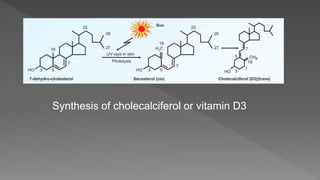
In the skin, ultraviolet light (290-315 nm) breaks the
bond between position 9 and 10 of the steroid ring.
So, the ring B is opened, to form the provitamin,
Secosterol
The cis double bond between 5th and 6th carbon atoms,
is the nisomerized to a trans double bond(rotation on
the6th carbon atom) to give rise to vitamin D3
orcholecalciferol
So, vitamin D is called the “sun-shine vitamin”.
Synthesis of cholecalciferol or vitamin D3
Usually we get vitamin D from sunlight and the food we
consume.
Actually the body makes vitamin D in a chemical reaction
When the sun hits the skin.
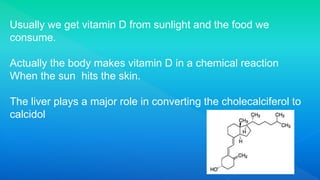
The liver plays a major role in converting the cholecalciferol to
calcidol
Application of sun creams causes vitamin D deficiency
The more vitamin D u take ,the better?
Which is mistaken usually …..
Vitamin D supplements are actually high doses of vitamin D
where the excess is excuted as heatboils
Vitamin D is actually a hormone that is the kidney produce
to control blood calcium concentration & impacts the
immune system
Actually vitamin D prevents Cancer cells from replicating
especially colorectal cancer
Women with healthy levels of vitamin D had 61% lower
odds of breast cancer than women didn’t have enough of it
.
1. Vitamin
D2
2. vitamin
D3
 Why do I need vitamin D?
 Your body must have vitamin D to absorb calcium and
promote bone growth. Too little vitamin D results in soft
bones in children (rickets) and fragile, misshapen bones
in adults (osteomalacia). You also need vitamin D for
other important body functions.
 Vitamin D deficiency has now been linked to breast
cancer, colon cancer, prostate cancer, heart disease,
depression, weight gain, and other maladies. These
studies show that people with higher levels of vitamin D
have a lower risk of disease, although they do not
definitively prove that lack of vitamin D causes disease --
or that vitamin D supplements would lower risk.
 The Vitamin D Council -- a scientist-led group promoting
vitamin D deficiency awareness -- suggests vitamin D
treatment might be found helpful in treating or preventing
autism, autoimmune disease, cancer, chronic pain,
depression, diabetes, heartdisease, high bloodpressure,
flu, neuromuscular diseases, and osteoporosis. However,
there have been no definitive clinical trials.
 That's why the Institute of Medicine expert committee's
November 2010 review found no conclusive evidence that
vitamin D, by itself, offers wide-ranging health benefits.
 Vitamin D has multiple roles in the body, helping to:
 Maintain the health of bones and teeth.
 Support the health of the immune system, brain, and nervous
system.
 Regulate insulin levels and aid diabetes management.
 Support lung function and cardiovascular health.
 Influence the expression of genes involved in cancer
development.
 Vitamin D2 is known as ergocalciferol, a form of Vitamin D. It
is created from viosterol, which in turn is created when
ultraviolet light activates ergosterol. Ergocalciferol is a fat-
soluble vitamin that regulates calcium and phosphorus
metabolism.
 Vitamin D3 is used as a dietary supplement in people who do
not get enough vitamin D in their diets to maintain adequate
health.
 Vitamin D3 may also be used for purposes not listed in this
medication guide.
 Factors that impact the ability of the body to synthesize vitamin d through
the skin are geographic latitude, time of year ,time of day, presence of
clouds and/or smog , skin melanin content , and whether or not sunscreen
has been applied. For example , residents at 42°N latitude or higher are
unable to synthesize vitamin D via the skin during the winter month (from
November through February).
1. SALMON
2.HERRING AND SARDINES
3.COD LIVER OIL
4.CANNED TUNA
5.OYESTERS
6.SHRIMP
7.EGG YOLKS
8.MUSHROOMS
9.FORTIFIED FOODS [cow’s milk, soy milk, orange juice,
cereal and oatmeal]
10.SUNLIGHT
CAUSES :
• Inadequate exposure to sunlight
• No proper diet
• Obesity
• Inefficient production in the skin
• Nutritional deficiency of calcium or
phosphate
 GETTING SICK OR INFECTED
OFTEN
 BONE PAIN AND BACK PAIN
 DEPRESSION AND TIREDNESS
 IMPAIRED WOUND HEALING
DISORDERS :
RICKETS
• WEAKENING AND SOFTENING OF BONES IN
CHILDREN
• RARE INHERITED PROBLEMS –CAUSE RICKETS
• DUE TO RICKETS –
MUSCLE WEAKNESS
PAIN IN SPINE PELVIS AND LEGS
DELAYED GROWTH
• RICKETS – DENTAL DEFECTS, BONE
DERFORMITIES
 WEAKIENING OR SOFTENING OF BONES
 EARLY STAGES – NO SYMPTOMS.
 AS THEY MATURE – CAUSES
BONE PAIN
MUSCLE WEAKNESS
DECREASED MUSCLE TONE
 ACHING PAIN MAINLY IN LEGS ,RIBS ,BACK ETC.
 DEFICENCY IN PHOSPHATE MAY ALSO LEAD TO
OSTEOMALACIA
Vitamin D deficiency may also leads to or raise the
risk of certain diseases like Schizophrenia and
multiple Sclerosis
A long-term mental disorder of a type involving a breakdown in
the relation between thought, emotion, and behavior, leading to
faulty perception, inappropriate actions and feelings, withdrawal
from reality and personal relationships into fantasy and delusion,
and a sense of mental fragmentation.
A chronic, typically progressive disease involving
damage to the sheaths of nerve cells in the brain and
spinal cord.
 EAT FOOD RICH IN VITAMIN D
 15-20 EACH DAY IN NATURAL SUN LIGHT
 MAINTAINING A HEALTHY BODY WEIGHT
 TAKING VITAMIN D SUPPLEMENT
Statistics :
15 % - world population are vitamin D deficient.
INDIA –major public problem.
New born –vitamin D deficiency .
Age group 6-18 are more affected.
Requirement of Vitamin D
i. Children = 10 microgram (400 IU)/day
ii. Adults = 5 microgram (200 IU)/day
iii. Pregnancy, lactation = 10 microgram/day
iv. Above the age of 60 = 600 IU per day.
vitamin D and its uses

vitamin D and its uses

  • 1.
    Done By: Bharathippriyan ,Laksha , Harisree , Koshiga
  • 2.
    Formation of VitaminD Vitamin D is derived either from 7-dehydrocholesterol or ergosterol by the action of ultraviolet radiations. 7-dehydrocholesterol, an intermediate of a minor pathway of cholesterol synthesis, is available in the Malpighian layer of epidermis. In the skin, ultraviolet light (290-315 nm) breaks the bond between position 9 and 10 of the steroid ring.
  • 3.
    So, the ringB is opened, to form the provitamin, Secosterol The cis double bond between 5th and 6th carbon atoms, is the nisomerized to a trans double bond(rotation on the6th carbon atom) to give rise to vitamin D3 orcholecalciferol So, vitamin D is called the “sun-shine vitamin”.
  • 4.
  • 6.
    Usually we getvitamin D from sunlight and the food we consume. Actually the body makes vitamin D in a chemical reaction When the sun hits the skin. The liver plays a major role in converting the cholecalciferol to calcidol
  • 7.
    Application of suncreams causes vitamin D deficiency The more vitamin D u take ,the better? Which is mistaken usually …..
  • 8.
    Vitamin D supplementsare actually high doses of vitamin D where the excess is excuted as heatboils Vitamin D is actually a hormone that is the kidney produce to control blood calcium concentration & impacts the immune system Actually vitamin D prevents Cancer cells from replicating especially colorectal cancer Women with healthy levels of vitamin D had 61% lower odds of breast cancer than women didn’t have enough of it .
  • 10.
  • 13.
     Why doI need vitamin D?  Your body must have vitamin D to absorb calcium and promote bone growth. Too little vitamin D results in soft bones in children (rickets) and fragile, misshapen bones in adults (osteomalacia). You also need vitamin D for other important body functions.  Vitamin D deficiency has now been linked to breast cancer, colon cancer, prostate cancer, heart disease, depression, weight gain, and other maladies. These studies show that people with higher levels of vitamin D have a lower risk of disease, although they do not definitively prove that lack of vitamin D causes disease -- or that vitamin D supplements would lower risk.  The Vitamin D Council -- a scientist-led group promoting vitamin D deficiency awareness -- suggests vitamin D treatment might be found helpful in treating or preventing autism, autoimmune disease, cancer, chronic pain, depression, diabetes, heartdisease, high bloodpressure, flu, neuromuscular diseases, and osteoporosis. However, there have been no definitive clinical trials.  That's why the Institute of Medicine expert committee's November 2010 review found no conclusive evidence that vitamin D, by itself, offers wide-ranging health benefits.
  • 14.
     Vitamin Dhas multiple roles in the body, helping to:  Maintain the health of bones and teeth.  Support the health of the immune system, brain, and nervous system.  Regulate insulin levels and aid diabetes management.  Support lung function and cardiovascular health.  Influence the expression of genes involved in cancer development.
  • 15.
     Vitamin D2is known as ergocalciferol, a form of Vitamin D. It is created from viosterol, which in turn is created when ultraviolet light activates ergosterol. Ergocalciferol is a fat- soluble vitamin that regulates calcium and phosphorus metabolism.
  • 16.
     Vitamin D3is used as a dietary supplement in people who do not get enough vitamin D in their diets to maintain adequate health.  Vitamin D3 may also be used for purposes not listed in this medication guide.
  • 17.
     Factors thatimpact the ability of the body to synthesize vitamin d through the skin are geographic latitude, time of year ,time of day, presence of clouds and/or smog , skin melanin content , and whether or not sunscreen has been applied. For example , residents at 42°N latitude or higher are unable to synthesize vitamin D via the skin during the winter month (from November through February).
  • 20.
    1. SALMON 2.HERRING ANDSARDINES 3.COD LIVER OIL 4.CANNED TUNA 5.OYESTERS 6.SHRIMP 7.EGG YOLKS 8.MUSHROOMS 9.FORTIFIED FOODS [cow’s milk, soy milk, orange juice, cereal and oatmeal] 10.SUNLIGHT
  • 24.
    CAUSES : • Inadequateexposure to sunlight • No proper diet • Obesity • Inefficient production in the skin • Nutritional deficiency of calcium or phosphate
  • 25.
     GETTING SICKOR INFECTED OFTEN  BONE PAIN AND BACK PAIN  DEPRESSION AND TIREDNESS  IMPAIRED WOUND HEALING
  • 26.
  • 27.
    RICKETS • WEAKENING ANDSOFTENING OF BONES IN CHILDREN • RARE INHERITED PROBLEMS –CAUSE RICKETS • DUE TO RICKETS – MUSCLE WEAKNESS PAIN IN SPINE PELVIS AND LEGS DELAYED GROWTH • RICKETS – DENTAL DEFECTS, BONE DERFORMITIES
  • 29.
     WEAKIENING ORSOFTENING OF BONES  EARLY STAGES – NO SYMPTOMS.  AS THEY MATURE – CAUSES BONE PAIN MUSCLE WEAKNESS DECREASED MUSCLE TONE  ACHING PAIN MAINLY IN LEGS ,RIBS ,BACK ETC.  DEFICENCY IN PHOSPHATE MAY ALSO LEAD TO OSTEOMALACIA
  • 30.
    Vitamin D deficiencymay also leads to or raise the risk of certain diseases like Schizophrenia and multiple Sclerosis
  • 31.
    A long-term mentaldisorder of a type involving a breakdown in the relation between thought, emotion, and behavior, leading to faulty perception, inappropriate actions and feelings, withdrawal from reality and personal relationships into fantasy and delusion, and a sense of mental fragmentation. A chronic, typically progressive disease involving damage to the sheaths of nerve cells in the brain and spinal cord.
  • 32.
     EAT FOODRICH IN VITAMIN D  15-20 EACH DAY IN NATURAL SUN LIGHT  MAINTAINING A HEALTHY BODY WEIGHT  TAKING VITAMIN D SUPPLEMENT
  • 33.
    Statistics : 15 %- world population are vitamin D deficient. INDIA –major public problem. New born –vitamin D deficiency . Age group 6-18 are more affected.
  • 34.
    Requirement of VitaminD i. Children = 10 microgram (400 IU)/day ii. Adults = 5 microgram (200 IU)/day iii. Pregnancy, lactation = 10 microgram/day iv. Above the age of 60 = 600 IU per day.