Introduction to Food
Analysis Lab
Ayesha Siddiqa
10/8/2020 1
Introduction of Food Lab Equipments
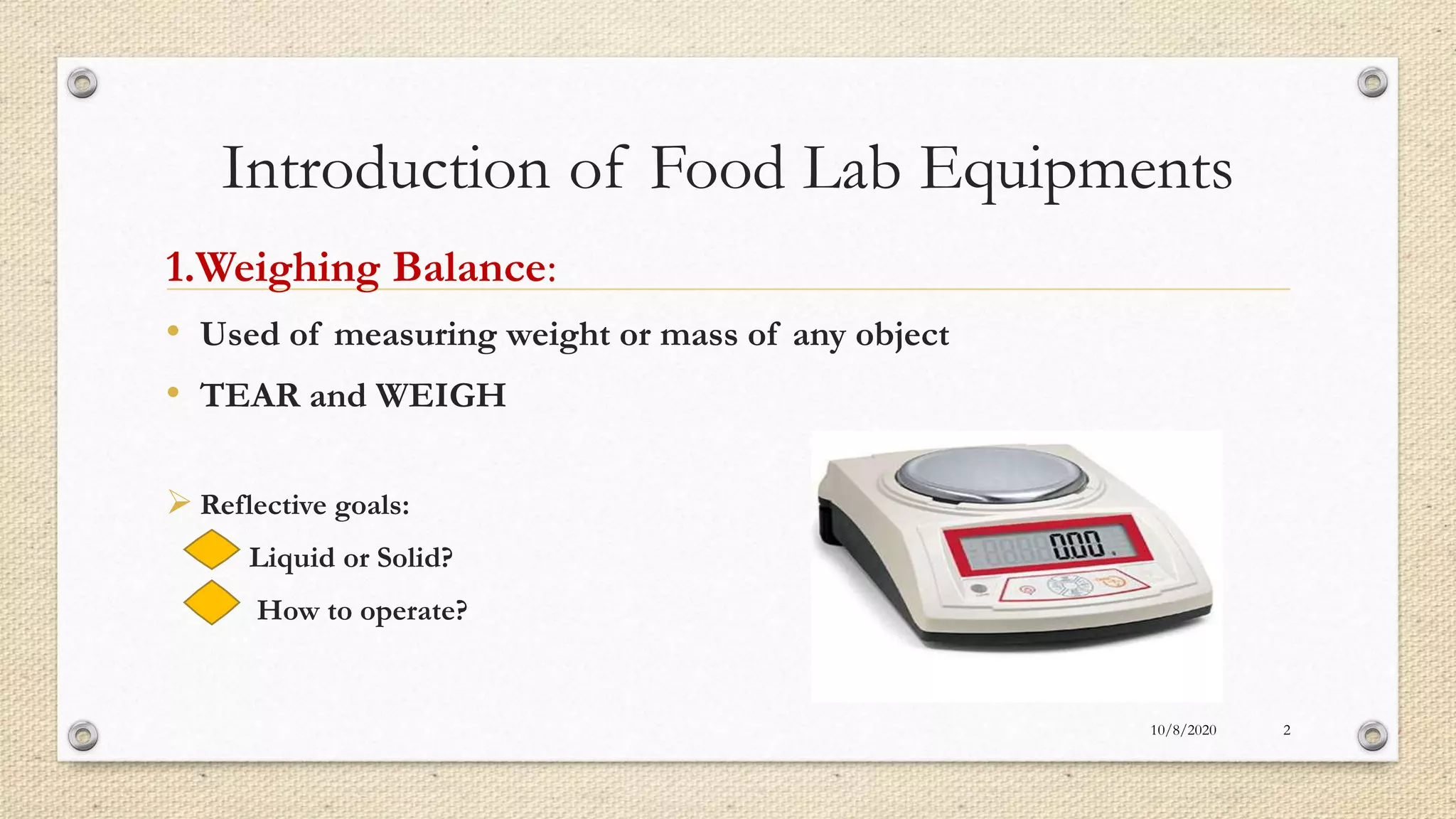
1.Weighing Balance:
• Used of measuring weight or mass of any object
• TEAR and WEIGH
 Reflective goals:
Liquid or Solid?
How to operate?
10/8/2020 2
Analytical Weighing Balance:
• Highly sensitive weight measuring instrument
particularly designed to measure weight accurately
• Its readability range is between 0.1mg - 0.01mg
• Analytical balances have a draft shield or cover with
glass chamber
• To control weight fluctuations of light weight samples
from being affected by air currents.
10/8/2020 3
Introduction of Food Lab Equipments
2.Hot Air Oven
• Principle
• Hot Air circulation in closed chamber
• Dry heat
• Used for drying and sterilizing
• Moisture Determination of Food products
• Temperature 105°C ; Time 24 hours
What do you understand by term dry heat?
10/8/2020 4
Introduction of Food Lab Equipments
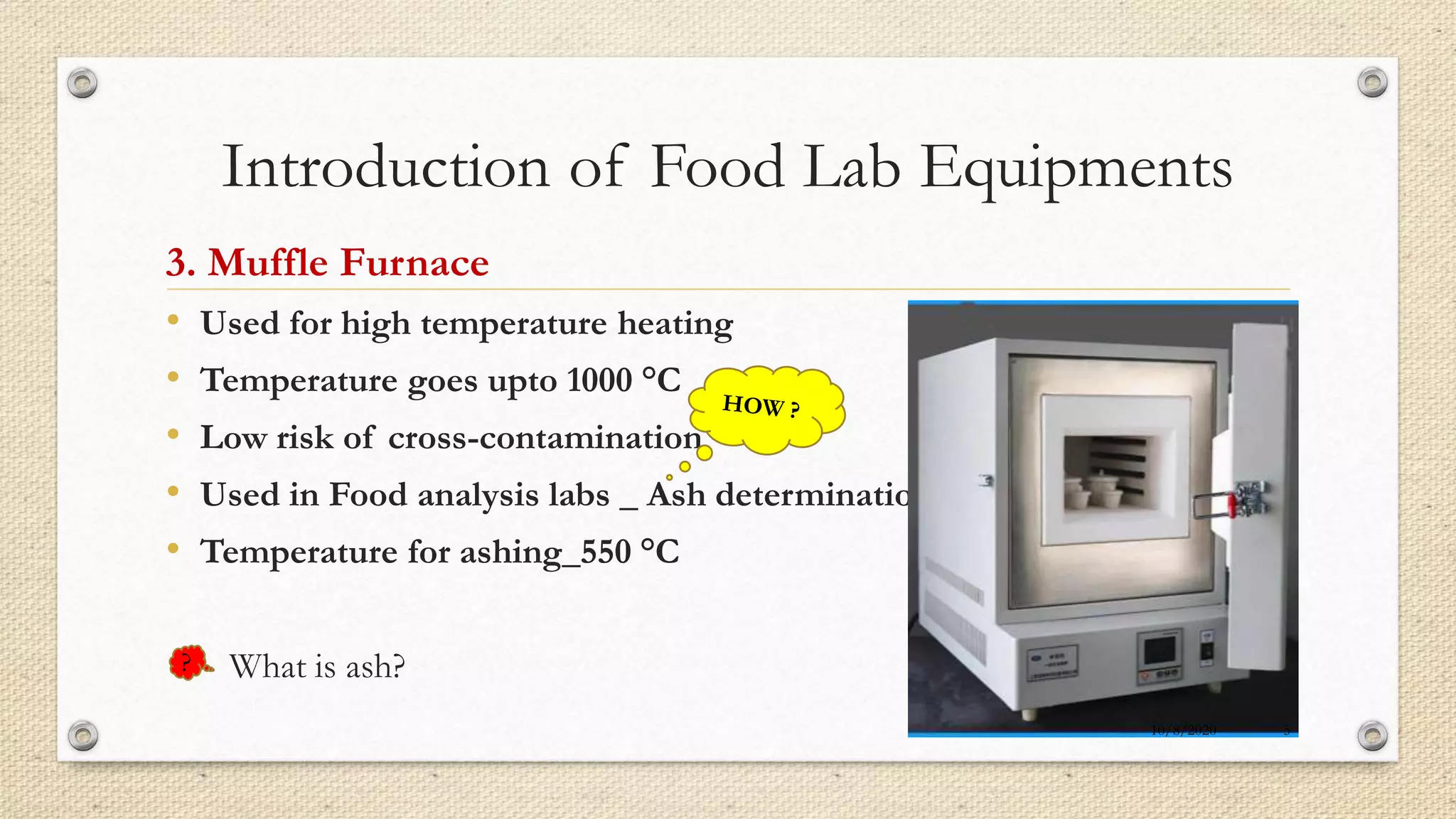
3. Muffle Furnace
• Used for high temperature heating
• Temperature goes upto 1000 °C
• Low risk of cross-contamination
• Used in Food analysis labs _ Ash determination
• Temperature for ashing_550 °C
What is ash??
10/8/2020 5
Introduction of Food Lab Equipments
4. Water Bath
• Used for indirect heating of highly inflammable
liquids
• Its shape is like a container that is filled with water
• Most of the water baths operate at 99.9˚C
• Purpose is to control heat sensitive components /
compounds of sample
Difference between Hot air oven and water bath?
When we choose water bath?
10/8/2020 6
Introduction of Food Lab Equipments
5. Incubator
• Used to increase or preserve cultures of microbes
and their cell structures
• Incubator _ a box insulated with a maintainable
heater
• Provide favorable/optimal growth conditions
• Temperature range of 60- 65 °C although some
are bit higher no more than 100˚C
What is incubation?
10/8/2020 7
Introduction of Food Lab Equipments
6. Autoclave
• Autoclave used for sterilization purpose
• Sterilization by moist heat
• Sterilization of supplies and equipment's
• By sustaining them to saturated steam pressurized at
121 °C for about 15-20 mins at 15-20 psi.
Difference between Autoclave and water bath?
10/8/2020 8
Introduction of Food Lab Equipments
7. Biosafety Cabinet
• It is an enclosed, ventilated laboratory
workspace for safely working with materials
contaminated with (or potentially contaminated
with) pathogens requiring a
defined biosafety level
• Microbiological testing of food samples
• It is also called a biological safety cabinet or
microbiological safety cabinet
10/8/2020 9
Introduction of Food Lab Equipments
8. Orbital Shaker
• For shaking/mixing purpose
• Its is used to mix, blend and agitate the
substances
• Samples subjected to shaking in tubes, glass
bottles or in flasks
• Speed can be adjustable
• Advance shakers are has inbuilt heating systems
When we used orbital shaker?
10/8/2020 10
Introduction of Food Lab Equipments
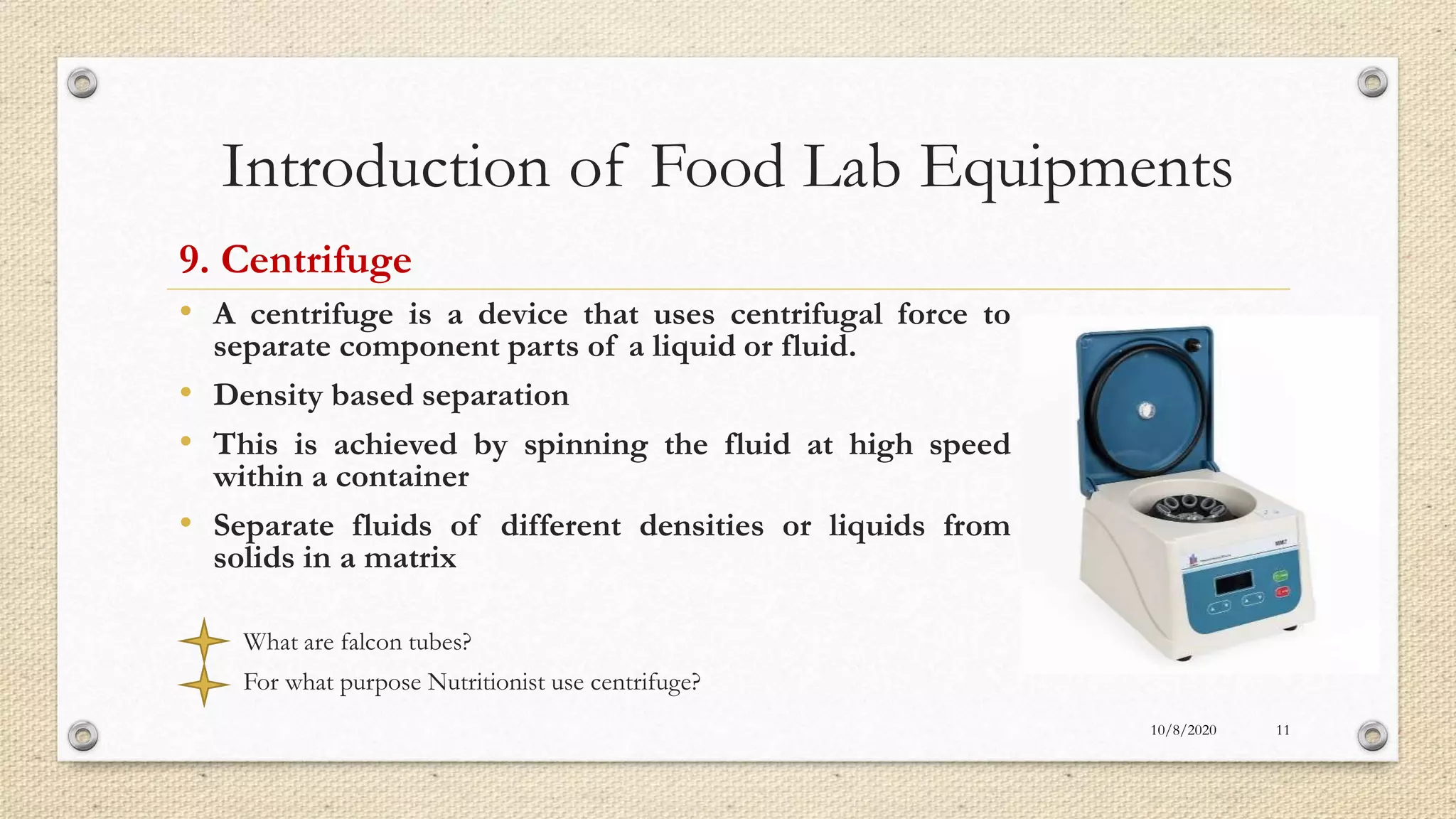
9. Centrifuge
• A centrifuge is a device that uses centrifugal force to
separate component parts of a liquid or fluid.
• Density based separation
• This is achieved by spinning the fluid at high speed
within a container
• Separate fluids of different densities or liquids from
solids in a matrix
What are falcon tubes?
For what purpose Nutritionist use centrifuge?
10/8/2020 11
Introduction of Food Lab Equipments
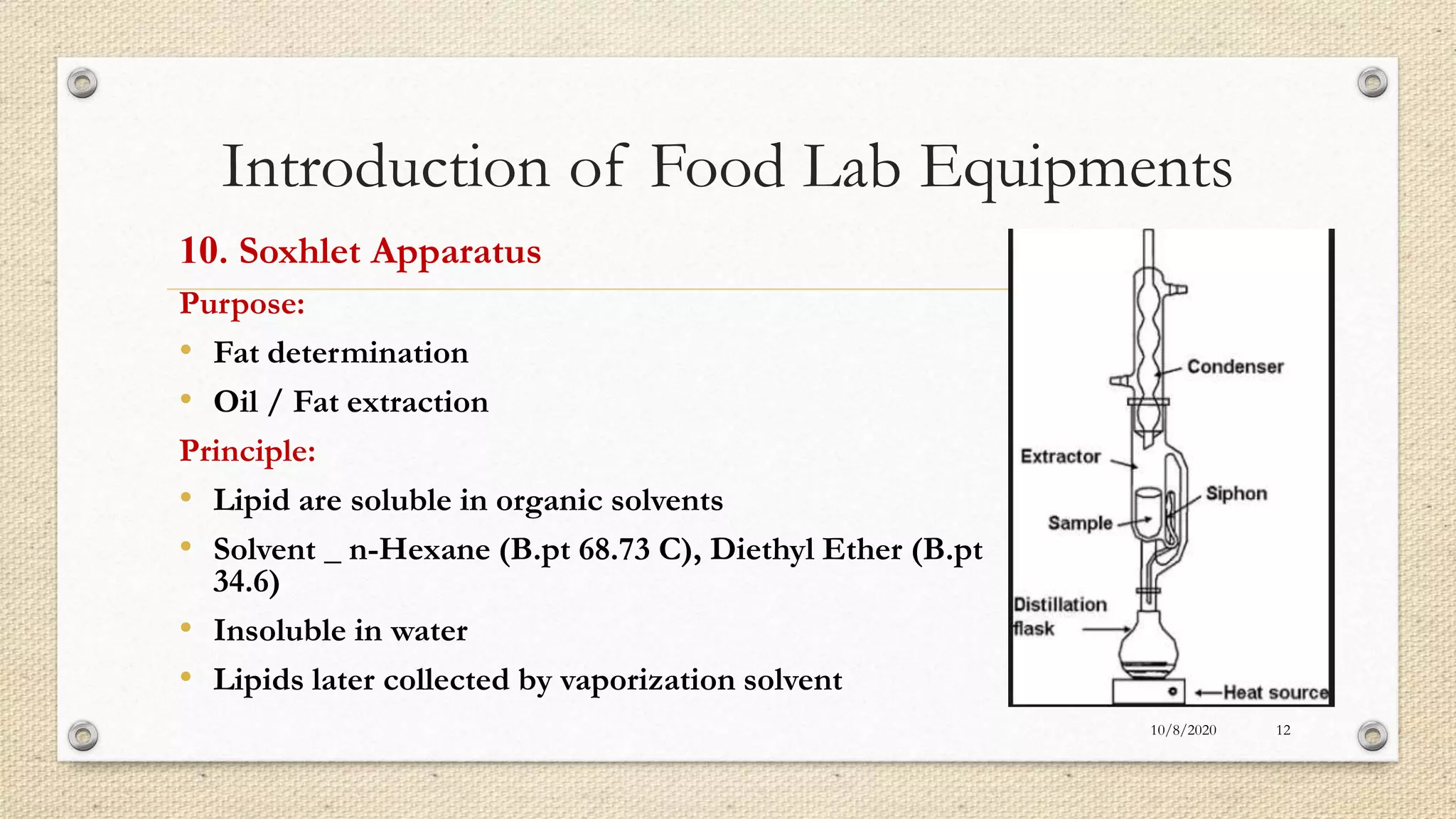
10. Soxhlet Apparatus
Purpose:
• Fat determination
• Oil / Fat extraction
Principle:
• Lipid are soluble in organic solvents
• Solvent _ n-Hexane (B.pt 68.73 C), Diethyl Ether (B.pt
34.6)
• Insoluble in water
• Lipids later collected by vaporization solvent
10/8/2020 12
Introduction of Food Lab Equipments
11. Kjeldahl Apparatus
• Used for the determination of protein content in substance
• By estimation of Organic Nitrogen (N2) content
10/8/2020 13
Introduction of Food Lab Equipments
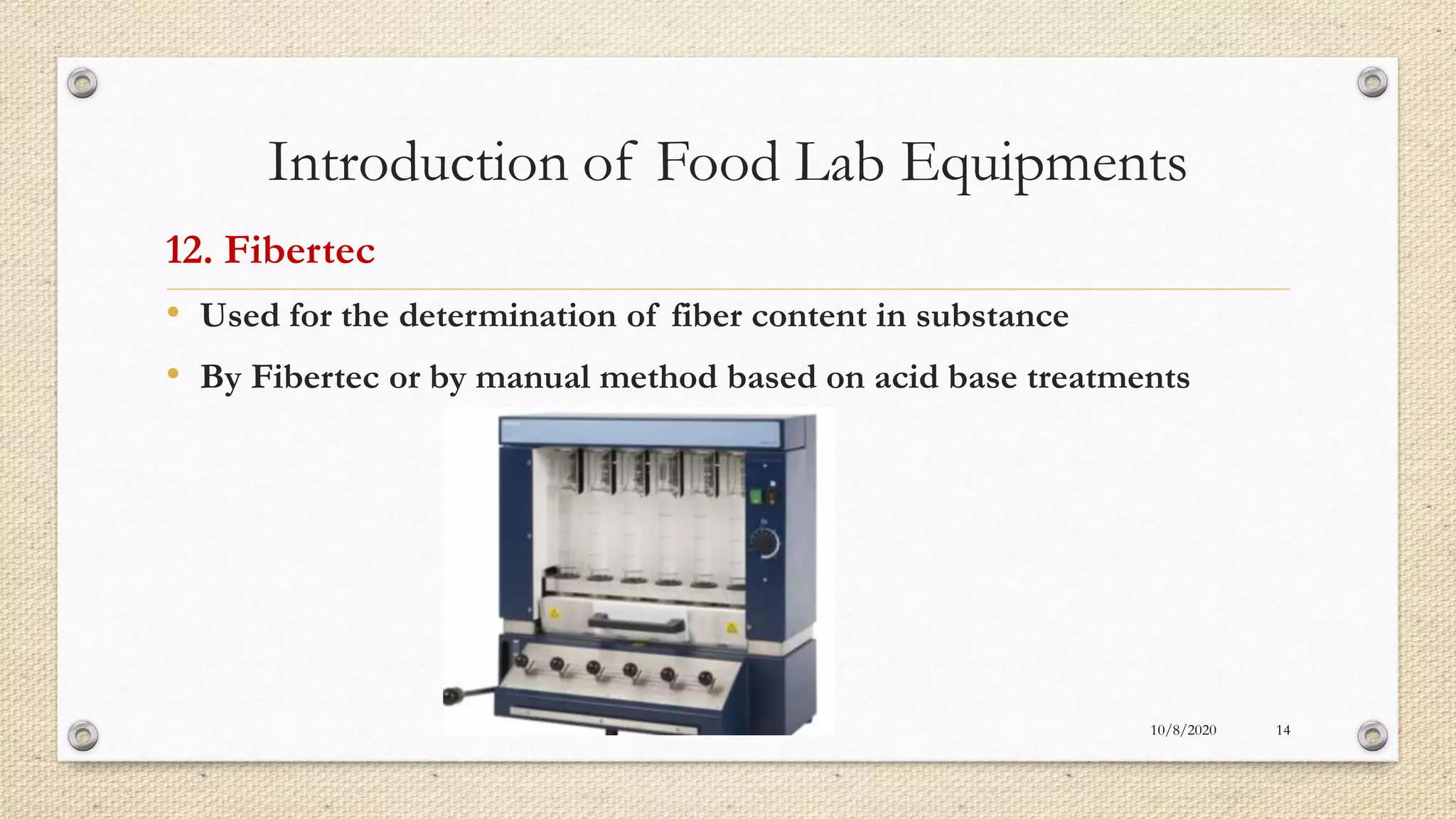
12. Fibertec
• Used for the determination of fiber content in substance
• By Fibertec or by manual method based on acid base treatments
10/8/2020 14
Introduction of Food Lab Equipments
13. pH meter
• Used to check pH of sample or solution
• pH meter is an electronic device having probe
connected with electronic meter
Can you differentiate pH and acidity?
10/8/2020 15
Introduction of Food Lab Equipments
14.Viscometer
• Used to measure Viscosity of liquid food
samples/solutions
• Fluid substances
Define viscosity?
10/8/2020 16
Introduction of Food Lab Equipments
15.Brix meter
• Used to calculate Brix value of sweet food sample
• Sweet fruits or sweet juice products
• Liquid food samples
How to use ?
Define Brix?
10/8/2020 17
Introduction of Food Lab Equipments
16.Chroma meter
• Used to measure color intensity of food product
• Color determination directly linked with consumer
acceptability
• Color indicates ripening stage of fruit
• Storage effect on food product characteristics
How to use ?
10/8/2020 18
Introduction of Food Lab Equipments
17. Lactoscan
• Lactoscan or milk analyzer
• Use to make quick analyses of milk:
• Fat
• Non-fat solids (SNF)
• Proteins
• Lactose and
• Water content percentage
• Temperature, pH, freezing point, salts, total solids, conductivity as well as density of
one and the same sample directly after milking, at collecting and during processing.
10/8/2020 19
Introduction of Food Lab Equipments
18.Rotary Evaporator
• Used for efficient removal of solvents from
sample by evaporation
• Also used for concentration purposes
• Efficient and sensitive
• Indirect heat evaporation
• Water bath attachment installed for heating
purpose
10/8/2020 20
Introduction of Food Lab Equipments
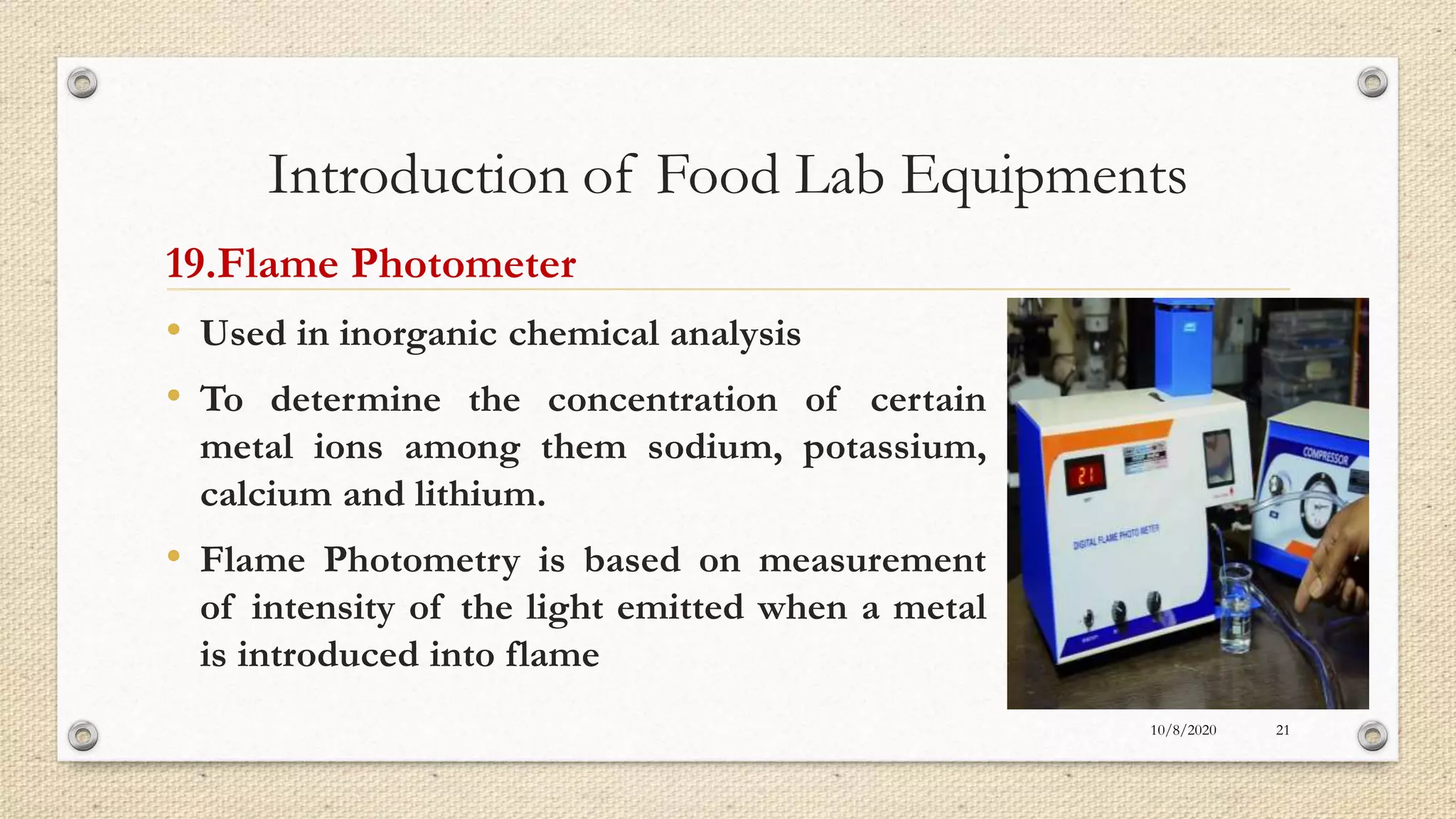
19.Flame Photometer
• Used in inorganic chemical analysis
• To determine the concentration of certain
metal ions among them sodium, potassium,
calcium and lithium.
• Flame Photometry is based on measurement
of intensity of the light emitted when a metal
is introduced into flame
10/8/2020 21
Introduction of Food Lab Equipments
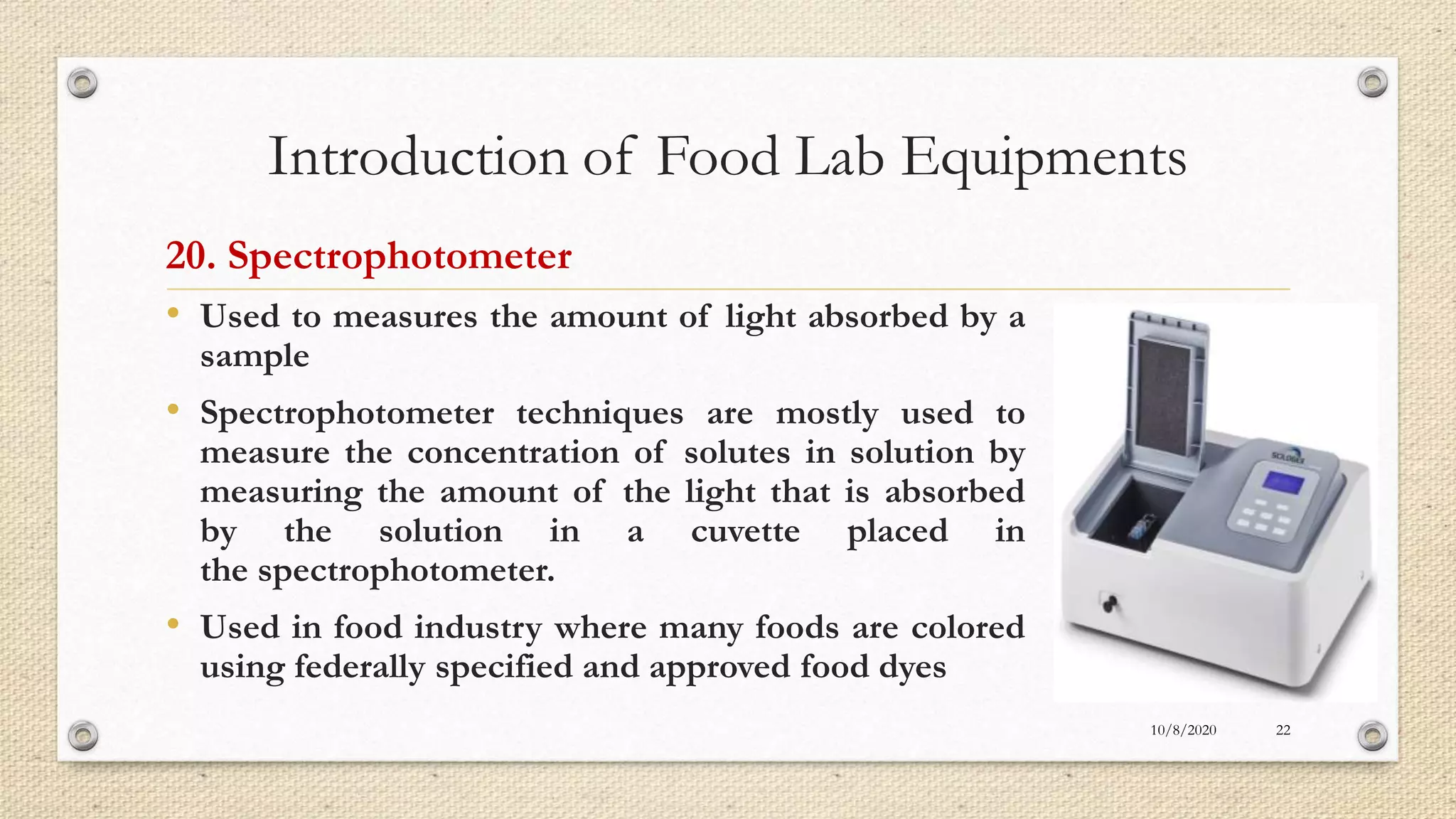
20. Spectrophotometer
• Used to measures the amount of light absorbed by a
sample
• Spectrophotometer techniques are mostly used to
measure the concentration of solutes in solution by
measuring the amount of the light that is absorbed
by the solution in a cuvette placed in
the spectrophotometer.
• Used in food industry where many foods are colored
using federally specified and approved food dyes
10/8/2020 22
10/8/2020 23

Hnd1 ppt 2p (1)

  • 1.
    Introduction to Food AnalysisLab Ayesha Siddiqa 10/8/2020 1
  • 2.
    Introduction of FoodLab Equipments 1.Weighing Balance: • Used of measuring weight or mass of any object • TEAR and WEIGH  Reflective goals: Liquid or Solid? How to operate? 10/8/2020 2
  • 3.
    Analytical Weighing Balance: •Highly sensitive weight measuring instrument particularly designed to measure weight accurately • Its readability range is between 0.1mg - 0.01mg • Analytical balances have a draft shield or cover with glass chamber • To control weight fluctuations of light weight samples from being affected by air currents. 10/8/2020 3
  • 4.
    Introduction of FoodLab Equipments 2.Hot Air Oven • Principle • Hot Air circulation in closed chamber • Dry heat • Used for drying and sterilizing • Moisture Determination of Food products • Temperature 105°C ; Time 24 hours What do you understand by term dry heat? 10/8/2020 4
  • 5.
    Introduction of FoodLab Equipments 3. Muffle Furnace • Used for high temperature heating • Temperature goes upto 1000 °C • Low risk of cross-contamination • Used in Food analysis labs _ Ash determination • Temperature for ashing_550 °C What is ash?? 10/8/2020 5
  • 6.
    Introduction of FoodLab Equipments 4. Water Bath • Used for indirect heating of highly inflammable liquids • Its shape is like a container that is filled with water • Most of the water baths operate at 99.9˚C • Purpose is to control heat sensitive components / compounds of sample Difference between Hot air oven and water bath? When we choose water bath? 10/8/2020 6
  • 7.
    Introduction of FoodLab Equipments 5. Incubator • Used to increase or preserve cultures of microbes and their cell structures • Incubator _ a box insulated with a maintainable heater • Provide favorable/optimal growth conditions • Temperature range of 60- 65 °C although some are bit higher no more than 100˚C What is incubation? 10/8/2020 7
  • 8.
    Introduction of FoodLab Equipments 6. Autoclave • Autoclave used for sterilization purpose • Sterilization by moist heat • Sterilization of supplies and equipment's • By sustaining them to saturated steam pressurized at 121 °C for about 15-20 mins at 15-20 psi. Difference between Autoclave and water bath? 10/8/2020 8
  • 9.
    Introduction of FoodLab Equipments 7. Biosafety Cabinet • It is an enclosed, ventilated laboratory workspace for safely working with materials contaminated with (or potentially contaminated with) pathogens requiring a defined biosafety level • Microbiological testing of food samples • It is also called a biological safety cabinet or microbiological safety cabinet 10/8/2020 9
  • 10.
    Introduction of FoodLab Equipments 8. Orbital Shaker • For shaking/mixing purpose • Its is used to mix, blend and agitate the substances • Samples subjected to shaking in tubes, glass bottles or in flasks • Speed can be adjustable • Advance shakers are has inbuilt heating systems When we used orbital shaker? 10/8/2020 10
  • 11.
    Introduction of FoodLab Equipments 9. Centrifuge • A centrifuge is a device that uses centrifugal force to separate component parts of a liquid or fluid. • Density based separation • This is achieved by spinning the fluid at high speed within a container • Separate fluids of different densities or liquids from solids in a matrix What are falcon tubes? For what purpose Nutritionist use centrifuge? 10/8/2020 11
  • 12.
    Introduction of FoodLab Equipments 10. Soxhlet Apparatus Purpose: • Fat determination • Oil / Fat extraction Principle: • Lipid are soluble in organic solvents • Solvent _ n-Hexane (B.pt 68.73 C), Diethyl Ether (B.pt 34.6) • Insoluble in water • Lipids later collected by vaporization solvent 10/8/2020 12
  • 13.
    Introduction of FoodLab Equipments 11. Kjeldahl Apparatus • Used for the determination of protein content in substance • By estimation of Organic Nitrogen (N2) content 10/8/2020 13
  • 14.
    Introduction of FoodLab Equipments 12. Fibertec • Used for the determination of fiber content in substance • By Fibertec or by manual method based on acid base treatments 10/8/2020 14
  • 15.
    Introduction of FoodLab Equipments 13. pH meter • Used to check pH of sample or solution • pH meter is an electronic device having probe connected with electronic meter Can you differentiate pH and acidity? 10/8/2020 15
  • 16.
    Introduction of FoodLab Equipments 14.Viscometer • Used to measure Viscosity of liquid food samples/solutions • Fluid substances Define viscosity? 10/8/2020 16
  • 17.
    Introduction of FoodLab Equipments 15.Brix meter • Used to calculate Brix value of sweet food sample • Sweet fruits or sweet juice products • Liquid food samples How to use ? Define Brix? 10/8/2020 17
  • 18.
    Introduction of FoodLab Equipments 16.Chroma meter • Used to measure color intensity of food product • Color determination directly linked with consumer acceptability • Color indicates ripening stage of fruit • Storage effect on food product characteristics How to use ? 10/8/2020 18
  • 19.
    Introduction of FoodLab Equipments 17. Lactoscan • Lactoscan or milk analyzer • Use to make quick analyses of milk: • Fat • Non-fat solids (SNF) • Proteins • Lactose and • Water content percentage • Temperature, pH, freezing point, salts, total solids, conductivity as well as density of one and the same sample directly after milking, at collecting and during processing. 10/8/2020 19
  • 20.
    Introduction of FoodLab Equipments 18.Rotary Evaporator • Used for efficient removal of solvents from sample by evaporation • Also used for concentration purposes • Efficient and sensitive • Indirect heat evaporation • Water bath attachment installed for heating purpose 10/8/2020 20
  • 21.
    Introduction of FoodLab Equipments 19.Flame Photometer • Used in inorganic chemical analysis • To determine the concentration of certain metal ions among them sodium, potassium, calcium and lithium. • Flame Photometry is based on measurement of intensity of the light emitted when a metal is introduced into flame 10/8/2020 21
  • 22.
    Introduction of FoodLab Equipments 20. Spectrophotometer • Used to measures the amount of light absorbed by a sample • Spectrophotometer techniques are mostly used to measure the concentration of solutes in solution by measuring the amount of the light that is absorbed by the solution in a cuvette placed in the spectrophotometer. • Used in food industry where many foods are colored using federally specified and approved food dyes 10/8/2020 22
  • 23.