Measurement and Control in Food Processing 1st Edition Manabendra Bhuyan
Measurement and Control in Food Processing 1st Edition Manabendra Bhuyan
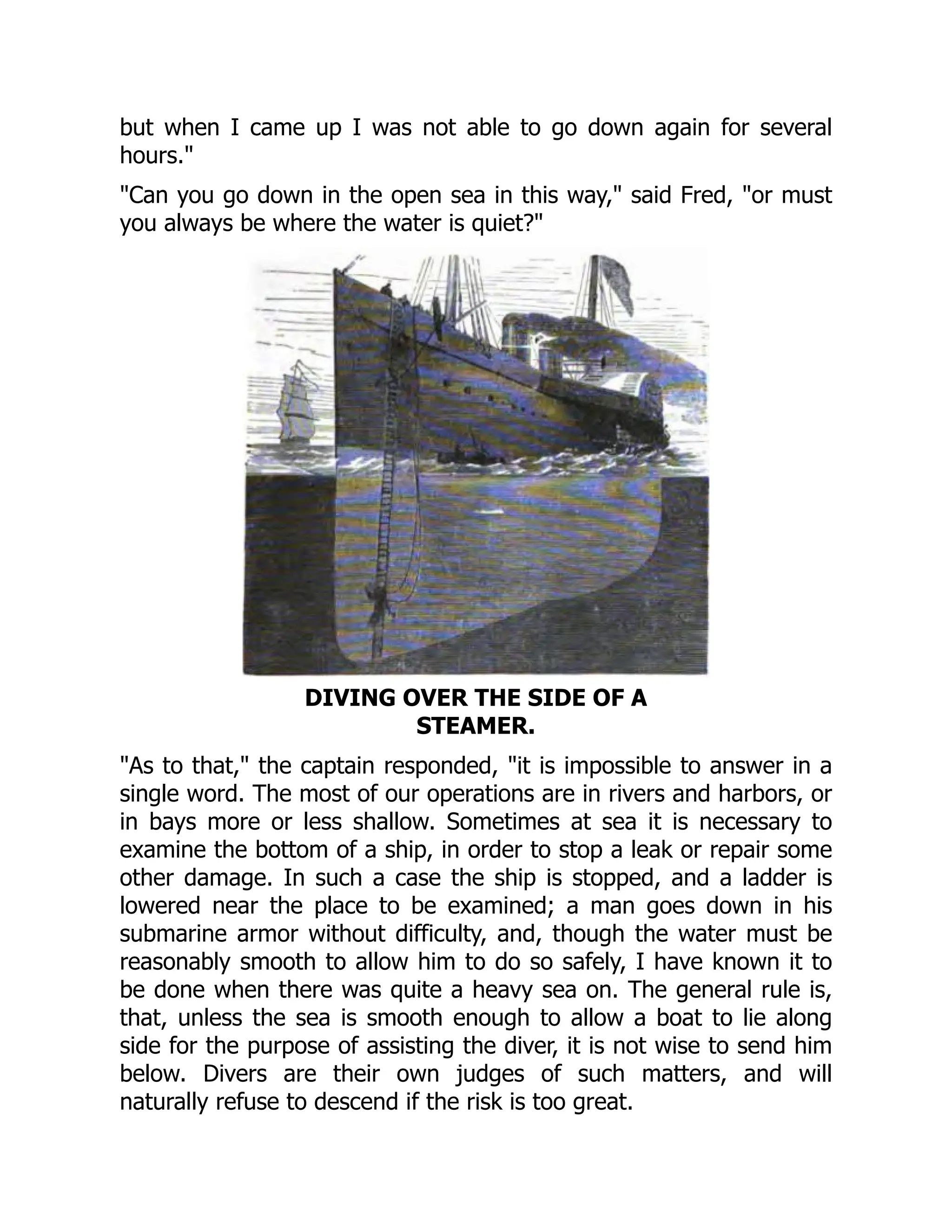
Measurement and Control in Food Processing 1st Edition Manabendra Bhuyan
Measurement and Control in Food Processing 1st Edition Manabendra Bhuyan
Measurement and Control in Food Processing 1st Edition Manabendra Bhuyan
1.
Visit https://ebookultra.com todownload the full version and
explore more ebooks
Measurement and Control in Food Processing 1st
Edition Manabendra Bhuyan
_____ Click the link below to download _____
https://ebookultra.com/download/measurement-and-
control-in-food-processing-1st-edition-manabendra-
bhuyan/
Explore and download more ebooks at ebookultra.com
2.
Here are somesuggested products you might be interested in.
Click the link to download
Measurement and Control Basics Resources for Measurement
and Control Series 3rd Edition Thomas A. Hughes
https://ebookultra.com/download/measurement-and-control-basics-
resources-for-measurement-and-control-series-3rd-edition-thomas-a-
hughes/
Food Biochemistry And Food Processing 1st ed Edition Y.H.
Hui
https://ebookultra.com/download/food-biochemistry-and-food-
processing-1st-ed-edition-y-h-hui/
Ozone in Food Processing 1st Edition Colm O'Donnell
https://ebookultra.com/download/ozone-in-food-processing-1st-edition-
colm-odonnell/
Hygiene in food processing 1st Edition H.L.M. Lelieveld
https://ebookultra.com/download/hygiene-in-food-processing-1st-
edition-h-l-m-lelieveld/
3.
Hydrocolloids in FoodProcessing 1st Edition Thomas R.
Laaman
https://ebookultra.com/download/hydrocolloids-in-food-processing-1st-
edition-thomas-r-laaman/
Thermal Technologies in Food Processing 1st Edition Philip
Richardson
https://ebookultra.com/download/thermal-technologies-in-food-
processing-1st-edition-philip-richardson/
Hygiene in Food Processing Principles and Practice 1st
Edition H.L.M. Lelieveld
https://ebookultra.com/download/hygiene-in-food-processing-principles-
and-practice-1st-edition-h-l-m-lelieveld/
Drying Technologies in Food Processing 1st Edition Xiao
Dong Chen
https://ebookultra.com/download/drying-technologies-in-food-
processing-1st-edition-xiao-dong-chen/
Ultrasound in Food Processing Recent Advances 1st Edition
Mar Villamiel
https://ebookultra.com/download/ultrasound-in-food-processing-recent-
advances-1st-edition-mar-villamiel/
5.
Measurement and Controlin Food Processing 1st Edition
Manabendra Bhuyan Digital Instant Download
Author(s): Manabendra Bhuyan
ISBN(s): 9781420006797, 1420006797
Edition: 1
File Details: PDF, 10.47 MB
Year: 2006
Language: english
CRC is animprint of the Taylor & Francis Group,
an informa business
MEASUREMENT
and CONTROL
in FOOD
PROCESSING
Manabendra Bhuyan, Ph.D.
Boca Raton London New York
Foreword
Maintenance of thequality of processed food is a matter of concern for both
food manufacturers and customers. If a product does not meet the estab-
lished specifications, then it has to be sold at a loss, destroyed, or reworked.
Therefore, quality control in food processing has become an integral part of
the food processing industry. By the end of the 20th century, the food pro-
cessing industry gradually adopted automated process control technologies
and left behind traditional inspection methods for ensuring food quality and
safety. Food quality and safety activities shifted from human inspection of
individual pieces to automated, statistically driven monitoring systems for
improved quality control. The new approach monitors key control points in
the process to make sure that the finished products will meet the specifica-
tions. These changes were possible due to the advantages of computers,
microchips, and sensor technology.
From the smallest baker to the largest snack manufacturer, food processing
has many operations elements in common. From receiving raw materials to
the finished product involving blending, the entire period of processing,
removing defects, value addition, checking weight, and packaging, measure-
ment and control devices have important roles to play. Therefore, it is essen-
tial that the detecting systems are properly calibrated and users understand
the limitations of the systems.
Although different instruments or devices were used for several decades
for measurement and control parameters during food processing, there have
been tremendous changes in these instruments due to advancement in
related areas. The measurement devices have become more accurate and
efficient, less power consuming, smaller in size, easier to operate, and also
cheaper in many instances. Detection systems and control mechanisms will
continue to be developed and improved. During the last 10 years sophisti-
cation of scanning technology has improved many times over. Currently,
biosensors are attracting a great deal of interest.
There exists much literature in the area, but it has not been compiled in one
place. The author has made an attempt to compile all the available information
and present it in a comprehensive manner. This book is divided into five major
chapters covering various aspects of measurement and control in food process-
ing. Apart from describing the principles and their applications, suitable exam-
ples, problems, and their solutions are also provided wherever applicable.
This book will be useful for food scientists, instrumentation engineers, trans-
ducer manufacturers, and food processing engineers. This is basically a refer-
ence book, but can also be a textbook for food science and technology courses
being offered in different colleges and universities at the graduate level.
7244_C000.fm Page v Thursday, July 6, 2006 11:15 PM
12.
I feel honoredto have been asked to write the foreword for such an
important book. I would like to congratulate Dr. M. Bhuyan, the author, for
his dedication and wholehearted effort to present the book in this form. He
has made a valuable contribution to food science and technology.
Professor P. C. Deka
Vice-Chancellor
Tezpur University, India
7244_C000.fm Page vi Thursday, July 6, 2006 11:15 PM
13.
Preface
The beginning ofmy research in instrumentation and control in the tea
industry dates back to the early 1990s, when I first recognized the need for
appropriate literature on the subject. I still remember when I had to jostle
through dozens of tables of contents and indexes looking for discussions of
a suitable converter for measuring process parameters in the tea industry. I
also remember how much of my valuable time was devoted to designing a
circuit for lack of proper literature. The feeling of need at that time translated
into the idea for this book now.
During the last few decades, many innovations came to the world of instru-
mentation and control in food processing, and in spite of a significant amount
of literature distributed in various places, common texts are still far less than
expected. Measurement and Control in Food Processing is an attempt to make
food scientists aware of various means of food-related measurements and
controls, help instrumentation engineers and transducer manufacturers
design instruments and control schemes suitable for food-processing envi-
ronments, make food engineers attentive to the applicability of instrumenta-
tion and control to enhance quality and productivity, and more importantly,
educate students of food science or food technology courses on methods and
techniques of measurements and control in food processing.
The advent of super-specializations in food processing has caused confu-
sion about who actually handles measurement and control in food processing.
A food-processing engineer may not know how to design a controller circuit,
but at the same time an instrumentation engineer may not know what com-
plex flavor components emanate from a cup of tea. It is not difficult to estab-
lish coordination between these two areas of knowledge. During my long
experience in food-related instrumentation and control, I have encountered
such problems and realized that there should not be a sharp line between
these two forms of expertise. This motivated me to address the problems
faced by food-processing engineers in quantifying food-related parameters
and their control from the angles both of food processing and instrumentation.
The book is divided into five major chapters, beginning with an illustrated
introduction to food processing measurement and control in chapter 1. Chap-
ter 2, a cornerstone for the book, is devoted to background materials about
basic principles of transducers and controllers. Numerical problems are dis-
cussed in several sections so that readers can understand the applicability
of food-processing devices. Readers who have already completed a course
in instrumentation and control can skip this chapter or can read it to refresh
their knowledge. Chapter 3 deals exclusively with measurement techniques
for food processing, covering a significant amount of food-related process
7244_C000.fm Page vii Thursday, July 6, 2006 11:15 PM
14.
parameters. The chapterfeatures the relevance and importance of process
parameters in food-processing industries and discussion of measuring tech-
niques, and specific applications in most recent developments have been
enumerated. A number of texts from research publications have been
included and several intelligent instrumentation techniques that have
emerged in recent years have been presented. In chapter 4, topics on con-
trollers and indicators for food-processing industries with a good deal of
practical application have been presented. Recent nontraditional control
schemes, such as fuzzy control, are also discussed in this chapter. Microcom-
puter-based process monitoring and control is a major issue today. The
devices, standards, and procedures and suitable examples for process–com-
puter interaction are presented in chapter 5.
The book is intended to respond well to the need of food engineers,
instrumentation engineers, transducer manufacturers, researchers, teachers,
and students of food science or food technology. Although the book looks
like a reference work, it can also be a good textbook for a course in food
science, food technology, or biosystems.
While the book is the result of my untiring efforts, there are many others
who contributed to its development. I must thank Prof. P.C. Deka, Vice-
chancellor, Tezpur University, India, for writing the foreword, where he has
presented a valuable comment on the aim and scope of the book; and my
M Tech students, A.G. Venkatesh, Mahanada Saharaia, Pawan Kumar Bhar-
gav, and Riku Chutia, for helping me with the artwork and text. A special
thanks to A.G. Venkatesh, who went to a lot of trouble with a major part of
the artwork, sending it via email from the University of Manchester, and
asking me to let him know “if there is anything more I can do.” Thanks also
to my research scholars, Kishana Ram Kashwan and Surajit Borah, who
helped me to include some of the topics from their theses; to my colleagues,
J.C. Dutta and P.P. Sahu, for their kind support during preparation of the
manuscript; and to our office assistants, Dwipendra Ch. Das and Dibakar
Nath, for their help.
I am grateful to the staff of Taylor & Francis Group for their professional
guidance and advice during the preparation of the project proposal and the
manuscript, particularly to Susan B. Lee, Amber Donley, Marsha Pronin, and
the production team. I am also grateful to the reviewers (unknown) of my
original book proposal.
I must thank my wife, Arihana (Nanti), who helped me indirectly in
writing the book, particularly during the last few weeks before sending the
manuscript to the publisher. I thank my daughter and son, Abhishruti (Pahi)
and Abhinab (Pol), for their patience during the writing of this book.
7244_C000.fm Page viii Thursday, July 6, 2006 11:15 PM
15.
Contents
Foreword ........................................................................................................ v
Preface...........................................................................................................vii
Chapter 1 Introduction......................................................................... 1
1.1 Food Processing Industries.......................................................................... 1
1.1.1 Canned and Bottled Fruits and Vegetables .................................. 2
1.1.2 Beer...................................................................................................... 4
1.1.3 Ciders .................................................................................................. 5
1.1.4 Soft Drinks.......................................................................................... 6
1.1.5 Sugar.................................................................................................... 7
1.1.6 Jams and Jellies.................................................................................. 8
1.1.7 Black Tea............................................................................................. 9
1.2 Introduction to Process Instrumentation and Control .......................... 10
1.2.1 An Industrial Process ..................................................................... 11
1.2.2 Process Parameters ......................................................................... 13
1.2.3 Batch and Continuous Processes.................................................. 14
1.2.4 Process Instrumentation and Control.......................................... 14
1.2.5 Selection of Controller.................................................................... 22
1.3 Conclusion .................................................................................................... 24
Chapter 2 Measuring and Controlling Devices .............................. 27
2.1 Role of Transducers in Food Processing.................................................. 28
2.2 Classification of Transducers..................................................................... 30
2.2.1 Self-Generating Type ...................................................................... 30
2.2.2 Variable Parameter Type................................................................ 30
2.2.3 Pulse or Frequency Generating Types......................................... 32
2.2.4 Digital Transducers......................................................................... 32
2.3 Self-Generating Transducers...................................................................... 33
2.3.1 Piezoelectric Transducers............................................................... 33
2.3.2 Thermocouples ................................................................................ 36
2.3.3 Photoelectric Transducers.............................................................. 41
2.3.4 Magneto-Electric Transducer......................................................... 44
2.3.5 Radioactive Transducer.................................................................. 47
2.4 Variable Parameter Type ............................................................................ 51
2.4.1 Resistive Transducer....................................................................... 51
2.4.2 Inductive Transducers .................................................................... 72
2.4.3 Capacitive Transducer.................................................................... 77
7244_C000.fm Page ix Thursday, July 6, 2006 11:15 PM
16.
2.5 Digital Transducers..................................................................................... 80
2.5.1 Direct Digital Encoder.................................................................... 80
2.5.2 Frequency, Pulse Encoder.............................................................. 80
2.5.3 Analog-to-Digital Encoder............................................................. 81
2.5.4 Analog-to-Digital Converter ......................................................... 81
2.5.5 Digital Encoders .............................................................................. 82
2.6 Selection of Transducers............................................................................. 83
2.7 Actuating and Controlling Devices.......................................................... 84
2.7.1 Actuators .......................................................................................... 85
2.7.2 Actuating Motors ............................................................................ 88
2.7.3 Final Control Elements................................................................... 96
2.7.4 Pneumatic Control Devices ........................................................... 98
2.8 Conclusion .................................................................................................. 103
Chapter 3 Measurements in Food Processing ............................... 105
3.1 Introduction................................................................................................ 108
3.2 Moisture Content Measurement ............................................................. 109
3.2.1 Role of Moisture Content in Quality of Food.......................... 109
3.2.2 Microwave Absorption Method ..................................................111
3.2.3 Radio Frequency (RF) Impedance Technique .......................... 113
3.2.4 DC Resistance Technique............................................................. 116
3.2.5 Infrared Technique........................................................................ 122
3.3 Moisture Release During Drying of Food............................................. 124
3.3.1 Mathematical Representation...................................................... 124
3.3.2 Mechanical Loading Arrangement............................................. 125
3.3.3 Measuring Circuit ......................................................................... 127
3.4 Humidity in the Food Processing Environment .................................. 129
3.4.1 Definition of Humidity ................................................................ 130
3.4.2 Conventional Types ...................................................................... 131
3.4.3 Electrical Type of Humidity Meters........................................... 134
3.4.4 Electronic Wet- and Dry-Bulb Hygrometer .............................. 135
3.5 Turbidity and Color of Food ................................................................... 139
3.5.1 Turbidity Measurement................................................................ 139
3.5.2 Food Color Measurement............................................................ 143
3.6 Food and Process Temperature Measurement ..................................... 152
3.6.1 Temperature Measurement in Food Processing....................... 152
3.6.2 Thermocouples .............................................................................. 153
3.6.3 Temperature of Food on a Conveyor ........................................ 155
3.6.4 Food Tempering Monitoring....................................................... 155
3.6.5 Precision Temperature Measurement ........................................ 156
3.7 Food Flow Metering.................................................................................. 157
3.7.1 Magnetic Flow Meters.................................................................. 158
3.7.2 Mass Flow Metering..................................................................... 159
3.7.3 Turbine Flow Meter ...................................................................... 162
3.7.4 Positive Displacement Flow Meter ............................................ 162
7244_C000.fm Page x Thursday, July 6, 2006 11:15 PM
17.
3.7.5 Solid FlowMetering ..................................................................... 162
3.7.6 Gravimetric Feeder Meters.......................................................... 163
3.8 Viscosity of Liquid Foods......................................................................... 165
3.8.1 Definition and Units..................................................................... 165
3.8.2 Newtonian and Non-Newtonian Food Flow ........................... 166
3.8.3 Laboratory Type Saybolt Viscometer......................................... 169
3.8.4 Capillary Tube Viscometer .......................................................... 170
3.8.5 On-line Variable Area or Rotameter Type Viscometer............ 172
3.8.6 Rotating Cylinder Viscometer..................................................... 174
3.9 Brix of Food................................................................................................ 177
3.9.1 Brix Standards................................................................................ 179
3.9.2 Refractometers ............................................................................... 179
3.10 pH Values of Food..................................................................................... 183
3.10.1 pH Scale.......................................................................................... 183
3.10.2 pH Electrodes and Potential ....................................................... 184
3.10.3 pH Signal Processing.................................................................... 187
3.10.4 Ion-Sensitive Field Effect Transistor pH Sensors..................... 187
3.11 Food Enzymes............................................................................................ 193
3.11.1 Importance of Food Enzyme Detection .................................... 193
3.11.2 Enzyme Sensors............................................................................. 193
3.11.3 Measuring Circuit ......................................................................... 196
3.11.4 Semiconductor Enzyme Sensor .................................................. 198
3.11.5 Applications in Food Processing................................................ 199
3.12 Flavor Measurement ................................................................................. 200
3.12.1 Sources of Flavor in Food............................................................ 200
3.12.2 Physiology of Human Olfaction................................................. 201
3.12.3 Organoleptic Panel........................................................................ 202
3.12.4 Electronic Nose.............................................................................. 203
3.12.5 Sensor Types .................................................................................. 204
3.12.6 The Signal Processing and Pattern Recognition ...................... 207
3.12.7 Applications of the Electronic Nose in Food Processing ....... 209
3.13 Food Texture and Particle Size................................................................ 219
3.13.1 Electromechanical Measuring Techniques ................................ 220
3.13.2 Fluorescence Technique for Beef Toughness Detection.......... 224
3.13.3 Machine Vision Technique........................................................... 226
3.13.4 Particle Size Detection.................................................................. 230
3.14 Food Constituents Analysis ..................................................................... 231
3.14.1 Carbonates, Bicarbonates, and Organic Matters
in Bottled Water............................................................................. 232
3.14.2 Volatile Compounds in Tropical Fruits ..................................... 234
3.14.3 Moisture, Protein, Fat, and Ash Content of Milk Powder..... 235
3.14.4 Components in Alcoholic Beverages ......................................... 235
3.14.5 Quality Parameters in Cereals and Cereal Products............... 236
3.14.6 Meat Content ................................................................................. 237
3.14.7 Bacteria and Foreign Body Detection........................................ 238
3.15 Conclusion .................................................................................................. 240
7244_C000.fm Page xi Thursday, July 6, 2006 11:15 PM
18.
Chapter 4 Controllersand Indicators............................................. 243
4.1 Introduction................................................................................................ 244
4.2 Temperature Control in Food Dehydration and Drying .................... 245
4.2.1 Control Parameters for Heat and Mass Transfer
in Drying ........................................................................................ 246
4.2.2 Feedback and Feedforward Control in Dryers ........................ 249
4.2.3 A Single-Input, Single-Output (SISO) Dryer Model ............... 251
4.2.4 A Multiple-Input, Multiple-Output (MIMO)
Dryer Model................................................................................... 252
4.2.5 Feedforward Control in the Food Dryer................................... 255
4.3 Electronic Controllers................................................................................ 258
4.3.1 On–Off Controller ......................................................................... 260
4.3.2 Controller Modes .......................................................................... 261
4.3.3 Fan Direction Control in Food Withering................................. 265
4.3.4 Cooling Surface Area Control in Chocolate Tempering......... 271
4.4 Flow Ratio Control in Food Pickling Process....................................... 271
4.4.1 Ratio Controller............................................................................. 272
4.4.2 Control Valves................................................................................ 273
4.5 Atmosphere Control in Food Preservation ........................................... 277
4.5.1 Control Scheme.............................................................................. 277
4.6 Timers and Indicators in Food Processing............................................ 278
4.6.1 Rolling Program in Tea Manufacturing .................................... 279
4.6.2 Temperature Indicator for Tea Dryer......................................... 284
4.7 Food Sorting and Grading Control ........................................................ 287
4.7.1 Objective of Sorting ...................................................................... 287
4.7.2 Various Sorting Techniques......................................................... 288
4.7.3 Automated Packaging and Bottling........................................... 289
4.8 Discrete Controllers................................................................................... 290
4.8.1 Ladder Diagram ............................................................................ 291
4.8.2 Programmable Logic Controllers ............................................... 292
4.9 Adaptive and Intelligent Controllers ..................................................... 293
4.9.1 Self-Tuning Controllers ................................................................ 294
4.9.2 Model Reference Adaptive Controllers..................................... 295
4.9.3 Intelligent Controllers................................................................... 296
4.10 Conclusion .................................................................................................. 300
Chapter 5 Computer-Based Monitoring and Control ................... 303
5.1 Introduction................................................................................................ 304
5.2 Importance of Monitoring and Control with Computers .................. 304
5.3 Hardware Features of a Data Acquisition and Control Computer... 305
5.4 Remote Data Acquisition with PCs........................................................ 306
5.4.1 Analog Signal Interfacing Card.................................................. 308
5.4.2 Connector Arrangements............................................................. 308
5.5 Signal Interfacing....................................................................................... 310
5.5.1 Input Signal Processing................................................................ 310
5.5.2 Output Signal Processing ............................................................ 312
7244_C000.fm Page xii Thursday, July 6, 2006 11:15 PM
19.
5.5.3 Interface Standards....................................................................... 312
5.5.4 Analog and Digital Signal Conversion ..................................... 314
5.5.5 Interface Components .................................................................. 318
5.6 Examples of Computer-Based Measurement and Control
in Food Processing .................................................................................... 320
5.6.1 Computer-Based Monitoring and Control of the
Withering Process in the Tea Industry ...................................... 320
5.6.2 Computer-Based Sequential Timer for Tea Rollers ................. 324
5.7 Conclusion .................................................................................................. 328
Appendixes........................................................................................... 331
Appendix A: SI Units.................................................................................331
Appendix B: English System of Units......................................................332
Appendix C: CGS Systems of Units.........................................................332
Appendix D: Standard Prefixes ................................................................332
Appendix E: Piping and Instrumentation Drawing
Sensor Designations ..........................................................................333
Appendix F: Standard Psychrometric Chart ...........................................334
Index............................................................................................................335
7244_C000.fm Page xiii Thursday, July 6, 2006 11:15 PM
This book isdedicated
to the fond memory of my mother Rupoprabha Bhuyan
and my father Ratnadhar Bhuyan
and to all those who die every day
from diseases related to inadequate diets
and lack of nutrients in foods
7244_C000.fm Page xv Thursday, July 6, 2006 11:15 PM
1
1
Introduction
CONTENTS
1.1 Food ProcessingIndustries.......................................................................... 1
1.1.1 Canned and Bottled Fruits and Vegetables .................................. 2
1.1.1.1 Quality Control of Ingredients......................................... 4
1.1.2 Beer...................................................................................................... 4
1.1.3 Ciders .................................................................................................. 5
1.1.4 Soft Drinks.......................................................................................... 6
1.1.4.1 Syrup Dosing and Filling.................................................. 6
1.1.5 Sugar.................................................................................................... 7
1.1.6 Jams and Jellies.................................................................................. 8
1.1.7 Black Tea............................................................................................. 9
1.2 Introduction to Process Instrumentation and Control .......................... 10
1.2.1 An Industrial Process ..................................................................... 11
1.2.2 Process Parameters ......................................................................... 13
1.2.3 Batch and Continuous Processes.................................................. 14
1.2.4 Process Instrumentation and Control.......................................... 14
1.2.4.1 On–Off Control Action .................................................... 16
1.2.4.2 Proportional Control Action ........................................... 17
1.2.4.3 Proportional Plus Integral Control Action ................... 21
1.2.4.4 Derivative Control Action............................................... 21
1.2.4.5 PID Controller ................................................................... 22
1.2.5 Selection of Controller.................................................................... 22
1.3 Conclusion .................................................................................................... 24
References ............................................................................................... 25
Further Reading ..................................................................................... 25
1.1 Food Processing Industries
Food processing is a vast sector of the industrial world. A major percentage
of cereals, vegetables, and fruits are processed for human consumption and
preservation for future use. In the United States, the combined activities of
the agricultural, food processing, marketing functions, and supporting
7244.book Page 1 Wednesday, June 21, 2006 11:14 AM
24.
2 Measurement andControl in Food Processing
industries generate about 20% of the gross national product and one fourth
of the total workforce. According to a survey on current business, approxi-
mately 1.7 million people in the United States were directly employed in food
manufacturing alone in 1991, not counting related businesses [1]. Food tech-
nology is the application of concepts generated by food science in processing,
preservation, packaging, and distribution of safe and nutritious food.
At one time food manufacturers did not pay much attention to production
of food by scientific methods as is done today. Due to the traditional pattern
of the food industries, many food manufacturers still try to produce quality
products with the old-fashioned approaches of measurement and control
methods: touching, smelling, and visual inspection. However, considerable
quality, efficiency, and energy are sacrificed in adopting these traditional
techniques.
The desirable characteristics of a food product are mainly determined by
its demand and usage. The quality control of processed food products has
become a concern both for manufacturers and consumers. Therefore, quality
control methods in food processing are required for the survival of the
industry because of user consciousness about safe and healthy products.
Apart from the important chemical and physical changes that can take place
during different stages of manufacturing, the quality of raw materials is also
an important factor. A good-quality food product cannot be processed from
poor-quality raw materials. Apart from composition, uniformity of size,
shape, color, and flavor have also become important in food processing.
The chemical aspect of food products is such an expansive field that it is
not possible to cover in detail and it is outside the scope of this book. Hence
a brief overview of a series of food processing industries is given in this
chapter, with an emphasis on the use of instrumentation and control.
When food processing was in its early stages, not much attention was paid
to relating quality to physical and chemical characteristics. However, as the
demand for quality products gradually increased, analysis of the relation
between chemical and physical characteristics started among food manufac-
turers. The following sections give an overview of some food manufacturing
processes with the potential of measurement and control strategies.
1.1.1 Canned and Bottled Fruits and Vegetables
Only good raw materials can result in superior quality food products. Food
specification defines ripeness of fruits by the maturity ratio, given by:
This ratio changes rapidly during the ripening period and reaches an
optimum value. This ratio can be different in different geographical regions;
Total solids, g/100ml
Acidity (as citric), g/ml
7244.book Page 2 Wednesday, June 21, 2006 11:14 AM
25.
Introduction 3
for example,in the case of orange juice, this ratio is 8 in California and Israel,
whereas South Africa requires a minimum value of 5.
Many similar terms have also been formulated to define the maturity of
vegetables. A criterion for canning and freezing peas, for example, has been
formulated on the basis of content of alcohol in insoluble solids, which is that
percentage of the fresh weight insoluble in 80% of ethyl alcohol after boiling for
30 min. A tenderometer is a common instrument for determining this criterion.
In an unprocessed state, fruits and vegetables consist of an agglomeration
of biochemical systems and their products, microorganisms such as yeast,
molds, and bacteria. After processing and canning, the food should be in a
stabilized condition and the dish should have the same taste as that of the
fresh material. Application of heat during processing causes undesirable
changes during storage due to enzyme loss and microorganism quality. To
avoid this and to improve the quality, the canned products are treated in a
blanching process. In this process, the free and intercellular gases from the
tissues are removed, causing a greater vacuum in the can and shrinking the
tissues for ease of handling and filling. However, in this process there is a
considerable loss of soluble nutrients such as sugars, amino acids, and
vitamins. An electronic blanching process might reduce this loss to a con-
siderable extent.
Once the cans are filled with fruit, heat treatment is performed, removing
gases from the fruit tissues. Thermal heating stabilizes the product by killing
microorganisms. The pH value of the food is responsible for the microflora
content in the can and the resistance to heat. Canned and bottled fruits and
vegetables are generally divided into the following four basic groups based
on their pH values:
1. Low-acid groups (pH of 5.3 and above); most vegetables
2. Medium low-acid groups (pH of 5.3–4.5); carrots
3. Medium-acid groups (pH of 4.5–3.7); tomatoes, pears, cherries, pine-
apples, and peaches
4. High-acid groups (pH of 3.7 and below); apples, plums, and berries
The process of thermal heating is performed with varying degrees of time
and temperature levels. In the last two groups, heating is done at 212°F for a
shorter period; but in low-acid and medium low-acid groups, high tempera-
ture is used for heating the product. The temperature coefficient is a number in
bacteriology that dictates the increase or decrease of temperature in °F that
causes an increase or decrease in number of bacterial spores by a factor of 10.
Thus, for example, if heating sterilizes the product when the food item is
heated at 258°F and kills 10 times more bacterial spores than heating at 240°F,
the factor is 18. This factor generally varies from 15 to 22. There must be an
optimum time and degree of heating for getting the best processing through
sterilization. Thus, in production of canned fruits and vegetables, a correct
correlation among the pH value, heating temperature, and heating duration
will result in an optimum solution for quality control of the product.
7244.book Page 3 Wednesday, June 21, 2006 11:14 AM
26.
4 Measurement andControl in Food Processing
1.1.1.1 Quality Control of Ingredients
The specifications of ingredient materials for best results are termed stan-
dards. The standards used by a manufacturer depend on the product in
which the material is to be used and on the manufacturing process. There
is no universally set standard for each material. Setting a standard for ingre-
dient material requires vast experience in handling, and the manufacturer
might set its own specifications. Nevertheless, some broad outlines can be
given for dictating the specifications in the following categories:
• Identity: This is a precise definition of originality of the material.
Only microscopic tests can determine these attributes.
• Purity and composition: The aspects of this standard can have the
following factors:
1. Chemical: This gives assay requirements such as percentage of
moisture, fat, protein, antioxidants, additives, and so on.
2. Physical: This specifies the requirements such as size, color,
weight, viscosity, density, and so on.
• Microbiological: This refers to microbiological organisms responsible
for health, safety significance, and sanitary conditions. Tests con-
ducted to measure sanitary conditions are called filth tests.
• Packaging: This refers to the net weight and quantity of the packag-
ing material.
• Storage: This standard depicts the conditions for cold storage outside
the factory. Warehouse conditions such as temperature and relative
humidity are major concerns of this category.
During the processes of cooking, canning, and sterilization and filling of
fruits and vegetables, several process parameters must be measured and
controlled, including the following:
1. pH, temperature, and timing during thermal heating of canned fruits
and vegetables
2. Moisture content, fat, protein, antioxidants, pH, color, brix, and fla-
vor of the product
3. Filling weight and filling temperature for canning
4. Temperature and humidity control during storage trials
1.1.2 Beer
Beer is an alcoholic beverage used worldwide. Considerable advances have
been made during the last decades in the brewing industry in quality and
maintaining uniformity.
The beer brewing process uses four principal ingredients: malts, hops, water,
and yeast. Barley is converted into malt and combined with water to form a
7244.book Page 4 Wednesday, June 21, 2006 11:14 AM
27.
Introduction 5
mash. Fermentablesugar, maltose, is formed due to the presence of enzymes
in the malt. Malt is prepared from barley corns in a process called malting.
Chemical analysis, appearance, flavor, texture, and moisture content determine
purity of malts. The sugar maltose is boiled in a kettle with the addition of
hops. It is then strained, cooled, and sent to a fermenting vessel, where yeast
is added.After a few days, alcohol is developed from the sugar and the resulting
beer is filtered and drained to a storage reservoir and then pasteurized. Pas-
teurization is the heating process required to destroy pathogenic microorgan-
isms. Controlled boiling of sugar maltose in the brew kettle is essential in
brewing to prevent insipid color, excessive bitterness, cloudy appearance, and
inconsistent taste of the final product. Moreover the efficiency of the process
can be improved by maximizing heat transfer and evaporation [2].
The major parameters of beer that need measurement and control are the
following:
1. Temperature during pasteurization and evaporation
2. Flow rate of product in various stages
3. Color matching against standard colors set by brewing conventions
of various countries
4. Measurement of yeast cell counts and minerals
5. Turbidity of the solution
6. pH measurement of infected pitching yeast for its purification
7. Estimation of oxygen, nitrogen, and hydrogen in the head space of
bottled beer
1.1.3 Ciders
Ciders are manufactured by fermentation of apple juice, which is a popular
drink in many countries. Juice is extracted from disintegrated apple by
applying hydraulic pressure on the pulp. Colloidal separation of juice from
the pressed pulp is achieved by adding a pectin-degrading enzyme followed
by a gelatin solution. Centrifugation and filtration of the gelatin solution
removes the precipitate. Evaporation reduces the volume of juice for inter-
mediate storage (see [3] for further details). Addition of sulfur dioxide or
ascorbic acid to the juice causes fermentation and reduces the tendency of
the product to become brown. Considerable attention should be given to the
following quality factors for the unfermented and fermented products:
The unfermented juice
1. Specific gravity of the fruit juice
2. Total sugar content of the fruit juice
3. Total acidity (pH)
4. Tannin content
5. Pectin content
7244.book Page 5 Wednesday, June 21, 2006 11:14 AM
28.
6 Measurement andControl in Food Processing
The fermented product
1. Specific gravity and viscosity
2. Alcohol content
3. Sugar content
4. Total acidity
5. Tannin content
6. Sulfur dioxide content
1.1.4 Soft Drinks
Soft drinks are refreshing, nonalcoholic beverages. Soft drinks can be cate-
gorized into the following groups:
1. Fruit drink or fruit juice
2. Soda water or any artificially carbonated water, either flavored or
nonflavored
3. Ginger beer or any herbal or plant-based beverages
The ingredients of bottling syrup are: sugar, fruit juices, essences, citric or
other permitted acids, artificial sweeteners, preservatives, colors, and emul-
sions for cloudy products. Bottling syrup is prepared by careful addition of
all the ingredients in correct proportion and sequence. To control the quality
of the syrup, chemical and physical tests must be carried out. The following
parameters are responsible for the flavor of the syrup:
1. Percentage of soluble solids
2. Acidity (pH)
3. Sulfur dioxide and sodium benzonate content determination
1.1.4.1 Syrup Dosing and Filling
For high-speed bottling, a premix system is more popular in bottling plants.
Here the syrup is mixed in correct proportion in a carbon dioxide pressurized
mixing chamber. An exact proportion of water is combined, cooled, carbon-
ated, and filled into the bottle. The flavored syrup content or capacity prior
to filling can be measured by an online refractometer, and a control signal
can be generated for adjusting the proportions of the ingredients.
1.1.4.1.1 On-Line Monitoring of the Qualities of Syrup
Brix, carbonation, and capacity of syrup must be graphically monitored for
managerial and quality-control purposes. Graphical records of the essential
quantities of syrup before bottling are powerful tools for statistical quality
7244.book Page 6 Wednesday, June 21, 2006 11:14 AM
29.
Introduction 7
control. Apartfrom quality control of syrup, the soft drink industry focuses
much attention on the hygiene of processing and bottling to keep bacterio-
logical infection to a permitted limit.
1.1.5 Sugar
Sugar is the cheapest kind of food item with a high calorie value per unit
cost. Per capita consumption of sugar is considered an indicator of a coun-
try’s standard of living. A number of plants contain sucrose, including:
sugarcane, sugar beets, maple trees, certain palm trees, and sweet sorghum
trees. Commercially, however, sugarcane and sugar beets are usually used
for sugar extraction because they are major sources of sucrose. Sixty percent
of the total sugar produced is obtained from sugarcane. The production of
refined sugar from cane includes two stages:
1. The extraction of sugar juice from cane and its conversion into raw
sugar.
2. The purification of raw sugar into refined sugar.
For extraction of the juice from cane, which contains 16% sugar, the cane
is first passed through crushing rollers, then through squeezing rollers under
high pressure and a spray of water. Milk of lime is added to the juice and
heated, causing coagulation of the impurities, arresting suspended solids,
and allowing sedimentation of the mud.
The clarified juice is then concentrated in multiple effect evaporators to a
solid content of about 65% for removing water content. This process pro-
duces sugar crystals called massecute and a mother syrup. The raw sugar
crystals are separated from the syrup in a centrifugal machine. The mother
syrup is recycled to extract more raw sugar.
The refining of raw sugar is a comparatively complex process requiring skill
and experience. The purpose of refining is to extract the maximum amount of
pure sucrose. The refining process involves seven stages of operation.
1. Affination: for removal of outer syrup film from the crystal surface
2. Melting: to dissolve the affined raw sugar
3. Defecation: to remove impurities
4. Decolorization: to remove the reddish color of molasses
5. White sugar boiling: to crystallize the sugar
6. Granulation: to produce dry and free-flowing sugar
7. Recovery: to recycle the syrup left
This is the conventional sequence of operation in refining, but there can
be variations in the defecation and decolorization processes.
7244.book Page 7 Wednesday, June 21, 2006 11:14 AM
30.
8 Measurement andControl in Food Processing
Process parameter monitoring and control in the sugar industry is essen-
tial for manufacturing a product of uniform quality from raw materials of
variable quantities. Two other important aspects of process control are min-
imizing fuel consumption and sugar loss. During processing, sucrose solu-
tions are hydrolyzed, forming invert sugar and causing chemical loss. At
low pH (e.g., 8), the inversion is slow but it is higher at high temperature.
To estimate the chemical loss, therefore, measurement of pH and tempera-
ture are prime criteria.
Dry crystalline sucrose is noninverting but when it contains acids or some
enzymes, the sucrose gets hydrolyzed. The invert sugar is hygroscopic; hence
the moisture content of the crystalline sugar also contributes to further
enhancing the process of formation of invert sugar. The ideal ratio of sugar
to water content is 100:1. As the moisture content is very minimal, sources of
error can contribute to the water content estimation. Therefore, sensitive and
accurate methods of moisture content measurement have to be employed in
this situation.
The appearance (hue) of the sugar is also a mark of its quality, influenced
by the color and grain size. Therefore, detection of the color and grain size
certainly helps in quality-control schemes in the sugar industry.
The sucrose content of the juice is also important. The most accurate
method of sucrose content measurement is the polarization of raw sugar.
Ash is a kind of impurity that can be present in the refined sugar. Although
this impurity does not account for any hazard, estimation of ash is most
frequently carried out both during processing and on the final refined sugar
because it is a general indication of the degree of refining. The conductometry
method is generally used for ash content determination in sugar.
1.1.6 Jams and Jellies
Jams are sugar pectin gels obtained from fruit juice. Jellies are different from
jams in composition and texture. Strawberries, raspberries, black currants,
red currants, guava, and pineapple are some of the fruits with high sugar
content suitable for jam and jelly.
Generally fruit pulps are preserved for production in the off-season. The
most common method of preservation is adding sulfur dioxide with the fruit
pulp. The sulfur dioxide is added as a gas, 6% aqueous solution, or a solution
of sodium meta bisulfate or calcium sulfate.
For jam preparation, fruit pulp and liquid pectin syrup are transported to
boiling pans through pipes. They are mixed to get a pH value of 3.0 and the
mixture is then boiled at about 105°C. During boiling, agents like yeast,
molds, and other destroying enzymes are removed.
In jelly manufacturing, a mixture of sucrose and glucose syrup is boiled
until solid content reaches 90%. The cooking is performed in open pan
evaporators or vacuum pans. After cooking, it is cooled to between 98°C and
7244.book Page 8 Wednesday, June 21, 2006 11:14 AM
31.
Introduction 9
99°C, addedwith soaked gelatin. Finally, color and flavor are also added.
The final product is stored in large slabs or molds.
Because pectin is the sole component of fruit juice, it cannot be destroyed
during cooking. In many cases, fruit pulp contains a considerable amount of
pectin-destroying enzymes. Therefore the pulp should be sufficiently cooked
to release all of the enzymes. Even a small trace of enzyme left after cooking
will hydrolyze the pectin, forming gelatinous masses. In view of this, detection
of such natural enzymes in the fruit pulp and the cooked pulp is necessary.
Fruit pulps should contain uniform food content; it is therefore necessary
to perform tests to detect the fruit concentration. Fruit concentration can be
ascertained by measuring the percentage content of soluble solids by refrac-
tometer. Acidity and percentage of insoluble solids are also important param-
eters. For manufacturing jellies, the fruit pulp should contain high gelatin
with an ideal Bloom strength of 250, a reading obtained from a Bloom
gelometer. Measurement of pH must also be performed because gel content
is dependent on it.
1.1.7 Black Tea
Tea is a high-value crop due to its high per capita consumption and demand.
Production of black tea from green tea leaves involves certain well-defined
processing stages determined by specific processing parameters. The quality
of tea can be interpreted as the presence of desirable characteristics like flavor
that pleases the sense of consumers, the briskness that refreshes, and the
strength or pungency that determines how many cups of tea can be brewed
from one kilogram of tea leaves. Production of tea involves the major pro-
cesses of withering, rolling, fermenting, drying, and grading.
During withering, the moisture level of the freshly picked green tea leaves
is reduced from around 77% to between 55% and 70% by circulating air using
electrically operated fans. During very rainy or damp weather conditions,
hot air is also used for withering. Therefore, the extent of withering
(expressed in percentage of moisture content) is determined by the withering
air flow, the relative humidity of the air, and the total time of withering.
The withered leaves are treated in the rolling process to damage the cell
membranes. This is performed in rolling tables for manufacturing orthodox
tea. For cut, tear, and curl (CTC) tea manufacturing, the withered tea leaves
are cut in a CTC cutter or Rotorvane (a cutter machine). The important
parameters that determine the quality of the processed tea in this stage are:
the pressure of the roller, the sharpness of the CTC roller, the gap between
the CTC rollers, and the temperature of the rolling room.
The rolled tea leaves are then sent to the fermenting stage, where they undergo
the chemical changes determining their color, flavor, and strength. In this stage
the rolled tea leaves are thinly spread in aluminum trays (tray fermentation) or
on a clean floor (floor fermentation) until the color of the green leaves changes
to dark copper. The most important parameters in this process responsible for
7244.book Page 9 Wednesday, June 21, 2006 11:14 AM
32.
10 Measurement andControl in Food Processing
the quality of the tea are the ambient temperature and relative humidity of the
fermenting room. The quality of the tea is developed in this stage primarily due
to the formation of two enzymes: thearubigin (TR) and theaflavin (TF).
The fermented tea is dried to deactivate its enzymes and stop fermentation
and to remove the moisture. This is achieved by passing hot air between
95°C and 145°C through the fermented tea in drying machines. The moisture
in the final black tea is reduced to the range of 3% to 5%. The desired moisture
content of the dried leaves can be achieved by maintaining the required feed
rate of fermented leaves and the inlet temperature of the hot air. The man-
ufactured black tea is then sorted into different grades or sizes using sorting
machines. The different grades of tea are then weighed, packed in jute sacks
or wooden boxes, and sealed so that the tea cannot absorb extra moisture
from the outside environment. The packed tea boxes or packets are sent to
tea warehouses for selling or auction. Black tea is currently available in
evacuated small packets of 200 g, 500 g, and so on. Evacuation of the packet
ensures that quality of the tea does not deteriorate.
The following parameters must be monitored and controlled to maintain
the quality of black tea during manufacturing [3]:
Parameters that need monitoring
1. Moisture content of the green tea leaves, withered tea leaves, fer-
mented tea leaves, and final black tea leaves
2. Relative humidity of air during withering and fermenting
3. Velocity of withering air
4. Percentage of withering
5. Temperature of air during withering and drying
6. Degree of fermentation, formation of color, flavor, and enzymes
Controllable parameters [4]
1. Withering on completeness of the process
2. Rolling time sequence and display timings
3. Relative humidity and temperature during fermentation
4. Overdrying and underdrying of tea during the drying process
5. Automated sorting of black tea
1.2 Introduction to Process Instrumentation and Control
There has been considerable development in the field of instrumentation in
the last few decades. The reason for this rapid growth is that its principles
7244.book Page 10 Wednesday, June 21, 2006 11:14 AM
33.
Introduction 11
are basedon multidisciplinary facts and the applications are also multidis-
ciplinary in nature. As technology advances in different fields, instrumenta-
tion also advances technologically. There is always an increasing need for
precise, efficient measurement schemes in industrial environments. Indus-
trial control and automation are meaningless without a proper instrumen-
tation scheme. Therefore, technological advancement requires advancement
in both instrumentation and control. A judicious amalgamation of instru-
mentation and control can only contribute to the industrial needs for improv-
ing quality, increasing productivity, increasing efficiency, reducing
manufacturing costs and material waste, saving energy, and so on.
1.2.1 An Industrial Process
An industrial process is a manufacturing unit in which a series of continuous
or regularly occurring actions take place in a predetermined or planned man-
ner to produce the desired product. The product changes from the raw material
stage to the final product stage within a certain span of time. During this
transition, there might be more than one form of physical or chemical change
of property of the material. On the other hand, there can be addition or removal
of materials in quantity. The physical and chemical changes that take place in
the materials or components in an industrial process are mainly responsible
for the quality of the final product. The causes of the physical and chemical
changes are the variations of some parameters that get reflected in some other
parameters. These parameters are called process parameters or process variables.
It is evident that the process action mainly depends on the process variables,
so careful attention to the process variables is very much essential to knowing
the state of the process action. The process variables that indicate the correct-
ness of the process action are the process outputs or system outputs. The process
variables that can change the process action are the process inputs or system
inputs. This concept of process input and output variables is explained by an
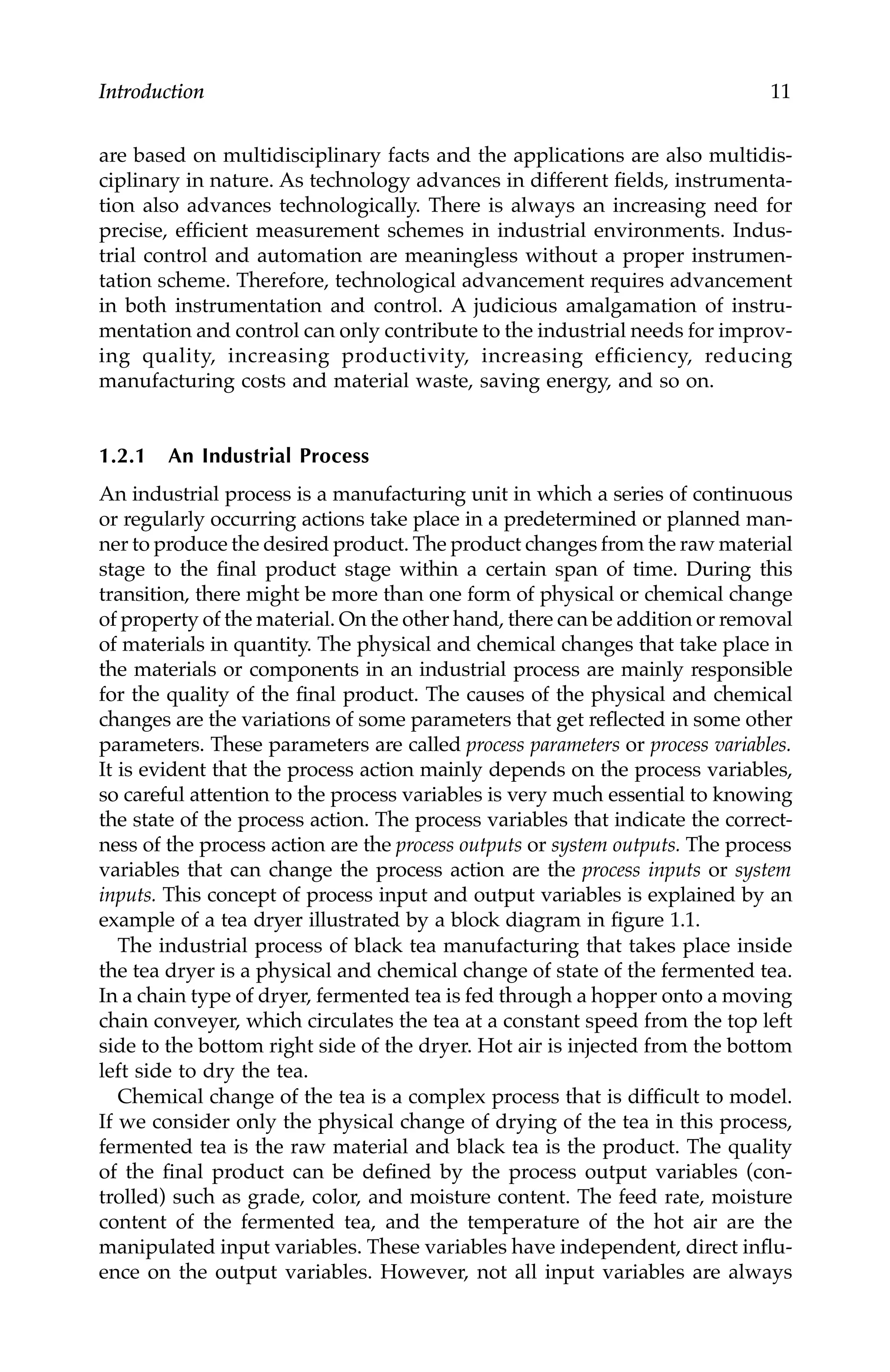
example of a tea dryer illustrated by a block diagram in figure 1.1.
The industrial process of black tea manufacturing that takes place inside
the tea dryer is a physical and chemical change of state of the fermented tea.
In a chain type of dryer, fermented tea is fed through a hopper onto a moving
chain conveyer, which circulates the tea at a constant speed from the top left
side to the bottom right side of the dryer. Hot air is injected from the bottom
left side to dry the tea.
Chemical change of the tea is a complex process that is difficult to model.
If we consider only the physical change of drying of the tea in this process,
fermented tea is the raw material and black tea is the product. The quality
of the final product can be defined by the process output variables (con-
trolled) such as grade, color, and moisture content. The feed rate, moisture
content of the fermented tea, and the temperature of the hot air are the
manipulated input variables. These variables have independent, direct influ-
ence on the output variables. However, not all input variables are always
7244.book Page 11 Wednesday, June 21, 2006 11:14 AM
34.
12 Measurement andControl in Food Processing
highly responsible for the quality of the product. For example, in a tea dryer,
the density of the fermented tea does not have a direct influence or might
have a low gain influence on the product quality.
At this point we can identify the flow rate of the black tea as productivity
of the final product rather than defining it as quality. Not all process input
or output variables affect the quality of the product. Some process output
variables might not indicate the quality of the product in a process. The flow
rate of the black tea is a similar kind of output variable. Therefore, sufficient
process knowledge is required to identify the actual process outputs that
represent the quality of the final product. Similarly, some input variables
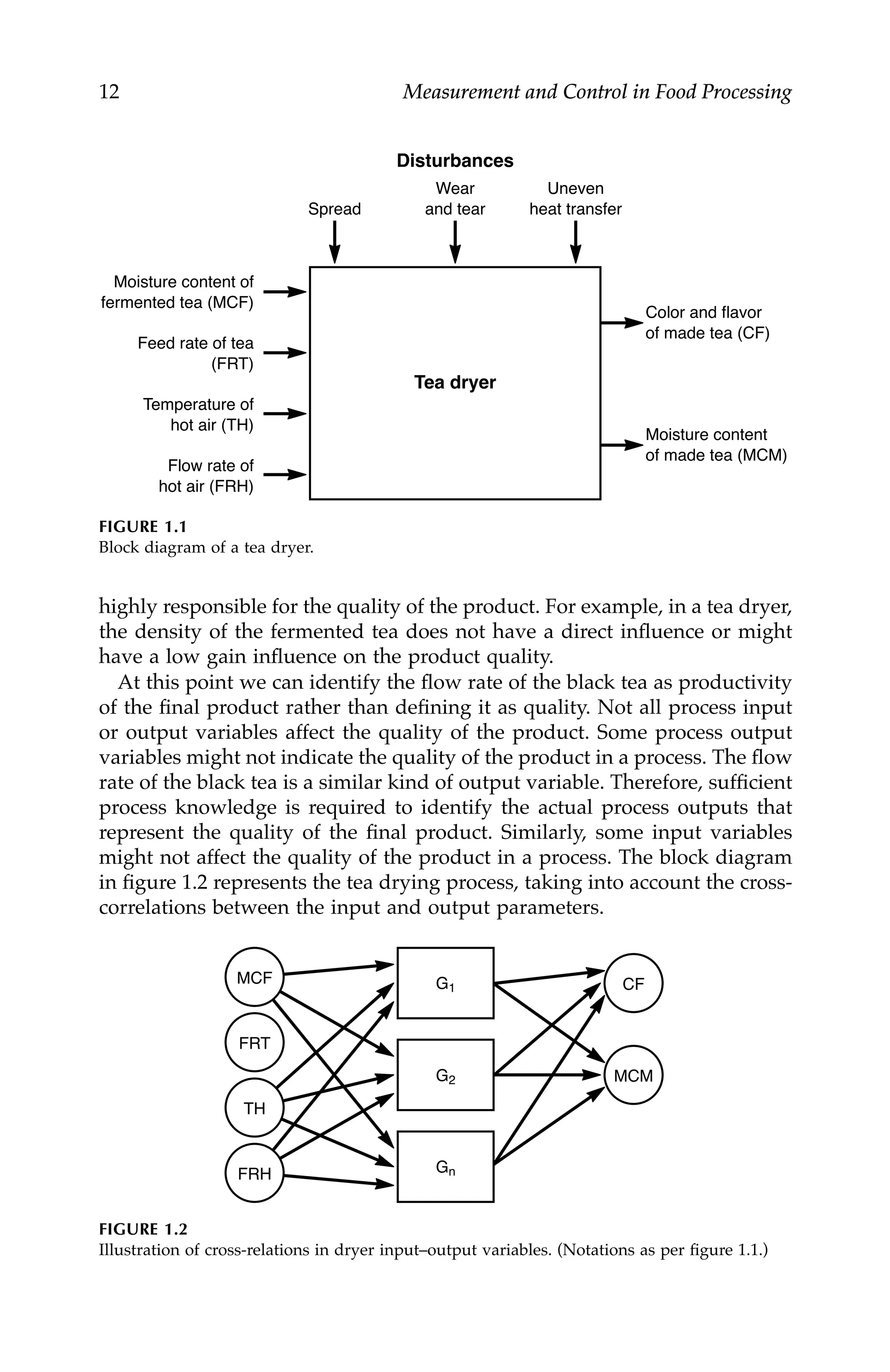
might not affect the quality of the product in a process. The block diagram
in figure 1.2 represents the tea drying process, taking into account the cross-
correlations between the input and output parameters.
FIGURE 1.1
Block diagram of a tea dryer.
FIGURE 1.2
Illustration of cross-relations in dryer input–output variables. (Notations as per figure 1.1.)
Moisture content of
fermented tea (MCF)
Spread
Wear
and tear
Uneven
heat transfer
Feed rate of tea
(FRT)
Temperature of
hot air (TH)
Flow rate of
hot air (FRH)
Moisture content
of made tea (MCM)
Color and flavor
of made tea (CF)
Tea dryer
Disturbances
MCF
FRT
CF
MCM
TH
FRH
G1
G2
Gn
7244.book Page 12 Wednesday, June 21, 2006 11:14 AM
35.
Introduction 13
A processcan thus be represented by a system with manipulated input
variables and controlled output process variables. The manipulated input vari-
ables control the quality of the final product and the controlled output variables
carry the signature of the quality of the product.
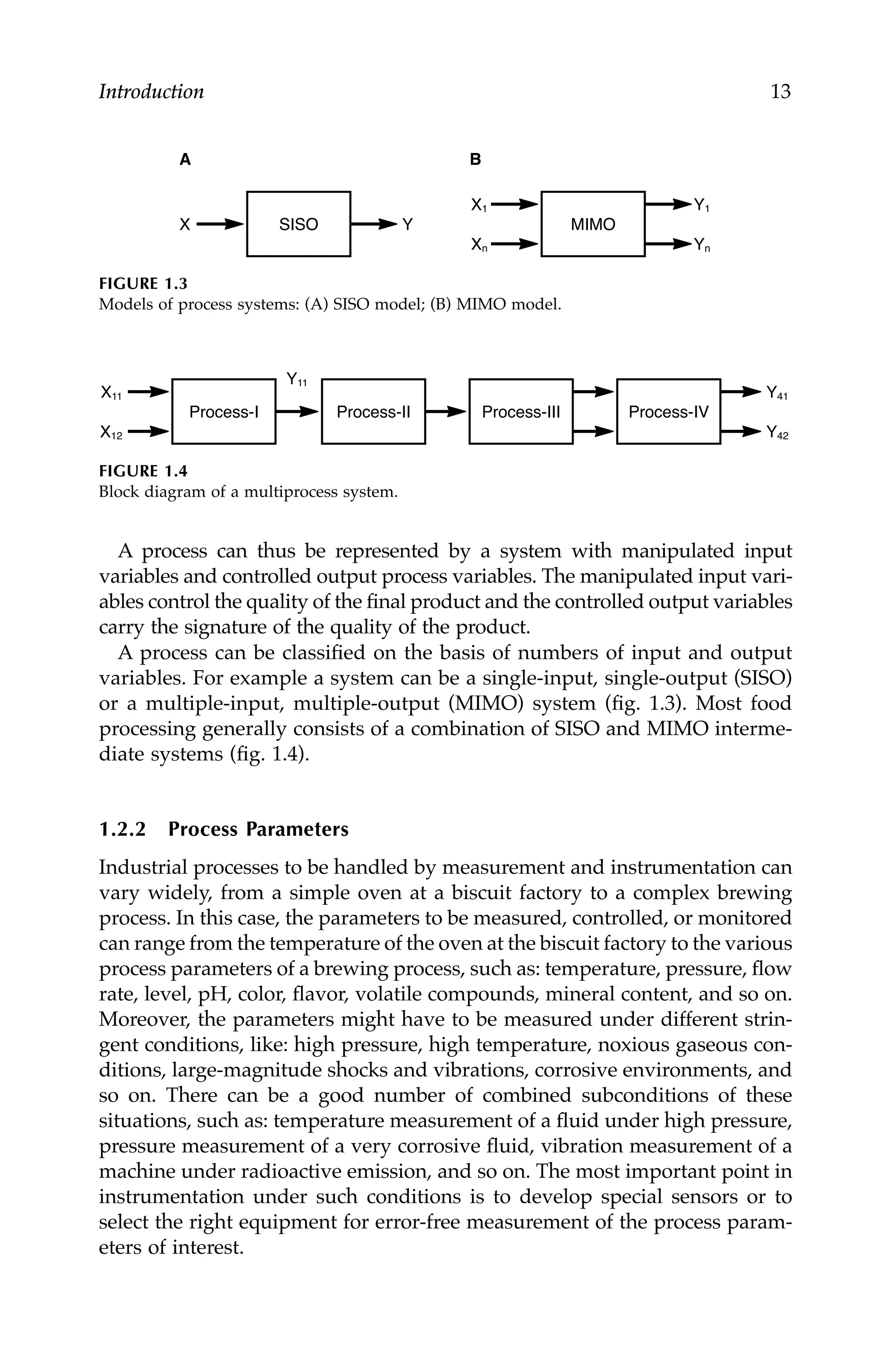
A process can be classified on the basis of numbers of input and output
variables. For example a system can be a single-input, single-output (SISO)
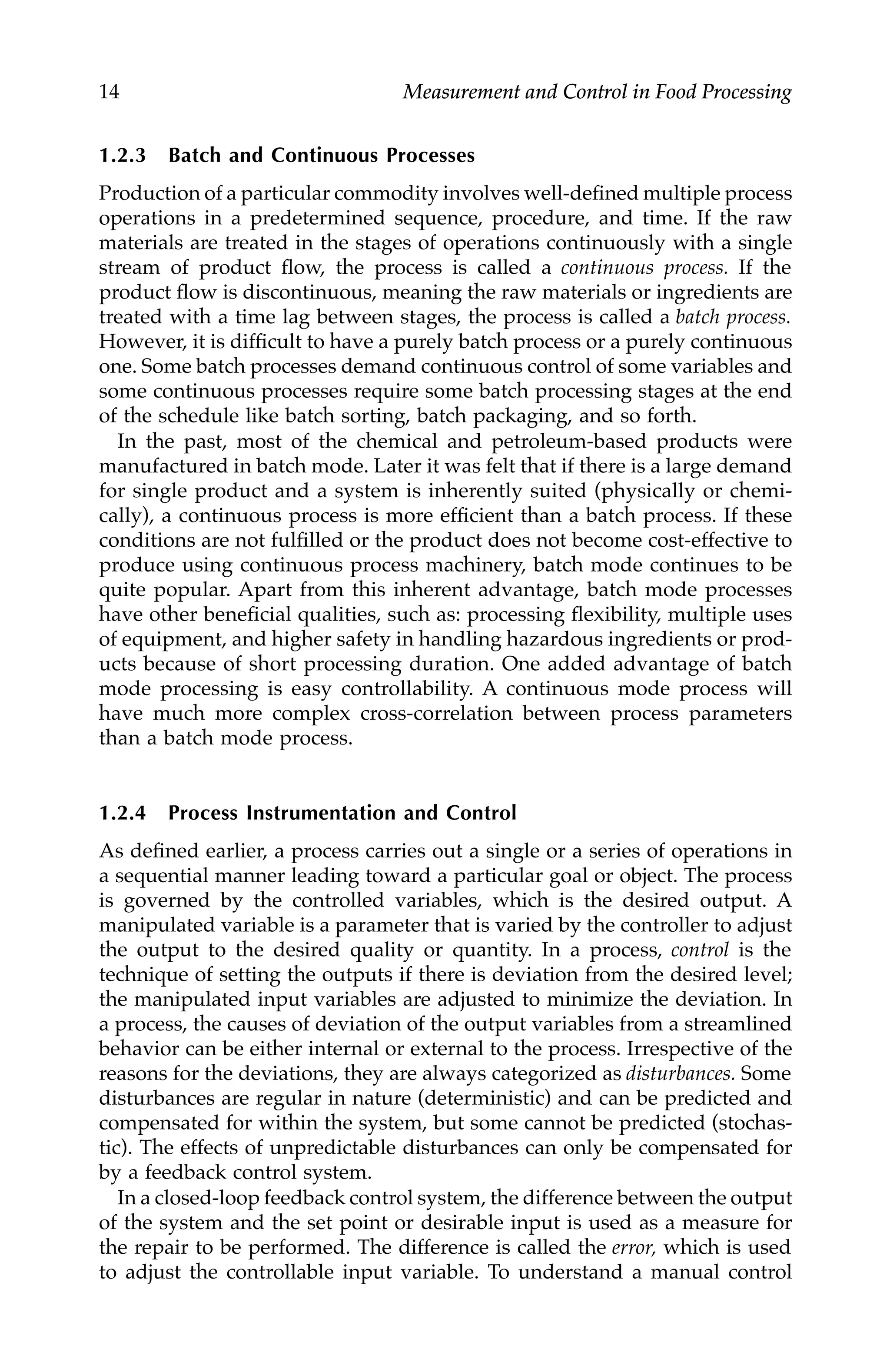
or a multiple-input, multiple-output (MIMO) system (fig. 1.3). Most food
processing generally consists of a combination of SISO and MIMO interme-
diate systems (fig. 1.4).
1.2.2 Process Parameters
Industrial processes to be handled by measurement and instrumentation can
vary widely, from a simple oven at a biscuit factory to a complex brewing
process. In this case, the parameters to be measured, controlled, or monitored
can range from the temperature of the oven at the biscuit factory to the various
process parameters of a brewing process, such as: temperature, pressure, flow
rate, level, pH, color, flavor, volatile compounds, mineral content, and so on.
Moreover, the parameters might have to be measured under different strin-
gent conditions, like: high pressure, high temperature, noxious gaseous con-
ditions, large-magnitude shocks and vibrations, corrosive environments, and
so on. There can be a good number of combined subconditions of these
situations, such as: temperature measurement of a fluid under high pressure,
pressure measurement of a very corrosive fluid, vibration measurement of a
machine under radioactive emission, and so on. The most important point in
instrumentation under such conditions is to develop special sensors or to
select the right equipment for error-free measurement of the process param-
eters of interest.
FIGURE 1.3
Models of process systems: (A) SISO model; (B) MIMO model.
FIGURE 1.4
Block diagram of a multiprocess system.
X Y
SISO
A B
Xn Yn
X1 Y1
MIMO
X12
X11
Y11
Process-I Process-II Process-III
Y42
Y41
Process-IV
7244.book Page 13 Wednesday, June 21, 2006 11:14 AM
36.
14 Measurement andControl in Food Processing
1.2.3 Batch and Continuous Processes
Production of a particular commodity involves well-defined multiple process
operations in a predetermined sequence, procedure, and time. If the raw
materials are treated in the stages of operations continuously with a single
stream of product flow, the process is called a continuous process. If the
product flow is discontinuous, meaning the raw materials or ingredients are
treated with a time lag between stages, the process is called a batch process.
However, it is difficult to have a purely batch process or a purely continuous
one. Some batch processes demand continuous control of some variables and
some continuous processes require some batch processing stages at the end
of the schedule like batch sorting, batch packaging, and so forth.
In the past, most of the chemical and petroleum-based products were
manufactured in batch mode. Later it was felt that if there is a large demand
for single product and a system is inherently suited (physically or chemi-
cally), a continuous process is more efficient than a batch process. If these
conditions are not fulfilled or the product does not become cost-effective to
produce using continuous process machinery, batch mode continues to be
quite popular. Apart from this inherent advantage, batch mode processes
have other beneficial qualities, such as: processing flexibility, multiple uses
of equipment, and higher safety in handling hazardous ingredients or prod-
ucts because of short processing duration. One added advantage of batch
mode processing is easy controllability. A continuous mode process will
have much more complex cross-correlation between process parameters
than a batch mode process.
1.2.4 Process Instrumentation and Control
As defined earlier, a process carries out a single or a series of operations in
a sequential manner leading toward a particular goal or object. The process
is governed by the controlled variables, which is the desired output. A
manipulated variable is a parameter that is varied by the controller to adjust
the output to the desired quality or quantity. In a process, control is the
technique of setting the outputs if there is deviation from the desired level;
the manipulated input variables are adjusted to minimize the deviation. In
a process, the causes of deviation of the output variables from a streamlined
behavior can be either internal or external to the process. Irrespective of the
reasons for the deviations, they are always categorized as disturbances. Some
disturbances are regular in nature (deterministic) and can be predicted and
compensated for within the system, but some cannot be predicted (stochas-
tic). The effects of unpredictable disturbances can only be compensated for
by a feedback control system.
In a closed-loop feedback control system, the difference between the output
of the system and the set point or desirable input is used as a measure for
the repair to be performed. The difference is called the error, which is used
to adjust the controllable input variable. To understand a manual control
7244.book Page 14 Wednesday, June 21, 2006 11:14 AM
37.
Introduction 15
system, imaginethe control of an electric heater by a human operator. The
operator controls the temperature under a specific condition, for example,
the maximum and minimum limits. The operator looks at the thermometer,
and if the temperature is above the specified limit, he or she switches the
power off and thereby decreases the temperature. When the temperature
decreases below the minimum limit, the operator switches the power on and
the temperature rises again. This is a manual control approach in which the
human operator works as a controller.
In another situation, consider an electric oven temperature that is con-
trolled within a certain limit using a simple thermal switch. When the tem-
perature of the oven crosses the limit, the thermal switch disconnects electric
power to the oven, working as a controlled switch. If the temperature drops
below the limit, the thermal switch operates to continue the power supply
to the oven, thereby increasing the temperature. The set point of the tem-
perature limit is imposed on the thermal switch; that is, the thermal switch
is adjusted as per the temperature limit. In this example the thermal switch
works both as a sensor and feedback controller. This feedback controller is
basically an on–off controller that simply switches the input to the system
to on or off state when the output goes below or above the set point, respec-
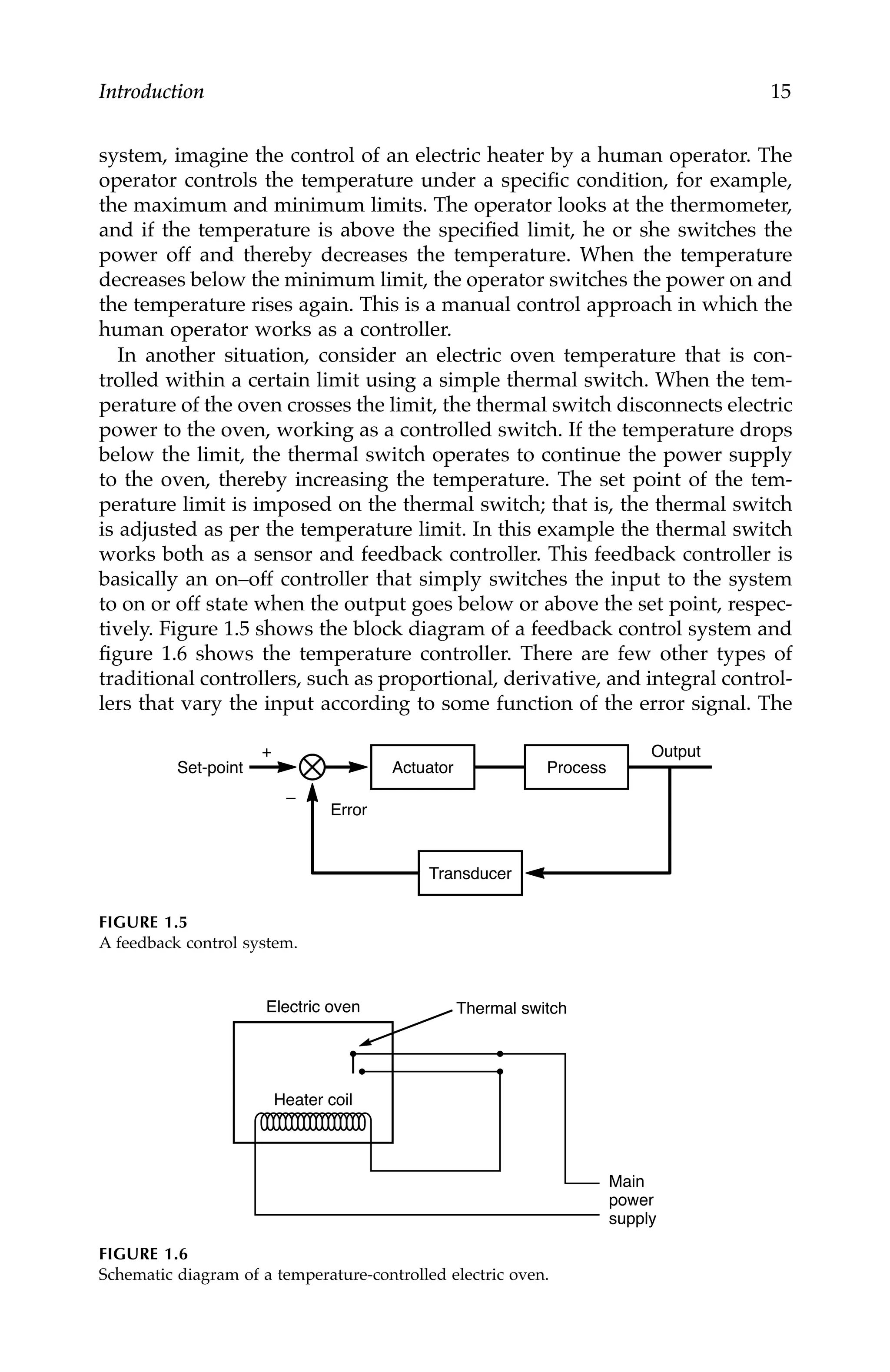
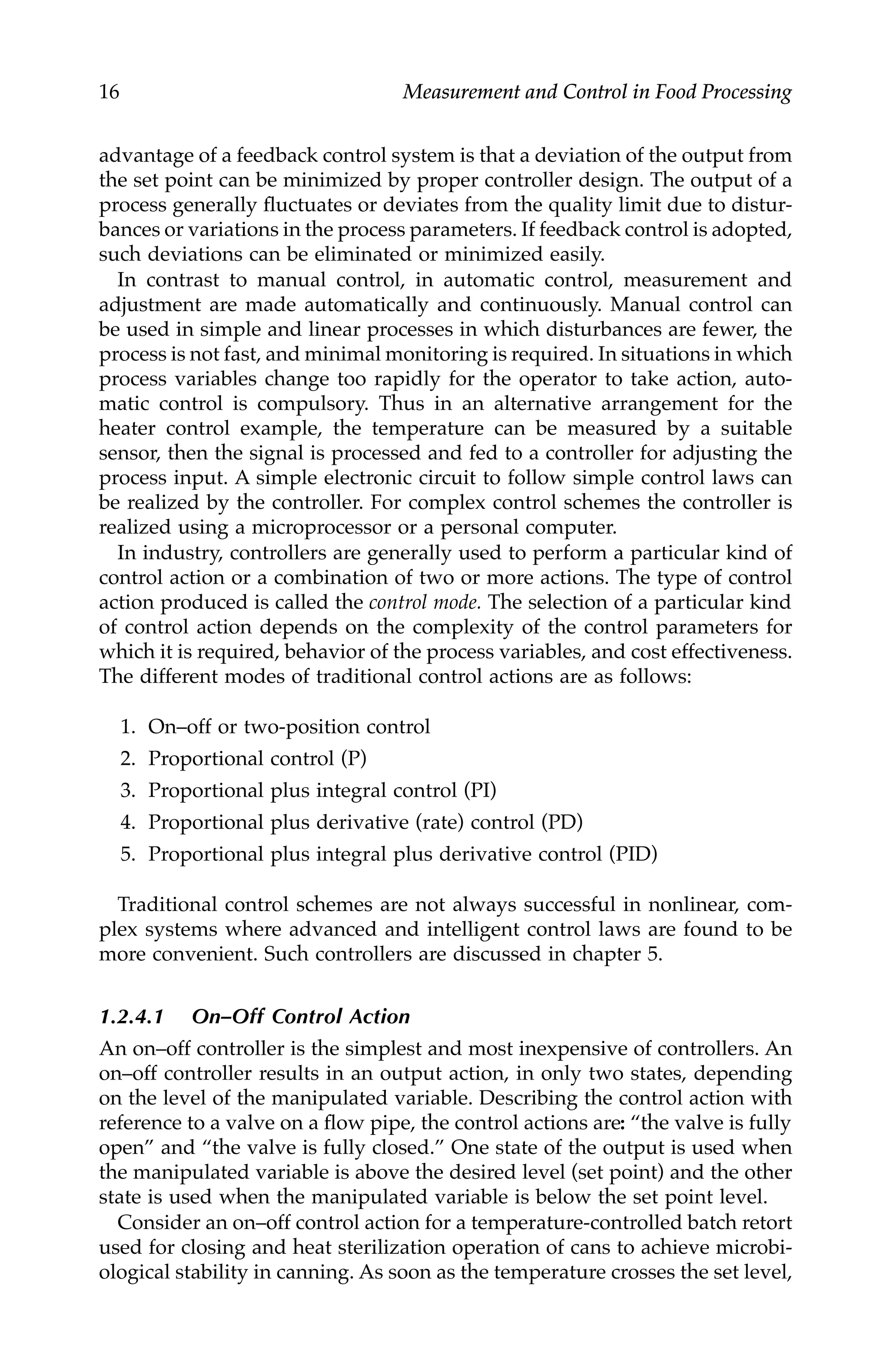
tively. Figure 1.5 shows the block diagram of a feedback control system and
figure 1.6 shows the temperature controller. There are few other types of
traditional controllers, such as proportional, derivative, and integral control-
lers that vary the input according to some function of the error signal. The
FIGURE 1.5
A feedback control system.
FIGURE 1.6
Schematic diagram of a temperature-controlled electric oven.
Error
Output
+
–
Actuator
Transducer
Set-point Process
Main
power
supply
Electric oven
Heater coil
Thermal switch
7244.book Page 15 Wednesday, June 21, 2006 11:14 AM
38.
16 Measurement andControl in Food Processing
advantage of a feedback control system is that a deviation of the output from
the set point can be minimized by proper controller design. The output of a
process generally fluctuates or deviates from the quality limit due to distur-
bances or variations in the process parameters. If feedback control is adopted,
such deviations can be eliminated or minimized easily.
In contrast to manual control, in automatic control, measurement and
adjustment are made automatically and continuously. Manual control can
be used in simple and linear processes in which disturbances are fewer, the
process is not fast, and minimal monitoring is required. In situations in which
process variables change too rapidly for the operator to take action, auto-
matic control is compulsory. Thus in an alternative arrangement for the
heater control example, the temperature can be measured by a suitable
sensor, then the signal is processed and fed to a controller for adjusting the
process input. A simple electronic circuit to follow simple control laws can
be realized by the controller. For complex control schemes the controller is
realized using a microprocessor or a personal computer.
In industry, controllers are generally used to perform a particular kind of
control action or a combination of two or more actions. The type of control
action produced is called the control mode. The selection of a particular kind
of control action depends on the complexity of the control parameters for
which it is required, behavior of the process variables, and cost effectiveness.
The different modes of traditional control actions are as follows:
1. On–off or two-position control
2. Proportional control (P)
3. Proportional plus integral control (PI)
4. Proportional plus derivative (rate) control (PD)
5. Proportional plus integral plus derivative control (PID)
Traditional control schemes are not always successful in nonlinear, com-
plex systems where advanced and intelligent control laws are found to be
more convenient. Such controllers are discussed in chapter 5.
1.2.4.1 On–Off Control Action
An on–off controller is the simplest and most inexpensive of controllers. An
on–off controller results in an output action, in only two states, depending
on the level of the manipulated variable. Describing the control action with
reference to a valve on a flow pipe, the control actions are: “the valve is fully
open” and “the valve is fully closed.” One state of the output is used when
the manipulated variable is above the desired level (set point) and the other
state is used when the manipulated variable is below the set point level.
Consider an on–off control action for a temperature-controlled batch retort
used for closing and heat sterilization operation of cans to achieve microbi-
ological stability in canning. As soon as the temperature crosses the set level,
7244.book Page 16 Wednesday, June 21, 2006 11:14 AM
39.
Introduction 17
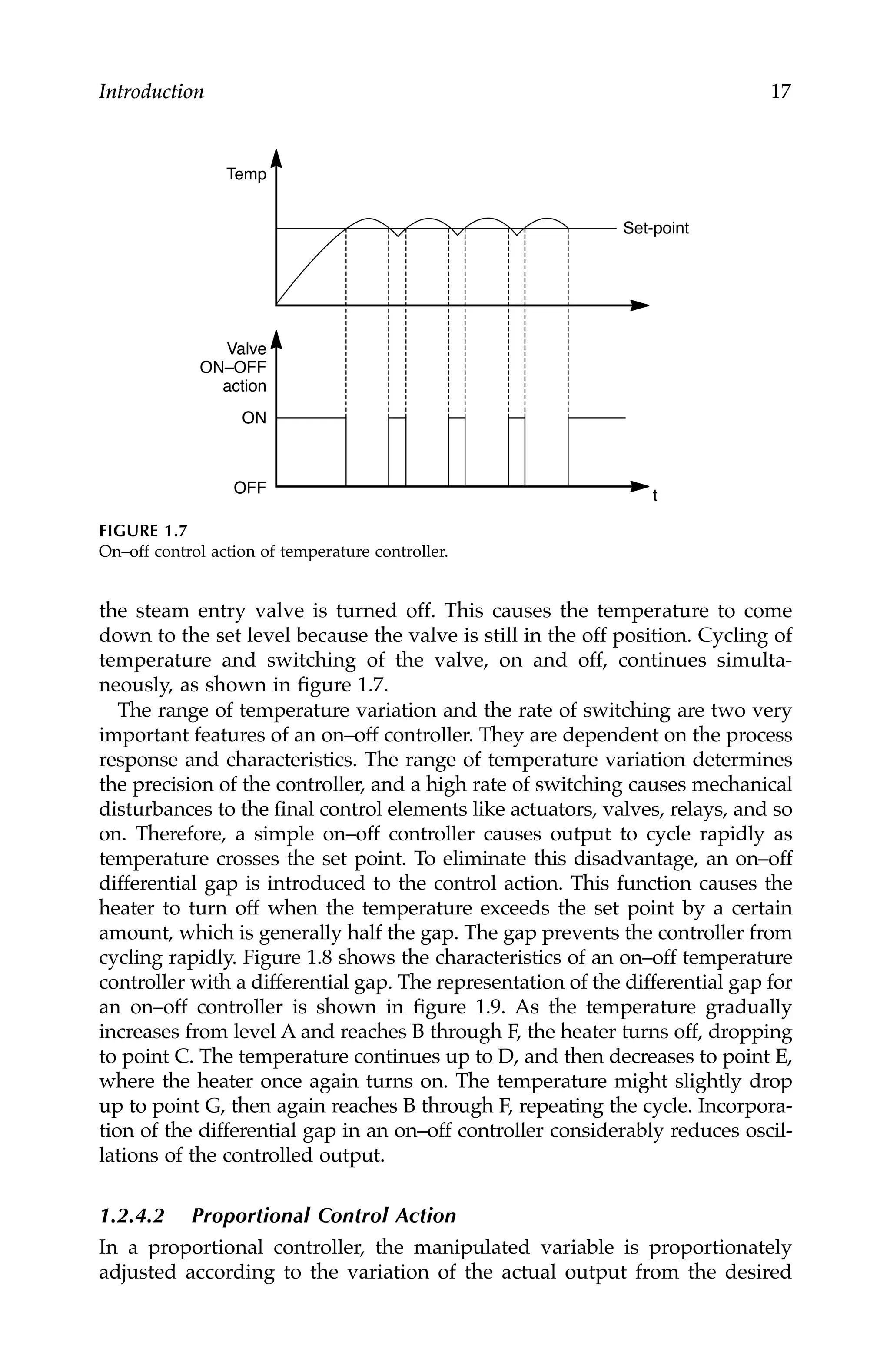
the steamentry valve is turned off. This causes the temperature to come
down to the set level because the valve is still in the off position. Cycling of
temperature and switching of the valve, on and off, continues simulta-
neously, as shown in figure 1.7.
The range of temperature variation and the rate of switching are two very
important features of an on–off controller. They are dependent on the process
response and characteristics. The range of temperature variation determines
the precision of the controller, and a high rate of switching causes mechanical
disturbances to the final control elements like actuators, valves, relays, and so
on. Therefore, a simple on–off controller causes output to cycle rapidly as
temperature crosses the set point. To eliminate this disadvantage, an on–off
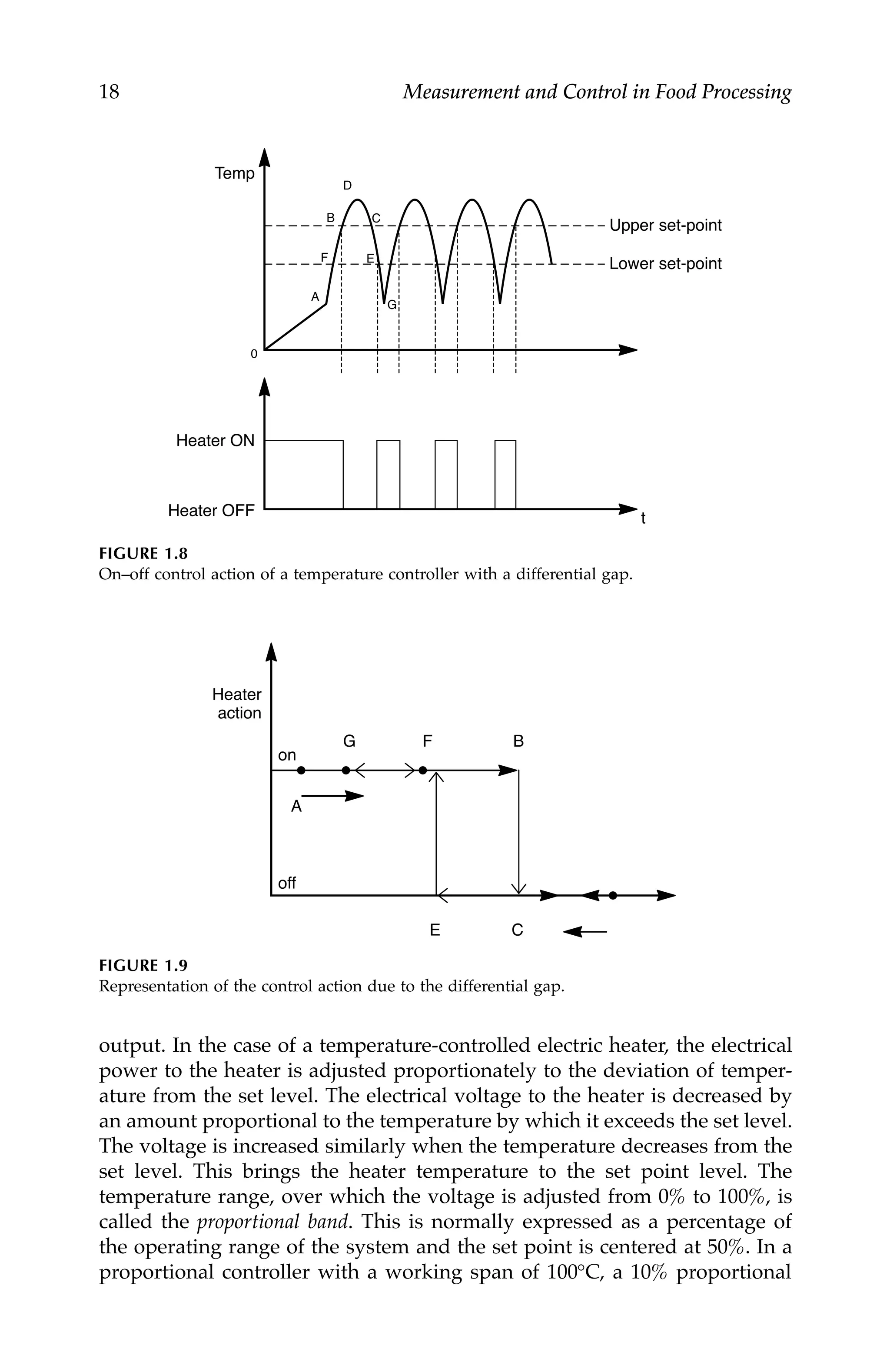
differential gap is introduced to the control action. This function causes the
heater to turn off when the temperature exceeds the set point by a certain
amount, which is generally half the gap. The gap prevents the controller from
cycling rapidly. Figure 1.8 shows the characteristics of an on–off temperature
controller with a differential gap. The representation of the differential gap for
an on–off controller is shown in figure 1.9. As the temperature gradually
increases from level A and reaches B through F, the heater turns off, dropping
to point C. The temperature continues up to D, and then decreases to point E,
where the heater once again turns on. The temperature might slightly drop
up to point G, then again reaches B through F, repeating the cycle. Incorpora-
tion of the differential gap in an on–off controller considerably reduces oscil-
lations of the controlled output.
1.2.4.2 Proportional Control Action
In a proportional controller, the manipulated variable is proportionately
adjusted according to the variation of the actual output from the desired
FIGURE 1.7
On–off control action of temperature controller.
Set-point
Temp
t
Valve
ON–OFF
action
ON
OFF
7244.book Page 17 Wednesday, June 21, 2006 11:14 AM
40.
18 Measurement andControl in Food Processing
output. In the case of a temperature-controlled electric heater, the electrical
power to the heater is adjusted proportionately to the deviation of temper-
ature from the set level. The electrical voltage to the heater is decreased by
an amount proportional to the temperature by which it exceeds the set level.
The voltage is increased similarly when the temperature decreases from the
set level. This brings the heater temperature to the set point level. The
temperature range, over which the voltage is adjusted from 0% to 100%, is
called the proportional band. This is normally expressed as a percentage of
the operating range of the system and the set point is centered at 50%. In a
proportional controller with a working span of 100°C, a 10% proportional
FIGURE 1.8
On–off control action of a temperature controller with a differential gap.
FIGURE 1.9
Representation of the control action due to the differential gap.
Lower set-point
Temp
A
G
D
B C
E
F
0
t
Heater ON
Heater OFF
Upper set-point
Heater
action
A
E C
G F
on
off
B
7244.book Page 18 Wednesday, June 21, 2006 11:14 AM
41.
Introduction 19
band wouldbe 10°C and the highest and lowest ranges of the band are 5°C
away from the set point level. The transfer characteristic of a proportional
controller is shown in figure 1.10. The figure illustrates that below 100°C,
which is the lowest range of the proportional band, the heater power should
be 100%. On the other hand, above the highest range of the proportional
band (i.e., 110°C), the heater voltage should be zero. The voltage to be applied
to the heater therefore can be determined from the characteristic graphically.
The heater voltage is fixed at 50% at the set point level. There is every
possibility that the proportional band might need to be adjusted as per the
requirement of the process response and characteristics. Hence the propor-
tional controller can have a wide band or narrow band of control. The transfer
characteristics of wide band and narrow band proportional controllers are
shown in figure 1.11.
In a narrow band proportional controller, a small change in temperature
causes a large manipulated output. The performance of a proportional con-
troller can be expressed in terms of the controller gain as
Gain = 100%/proportional band (percent).
Hence, the gain of a narrow band proportional controller is higher than
that of a wide band controller. A proportional controller is suitable for a
system where deviation of output is not large and is not sudden. A propor-
tional controller can be incorporated in a closed-loop feedback control system
illustrated in figure 1.12. The output signal is sensed by a sensor and ampli-
fied before comparison with the set point level. The error signal is positive
when the output is below the set point level, negative when the output is
above the set point, and zero when the output is adjusted to make it equal
to the set point. The proportional output is 50% when the error signal is zero.
In practical situations, the heat input for attaining set point temperature
never equals 50% of the maximum available. Therefore, the output temperature
FIGURE 1.10
Transfer characteristic of a proportional controller.
Heater
voltage
(%)
Temperature (°C)
105
100
50
100
7244.book Page 19 Wednesday, June 21, 2006 11:14 AM
42.
20 Measurement andControl in Food Processing
oscillates before coming to an equilibrium condition. The temperature differ-
ence between the stabilized and set point level is called the offset. The offset
temperature value becomes less in a narrow band proportional controller.
For fine-tuning of a controller the offset must be removed. This can be done
manually or automatically. Manual reset is a traditional method in which a
potentiometer is used to nullify the offset electrically. The amount of proportional
FIGURE 1.11
Transfer characteristic of (A) a narrow band and (B) a wide band proportional controller.
FIGURE 1.12
Block diagram of a proportional controller.
Heater
voltage
(%)
Wide band
100
0
50
B
Heater
voltage
(%)
Narrow band
100
0
50
A
Error
Amplifier
Output
Proportional
controller
Transducer
Set-point
+
–
Plant
7244.book Page 20 Wednesday, June 21, 2006 11:14 AM
43.
Introduction 21
band shiftingis manually done, step by step, until the manipulated input to
controller (process heat demand) conforms with the set point level of temper-
ature. The manual reset proportional controller is shown in figure 1.13.
1.2.4.3 Proportional Plus Integral Control Action
An automatic reset proportional controller performs a reset operation with
the help of an electronic integrator. The error is integrated and added with
the error signal. Due to the integral term in the control law, a sudden change
in deviation is tracked continuously, at a certain rate, determined by the reset
rate (inverse of the integral time). Performance of a proportional controller
is expressed by two terms: proportional gain and integral time constant.
During integral time, equal parts of the output signal due to integral action
advance as that of the output signal due to proportional action.
The block diagram and timing diagram of a proportional plus integral
controller are shown in figure 1.14 and figure 1.15, respectively.
1.2.4.4 Derivative Control Action
Derivative control incorporates a term in the control law, which is first deriv-
ative of the error signal. It facilitates the shift of the proportional band either
up or down to compensate for rapidly changing outputs. The controller tracks
the set point level at a rate proportional to the rate of change of the error signal.
If the output makes a sudden jump, the derivative action immediately brings
FIGURE 1.13
Block diagram of a proportional controller with manual reset.
FIGURE 1.14
Block diagram of a proportional plus integral controller.
Manual reset
Amplifier
Output
Proportional
controller
Transducer
+
–
Plant
Set-point
+
–
Amplifier
Output
Proportional
controller
Transducer
+
Plant
Set-point +
–
Integration
7244.book Page 21 Wednesday, June 21, 2006 11:14 AM
44.
22 Measurement andControl in Food Processing
the output toward the set point level. If the output changes gradually at a
constant rate, the output tracks the set point at a similar rate to the proportional
action. In this control action, a derivative time constant can also be defined in
a similar manner. The derivative action does not have any limit of occurrence,
unlike integral action. The derivative action can occur even outside the pro-
portional band. The speed of correction is proportional to the amount of
deviation, but this incorporates oscillations in the system output. The timing
diagram of a proportional plus derivative control action is shown in figure 1.16.
1.2.4.5 PID Controller
Combination of these three modes of control action is advantageous for
controlling complex processes. This mode of control is best suited for cases
where the output fluctuations are large and sudden and the system has a
lag. The block diagram of a proportional-integral-derivative controller (PID)
controller is shown in figure 1.17.
1.2.5 Selection of Controller
Selection of a controller for a particular application requires attention to
several factors. It has been found that the simplest controller that meets the
requirement of the process is the best and least expensive. Although a better
controller might be employed in a process that needs precise tuning of the
output, a simple controller can be adequate in a process that permits a
comparatively wide range of outputs.
Selection of a controller depends on the following factors:
1. Process response curve
2. Physical system analysis
3. Past experience
4. Experimental testing
FIGURE 1.15
Typical characteristics of a PI controller.
Output
Time
Adjustment
due to I action
Adjustment
due to P action
Integral
action time
7244.book Page 22 Wednesday, June 21, 2006 11:14 AM
45.
Introduction 23
A processresponse curve is a plot between the process outputs with time
when a steady input is applied. The process response curve for a first-order
thermal system is shown in figure 1.18. The essential characteristics of a
thermal process response curve are the time constant and the rate of temper-
ature increase. The controllability of a process depends on these two factors.
If the curve becomes steeper, the controllability of the process becomes diffi-
cult. If the output temperature (Tp) starts increasing as soon as the input is
applied, there is no propagation delay or dead time. This relates to the time
constant (τ). Such a system is easy to control. In a more complicated situation,
FIGURE 1.16
Typical characteristics of proportional plus derivative controller.
FIGURE 1.17
Block diagram of a PID controller.
Output
Time
Error
Time
Adjustment due to P action
Adjustment due to D action
Proportional
action time
Amplifier
Output
Proportional
controller
Sensor
+
+
+
+
Plant
Set-point +
–
Derivative Integrator
7244.book Page 23 Wednesday, June 21, 2006 11:14 AM
46.
24 Measurement andControl in Food Processing
when a heater is modified with thick metal plates, it introduces more time
lag in the thermal system. This will introduce a second time constant, which
results in a second-order system that is more difficult to control than a first-
order system. The size of the process compared to the output requirement
is also a major factor in selecting the controller. An oversized process does
not give stable output, whereas an undersized one gives slow response.
Analyzing controllability and process output stability requirements will help
in selecting the controller. Thorough knowledge about the process response
in the past is also an important clue. Experimental verification of the process
response by computer simulation of the process is also a faithful method of
selection of a controller. However there are obviously some guidelines for
controller selection, as follows:
1. A proportional controller is used where:
a. load analysis is insignificant.
b. offset can be permitted.
c. a narrow proportional band is permitted.
2. Integral control is used where:
a. offset cannot be permitted.
b. process has a lag.
3. Derivative control is used where:
a. sudden and large deviation of output takes place.
b. there are severe plant lags.
1.3 Conclusion
In the food industry, numerous approaches are involved in every step, from
research to trade, where engineering techniques are mandatory. Our objective
FIGURE 1.18
Response of a first-order thermal system.
τ
Final steady value
Temp
t
Tp = Tf (1- e–t/λ)
63.2%
7244.book Page 24 Wednesday, June 21, 2006 11:14 AM
47.
Introduction 25
is tohelp those practically involved with those engineering approaches to
make food processing more scientific and engineered. There is confusion
about who designs the food processing measurements and controls: a food
scientist or an instrumentation engineer? What should a food science course
cover? The definitions are misleading in the present day because behind the
measurement and control of most food processing systems is the skill of both
the food scientists and the engineers. In the broad perspective of food pro-
cessing measurement and control, a food scientist is also an instrumentation
engineer and vice versa.
The objective of this chapter is to inform food scientists as well as instru-
mentation engineers about the basics of engineering concepts of measure-
ment and control and food processes, respectively.
This chapter presented a short description of the various food processing
industries and the process parameters, as well as their importance in quality
control. The basic structures of process input–output variables and basic
principles of feedback control systems were also presented.
These basic concepts will be especially useful in understanding the various
measurement and control techniques discussed in later chapters.
References
1. Potter, N. N., and Hotchkiss, J. H. 1995. Food science (5th ed). Gaithersburg,
MD: Coultate TP.
2. Lewis, M. J. 1995. Brewing. New York: Chapman & Hall.
3. Ranken, M. D., and Kill, R. C. 1993. Food industries manual (23rd ed.). London:
Blackie Academic & Professional.
4. Bhuyan, M. 1997. An integrated PC based tea process monitoring and control system,
PhD thesis, Department of Electronics, Gauhati University, India.
Further Reading
1. Beckett, S. T. (Ed.). 1994. Industrial chocolate manufacture and use (2nd ed.).
London: Blackie Academic & Professional.
2. Multon, J. L. (Ed.). 1996. Quality control for foods and agricultural products. New
York: VCH Publishers.
3. Ogata, K. 1982. Modern control engineering. New Delhi: Prentice Hall.
4. Kuo, B. C. 1982. Automatic control systems (3rd ed.). New Delhi: Prentice Hall.
5. Johnson, C. D. 2000. Process control instrumentation technology (6th ed.). Upper
Saddle River, NJ: Prentice Hall International.
7244.book Page 25 Wednesday, June 21, 2006 11:14 AM
27
2
Measuring and ControllingDevices
CONTENTS
2.1 Role of Transducers in Food Processing.................................................. 28
2.2 Classification of Transducers..................................................................... 30
2.2.1 Self-Generating Type ...................................................................... 30
2.2.2 Variable Parameter Type................................................................ 30
2.2.2.1 Change in Resistance or Conductance.......................... 31
2.2.2.2 Change in Capacitance .................................................... 31
2.2.2.3 Change in Magnetic Properties...................................... 31
2.2.3 Pulse or Frequency Generating Types......................................... 32
2.2.4 Digital Transducers......................................................................... 32
2.3 Self-Generating Transducers...................................................................... 33
2.3.1 Piezoelectric Transducers............................................................... 33
2.3.2 Thermocouples ................................................................................ 36
2.3.2.1 Thermocouple Materials.................................................. 38
2.3.2.2 Reference Junction Compensation................................. 39
2.3.2.3 Thermocouple Installations............................................. 39
2.3.2.4 Thermocouple Wire Insulators....................................... 40
2.3.3 Photoelectric Transducers.............................................................. 41
2.3.3.1 Photo-Emissive Transducer............................................. 41
2.3.3.2 Photoconductive Cell ....................................................... 42
2.3.3.3 Photovoltaic Cell............................................................... 43
2.3.3.4 Photodiode and Phototransistor .................................... 44
2.3.4 Magneto-Electric Transducer......................................................... 44
2.3.4.1 Electrodynamic Transducer............................................. 45
2.3.4.2 Electromagnetic Transducer............................................ 46
2.3.4.3 Pulse Generator Type....................................................... 46
2.3.5 Radioactive Transducer.................................................................. 47
2.3.5.1 Penetrating Power ............................................................ 47
2.3.5.2 Half Life ............................................................................. 49
2.3.5.3 Half Distance..................................................................... 49
2.4 Variable Parameter Type ............................................................................ 51
2.4.1 Resistive Transducer....................................................................... 51
2.4.1.1 Potentiometer .................................................................... 52
2.4.1.2 Resistance Strain Gauge .................................................. 54
7244.book Page 27 Wednesday, June 21, 2006 11:14 AM
50.
28 Measurement andControl in Food Processing
2.4.1.3 Diaphragm Pressure Sensor............................................ 60
2.4.1.4 Load Cell............................................................................ 63
2.4.1.5 Resistance Temperature Detectors ................................. 63
2.4.1.6 Thermistors........................................................................ 66
2.4.1.7 Semiconductor Temperature Sensors ............................ 69
2.4.1.8 Hot Wire Anemometer..................................................... 71
2.4.1.9 Resistive Humidity Sensors............................................ 72
2.4.2 Inductive Transducers .................................................................... 72
2.4.2.1 Variable Inductance Type................................................ 73
2.4.2.2 Variable Reluctance Type Sensors.................................. 74
2.4.3 Capacitive Transducer.................................................................... 77
2.5 Digital Transducers ..................................................................................... 80
2.5.1 Direct Digital Encoder.................................................................... 80
2.5.2 Frequency, Pulse Encoder.............................................................. 80
2.5.3 Analog-to-Digital Encoder............................................................. 81
2.5.4 Analog-to-Digital Converter ......................................................... 81
2.5.5 Digital Encoders .............................................................................. 82
2.5.5.1 Digital Shaft Encoder....................................................... 82
2.6 Selection of Transducers............................................................................. 83
2.7 Actuating and Controlling Devices.......................................................... 84
2.7.1 Actuators .......................................................................................... 85
2.7.1.1 Electrical Solenoids........................................................... 86
2.7.1.2 Electrical Motors ............................................................... 86
2.7.1.3 Fluid Control Valves ........................................................ 86
2.7.2 Actuating Motors ............................................................................ 88
2.7.2.1 DC Motors.......................................................................... 88
2.7.2.2 Control Motors.................................................................. 89
2.7.2.3 Stepper Motors.................................................................. 92
2.7.3 Final Control Elements................................................................... 96
2.7.3.1 Mechanical Types.............................................................. 97
2.7.3.2 Electrical Types.................................................................. 98
2.7.4 Pneumatic Control Devices ........................................................... 98
2.7.4.1 Baffle-Nozzle Detector ..................................................... 99
2.7.4.2 Pneumatic Amplifiers .................................................... 100
2.8 Conclusion .................................................................................................. 103
Further Reading ................................................................................... 103
2.1 Role of Transducers in Food Processing
Transducers and sensors are the basic input devices for industrial process
measurement and control. In some industries automatic control devices are
not adopted, either due to lack of necessity or lack of cost-effectiveness. In
such situations, transducers might be used only for routine checks of various
7244.book Page 28 Wednesday, June 21, 2006 11:14 AM
WATER-FOWL
OF SIAM.
COAST OFSIAM, NEAR THE MOUTH
OF THE RIVER.
Although the steamer was of light draught, she stirred the mud from
the bottom as she crossed the bar at the mouth of the Menam; she
left a long trail of discolored water behind her, but it disappeared as
she steamed onward and left the shores of Siam fading in the
distance. While the boys were busy with their contemplation of the
scene, the Chinese steward of the steamer came to tell them dinner
was ready. They went below, and were soon seated at the cabin
table.
The passengers were not numerous. Besides the
Doctor and his young friends, there were only
two others in the cabin, and it did not take long
for them to form an acquaintance. One of the
twain was a German merchant living at Bangkok,
and the other was a personage who reminded
the boys a little of their old friend, "the Mystery."
He was affable, and inclined to free
conversation; and though they could not at first
make him out, they found themselves attracted
towards him.
When they went on deck after dinner, the
stranger followed; and by invitation of Doctor
Bronson, he drew his chair near them.
In the course of the rambling talk that ensued,
Fred wondered if there were any pearls in the
Gulf of Siam. Frank quickly responded that it was
Ceylon, and not Siam, where the most of the
pearls of commerce were to be found.
The remark about pearls led to a discussion of
the mode of gathering them. Very naturally
something was said about the methods of going
beneath the waves of the sea.
53.
The stranger joinedin the conversation, and it was not long before
he developed much more than a casual knowledge of the business
under consideration.
"I may as well introduce myself," he remarked, "and then we will be
able to talk freely. I am known as Captain Johnson, and have been
around the Eastern seas for the past twenty years. I am an
Englishman by birth, and have been captain of a ship trading
between London and Singapore; but at present I am a wrecker."
Doctor Bronson replied to this introduction by handing his own card
to Captain Johnson, and introducing the two youths by name.
The boys showed by the expression of their faces that they were not
altogether familiar with the peculiarities of the stranger's occupation;
evidently he perceived it, for he proceeded to explain what a
wrecker was.
"Properly speaking," said he, "a wrecker is a man who lives on a
dangerous coast, and makes a living by assisting wrecked vessels,
and saving what can be saved from their cargoes. My occupation is
something like his, but not exactly; he works above the waters,
while I go below them."
"Go below the water to save a ship!" said Fred, in astonishment.
"How can you save a ship in that way?"
The question led to an explanation that lasted through the entire
afternoon and evening. We will endeavor to give the substance of it,
as nearly as possible, in the words of Captain Johnson.
"Life beneath the ocean wave," said he, after he was comfortably
balanced in his chair, "has many features of interest. In my
profession of wrecking I have seen much that does not ordinarily
happen to a man; I am sorry I cannot remember all that has come
under my observation, but perhaps it is just as well, as I might
remember too much, and so weary you."
Frank assured him it would take a longer period than they were
likely to pass together on the ship for him to become weary of
54.
stories of thesea. Fred echoed the remark, and thus the captain was
encouraged to proceed.
"Thanks to men of science and ingenuity," the captain continued,
"we have made great progress in going beneath the water in the last
twenty-five years. Formerly a man could only stay below as long as
he could hold his breath, and of course this prevented his
descending to any great depth. With the diving apparatus now in
use he can go far below the surface, and remain there for hours."
A WRECK AMONG
THE BREAKERS.
The boys opened their eyes very wide at this assertion, but they did
not interrupt the story by saying what they thought.
PEARL-FISHER ATTACKED BY
A SHARK.
"The fisher for pearls in the primitive way has no apparatus beyond
a stone attached to a cord, a basket slung around his neck to hold
55.
the pearl-oysters, anda knife to detach them from the bottom, and
also to defend himself from sharks. At the moment of diving he fills
his lungs with air and grasps the cord, and as he does so the stone
is thrown from the side of the boat by his assistant. The weight of
the stone carries him down; he gathers as many oysters as he can
while the air in his lungs holds out, and then he shakes the cord as a
signal to be drawn up. Sharks abound in the regions where the pearl
is found, and not infrequently they seize the poor diver as he rises to
the surface. His only mode of escape is by rapid movement; and you
can readily see that he is at a great disadvantage, as he is out of his
proper element, and in that of the shark.
"The diving-bell was the first invention to improve on the old
process; it consisted of a wide-mouthed bell large enough to contain
one or two men, who stood or were seated inside. If you put a
tumbler into the water with the mouth downwards, you will perceive,
as you press below the surface, that the air within keeps the water
from rising."
The boys nodded assent to the captain's remark.
"In this way the air remains in the bell, and until it becomes foul the
divers suffer no particular inconvenience. But as soon as it has been
breathed so as to cause a sense of suffocation they must be drawn
up, or they will die.
"Then somebody arranged an air-pump so as to connect with the
bell, and by constantly working this pump the foul air was expelled,
and new air came in to supply its place. By this process the men
could remain some time below; but they could not leave the bell,
and their operations were confined to the space covered by its
mouth. It is a curious fact that the first diving-bell was invented by a
spider, and not by a man."
"Invented by a spider!" the two boys exclaimed in a breath.
"Yes, invented by a spider," the captain continued.
"Why, how can that be?" Frank asked.
56.
; NESTS OFTHE WATER-SPIDER.
"The water-spider builds a house of silk in the shape of a bell, and
anchors it to the roots of the grasses that grow several feet under
the water. Having finished his dwelling, he proceeds to stock it with
air. For this purpose he comes to the surface, takes a bubble of air
under his abdomen and carries it to the house, where he releases it,
and allows it to rise into the cavity where he wants it. He repeats the
operation till he has filled it with air, and then he has a satisfactory
home for his family.
57.
; DIVERS INTHEIR ARMOR.
"Now the diving-bell is on this principle, with the advantage of not
being stationary, and also with the greater advantage that the air
can be renewed when it becomes foul. But the modern armor
dispenses with the bell; the head of the diver is covered with an air-
tight helmet with a plate of glass in front, so that the man can see
what is about him, and the air is kept fresh by means of an air-pump
and a flexible tube of india-rubber. There are several forms of this
apparatus, some of them having a metallic knapsack, where the air
is received before it goes to the helmet, while others dispense with
the knapsack, and carry the air directly to the head of the man who
is to breathe it. Sometimes, where the depth is slight, and he is not
to remain long below, the diver does not use the helmet at all, but
simply holds a tube in his mouth, through which a stream of air is
driven to him."
Frank asked how the man wearing this armor managed to sink in the
water, and retain his perpendicular position. According to his
experience, there was a tendency of the feet to fly upwards as soon
58.
as the bodywas in the water, especially where it was salt instead of
fresh.
"That is provided for," said Captain Johnson, "by giving the diver a
pair of shoes with soles of lead. They are so heavy that when he is
out of water he can lift his feet with difficulty; but when he goes
below, the specific gravity of the water makes them much lighter. He
can then step around, and at the same time his equilibrium is
maintained."
"How long can a man stay under water with the apparatus you have
described?" Fred asked.
DIVERS AT WORK.
"From one to two hours," was the reply; "according to the depth and
condition of the water. If it is very cold, he will be chilled in a little
while, and must come up to get warm again; and if he has to hold
himself against a strong current he will find his strength leaving him,
and must make a signal to be drawn to the surface. I have been two
hours under, at a depth of eighty feet, and felt no inconvenience;
59.
but when Icame up I was not able to go down again for several
hours."
"Can you go down in the open sea in this way," said Fred, "or must
you always be where the water is quiet?"
DIVING OVER THE SIDE OF A
STEAMER.
"As to that," the captain responded, "it is impossible to answer in a
single word. The most of our operations are in rivers and harbors, or
in bays more or less shallow. Sometimes at sea it is necessary to
examine the bottom of a ship, in order to stop a leak or repair some
other damage. In such a case the ship is stopped, and a ladder is
lowered near the place to be examined; a man goes down in his
submarine armor without difficulty, and, though the water must be
reasonably smooth to allow him to do so safely, I have known it to
be done when there was quite a heavy sea on. The general rule is,
that, unless the sea is smooth enough to allow a boat to lie along
side for the purpose of assisting the diver, it is not wise to send him
below. Divers are their own judges of such matters, and will
naturally refuse to descend if the risk is too great.
60.
"Once in awhilewe have cases of diving in the open ocean. Do you
remember the loss of the steamship Japan, on the coast of China, in
December, 1874?"
The boys said they had heard about it while they were in China, but
could not remember anything particular about the affair.
"Well," continued the captain, "the Japan was burnt at sea, one
hundred and thirty-five miles north-east of Hong-kong, and fifty
miles from Swatow. The nearest land was Breaker Point, twenty
miles away, and the water where the wreck sunk was twenty-three
fathoms, or one hundred and thirty-eight feet deep. The Japan had
about three hundred and fifty thousand dollars in silver on board,
and the underwriters at Hong-kong who had insured it determined
to make an effort for its recovery. For this purpose they engaged
Captain Roberts, who was a well-known wrecker on the coast of
China, and set him at work.
"A schooner and a small steamer were bought, and in January,
1875, Captain Roberts began looking for the wreck. He dragged the
bed of the ocean for four or five weeks before he found anything;
but at last he was successful, and discovered one of the paddle-
wheels of the ship. It was some time later before he found the
wreck of the ship, as it proved to have drifted eleven miles south-
west of the spot where the wheel had dropped off."
"How could that be?" Frank exclaimed.
"It was because the wind was blowing very strong at the time from
the north-east, and after the wheel fell off the ship was driven on
before the gale till it had burnt low enough to sink. It took from
March to July to find the wreck after the wheel was discovered, and
then they immediately began operations for getting at the sunken
treasure.
"The south-west monsoon blows from March till September, and it
was only during this monsoon that the divers could work. On the
12th of that month the monsoon ceased, and Captain Roberts had
not been able to get at the treasure, which was contained in an iron
61.
tank in thehold of the ship. He thought the whole enterprise would
end there, and the Japan and her three hundred and fifty thousand
dollars would remain undisturbed at the bottom of the sea. It was
not likely that the underwriters would incur the expense of another
expedition the following year, when the chances of recovering
anything were so doubtful.
"The diver went down for the last time; and while he was below the
crew were making preparations to hoist anchor, and be off for Hong-
kong as soon as he rose.
"Suddenly he signalled to be pulled up, and they hoisted away. As he
rose he held a lump of something in his hand, and passed it to
Captain Roberts, who was standing on the deck of the schooner.
"It was a lump that looked like coal; but it was heavier than coal by
a great deal. Examination showed that it was a mass of twenty-four
silver dollars, all melted and charred together, but still
distinguishable as dollars.
"The question was settled. The wreckers retired to Hong-kong
during the six months that the north-east monsoon blows, and in the
following March they returned to their work. In 1876 they recovered
about twenty-five thousand dollars; and in the two following years
the whole of the treasure was secured. It was one of the finest
wrecking operations ever known. And here is one of the dollars that
lay for three years at the bottom of the Pacific Ocean."
As he spoke, Captain Johnson drew from his pocket an American
trade-dollar bearing the date 1874. It was quite black from the effect
of its long immersion in the ocean, but otherwise was as perfect as
when it came from the mint at San Francisco. The boys were greatly
interested in this curious coin, and so was Doctor Bronson. It was
passed from one to the other of the trio, and the boys were for
some minutes so thoroughly engrossed in examining it that they had
no attention to bestow on anything else.
62.
CORAL-FISHING IN THE
MEDITERRANEAN.
Frankwished to know whether there was any coral or other curious
products of the sea where the wreck of the Japan was lying at the
bottom of the ocean.
THE CORAL-WORM.
63.
Captain Johnson toldhim there was nothing of the kind in that
particular spot, but that a great deal of coral was to be found in the
tropical waters of the Far East. "The best coral," said he, "comes
from the Mediterranean; other parts of the world produce it in much
larger quantities, but it is not generally fine enough to be wrought
into jewellery, like that from the northern coast of Africa. Can you
tell me what coral is?"
CUP-CORAL AND BRAIN-CORAL.
Frank answered that coral was a substance produced by a small
insect which works under the water, and produces a substance
somewhat resembling stone. There are many varieties of it, and the
work of the coral insect is usually in the form of branches—like a
small tree without leaves. There are also formations known as cup-
coral and brain-coral, on account of their shape and general
appearance.
Fred said he had read somewhere that in the Pacific Ocean there
were islands of solid coral; and there were also reefs surrounding
64.
islands like greatwalls. Some of these walls were hundreds of miles
in extent, and kept ships from approaching the land.
"Can you tell me what an atoll is?" said the captain, with a smile.
The boys had both heard of an atoll, but at the moment they were
unable to describe it. So the captain came to their relief, and
explained it to them.
"An atoll," said he, "is a circular island or reef, with an opening on
one side, with water that is usually deep enough for the largest ships
to enter. The strip of land or coral is a few hundred yards wide, and
often covered with palm and other trees; and there are sometimes
hundreds of atolls in a single group. They vary in size from half a
mile to forty or fifty miles in diameter, and the lake or lagoon inside
is from one to four hundred feet in depth. Ships may sail around in
these lagoons, and they often abound in fish of many varieties. The
contrast between the rough ocean outside and the calm lake within
is very impressive, and will never be forgotten by one who has
observed it."
AN ATOLL IN THIS PACIFIC OCEAN.
65.
CHAPTER XX.
LIGHT UNDERWATER.—PEARL-FISHING AND
TURTLE-HUNTING.
Frank was curious to know how it was possible to see under water.
He thought it would be dark at great depths, and, if so, it would be
impossible to do anything there on account of the darkness. Lamps
could not be made to burn under water, and until this was done the
explorers of the sea could not make much progress.
Captain Johnson replied that Frank's theory was correct. As the diver
goes down the light becomes more and more dim, but the dimness
or the absence of it depends upon the clearness of the water where
he is at work. If the water is clear and the sunlight good, there is no
trouble about seeing at any depth to which a diver may safely
descend. In a stream like the Mississippi or the Missouri river it will
be darker at ten feet deep than in the Mediterranean at a hundred.
"But science has come to our aid," he continued, "by giving us the
electric light. There is one form of it that can burn in a vacuum—in
fact, it needs a vacuum for its proper working. Now all you have to
do is to insulate the wires leading to the glass globe that holds the
light, and you can carry it under the water without the least trouble.
"For ordinary purposes there is a very simple arrangement, which
consists of a box with a plate of glass in the bottom. You put this in
the water, so that the glass is a few inches below the surface, and
then you can see very clearly, where the depth is not too great.
Fishermen in some parts of the world have something of the same
nature, which they call a telescope; it is nothing but a tube of wood
four or five feet long, and six inches in diameter, and with the top so
arranged that when the eye is put against it there can be no
66.
entrance of lightat that end of the tube. When a man wishes to
examine the bottom of the sea where he is fishing, he sinks this
tube and looks through it. He can make out many objects that are
altogether invisible under ordinary circumstances, and can frequently
discover the whereabouts of a school of fish that might otherwise
escape him.
SUBMARINE OBSERVATIONS.
"Sometimes a man who is using one of these aids to marine
observation finds himself the object of attentions he would gladly
67.
avoid. A friendof mine was once looking through a box from the
side of a boat, when a large sawfish came from below and thrust his
snout through the glass. A shark followed the sawfish, and was
evidently anxious for a fight, and the two swum off together, to the
satisfaction of my friend. What made the matter more exciting was
that an expert swimmer had just dived from the boat, and gone
down to take a survey of the coral-trees that grew on the bottom.
He came up safe and undisturbed, and the probabilities are that the
sawfish and shark had been too busy over each other and the glass-
bottomed box to pay any attention to such an insignificant object as
a man swimming near them.
THE BELLOWS-FISH, OR ANGLER.
"The bottom of the sea abounds in many curious things that we
never see at the surface, unless they are brought there. There is a
68.
fish known asthe Lophius, or bellows-fish; he is also called 'the
angler,' from his artistic way of supplying himself with food. He
seems to be nearly all mouth, and reminds you of the dog that could
walk down his own throat without touching the sides. He has a long
rod projecting from the middle of his forehead, and at the end of it
there is a lump of flesh, like a morsel of beef. This rod is movable;
and, as he lies flat on the mud, he spreads his great mouth open like
a trap. Then he angles, or fishes, with his rod, moving it up and
down and on both sides, so as to attract fish or crabs, or anything
else that is edible. When they come within reach of his capacious
jaws he closes on his prey, and goes on with his fishing as
unconcerned as a man who has caught a small trout, and stowed it
away in his basket."
The boys laughed at the idea of an angling fish, and wondered how
he managed to get along when he had lost his bait by any accident.
The captain was unable to tell them, as he had never seen a
bellows-fish that had suffered such a misfortune.
A CURIOUS HOME.
"You see thousands of crabs and lobsters and other creeping things
at the bottom of the sea," the captain continued; "there is one kind
of crab that loves to live in a shell which is not his own, at any rate
not the one he was born to. They crawl around with these shells,
never daring to leave them for fear some other crab will happen
69.
along and takepossession. Sometimes two of them will fight for a
shell, and they tear away each other's claws and commit other havoc
before the battle is over. Generally the one in the shell has the best
of it, as he is on the defensive, and the house in which he is lodged
is a good protection. One day I found one of these crabs in the bowl
of a tobacco-pipe that had the stem broken short off, and it was very
funny to see him move around with this awkward covering. It was
not as convenient as the sea-shells in which his brethren were
quartered, and he seemed to understand it, as he changed to an
empty shell as soon as one was placed near him, and he was left
undisturbed.
CRABS IN A QUARREL.
"These crabs are amphibious, and seem equally at home above or
under the water. They are very quarrelsome, and when put together
in a box proceed to eat each other up without the least hesitation. I
70.
once put adozen of them together, and in two days there was only
one left; he was large, and had a good appetite, as he left nothing
but shells and crushed claws to tell what had become of his
comrades.
"But we have been so long beneath the surface that we must go
above to breathe. As we come up we must be careful not to touch
one of those long filaments hanging down from the Physalia that has
spread its sail to the wind. If we do, we shall feel a sharp sting that
will last us for some time."
Frank inquired what the Physalia was.
"You have seen it very often at sea," said Captain Johnson, "and
probably you knew it as a Portuguese man-of-war."
"Oh, certainly," Frank answered. "We saw thousands and thousands
of them on the Pacific Ocean when we were coming from San
Francisco, and sometimes the water was covered with them for
hours at a time. And they looked very pretty, with their little sails
spread to catch the wind."
"What you saw above the surface was not really a sail," the captain
replied, "but a little sack containing air. The Physalia has the power
of contracting this sack, so that it can sink beneath the waves for
protection against a storm or to avoid other dangers. The use of the
long filaments is not well understood; but they are evidently for
purposes of defence, as each of them contains a sting that has
anything but an agreeable effect on the swimmer who comes in
contact with it."
Fred asked if the Physalia was anything like the sea-anemone which
he had seen in Aquarius, and had admired greatly on account of its
beautiful colors.
"How many colors of it do you think you have seen?" the captain
asked, in reply.
71.
SEA-ANEMONES.
Fred could notsay positively, but he thought he had seen not less
than three or four.
"They are of every color imaginable," responded Captain Johnson;
"we find them white, with a delicate shading of pearl, and we have
them in gray, pink, purple, yellow, orange, lilac, green, and blue.
Sometimes a single specimen will have half a dozen colors in his
composition, and you could easily imagine he had borrowed all the
hues of the rainbow in getting himself up to a satisfactory
complexion. They have the properties of both animal and vegetable,
and in this particular they resemble the sponge and other marine
productions. If a part of the sea-anemone is destroyed, it is
reproduced; and if one of them is torn or cut into several pieces,
each piece converts itself into a perfect anemone."
"Is the sponge an animal?" Frank asked of the captain. "You said
something about the sea-anemone having animal and vegetable
properties like the sponge. I always supposed the sponge was a
72.
vegetable growing atthe bottom of the sea, and had nothing of the
animal about it."
"Scientific men have long been in dispute on this subject," was the
reply; "and while some assign the sponge to the vegetable kingdom,
others class it with the animal. The latest authorities favor the theory
that the sponge is an animal, and all agree that it occupies a middle
ground between the two forms of life.
THE SPONGE AT HOME.
"It is fastened to a rock, or to the hard bottom of the part of the sea
where it grows, and it has no power of moving from one place to
another. Water is continually absorbed into the sponge, just as we
absorb air by breathing; and when the food and air contained in the
water have served their purpose, the residue is thrown off.
73.
"The sponge hasa skeleton that must be dissolved and washed
away before the article is of use. Various processes are used to
remove the skeleton—according to the character of the sponge and
the purposes for which it is designed. The finest are washed
repeatedly in water, and in a weak solution of acid, and are then
bleached in a bath of diluted soda. These fine sponges come from
Syria, and from the Greek islands of the Mediterranean; the coarse
sponges, used for washing carriages and similar purposes, come
from the West Indies, and also from the East; and when first taken
from the sea they have a sickening odor, like flesh that is just
beginning to decay. This odor becomes stronger and stronger, and
finally resembles exactly that which arises from a putrefying body.
During this process of decomposition they are buried in the sand,
and are afterwards submitted to the action of the waves to wash
away the impurities that the decay has left."
One of the boys asked how sponges were obtained, and at what
depths of water they were to be found.
74.
HOW SPONGES ARESPEARED.
The captain explained that they were found at all depths, from a few
feet to two or three hundred. The most of them were taken from
shoals and reefs, where they were ten or twenty feet below the
surface, as they could not get a good supply of light in deeper water.
In the East they are generally taken by diving, after the primitive
fashion; while in the West Indies they are speared from boats.
"But we started out to talk about pearls," said Captain Johnson, "and
we have wandered off to several other things. Suppose we go back
to pearls, and see what we can ascertain about them."
The boys promptly agreed to this; and Frank was evidently
determined to begin at the beginning, as he referred to the pearl
which Cleopatra was said to have dissolved in vinegar, so that she
75.
might swallow amore costly drink than had ever been known to
anybody else.
"That was more than eighteen hundred years ago," said Fred, "and
perhaps the incident never happened."
CLEOPATRA DISSOLVING THE PEARL.
Captain Johnson was uncertain about it, as he said he had no
documentary proof sufficient to convince an ordinary court of law
that dissolved pearls were a fashionable beverage in the days of
Antony and Cleopatra. "However," he said, "the pearl can be
dissolved in strong vinegar; and this fact is sufficient to establish the
possibility of the beautiful Queen of Egypt indulging in the freak that
is attributed to her.
"Pearls have been known and valued for a great many hundred
years. They are mentioned in the Bible, and in the time of Job they
were great price. The Greeks and Romans had great numbers of
pearls, and some of the wealthy citizens were in the habit of wearing
76.
them on theirshoes. In all ages they have been associated with
wealth, and probably they will continue to be for ages to come.
PEARL-BEARING SHELLS.
"The oyster that produces them is not good to eat; probably he
thinks he has quite enough to do to make pearls, without being
devoured after he has performed that noble duty. They are found in
various parts of the world; but the best pearls have always come
from the East: they are valuable in proportion as they possess that
peculiar lustre known as 'water,' which it is impossible to describe in
words. There are several varieties of the pearl-oyster, but the best of
them is of a nearly circular form, and from four to eight inches in
diameter. Here is a picture of one of these shells, with a single pearl
adhering to it. The outside of the shell is rough, and has a series of
ridges that extend from the valve to the edge. The young oysters
rarely contain pearls; and the divers understand this so well that,
when they find smooth-shelled and small oysters in their baskets,
they throw them back into the sea. In the haste of gathering them
from the rocky bottom, they have no time to select with care.
"The pearl is nothing more nor less than carbonate of lime, secreted
by the oyster, and hardened after a process which he carefully keeps
77.
to himself. Itwas for a long time supposed that the pearl was
formed by the attempt of the oyster to cover a grain of sand with a
smooth substance, so that it would not be inconvenient to him. It
was believed that the sand was rolled in by the action of the waves
while the oyster had his mouth open; and, as he could not expel it,
he proceeded to cover it up. Many persons adhere to this theory
still; but the fact that many pearls have been sawed open and found
not to contain the least particle of sand or other impurity, is
calculated to throw doubt upon it. The latter belief is, that the pearl
is the result of a disease in the oyster, just as a tumor is the result of
disease in man.
"In China and Japan the natives have long followed the practice of
putting small beads of porcelain inside the oyster, and then returning
him to the water, where he is left undisturbed for three or four
years. At the end of that time he is taken up and opened, and the
beads are found to be coated with the pearly substance. They also
have the trick of putting little images or idols into the oyster, and in
course of time these become coated over in the manner I have
described. You can see some of the results of these processes by
looking at the two open shells on the right of the picture."
Frank wished to know the different sizes of pearls and their values.
SIZES OF PEARLS.
78.
"As to that,"said the captain, "your question is not an easy one to
answer. Some pearls are so small as to be hardly visible to the eye;
and of course they are of no value when you cannot see them. They
are only useful when large enough to be strung on a necklace, or
otherwise set as jewellery. The largest pearls are apocryphal; by this
I mean that no person of modern times has seen some that are
famous in history, and there are doubts that they ever existed. It is
said that the pearl which Cleopatra drank to the health of Mark
Antony was worth $375,000 of our money; and, if so, it must have
been of great size. Pearls have been reported to exist that were
nearly two inches long by one and a quarter in diameter, and
weighed fifty-five carats, or two hundred and twenty grains.
"The largest that we know of at the present time do not exceed
thirty carats, or one hundred and twenty grains. There is one among
the crown-jewels of Portugal weighing twenty-five carats; and there
is said to be one of twenty-seven carats in the hands of a Russian
merchant in Moscow. It is safe to say that there are not two dozen
pearls known to exist now that weigh over twenty carats, or eighty
grains.
"The value of a pearl is generally estimated like that of a diamond—
by the multiplication of the square of its weight. A pearl of one carat
is held to be worth about $16; and to get the value of a pearl of two
carats we multiply two by two, and the product by $16, and we get
$64. In the same way the value of a pearl of three carats would be
$144, and so on for any weight we happen to have.
79.
PEARL-FISHERY AT BAHREIN.
"Oneof the favorite fishing-grounds for pearls is at Bahrein, on the
Persian Gulf. The divers bring in the oysters from the fishing-banks
in the gulf, and pile them on the shore in great heaps. Here they lie
till they are rotted; and the stench that arises is enough to turn any
inexperienced stomach. When the substance of the oyster is quite
decomposed, the shells are opened, and the mass of matter they
contain is thrown into tubs and washed with water. It is necessary to
pass the pulp very carefully through the fingers for fear that some of
the pearls will be lost, and consequently the washing is very slow.
When a pearl beyond a certain size is found, the washer receives a
handsome present; but below the regulation figure he gets nothing
but his daily wages. Large pearls are very rare, and consequently the
chances that a pearl-washer will make a fortune by a lucky find are
exceedingly small.
80.
PERSIAN GULF
DIVER.PERSIA
N GULFDIVER.
"There is a belief quite current through the East that the pearl is a
drop of rain-water which has fallen into the shell of the oyster when
he was at the surface, and been afterwards hardened. This is a
pretty bit of sentiment; but as the oyster never goes to the surface
unless he is carried there, the story does not have much foundation
to rest upon."
"If the pearl is so valuable, and so difficult to get, I should think
there would be men who would try to imitate it," Frank remarked.
"You are quite right," was the reply; "and men have tried a great
many times to make false pearls."
"Have they succeeded?"
"Partially; but not altogether. No counterfeit pearl has yet been made
that could pass all the tests of the genuine; but their lustre is quite
81.
equal, sometimes, tothe best pearls of Ceylon, and they can be
made to deceive anybody but an expert."
"How do they make them?"
"The best of the false pearls," said the captain, "are made by what is
known as Jaquin's process.
"M. Jaquin was a manufacturer of beads in France, and he spent a
great deal of time and money in trying to make his beads better
than any other man's. One day he was walking in his garden, and
observed a remarkable silvery lustre on some water in a basin. It
instantly occurred to him that if he could put that lustre on his
beads, he would have something decidedly new.
"So he called his old servant, and asked what had been in the water.
She answered that it was nothing but some little fish called ablettes,
that had been crushed in the basin, and she had neglected to throw
the water out.
82.
M. JAQUIN'S EXPERIMENT.
"M.Jaquin was very glad, for once, that she had neglected her duty.
He began experimenting with the scales of the ablette, or bleak, a
little fish about the size of a sardine, and very abundant in certain
parts of Europe. After several trials he adopted the plan of washing
the scales several times in water, and saving the sediment that
gathered at the bottom of the basin. This was about the consistency
of oil, and had the lustre he desired. Next, he blew some beads of
very thin glass, and after coating the inside of a bead with this
substance, he filled it up with wax, so as to give it solidity. Thus the
83.
fish-scales gave thelustre, the glass gave the polish and brilliancy
that we find on the genuine pearl, and the wax furnished a solid
backing to the thin glass. This is the process of making false pearls;
and it is fortunate that the bleak is very abundant, or he would run
the risk of extermination.
84.
THE BLEAK.
"Is themanufacture of false pearls so great as that?" Fred inquired.
"It is pretty extensive," was the captain's response, "but not enormously so.
The fact is, it requires more than a thousand of these little fish to make an
ounce of the 'essence d'orient,' as the French call it, or essence of pearl.
Other substances have been tried, in the hope of obtaining the same result
for a smaller outlay, but none of them have been entirely successful. There is
—"
The conversation was interrupted at this moment by a call from the Doctor,
who was sitting near the rail, and happened to be looking at the sea. The rest
of the party rushed to his side, and their eyes followed the direction indicated
by his finger.
THE DOCTOR'S DISCOVERY.
The object that attracted his attention was an enormous turtle not more than
ten yards away. He appeared to be asleep, as he was lying perfectly still, and
did not seem aware that a ship was near him. Suddenly he roused himself,
and raised his head an instant above the surface to take a survey of the
situation. Evidently he scented danger, as he lost no time in diving below,
where the ship was not likely to follow him.
Pearls were dropped from the conversation, and turtles took their place. As
the turtle is a product of the sea, the subject was not likely to be an unknown
one to Captain Johnson.
85.
"There are severalvarieties of the marine turtle," said the captain, "and more
of the land-turtle, or tortoise; as we are at sea, and engaged on matters
connected with salt-water, we will leave the occupant of the land quite out of
consideration. His marine brother has fins instead of feet, and he rarely goes
on shore except in the breeding-season. Some of the sea-turtles live entirely
on vegetable food, while others devour shell-fish and other living things; the
flesh of the vegetable-feeders is delicious, while that of the animal-feeders is
not. They grow to a great size when compared with the land-turtle: the green
turtle that makes such excellent soup is frequently five feet long, and weighs
five or six hundred pounds; and the loggerhead-turtle sometimes reaches a
weight of one thousand five hundred pounds and more."
"Enough to feed a great many people," Frank remarked.
"Unfortunately," the captain continued, "a great many people would not eat
his flesh. The green-turtle feeds on sea-weed, and is very choice about what
he eats, and therefore his flesh is highly esteemed. The loggerhead-turtle is
much more common than the green one, but he eats shell-fish of all the sorts
he can crush in his powerful jaws. The flesh of the young turtles of this
variety is sometimes eaten, but the old ones are so tough and musky that a
man must needs be very hungry to be able to eat them. Even their eggs are
too strong of musk to be edible, and the shell is of little value; about the only
use that can be made of the loggerhead-turtle is to try out the large
quantities of oil that he contains.
"The flesh of the turtle you just saw is not of much consequence, for the
same reason. He is more valuable for his shell, which forms the turtle, or
tortoise, shell of commerce."
"I remember," said Fred, "that we saw a great deal of shell at Nagasaki, in
Japan, that had been wrought into many beautiful forms. The Japanese are
very skilful in this kind of work, and so are the Chinese."
"You will see more tortoise-shell," was the reply, "when you get to Singapore.
A great deal of the shell comes there for a market from all parts of the
Eastern Archipelago."
Frank asked how the turtle was caught, when he spent so much time in the
water, and was so far away from land.
"He is caught," said the captain, "in two or three ways. He sleeps on the
surface of the water, and, when thus off his guard, he can be easily
approached. A boat steals quietly up to him, and, before he is aware what is
happening, he is a prisoner.
86.
Welcome to ourwebsite – the ideal destination for book lovers and
knowledge seekers. With a mission to inspire endlessly, we offer a
vast collection of books, ranging from classic literary works to
specialized publications, self-development books, and children's
literature. Each book is a new journey of discovery, expanding
knowledge and enriching the soul of the reade
Our website is not just a platform for buying books, but a bridge
connecting readers to the timeless values of culture and wisdom. With
an elegant, user-friendly interface and an intelligent search system,
we are committed to providing a quick and convenient shopping
experience. Additionally, our special promotions and home delivery
services ensure that you save time and fully enjoy the joy of reading.
Let us accompany you on the journey of exploring knowledge and
personal growth!
ebookultra.com

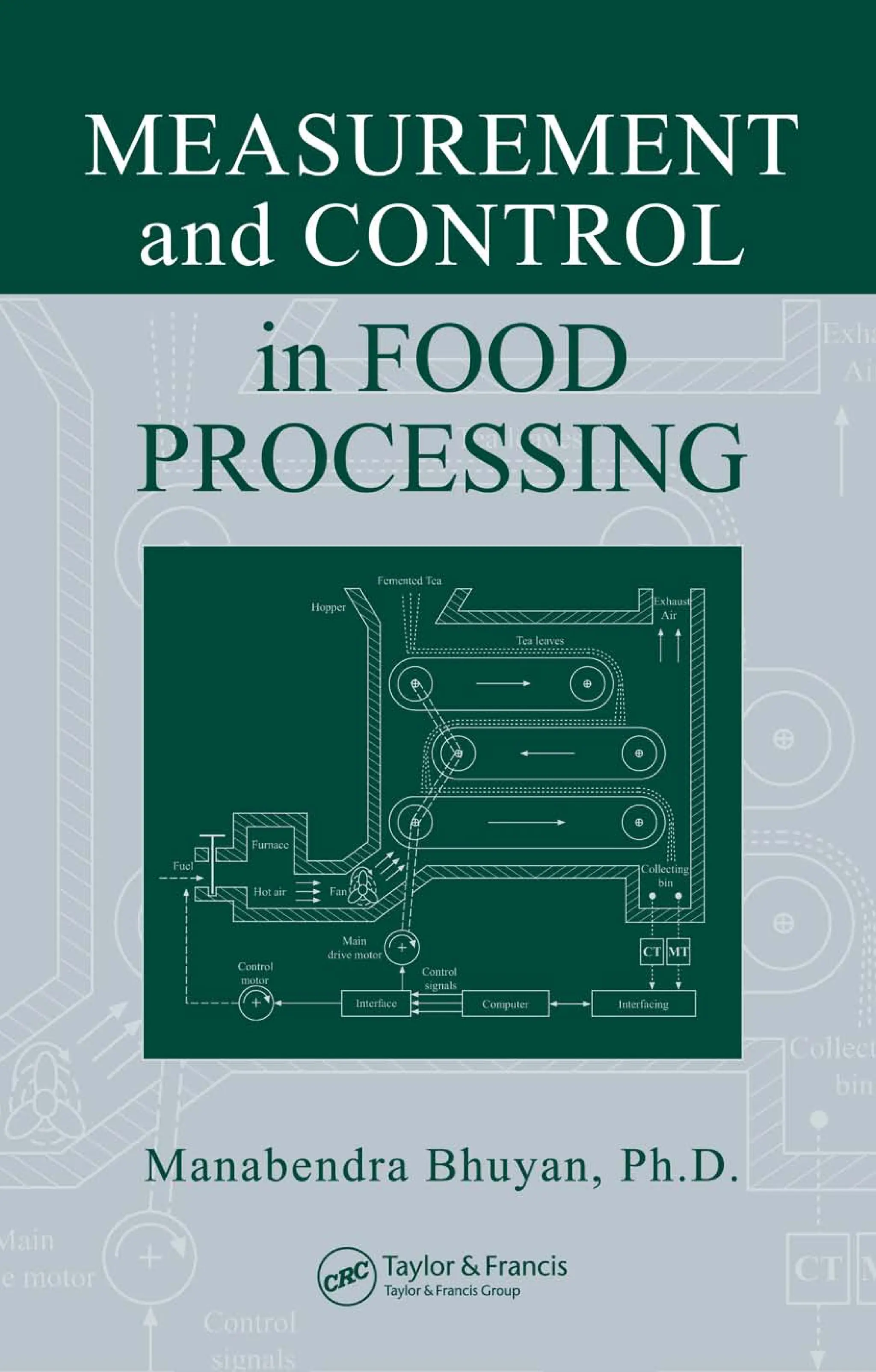


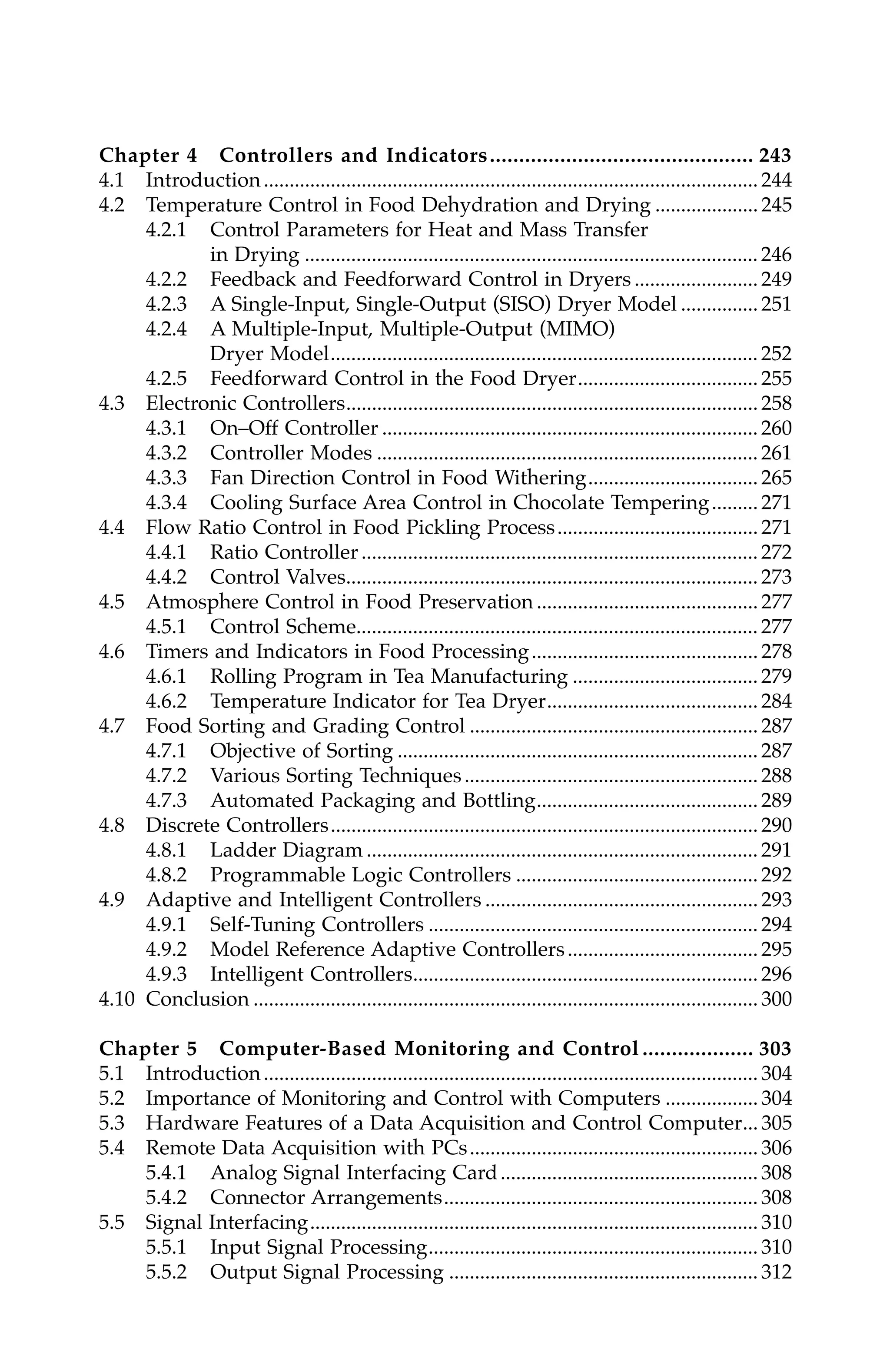
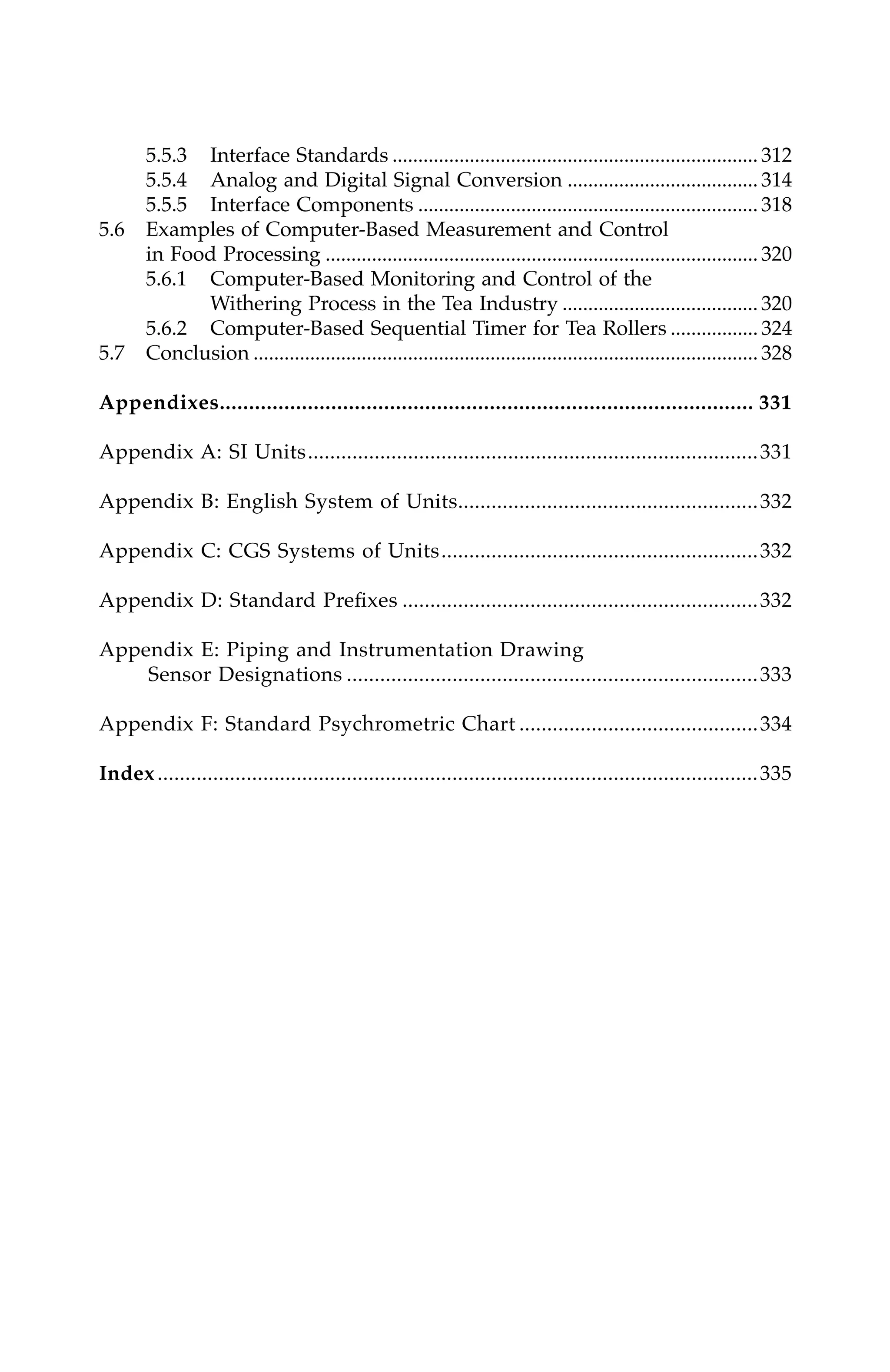



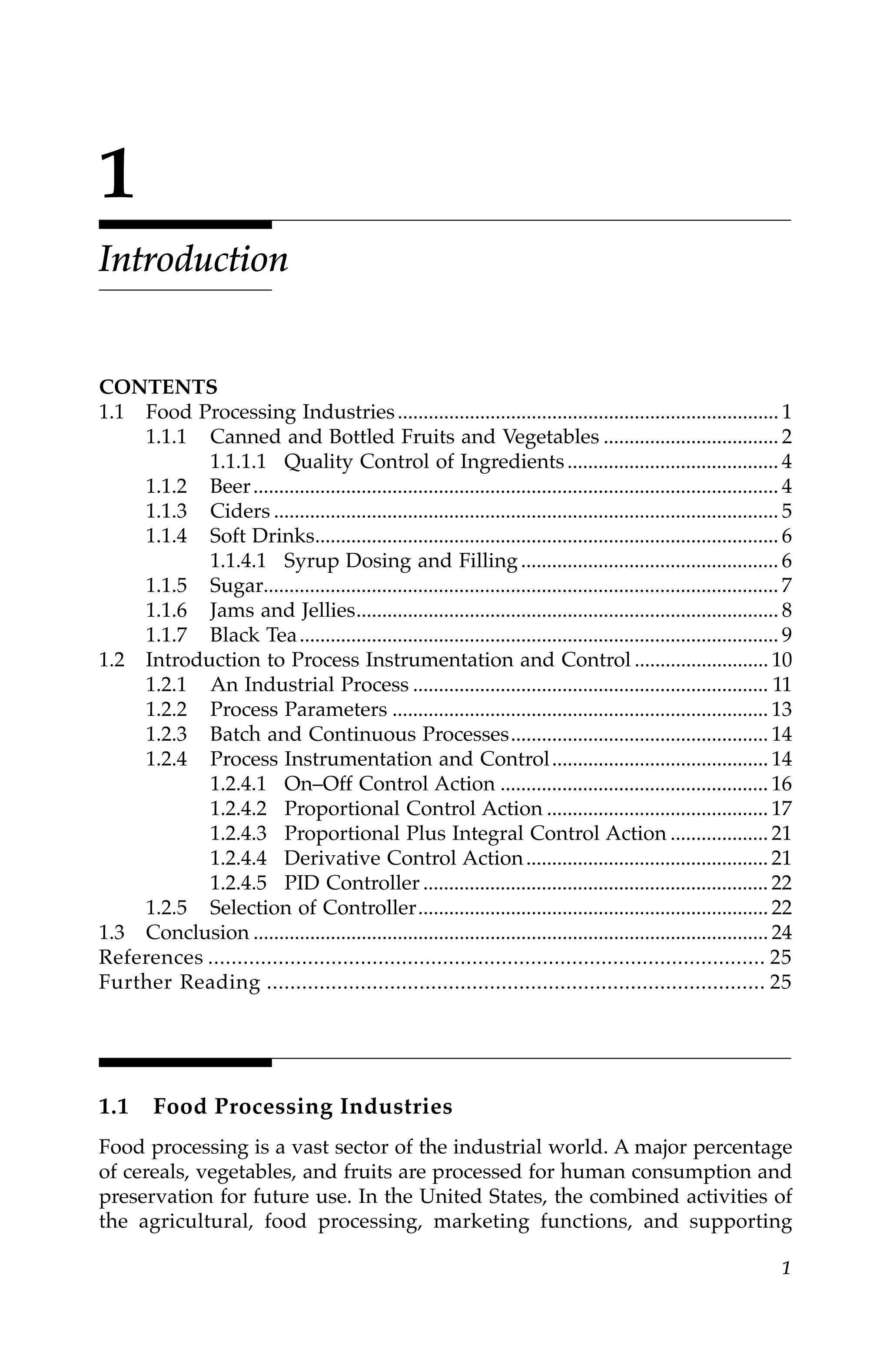
![2 Measurement and Control in Food Processing
industries generate about 20% of the gross national product and one fourth
of the total workforce. According to a survey on current business, approxi-
mately 1.7 million people in the United States were directly employed in food
manufacturing alone in 1991, not counting related businesses [1]. Food tech-
nology is the application of concepts generated by food science in processing,
preservation, packaging, and distribution of safe and nutritious food.
At one time food manufacturers did not pay much attention to production
of food by scientific methods as is done today. Due to the traditional pattern
of the food industries, many food manufacturers still try to produce quality
products with the old-fashioned approaches of measurement and control
methods: touching, smelling, and visual inspection. However, considerable
quality, efficiency, and energy are sacrificed in adopting these traditional
techniques.
The desirable characteristics of a food product are mainly determined by
its demand and usage. The quality control of processed food products has
become a concern both for manufacturers and consumers. Therefore, quality
control methods in food processing are required for the survival of the
industry because of user consciousness about safe and healthy products.
Apart from the important chemical and physical changes that can take place
during different stages of manufacturing, the quality of raw materials is also
an important factor. A good-quality food product cannot be processed from
poor-quality raw materials. Apart from composition, uniformity of size,
shape, color, and flavor have also become important in food processing.
The chemical aspect of food products is such an expansive field that it is
not possible to cover in detail and it is outside the scope of this book. Hence
a brief overview of a series of food processing industries is given in this
chapter, with an emphasis on the use of instrumentation and control.
When food processing was in its early stages, not much attention was paid
to relating quality to physical and chemical characteristics. However, as the
demand for quality products gradually increased, analysis of the relation
between chemical and physical characteristics started among food manufac-
turers. The following sections give an overview of some food manufacturing
processes with the potential of measurement and control strategies.
1.1.1 Canned and Bottled Fruits and Vegetables
Only good raw materials can result in superior quality food products. Food
specification defines ripeness of fruits by the maturity ratio, given by:
This ratio changes rapidly during the ripening period and reaches an
optimum value. This ratio can be different in different geographical regions;
Total solids, g/100ml
Acidity (as citric), g/ml
7244.book Page 2 Wednesday, June 21, 2006 11:14 AM](https://image.slidesharecdn.com/541-250227215840-1235466d/75/Measurement-and-Control-in-Food-Processing-1st-Edition-Manabendra-Bhuyan-24-2048.jpg)
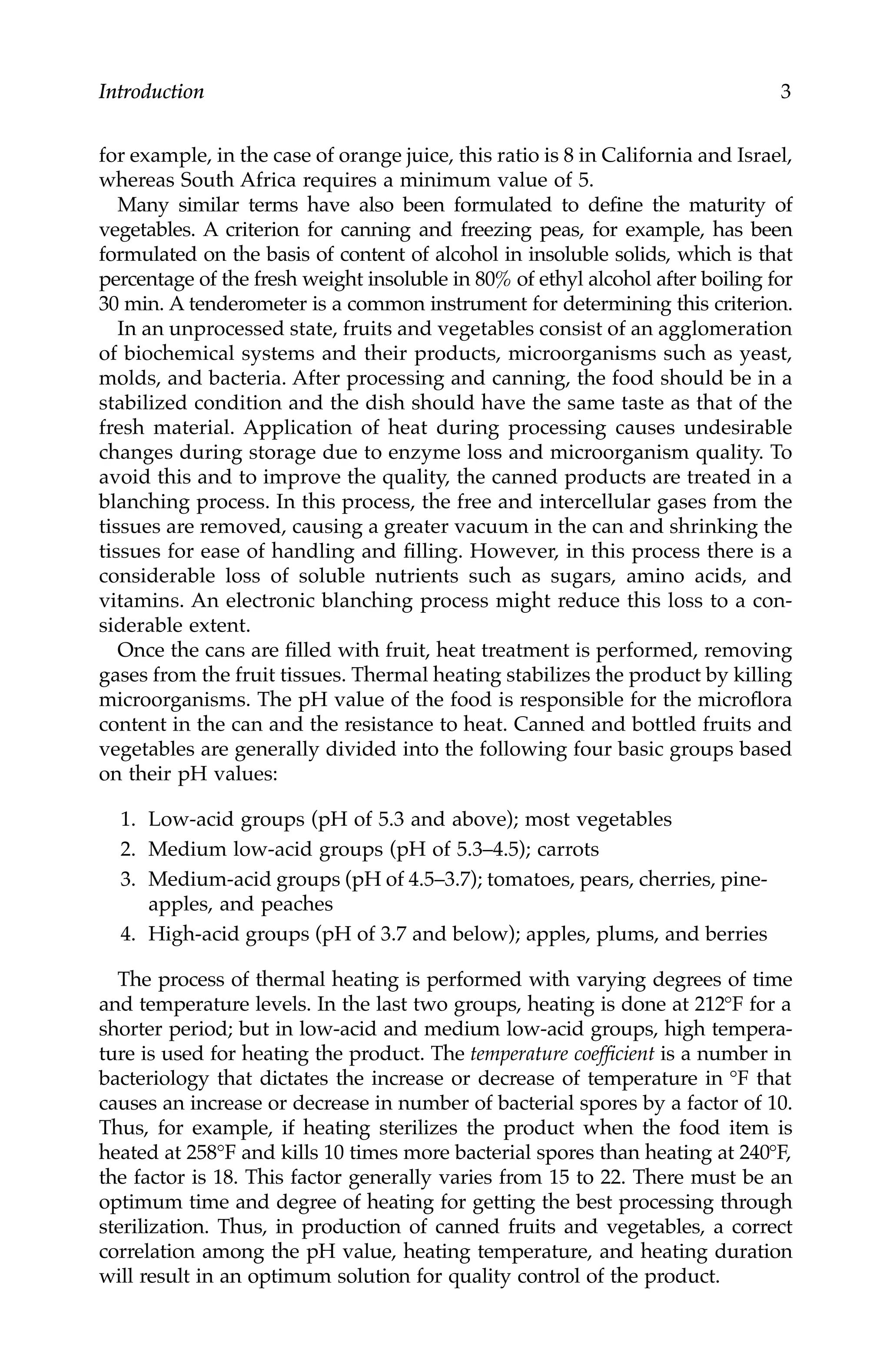
![Introduction 5
mash. Fermentable sugar, maltose, is formed due to the presence of enzymes
in the malt. Malt is prepared from barley corns in a process called malting.
Chemical analysis, appearance, flavor, texture, and moisture content determine
purity of malts. The sugar maltose is boiled in a kettle with the addition of
hops. It is then strained, cooled, and sent to a fermenting vessel, where yeast
is added.After a few days, alcohol is developed from the sugar and the resulting
beer is filtered and drained to a storage reservoir and then pasteurized. Pas-
teurization is the heating process required to destroy pathogenic microorgan-
isms. Controlled boiling of sugar maltose in the brew kettle is essential in
brewing to prevent insipid color, excessive bitterness, cloudy appearance, and
inconsistent taste of the final product. Moreover the efficiency of the process
can be improved by maximizing heat transfer and evaporation [2].
The major parameters of beer that need measurement and control are the
following:
1. Temperature during pasteurization and evaporation
2. Flow rate of product in various stages
3. Color matching against standard colors set by brewing conventions
of various countries
4. Measurement of yeast cell counts and minerals
5. Turbidity of the solution
6. pH measurement of infected pitching yeast for its purification
7. Estimation of oxygen, nitrogen, and hydrogen in the head space of
bottled beer
1.1.3 Ciders
Ciders are manufactured by fermentation of apple juice, which is a popular
drink in many countries. Juice is extracted from disintegrated apple by
applying hydraulic pressure on the pulp. Colloidal separation of juice from
the pressed pulp is achieved by adding a pectin-degrading enzyme followed
by a gelatin solution. Centrifugation and filtration of the gelatin solution
removes the precipitate. Evaporation reduces the volume of juice for inter-
mediate storage (see [3] for further details). Addition of sulfur dioxide or
ascorbic acid to the juice causes fermentation and reduces the tendency of
the product to become brown. Considerable attention should be given to the
following quality factors for the unfermented and fermented products:
The unfermented juice
1. Specific gravity of the fruit juice
2. Total sugar content of the fruit juice
3. Total acidity (pH)
4. Tannin content
5. Pectin content
7244.book Page 5 Wednesday, June 21, 2006 11:14 AM](https://image.slidesharecdn.com/541-250227215840-1235466d/75/Measurement-and-Control-in-Food-Processing-1st-Edition-Manabendra-Bhuyan-27-2048.jpg)
![10 Measurement and Control in Food Processing
the quality of the tea are the ambient temperature and relative humidity of the
fermenting room. The quality of the tea is developed in this stage primarily due
to the formation of two enzymes: thearubigin (TR) and theaflavin (TF).
The fermented tea is dried to deactivate its enzymes and stop fermentation
and to remove the moisture. This is achieved by passing hot air between
95°C and 145°C through the fermented tea in drying machines. The moisture
in the final black tea is reduced to the range of 3% to 5%. The desired moisture
content of the dried leaves can be achieved by maintaining the required feed
rate of fermented leaves and the inlet temperature of the hot air. The man-
ufactured black tea is then sorted into different grades or sizes using sorting
machines. The different grades of tea are then weighed, packed in jute sacks
or wooden boxes, and sealed so that the tea cannot absorb extra moisture
from the outside environment. The packed tea boxes or packets are sent to
tea warehouses for selling or auction. Black tea is currently available in
evacuated small packets of 200 g, 500 g, and so on. Evacuation of the packet
ensures that quality of the tea does not deteriorate.
The following parameters must be monitored and controlled to maintain
the quality of black tea during manufacturing [3]:
Parameters that need monitoring
1. Moisture content of the green tea leaves, withered tea leaves, fer-
mented tea leaves, and final black tea leaves
2. Relative humidity of air during withering and fermenting
3. Velocity of withering air
4. Percentage of withering
5. Temperature of air during withering and drying
6. Degree of fermentation, formation of color, flavor, and enzymes
Controllable parameters [4]
1. Withering on completeness of the process
2. Rolling time sequence and display timings
3. Relative humidity and temperature during fermentation
4. Overdrying and underdrying of tea during the drying process
5. Automated sorting of black tea
1.2 Introduction to Process Instrumentation and Control
There has been considerable development in the field of instrumentation in
the last few decades. The reason for this rapid growth is that its principles
7244.book Page 10 Wednesday, June 21, 2006 11:14 AM](https://image.slidesharecdn.com/541-250227215840-1235466d/75/Measurement-and-Control-in-Food-Processing-1st-Edition-Manabendra-Bhuyan-32-2048.jpg)