Presentation On
ENVIRONMENTAL LAB INSTRUMENTS AND ITS APPLICATION
Presented by:
Prasanna Kumar Tiwari
Mousmi Thumber
M. E. I – Semester I
PG Centre
Masters in Environmental Engineering
GUJARAT TECHNOLOGICAL UNIVERSITY
2017-2018
PG In-charge
Prof. Mehali Mehta
SCET, Surat
Head of Department
Dr. Pratima A. Patel
SCET, Surat
Guide
Prof. Mitali Shah
SCET, Surat
SARVAJANIK EDUCATION SOCIETY
SARVAJANIK COLLEGE OF ENGINEERING & TECHNOLOGY
Dr. R. K. Desai Marg, Athwalines, Surat – 395001
Towards progressive civilization…..
Co-Guide
Prof. Ankita Parmar
SCET, Surat
1
List Of Instruments
• pH meter
• Weighing balance
• Turbidity meter
• COD digester
• Muffle furnace
• Flame photometer
• BOD incubator
• Water bath
• Hot air Oven
• Centrifuge
• Spectrophotometer
• Conductivity meter
• Gas Chromatograph
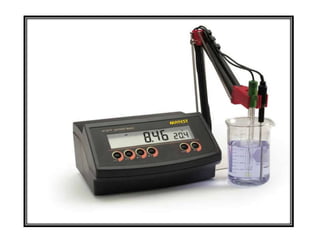
• pH meter
• A pH meter is a scientific instrument that measures
the hydrogen-ion activity in water-based solutions,
indicating its acidity or alkalinity expressed as pH. The
pH meter measures the difference in electrical
potential between a pH electrode and a reference
electrode, and so the pH meter is sometimes referred to
as a “potentiometric pH meter”. The difference in
electrical potential relates to the acidity or pH of the
solution. The pH meter is used in many applications
ranging from laboratory experimentation to quality
control.
• The pH meter is used in
many applications ranging from laboratory
experimentation to quality control.
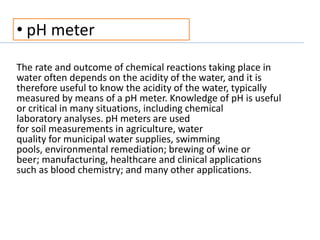
• pH meter
The rate and outcome of chemical reactions taking place in
water often depends on the acidity of the water, and it is
therefore useful to know the acidity of the water, typically
measured by means of a pH meter. Knowledge of pH is useful
or critical in many situations, including chemical
laboratory analyses. pH meters are used
for soil measurements in agriculture, water
quality for municipal water supplies, swimming
pools, environmental remediation; brewing of wine or
beer; manufacturing, healthcare and clinical applications
such as blood chemistry; and many other applications.
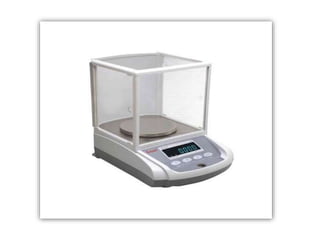
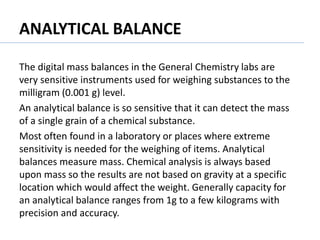
ANALYTICAL BALANCE
The digital mass balances in the General Chemistry labs are
very sensitive instruments used for weighing substances to the
milligram (0.001 g) level.
An analytical balance is so sensitive that it can detect the mass
of a single grain of a chemical substance.
Most often found in a laboratory or places where extreme
sensitivity is needed for the weighing of items. Analytical
balances measure mass. Chemical analysis is always based
upon mass so the results are not based on gravity at a specific
location which would affect the weight. Generally capacity for
an analytical balance ranges from 1g to a few kilograms with
precision and accuracy.
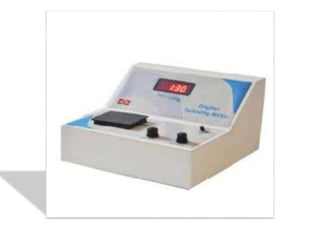
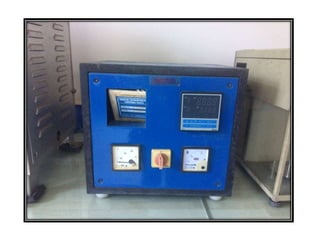
TURBIDITY METER
Turbidity meters, are used to determine the concentration of solids in a sample
of liquid, usually water. Turbidity is the cloudiness of a liquid caused by the
presence of suspended solids (particles) that may include microorganisms,
yeast, or sediment.
Turbidimetry (the name being derived from turbidity) is the process of
measuring the loss of intensity of transmitted light due to the scattering effect
of particles suspended in it. Light is passed through a filter creating a light of
known wavelength which is then passed through a cuvette containing a
solution. A photoelectric cell collects the light which passes through the
cuvette. A measurement is then given for the amount of absorbed light.
Turbidimetry can be used in biology to find the number of cells in a solution
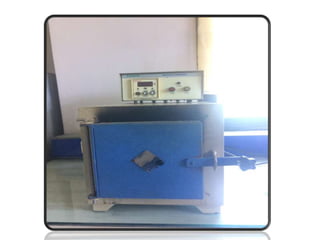
COD DIGESTER
COD Digester Is The Most Accepted Thermoreactor
For Determination of Chemical Oxygen Demand in
Various Substances. Chemical Oxygen Demand
(COD) is a measure of the capacity of water to
Consume Oxygen during the decomposition of
Organic Matter and the Oxidation of inorganic
chemicals such as Ammonia and Nitrite.
Chemical Oxygen Demand Digester Designed for
digestion of COD test samples and multi-function
dry bath heating.
The COD Digester is ideal for rapid & frequent
monitoring of treatment plant efficiency and water
quality.
MUFFLE FURNACE
A muffle furnace is a furnace in which the subject
material is isolated from the fuel and all of the
products of combustion, including gases and flying
ash.
It is used in order to determine what proportion of a
sample is non-combustible and non-volatile.
FLAME PHOTOMETER
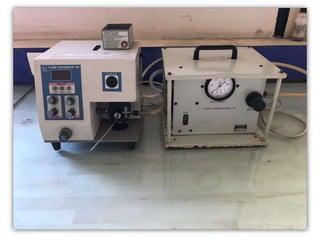
Flame photometer is used in various industries like chemicals
, soils, agriculture, pharmaceuticals, glass and ceramics, in
plant materials and water, oceanography, and in biological
and microbiological laboratories.
It is used in determination of potassium, sodium,
magnesium and calcium in biological fluids like serum,
plasma, urine etc, is routinely carried out by flame
photometer.
Analysis of industrial water, natural water for determining
elements responsible for hard water (magnesium, barium,
calcium etc.) is standard procedure in many laboratories
Soil samples are routinely analysed mainly for sodium and
potassium and also for calcium and magnesium (after
removing other interfering elements) by flame photometer.
Flame photometer is extensively used in estimation of alkali-
alkaline earth metals as well as other metals present in
metallurgical products, catalysts, alloys etc.
Analysis of ash by flame photometer is routinely carried out
in various industries for estimating alkali and alkaline earth
metals as their oxides.
FLAME PHOTOMETER
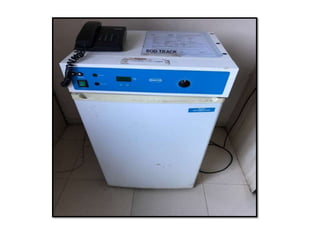
BOD INCUBATOR
B.O.D Incubators or Low Temperature Incubators, are
commonly used for applications such as
B.O.D. Determinations, Plant and Insect Studies,
Fermentation Studies, and Bacterial Culturing among many
others.
BOD incubator is the most versatile and reliable low
temperature incubator which is designed to maintain at 20°C,
necessary for Biological Oxygen Demand/Biochemical
Oxygen Demand (BOD) determination. BOD incubators
provide controlled temperature conditions for accelerated
tests and exposures.
In measuring waste loadings to treatment plants and in
evaluating the BOD-removal efficiency of such treatment
systems.
It measures the molecular oxygen utilized during a specified
incubation period for the biochemical degradation of organic
material (carbonaceous demand) and the oxygen used to
oxidize inorganic material such as sulfides and ferrous iron.
It measures the amount of oxygen used to oxidize reduced
forms of nitrogen (nitrogenous demand) unless their
oxidation is prevented by an inhibitor.
BOD INCUBATOR
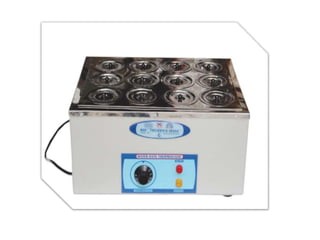
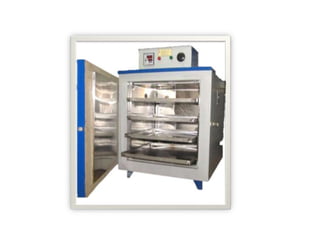
WATER BATH
A water bath is laboratory equipment made from a container
filled with heated water. It is used to incubate samples in
water at a constant temperature over a long period of time.
Utilisations include warming of reagents, melting
of substrates or incubation of cell cultures. It is also used to
enable certain chemical reactions to occur at high
temperature. Water bath is a preferred heat source for
heating flammable chemicals instead of an open flame to
prevent ignition.
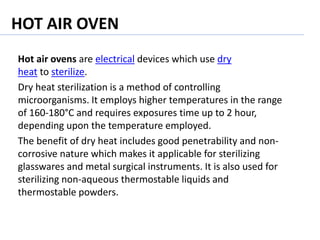
HOT AIR OVEN
Hot air ovens are electrical devices which use dry
heat to sterilize.
Dry heat sterilization is a method of controlling
microorganisms. It employs higher temperatures in the range
of 160-180°C and requires exposures time up to 2 hour,
depending upon the temperature employed.
The benefit of dry heat includes good penetrability and non-
corrosive nature which makes it applicable for sterilizing
glasswares and metal surgical instruments. It is also used for
sterilizing non-aqueous thermostable liquids and
thermostable powders.
Dry heat destroys bacterial endotoxins (or pyrogens) which
are difficult to eliminate by other means and this property
makes it applicable for sterilizing glass bottles which are to
be filled aseptically). Dry heat kills by Oxidation, Protein
Denaturation and toxic effects of eleveated levels of
electrolytes.
HOT AIR OVEN
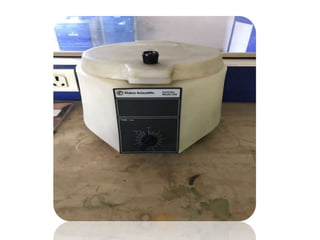
CENTRIFUGE
A centrifuge is a piece of equipment that puts an object
in rotation around a fixed axis (spins it in a circle), applying a
potentially strong force perpendicular to the axis of spin
(outward). The centrifuge works using the sedimentation
principle, where the centripetal acceleration causes denser
substances and particles to move outward in the radial
direction. At the same time, objects that are less dense are
displaced and move to the center. In a laboratory centrifuge
that uses sample tubes, the radial acceleration causes denser
particles to settle to the bottom of the tube, while low-
density substances rise to the top.
A wide variety of laboratory-scale centrifuges are used in
chemistry, biology, biochemistry and clinical medicine for
isolating and separating suspensions and immiscible liquids.
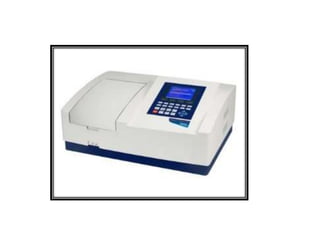
SPECTROPOTOMETER
A spectrophotometer measures either the amount of light
reflected from a sample object or the amount of light that is
absorbed by the sample object.
In chemistry, spectrophotometry is the quantitative
measurement of the reflection or transmission properties of
a material as a function of wavelength. It is more specific
than the general term electromagnetic spectroscopy in that
spectrophotometry deals with visible light, near-ultraviolet,
and near-infrared, but does not cover time-resolved
spectroscopic techniques.
SPECTROPOTOMETER
Spectrophotometry uses photometers, known as
spectrophotometers, that can measure a light beam's
intensity as a function of its color (wavelength). Important
features of spectrophotometers are spectral bandwidth (the
range of colors it can transmit through the test sample), the
percentage of sample-transmission, the logarithmic range of
sample-absorption, and sometimes a percentage of
reflectance measurement.
A spectrophotometer is commonly used for the
measurement of transmittance or reflectance of solutions,
transparent or opaque solids, such as polished glass, or
gases. Although many biochemicals are coloured, as in, they
absorb visible light and therefore can be measured by
colorimetric procedures, even colourless biochemicals can
often be converted to coloured compounds suitable for
chromogenic colour-forming reactions to yield compounds
suitable for colorimetric analysis.
SPECTROPOTOMETER
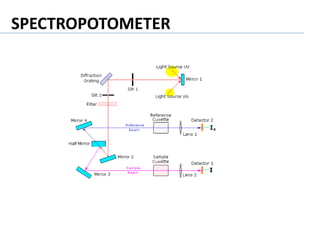
A beam of light from a visible and/or UV light source (colored
red) is separated into its component wavelengths by a prism
or diffraction grating. Each monochromatic (single
wavelength) beam in turn is split into two equal intensity
beams by a half-mirrored device. One beam, the sample
beam (colored magenta), passes through a small transparent
container (cuvette) containing a solution of the compound
being studied in a transparent solvent.
UV – VISIBLE SPECTROPOTOMETER
The other beam, the reference (colored blue), passes
through an identical cuvette containing only the solvent. The
intensities of these light beams are then measured by
electronic detectors and compared. The intensity of the
reference beam, which should have suffered little or no light
absorption, is defined as I0. The intensity of the sample beam
is defined as I. Over a short period of time, the spectrometer
automatically scans all the component wavelengths in the
manner described. The ultraviolet (UV) region scanned is
normally from 200 to 400 nm, and the visible portion is from
400 to 800 nm.
UV – VISIBLE SPECTROPOTOMETER
SPECTROPOTOMETER
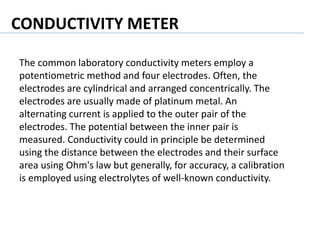
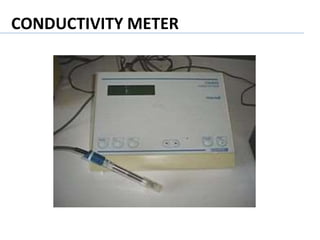
The common laboratory conductivity meters employ a
potentiometric method and four electrodes. Often, the
electrodes are cylindrical and arranged concentrically. The
electrodes are usually made of platinum metal. An
alternating current is applied to the outer pair of the
electrodes. The potential between the inner pair is
measured. Conductivity could in principle be determined
using the distance between the electrodes and their surface
area using Ohm's law but generally, for accuracy, a calibration
is employed using electrolytes of well-known conductivity.
CONDUCTIVITY METER
CONDUCTIVITY METER
In gas chromatography, the mobile phase (or "moving
phase") is a carrier gas, usually an inert gas such as helium or
an unreactive gas such as nitrogen. Helium remains the most
commonly used carrier gas in about 90% of instruments
although hydrogen is preferred for improved separations.
The stationary phase is a microscopic layer of liquid or
polymer on an inert solid support, inside a piece of glass or
metal tubing called a column.
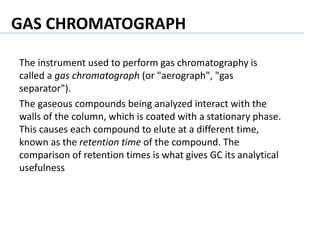
GAS CHROMATOGRAPH
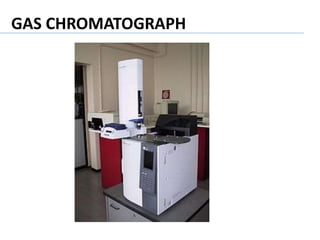
The instrument used to perform gas chromatography is
called a gas chromatograph (or "aerograph", "gas
separator").
The gaseous compounds being analyzed interact with the
walls of the column, which is coated with a stationary phase.
This causes each compound to elute at a different time,
known as the retention time of the compound. The
comparison of retention times is what gives GC its analytical
usefulness
GAS CHROMATOGRAPH
GAS CHROMATOGRAPH
Environment lab instruments

Environment lab instruments

  • 1.
    Presentation On ENVIRONMENTAL LABINSTRUMENTS AND ITS APPLICATION Presented by: Prasanna Kumar Tiwari Mousmi Thumber M. E. I – Semester I PG Centre Masters in Environmental Engineering GUJARAT TECHNOLOGICAL UNIVERSITY 2017-2018 PG In-charge Prof. Mehali Mehta SCET, Surat Head of Department Dr. Pratima A. Patel SCET, Surat Guide Prof. Mitali Shah SCET, Surat SARVAJANIK EDUCATION SOCIETY SARVAJANIK COLLEGE OF ENGINEERING & TECHNOLOGY Dr. R. K. Desai Marg, Athwalines, Surat – 395001 Towards progressive civilization….. Co-Guide Prof. Ankita Parmar SCET, Surat 1
  • 2.
    List Of Instruments •pH meter • Weighing balance • Turbidity meter • COD digester • Muffle furnace • Flame photometer • BOD incubator • Water bath • Hot air Oven • Centrifuge • Spectrophotometer • Conductivity meter • Gas Chromatograph
  • 4.
    • pH meter •A pH meter is a scientific instrument that measures the hydrogen-ion activity in water-based solutions, indicating its acidity or alkalinity expressed as pH. The pH meter measures the difference in electrical potential between a pH electrode and a reference electrode, and so the pH meter is sometimes referred to as a “potentiometric pH meter”. The difference in electrical potential relates to the acidity or pH of the solution. The pH meter is used in many applications ranging from laboratory experimentation to quality control. • The pH meter is used in many applications ranging from laboratory experimentation to quality control.
  • 5.
    • pH meter Therate and outcome of chemical reactions taking place in water often depends on the acidity of the water, and it is therefore useful to know the acidity of the water, typically measured by means of a pH meter. Knowledge of pH is useful or critical in many situations, including chemical laboratory analyses. pH meters are used for soil measurements in agriculture, water quality for municipal water supplies, swimming pools, environmental remediation; brewing of wine or beer; manufacturing, healthcare and clinical applications such as blood chemistry; and many other applications.
  • 7.
    ANALYTICAL BALANCE The digitalmass balances in the General Chemistry labs are very sensitive instruments used for weighing substances to the milligram (0.001 g) level. An analytical balance is so sensitive that it can detect the mass of a single grain of a chemical substance. Most often found in a laboratory or places where extreme sensitivity is needed for the weighing of items. Analytical balances measure mass. Chemical analysis is always based upon mass so the results are not based on gravity at a specific location which would affect the weight. Generally capacity for an analytical balance ranges from 1g to a few kilograms with precision and accuracy.
  • 9.
    TURBIDITY METER Turbidity meters,are used to determine the concentration of solids in a sample of liquid, usually water. Turbidity is the cloudiness of a liquid caused by the presence of suspended solids (particles) that may include microorganisms, yeast, or sediment. Turbidimetry (the name being derived from turbidity) is the process of measuring the loss of intensity of transmitted light due to the scattering effect of particles suspended in it. Light is passed through a filter creating a light of known wavelength which is then passed through a cuvette containing a solution. A photoelectric cell collects the light which passes through the cuvette. A measurement is then given for the amount of absorbed light. Turbidimetry can be used in biology to find the number of cells in a solution

  • 11.
    COD DIGESTER COD DigesterIs The Most Accepted Thermoreactor For Determination of Chemical Oxygen Demand in Various Substances. Chemical Oxygen Demand (COD) is a measure of the capacity of water to Consume Oxygen during the decomposition of Organic Matter and the Oxidation of inorganic chemicals such as Ammonia and Nitrite. Chemical Oxygen Demand Digester Designed for digestion of COD test samples and multi-function dry bath heating. The COD Digester is ideal for rapid & frequent monitoring of treatment plant efficiency and water quality.
  • 13.
    MUFFLE FURNACE A mufflefurnace is a furnace in which the subject material is isolated from the fuel and all of the products of combustion, including gases and flying ash. It is used in order to determine what proportion of a sample is non-combustible and non-volatile.
  • 15.
    FLAME PHOTOMETER Flame photometeris used in various industries like chemicals , soils, agriculture, pharmaceuticals, glass and ceramics, in plant materials and water, oceanography, and in biological and microbiological laboratories. It is used in determination of potassium, sodium, magnesium and calcium in biological fluids like serum, plasma, urine etc, is routinely carried out by flame photometer. Analysis of industrial water, natural water for determining elements responsible for hard water (magnesium, barium, calcium etc.) is standard procedure in many laboratories
  • 16.
    Soil samples areroutinely analysed mainly for sodium and potassium and also for calcium and magnesium (after removing other interfering elements) by flame photometer. Flame photometer is extensively used in estimation of alkali- alkaline earth metals as well as other metals present in metallurgical products, catalysts, alloys etc. Analysis of ash by flame photometer is routinely carried out in various industries for estimating alkali and alkaline earth metals as their oxides. FLAME PHOTOMETER
  • 18.
    BOD INCUBATOR B.O.D Incubatorsor Low Temperature Incubators, are commonly used for applications such as B.O.D. Determinations, Plant and Insect Studies, Fermentation Studies, and Bacterial Culturing among many others. BOD incubator is the most versatile and reliable low temperature incubator which is designed to maintain at 20°C, necessary for Biological Oxygen Demand/Biochemical Oxygen Demand (BOD) determination. BOD incubators provide controlled temperature conditions for accelerated tests and exposures.
  • 19.
    In measuring wasteloadings to treatment plants and in evaluating the BOD-removal efficiency of such treatment systems. It measures the molecular oxygen utilized during a specified incubation period for the biochemical degradation of organic material (carbonaceous demand) and the oxygen used to oxidize inorganic material such as sulfides and ferrous iron. It measures the amount of oxygen used to oxidize reduced forms of nitrogen (nitrogenous demand) unless their oxidation is prevented by an inhibitor. BOD INCUBATOR
  • 21.
    WATER BATH A waterbath is laboratory equipment made from a container filled with heated water. It is used to incubate samples in water at a constant temperature over a long period of time. Utilisations include warming of reagents, melting of substrates or incubation of cell cultures. It is also used to enable certain chemical reactions to occur at high temperature. Water bath is a preferred heat source for heating flammable chemicals instead of an open flame to prevent ignition.
  • 23.
    HOT AIR OVEN Hotair ovens are electrical devices which use dry heat to sterilize. Dry heat sterilization is a method of controlling microorganisms. It employs higher temperatures in the range of 160-180°C and requires exposures time up to 2 hour, depending upon the temperature employed. The benefit of dry heat includes good penetrability and non- corrosive nature which makes it applicable for sterilizing glasswares and metal surgical instruments. It is also used for sterilizing non-aqueous thermostable liquids and thermostable powders.
  • 24.
    Dry heat destroysbacterial endotoxins (or pyrogens) which are difficult to eliminate by other means and this property makes it applicable for sterilizing glass bottles which are to be filled aseptically). Dry heat kills by Oxidation, Protein Denaturation and toxic effects of eleveated levels of electrolytes. HOT AIR OVEN
  • 26.
    CENTRIFUGE A centrifuge isa piece of equipment that puts an object in rotation around a fixed axis (spins it in a circle), applying a potentially strong force perpendicular to the axis of spin (outward). The centrifuge works using the sedimentation principle, where the centripetal acceleration causes denser substances and particles to move outward in the radial direction. At the same time, objects that are less dense are displaced and move to the center. In a laboratory centrifuge that uses sample tubes, the radial acceleration causes denser particles to settle to the bottom of the tube, while low- density substances rise to the top. A wide variety of laboratory-scale centrifuges are used in chemistry, biology, biochemistry and clinical medicine for isolating and separating suspensions and immiscible liquids.
  • 28.
    SPECTROPOTOMETER A spectrophotometer measureseither the amount of light reflected from a sample object or the amount of light that is absorbed by the sample object. In chemistry, spectrophotometry is the quantitative measurement of the reflection or transmission properties of a material as a function of wavelength. It is more specific than the general term electromagnetic spectroscopy in that spectrophotometry deals with visible light, near-ultraviolet, and near-infrared, but does not cover time-resolved spectroscopic techniques.
  • 29.
    SPECTROPOTOMETER Spectrophotometry uses photometers,known as spectrophotometers, that can measure a light beam's intensity as a function of its color (wavelength). Important features of spectrophotometers are spectral bandwidth (the range of colors it can transmit through the test sample), the percentage of sample-transmission, the logarithmic range of sample-absorption, and sometimes a percentage of reflectance measurement.
  • 30.
    A spectrophotometer iscommonly used for the measurement of transmittance or reflectance of solutions, transparent or opaque solids, such as polished glass, or gases. Although many biochemicals are coloured, as in, they absorb visible light and therefore can be measured by colorimetric procedures, even colourless biochemicals can often be converted to coloured compounds suitable for chromogenic colour-forming reactions to yield compounds suitable for colorimetric analysis. SPECTROPOTOMETER
  • 31.
    A beam oflight from a visible and/or UV light source (colored red) is separated into its component wavelengths by a prism or diffraction grating. Each monochromatic (single wavelength) beam in turn is split into two equal intensity beams by a half-mirrored device. One beam, the sample beam (colored magenta), passes through a small transparent container (cuvette) containing a solution of the compound being studied in a transparent solvent. UV – VISIBLE SPECTROPOTOMETER
  • 32.
    The other beam,the reference (colored blue), passes through an identical cuvette containing only the solvent. The intensities of these light beams are then measured by electronic detectors and compared. The intensity of the reference beam, which should have suffered little or no light absorption, is defined as I0. The intensity of the sample beam is defined as I. Over a short period of time, the spectrometer automatically scans all the component wavelengths in the manner described. The ultraviolet (UV) region scanned is normally from 200 to 400 nm, and the visible portion is from 400 to 800 nm. UV – VISIBLE SPECTROPOTOMETER
  • 33.
  • 34.
    The common laboratoryconductivity meters employ a potentiometric method and four electrodes. Often, the electrodes are cylindrical and arranged concentrically. The electrodes are usually made of platinum metal. An alternating current is applied to the outer pair of the electrodes. The potential between the inner pair is measured. Conductivity could in principle be determined using the distance between the electrodes and their surface area using Ohm's law but generally, for accuracy, a calibration is employed using electrolytes of well-known conductivity. CONDUCTIVITY METER
  • 35.
  • 36.
    In gas chromatography,the mobile phase (or "moving phase") is a carrier gas, usually an inert gas such as helium or an unreactive gas such as nitrogen. Helium remains the most commonly used carrier gas in about 90% of instruments although hydrogen is preferred for improved separations. The stationary phase is a microscopic layer of liquid or polymer on an inert solid support, inside a piece of glass or metal tubing called a column. GAS CHROMATOGRAPH
  • 37.
    The instrument usedto perform gas chromatography is called a gas chromatograph (or "aerograph", "gas separator"). The gaseous compounds being analyzed interact with the walls of the column, which is coated with a stationary phase. This causes each compound to elute at a different time, known as the retention time of the compound. The comparison of retention times is what gives GC its analytical usefulness GAS CHROMATOGRAPH
  • 38.