

Human Sexuality Chapter 8
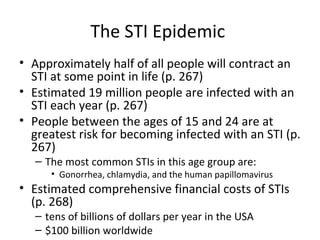
The STI Epidemic  Approximately half of all people will contract an STI at some point in life (p. 267) Estimated 19 million people are infected with an STI each year (p. 267) People between the ages of 15 and 24 are at greatest risk for becoming infected with an STI (p. 267) The most common STIs in this age group are: Gonorrhea, chlamydia, and the human papillomavirus Estimated comprehensive financial costs of STIs (p. 268) tens of billions of dollars per year in the USA $100 billion worldwide
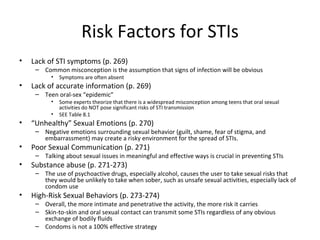
Risk Factors for STIs Lack of STI symptoms (p. 269) Common misconception is the assumption that signs of infection will be obvious Symptoms are often absent Lack of accurate information (p. 269) Teen oral-sex “epidemic” Some experts theorize that there is a widespread misconception among teens that oral sexual activities do NOT pose significant risks of STI transmission SEE Table 8.1 “ Unhealthy” Sexual Emotions (p. 270) Negative emotions surrounding sexual behavior (guilt, shame, fear of stigma, and embarrassment) may create a risky environment for the spread of STIs. Poor Sexual Communication (p. 271) Talking about sexual issues in meaningful and effective ways is crucial in preventing STIs Substance abuse (p. 271-273) The use of psychoactive drugs, especially alcohol, causes the user to take sexual risks that they would be unlikely to take when sober, such as unsafe sexual activities, especially lack of condom use High-Risk Sexual Behaviors (p. 273-274) Overall, the more intimate and penetrative the activity, the more risk it carries Skin-to-skin and oral sexual contact can transmit some STIs regardless of any obvious exchange of bodily fluids Condoms is not a 100% effective strategy
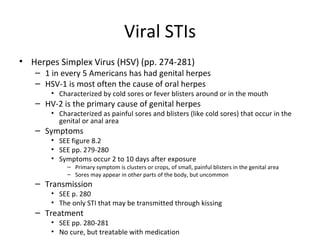
Viral STIs Herpes Simplex Virus (HSV) (pp. 274-281) 1 in every 5 Americans has had genital herpes HSV-1 is most often the cause of oral herpes Characterized by cold sores or fever blisters around or in the mouth HV-2 is the primary cause of genital herpes Characterized as painful sores and blisters (like cold sores) that occur in the genital or anal area Symptoms SEE figure 8.2 SEE pp. 279-280 Symptoms occur 2 to 10 days after exposure Primary symptom is clusters or crops, of small, painful blisters in the genital area Sores may appear in other parts of the body, but uncommon Transmission SEE p. 280 The only STI that may be transmitted through kissing Treatment SEE pp. 280-281 No cure, but treatable with medication
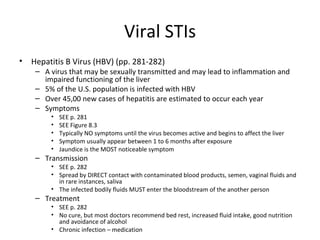
Viral STIs Hepatitis B Virus (HBV) (pp. 281-282) A virus that may be sexually transmitted and may lead to inflammation and impaired functioning of the liver 5% of the U.S. population is infected with HBV Over 45,00 new cases of hepatitis are estimated to occur each year Symptoms SEE p. 281 SEE Figure 8.3 Typically NO symptoms until the virus becomes active and begins to affect the liver Symptom usually appear between 1 to 6 months after exposure Jaundice is the MOST noticeable symptom Transmission SEE p. 282 Spread by DIRECT contact with contaminated blood products, semen, vaginal fluids and in rare instances, saliva The infected bodily fluids MUST enter the bloodstream of the another person Treatment SEE p. 282 No cure, but most doctors recommend bed rest, increased fluid intake, good nutrition and avoidance of alcohol Chronic infection – medication
Viral STIs Human Papilloma Virus (Genital Warts) (pp. 282-286) A sexually transmitted virus that is typically characterized by warts in the genital or anal area and that may lead to some forms of cancer 75% of Americans of reproductive age may be infected May be the MOST common STI in the U.S. 6 million become infected each year Symptoms SEE p. 283 SEE Figure 8.4 MOST have never noticed an active outbreak of warts and are UNAWARE they are infected Transmission SEE p. 283 No cure, but can remove warts
Viral STIs HIV and AIDS (pp. 286-298)  HIV is NOT AIDS HIV is the virus that causes AIDS AIDS is a gradual failure of the immune system Symptoms SEE p. 291 Most with HIV at first experience NO symptoms at all If symptoms do occur, the may resemble the common cold These symptoms typically occur within a few days to several weeks and then resolve within one to three weeks Transmission SEE pp. 291-295 From transmissible amounts in the semen, vaginal fluids, and blood It must enter the bloodstream The MOST common sexual routes is through unprotected vaginal and anal intercourse  Treatment SEE pp. 295-296 No cure, but preventing the progression of the infection to AIDS has improved greatly since the virus was discovered Treatment consists of a three-pronged approach: 1. attacking the virus itself, 2. strengthening the immune system, and 3. preventing and controlling opportunistic infections and diseases HAART – is a combination of several medications prescribed for people who are HIV positive  to delay the onset of AIDS
Bacterial STIs Chlamydia (pp. 298-300) A sexually transmitted bacterium, often causing a thick, cloudy discharge from the vagina or penis; may be asymptomatic, especially in women MOST commonly diagnosed and reported STI in the U.S. Estimated 1 million new infections occur each year Highest rates of infection are among women under the age of 25 Symptoms  SEE pp. 298-299 SEE figure 8.8 75% of women and 50% of men have no  noticeable symptoms When signs are present, the MOST common symptom is a thick, cloudy discharge from the vagina or penis This occurs 1 to 3 weeks after exposure SEE Figure 8.8 Transmission SEE pp. 299-300 Through sexual contact Primarily oral, vaginal and anal sex The bacterium survives in the cells of bodily fluids such as vaginal secretions and semen Treatment SEE p. 300 Oral antibiotics will cure MOST cases
Bacterial STIs Gonorrhea (pp. 300-302) A sexually transmitted bacterium typically producing pain upon urination and a thick cloudy discharge from the penis or vagina; often asymptomatic, especially in women Vernacular names: clap, drip, and burn Highest rates are among the ages of 15 to 24 Symptoms SEE pp. 300-301 SEE Figure 8.9 Typically producing pain upon urination and a thick cloudy discharge from the penis or vagina In oral infection, the main symptom is a severe sore throat Transmission SEE p. 301 Easily transmitted through vaginal, anal, or oral sexual contact Treatment SEE p. 300 Oral antibiotics will cure MOST cases
Bacterial STIs Syphilis (pp. 302-304) A sexually transmitted bacterium characterized by a sore, or chancre, at the point of infection Symptoms SEE pp. 303-304 SEE figure 8.11 4 distinct stages 1. The primary stage occurs within 10 days to 3 months after exposure It is characterized by a sore called chancre, which appears at the site of infection 2. The secondary stage occurs within a few weeks to up to six months of the initial infection It includes low-grade fever, sore throat, fatigue, headache, hair loss, and skin rashes See Figure 8.12
CONT: Bacterial STIs 3. The latent stage, which follows the disappearance of the secondary-stage symptoms No symptoms, but blood testing would indicate the presence of T. Palllidum CAN LAST FOR YEARS EVEN DECADES The person is NO longer contagious, but the bacteria are spreading throughout the entire body; attacking the heart, muscles, lungs, liver, brain, shin, and nervous system 4. Tertiary stage (late stage), which last 10 to 20 years after initial infection Extensive damage has occurred Organ failure and neurological injury resulting in paralysis, mental illness, and death Transmission Transmitted through sexual contact, especially vaginal, anal, and oral sexual practices Treatment Antibiotics, primarily penicillin, typically cures the infection
Bacterial STIs Chancroid (pp. 304-305) A sexually transmitted bacterial infection causing one or more painful soft chancre sores in the genital or anal area It is rarely seen in the U.S. Symptoms SEE p. 305 SEE Figure 8.13 Painful soft chancre sores in the genital or anal area Transmission SEE p. 305 Transmitted through oral, vaginal or anal sexual contact CAN occur in other areas – fingers and the eyes Treatment SEE p. 305 Oral antibiotics will cure MOST cases
Bacterial STIs Pelvic inflammatory disease (PID) (pp. 305-306) NOT an STI but a condition resulting from several STIs An infection of the upper genital tract In the U.S., over 1 million women are diagnosed with PID Highest incidence is among teenage girls Symptoms Lower abdominal sensitivity and pain, pain during intercourse, irregular periods, cervical discharge and tenderness, fever, nausea, and vomiting Transmission Aside from AIDS, PID is the MOST common and MOST serious complication of sexually transmitted infection  Direct result of various STIs transmitted through sexual contact Treatment Various oral or injected antibiotics Untreated, PID causes scarring and can lead to infertility, tubal pregnancy, chronic pelvic pain, and other serious consequences
Parasitic STIs: Sexually Transmitted Bugs Trichomoniasis (Trich) (p. 307) A COMMON sexually transmitted protozoan parasite causing symptoms in women; infected men are typically asymptomatic, but can pass it on  SEE Figure 8.14 MOST common nonbacterial, nonviral STI On-third of all STI diagnoses in the U.S. each year (7.4 million cases) 1 and 4 will be infected at some point in their lifetime Symptoms  In women, genital irritation, painful urination, and a foul-smelling vaginal discharge In men, irritation of the urethra, a light discharge, and pain after urination or ejeaculation Transmission Sexual contact, including vaginal, anal, and oral sexual practices Treatment Cured with a single dose of metronidazole (Flagyl) --- an antibacterial, antibiotic-like drug taken orally
Parasitic STIs: Sexually Transmitted Bugs Pubic Lice (Crabs) (pp. 307-308) Small buglike parasites, usually sexually transmitted SEE Figure 8.15 Symptoms Extreme itching in the genital area Transmission Sexual contact, sharing bedding, sharing clothing Treatment Prescription shampoos, creams and ointments; washing of all bedding and clothes in hot water

HLT 200: Human Sexuality Chapter 8

  • 1.
  • 2.
    The STI Epidemic Approximately half of all people will contract an STI at some point in life (p. 267) Estimated 19 million people are infected with an STI each year (p. 267) People between the ages of 15 and 24 are at greatest risk for becoming infected with an STI (p. 267) The most common STIs in this age group are: Gonorrhea, chlamydia, and the human papillomavirus Estimated comprehensive financial costs of STIs (p. 268) tens of billions of dollars per year in the USA $100 billion worldwide
  • 3.
    Risk Factors forSTIs Lack of STI symptoms (p. 269) Common misconception is the assumption that signs of infection will be obvious Symptoms are often absent Lack of accurate information (p. 269) Teen oral-sex “epidemic” Some experts theorize that there is a widespread misconception among teens that oral sexual activities do NOT pose significant risks of STI transmission SEE Table 8.1 “ Unhealthy” Sexual Emotions (p. 270) Negative emotions surrounding sexual behavior (guilt, shame, fear of stigma, and embarrassment) may create a risky environment for the spread of STIs. Poor Sexual Communication (p. 271) Talking about sexual issues in meaningful and effective ways is crucial in preventing STIs Substance abuse (p. 271-273) The use of psychoactive drugs, especially alcohol, causes the user to take sexual risks that they would be unlikely to take when sober, such as unsafe sexual activities, especially lack of condom use High-Risk Sexual Behaviors (p. 273-274) Overall, the more intimate and penetrative the activity, the more risk it carries Skin-to-skin and oral sexual contact can transmit some STIs regardless of any obvious exchange of bodily fluids Condoms is not a 100% effective strategy
  • 4.
    Viral STIs HerpesSimplex Virus (HSV) (pp. 274-281) 1 in every 5 Americans has had genital herpes HSV-1 is most often the cause of oral herpes Characterized by cold sores or fever blisters around or in the mouth HV-2 is the primary cause of genital herpes Characterized as painful sores and blisters (like cold sores) that occur in the genital or anal area Symptoms SEE figure 8.2 SEE pp. 279-280 Symptoms occur 2 to 10 days after exposure Primary symptom is clusters or crops, of small, painful blisters in the genital area Sores may appear in other parts of the body, but uncommon Transmission SEE p. 280 The only STI that may be transmitted through kissing Treatment SEE pp. 280-281 No cure, but treatable with medication
  • 5.
    Viral STIs HepatitisB Virus (HBV) (pp. 281-282) A virus that may be sexually transmitted and may lead to inflammation and impaired functioning of the liver 5% of the U.S. population is infected with HBV Over 45,00 new cases of hepatitis are estimated to occur each year Symptoms SEE p. 281 SEE Figure 8.3 Typically NO symptoms until the virus becomes active and begins to affect the liver Symptom usually appear between 1 to 6 months after exposure Jaundice is the MOST noticeable symptom Transmission SEE p. 282 Spread by DIRECT contact with contaminated blood products, semen, vaginal fluids and in rare instances, saliva The infected bodily fluids MUST enter the bloodstream of the another person Treatment SEE p. 282 No cure, but most doctors recommend bed rest, increased fluid intake, good nutrition and avoidance of alcohol Chronic infection – medication
  • 6.
    Viral STIs HumanPapilloma Virus (Genital Warts) (pp. 282-286) A sexually transmitted virus that is typically characterized by warts in the genital or anal area and that may lead to some forms of cancer 75% of Americans of reproductive age may be infected May be the MOST common STI in the U.S. 6 million become infected each year Symptoms SEE p. 283 SEE Figure 8.4 MOST have never noticed an active outbreak of warts and are UNAWARE they are infected Transmission SEE p. 283 No cure, but can remove warts
  • 7.
    Viral STIs HIVand AIDS (pp. 286-298) HIV is NOT AIDS HIV is the virus that causes AIDS AIDS is a gradual failure of the immune system Symptoms SEE p. 291 Most with HIV at first experience NO symptoms at all If symptoms do occur, the may resemble the common cold These symptoms typically occur within a few days to several weeks and then resolve within one to three weeks Transmission SEE pp. 291-295 From transmissible amounts in the semen, vaginal fluids, and blood It must enter the bloodstream The MOST common sexual routes is through unprotected vaginal and anal intercourse Treatment SEE pp. 295-296 No cure, but preventing the progression of the infection to AIDS has improved greatly since the virus was discovered Treatment consists of a three-pronged approach: 1. attacking the virus itself, 2. strengthening the immune system, and 3. preventing and controlling opportunistic infections and diseases HAART – is a combination of several medications prescribed for people who are HIV positive to delay the onset of AIDS
  • 8.
    Bacterial STIs Chlamydia(pp. 298-300) A sexually transmitted bacterium, often causing a thick, cloudy discharge from the vagina or penis; may be asymptomatic, especially in women MOST commonly diagnosed and reported STI in the U.S. Estimated 1 million new infections occur each year Highest rates of infection are among women under the age of 25 Symptoms SEE pp. 298-299 SEE figure 8.8 75% of women and 50% of men have no noticeable symptoms When signs are present, the MOST common symptom is a thick, cloudy discharge from the vagina or penis This occurs 1 to 3 weeks after exposure SEE Figure 8.8 Transmission SEE pp. 299-300 Through sexual contact Primarily oral, vaginal and anal sex The bacterium survives in the cells of bodily fluids such as vaginal secretions and semen Treatment SEE p. 300 Oral antibiotics will cure MOST cases
  • 9.
    Bacterial STIs Gonorrhea(pp. 300-302) A sexually transmitted bacterium typically producing pain upon urination and a thick cloudy discharge from the penis or vagina; often asymptomatic, especially in women Vernacular names: clap, drip, and burn Highest rates are among the ages of 15 to 24 Symptoms SEE pp. 300-301 SEE Figure 8.9 Typically producing pain upon urination and a thick cloudy discharge from the penis or vagina In oral infection, the main symptom is a severe sore throat Transmission SEE p. 301 Easily transmitted through vaginal, anal, or oral sexual contact Treatment SEE p. 300 Oral antibiotics will cure MOST cases
  • 10.
    Bacterial STIs Syphilis(pp. 302-304) A sexually transmitted bacterium characterized by a sore, or chancre, at the point of infection Symptoms SEE pp. 303-304 SEE figure 8.11 4 distinct stages 1. The primary stage occurs within 10 days to 3 months after exposure It is characterized by a sore called chancre, which appears at the site of infection 2. The secondary stage occurs within a few weeks to up to six months of the initial infection It includes low-grade fever, sore throat, fatigue, headache, hair loss, and skin rashes See Figure 8.12
  • 11.
    CONT: Bacterial STIs3. The latent stage, which follows the disappearance of the secondary-stage symptoms No symptoms, but blood testing would indicate the presence of T. Palllidum CAN LAST FOR YEARS EVEN DECADES The person is NO longer contagious, but the bacteria are spreading throughout the entire body; attacking the heart, muscles, lungs, liver, brain, shin, and nervous system 4. Tertiary stage (late stage), which last 10 to 20 years after initial infection Extensive damage has occurred Organ failure and neurological injury resulting in paralysis, mental illness, and death Transmission Transmitted through sexual contact, especially vaginal, anal, and oral sexual practices Treatment Antibiotics, primarily penicillin, typically cures the infection
  • 12.
    Bacterial STIs Chancroid(pp. 304-305) A sexually transmitted bacterial infection causing one or more painful soft chancre sores in the genital or anal area It is rarely seen in the U.S. Symptoms SEE p. 305 SEE Figure 8.13 Painful soft chancre sores in the genital or anal area Transmission SEE p. 305 Transmitted through oral, vaginal or anal sexual contact CAN occur in other areas – fingers and the eyes Treatment SEE p. 305 Oral antibiotics will cure MOST cases
  • 13.
    Bacterial STIs Pelvicinflammatory disease (PID) (pp. 305-306) NOT an STI but a condition resulting from several STIs An infection of the upper genital tract In the U.S., over 1 million women are diagnosed with PID Highest incidence is among teenage girls Symptoms Lower abdominal sensitivity and pain, pain during intercourse, irregular periods, cervical discharge and tenderness, fever, nausea, and vomiting Transmission Aside from AIDS, PID is the MOST common and MOST serious complication of sexually transmitted infection Direct result of various STIs transmitted through sexual contact Treatment Various oral or injected antibiotics Untreated, PID causes scarring and can lead to infertility, tubal pregnancy, chronic pelvic pain, and other serious consequences
  • 14.
    Parasitic STIs: SexuallyTransmitted Bugs Trichomoniasis (Trich) (p. 307) A COMMON sexually transmitted protozoan parasite causing symptoms in women; infected men are typically asymptomatic, but can pass it on SEE Figure 8.14 MOST common nonbacterial, nonviral STI On-third of all STI diagnoses in the U.S. each year (7.4 million cases) 1 and 4 will be infected at some point in their lifetime Symptoms In women, genital irritation, painful urination, and a foul-smelling vaginal discharge In men, irritation of the urethra, a light discharge, and pain after urination or ejeaculation Transmission Sexual contact, including vaginal, anal, and oral sexual practices Treatment Cured with a single dose of metronidazole (Flagyl) --- an antibacterial, antibiotic-like drug taken orally
  • 15.
    Parasitic STIs: SexuallyTransmitted Bugs Pubic Lice (Crabs) (pp. 307-308) Small buglike parasites, usually sexually transmitted SEE Figure 8.15 Symptoms Extreme itching in the genital area Transmission Sexual contact, sharing bedding, sharing clothing Treatment Prescription shampoos, creams and ointments; washing of all bedding and clothes in hot water