Sexually Transmitted Infections…STI
Sexually transmitted infections (STIs) are infections that are spread primarily through person-to-person sexual contact such as vaginal intercourse, oral and anal sex.  There are more than 30 different sexually transmissible bacteria, viruses and parasites.
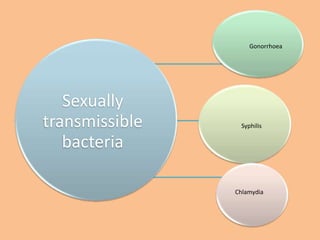
SYPHILISHow do people get syphilis?Direct contact with a syphilis sore. Sores occur mainly on the external genitals, vagina, anus, or in the rectum. Sores also can occur on the lips and in the mouth. Transmission of the organism occurs during vaginal, anal, or oral sex. Pregnant women with the disease can pass it to the babies they are carrying. Syphilis cannot be spread through contact with toilet seats, doorknobs, swimming pools, hot tubs, bathtubs, shared clothing, or eating utensils.
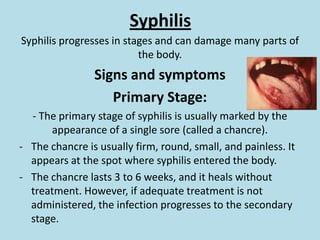
Syphilis Syphilis progresses in stages and can damage many parts of the body.Signs and symptoms Primary Stage:- The primary stage of syphilis is usually marked by the  appearance of a single sore (called a chancre). The chancre is usually firm, round, small, and painless. It appears at the spot where syphilis entered the body.
The chancre lasts 3 to 6 weeks, and it heals without treatment. However, if adequate treatment is not administered, the infection progresses to the secondary stage.Secondary stage:Skin rash and mucous membrane lesions characterize the secondary stage.This stage typically starts with the development of a rash on one or more areas of the body. The rash usually does not cause itching. Rashes associated with secondary syphilis can appear as the chancre is healing or several weeks after the chancre has healed. In addition to rashes, symptoms of secondary syphilis may include:Feversore throatpatchy hair lossHeadachesweight lossmuscle achesfatigue. The signs and symptoms of secondary syphilis will resolve with or without treatment, but without treatment, the infection will progress to the latent and possibly late stages of disease.
Late and Latent StagesWithout treatment, the infected person will continue to have syphilis even though there are no signs or symptoms; infection remains in the body. This latent stage can last for years.
In the late stages of syphilis, the disease may subsequently damage the internal organs, including the brain, nerves, eyes, heart, blood vessels, liver, bones, and joints.
Signs and symptoms of the late stage of syphilis include difficulty coordinating muscle movements, paralysis, numbness, gradual blindness, and dementia. This damage may be serious enough to cause death.How is syphilis diagnosed?Examining material from a chancre (infectious sore) using a special microscope called a dark-field microscope.A blood test is another way to determine whether someone has syphilis.
What is the treatment for syphilis?A single intramuscular injection of penicillin, an antibiotic, will cure a person who has had syphilis for less than a year. Additional doses are needed to treat someone who has had syphilis for longer than a year.Persons who receive syphilis treatment must abstain from sexual contact with new partners until the syphilis sores are completely healed.Persons with syphilis must notify their sex partners so that they also can be tested and receive treatment if necessary.
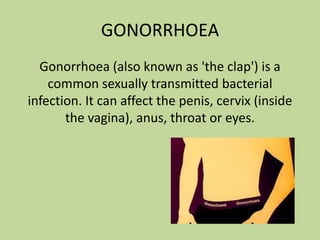
GONORRHOEAGonorrhoea (also known as 'the clap') is a common sexually transmitted bacterial infection. It can affect the penis, cervix (inside the vagina), anus, throat or eyes.
How do you catch it?Gonorrhoea is transmitted through unprotected sex (sex without a condom). This can be vaginal, anal or oral sex. A pregnant woman with gonorrhoea can also pass it onto her baby during birth.
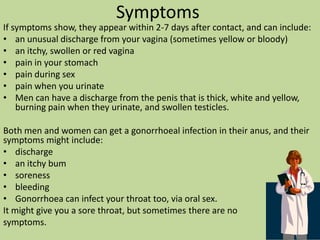
SymptomsIf symptoms show, they appear within 2-7 days after contact, and can include:an unusual discharge from your vagina (sometimes yellow or bloody)an itchy, swollen or red vaginapain in your stomachpain during sexpain when you urinateMen can have a discharge from the penis that is thick, white and yellow, burning pain when they urinate, and swollen testicles.Both men and women can get a gonorrhoeal infection in their anus, and their symptoms might include:dischargean itchy bumsorenessbleedingGonorrhoea can infect your throat too, via oral sex. It might give you a sore throat, but sometimes there are no symptoms.
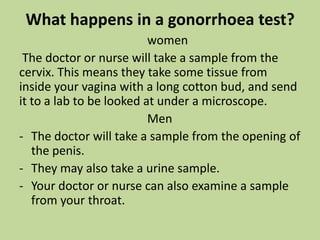
				women The doctor or nurse will take a sample from the cervix. This means they take some tissue from inside your vagina with a long cotton bud, and send it to a lab to be looked at under a microscope. 				MenThe doctor will take a sample from the opening of the penis.
They may also take a urine sample.
Your doctor or nurse can also examine a sample from your throat.What happens in a gonorrhoea test?
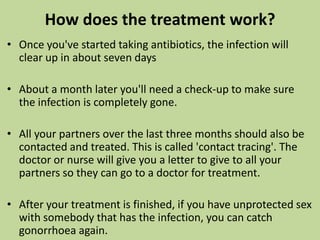
How does the treatment work?Once you've started taking antibiotics, the infection will clear up in about seven days About a month later you'll need a check-up to make sure the infection is completely gone.All your partners over the last three months should also be contacted and treated. This is called 'contact tracing'. The doctor or nurse will give you a letter to give to all your partners so they can go to a doctor for treatment.After your treatment is finished, if you have unprotected sex with somebody that has the infection, you can catch gonorrhoea again.
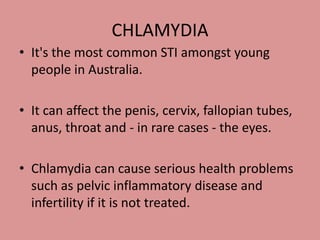
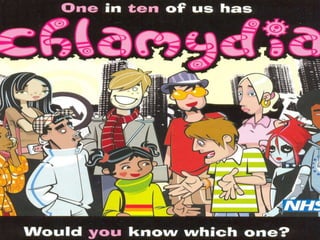
CHLAMYDIAIt's the most common STI amongst young people in Australia.It can affect the penis, cervix, fallopian tubes, anus, throat and - in rare cases - the eyes.Chlamydia can cause serious health problems such as pelvic inflammatory disease and infertility if it is not treated.
How do you get it?Chlamydia can be passed on through unprotected oral, vaginal or anal sex with an infected person. A pregnant woman can also pass it on to her baby during childbirth.Using condoms will protect you from Chlamydia.
SYMPTOMS:75% of women infected with chlamydia show no symptoms at all, so you can pass it on without even knowing you have it. Symptoms for women include:vaginal discharge needing to urinate a lot burning when you urinate itchiness bleeding and/or deep pain during sex bleeding between periods painful periods high temperature stomach painMen with chlamydia might notice:needing to urinate a lot burning when you urinate watery discharge from your penis burning and itching around the hole of your penis pain in your balls swelling of your balls
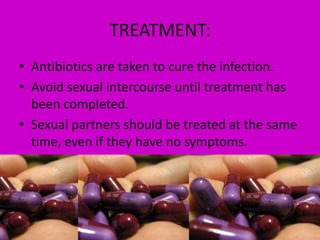
TREATMENT:Chlamydia can be easily treated with a course of antibiotic pills. After you've had the antibiotics you will need to do a follow-up test to check that the infection is really gone.
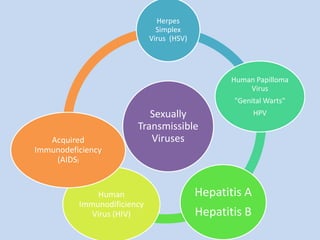
Human Immunodeficiency Virus (HIV)HIV is a type of virus called a retrovirusIt incorporates itself into the genetic material of cells called 'CD4 white blood cells', which are part of  the immune system. This process is called 'reverse transcription', and it enables HIV to replicate.  This leads to destruction of the CD4 cells and damages the immune system.
How is HIV transmitted?Unprotected sexual contact or sharing drug injecting equipment are the most common causes of HIV transmission. Sexual contact that may transmit HIV includes vaginal and anal sex, and with lower associated risk, oral sex.In a some cases, HIV can be transmitted from pregnant mother to child. This is called ‘vertical transmission’. The risk of vertical transmission can be reduced if the mother uses anti-HIV drugs during pregnancy and delivery. In Australia breast feeding is not recommended for mothers infected with HIV because of the risk of HIV being transmitted through breast milk.Healthcare workers and emergency personnel are at low risk of acquiring HIV from workplace exposure to HIV (for example by needlestick injury). A drug treatment regime called Post Exposure Prophylaxis (‘PEP’) has been shown to be effective in preventing seroconversion to HIV in these circumstances.Blood products have been screened for HIV in Australia since 1985 and receiving transfusions of blood products is considered safe.There is no evidence of transmission of HIV through ordinary social contact. HIV is not transmitted through sharing of plates, cups, cutlery, swimming pools or toilets, kissing, coughing, sneezing or spitting . The necessary conditions for HIV transmission (see below) are not present in these situations.
Stages of HIV infectionSeroconversion and primary illnessPeople experience ‘Seroconversion’ illness between two and six weeks after becoming infected.  The symptoms of this illness include Tiredness
Fever
Diarrhoea
Rash
flu like symptomsAsymptomatic HIV infectionFollowing seroconversion there may be a period of months or years during which HIV infection damages the immune system but does not manifest in outward signs or symptoms.  Some people may experience a persistent swelling in the lymph nodes.  During this time there is a constant battle taking place  between the immune system and HIV.
Symptomatic HIV infectionIndications of symptomatic HIV infection may include:lack of energy
fevers and night sweats
persistent thrush in women
prolonged bouts of diarrhoea.Late-Stage HIV Disease (equiVALENT TO AIDS)When immune system damage is more severe, HIV positive individuals may experience opportunistic infections (called "opportunistic" because they are caused by organisms which do not ordinarily induce illness in people with normal immune systems, but take the opportunity to flourish in people with compromised immune systems).
Testing and diagnosis of HIVHIV infection is detected by a blood test for HIV antibodies. Antibodies to HIV will not be detectable immediately after HIV infection, because it takes a while for measurable quantities of HIV antibodies to be produced by the immune system (up to three months). 
Treating HIV Drug treatment for HIV is known as combined antiretroviral therapy (CAR)Drug treatment does not prevent transmission of the virus but starting treatment early can lead to better outcomes for many HIV-infected people.New drug treatmentsNew drugs and types of drugs are being developed all the time. Trials of these treatments are being conducted in specialist HIV/AIDS treatment and research centres.Alternative therapies include:Vitamin and mineral supplements Massage Meditation Herbal remedies Traditional Chinese Medicine Acupuncture.
HERPES SIMPLEX VIRUSType 1 typically infects the mouth and face producing cold sores.Type 2 typically infects the genital area (genital herpes).However, due to oral sex, type 1 can infect the genital area and type 2 can infect around the mouth.
How is it caught?The virus is spread through direct contact with blisters/ ulcers, mucus or vaginal secretions. This includes vaginal, oral, anal sex or other intimate physical contact.NOTE: the virus can be passed on by an infected person displaying NO symptoms of the infection i.e. no ulcers or blisters at the time.Unfortunately, condoms only provides protection when covering or separating body parts infected with ulcers and blisters.
Short term effects:Itching and tingling in the genital area can cause discomfort.Cold sores around the mouth and on the face can be annoying, inconvenient and embarrassing.Typically clear up within 7 to 10 days.
Long term effectsA person carries the virus their entire life.The frequency of outbreaks will vary from individual to individual.
How is it treated?There is NO cure for HerpesBathing the sores in warm salt water can aid the healing process and reduce inflammation.Antiviral treatment is highly effective in decreasing the symptoms and preventing lapses.The doctor may do a viral swab to confirm the presence of the virus.
				GENITAL WARTSThe human papilloma wart virus belongs to a large family of viruses with 100 members.About 30 strains of these viruses tend to infect the genital areas, and may infect the vagina, penis, anus, cervix and the vulva.Some viruses never produce any symptoms at all and only show up in routine pap smears.
How is it caught?Usually HPV is passed on during sexual activity either by direct skin – on – skin contact, or through the exchange of body fluids from genital to genital (especially if there is any broken skin).HPV is invisibleUsing a condom will provide SOME protection from HPV, however a condom does not cover all the areas of the skin that may be infected. NOTE: the virus can also be passed on by an infected person displaying NO symptoms of the infection.
SYMPTOMS:Some people never have any symptoms at all.Usually don’t cause any discomfort, unless they rub against tight clothing.Some people feel mild irritation and need to scratch, or the warts may be in an inconvenient position and interfere with sexual activity.
How are they treated?Genital warts can be removed by a doctor.Can be frozen or treated with creams or chemical paints.Regular and frequent pap smears for women.
HEPATITIS BThe term ‘hepatitis’ means inflammation of the liver.Hep B can be transmitted by:Unprotected sex Sharing needles and drug taking equipment Non sterile piercing or tattooing.A baby can become infected with the virus at birth from an infected mother.Never share personal items such as tooth brushes or razors as they can harbour the virus in infected blood.
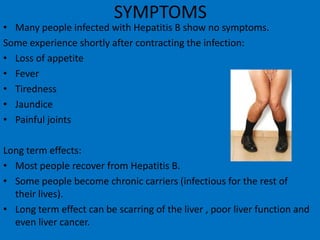
SYMPTOMS Many people infected with Hepatitis B show no symptoms. Some experience shortly after contracting the infection:Loss of appetite FeverTiredness JaundicePainful joints Long term effects:Most people recover from Hepatitis B.Some people become chronic carriers (infectious for the rest of their lives).Long term effect can be scarring of the liver , poor liver function and even liver cancer.
How is Hep B treated?A vaccine is readily available which prevents people from contracting the disease.Prevention is better than a cure.If you do not know if you have had the vaccination, get a blood test at the doctors.
Hepatitis CHep C is a viral disease that leads to swelling (inflammation) of the liver.Hep C can be caught via:-blood-to- blood contactSharing needles
Razor blades
Unsterile tattooing
Body piercing equipment
Rarely acquired through unprotected sexSYMPTOMS:Some people show no symptoms at firstOthers can experience flu-like symptomsJaundice or a darkening of the urineFatigue Testing for Hep C involves a blood test. A test can give a negative result for several months after infection, so a second follow up test needs to be done.
How is Hep C treated?Some Hep C strains are showing promising results with the use of anti-viral therapy.As hepatitis affects the function of the liver, alcohol should be avoided.
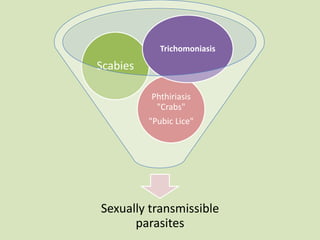
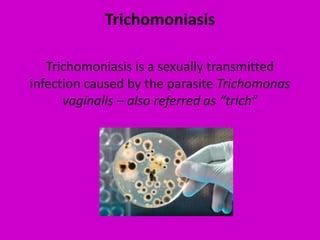
TrichomoniasisTrichomoniasisis a sexually transmitted infection caused by the parasite Trichomonasvaginalis – also referred as “trich”
SymptomsWomen:Discomfort during intercourseItching of the inner thighsVaginal discharge (thin, greenish-yellow, frothy or foamy)Vaginal itchingVaginal odour (foul or strong smell)Men: Burning after urination or ejaculationItching of urethraSlight discharge from urethra

STI's

  • 1.
  • 2.
    Sexually transmitted infections(STIs) are infections that are spread primarily through person-to-person sexual contact such as vaginal intercourse, oral and anal sex. There are more than 30 different sexually transmissible bacteria, viruses and parasites.
  • 6.
    SYPHILISHow do peopleget syphilis?Direct contact with a syphilis sore. Sores occur mainly on the external genitals, vagina, anus, or in the rectum. Sores also can occur on the lips and in the mouth. Transmission of the organism occurs during vaginal, anal, or oral sex. Pregnant women with the disease can pass it to the babies they are carrying. Syphilis cannot be spread through contact with toilet seats, doorknobs, swimming pools, hot tubs, bathtubs, shared clothing, or eating utensils.
  • 7.
    Syphilis Syphilis progressesin stages and can damage many parts of the body.Signs and symptoms Primary Stage:- The primary stage of syphilis is usually marked by the appearance of a single sore (called a chancre). The chancre is usually firm, round, small, and painless. It appears at the spot where syphilis entered the body.
  • 8.
    The chancre lasts3 to 6 weeks, and it heals without treatment. However, if adequate treatment is not administered, the infection progresses to the secondary stage.Secondary stage:Skin rash and mucous membrane lesions characterize the secondary stage.This stage typically starts with the development of a rash on one or more areas of the body. The rash usually does not cause itching. Rashes associated with secondary syphilis can appear as the chancre is healing or several weeks after the chancre has healed. In addition to rashes, symptoms of secondary syphilis may include:Feversore throatpatchy hair lossHeadachesweight lossmuscle achesfatigue. The signs and symptoms of secondary syphilis will resolve with or without treatment, but without treatment, the infection will progress to the latent and possibly late stages of disease.
  • 9.
    Late and LatentStagesWithout treatment, the infected person will continue to have syphilis even though there are no signs or symptoms; infection remains in the body. This latent stage can last for years.
  • 10.
    In the latestages of syphilis, the disease may subsequently damage the internal organs, including the brain, nerves, eyes, heart, blood vessels, liver, bones, and joints.
  • 11.
    Signs and symptomsof the late stage of syphilis include difficulty coordinating muscle movements, paralysis, numbness, gradual blindness, and dementia. This damage may be serious enough to cause death.How is syphilis diagnosed?Examining material from a chancre (infectious sore) using a special microscope called a dark-field microscope.A blood test is another way to determine whether someone has syphilis.
  • 12.
    What is thetreatment for syphilis?A single intramuscular injection of penicillin, an antibiotic, will cure a person who has had syphilis for less than a year. Additional doses are needed to treat someone who has had syphilis for longer than a year.Persons who receive syphilis treatment must abstain from sexual contact with new partners until the syphilis sores are completely healed.Persons with syphilis must notify their sex partners so that they also can be tested and receive treatment if necessary.
  • 13.
    GONORRHOEAGonorrhoea (also knownas 'the clap') is a common sexually transmitted bacterial infection. It can affect the penis, cervix (inside the vagina), anus, throat or eyes.
  • 14.
    How do youcatch it?Gonorrhoea is transmitted through unprotected sex (sex without a condom). This can be vaginal, anal or oral sex. A pregnant woman with gonorrhoea can also pass it onto her baby during birth.
  • 15.
    SymptomsIf symptoms show,they appear within 2-7 days after contact, and can include:an unusual discharge from your vagina (sometimes yellow or bloody)an itchy, swollen or red vaginapain in your stomachpain during sexpain when you urinateMen can have a discharge from the penis that is thick, white and yellow, burning pain when they urinate, and swollen testicles.Both men and women can get a gonorrhoeal infection in their anus, and their symptoms might include:dischargean itchy bumsorenessbleedingGonorrhoea can infect your throat too, via oral sex. It might give you a sore throat, but sometimes there are no symptoms.
  • 16.
    women The doctoror nurse will take a sample from the cervix. This means they take some tissue from inside your vagina with a long cotton bud, and send it to a lab to be looked at under a microscope. MenThe doctor will take a sample from the opening of the penis.
  • 17.
    They may alsotake a urine sample.
  • 18.
    Your doctor ornurse can also examine a sample from your throat.What happens in a gonorrhoea test?
  • 19.
    How does thetreatment work?Once you've started taking antibiotics, the infection will clear up in about seven days About a month later you'll need a check-up to make sure the infection is completely gone.All your partners over the last three months should also be contacted and treated. This is called 'contact tracing'. The doctor or nurse will give you a letter to give to all your partners so they can go to a doctor for treatment.After your treatment is finished, if you have unprotected sex with somebody that has the infection, you can catch gonorrhoea again.
  • 20.
    CHLAMYDIAIt's the mostcommon STI amongst young people in Australia.It can affect the penis, cervix, fallopian tubes, anus, throat and - in rare cases - the eyes.Chlamydia can cause serious health problems such as pelvic inflammatory disease and infertility if it is not treated.
  • 22.
    How do youget it?Chlamydia can be passed on through unprotected oral, vaginal or anal sex with an infected person. A pregnant woman can also pass it on to her baby during childbirth.Using condoms will protect you from Chlamydia.
  • 23.
    SYMPTOMS:75% of womeninfected with chlamydia show no symptoms at all, so you can pass it on without even knowing you have it. Symptoms for women include:vaginal discharge needing to urinate a lot burning when you urinate itchiness bleeding and/or deep pain during sex bleeding between periods painful periods high temperature stomach painMen with chlamydia might notice:needing to urinate a lot burning when you urinate watery discharge from your penis burning and itching around the hole of your penis pain in your balls swelling of your balls
  • 24.
    TREATMENT:Chlamydia can beeasily treated with a course of antibiotic pills. After you've had the antibiotics you will need to do a follow-up test to check that the infection is really gone.
  • 25.
    Human Immunodeficiency Virus(HIV)HIV is a type of virus called a retrovirusIt incorporates itself into the genetic material of cells called 'CD4 white blood cells', which are part of  the immune system. This process is called 'reverse transcription', and it enables HIV to replicate.  This leads to destruction of the CD4 cells and damages the immune system.
  • 26.
    How is HIVtransmitted?Unprotected sexual contact or sharing drug injecting equipment are the most common causes of HIV transmission. Sexual contact that may transmit HIV includes vaginal and anal sex, and with lower associated risk, oral sex.In a some cases, HIV can be transmitted from pregnant mother to child. This is called ‘vertical transmission’. The risk of vertical transmission can be reduced if the mother uses anti-HIV drugs during pregnancy and delivery. In Australia breast feeding is not recommended for mothers infected with HIV because of the risk of HIV being transmitted through breast milk.Healthcare workers and emergency personnel are at low risk of acquiring HIV from workplace exposure to HIV (for example by needlestick injury). A drug treatment regime called Post Exposure Prophylaxis (‘PEP’) has been shown to be effective in preventing seroconversion to HIV in these circumstances.Blood products have been screened for HIV in Australia since 1985 and receiving transfusions of blood products is considered safe.There is no evidence of transmission of HIV through ordinary social contact. HIV is not transmitted through sharing of plates, cups, cutlery, swimming pools or toilets, kissing, coughing, sneezing or spitting . The necessary conditions for HIV transmission (see below) are not present in these situations.
  • 27.
    Stages of HIVinfectionSeroconversion and primary illnessPeople experience ‘Seroconversion’ illness between two and six weeks after becoming infected.  The symptoms of this illness include Tiredness
  • 28.
  • 29.
  • 30.
  • 31.
    flu like symptomsAsymptomaticHIV infectionFollowing seroconversion there may be a period of months or years during which HIV infection damages the immune system but does not manifest in outward signs or symptoms.  Some people may experience a persistent swelling in the lymph nodes.  During this time there is a constant battle taking place  between the immune system and HIV.
  • 32.
    Symptomatic HIV infectionIndicationsof symptomatic HIV infection may include:lack of energy
  • 33.
  • 34.
  • 35.
    prolonged bouts ofdiarrhoea.Late-Stage HIV Disease (equiVALENT TO AIDS)When immune system damage is more severe, HIV positive individuals may experience opportunistic infections (called "opportunistic" because they are caused by organisms which do not ordinarily induce illness in people with normal immune systems, but take the opportunity to flourish in people with compromised immune systems).
  • 36.
    Testing and diagnosisof HIVHIV infection is detected by a blood test for HIV antibodies. Antibodies to HIV will not be detectable immediately after HIV infection, because it takes a while for measurable quantities of HIV antibodies to be produced by the immune system (up to three months). 
  • 37.
    Treating HIV Drugtreatment for HIV is known as combined antiretroviral therapy (CAR)Drug treatment does not prevent transmission of the virus but starting treatment early can lead to better outcomes for many HIV-infected people.New drug treatmentsNew drugs and types of drugs are being developed all the time. Trials of these treatments are being conducted in specialist HIV/AIDS treatment and research centres.Alternative therapies include:Vitamin and mineral supplements Massage Meditation Herbal remedies Traditional Chinese Medicine Acupuncture.
  • 38.
    HERPES SIMPLEX VIRUSType1 typically infects the mouth and face producing cold sores.Type 2 typically infects the genital area (genital herpes).However, due to oral sex, type 1 can infect the genital area and type 2 can infect around the mouth.
  • 39.
    How is itcaught?The virus is spread through direct contact with blisters/ ulcers, mucus or vaginal secretions. This includes vaginal, oral, anal sex or other intimate physical contact.NOTE: the virus can be passed on by an infected person displaying NO symptoms of the infection i.e. no ulcers or blisters at the time.Unfortunately, condoms only provides protection when covering or separating body parts infected with ulcers and blisters.
  • 40.
    Short term effects:Itchingand tingling in the genital area can cause discomfort.Cold sores around the mouth and on the face can be annoying, inconvenient and embarrassing.Typically clear up within 7 to 10 days.
  • 41.
    Long term effectsAperson carries the virus their entire life.The frequency of outbreaks will vary from individual to individual.
  • 42.
    How is ittreated?There is NO cure for HerpesBathing the sores in warm salt water can aid the healing process and reduce inflammation.Antiviral treatment is highly effective in decreasing the symptoms and preventing lapses.The doctor may do a viral swab to confirm the presence of the virus.
  • 43.
    GENITAL WARTSThe humanpapilloma wart virus belongs to a large family of viruses with 100 members.About 30 strains of these viruses tend to infect the genital areas, and may infect the vagina, penis, anus, cervix and the vulva.Some viruses never produce any symptoms at all and only show up in routine pap smears.
  • 44.
    How is itcaught?Usually HPV is passed on during sexual activity either by direct skin – on – skin contact, or through the exchange of body fluids from genital to genital (especially if there is any broken skin).HPV is invisibleUsing a condom will provide SOME protection from HPV, however a condom does not cover all the areas of the skin that may be infected. NOTE: the virus can also be passed on by an infected person displaying NO symptoms of the infection.
  • 45.
    SYMPTOMS:Some people neverhave any symptoms at all.Usually don’t cause any discomfort, unless they rub against tight clothing.Some people feel mild irritation and need to scratch, or the warts may be in an inconvenient position and interfere with sexual activity.
  • 46.
    How are theytreated?Genital warts can be removed by a doctor.Can be frozen or treated with creams or chemical paints.Regular and frequent pap smears for women.
  • 47.
    HEPATITIS BThe term‘hepatitis’ means inflammation of the liver.Hep B can be transmitted by:Unprotected sex Sharing needles and drug taking equipment Non sterile piercing or tattooing.A baby can become infected with the virus at birth from an infected mother.Never share personal items such as tooth brushes or razors as they can harbour the virus in infected blood.
  • 48.
    SYMPTOMS Many peopleinfected with Hepatitis B show no symptoms. Some experience shortly after contracting the infection:Loss of appetite FeverTiredness JaundicePainful joints Long term effects:Most people recover from Hepatitis B.Some people become chronic carriers (infectious for the rest of their lives).Long term effect can be scarring of the liver , poor liver function and even liver cancer.
  • 49.
    How is HepB treated?A vaccine is readily available which prevents people from contracting the disease.Prevention is better than a cure.If you do not know if you have had the vaccination, get a blood test at the doctors.
  • 50.
    Hepatitis CHep Cis a viral disease that leads to swelling (inflammation) of the liver.Hep C can be caught via:-blood-to- blood contactSharing needles
  • 51.
  • 52.
  • 53.
  • 54.
    Rarely acquired throughunprotected sexSYMPTOMS:Some people show no symptoms at firstOthers can experience flu-like symptomsJaundice or a darkening of the urineFatigue Testing for Hep C involves a blood test. A test can give a negative result for several months after infection, so a second follow up test needs to be done.
  • 55.
    How is HepC treated?Some Hep C strains are showing promising results with the use of anti-viral therapy.As hepatitis affects the function of the liver, alcohol should be avoided.
  • 56.
    TrichomoniasisTrichomoniasisis a sexuallytransmitted infection caused by the parasite Trichomonasvaginalis – also referred as “trich”
  • 57.
    SymptomsWomen:Discomfort during intercourseItchingof the inner thighsVaginal discharge (thin, greenish-yellow, frothy or foamy)Vaginal itchingVaginal odour (foul or strong smell)Men: Burning after urination or ejaculationItching of urethraSlight discharge from urethra