The 8 Most Common
STD vs STI
STD – sexually transmitted disease
• A disease is any condition of the body or mind that displays
  some type of symptom.

STI – sexually transmitted infection
• Infection means that a bacteria, parasite or virus is present
  in the body.
• Symptoms may not be present and the person may be
  unaware that she/he is infected.
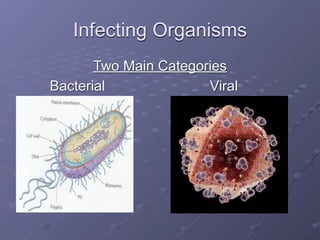
Infecting Organisms
       Two Main Categories
Bacterial              Viral
Infecting Organisms
Viruses
Bacteria
   Syphilis
   Chlamydia
   Gonorrhea
   NGU
Characteristics of Bacteria
Usually can be quickly treated and CURED with
antibiotics

   Although treatment is brief, those who test positive
    need to abstain from sexual contact for 7-10 days

   Re-testing is recommended, 3 months after treatment
Syphilis
Syphilis

Can be passed by skin-to-skin contact
during oral, anal and vaginal sex
Is often called “The Great Imitator”
because its symptoms often are mistaken
for those of other infections
Primary Syphilis
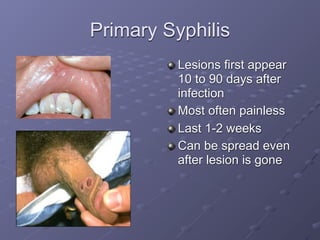
          Lesions first appear
          10 to 90 days after
          infection
          Most often painless
          Last 1-2 weeks
          Can be spread even
          after lesion is gone
Secondary syphilis
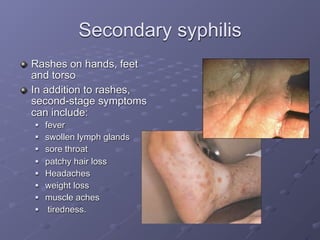
Rashes on hands, feet
and torso
In addition to rashes,
second-stage symptoms
can include:
   fever
   swollen lymph glands
   sore throat
   patchy hair loss
   Headaches
   weight loss
   muscle aches
    tiredness.
Latent Syphilis
Without treatment, the infected person still has
syphilis even though there are no signs or
symptoms.
   Damage can affect:
Gonorrhea, Chlamydia & Non-
Gonorrhea
Gonorrhea
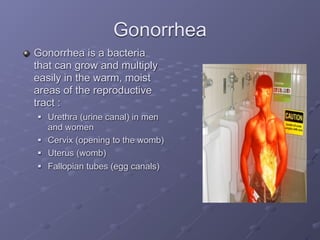
Gonorrhea is a bacteria
that can grow and multiply
easily in the warm, moist
areas of the reproductive
tract :
   Urethra (urine canal) in men
    and women
   Cervix (opening to the womb)
   Uterus (womb)
   Fallopian tubes (egg canals)
Gonorrhea
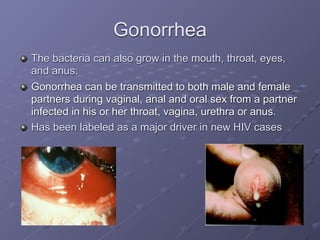
The bacteria can also grow in the mouth, throat, eyes,
and anus.
Gonorrhea can be transmitted to both male and female
partners during vaginal, anal and oral sex from a partner
infected in his or her throat, vagina, urethra or anus.
Has been labeled as a major driver in new HIV cases
Gonorrhea
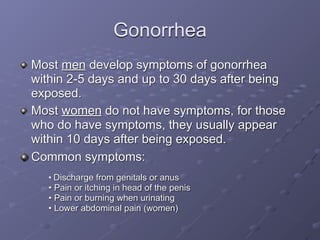
Most men develop symptoms of gonorrhea
within 2-5 days and up to 30 days after being
exposed.
Most women do not have symptoms, for those
who do have symptoms, they usually appear
within 10 days after being exposed.
Common symptoms:
   • Discharge from genitals or anus
   • Pain or itching in head of the penis
   • Pain or burning when urinating
   • Lower abdominal pain (women)
Chlamydia
Chlamydia
Chlamydia is a common STI caused by a
bacteria.

Symptoms are usually mild or absent, serious
complications that cause irreversible damage
Chlamydia
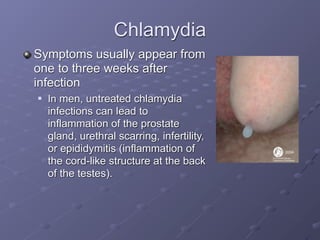
Symptoms usually appear from
one to three weeks after
infection
   In men, untreated chlamydia
    infections can lead to
    inflammation of the prostate
    gland, urethral scarring, infertility,
    or epididymitis (inflammation of
    the cord-like structure at the back
    of the testes).
Chlamydia
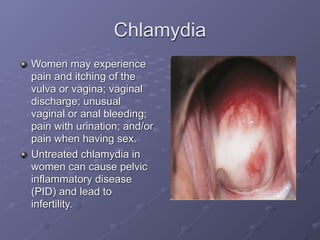
Women may experience
pain and itching of the
vulva or vagina; vaginal
discharge; unusual
vaginal or anal bleeding;
pain with urination; and/or
pain when having sex.
Untreated chlamydia in
women can cause pelvic
inflammatory disease
(PID) and lead to
infertility.
Lymphogranuloma Venereum
         (LGV)
Sexually transmitted disease caused by three
strains of the bacterium of chlamydia transmitted
through unprotected oral, vaginal and anal sex.
Symptoms include raised bumps, swelling of the
lymph glands. Rectal ulcers, bleeding and
discharge are also common.
Treated with antibiotics over a 21-day period
Non Gonococcal Urethritis
        (NGU)
 NGU is an infection of the male urethra caused
by bacteria other than gonorrhea, most often
chlamydia or another type of bacteria
Usually transmitted with direct mucous
membrane contact during oral, vaginal or anal
sex even if body fluids are not exchanged.
Non-sexually, NGU may be caused by urinary
tract infections
Symptoms are similar to those experienced with
gonorrhea and chlamydia
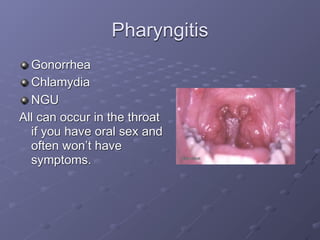
Pharyngitis
  Gonorrhea
  Chlamydia
  NGU
All can occur in the throat
  if you have oral sex and
  often won’t have
  symptoms.
Infecting Organisms
Viruses
   Human Papilloma Virus (HPV)
   Herpes Simplex (1,2)
   Hepatitis (A,B & C)
   Human Immunodeficiency Virus (HIV)

Bacteria
Characteristics of Viruses
Viruses cannot be cured.
   Medications are available to reduce the
    frequency and severity of outbreaks..

   Some viruses are like Chickenpox; they infect
    you once and then go away.
Human Papilloma Virus
Human Papilloma Virus (HPV)
Most common STI

Can be passed by skin-to-skin contact during oral, anal
and vaginal sex

There are 100 types of HPV. Only some of them cause
genital warts and other types can cause various types of
cancer
Human Papilloma Virus (HPV)
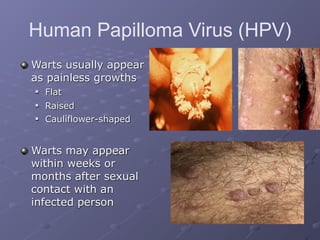
Warts usually appear
as painless growths
   Flat
   Raised
   Cauliflower-shaped


Warts may appear
within weeks or
months after sexual
contact with an
infected person
Herpes Simplex Virus
           (HSV-I & HSV-II)

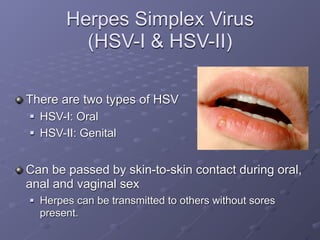
There are two types of HSV
   HSV-I: Oral
   HSV-II: Genital


Can be passed by skin-to-skin contact during oral,
anal and vaginal sex
   Herpes can be transmitted to others without sores
    present.
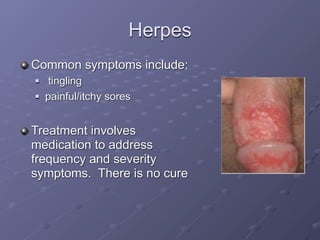
Herpes
Common symptoms include:
   tingling
   painful/itchy sores


Treatment involves
medication to address
frequency and severity
symptoms. There is no cure
Hepatitis A, B, C
Hepatitis A, B, C
The word "hepatitis" means inflammation of the
liver and also refers to a group of viral infections
that affect the liver.
Symptoms of all types of viral hepatitis are
similar and can include one or more of the
following:
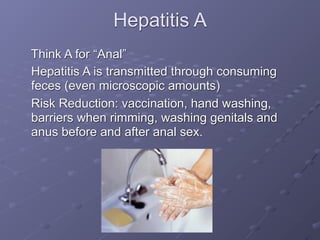
Hepatitis A
Think A for “Anal”
Hepatitis A is transmitted through consuming
feces (even microscopic amounts)
Risk Reduction: vaccination, hand washing,
barriers when rimming, washing genitals and
anus before and after anal sex.
Hepatitis B
Think B for “Body Fluids”
Hepatitis B is transmitted through contact with
  infectious blood, semen, are found in blood,
  semen, vaginal secretions, and saliva primarily
  through:
     Sexual contact with an infected person
     Sharing of contaminated needles, syringes or other
      injection drug equipment
     Needlesticks or other sharp instrument injuries


Risk reduction: Vaccination, barriers during oral
Hepatitis C
Think C for “cooker” (used for cooking heroin
  before injection). Hepatitis C is transmitted
  through contact with infectious blood, semen,
  and other body fluids, primarily through:
     Sexual contact with an infected person
     Sharing of contaminated needles, syringes or other
      injection drug equipment
     Needlesticks or other sharp instrument injuries


Risk Reduction: Condoms and barriers during oral,
  vaginal and anal sex. Blood awareness during
HIV & STI Relationship
Having an STI increases the risk for
getting HIV
Getting an STI for people with HIV can
increase viral load and chance of
transmitting HIV/STIs to others
Risk reduction: Using barriers for oral,
vaginal and anal sex. Getting tested.
Talking about status with partners. Using
clean needles and equipment.
Prevention & Risk Reduction
Condoms and barriers, correct and consistent use
can dramatically reduce your risk of getting a STI.
Remember that some STIs may occur on parts of
the body not covered by condoms.
Getting Tested every 3 – 6 months
Communication
   Ask about testing history
   Do not assume “clean means clean”
Partner Reduction
   Greater the number of partners the more often you are
    potentially exposed.
Prevention & Risk Reduction
Partner Notification
   www.InSpot.org
   City Clinic staff (for Syphilis and HIV)
Setting limits for what you’re OK and not OK with
Limiting drug and alcohol use
Discretion
   If it’s a sore, don’t touch it. Don’t convince yourself it’s a zipper
    cut, etc. Get checked or encourage partner to get checked.
Tips on Talking to Partners
          About Status
1. Pick a time when you won't be
   interrupted.
2. Pick a neutral place to chat (not the
   bedroom, or in the throes of
   passion).
3. Be sober.
4. Be open to the possibilities.
5. Have a sense of humor and use it—
   remember sex is about having fun
Testing Locations & Methods
 San Francisco City Clinic 356 - 7th Street (between
 Harrison and Folsom St; 487-5500).
 www.SFcityclinic.org
   Confidential, free/low-cost, comprehensive STD/HIV and family
   planning services
   Services provided to patients age 12 and up – parental consent is
   not required, per California law.

  Monday, Wednesday, Friday:
 Open 8:00 -4:00

 We will accept provider referrals until 4:00; call 487-5595


   Tuesday:1:00pm - 6:00pm
   Thursday 1:00pm - 4:00pm

*Clinic may be unable to see patients without symptoms if maximum
   capacity has been reached. Urge your referrals to visit earlier during
You can always
        find resources online…
 San Francisco City Clinic www.SFCityClinic.org


 Online Partner Notification www.InSpot.org

 Center For Disease Control (CDC) www.cdc.gov
Thank You!
Brandon Ivory
415.355.2033
Brandon.Ivory@sfdph.org

Std2011plus2 111204122105 Phpapp02

  • 1.
    The 8 MostCommon
  • 2.
    STD vs STI STD– sexually transmitted disease • A disease is any condition of the body or mind that displays some type of symptom. STI – sexually transmitted infection • Infection means that a bacteria, parasite or virus is present in the body. • Symptoms may not be present and the person may be unaware that she/he is infected.
  • 3.
    Infecting Organisms Two Main Categories Bacterial Viral
  • 4.
    Infecting Organisms Viruses Bacteria  Syphilis  Chlamydia  Gonorrhea  NGU
  • 5.
    Characteristics of Bacteria Usuallycan be quickly treated and CURED with antibiotics  Although treatment is brief, those who test positive need to abstain from sexual contact for 7-10 days  Re-testing is recommended, 3 months after treatment
  • 6.
  • 7.
    Syphilis Can be passedby skin-to-skin contact during oral, anal and vaginal sex Is often called “The Great Imitator” because its symptoms often are mistaken for those of other infections
  • 8.
    Primary Syphilis Lesions first appear 10 to 90 days after infection Most often painless Last 1-2 weeks Can be spread even after lesion is gone
  • 9.
    Secondary syphilis Rashes onhands, feet and torso In addition to rashes, second-stage symptoms can include:  fever  swollen lymph glands  sore throat  patchy hair loss  Headaches  weight loss  muscle aches  tiredness.
  • 10.
    Latent Syphilis Without treatment,the infected person still has syphilis even though there are no signs or symptoms.  Damage can affect:
  • 11.
  • 12.
  • 13.
    Gonorrhea Gonorrhea is abacteria that can grow and multiply easily in the warm, moist areas of the reproductive tract :  Urethra (urine canal) in men and women  Cervix (opening to the womb)  Uterus (womb)  Fallopian tubes (egg canals)
  • 14.
    Gonorrhea The bacteria canalso grow in the mouth, throat, eyes, and anus. Gonorrhea can be transmitted to both male and female partners during vaginal, anal and oral sex from a partner infected in his or her throat, vagina, urethra or anus. Has been labeled as a major driver in new HIV cases
  • 15.
    Gonorrhea Most men developsymptoms of gonorrhea within 2-5 days and up to 30 days after being exposed. Most women do not have symptoms, for those who do have symptoms, they usually appear within 10 days after being exposed. Common symptoms: • Discharge from genitals or anus • Pain or itching in head of the penis • Pain or burning when urinating • Lower abdominal pain (women)
  • 16.
  • 17.
    Chlamydia Chlamydia is acommon STI caused by a bacteria. Symptoms are usually mild or absent, serious complications that cause irreversible damage
  • 18.
    Chlamydia Symptoms usually appearfrom one to three weeks after infection  In men, untreated chlamydia infections can lead to inflammation of the prostate gland, urethral scarring, infertility, or epididymitis (inflammation of the cord-like structure at the back of the testes).
  • 19.
    Chlamydia Women may experience painand itching of the vulva or vagina; vaginal discharge; unusual vaginal or anal bleeding; pain with urination; and/or pain when having sex. Untreated chlamydia in women can cause pelvic inflammatory disease (PID) and lead to infertility.
  • 20.
    Lymphogranuloma Venereum (LGV) Sexually transmitted disease caused by three strains of the bacterium of chlamydia transmitted through unprotected oral, vaginal and anal sex. Symptoms include raised bumps, swelling of the lymph glands. Rectal ulcers, bleeding and discharge are also common. Treated with antibiotics over a 21-day period
  • 21.
    Non Gonococcal Urethritis (NGU) NGU is an infection of the male urethra caused by bacteria other than gonorrhea, most often chlamydia or another type of bacteria Usually transmitted with direct mucous membrane contact during oral, vaginal or anal sex even if body fluids are not exchanged. Non-sexually, NGU may be caused by urinary tract infections Symptoms are similar to those experienced with gonorrhea and chlamydia
  • 22.
    Pharyngitis Gonorrhea Chlamydia NGU All can occur in the throat if you have oral sex and often won’t have symptoms.
  • 23.
    Infecting Organisms Viruses  Human Papilloma Virus (HPV)  Herpes Simplex (1,2)  Hepatitis (A,B & C)  Human Immunodeficiency Virus (HIV) Bacteria
  • 24.
    Characteristics of Viruses Virusescannot be cured.  Medications are available to reduce the frequency and severity of outbreaks..  Some viruses are like Chickenpox; they infect you once and then go away.
  • 25.
  • 26.
    Human Papilloma Virus(HPV) Most common STI Can be passed by skin-to-skin contact during oral, anal and vaginal sex There are 100 types of HPV. Only some of them cause genital warts and other types can cause various types of cancer
  • 27.
    Human Papilloma Virus(HPV) Warts usually appear as painless growths  Flat  Raised  Cauliflower-shaped Warts may appear within weeks or months after sexual contact with an infected person
  • 28.
  • 29.
    Herpes Simplex Virus (HSV-I & HSV-II) There are two types of HSV  HSV-I: Oral  HSV-II: Genital Can be passed by skin-to-skin contact during oral, anal and vaginal sex  Herpes can be transmitted to others without sores present.
  • 30.
    Herpes Common symptoms include:  tingling  painful/itchy sores Treatment involves medication to address frequency and severity symptoms. There is no cure
  • 31.
  • 32.
    Hepatitis A, B,C The word "hepatitis" means inflammation of the liver and also refers to a group of viral infections that affect the liver. Symptoms of all types of viral hepatitis are similar and can include one or more of the following:
  • 33.
    Hepatitis A Think Afor “Anal” Hepatitis A is transmitted through consuming feces (even microscopic amounts) Risk Reduction: vaccination, hand washing, barriers when rimming, washing genitals and anus before and after anal sex.
  • 34.
    Hepatitis B Think Bfor “Body Fluids” Hepatitis B is transmitted through contact with infectious blood, semen, are found in blood, semen, vaginal secretions, and saliva primarily through:  Sexual contact with an infected person  Sharing of contaminated needles, syringes or other injection drug equipment  Needlesticks or other sharp instrument injuries Risk reduction: Vaccination, barriers during oral
  • 35.
    Hepatitis C Think Cfor “cooker” (used for cooking heroin before injection). Hepatitis C is transmitted through contact with infectious blood, semen, and other body fluids, primarily through:  Sexual contact with an infected person  Sharing of contaminated needles, syringes or other injection drug equipment  Needlesticks or other sharp instrument injuries Risk Reduction: Condoms and barriers during oral, vaginal and anal sex. Blood awareness during
  • 36.
    HIV & STIRelationship Having an STI increases the risk for getting HIV Getting an STI for people with HIV can increase viral load and chance of transmitting HIV/STIs to others Risk reduction: Using barriers for oral, vaginal and anal sex. Getting tested. Talking about status with partners. Using clean needles and equipment.
  • 37.
    Prevention & RiskReduction Condoms and barriers, correct and consistent use can dramatically reduce your risk of getting a STI. Remember that some STIs may occur on parts of the body not covered by condoms. Getting Tested every 3 – 6 months Communication  Ask about testing history  Do not assume “clean means clean” Partner Reduction  Greater the number of partners the more often you are potentially exposed.
  • 38.
    Prevention & RiskReduction Partner Notification  www.InSpot.org  City Clinic staff (for Syphilis and HIV) Setting limits for what you’re OK and not OK with Limiting drug and alcohol use Discretion  If it’s a sore, don’t touch it. Don’t convince yourself it’s a zipper cut, etc. Get checked or encourage partner to get checked.
  • 39.
    Tips on Talkingto Partners About Status 1. Pick a time when you won't be interrupted. 2. Pick a neutral place to chat (not the bedroom, or in the throes of passion). 3. Be sober. 4. Be open to the possibilities. 5. Have a sense of humor and use it— remember sex is about having fun
  • 40.
    Testing Locations &Methods San Francisco City Clinic 356 - 7th Street (between Harrison and Folsom St; 487-5500). www.SFcityclinic.org Confidential, free/low-cost, comprehensive STD/HIV and family planning services Services provided to patients age 12 and up – parental consent is not required, per California law. Monday, Wednesday, Friday: Open 8:00 -4:00 We will accept provider referrals until 4:00; call 487-5595 Tuesday:1:00pm - 6:00pm Thursday 1:00pm - 4:00pm *Clinic may be unable to see patients without symptoms if maximum capacity has been reached. Urge your referrals to visit earlier during
  • 41.
    You can always find resources online…  San Francisco City Clinic www.SFCityClinic.org  Online Partner Notification www.InSpot.org  Center For Disease Control (CDC) www.cdc.gov
  • 42.