Research Proposal Presentation
Vikram Paswan
MAD14210
Introduction to Research
Azim Premji University
Tuberculosis-The Silent Killer in India
5/6/2015 Introduction to Research 2
Background
• Until mid-1800s, many believed TB
was hereditary, white plague
• 1865 Jean Antoine-Villemin
proved TB was contagious
• 1882 Robert Koch discovered
Mycobacterium tuberculosis, the
bacterium that causes TB
Drugs that could kill TB
bacteria were discovered
in 1940s and 1950s
• Streptomycin (SM) discovered in
1943
• Isoniazid (INH) and
p-aminosalicylic acid (PAS)
discovered between 1943 and 1952
5/6/2015 Introduction to Research 3
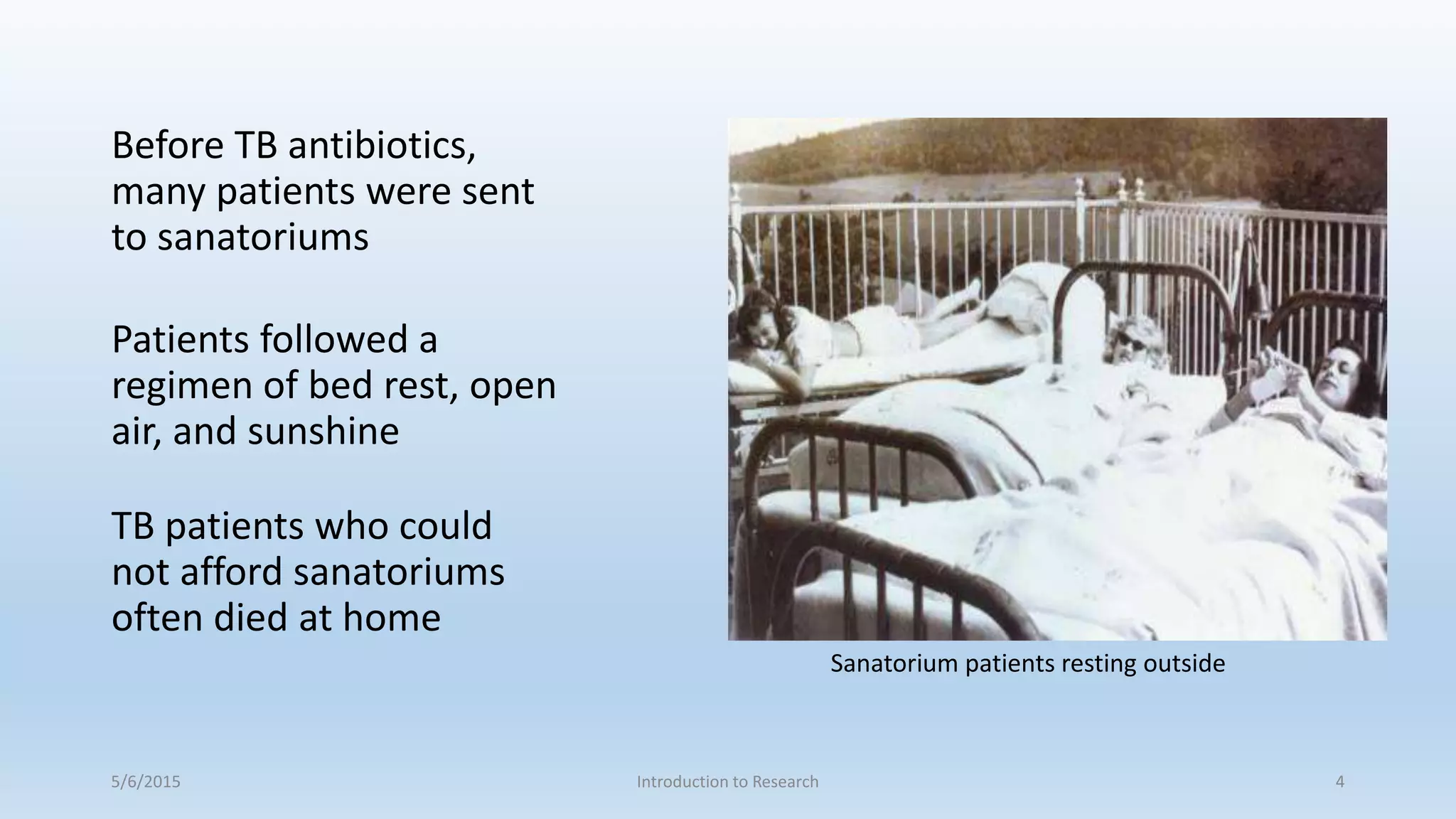
Before TB antibiotics,
many patients were sent
to sanatoriums
Patients followed a
regimen of bed rest, open
air, and sunshine
TB patients who could
not afford sanatoriums
often died at home
5/6/2015 Introduction to Research 4
Sanatorium patients resting outside
Objective:
To study the factors causing deaths of patients suffering from Tuberculosis
Research Question:
Why the patients suffering from TB died though it is curable and treated free of cost?
5/6/2015 Introduction to Research 5
5/6/2015 Introduction to Research 6
Literature Review
 Tuberculosis (TB) is a global public health problem with a third of the world's population infected with TB[1].
 It is estimated that, in every 3 minute, in India 2 person dies of tuberculosis [2] and kills
about 1000 people every day Causes 3,00,000 deaths and 20,20,000 new cases each year
 Accounts for approx. one fifth (21%) of the global incidence
 Global annual incidence estimate is 9.4 million cases
 Rank 17th among 22 High Burden Countries in terms of TB incidence rate [3]
 in May 07, 2012 India declared TB to be a notifiable disease [4]
 58,000 TB cases recorded in Bihar last year, 2014 [5]
• Sources: 1. Sudre P, Ten DG, Kochi A: Tuberculosis: a global overview of the situation today. Bull World Health Organ 1992(i)
2. Indian Journal of Tuberculosis, Jan.2006, Page 25
3. TB India 2014, Annual Report, Central Division of TB, Revised National TB Control Programme Annual Status Report, New Delhi.
4. http://www.igovernment.in/news/35014/india-declares-tuberculosis-a-notifiable-disease
5. http://timesofindia.indiatimes.com/city/patna/58k-TB-cases-in-Bihar-last-year/articleshow/46668440.cms? Mar 23, 2015, 11.40 PM IST
Blister pack- TB
 Nearly one in six deaths among adults aged 15-49 are due to TB. Nearly
100,000 cases of serious multi-drug-resistant TB (MDR-TB) are estimated
to occur in the country annually, and each MDR TB case costs more than
Rs 1 lakh to diagnose and treat [6]
 India will soon have the highest number of people suffering from
extremely drug-resistant (X-DR)TB [7], more toxic, longer period
 India in 10-15 years going to be the nation with the most number of
tuberculosis patients and highest number of cases of drug-resistant TB [7]
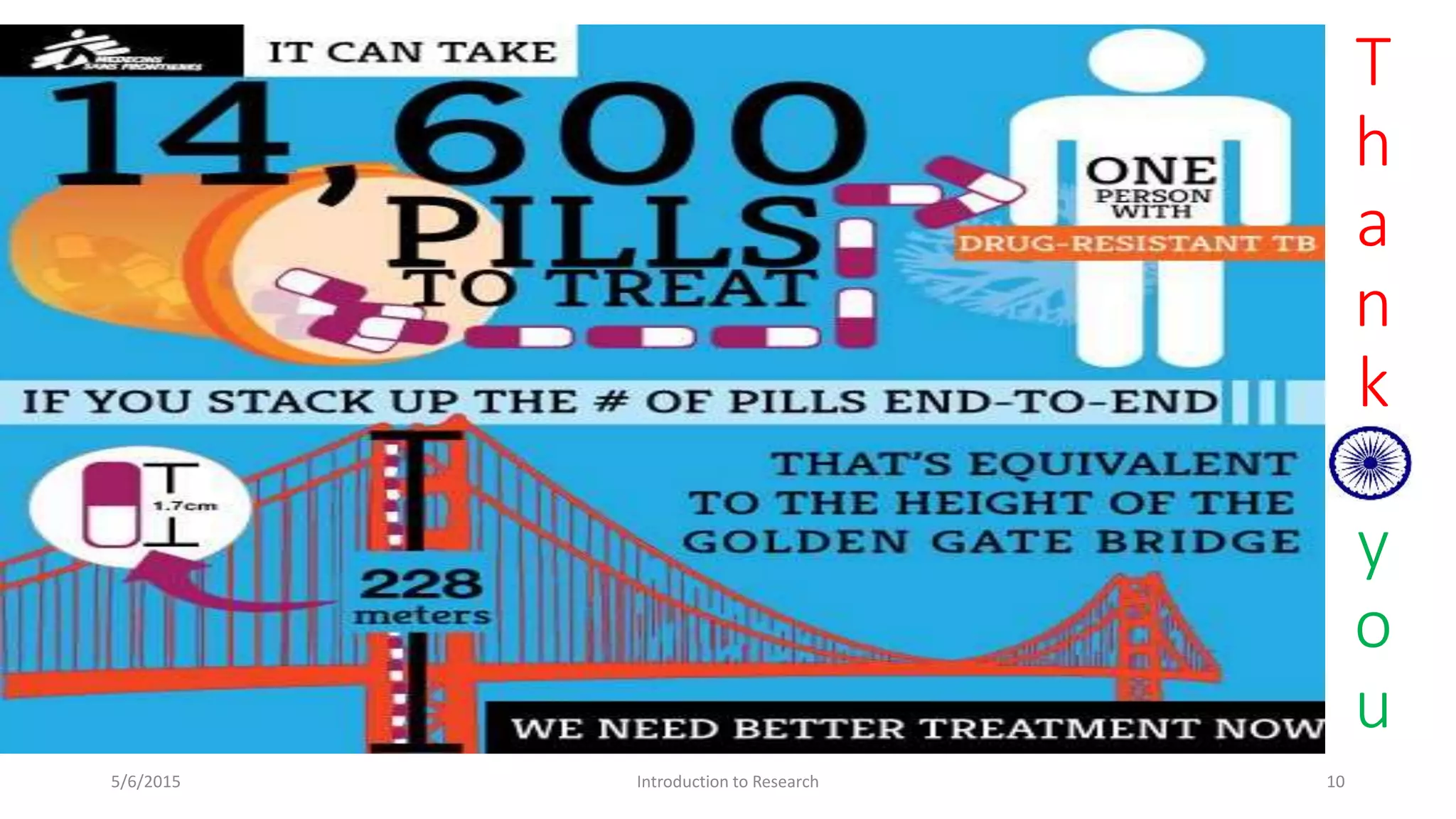
 a person has to take around 10 tablets a day. One tablet is 1.7cm in height
and in two years, the patient ends up popping 14,600 tablets. If you put
them one above the other, it will be three times the height of Qutub Minar!
 The government spends $200 million on TB every year, while it requires at
least $1 billion, annual economic loss to India on account of uncontrolled
TB is $23.7 billion [7]
Sources: (6) http://timesofindia.indiatimes.com/india/Finally-tuberculosis-declared-a-notifiable-disease May 07, 2012
(7) Gunjan Sharma, July 21, 2014, Does Anyone Care, THE WEEK
5/6/2015 Introduction to Research 7
Research Methodology and Methods
 Qualitative Approach
 Longitudinal Strategy: requires 1-6 months in length (course duration of TB)
 In-depth interviews with DOTS providers, doctors and patients
 Group interviews with team members particularly medical staffs and volunteers
 Semi-structured questionnaire (allowing new ideas)
5/6/2015 Introduction to Research 8
5/6/2015 Introduction to Research 9
 The nature of TB patients i.e. economic status, gender, category-child
 The role of public health care system in controlling TB
 Role of Private Sector Doctors, NGOs
 Knowledge about symptoms and transmission of TB, social stigma about TB
Potential Findings
T
h
a
n
k
y
o
u
5/6/2015 Introduction to Research 10

Tuberculosis-Sailent Killer in India

  • 1.
    Research Proposal Presentation VikramPaswan MAD14210 Introduction to Research Azim Premji University
  • 2.
    Tuberculosis-The Silent Killerin India 5/6/2015 Introduction to Research 2
  • 3.
    Background • Until mid-1800s,many believed TB was hereditary, white plague • 1865 Jean Antoine-Villemin proved TB was contagious • 1882 Robert Koch discovered Mycobacterium tuberculosis, the bacterium that causes TB Drugs that could kill TB bacteria were discovered in 1940s and 1950s • Streptomycin (SM) discovered in 1943 • Isoniazid (INH) and p-aminosalicylic acid (PAS) discovered between 1943 and 1952 5/6/2015 Introduction to Research 3
  • 4.
    Before TB antibiotics, manypatients were sent to sanatoriums Patients followed a regimen of bed rest, open air, and sunshine TB patients who could not afford sanatoriums often died at home 5/6/2015 Introduction to Research 4 Sanatorium patients resting outside
  • 5.
    Objective: To study thefactors causing deaths of patients suffering from Tuberculosis Research Question: Why the patients suffering from TB died though it is curable and treated free of cost? 5/6/2015 Introduction to Research 5
  • 6.
    5/6/2015 Introduction toResearch 6 Literature Review  Tuberculosis (TB) is a global public health problem with a third of the world's population infected with TB[1].  It is estimated that, in every 3 minute, in India 2 person dies of tuberculosis [2] and kills about 1000 people every day Causes 3,00,000 deaths and 20,20,000 new cases each year  Accounts for approx. one fifth (21%) of the global incidence  Global annual incidence estimate is 9.4 million cases  Rank 17th among 22 High Burden Countries in terms of TB incidence rate [3]  in May 07, 2012 India declared TB to be a notifiable disease [4]  58,000 TB cases recorded in Bihar last year, 2014 [5] • Sources: 1. Sudre P, Ten DG, Kochi A: Tuberculosis: a global overview of the situation today. Bull World Health Organ 1992(i) 2. Indian Journal of Tuberculosis, Jan.2006, Page 25 3. TB India 2014, Annual Report, Central Division of TB, Revised National TB Control Programme Annual Status Report, New Delhi. 4. http://www.igovernment.in/news/35014/india-declares-tuberculosis-a-notifiable-disease 5. http://timesofindia.indiatimes.com/city/patna/58k-TB-cases-in-Bihar-last-year/articleshow/46668440.cms? Mar 23, 2015, 11.40 PM IST
  • 7.
    Blister pack- TB Nearly one in six deaths among adults aged 15-49 are due to TB. Nearly 100,000 cases of serious multi-drug-resistant TB (MDR-TB) are estimated to occur in the country annually, and each MDR TB case costs more than Rs 1 lakh to diagnose and treat [6]  India will soon have the highest number of people suffering from extremely drug-resistant (X-DR)TB [7], more toxic, longer period  India in 10-15 years going to be the nation with the most number of tuberculosis patients and highest number of cases of drug-resistant TB [7]  a person has to take around 10 tablets a day. One tablet is 1.7cm in height and in two years, the patient ends up popping 14,600 tablets. If you put them one above the other, it will be three times the height of Qutub Minar!  The government spends $200 million on TB every year, while it requires at least $1 billion, annual economic loss to India on account of uncontrolled TB is $23.7 billion [7] Sources: (6) http://timesofindia.indiatimes.com/india/Finally-tuberculosis-declared-a-notifiable-disease May 07, 2012 (7) Gunjan Sharma, July 21, 2014, Does Anyone Care, THE WEEK 5/6/2015 Introduction to Research 7
  • 8.
    Research Methodology andMethods  Qualitative Approach  Longitudinal Strategy: requires 1-6 months in length (course duration of TB)  In-depth interviews with DOTS providers, doctors and patients  Group interviews with team members particularly medical staffs and volunteers  Semi-structured questionnaire (allowing new ideas) 5/6/2015 Introduction to Research 8
  • 9.
    5/6/2015 Introduction toResearch 9  The nature of TB patients i.e. economic status, gender, category-child  The role of public health care system in controlling TB  Role of Private Sector Doctors, NGOs  Knowledge about symptoms and transmission of TB, social stigma about TB Potential Findings
  • 10.

Editor's Notes

  • #3 Samastipur and other neighbouring districts is affected by high rate of migration,
  • #10 I expect to know