HIV infection in children
Paediatrics
Paediatric HIV Infection:
Epidemiology, biology, and
pathophysiology
Adapted from the National AIDS Control Program Curriculum
THE UNITED REPUBLIC OF TANZANIA
MINISTRY OF HEALTH & SOCIAL WELFARE
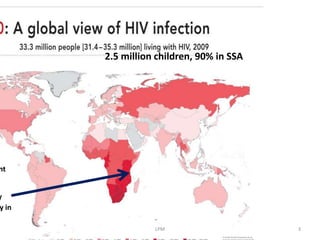
2.5 million children, 90% in SSA
3LPM
nt
V
y in
• 1.3 million people (5.7%)
• 10% < age 15
• 12000 infant infections annually
Tanzania
• Prevalence 1.9%
Kilimanjaro region
Introduction: HIV epidemiology
UNGASS/TACAIDS (2010).
Modes of HIV Transmission to Children
• MTCT – responsible for 95% of infected infants
• Sexual transmission (adolescents/abuse)
• Transfusion of infected blood
• Unsterile injection procedures (2.5% in both adult
and paediatric population)
• Scarification
Factors Contributing To High HIV Prevalence In
Children In Sub-saharan Africa
• High prevalence of infection in women of
childbearing age
• Efficiency of MTCT where infection rates
among women (15-49 yrs) in Tanzania range
from 2% (Manyara) to 15.2% (Mbeya)
Consequences of the HIV Epidemic on Children
AIDS impacts children in many ways
• Increased infant and childhood morbidity
• Increased infant and childhood mortality
• Increase in number of orphaned children
• Increased deprivations in various forms;
– Mental
– Psychological
– School dropouts
• Abuse : Physical, Sexual
HIV epidemiology - summary
• Over the past 2 decades HIV has spread worldwide with devastating
epidemiological consequences particularly in Sub Saharan Africa
• MTCT is the greatest mode of transmission of HIV infection in
children.
• The burden of HIV/AIDS among Tanzanian children is high: 72,000
new infections each year, 140,000 total infections, and a high
proportion of orphaned children (11% of children under 18)
HIV biology
4/23/2015
The Biology of the Human Immunodeficiency Virus
HIV – 1
• Is found worldwide
• Is the main cause of
the worldwide
pandemic
NB: Unless otherwise
specified, ‘HIV’ in this
training refers to HIV-1
HIV – 2
• Mainly found in West Africa,
Mozambique and Angola.
• Causes a similar illness to
HIV – 1
• Less efficiently
transmissible, rarely causing
vertical transmission
• Less aggressive, slower
disease progression
There are two types of HIV:
4/23/2015
HIV-1 SUBTYPES
• HIV-1 has many subtypes: A-K
• A-E are the predominant subtypes
– A: W. Africa, E. Africa, Central Africa East Europe &
Middle East
– B: N. America, Europe, Middle East, E. Asia, Latin
America
– C: S. Africa, S. Asia, Ethiopia
– D: E. Africa
– E: S. E. Asia
4/23/2015
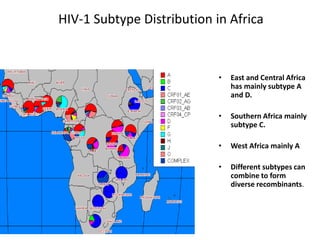
HIV-1 Subtype Distribution in Africa
• East and Central Africa
has mainly subtype A
and D.
• Southern Africa mainly
subtype C.
• West Africa mainly A
• Different subtypes can
combine to form
diverse recombinants.
4/23/2015
HIV SUBTYPE C
• This is the most virulent subtype.
• It has higher transcription rates.
• In Tanzania is associated with higher MTCT
rates than subtype A.
• Is associated with faster disease progression in
adults.
4/23/2015
Viral Enzymes
• The most important are Reverse Transcriptase (RT), Protease and Integrase.
• RT converts viral single-stranded RNA into a single strand deoxyribonucleic
acid (DNA).
– DNA polymerizes to form a double stranded DNA (dsDNA)
– DNA is incorporated into host nucleus as the proviral DNA.
• Integrase facilitates integration of the dsDNA into the host’s chromosomal
DNA.
• Protease enzyme splits generated macro-proteins into smaller viral proteins
(core, envelope & regulatory proteins and enzymes) which are then
incorporated into the new viral particles.
4/23/2015
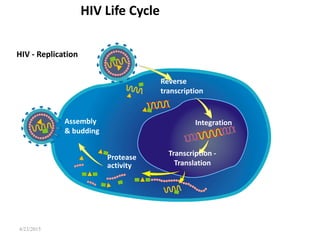
HIV - Replication
Fusion & viral entry
Reverse
transcription
Integration
Transcription -
Translation
Protease
activity
Assembly
& budding
HIV Life Cycle
4/23/2015
HIV biology - summary
• Rapid replication of HIV causes genetic diversity
of the virus
• Knowledge of HIV structure is important in
understanding the mechanism of ARV drugs
• Current ARV drugs act mainly by antagonizing
various HIV enzymes necessary for viral
replication
HIV pathophysiology
Cells Of The Immune System
• Found in blood and tissues
• In blood mostly are white blood cells (WBC)
– Macrophages act as clearing cells
– Neutrophils attack bacteria
– Eosinophils attack helminths (and mediate
allergies)
– B-lymphocytes make antibodies
Cells of the Immune System
– T-lymphocytes
• Responsible for attacking viruses, fungi and
some bacteria
• T helper cells central in orchestrating
function of other immune cells
– T killer cells are able to destroy infected cells
How HIV Affects the Immune System
• HIV attaches to cells of the immune system with
special surface markers called CD4 receptors
• The following immune cells have CD4 receptors
• T-Lymphocytes – CD4 Cells
• Macrophages
• Monocytes
• Dendritic cells
HIV Effect on Immune System
• The hallmark of HIV/AIDS is profound
immunodeficiency as a result depletion of
CD4+ T lymphocytes.
• The CD4+ T cell dysfunction is two fold:
– Reduction in numbers
– Impairment in function
HIV Effect On Immune System
• Reduction in the CD4 cell number and the
effects on their function reduces the capacity
of the body to fight infectious diseases
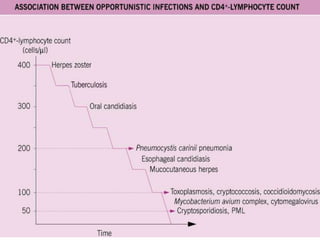
• Individuals with HIV infection are therefore
increasingly susceptible to many infections
especially at later stages of HIV infection
HIV Effect On Other Parts Of Immune System
• Lymphoid tissue destruction
• CD8+ cell dysfunction
• B cell abnormalities
• Thymic dysfunction
• Autoimmune abnormalities
Immunological Parameters in Children:
Background
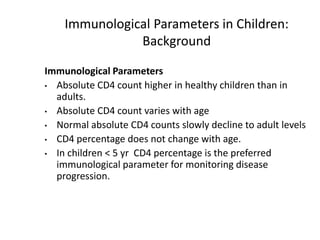
Immunological Parameters
• Absolute CD4 count higher in healthy children than in
adults.
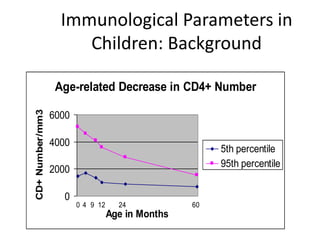
• Absolute CD4 count varies with age
• Normal absolute CD4 counts slowly decline to adult levels
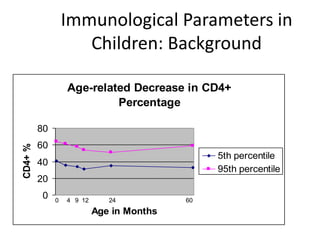
• CD4 percentage does not change with age.
• In children < 5 yr CD4 percentage is the preferred
immunological parameter for monitoring disease
progression.
Immunological Parameters in
Children: Background
Age-related Decrease in CD4+ Number
0
2000
4000
6000
Age in Months
CD+Number/mm3
5th percentile
95th percentile
4 12 24 6090
Immunological Parameters in
Children: Background
Age-related Decrease in CD4+
Percentage
0
20
40
60
80
Age in Months
CD4+%
5th percentile
95th percentile
4 12 24 6090
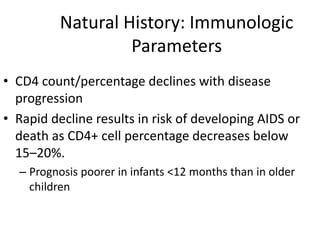
Natural History: Immunologic
Parameters
• CD4 count/percentage declines with disease
progression
• Rapid decline results in risk of developing AIDS or
death as CD4+ cell percentage decreases below
15–20%.
– Prognosis poorer in infants <12 months than in older
children
Natural History: Immunologic
Parameters
• CD4+ T cell count and CD4% are useful when caring for HIV-infected
infants and children
• The CD4+ T cell count or percentage value is used in conjunction with
clinical indicators to guide antiretroviral treatment decisions
– CD4+ T cell values can be associated with considerable intra-patient
variation.
– Transient decreases may be associated with intercurrent illnesses &
vaccinations
– CD4+ T cell values are best measured when patients are clinically
stable.
HIV RNA in Children
The HIV RNA pattern in perinatally infected infants
differs from infected adults (90% pediatric HIV is perinatally-
acquired)
In Infants:
• RNA levels are low at birth.
• Increase to high levels > 100,000-millions of copies/ml by 2 months
of age.
• Remain high throughout the first year of life.
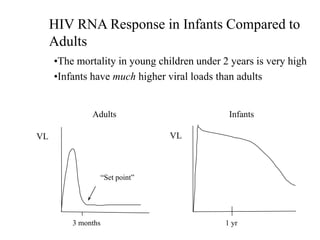
• Decline slowly over the next few years to “set point”.
VL VL
Adults Infants
“Set point”
3 months 1 yr
HIV RNA Response in Infants Compared to
Adults
•The mortality in young children under 2 years is very high
•Infants have much higher viral loads than adults
HIV RNA In Children
• This pattern is due to inability of the
infant’s immature immune system to
contain viral replication.
• There is also a greater number of HIV
susceptible cells.
• High RNA levels and low CD4 counts (<15%)
are independently predictive of increased
risk of progression to AIDS and death.
HIV RNA in Children
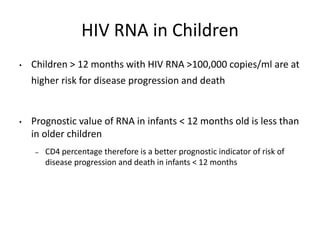
• Children > 12 months with HIV RNA >100,000 copies/ml are at
higher risk for disease progression and death
• Prognostic value of RNA in infants < 12 months old is less than
in older children
– CD4 percentage therefore is a better prognostic indicator of risk of
disease progression and death in infants < 12 months
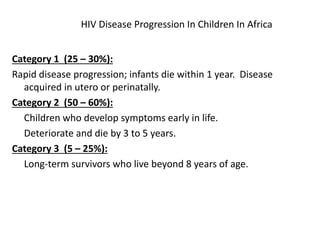
HIV Disease Progression In Children In Africa
Category 1 (25 – 30%):
Rapid disease progression; infants die within 1 year. Disease
acquired in utero or perinatally.
Category 2 (50 – 60%):
Children who develop symptoms early in life.
Deteriorate and die by 3 to 5 years.
Category 3 (5 – 25%):
Long-term survivors who live beyond 8 years of age.
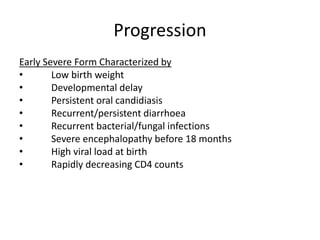
Progression
Early Severe Form Characterized by
• Low birth weight
• Developmental delay
• Persistent oral candidiasis
• Recurrent/persistent diarrhoea
• Recurrent bacterial/fungal infections
• Severe encephalopathy before 18 months
• High viral load at birth
• Rapidly decreasing CD4 counts
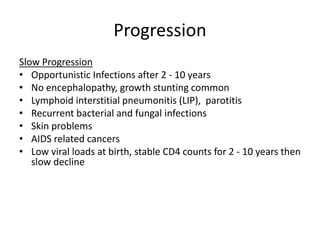
Progression
Slow Progression
• Opportunistic Infections after 2 - 10 years
• No encephalopathy, growth stunting common
• Lymphoid interstitial pneumonitis (LIP), parotitis
• Recurrent bacterial and fungal infections
• Skin problems
• AIDS related cancers
• Low viral loads at birth, stable CD4 counts for 2 - 10 years then
slow decline
Natural History of HIV
Factors that related to disease progression are:
• The child’s immature immune system
• Size of infecting viral dose
• Maternal disease status
• Infant peak viremia
• Infant CD4+ cell counts

Hiv in children

  • 1.
    HIV infection inchildren Paediatrics
  • 2.
    Paediatric HIV Infection: Epidemiology,biology, and pathophysiology Adapted from the National AIDS Control Program Curriculum THE UNITED REPUBLIC OF TANZANIA MINISTRY OF HEALTH & SOCIAL WELFARE
  • 3.
    2.5 million children,90% in SSA 3LPM nt V y in
  • 4.
    • 1.3 millionpeople (5.7%) • 10% < age 15 • 12000 infant infections annually Tanzania • Prevalence 1.9% Kilimanjaro region Introduction: HIV epidemiology UNGASS/TACAIDS (2010).
  • 5.
    Modes of HIVTransmission to Children • MTCT – responsible for 95% of infected infants • Sexual transmission (adolescents/abuse) • Transfusion of infected blood • Unsterile injection procedures (2.5% in both adult and paediatric population) • Scarification
  • 6.
    Factors Contributing ToHigh HIV Prevalence In Children In Sub-saharan Africa • High prevalence of infection in women of childbearing age • Efficiency of MTCT where infection rates among women (15-49 yrs) in Tanzania range from 2% (Manyara) to 15.2% (Mbeya)
  • 7.
    Consequences of theHIV Epidemic on Children AIDS impacts children in many ways • Increased infant and childhood morbidity • Increased infant and childhood mortality • Increase in number of orphaned children • Increased deprivations in various forms; – Mental – Psychological – School dropouts • Abuse : Physical, Sexual
  • 8.
    HIV epidemiology -summary • Over the past 2 decades HIV has spread worldwide with devastating epidemiological consequences particularly in Sub Saharan Africa • MTCT is the greatest mode of transmission of HIV infection in children. • The burden of HIV/AIDS among Tanzanian children is high: 72,000 new infections each year, 140,000 total infections, and a high proportion of orphaned children (11% of children under 18)
  • 9.
  • 10.
    4/23/2015 The Biology ofthe Human Immunodeficiency Virus HIV – 1 • Is found worldwide • Is the main cause of the worldwide pandemic NB: Unless otherwise specified, ‘HIV’ in this training refers to HIV-1 HIV – 2 • Mainly found in West Africa, Mozambique and Angola. • Causes a similar illness to HIV – 1 • Less efficiently transmissible, rarely causing vertical transmission • Less aggressive, slower disease progression There are two types of HIV:
  • 11.
    4/23/2015 HIV-1 SUBTYPES • HIV-1has many subtypes: A-K • A-E are the predominant subtypes – A: W. Africa, E. Africa, Central Africa East Europe & Middle East – B: N. America, Europe, Middle East, E. Asia, Latin America – C: S. Africa, S. Asia, Ethiopia – D: E. Africa – E: S. E. Asia
  • 12.
    4/23/2015 HIV-1 Subtype Distributionin Africa • East and Central Africa has mainly subtype A and D. • Southern Africa mainly subtype C. • West Africa mainly A • Different subtypes can combine to form diverse recombinants.
  • 13.
    4/23/2015 HIV SUBTYPE C •This is the most virulent subtype. • It has higher transcription rates. • In Tanzania is associated with higher MTCT rates than subtype A. • Is associated with faster disease progression in adults.
  • 14.
    4/23/2015 Viral Enzymes • Themost important are Reverse Transcriptase (RT), Protease and Integrase. • RT converts viral single-stranded RNA into a single strand deoxyribonucleic acid (DNA). – DNA polymerizes to form a double stranded DNA (dsDNA) – DNA is incorporated into host nucleus as the proviral DNA. • Integrase facilitates integration of the dsDNA into the host’s chromosomal DNA. • Protease enzyme splits generated macro-proteins into smaller viral proteins (core, envelope & regulatory proteins and enzymes) which are then incorporated into the new viral particles.
  • 15.
    4/23/2015 HIV - Replication Fusion& viral entry Reverse transcription Integration Transcription - Translation Protease activity Assembly & budding HIV Life Cycle
  • 16.
    4/23/2015 HIV biology -summary • Rapid replication of HIV causes genetic diversity of the virus • Knowledge of HIV structure is important in understanding the mechanism of ARV drugs • Current ARV drugs act mainly by antagonizing various HIV enzymes necessary for viral replication
  • 17.
  • 18.
    Cells Of TheImmune System • Found in blood and tissues • In blood mostly are white blood cells (WBC) – Macrophages act as clearing cells – Neutrophils attack bacteria – Eosinophils attack helminths (and mediate allergies) – B-lymphocytes make antibodies
  • 19.
    Cells of theImmune System – T-lymphocytes • Responsible for attacking viruses, fungi and some bacteria • T helper cells central in orchestrating function of other immune cells – T killer cells are able to destroy infected cells
  • 20.
    How HIV Affectsthe Immune System • HIV attaches to cells of the immune system with special surface markers called CD4 receptors • The following immune cells have CD4 receptors • T-Lymphocytes – CD4 Cells • Macrophages • Monocytes • Dendritic cells
  • 21.
    HIV Effect onImmune System • The hallmark of HIV/AIDS is profound immunodeficiency as a result depletion of CD4+ T lymphocytes. • The CD4+ T cell dysfunction is two fold: – Reduction in numbers – Impairment in function
  • 22.
    HIV Effect OnImmune System • Reduction in the CD4 cell number and the effects on their function reduces the capacity of the body to fight infectious diseases • Individuals with HIV infection are therefore increasingly susceptible to many infections especially at later stages of HIV infection
  • 24.
    HIV Effect OnOther Parts Of Immune System • Lymphoid tissue destruction • CD8+ cell dysfunction • B cell abnormalities • Thymic dysfunction • Autoimmune abnormalities
  • 25.
    Immunological Parameters inChildren: Background Immunological Parameters • Absolute CD4 count higher in healthy children than in adults. • Absolute CD4 count varies with age • Normal absolute CD4 counts slowly decline to adult levels • CD4 percentage does not change with age. • In children < 5 yr CD4 percentage is the preferred immunological parameter for monitoring disease progression.
  • 26.
    Immunological Parameters in Children:Background Age-related Decrease in CD4+ Number 0 2000 4000 6000 Age in Months CD+Number/mm3 5th percentile 95th percentile 4 12 24 6090
  • 27.
    Immunological Parameters in Children:Background Age-related Decrease in CD4+ Percentage 0 20 40 60 80 Age in Months CD4+% 5th percentile 95th percentile 4 12 24 6090
  • 28.
    Natural History: Immunologic Parameters •CD4 count/percentage declines with disease progression • Rapid decline results in risk of developing AIDS or death as CD4+ cell percentage decreases below 15–20%. – Prognosis poorer in infants <12 months than in older children
  • 29.
    Natural History: Immunologic Parameters •CD4+ T cell count and CD4% are useful when caring for HIV-infected infants and children • The CD4+ T cell count or percentage value is used in conjunction with clinical indicators to guide antiretroviral treatment decisions – CD4+ T cell values can be associated with considerable intra-patient variation. – Transient decreases may be associated with intercurrent illnesses & vaccinations – CD4+ T cell values are best measured when patients are clinically stable.
  • 30.
    HIV RNA inChildren The HIV RNA pattern in perinatally infected infants differs from infected adults (90% pediatric HIV is perinatally- acquired) In Infants: • RNA levels are low at birth. • Increase to high levels > 100,000-millions of copies/ml by 2 months of age. • Remain high throughout the first year of life. • Decline slowly over the next few years to “set point”.
  • 31.
    VL VL Adults Infants “Setpoint” 3 months 1 yr HIV RNA Response in Infants Compared to Adults •The mortality in young children under 2 years is very high •Infants have much higher viral loads than adults
  • 32.
    HIV RNA InChildren • This pattern is due to inability of the infant’s immature immune system to contain viral replication. • There is also a greater number of HIV susceptible cells. • High RNA levels and low CD4 counts (<15%) are independently predictive of increased risk of progression to AIDS and death.
  • 33.
    HIV RNA inChildren • Children > 12 months with HIV RNA >100,000 copies/ml are at higher risk for disease progression and death • Prognostic value of RNA in infants < 12 months old is less than in older children – CD4 percentage therefore is a better prognostic indicator of risk of disease progression and death in infants < 12 months
  • 34.
    HIV Disease ProgressionIn Children In Africa Category 1 (25 – 30%): Rapid disease progression; infants die within 1 year. Disease acquired in utero or perinatally. Category 2 (50 – 60%): Children who develop symptoms early in life. Deteriorate and die by 3 to 5 years. Category 3 (5 – 25%): Long-term survivors who live beyond 8 years of age.
  • 35.
    Progression Early Severe FormCharacterized by • Low birth weight • Developmental delay • Persistent oral candidiasis • Recurrent/persistent diarrhoea • Recurrent bacterial/fungal infections • Severe encephalopathy before 18 months • High viral load at birth • Rapidly decreasing CD4 counts
  • 36.
    Progression Slow Progression • OpportunisticInfections after 2 - 10 years • No encephalopathy, growth stunting common • Lymphoid interstitial pneumonitis (LIP), parotitis • Recurrent bacterial and fungal infections • Skin problems • AIDS related cancers • Low viral loads at birth, stable CD4 counts for 2 - 10 years then slow decline
  • 37.
    Natural History ofHIV Factors that related to disease progression are: • The child’s immature immune system • Size of infecting viral dose • Maternal disease status • Infant peak viremia • Infant CD4+ cell counts