BASIC FACTS ON
HIV
What is HIV?
2
H -uman
Found only in humansFound only in humans
Transmitted among humansTransmitted among humans
Preventable by humansPreventable by humans
I -mmunodefiency
Body lacks ability to fight off infectionsBody lacks ability to fight off infections
V -irus
Type of germType of germ
Lives and reproduces in body cellsLives and reproduces in body cells
AIDS
07/18/15Copyright - National HIV/STI Programme3
A -cquired; received, not inherited (does not runreceived, not inherited (does not run
in families)in families)
I -mmuno; protected from (in this case theprotected from (in this case the
system protects the body from disease)system protects the body from disease)
D -eficiency, -- a lack ofa lack of
S-yndrome; – a group of symptoms or– a group of symptoms or
diseasesdiseases
HIV IS FOUND IN BODY
FLUIDS
07/18/15Copyright - National HIV/STI Programme4
ď‚—Semen
ď‚—Breast milk
ď‚—Blood
ď‚—Vaginal fluid
How HIV is passed on?
07/18/15Copyright - National HIV/STI Programme5
ď‚§ During unprotected (skin to skin) sex (anal, vaginal or oral)
ď‚§ Contact with HIV infected blood or blood products
ď‚§ Sharing IV drug needles of HIV positive people
ď‚§ From HIV positive mother to child
ď‚§ During breast feeding
You CANNOT get HIV from…
07/18/15Copyright - National HIV/STI Programme6
ď‚§Tears
ď‚§Saliva
ď‚§Sweat
ď‚§Urine
of an HIV infected person
Window Period
07/18/15Copyright - National HIV/STI Programme7
ď‚—When a person gets infected it may take 6 weeks or up to 3
months before antibodies to HIV are detected in the blood
ď‚—The HIV test looks for antibodies. When these antibodies are
detected the person is diagnosed HIV positive
ď‚—A person can be positive and the test shows negative because the
test was done during the window period
07/18/15Copyright - National HIV/STI Programme8
Why HIV rates not goingWhy HIV rates not going
down?down?
ď‚§ Sex at an early age
ď‚§ Little life-skills and sex education
ď‚§ Little condom use
ď‚§ Multiple partners
ď‚§ Stigma and Discrimination
ď‚§ Sex for money or sex for .....things
ď‚§ Substance abuse: Ganja, cocaine, alcohol
ď‚§ Men having sex with men & homophobia
ď‚§ Gender inequity and gender roles
07/18/15Copyright - National HIV/STI Programme9
STI and HIV – The LinkSTI and HIV – The Link
ď‚§ Persons with a history of STIs are more likely to get HIV
because:
ď‚— persons with STIs are more likely to have sores
and small breaks in the skin and lining of their
genitals.
ď‚—HIV can more easily enter the body through
these breaks.
07/18/15Copyright - National HIV/STI Programme10
STI and HIV – The LinkSTI and HIV – The Link
ď‚§ You can get an STI by having sex without a condom, with
an infected person.
ď‚§ At the same time, you could be getting HIV which is also
contracted by having unprotected sex.
07/18/15Copyright - National HIV/STI Programme11
ALL STIs are
Preventable
Most STI’s are treatable
But
HIV/AIDS CANNOT BE CURED
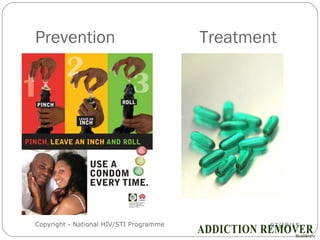
Prevention Treatment
07/18/15Copyright - National HIV/STI Programme12
Prevention
07/18/15Copyright - National HIV/STI Programme13
ď‚§ Talk with partner about HIV
ď‚§ Use a condom with your regular and non-regular clients, and
partners every time you have sex
ď‚§ Reduce the number of main partners
ď‚§ Get tested. Know your status
Who is most at risk for HIV?
07/18/15Copyright - National HIV/STI Programme14
ď‚§ Anybody having sex without a condom.
 People with more than 1 partner who don’t use a condom
during sex
ď‚§ People whose sex partner have sex with other partners
without using a condom
How You DON’T Get HIV
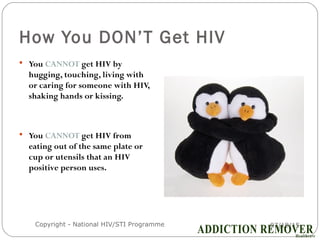
ď‚§ You CANNOT get HIV by
hugging, touching, living with
or caring for someone with HIV,
shaking hands or kissing.
ď‚§ You CANNOT get HIV from
eating out of the same plate or
cup or utensils that an HIV
positive person uses.
07/18/15Copyright - National HIV/STI Programme15
07/18/15Copyright - National HIV/STI Programme16
Early Signs & Symptoms ofEarly Signs & Symptoms of
HIVHIV
ď‚§ Fever
ď‚§ Fatigue
ď‚§ Night Sweats
ď‚§ Loss of Appetite
ď‚§ Diarrhea
ď‚§ Swollen Lymph Glands
Remember these are symptoms of many other illnesses.
REMEMBER
ď‚§ You CANNOT tell by looking if someone has HIV.
ď‚§ An individual can look and feel well for many years and be HIV
positive.
ď‚§ The HIV positive person can pass the virus on to someone else.
07/18/15Copyright - National HIV/STI Programme17
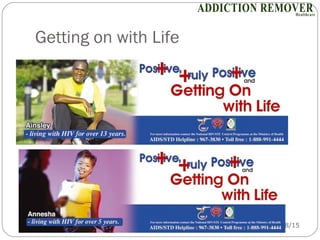
Getting on with Life
07/18/15Copyright - National HIV/STI Programme18
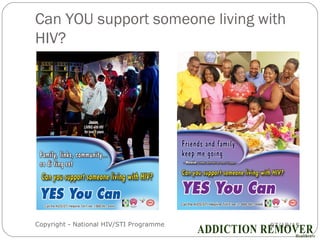
Can YOU support someone living with
HIV?
07/18/15Copyright - National HIV/STI Programme19
For More Information and Treatment
07/18/15Copyright - National HIV/STI Programme20
Contact Us at:
www.Addictionremover.in
www.facebook.com/Addictionremover
info@addictionremover.in
Call us @ 8979354316/8791448433

BASIC FACTS ON HIV-AIDS

  • 1.
  • 2.
    What is HIV? 2 H-uman Found only in humansFound only in humans Transmitted among humansTransmitted among humans Preventable by humansPreventable by humans I -mmunodefiency Body lacks ability to fight off infectionsBody lacks ability to fight off infections V -irus Type of germType of germ Lives and reproduces in body cellsLives and reproduces in body cells
  • 3.
    AIDS 07/18/15Copyright - NationalHIV/STI Programme3 A -cquired; received, not inherited (does not runreceived, not inherited (does not run in families)in families) I -mmuno; protected from (in this case theprotected from (in this case the system protects the body from disease)system protects the body from disease) D -eficiency, -- a lack ofa lack of S-yndrome; – a group of symptoms or– a group of symptoms or diseasesdiseases
  • 4.
    HIV IS FOUNDIN BODY FLUIDS 07/18/15Copyright - National HIV/STI Programme4 ď‚—Semen ď‚—Breast milk ď‚—Blood ď‚—Vaginal fluid
  • 5.
    How HIV ispassed on? 07/18/15Copyright - National HIV/STI Programme5 ď‚§ During unprotected (skin to skin) sex (anal, vaginal or oral) ď‚§ Contact with HIV infected blood or blood products ď‚§ Sharing IV drug needles of HIV positive people ď‚§ From HIV positive mother to child ď‚§ During breast feeding
  • 6.
    You CANNOT getHIV from… 07/18/15Copyright - National HIV/STI Programme6 Tears Saliva Sweat Urine of an HIV infected person
  • 7.
    Window Period 07/18/15Copyright -National HIV/STI Programme7 ď‚—When a person gets infected it may take 6 weeks or up to 3 months before antibodies to HIV are detected in the blood ď‚—The HIV test looks for antibodies. When these antibodies are detected the person is diagnosed HIV positive ď‚—A person can be positive and the test shows negative because the test was done during the window period
  • 8.
    07/18/15Copyright - NationalHIV/STI Programme8 Why HIV rates not goingWhy HIV rates not going down?down? ď‚§ Sex at an early age ď‚§ Little life-skills and sex education ď‚§ Little condom use ď‚§ Multiple partners ď‚§ Stigma and Discrimination ď‚§ Sex for money or sex for .....things ď‚§ Substance abuse: Ganja, cocaine, alcohol ď‚§ Men having sex with men & homophobia ď‚§ Gender inequity and gender roles
  • 9.
    07/18/15Copyright - NationalHIV/STI Programme9 STI and HIV – The LinkSTI and HIV – The Link  Persons with a history of STIs are more likely to get HIV because:  persons with STIs are more likely to have sores and small breaks in the skin and lining of their genitals. HIV can more easily enter the body through these breaks.
  • 10.
    07/18/15Copyright - NationalHIV/STI Programme10 STI and HIV – The LinkSTI and HIV – The Link  You can get an STI by having sex without a condom, with an infected person.  At the same time, you could be getting HIV which is also contracted by having unprotected sex.
  • 11.
    07/18/15Copyright - NationalHIV/STI Programme11 ALL STIs are Preventable Most STI’s are treatable But HIV/AIDS CANNOT BE CURED
  • 12.
    Prevention Treatment 07/18/15Copyright -National HIV/STI Programme12
  • 13.
    Prevention 07/18/15Copyright - NationalHIV/STI Programme13 ď‚§ Talk with partner about HIV ď‚§ Use a condom with your regular and non-regular clients, and partners every time you have sex ď‚§ Reduce the number of main partners ď‚§ Get tested. Know your status
  • 14.
    Who is mostat risk for HIV? 07/18/15Copyright - National HIV/STI Programme14  Anybody having sex without a condom.  People with more than 1 partner who don’t use a condom during sex  People whose sex partner have sex with other partners without using a condom
  • 15.
    How You DON’TGet HIV  You CANNOT get HIV by hugging, touching, living with or caring for someone with HIV, shaking hands or kissing.  You CANNOT get HIV from eating out of the same plate or cup or utensils that an HIV positive person uses. 07/18/15Copyright - National HIV/STI Programme15
  • 16.
    07/18/15Copyright - NationalHIV/STI Programme16 Early Signs & Symptoms ofEarly Signs & Symptoms of HIVHIV ď‚§ Fever ď‚§ Fatigue ď‚§ Night Sweats ď‚§ Loss of Appetite ď‚§ Diarrhea ď‚§ Swollen Lymph Glands Remember these are symptoms of many other illnesses.
  • 17.
    REMEMBER ď‚§ You CANNOTtell by looking if someone has HIV. ď‚§ An individual can look and feel well for many years and be HIV positive. ď‚§ The HIV positive person can pass the virus on to someone else. 07/18/15Copyright - National HIV/STI Programme17
  • 18.
    Getting on withLife 07/18/15Copyright - National HIV/STI Programme18
  • 19.
    Can YOU supportsomeone living with HIV? 07/18/15Copyright - National HIV/STI Programme19
  • 20.
    For More Informationand Treatment 07/18/15Copyright - National HIV/STI Programme20 Contact Us at: www.Addictionremover.in www.facebook.com/Addictionremover info@addictionremover.in Call us @ 8979354316/8791448433