HIV ?
HIV ?
HIV> Human Immuno-
HIV > Human Immuno-
Deficiency Virus
Deficiency Virus
AIDS ?
AIDS ?
AIDS > Acquired Immuno -
AIDS > Acquired Immuno -
Deficiency Syndrome
Deficiency Syndrome
2.
Why the termAIDS
Why the term AIDS
• A
Acquired is used to differentiate it from
cquired is used to differentiate it from
the term congenital
the term congenital
The word congenital means it presents
The word congenital means it presents
since birth passed down through heredity.
since birth passed down through heredity.
• I
Immune
mmune D
Deficiency – the virus destroys
eficiency – the virus destroys
the immunity system
the immunity system
• S
Syndrome-it means it is characterized by
yndrome-it means it is characterized by
constellation of signs and symptoms
constellation of signs and symptoms
3.
What is HIV?
Whatis HIV?
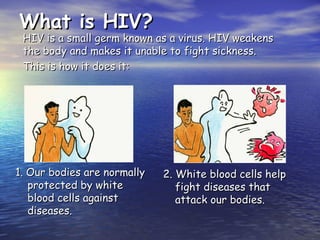
1. Our bodies are normally
1. Our bodies are normally
protected by white
protected by white
blood cells against
blood cells against
diseases.
diseases.
2. White blood cells help
2. White blood cells help
fight diseases that
fight diseases that
attack our bodies.
attack our bodies.
HIV is a small germ known as a virus. HIV weakens
HIV is a small germ known as a virus. HIV weakens
the body and makes it unable to fight sickness.
the body and makes it unable to fight sickness.
This is how it does it:
This is how it does it:
4.
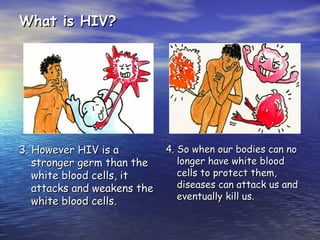
3. However HIVis a
3. However HIV is a
stronger germ than the
stronger germ than the
white blood cells, it
white blood cells, it
attacks and weakens the
attacks and weakens the
white blood cells.
white blood cells.
4. So when our bodies can no
4. So when our bodies can no
longer have white blood
longer have white blood
cells to protect them,
cells to protect them,
diseases can attack us and
diseases can attack us and
eventually kill us.
eventually kill us.
What is HIV?
What is HIV?
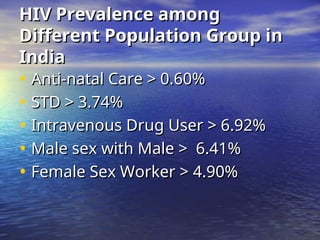
HIV Prevalence among
HIVPrevalence among
Different Population Group in
Different Population Group in
India
India
• Anti-natal Care > 0.60%
Anti-natal Care > 0.60%
• STD > 3.74%
STD > 3.74%
• Intravenous Drug User > 6.92%
Intravenous Drug User > 6.92%
• Male sex with Male > 6.41%
Male sex with Male > 6.41%
• Female Sex Worker > 4.90%
Female Sex Worker > 4.90%
8.
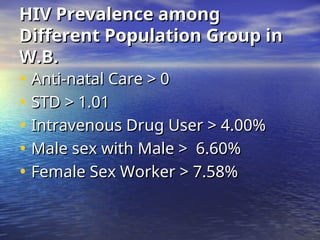
HIV Prevalence among
HIVPrevalence among
Different Population Group in
Different Population Group in
W.B.
W.B.
• Anti-natal Care > 0
Anti-natal Care > 0
• STD > 1.01
STD > 1.01
• Intravenous Drug User > 4.00%
Intravenous Drug User > 4.00%
• Male sex with Male > 6.60%
Male sex with Male > 6.60%
• Female Sex Worker > 7.58%
Female Sex Worker > 7.58%
What is AIDS?
Whatis AIDS?
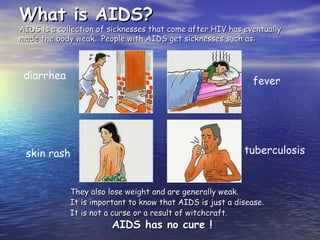
AIDS is a collection of sicknesses that come after HIV has eventually
AIDS is a collection of sicknesses that come after HIV has eventually
made the body weak. People with AIDS get sicknesses such as:
made the body weak. People with AIDS get sicknesses such as:
They also lose weight and are generally weak.
They also lose weight and are generally weak.
It is important to know that AIDS is just a disease.
It is important to know that AIDS is just a disease.
It is not a curse or a result of witchcraft.
It is not a curse or a result of witchcraft.
AIDS has no cure !
AIDS has no cure !
diarrhea fever
skin rash tuberculosis
11.
How HIV isspread :
How HIV is spread :
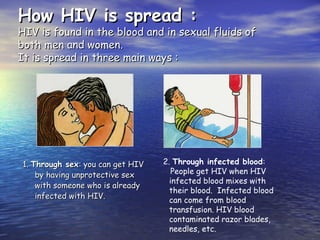
HIV is found in the blood and in sexual fluids of
HIV is found in the blood and in sexual fluids of
both men and women.
both men and women.
It is spread in three main ways :
It is spread in three main ways :
1.
1. Through sex
Through sex: you can get HIV
: you can get HIV
by having unprotective sex
by having unprotective sex
with someone who is already
with someone who is already
infected with HIV.
infected with HIV.
2. Through infected blood:
People get HIV when HIV
infected blood mixes with
their blood. Infected blood
can come from blood
transfusion. HIV blood
contaminated razor blades,
needles, etc.
12.
How HIV isspread :
How HIV is spread :
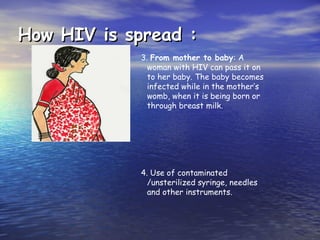
3. From mother to baby: A
woman with HIV can pass it on
to her baby. The baby becomes
infected while in the mother’s
womb, when it is being born or
through breast milk.
4. Use of contaminated
/unsterilized syringe, needles
and other instruments.
13.
How to preventHIV infection:
How to prevent HIV infection:
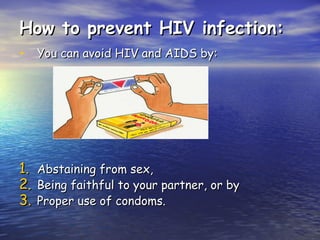
• You can avoid HIV and AIDS by:
You can avoid HIV and AIDS by:
1.
1. Abstaining from sex,
Abstaining from sex,
2.
2. Being faithful to your partner, or by
Being faithful to your partner, or by
3.
3. Proper use of condoms.
Proper use of condoms.
14.
How to preventHIV
How to prevent HIV
infection:
infection:
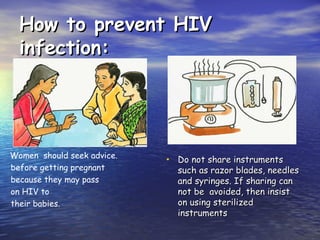
• Do not share instruments
Do not share instruments
such as razor blades, needles
such as razor blades, needles
and syringes. If sharing can
and syringes. If sharing can
not be avoided, then insist
not be avoided, then insist
on using sterilized
on using sterilized
instruments
instruments
Women should seek advice.
.
before getting pregnant
because they may pass
on HIV to
their babies.
15.
How to preventHIV infection:
How to prevent HIV infection:
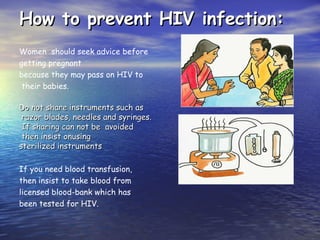
Women should seek advice before
getting pregnant
because they may pass on HIV to
their babies.
Do not share instruments such as
Do not share instruments such as
razor blades, needles and syringes.
razor blades, needles and syringes.
If sharing can not be avoided
If sharing can not be avoided
then insist onusing
then insist onusing
sterilized instruments
sterilized instruments
If you need blood transfusion,
then insist to take blood from
licensed blood-bank which has
been tested for HIV.
16.
How to preventHIV infection:
How to prevent HIV infection:
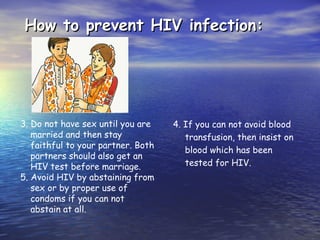
3. Do not have sex until you are
married and then stay
faithful to your partner. Both
partners should also get an
HIV test before marriage.
5. Avoid HIV by abstaining from
sex or by proper use of
condoms if you can not
abstain at all.
4. If you can not avoid blood
transfusion, then insist on
blood which has been
tested for HIV.
17.
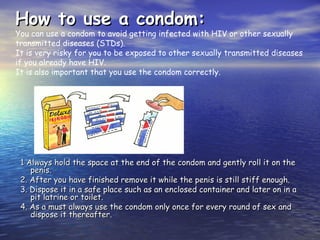
How to usea condom:
How to use a condom:
1 Always hold the space at the end of the condom and gently roll it on the
1 Always hold the space at the end of the condom and gently roll it on the
penis.
penis.
2. After you have finished remove it while the penis is still stiff enough.
2. After you have finished remove it while the penis is still stiff enough.
3. Dispose it in a safe place such as an enclosed container and later on in a
3. Dispose it in a safe place such as an enclosed container and later on in a
pit latrine or toilet.
pit latrine or toilet.
4. As a must always use the condom only once for every round of sex and
4. As a must always use the condom only once for every round of sex and
dispose it thereafter.
dispose it thereafter.
You can use a condom to avoid getting infected with HIV or other sexually
transmitted diseases (STDs).
It is very risky for you to be exposed to other sexually transmitted diseases
if you already have HIV.
It is also important that you use the condom correctly.
18.
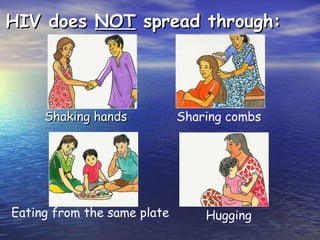
HIV does
HIV doesNOT
NOT spread through:
spread through:
Shaking hands
Shaking hands Sharing combs
Eating from the same plate Hugging
19.
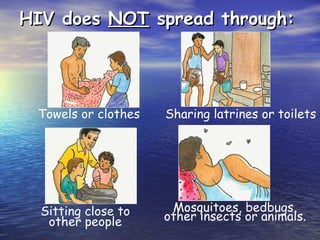
HIV does
HIV doesNOT
NOT spread through:
spread through:
Towels or clothes Sharing latrines or toilets
Sitting close to
other people
Mosquitoes, bedbugs,
other insects or animals.
20.
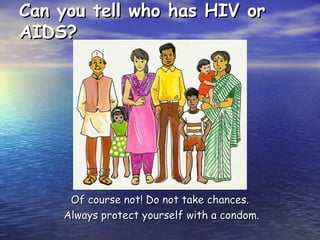
Can you tellwho has HIV or
Can you tell who has HIV or
AIDS?
AIDS?
Of course not! Do not take chances.
Of course not! Do not take chances.
Always protect yourself with a condom.
Always protect yourself with a condom.
21.
How to detectHIV ?
How to detect HIV ?
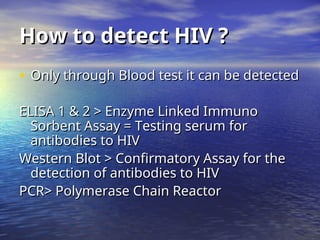
• Only through Blood test it can be detected
Only through Blood test it can be detected
ELISA 1 & 2 > Enzyme Linked Immuno
ELISA 1 & 2 > Enzyme Linked Immuno
Sorbent Assay = Testing serum for
Sorbent Assay = Testing serum for
antibodies to HIV
antibodies to HIV
Western Blot > Confirmatory Assay for the
Western Blot > Confirmatory Assay for the
detection of antibodies to HIV
detection of antibodies to HIV
PCR> Polymerase Chain Reactor
PCR> Polymerase Chain Reactor
22.
Why have anHIV test?
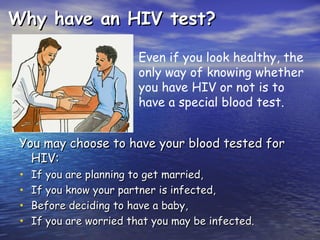
Why have an HIV test?
You may choose to have your blood tested for
You may choose to have your blood tested for
HIV:
HIV:
• If you are planning to get married,
If you are planning to get married,
• If you know your partner is infected,
If you know your partner is infected,
• Before deciding to have a baby,
Before deciding to have a baby,
• If you are worried that you may be infected.
If you are worried that you may be infected.
Even if you look healthy, the
only way of knowing whether
you have HIV or not is to
have a special blood test.
23.
Testing for HIV.
Testingfor HIV.
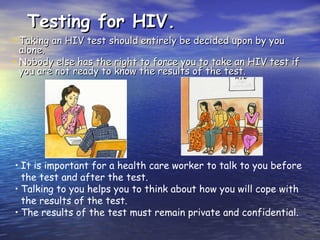
• Taking an HIV test should entirely be decided upon by you
Taking an HIV test should entirely be decided upon by you
alone.
alone.
• Nobody else has the right to force you to take an HIV test if
Nobody else has the right to force you to take an HIV test if
you are not ready to know the results of the test.
you are not ready to know the results of the test.
• It is important for a health care worker to talk to you before
the test and after the test.
• Talking to you helps you to think about how you will cope with
the results of the test.
• The results of the test must remain private and confidential.
24.
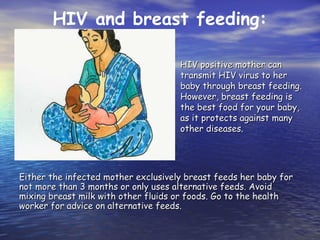
HIV positive mothercan
HIV positive mother can
transmit HIV virus to her
transmit HIV virus to her
baby through breast feeding.
baby through breast feeding.
However, breast feeding is
However, breast feeding is
the best food for your baby,
the best food for your baby,
as it protects against many
as it protects against many
other diseases.
other diseases.
Either the infected mother exclusively breast feeds her baby for
Either the infected mother exclusively breast feeds her baby for
not more than 3 months or only uses alternative feeds. Avoid
not more than 3 months or only uses alternative feeds. Avoid
mixing breast milk with other fluids or foods. Go to the health
mixing breast milk with other fluids or foods. Go to the health
worker for advice on alternative feeds.
worker for advice on alternative feeds.
HIV and breast feeding:
25.
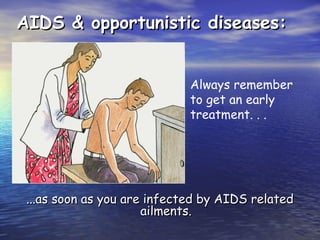
AIDS & opportunisticdiseases:
AIDS & opportunistic diseases:
...as soon as you are infected by AIDS related
...as soon as you are infected by AIDS related
ailments.
ailments.
Always remember
to get an early
treatment. . .
26.
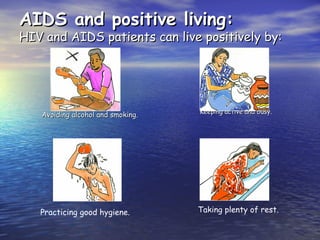
AIDS and positiveliving:
AIDS and positive living:
HIV and AIDS patients can live positively by:
HIV and AIDS patients can live positively by:
Avoiding alcohol and smoking.
Avoiding alcohol and smoking. Keeping active and busy.
Keeping active and busy.
Practicing good hygiene. Taking plenty of rest.
27.
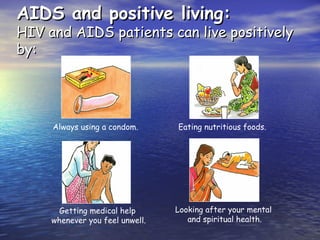
AIDS and positiveliving:
AIDS and positive living:
HIV and AIDS patients can live positively
HIV and AIDS patients can live positively
by:
by:
Always using a condom.
Getting medical help
whenever you feel unwell.
Eating nutritious foods.
Looking after your mental
and spiritual health.
28.
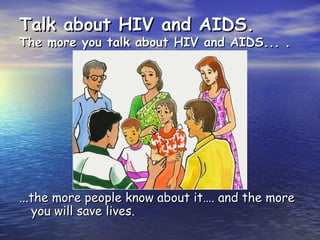
Talk about HIVand AIDS.
Talk about HIV and AIDS.
The more you talk about HIV and AIDS... .
The more you talk about HIV and AIDS... .
...the more people know about it…. and the more
...the more people know about it…. and the more
you will save lives.
you will save lives.
29.
Sexually Transmitted Diseases(STD)
Sexually Transmitted Diseases (STD)
enhances the possibility of transmitting
enhances the possibility of transmitting
HIV/AIDS
HIV/AIDS
Symptoms of STD:
Symptoms of STD:
Genital Ulcer.
Genital Ulcer.
Burning Sensation in urine.
Burning Sensation in urine.
Swelling in inguinal region.
Swelling in inguinal region.
Vaginal or genital discharge.
Vaginal or genital discharge.
Prevention of STD:
Prevention of STD:
Following full course of treatment from
Following full course of treatment from
MBBS Doctor.
MBBS Doctor.
Practicing safe sex(using condom)
Practicing safe sex(using condom)
Spouse notification and treatment
Spouse notification and treatment