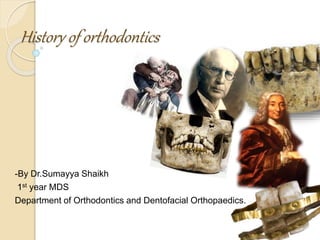
History of orthodontics
-By Dr.Sumayya Shaikh
1st year MDS
Department of Orthodontics and Dentofacial Orthopaedics.
WHY STUDY
HISTORY?
Introduction
to
Orthodontics
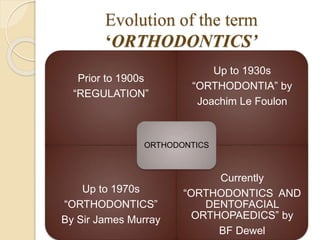
Evolution of the term
‘ORTHODONTICS’
Prior to 1900s
“REGULATION”
Up to 1930s
“ORTHODONTIA” by
Joachim Le Foulon
Up to 1970s
“ORTHODONTICS”
By Sir James Murray
Currently
“ORTHODONTICS AND
DENTOFACIAL
ORTHOPAEDICS” by
BF Dewel
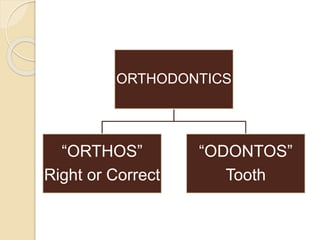
ORTHODONTICS
ORTHODONTICS
“ORTHOS”
Right or Correct
“ODONTOS”
Tooth
Definition of Orthodontics
NOYES – 1911
First definition
- “The study of the relation of the teeth
to the development of the face, and the
correction of arrested and perverted
development.”
THE BRITISH SOCIETY FOR THE STUDY
OF ORTHODONTICS – 1922
-“Orthodontics includes the study of the
growth and development of jaws and face
particularly, and the body generally,
as influencing the position of the teeth;
the study of action and reaction of internal
and external influences on the development,
and the prevention and correction of arrested
and perverted development.”
THE AMERICAN BOARD OF
ORTHODONTICS (ABO) AND THE
AMERICAN ASSOCIATION OF
ORTHODONTISTS(AAO)
-“Orthodontics is that specific area of dental
practice that has as its responsibility,the study
and supervision of growth and development of
the dentition and the related anatomical
structures from birth to dental
maturity,including all preventive and corrective
procedures of dental irregularities,requiring the
repositioning of teeth by functional or
mechanical means to establish normal
occlusion and pleasing facial contours.”
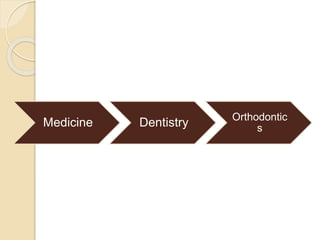
Medicine Dentistry Orthodontic
s
Ancient Civilization
 Specimens dating back to the eight
century BC indicate that Etruscans may
have been the first people to employ
orthodontics to improve tooth alignment.
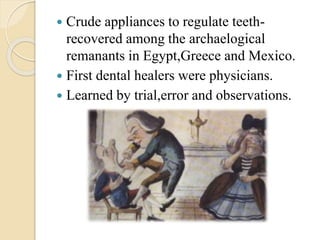
 Crude appliances to regulate teeth-
recovered among the archaelogical
remanants in Egypt,Greece and Mexico.
 First dental healers were physicians.
 Learned by trial,error and observations.
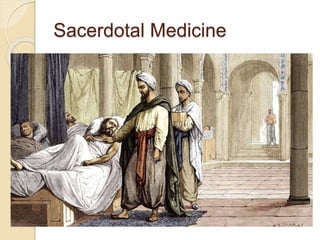
Sacerdotal Medicine
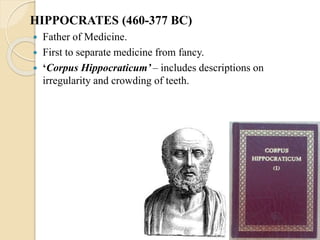
HIPPOCRATES (460-377 BC)
 Father of Medicine.
 First to separate medicine from fancy.
 ‘Corpus Hippocraticum’ – includes descriptions on
irregularity and crowding of teeth.
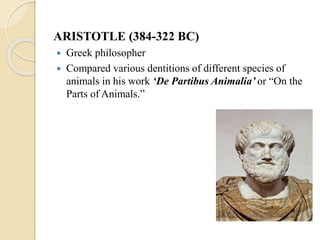
ARISTOTLE (384-322 BC)
 Greek philosopher
 Compared various dentitions of different species of
animals in his work ‘De Partibus Animalia’ or “On the
Parts of Animals.”
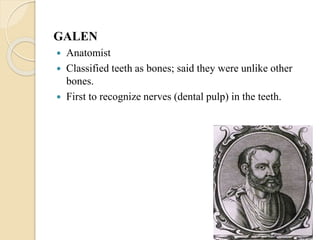
GALEN
 Anatomist
 Classified teeth as bones; said they were unlike other
bones.
 First to recognize nerves (dental pulp) in the teeth.
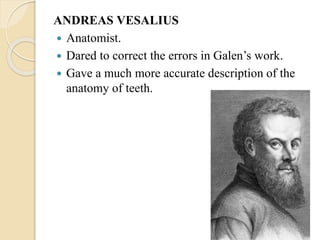
ANDREAS VESALIUS
 Anatomist.
 Dared to correct the errors in Galen’s work.
 Gave a much more accurate description of the
anatomy of teeth.
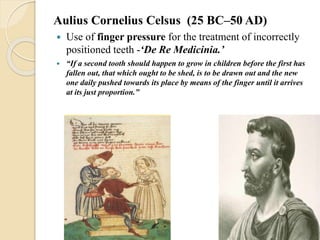
Aulius Cornelius Celsus (25 BC–50 AD)
 Use of finger pressure for the treatment of incorrectly
positioned teeth -‘De Re Medicinia.’
 “If a second tooth should happen to grow in children before the first has
fallen out, that which ought to be shed, is to be drawn out and the new
one daily pushed towards its place by means of the finger until it arrives
at its just proportion.”
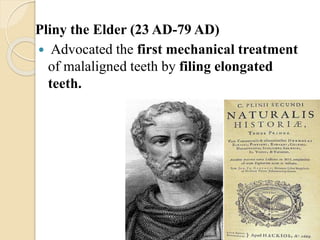
Pliny the Elder (23 AD-79 AD)
 Advocated the first mechanical treatment
of malaligned teeth by filing elongated
teeth.
RENAISSANCE PERIOD
(14th – 16th Century)
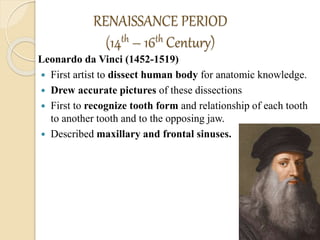
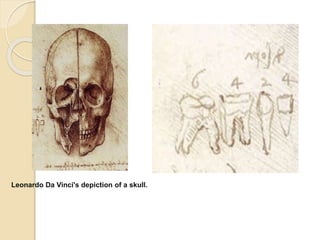
Leonardo da Vinci (1452-1519)
 First artist to dissect human body for anatomic knowledge.
 Drew accurate pictures of these dissections
 First to recognize tooth form and relationship of each tooth
to another tooth and to the opposing jaw.
 Described maxillary and frontal sinuses.
Leonardo Da Vinci's depiction of a skull.
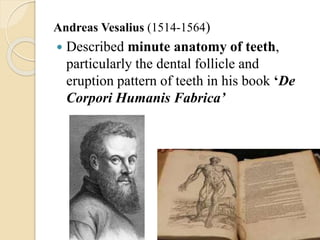
Andreas Vesalius (1514-1564)
 Described minute anatomy of teeth,
particularly the dental follicle and
eruption pattern of teeth in his book ‘De
Corpori Humanis Fabrica’
Ambroise Pare (1517-1590)
 First to use obturator for treatment of cleft
palate.
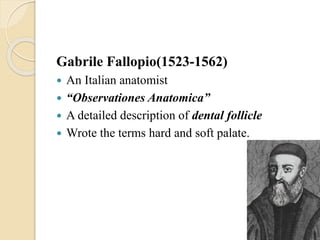
Gabrile Fallopio(1523-1562)
 An Italian anatomist
 “Observationes Anatomica”
 A detailed description of dental follicle
 Wrote the terms hard and soft palate.
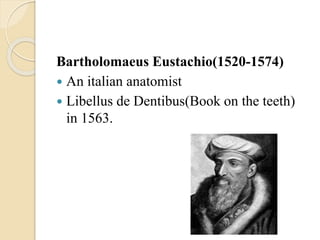
Bartholomaeus Eustachio(1520-1574)
 An italian anatomist
 Libellus de Dentibus(Book on the teeth)
in 1563.
 “ARZEI BUCHLEIN”(A Book of the
Surgical Art) published in 1530
AD(author unknown).
 “When the teeth begin to drop
out…push the new one every day
toward that place where the first one
was until it sits there and fits among
the others.”
EIGHTEENTH
CENTURY
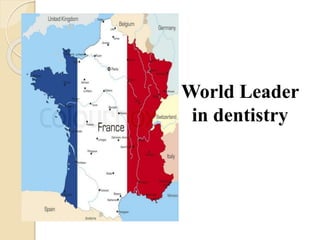
World Leader
in dentistry
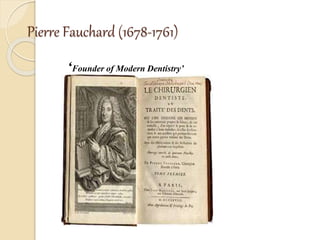
Pierre Fauchard (1678-1761)
‘Founder of Modern Dentistry’
 1728- Le Chirurgien Dentiste (The Surgeon Dentist, A Treatise
on the Teeth)- First complete scientific description of dentistry.
 Pioneer of Dental Prosthesis
 Introduced fillings for cavities
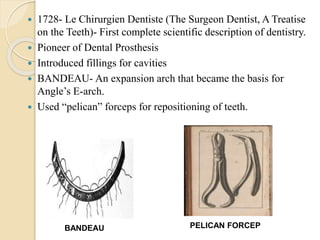
 BANDEAU- An expansion arch that became the basis for
Angle’s E-arch.
 Used “pelican” forceps for repositioning of teeth.
BANDEAU PELICAN FORCEP
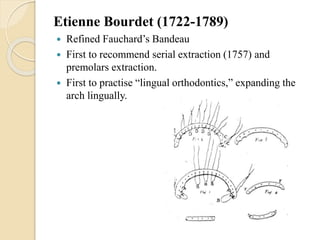
Etienne Bourdet (1722-1789)
 Refined Fauchard’s Bandeau
 First to recommend serial extraction (1757) and
premolars extraction.
 First to practise “lingual orthodontics,” expanding the
arch lingually.
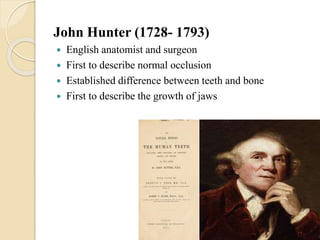
John Hunter (1728- 1793)
 English anatomist and surgeon
 First to describe normal occlusion
 Established difference between teeth and bone
 First to describe the growth of jaws
NINETEENTH
CENTURY
Early Nineteenth Century
 Joseph Fox (1814) - First English dental textbook- The Natural History and Diseases
of the Human Teeth.
First to classify malocclusion.
First to give directions for correcting irregularities of teeth.
 Le Foulon- First to use the term ORTHODONTIA
 James Murray- Coined the term ORTHODONTICS
 Delabarre (1819)- Introduced the crib.
Separated crowded teeth by means of wooden wedges placed between
teeth.
 J. M. Alexis Schange (1841)- Published the first work confined to orthodontics
Coined the term ‘anchorage’
 Kneisel (1836)- FIRST to use plaster models to record malocclusion.
FIRST to use a removable appliance.
FIRST introduced modern impression trays
 Joseph Sigmond (1825)- Recognised habit as factor in Malocclusion
 William Imrie (1834)- Thumb sucking as cause of dental abnormalities
 Rodrigues (1839)- Abnormal muscle pressure causes malocclusion
Year Author Contribution to
Orthodontics
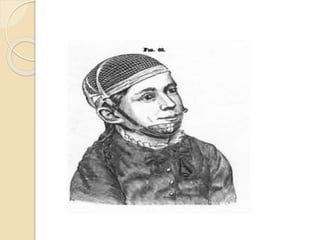
1840 JS Gunnell Introduced chin strap.
1841 William Lintott Introduced the use of screws.
1860 Emerson C Angel Introduced arch expansion by
opening midpalatal suture
“Father of expansion appliances”
1871 William and Magill Developed molar bands.
1888 and 1889 John Nutting Farrar “Father of American Orthodontics”
Wrote “irregularities of teeth and
their correction” first exclusive
textbook devoted to orthodontics.
1829 to 1913 Norman N Kingsley “Treatise on oral deformities”
worked on correction of cleft
palate
Extraoral traction
1893 Henry A Baker Bakers anchorage(intermaxillary
elastics)
Orthodontics In
United States
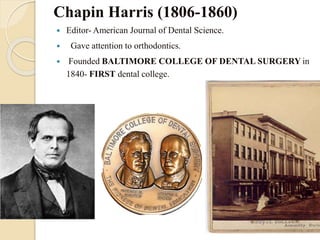
Chapin Harris (1806-1860)
 Editor- American Journal of Dental Science.
 Gave attention to orthodontics.
 Founded BALTIMORE COLLEGE OF DENTAL SURGERY in
1840- FIRST dental college.
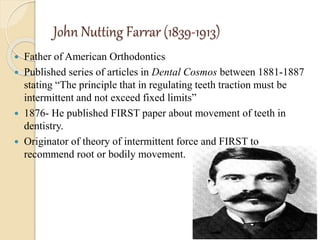
John Nutting Farrar (1839-1913)
 Father of American Orthodontics
 Published series of articles in Dental Cosmos between 1881-1887
stating “The principle that in regulating teeth traction must be
intermittent and not exceed fixed limits”
 1876- He published FIRST paper about movement of teeth in
dentistry.
 Originator of theory of intermittent force and FIRST to
recommend root or bodily movement.
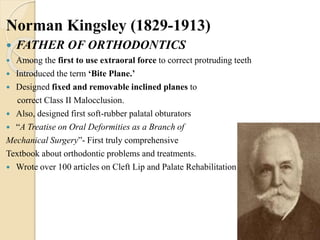
Norman Kingsley (1829-1913)
 FATHER OF ORTHODONTICS
 Among the first to use extraoral force to correct protruding teeth
 Introduced the term ‘Bite Plane.’
 Designed fixed and removable inclined planes to
correct Class II Malocclusion.
 Also, designed first soft-rubber palatal obturators
 “A Treatise on Oral Deformities as a Branch of
Mechanical Surgery”- First truly comprehensive
Textbook about orthodontic problems and treatments.
 Wrote over 100 articles on Cleft Lip and Palate Rehabilitation
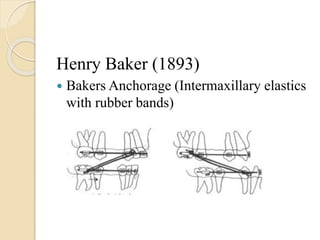
Henry Baker (1893)
 Bakers Anchorage (Intermaxillary elastics
with rubber bands)
Eugene Talbot
• Stressed that key to treatment was to study
and understand causes of malocclusion.
• FIRST to recommend surgical exposure
of canines.
• FIRST to state endocrine glands as
agents in development of malocclusion
• FIRST to use X-Rays for orthodontic
diagnosis.
 One of the EARLIEST attempts in
analysis of casts for measurement of jaws.
W.G.A Bonwill
 Bonwill Equilateral Triangle
 His measurements (2000 cases)
showed distance from one condylar
process to another is 4 inches and
that to the incisors is also 4 inches
 Used this in orthodontic treatment
TWENTIETH CENTURY
MODERN ORTHODONTICS
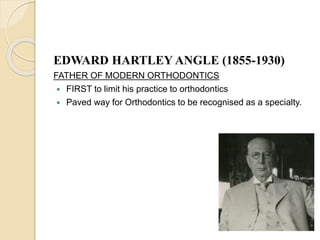
EDWARD HARTLEY ANGLE (1855-1930)
FATHER OF MODERN ORTHODONTICS
 FIRST to limit his practice to orthodontics
 Paved way for Orthodontics to be recognised as a specialty.
 1887 - At the Ninth International Medical
Congress in Washington, DC, called for the
separation of orthodontics from dentistry.
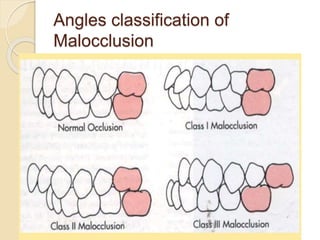
 1899 - Angle’s Classification of Malocclusion
published in Dental Cosmos.
 1900 – Founded the first postgraduate school
of orthodontics (Angle School of Orthodontia).
 1907 - Founded the first orthodontic journal,
The American Orthodontist.
Angles classification of
Malocclusion
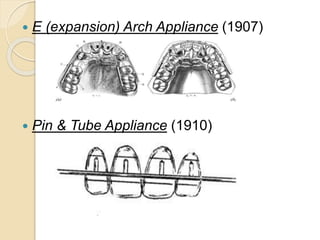
 E (expansion) Arch Appliance (1907)
 Pin & Tube Appliance (1910)
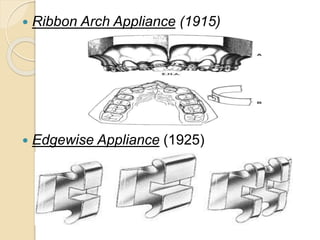
 Ribbon Arch Appliance (1915)
 Edgewise Appliance (1925)
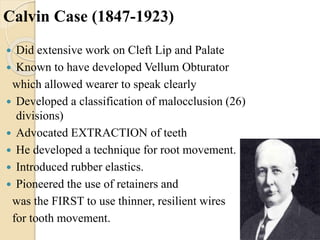
Calvin Case (1847-1923)
 Did extensive work on Cleft Lip and Palate
 Known to have developed Vellum Obturator
which allowed wearer to speak clearly
 Developed a classification of malocclusion (26)
divisions)
 Advocated EXTRACTION of teeth
 He developed a technique for root movement.
 Introduced rubber elastics.
 Pioneered the use of retainers and
was the FIRST to use thinner, resilient wires
for tooth movement.
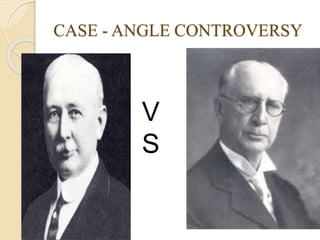
CASE - ANGLE CONTROVERSY
V
S
TO EXTRACT OR
NOT TO EXTRACT?
EXTRACTION v/s NON-EXTRACTION
 In 1911, at the Annual meeting of ADA, the
GREAT EXTRACTION DEBATE took place
between Angle’s student Dewey and Case.
Angle’s proposal and Beliefs-
 Ideal facial esthetics would result when the
teeth are placed in ideal occlusion.
 He believed this can be achieved when the
dental arches are expanded so that all the
teeth were in ideal occlusion.
Calvin Case
 Argued that although the arches could
always be expanded so that the teeth
could be placed in alignment, neither
esthetics nor stability would be
satisfactory in the long term for many
patients.
The Result
 Angle followers won- Extraction as
treatment modality reduced greatly
between World War I & II.
From 1930s to 1970s
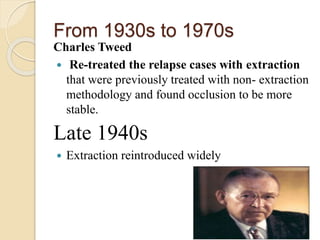
Charles Tweed
 Re-treated the relapse cases with extraction
that were previously treated with non- extraction
methodology and found occlusion to be more
stable.
Late 1940s
 Extraction reintroduced widely
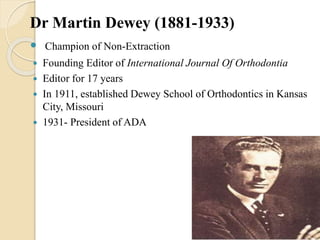
Dr Martin Dewey (1881-1933)
 Champion of Non-Extraction
 Founding Editor of International Journal Of Orthodontia
 Editor for 17 years
 In 1911, established Dewey School of Orthodontics in Kansas
City, Missouri
 1931- President of ADA
George Ainsworth (1904) –
Patented regulating appliance that used vertical tubes and
principle of loop wires.
Victor Jackson (1850-1929)-
Designed JACKSON CRIB,which incorporated finger
springs.
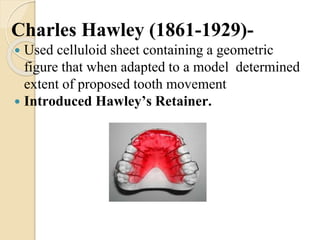
Charles Hawley (1861-1929)-
 Used celluloid sheet containing a geometric
figure that when adapted to a model determined
extent of proposed tooth movement
 Introduced Hawley’s Retainer.
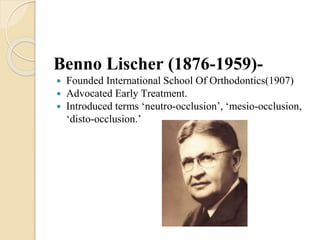
Benno Lischer (1876-1959)-
 Founded International School Of Orthodontics(1907)
 Advocated Early Treatment.
 Introduced terms ‘neutro-occlusion’, ‘mesio-occlusion,
‘disto-occlusion.’
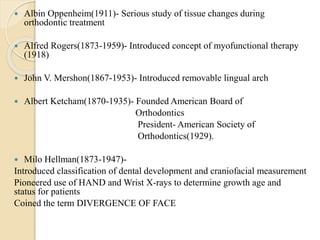
 Albin Oppenheim(1911)- Serious study of tissue changes during
orthodontic treatment
 Alfred Rogers(1873-1959)- Introduced concept of myofunctional therapy
(1918)
 John V. Mershon(1867-1953)- Introduced removable lingual arch
 Albert Ketcham(1870-1935)- Founded American Board of
Orthodontics
President- American Society of
Orthodontics(1929).
 Milo Hellman(1873-1947)-
Introduced classification of dental development and craniofacial measurement
Pioneered use of HAND and Wrist X-rays to determine growth age and
status for patients
Coined the term DIVERGENCE OF FACE
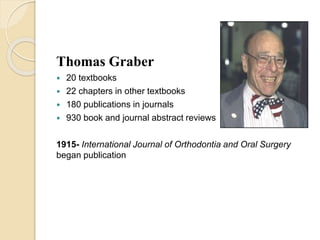
Thomas Graber
 20 textbooks
 22 chapters in other textbooks
 180 publications in journals
 930 book and journal abstract reviews
1915- International Journal of Orthodontia and Oral Surgery
began publication
1920s
 Open tube appliance- James McCoy (1922)
 Removable appliance with spring- George
Crozat (1928)
 Universal appliance- Spencer Atkinson
(combination of ribbon arch and edgewise)
 Introduction of stainless steel to appliance
fabrication- Lucien de Coster
CEPHALOMETRICS
 Pacini (1922)- Introduced method for standardised
head radiography.
 Hofrath (1931)- Introduced standardised cephalometric
technique using high-powered X-ray Machine and head
holder called CEPHALOSTAT.
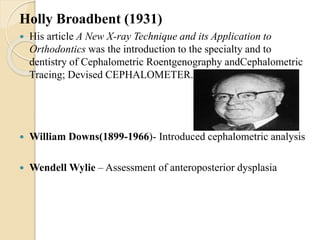
Holly Broadbent (1931)
 His article A New X-ray Technique and its Application to
Orthodontics was the introduction to the specialty and to
dentistry of Cephalometric Roentgenography andCephalometric
Tracing; Devised CEPHALOMETER.
 William Downs(1899-1966)- Introduced cephalometric analysis
 Wendell Wylie – Assessment of anteroposterior dysplasia
 Wilton Krogman(1903-1987)- Applied principles of
anthropology to dentofacial complex with Craniometry and
Cephalometry.
 Allan Brodie- Contributed to study of growth patterns of
human head.
 Weinmann and Sicher- Sutural theory of growth control.
 Joseph Jarabak- Introduced Jarabak Cephalometric Analysis.
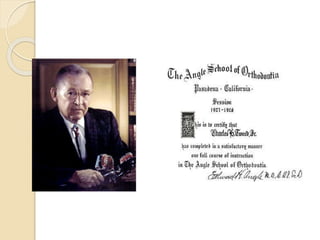
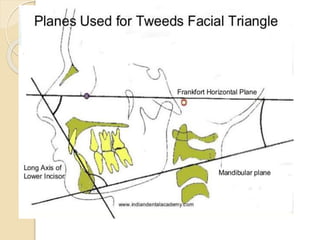
Charles Tweed (1895-1970)
• Student of Dr. Angle in Pasadena.
• Chosen by Dr. Angle in preparing Edgewise bracket for
introduction and manufacture
• Returned to Phoenix to set up FIRST pure edgewise specialty
practice in U.S
• Initially treated patients without extraction, but was discouraged
by results
• In 1940, treated 100 patients without extraction and when
treatment failed, he treated them with extraction for no additional
fee.
• Angle gave orthodontics the edgewise bracket, but Tweed gave
orthodontists a way to use it.
 Under his leadership, extraction was reintroduced in 1940-50s to
enhance facial esthetics and occlusal relationships.
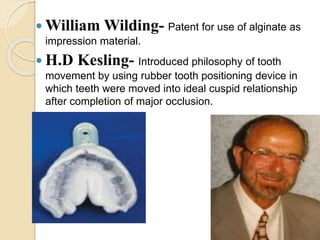
 William Wilding- Patent for use of alginate as
impression material.
 H.D Kesling- Introduced philosophy of tooth
movement by using rubber tooth positioning device in
which teeth were moved into ideal cuspid relationship
after completion of major occlusion.
ALLOYS IN
ORTHODONTICS
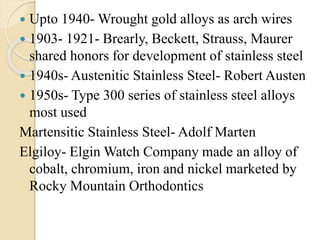
 Upto 1940- Wrought gold alloys as arch wires
 1903- 1921- Brearly, Beckett, Strauss, Maurer
shared honors for development of stainless steel
 1940s- Austenitic Stainless Steel- Robert Austen
 1950s- Type 300 series of stainless steel alloys
most used
Martensitic Stainless Steel- Adolf Marten
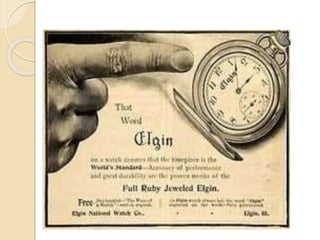
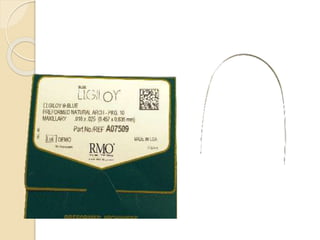
Elgiloy- Elgin Watch Company made an alloy of
cobalt, chromium, iron and nickel marketed by
Rocky Mountain Orthodontics
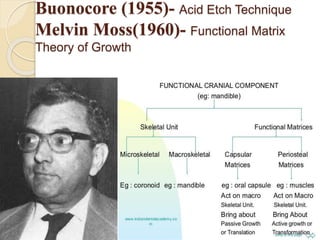
Buonocore (1955)- Acid Etch Technique
Melvin Moss(1960)- Functional Matrix
Theory of Growth
 Newmann (1965)- Introduced Bonding.
 Wilson and Kent (1972)- Intoduced
Glass Ionomer Cement.
 Majjer and Smith (1979)- Introduced
crystal growth theory to promote
bonding (sulfated polyacrylic acid).
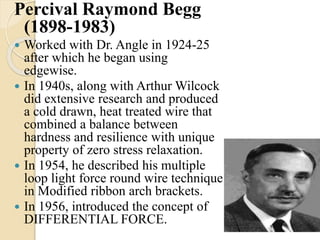
Percival Raymond Begg
(1898-1983)
 Worked with Dr. Angle in 1924-25
after which he began using
edgewise.
 In 1940s, along with Arthur Wilcock
did extensive research and produced
a cold drawn, heat treated wire that
combined a balance between
hardness and resilience with unique
property of zero stress relaxation.
 In 1954, he described his multiple
loop light force round wire technique
in Modified ribbon arch brackets.
 In 1956, introduced the concept of
DIFFERENTIAL FORCE.
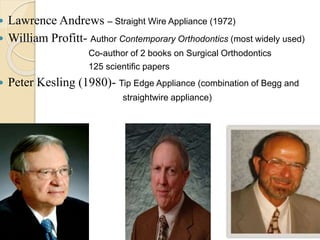
 Lawrence Andrews – Straight Wire Appliance (1972)
 William Profitt- Author Contemporary Orthodontics (most widely used)
Co-author of 2 books on Surgical Orthodontics
125 scientific papers
 Peter Kesling (1980)- Tip Edge Appliance (combination of Begg and
straightwire appliance)
History of Archwire
 George Andreasen (1970s)- Nitinol
 Burstone (1980)- TMA (stabilised beta phase
titanium alloy)
 Tien Hua Cheng (1985)- Chinese NiTi
 Miura F et al (1986)- Japanese NiTi
 Rohit Sachdeva – Copper NiTi
 A.J Wilcock- alpha phase titanium wire
 Rohit Sachdeva- Titanium-Neobium finishing
archwire
 Deva Devanathan- Timolium
 Talass (1992)- Optiflex
Removable
Appliances
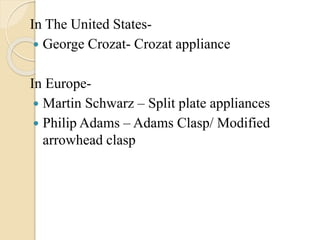
In The United States-
 George Crozat- Crozat appliance
In Europe-
 Martin Schwarz – Split plate appliances
 Philip Adams – Adams Clasp/ Modified
arrowhead clasp
Functional
Appliances
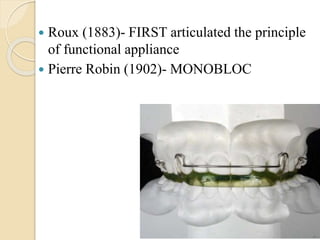
 Roux (1883)- FIRST articulated the principle
of functional appliance
 Pierre Robin (1902)- MONOBLOC
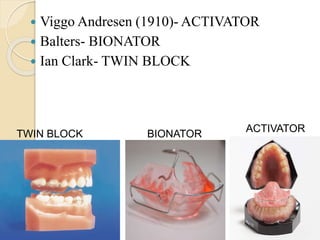
 Viggo Andresen (1910)- ACTIVATOR
 Balters- BIONATOR
 Ian Clark- TWIN BLOCK
ACTIVATOR
TWIN BLOCK BIONATOR
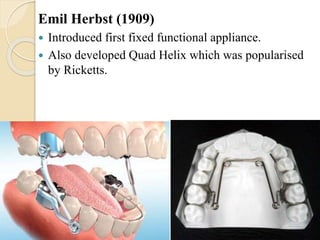
Emil Herbst (1909)
 Introduced first fixed functional appliance.
 Also developed Quad Helix which was popularised
by Ricketts.
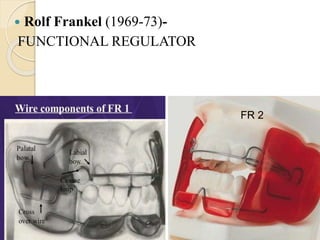
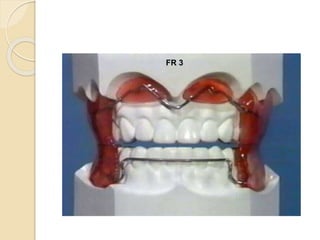
 Rolf Frankel (1969-73)-
FUNCTIONAL REGULATOR
FR 2
FR 3
HISTORY OF FIXED
ORTHODONTIC
APPLIANCES
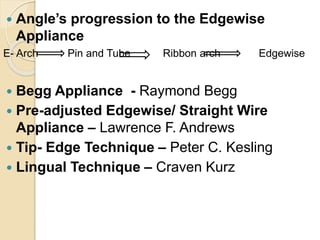
 Angle’s progression to the Edgewise
Appliance
E- Arch Pin and Tube Ribbon arch Edgewise
 Begg Appliance - Raymond Begg
 Pre-adjusted Edgewise/ Straight Wire
Appliance – Lawrence F. Andrews
 Tip- Edge Technique – Peter C. Kesling
 Lingual Technique – Craven Kurz
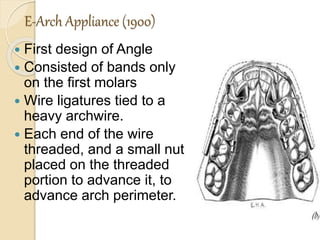
E-Arch Appliance (1900)
 First design of Angle
 Consisted of bands only
on the first molars
 Wire ligatures tied to a
heavy archwire.
 Each end of the wire
threaded, and a small nut
placed on the threaded
portion to advance it, to
advance arch perimeter.
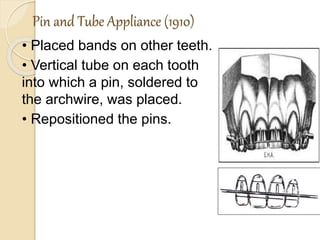
Pin and Tube Appliance (1910)
• Placed bands on other teeth.
• Vertical tube on each tooth
into which a pin, soldered to
the archwire, was placed.
• Repositioned the pins.
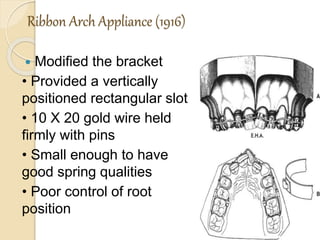
Ribbon Arch Appliance (1916)
 Modified the bracket
• Provided a vertically
positioned rectangular slot
• 10 X 20 gold wire held
firmly with pins
• Small enough to have
good spring qualities
• Poor control of root
position
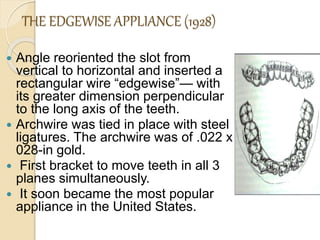
THE EDGEWISE APPLIANCE (1928)
 Angle reoriented the slot from
vertical to horizontal and inserted a
rectangular wire “edgewise”— with
its greater dimension perpendicular
to the long axis of the teeth.
 Archwire was tied in place with steel
ligatures. The archwire was of .022 x
028-in gold.
 First bracket to move teeth in all 3
planes simultaneously.
 It soon became the most popular
appliance in the United States.
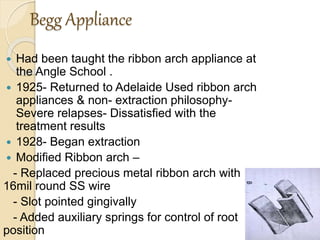
Begg Appliance
 Had been taught the ribbon arch appliance at
the Angle School .
 1925- Returned to Adelaide Used ribbon arch
appliances & non- extraction philosophy-
Severe relapses- Dissatisfied with the
treatment results
 1928- Began extraction
 Modified Ribbon arch –
- Replaced precious metal ribbon arch with
16mil round SS wire
- Slot pointed gingivally
- Added auxiliary springs for control of root
position
Straight Wire Appliance (1970s)
 Lawrence F Andrews – 6 keys of occlusion
 Modification of edgewise appliance
 Rectangular slots similar to edgewise
 Pre-programmed brackets
 No need for complex wire bending
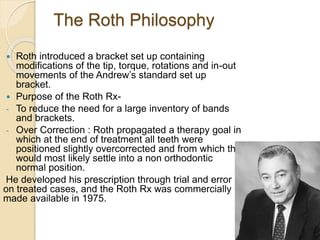
The Roth Philosophy
 Roth introduced a bracket set up containing
modifications of the tip, torque, rotations and in-out
movements of the Andrew’s standard set up
bracket.
 Purpose of the Roth Rx-
- To reduce the need for a large inventory of bands
and brackets.
- Over Correction : Roth propagated a therapy goal in
which at the end of treatment all teeth were
positioned slightly overcorrected and from which the
would most likely settle into a non orthodontic
normal position.
He developed his prescription through trial and error
on treated cases, and the Roth Rx was commercially
made available in 1975.
MBT
•Mclaughlin, Bennett and Trevisi redesigned the
entire standard bracket system to complement their
proven treatment philosophy and to overcome the
inadequacies of SWA.
•They re-examined Andrew’s original findings and
took into account additional research input from
Japanese sources.
•This 3rd generation bracket system is designed for
use with light continuous forces,
lacebacks,bendbacks and sliding mechanics.
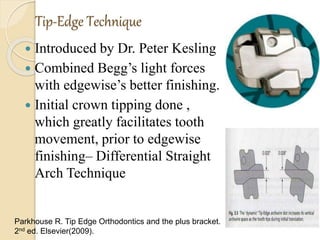
Tip-Edge Technique
 Introduced by Dr. Peter Kesling
 Combined Begg’s light forces
with edgewise’s better finishing.
 Initial crown tipping done ,
which greatly facilitates tooth
movement, prior to edgewise
finishing– Differential Straight
Arch Technique
Parkhouse R. Tip Edge Orthodontics and the plus bracket.
2nd ed. Elsevier(2009).
Alexander (1978)
 "Vari" - variety of bracket types used.
 "Simplex" related to the concept of
keeping all aspects of the discipline as
simple as possible.
 Arch wire fabrication and the incorporation
of many aspects of treatment options into
the brackets (ie, elastics hooks and
rotational wings on the brackets) added up
to the "simplex" concept.
 Based on edgewise philosophy.
Contribution of
Indians
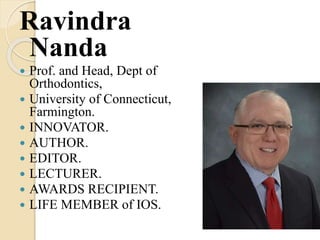
Ravindra
Nanda
 Prof. and Head, Dept of
Orthodontics,
 University of Connecticut,
Farmington.
 INNOVATOR.
 AUTHOR.
 EDITOR.
 LECTURER.
 AWARDS RECIPIENT.
 LIFE MEMBER of IOS.
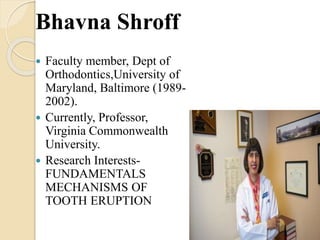
Bhavna Shroff
 Faculty member, Dept of
Orthodontics,University of
Maryland, Baltimore (1989-
2002).
 Currently, Professor,
Virginia Commonwealth
University.
 Research Interests-
FUNDAMENTALS
MECHANISMS OF
TOOTH ERUPTION