


DIAGNOSTIC AIDS –
STUDY MODELS
Dr. Miliya Parveen & Dr. Karuna Elza
Oommen
CONTENTS
 Introduction
 Essential Diagnostic Aids
 Supplemental Diagnostic
Aids
 Study Cast Analysis
 Dental Arch Width
 Pont’s Index
 Anterior Dental Arch
Length
 Korkhaus’ Analysis
 Intramaxillary Symmetry
 Palatal Height
 Analysis Of Supporting
Zones
 Space Analysis
 Nance Analysis
 Lundstrom Segmental
Analysis
 Analysis In The Vertical
Plane
 Bolton Analysis
 Analysis Of The Apical
Base
INTRODUCTION
 Diagnosis in orthodontics, as in other
disciplines of dentistry and medicine, requires
the collection of an adequate database of
information about the patient’s problems.
 Comprehensive orthodontic diagnosis is
established by use of certain clinical
implements called diagnostic aids.
 Orthodontic diagnostic aids are of two types.
 They are the ESSENTIAL DIAGNOSTIC AIDS
and the SUPPLEMENTAL DIAGNOSTIC
AIDS.
ESSENTIAL DIAGNOSTIC
AIDS
 They are clinical aids that are considered very
important for all cases.
• Case history
• Study models
• Peri-apical radiographs
• Bite wing
• Panoramic
• Lateral ceph
• Facial photographs
SUPPLEMENTAL
DIAGNOSTIC AIDS
 Specialized radiographs
• Cephalometric radiographs
• Occlusal intra- oral films
• Selected lateral jaw views
• Cone shift technique
 Electro-myographic examination of muscle activity
 Hand-wrist radiographs
 Endocrine tests
 Estimation of basal metabolic rate
 Diagnostic setup
 Occlusograms
STUDY CAST ANALYSIS
 Important method of evaluation for orthodontic
diagnosis and treatment planning.
 Advantage - degree of malocclusions can be
diagnosed in three dimensions
 Disadvantage - concerns correlation analyses
(tooth size asses the width and length of the
dental arches) so is not correlated with other
important diagnostic criteria (radiographs) →
minimal diagnostic value
DENTAL ARCH WIDTH
1. Sum Of The Incisors
 The standard values of the transverse arch
width in the premolar and molar region depend
on the mesiodistal size of the four upper
incisors
 Comparing the ideal value with the actual
value – narrow or broad.
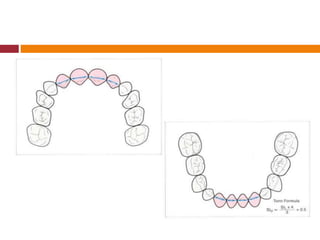
 The sum of the upper incisor width Slu has to
be calculated with the help of the Tonn
Formula, using the sum of the lower incisor
width.
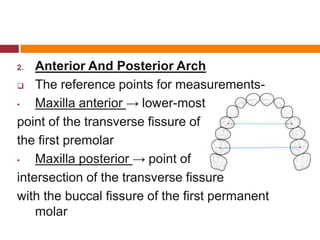
2. Anterior And Posterior Arch
 The reference points for measurements-
• Maxilla anterior → lower-most
point of the transverse fissure of
the first premolar
• Maxilla posterior → point of
intersection of the transverse fissure
with the buccal fissure of the first permanent
molar
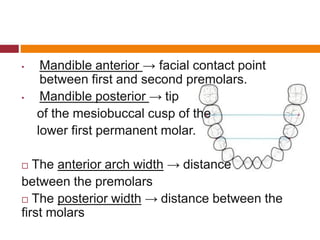
• Mandible anterior → facial contact point
between first and second premolars.
• Mandible posterior → tip
of the mesiobuccal cusp of the
lower first permanent molar.
 The anterior arch width → distance
between the premolars
 The posterior width → distance between the
first molars
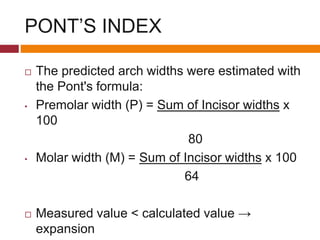
PONT’S INDEX
 The predicted arch widths were estimated with
the Pont's formula:
• Premolar width (P) = Sum of Incisor widths x
100
80
• Molar width (M) = Sum of Incisor widths x 100
64
 Measured value < calculated value →
expansion
ANTERIOR DENTAL ARCH
LENGTH
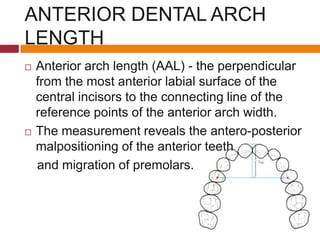
 Anterior arch length (AAL) - the perpendicular
from the most anterior labial surface of the
central incisors to the connecting line of the
reference points of the anterior arch width.
 The measurement reveals the antero-posterior
malpositioning of the anterior teeth
and migration of premolars.
KORKHAUS’ ANALYSIS
 The mesiodistal widths of maxillary incisors are
measured and added (SIu).
 The available anterior arch length (AAAL) is compared
with ideal anterior arch length.
 Ideal anterior arch length = Siu x 100
160
 AAAL > IAAL → the maxillary CIs anteriorly
malpositioned, bimaxillary protrusion or distoversion of
premolars.
 AAAL < IAAL → the maxillary CIs posteriorly
malpositioned, Class II division 2 malocclusion or
mesioversion of premolars.
INTRAMAXILLARY
SYMMETRY
 Intramaxillary Symmetry
— Transverse symmetry
— Anteroposterior symmetry
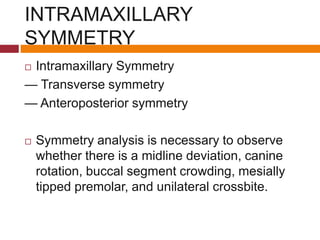
 Symmetry analysis is necessary to observe
whether there is a midline deviation, canine
rotation, buccal segment crowding, mesially
tipped premolar, and unilateral crossbite.
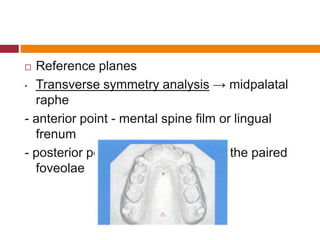
 Reference planes
• Transverse symmetry analysis → midpalatal
raphe
- anterior point - mental spine film or lingual
frenum
- posterior point - midpoint between the paired
foveolae
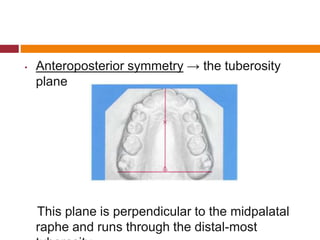
• Anteroposterior symmetry → the tuberosity
plane
This plane is perpendicular to the midpalatal
raphe and runs through the distal-most
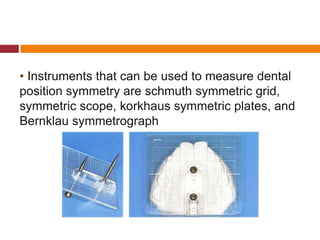
• Instruments that can be used to measure dental
position symmetry are schmuth symmetric grid,
symmetric scope, korkhaus symmetric plates, and
Bernklau symmetrograph
Analysis Of Transverse
Symmetry
 Midpalatal raphe (MPR) is the reference point
for determining transversal symmetry.
 The symmetry between right and left dental
arch can be determined and the dysharmony
of dental midline and skeletal midline is
observed.
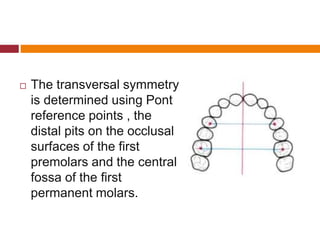
 The transversal symmetry
is determined using Pont
reference points , the
distal pits on the occlusal
surfaces of the first
premolars and the central
fossa of the first
permanent molars.
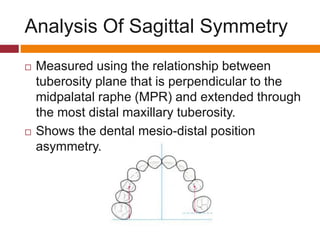
Analysis Of Sagittal Symmetry
 Measured using the relationship between
tuberosity plane that is perpendicular to the
midpalatal raphe (MPR) and extended through
the most distal maxillary tuberosity.
 Shows the dental mesio-distal position
asymmetry.
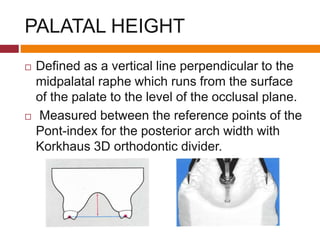
PALATAL HEIGHT
 Defined as a vertical line perpendicular to the
midpalatal raphe which runs from the surface
of the palate to the level of the occlusal plane.
 Measured between the reference points of the
Pont-index for the posterior arch width with
Korkhaus 3D orthodontic divider.
 Korkhaus ,
Palatal height index = Palatal height X 100
Posterior arch width
 Average index value is 42%
 Increased → palatal vault relative to the
transverse arch development is high - apical
narrowing of maxillary alveolar process
(chronic mouth-breathing, rickets, sucking
habits)
 Decreased → palate is shallow.
ANALYSIS OF SUPPORTING
ZONES
 Carried out in the mixed dentition period to
determine the difference between space available
and space required for unerupted permanent
canines and premolars.
 Four different methods of evaluation:
1. A prediction method based on mean values for
supporting zones
2. Proportionality tables taking into account size of the
anterior teeth
3. Radiologic methods
4. Combination of radiologic and prediction table
PREDICTION FROM PROPORTIONALITY
TABLES
The best known prediction tables for estimating the
required space of unerupted permanent canines and
first and second premolars is that of Moyers(1967). It
is used as:
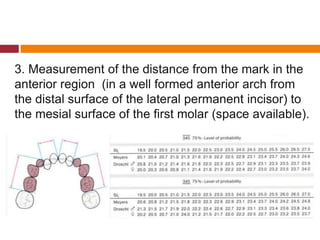
1. Determination of the sum of mesiodistal tooth width
of lower permanent incisors (SIL).
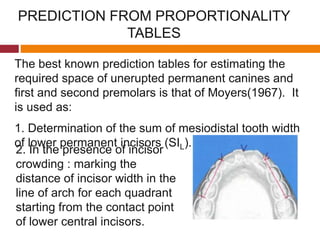
2. In the presence of incisor
crowding : marking the
distance of incisor width in the
line of arch for each quadrant
starting from the contact point
of lower central incisors.
3. Measurement of the distance from the mark in the
anterior region (in a well formed anterior arch from
the distal surface of the lateral permanent incisor) to
the mesial surface of the first molar (space available).
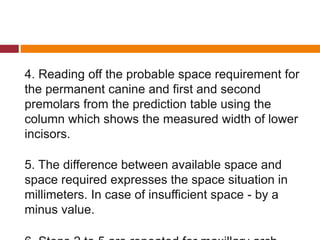
4. Reading off the probable space requirement for
the permanent canine and first and second
premolars from the prediction table using the
column which shows the measured width of lower
incisors.
5. The difference between available space and
space required expresses the space situation in
millimeters. In case of insufficient space - by a
minus value.
COMBINED RADIOLOGIC-PREDICTION TABLE
METHOD
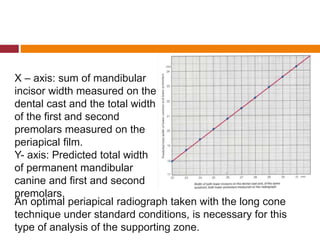
This procedure combines measurements from the
dental cast and width measurements from the
periapical radiograph.
The method of Hixon and Oldfather(1956), modified
by Staley and Kerbers(1980) is restricted to the
analyis of the supporting zone in the mandible.
The procedure is as follows:
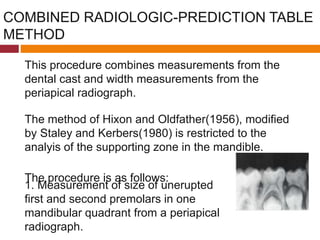
1. Measurement of size of unerupted
first and second premolars in one
mandibular quadrant from a periapical
radiograph.
2. Determination of mesiodistal tooth width of the
lower central and lateral incisors on the study cast
corresponding to the side of the radiograph.
3. After adding together both figures, the probable
width of the permanent canine and first and
second premolars for the corresponding quadrant
can be read off in the prediction graph under the
column of the calculated sum total.
An optimal periapical radiograph taken with the long cone
technique under standard conditions, is necessary for this
type of analysis of the supporting zone.
X – axis: sum of mandibular
incisor width measured on the
dental cast and the total width
of the first and second
premolars measured on the
periapical film.
Y- axis: Predicted total width
of permanent mandibular
canine and first and second
premolars.
SPACE ANALYSIS IN THE PERMANENT
DENTITION
 It is important to determine from the study casts the
amount of crowding in the maxillary and mandibular
arches for patients with malalignment resulting from
lack of space.
 The purpose is to determine the difference between
space available and space required for tooth alignment.
 Analysis can be carried out by two methods
1.Nance analysis
2.Lundstrom segmental analysis
NANCE ANALYSIS
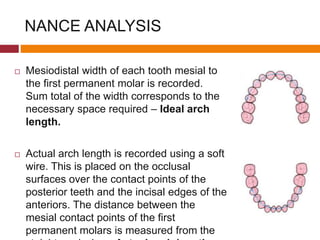
 Mesiodistal width of each tooth mesial to
the first permanent molar is recorded.
Sum total of the width corresponds to the
necessary space required – Ideal arch
length.
 Actual arch length is recorded using a soft
wire. This is placed on the occlusal
surfaces over the contact points of the
posterior teeth and the incisal edges of the
anteriors. The distance between the
mesial contact points of the first
permanent molars is measured from the
 The assessment of space relationship is the
result of the difference between the ideal and
actual arch length.
 Negative value - space deficiency
 Positive value - space excess.
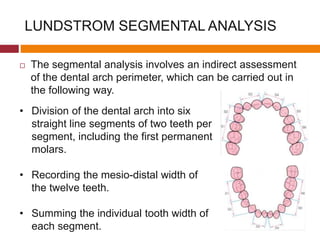
LUNDSTROM SEGMENTAL ANALYSIS
 The segmental analysis involves an indirect assessment
of the dental arch perimeter, which can be carried out in
the following way.
• Division of the dental arch into six
straight line segments of two teeth per
segment, including the first permanent
molars.
• Recording the mesio-distal width of
the twelve teeth.
• Summing the individual tooth width of
each segment.
• Recording the available mesiodistal space on
the study cast separately for each segment.
• The sum of the difference between ideal and
actual length of each segment expresses the
space relationship.
DISCREPANCY CALCULATION
Limiting the assessment of space relationships to the
analysis of study casts is insufficient in itself. The
difference between space required and the amount of
space available for alignment of the teeth is determined by
two different parameters:
 Amount of dental crowding
 Anteroposterior position of the incisors in relation to the
facial skeleton.
Comprehensive space analysis must therefore consist of a
combined analysis including measurements from the
cephalogram and study casts.
The steps in this overall discrepancy calculation in upper and
lower arches are:
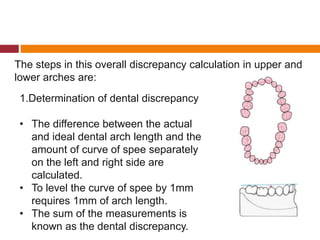
1.Determination of dental discrepancy
• The difference between the actual
and ideal dental arch length and the
amount of curve of spee separately
on the left and right side are
calculated.
• To level the curve of spee by 1mm
requires 1mm of arch length.
• The sum of the measurements is
known as the dental discrepancy.
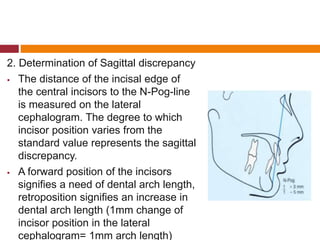
2. Determination of Sagittal discrepancy
 The distance of the incisal edge of
the central incisors to the N-Pog-line
is measured on the lateral
cephalogram. The degree to which
incisor position varies from the
standard value represents the sagittal
discrepancy.
 A forward position of the incisors
signifies a need of dental arch length,
retroposition signifies an increase in
dental arch length (1mm change of
incisor position in the lateral
cephalogram= 1mm arch length)
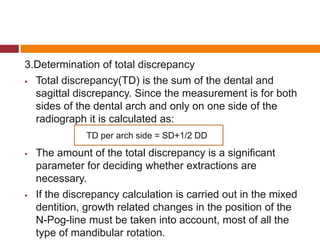
3.Determination of total discrepancy
 Total discrepancy(TD) is the sum of the dental and
sagittal discrepancy. Since the measurement is for both
sides of the dental arch and only on one side of the
radiograph it is calculated as:
 The amount of the total discrepancy is a significant
parameter for deciding whether extractions are
necessary.
 If the discrepancy calculation is carried out in the mixed
dentition, growth related changes in the position of the
N-Pog-line must be taken into account, most of all the
type of mandibular rotation.
TD per arch side = SD+1/2 DD
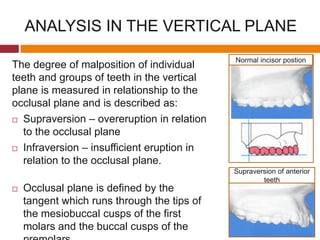
ANALYSIS IN THE VERTICAL PLANE
The degree of malposition of individual
teeth and groups of teeth in the vertical
plane is measured in relationship to the
occlusal plane and is described as:
 Supraversion – overeruption in relation
to the occlusal plane
 Infraversion – insufficient eruption in
relation to the occlusal plane.
 Occlusal plane is defined by the
tangent which runs through the tips of
the mesiobuccal cusps of the first
molars and the buccal cusps of the
Normal incisor postion
Supraversion of anterior
teeth
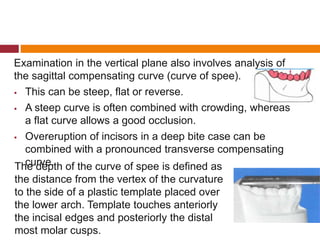
Examination in the vertical plane also involves analysis of
the sagittal compensating curve (curve of spee).
 This can be steep, flat or reverse.
 A steep curve is often combined with crowding, whereas
a flat curve allows a good occlusion.
 Overeruption of incisors in a deep bite case can be
combined with a pronounced transverse compensating
curve.The depth of the curve of spee is defined as
the distance from the vertex of the curvature
to the side of a plastic template placed over
the lower arch. Template touches anteriorly
the incisal edges and posteriorly the distal
most molar cusps.
BOLTON ANALYSIS
 The Bolton analysis (Bolton, 1958) determines the ratio
of the mesiodistal widths of the maxillary versus the
mandibular teeth (i.e., tooth size discrepancy).
 In the analysis of the overall ratio the relationship of the
12 mandibular teeth to the 12 maxillary teeth is
assessed (second and third molars are excluded).
 On account of the importance for the canine relations as
well as for overbite and overjet relationships, a further
analysis is performed to evaluate the ratio between the
six upper and lower anterior teeth (anterior ratio).
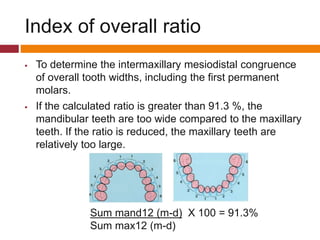
 To determine the intermaxillary mesiodistal congruence
of overall tooth widths, including the first permanent
molars.
 If the calculated ratio is greater than 91.3 %, the
mandibular teeth are too wide compared to the maxillary
teeth. If the ratio is reduced, the maxillary teeth are
relatively too large.
Sum mand12 (m-d) X 100 = 91.3%
Sum max12 (m-d)
Index of overall ratio
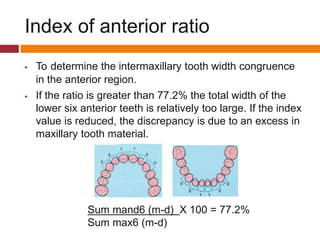
Index of anterior ratio
 To determine the intermaxillary tooth width congruence
in the anterior region.
 If the ratio is greater than 77.2% the total width of the
lower six anterior teeth is relatively too large. If the index
value is reduced, the discrepancy is due to an excess in
maxillary tooth material.
Sum mand6 (m-d) X 100 = 77.2%
Sum max6 (m-d)
In the maxillary arch
 Increased overbite
 Increased overjet
 Crowding in the maxillary arch
 Spacing in the mandibular arch
 Linguoversion of upper incisors
 Labioversion of lower incisors
Excessive mesiodistal tooth
material
In the mandibular arch
 Reduced overbite
 Reduced overjet
 Crowding in the mandibular arch
 Spacing in the maxillary arch
 Labioversion of upper incisors
 Linguoversion of lower incisors
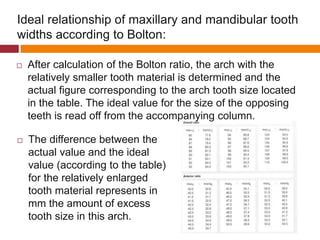
Ideal relationship of maxillary and mandibular tooth
widths according to Bolton:
 The difference between the
actual value and the ideal
value (according to the table)
for the relatively enlarged
tooth material represents in
mm the amount of excess
tooth size in this arch.
 After calculation of the Bolton ratio, the arch with the
relatively smaller tooth material is determined and the
actual figure corresponding to the arch tooth size located
in the table. The ideal value for the size of the opposing
teeth is read off from the accompanying column.
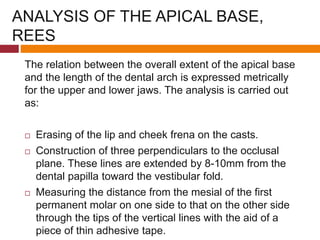
ANALYSIS OF THE APICAL BASE,
REES
The relation between the overall extent of the apical base
and the length of the dental arch is expressed metrically
for the upper and lower jaws. The analysis is carried out
as:
 Erasing of the lip and cheek frena on the casts.
 Construction of three perpendiculars to the occlusal
plane. These lines are extended by 8-10mm from the
dental papilla toward the vestibular fold.
 Measuring the distance from the mesial of the first
permanent molar on one side to that on the other side
through the tips of the vertical lines with the aid of a
piece of thin adhesive tape.
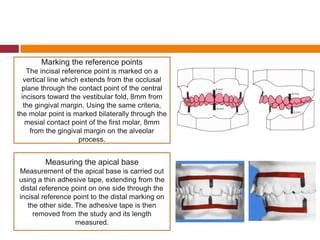
Marking the reference points
The incisal reference point is marked on a
vertical line which extends from the occlusal
plane through the contact point of the central
incisors toward the vestibular fold, 8mm from
the gingival margin. Using the same criteria,
the molar point is marked bilaterally through the
mesial contact point of the first molar, 8mm
from the gingival margin on the alveolar
process.
Measuring the apical base
Measurement of the apical base is carried out
using a thin adhesive tape, extending from the
distal reference point on one side through the
incisal reference point to the distal marking on
the other side. The adhesive tape is then
removed from the study and its length
measured.
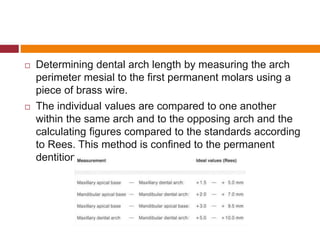
 Determining dental arch length by measuring the arch
perimeter mesial to the first permanent molars using a
piece of brass wire.
 The individual values are compared to one another
within the same arch and to the opposing arch and the
calculating figures compared to the standards according
to Rees. This method is confined to the permanent
dentition.
EXAMINATION OF OCCLUSION
The three dimensional analysis estimates the intermaxillary
relationship between the upper and lower dental arches in
habitual occlusion.
 Transverse malocclusions
• Anterior: Anterior crossbite, skeletal mandibular shift
• Posterior: Posterior crossbite(unilateral, bilateral), non
occlusion (buccal, lingual)
 Anteroposterior malocclusions
• Anterior: Increased overjet, negative overjet
• Posterior: Distocclusion, mesiocclusion
 Vertical malocclusions
• Unsupported overbite, deep bite(dentally/ gingivally
supported), open bite(anterior, lateral,complex)
When examining the occlusion , distinction has to be made
between the occlusal and maxillomandibular relationships.
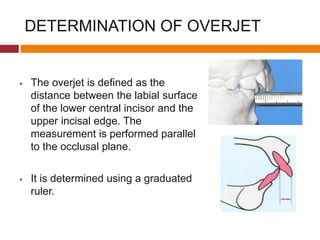
 The overjet is defined as the
distance between the labial surface
of the lower central incisor and the
upper incisal edge. The
measurement is performed parallel
to the occlusal plane.
 It is determined using a graduated
ruler.
DETERMINATION OF OVERJET
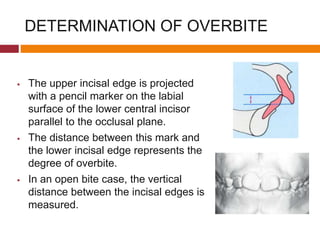
 The upper incisal edge is projected
with a pencil marker on the labial
surface of the lower central incisor
parallel to the occlusal plane.
 The distance between this mark and
the lower incisal edge represents the
degree of overbite.
 In an open bite case, the vertical
distance between the incisal edges is
measured.
DETERMINATION OF OVERBITE
Study models in Orthodontics

Study models in Orthodontics

  • 1.
    DIAGNOSTIC AIDS – STUDYMODELS Dr. Miliya Parveen & Dr. Karuna Elza Oommen
  • 2.
    CONTENTS  Introduction  EssentialDiagnostic Aids  Supplemental Diagnostic Aids  Study Cast Analysis  Dental Arch Width  Pont’s Index  Anterior Dental Arch Length  Korkhaus’ Analysis  Intramaxillary Symmetry  Palatal Height  Analysis Of Supporting Zones  Space Analysis  Nance Analysis  Lundstrom Segmental Analysis  Analysis In The Vertical Plane  Bolton Analysis  Analysis Of The Apical Base
  • 3.
    INTRODUCTION  Diagnosis inorthodontics, as in other disciplines of dentistry and medicine, requires the collection of an adequate database of information about the patient’s problems.  Comprehensive orthodontic diagnosis is established by use of certain clinical implements called diagnostic aids.
  • 4.
     Orthodontic diagnosticaids are of two types.  They are the ESSENTIAL DIAGNOSTIC AIDS and the SUPPLEMENTAL DIAGNOSTIC AIDS.
  • 5.
    ESSENTIAL DIAGNOSTIC AIDS  Theyare clinical aids that are considered very important for all cases. • Case history • Study models • Peri-apical radiographs • Bite wing • Panoramic • Lateral ceph • Facial photographs
  • 6.
    SUPPLEMENTAL DIAGNOSTIC AIDS  Specializedradiographs • Cephalometric radiographs • Occlusal intra- oral films • Selected lateral jaw views • Cone shift technique  Electro-myographic examination of muscle activity  Hand-wrist radiographs  Endocrine tests  Estimation of basal metabolic rate  Diagnostic setup  Occlusograms
  • 7.
    STUDY CAST ANALYSIS Important method of evaluation for orthodontic diagnosis and treatment planning.  Advantage - degree of malocclusions can be diagnosed in three dimensions  Disadvantage - concerns correlation analyses (tooth size asses the width and length of the dental arches) so is not correlated with other important diagnostic criteria (radiographs) → minimal diagnostic value
  • 8.
    DENTAL ARCH WIDTH 1.Sum Of The Incisors  The standard values of the transverse arch width in the premolar and molar region depend on the mesiodistal size of the four upper incisors  Comparing the ideal value with the actual value – narrow or broad.  The sum of the upper incisor width Slu has to be calculated with the help of the Tonn Formula, using the sum of the lower incisor width.
  • 10.
    2. Anterior AndPosterior Arch  The reference points for measurements- • Maxilla anterior → lower-most point of the transverse fissure of the first premolar • Maxilla posterior → point of intersection of the transverse fissure with the buccal fissure of the first permanent molar
  • 11.
    • Mandible anterior→ facial contact point between first and second premolars. • Mandible posterior → tip of the mesiobuccal cusp of the lower first permanent molar.  The anterior arch width → distance between the premolars  The posterior width → distance between the first molars
  • 12.
    PONT’S INDEX  Thepredicted arch widths were estimated with the Pont's formula: • Premolar width (P) = Sum of Incisor widths x 100 80 • Molar width (M) = Sum of Incisor widths x 100 64  Measured value < calculated value → expansion
  • 13.
    ANTERIOR DENTAL ARCH LENGTH Anterior arch length (AAL) - the perpendicular from the most anterior labial surface of the central incisors to the connecting line of the reference points of the anterior arch width.  The measurement reveals the antero-posterior malpositioning of the anterior teeth and migration of premolars.
  • 14.
    KORKHAUS’ ANALYSIS  Themesiodistal widths of maxillary incisors are measured and added (SIu).  The available anterior arch length (AAAL) is compared with ideal anterior arch length.  Ideal anterior arch length = Siu x 100 160  AAAL > IAAL → the maxillary CIs anteriorly malpositioned, bimaxillary protrusion or distoversion of premolars.  AAAL < IAAL → the maxillary CIs posteriorly malpositioned, Class II division 2 malocclusion or mesioversion of premolars.
  • 15.
    INTRAMAXILLARY SYMMETRY  Intramaxillary Symmetry —Transverse symmetry — Anteroposterior symmetry  Symmetry analysis is necessary to observe whether there is a midline deviation, canine rotation, buccal segment crowding, mesially tipped premolar, and unilateral crossbite.
  • 16.
     Reference planes •Transverse symmetry analysis → midpalatal raphe - anterior point - mental spine film or lingual frenum - posterior point - midpoint between the paired foveolae
  • 17.
    • Anteroposterior symmetry→ the tuberosity plane This plane is perpendicular to the midpalatal raphe and runs through the distal-most
  • 18.
    • Instruments thatcan be used to measure dental position symmetry are schmuth symmetric grid, symmetric scope, korkhaus symmetric plates, and Bernklau symmetrograph
  • 19.
    Analysis Of Transverse Symmetry Midpalatal raphe (MPR) is the reference point for determining transversal symmetry.  The symmetry between right and left dental arch can be determined and the dysharmony of dental midline and skeletal midline is observed.
  • 20.
     The transversalsymmetry is determined using Pont reference points , the distal pits on the occlusal surfaces of the first premolars and the central fossa of the first permanent molars.
  • 21.
    Analysis Of SagittalSymmetry  Measured using the relationship between tuberosity plane that is perpendicular to the midpalatal raphe (MPR) and extended through the most distal maxillary tuberosity.  Shows the dental mesio-distal position asymmetry.
  • 22.
    PALATAL HEIGHT  Definedas a vertical line perpendicular to the midpalatal raphe which runs from the surface of the palate to the level of the occlusal plane.  Measured between the reference points of the Pont-index for the posterior arch width with Korkhaus 3D orthodontic divider.
  • 23.
     Korkhaus , Palatalheight index = Palatal height X 100 Posterior arch width  Average index value is 42%  Increased → palatal vault relative to the transverse arch development is high - apical narrowing of maxillary alveolar process (chronic mouth-breathing, rickets, sucking habits)  Decreased → palate is shallow.
  • 24.
    ANALYSIS OF SUPPORTING ZONES Carried out in the mixed dentition period to determine the difference between space available and space required for unerupted permanent canines and premolars.  Four different methods of evaluation: 1. A prediction method based on mean values for supporting zones 2. Proportionality tables taking into account size of the anterior teeth 3. Radiologic methods 4. Combination of radiologic and prediction table
  • 25.
    PREDICTION FROM PROPORTIONALITY TABLES Thebest known prediction tables for estimating the required space of unerupted permanent canines and first and second premolars is that of Moyers(1967). It is used as: 1. Determination of the sum of mesiodistal tooth width of lower permanent incisors (SIL). 2. In the presence of incisor crowding : marking the distance of incisor width in the line of arch for each quadrant starting from the contact point of lower central incisors.
  • 26.
    3. Measurement ofthe distance from the mark in the anterior region (in a well formed anterior arch from the distal surface of the lateral permanent incisor) to the mesial surface of the first molar (space available).
  • 27.
    4. Reading offthe probable space requirement for the permanent canine and first and second premolars from the prediction table using the column which shows the measured width of lower incisors. 5. The difference between available space and space required expresses the space situation in millimeters. In case of insufficient space - by a minus value.
  • 28.
    COMBINED RADIOLOGIC-PREDICTION TABLE METHOD Thisprocedure combines measurements from the dental cast and width measurements from the periapical radiograph. The method of Hixon and Oldfather(1956), modified by Staley and Kerbers(1980) is restricted to the analyis of the supporting zone in the mandible. The procedure is as follows: 1. Measurement of size of unerupted first and second premolars in one mandibular quadrant from a periapical radiograph.
  • 29.
    2. Determination ofmesiodistal tooth width of the lower central and lateral incisors on the study cast corresponding to the side of the radiograph. 3. After adding together both figures, the probable width of the permanent canine and first and second premolars for the corresponding quadrant can be read off in the prediction graph under the column of the calculated sum total.
  • 30.
    An optimal periapicalradiograph taken with the long cone technique under standard conditions, is necessary for this type of analysis of the supporting zone. X – axis: sum of mandibular incisor width measured on the dental cast and the total width of the first and second premolars measured on the periapical film. Y- axis: Predicted total width of permanent mandibular canine and first and second premolars.
  • 31.
    SPACE ANALYSIS INTHE PERMANENT DENTITION  It is important to determine from the study casts the amount of crowding in the maxillary and mandibular arches for patients with malalignment resulting from lack of space.  The purpose is to determine the difference between space available and space required for tooth alignment.  Analysis can be carried out by two methods 1.Nance analysis 2.Lundstrom segmental analysis
  • 32.
    NANCE ANALYSIS  Mesiodistalwidth of each tooth mesial to the first permanent molar is recorded. Sum total of the width corresponds to the necessary space required – Ideal arch length.  Actual arch length is recorded using a soft wire. This is placed on the occlusal surfaces over the contact points of the posterior teeth and the incisal edges of the anteriors. The distance between the mesial contact points of the first permanent molars is measured from the
  • 33.
     The assessmentof space relationship is the result of the difference between the ideal and actual arch length.  Negative value - space deficiency  Positive value - space excess.
  • 34.
    LUNDSTROM SEGMENTAL ANALYSIS The segmental analysis involves an indirect assessment of the dental arch perimeter, which can be carried out in the following way. • Division of the dental arch into six straight line segments of two teeth per segment, including the first permanent molars. • Recording the mesio-distal width of the twelve teeth. • Summing the individual tooth width of each segment.
  • 35.
    • Recording theavailable mesiodistal space on the study cast separately for each segment. • The sum of the difference between ideal and actual length of each segment expresses the space relationship.
  • 36.
    DISCREPANCY CALCULATION Limiting theassessment of space relationships to the analysis of study casts is insufficient in itself. The difference between space required and the amount of space available for alignment of the teeth is determined by two different parameters:  Amount of dental crowding  Anteroposterior position of the incisors in relation to the facial skeleton. Comprehensive space analysis must therefore consist of a combined analysis including measurements from the cephalogram and study casts.
  • 37.
    The steps inthis overall discrepancy calculation in upper and lower arches are: 1.Determination of dental discrepancy • The difference between the actual and ideal dental arch length and the amount of curve of spee separately on the left and right side are calculated. • To level the curve of spee by 1mm requires 1mm of arch length. • The sum of the measurements is known as the dental discrepancy.
  • 38.
    2. Determination ofSagittal discrepancy  The distance of the incisal edge of the central incisors to the N-Pog-line is measured on the lateral cephalogram. The degree to which incisor position varies from the standard value represents the sagittal discrepancy.  A forward position of the incisors signifies a need of dental arch length, retroposition signifies an increase in dental arch length (1mm change of incisor position in the lateral cephalogram= 1mm arch length)
  • 39.
    3.Determination of totaldiscrepancy  Total discrepancy(TD) is the sum of the dental and sagittal discrepancy. Since the measurement is for both sides of the dental arch and only on one side of the radiograph it is calculated as:  The amount of the total discrepancy is a significant parameter for deciding whether extractions are necessary.  If the discrepancy calculation is carried out in the mixed dentition, growth related changes in the position of the N-Pog-line must be taken into account, most of all the type of mandibular rotation. TD per arch side = SD+1/2 DD
  • 40.
    ANALYSIS IN THEVERTICAL PLANE The degree of malposition of individual teeth and groups of teeth in the vertical plane is measured in relationship to the occlusal plane and is described as:  Supraversion – overeruption in relation to the occlusal plane  Infraversion – insufficient eruption in relation to the occlusal plane.  Occlusal plane is defined by the tangent which runs through the tips of the mesiobuccal cusps of the first molars and the buccal cusps of the Normal incisor postion Supraversion of anterior teeth
  • 41.
    Examination in thevertical plane also involves analysis of the sagittal compensating curve (curve of spee).  This can be steep, flat or reverse.  A steep curve is often combined with crowding, whereas a flat curve allows a good occlusion.  Overeruption of incisors in a deep bite case can be combined with a pronounced transverse compensating curve.The depth of the curve of spee is defined as the distance from the vertex of the curvature to the side of a plastic template placed over the lower arch. Template touches anteriorly the incisal edges and posteriorly the distal most molar cusps.
  • 42.
    BOLTON ANALYSIS  TheBolton analysis (Bolton, 1958) determines the ratio of the mesiodistal widths of the maxillary versus the mandibular teeth (i.e., tooth size discrepancy).  In the analysis of the overall ratio the relationship of the 12 mandibular teeth to the 12 maxillary teeth is assessed (second and third molars are excluded).  On account of the importance for the canine relations as well as for overbite and overjet relationships, a further analysis is performed to evaluate the ratio between the six upper and lower anterior teeth (anterior ratio).
  • 43.
     To determinethe intermaxillary mesiodistal congruence of overall tooth widths, including the first permanent molars.  If the calculated ratio is greater than 91.3 %, the mandibular teeth are too wide compared to the maxillary teeth. If the ratio is reduced, the maxillary teeth are relatively too large. Sum mand12 (m-d) X 100 = 91.3% Sum max12 (m-d) Index of overall ratio
  • 44.
    Index of anteriorratio  To determine the intermaxillary tooth width congruence in the anterior region.  If the ratio is greater than 77.2% the total width of the lower six anterior teeth is relatively too large. If the index value is reduced, the discrepancy is due to an excess in maxillary tooth material. Sum mand6 (m-d) X 100 = 77.2% Sum max6 (m-d)
  • 45.
    In the maxillaryarch  Increased overbite  Increased overjet  Crowding in the maxillary arch  Spacing in the mandibular arch  Linguoversion of upper incisors  Labioversion of lower incisors Excessive mesiodistal tooth material
  • 46.
    In the mandibulararch  Reduced overbite  Reduced overjet  Crowding in the mandibular arch  Spacing in the maxillary arch  Labioversion of upper incisors  Linguoversion of lower incisors
  • 47.
    Ideal relationship ofmaxillary and mandibular tooth widths according to Bolton:  The difference between the actual value and the ideal value (according to the table) for the relatively enlarged tooth material represents in mm the amount of excess tooth size in this arch.  After calculation of the Bolton ratio, the arch with the relatively smaller tooth material is determined and the actual figure corresponding to the arch tooth size located in the table. The ideal value for the size of the opposing teeth is read off from the accompanying column.
  • 48.
    ANALYSIS OF THEAPICAL BASE, REES The relation between the overall extent of the apical base and the length of the dental arch is expressed metrically for the upper and lower jaws. The analysis is carried out as:  Erasing of the lip and cheek frena on the casts.  Construction of three perpendiculars to the occlusal plane. These lines are extended by 8-10mm from the dental papilla toward the vestibular fold.  Measuring the distance from the mesial of the first permanent molar on one side to that on the other side through the tips of the vertical lines with the aid of a piece of thin adhesive tape.
  • 49.
    Marking the referencepoints The incisal reference point is marked on a vertical line which extends from the occlusal plane through the contact point of the central incisors toward the vestibular fold, 8mm from the gingival margin. Using the same criteria, the molar point is marked bilaterally through the mesial contact point of the first molar, 8mm from the gingival margin on the alveolar process. Measuring the apical base Measurement of the apical base is carried out using a thin adhesive tape, extending from the distal reference point on one side through the incisal reference point to the distal marking on the other side. The adhesive tape is then removed from the study and its length measured.
  • 50.
     Determining dentalarch length by measuring the arch perimeter mesial to the first permanent molars using a piece of brass wire.  The individual values are compared to one another within the same arch and to the opposing arch and the calculating figures compared to the standards according to Rees. This method is confined to the permanent dentition.
  • 51.
    EXAMINATION OF OCCLUSION Thethree dimensional analysis estimates the intermaxillary relationship between the upper and lower dental arches in habitual occlusion.  Transverse malocclusions • Anterior: Anterior crossbite, skeletal mandibular shift • Posterior: Posterior crossbite(unilateral, bilateral), non occlusion (buccal, lingual)
  • 52.
     Anteroposterior malocclusions •Anterior: Increased overjet, negative overjet • Posterior: Distocclusion, mesiocclusion  Vertical malocclusions • Unsupported overbite, deep bite(dentally/ gingivally supported), open bite(anterior, lateral,complex) When examining the occlusion , distinction has to be made between the occlusal and maxillomandibular relationships.
  • 53.
     The overjetis defined as the distance between the labial surface of the lower central incisor and the upper incisal edge. The measurement is performed parallel to the occlusal plane.  It is determined using a graduated ruler. DETERMINATION OF OVERJET
  • 54.
     The upperincisal edge is projected with a pencil marker on the labial surface of the lower central incisor parallel to the occlusal plane.  The distance between this mark and the lower incisal edge represents the degree of overbite.  In an open bite case, the vertical distance between the incisal edges is measured. DETERMINATION OF OVERBITE