History of Computer
Introduction to Computer(Lab) 27-01-16
1

The word Computer derivedfrom “Compute” meansto calculate. Computer is
an electronic device used to solve variousproblem accordingto given set of
instructions. A computer can accept data, processdata into usefulinformation
and store it for later use.
Computer isinvented because the “necessity is the mother of invention”. Man
alwayssearched for a fast calculating device. It took to a long time to invent
the digital computer. A brief history behind the invention of computer is as
follow:
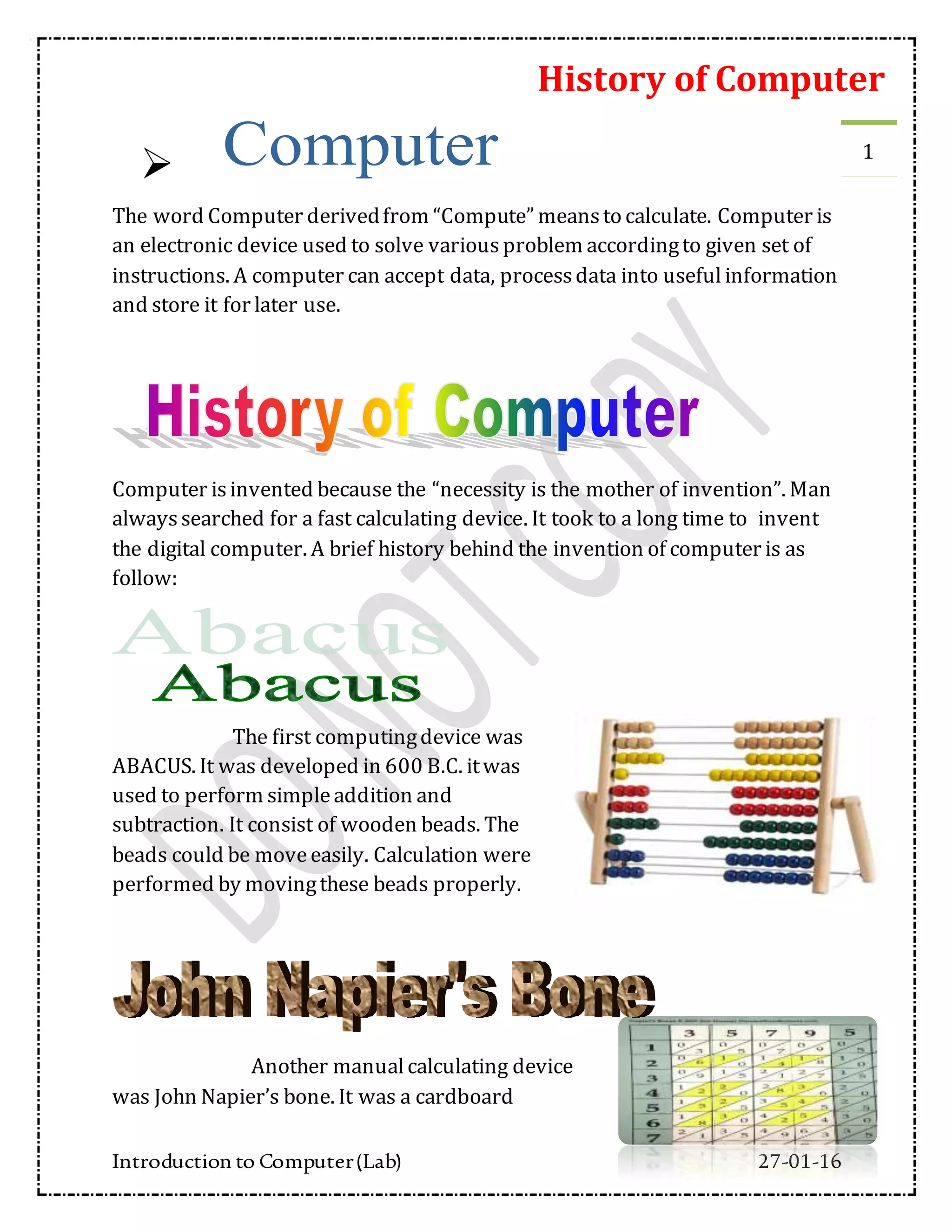
The first computingdevice was
ABACUS. It was developed in 600 B.C. itwas
used to perform simpleaddition and
subtraction. It consist of wooden beads. The
beads could be moveeasily. Calculation were
performed by movingthese beads properly.
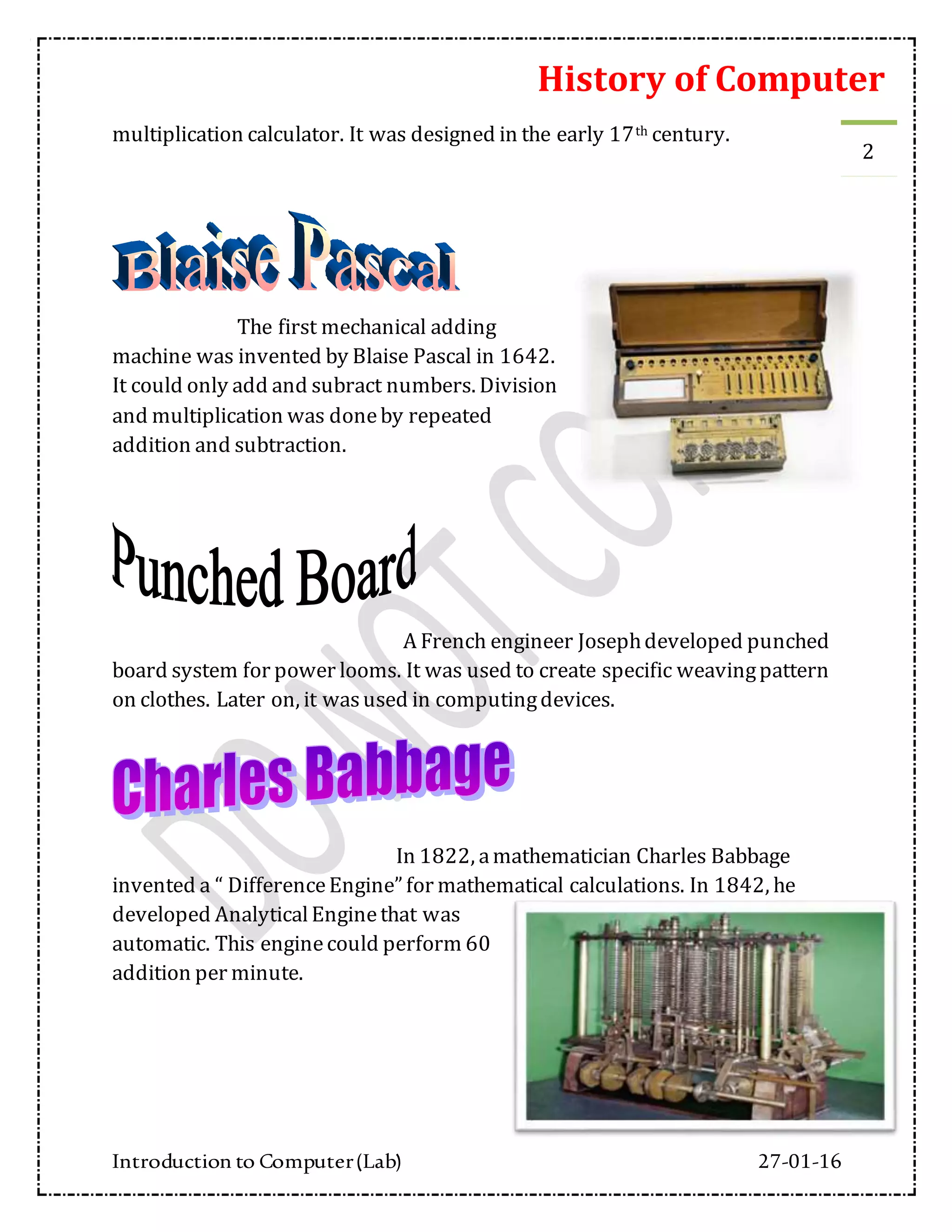
Another manualcalculating device
was John Napier’s bone. It was a cardboard
History of Computer
Introduction to Computer(Lab) 27-01-16
2
multiplication calculator. It was designed in the early 17th century.
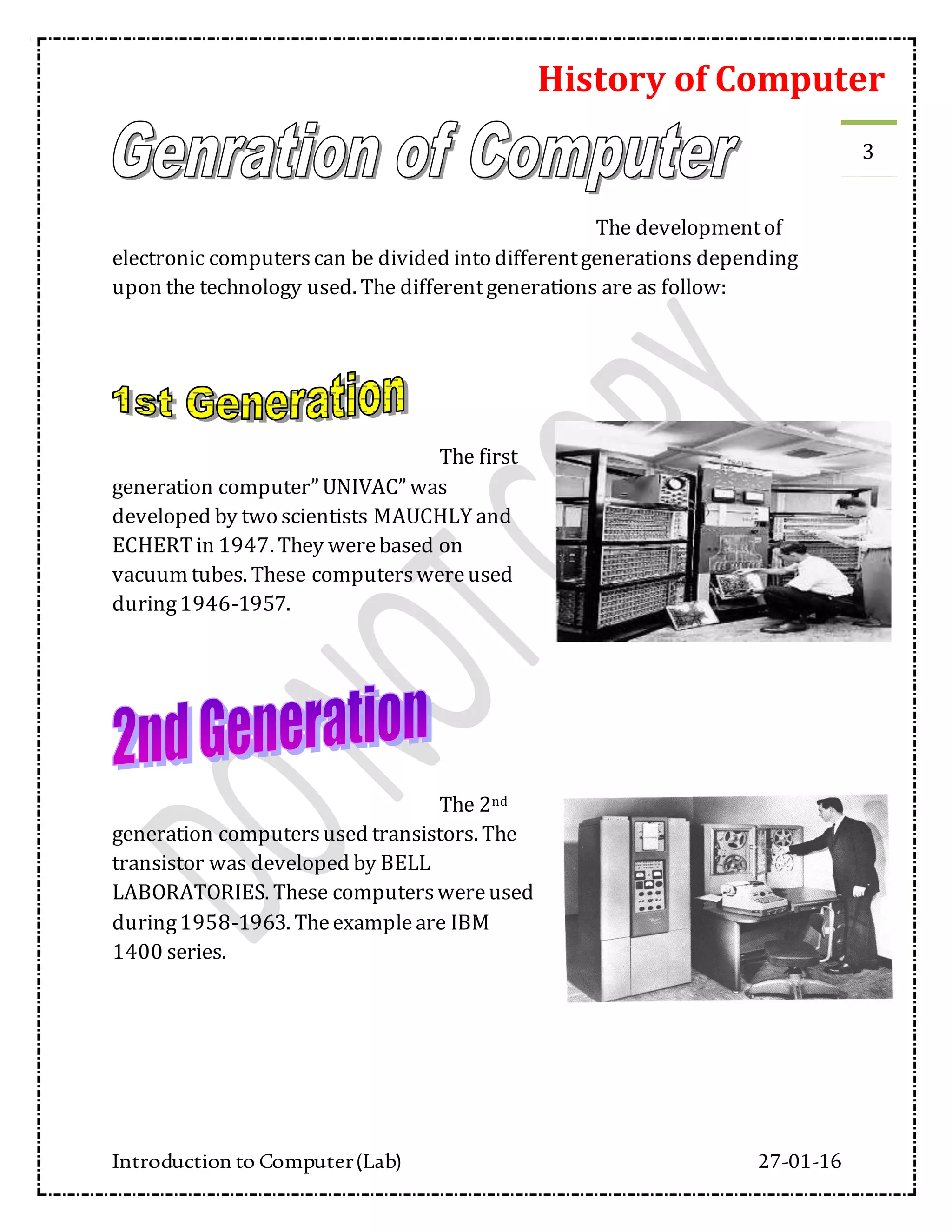
The first mechanical adding
machine was invented by Blaise Pascal in 1642.
It could only add and subract numbers. Division
and multiplication was doneby repeated
addition and subtraction.
A French engineer Josephdeveloped punched
board system for power looms. It was used to create specific weavingpattern
on clothes. Later on, it wasused in computingdevices.
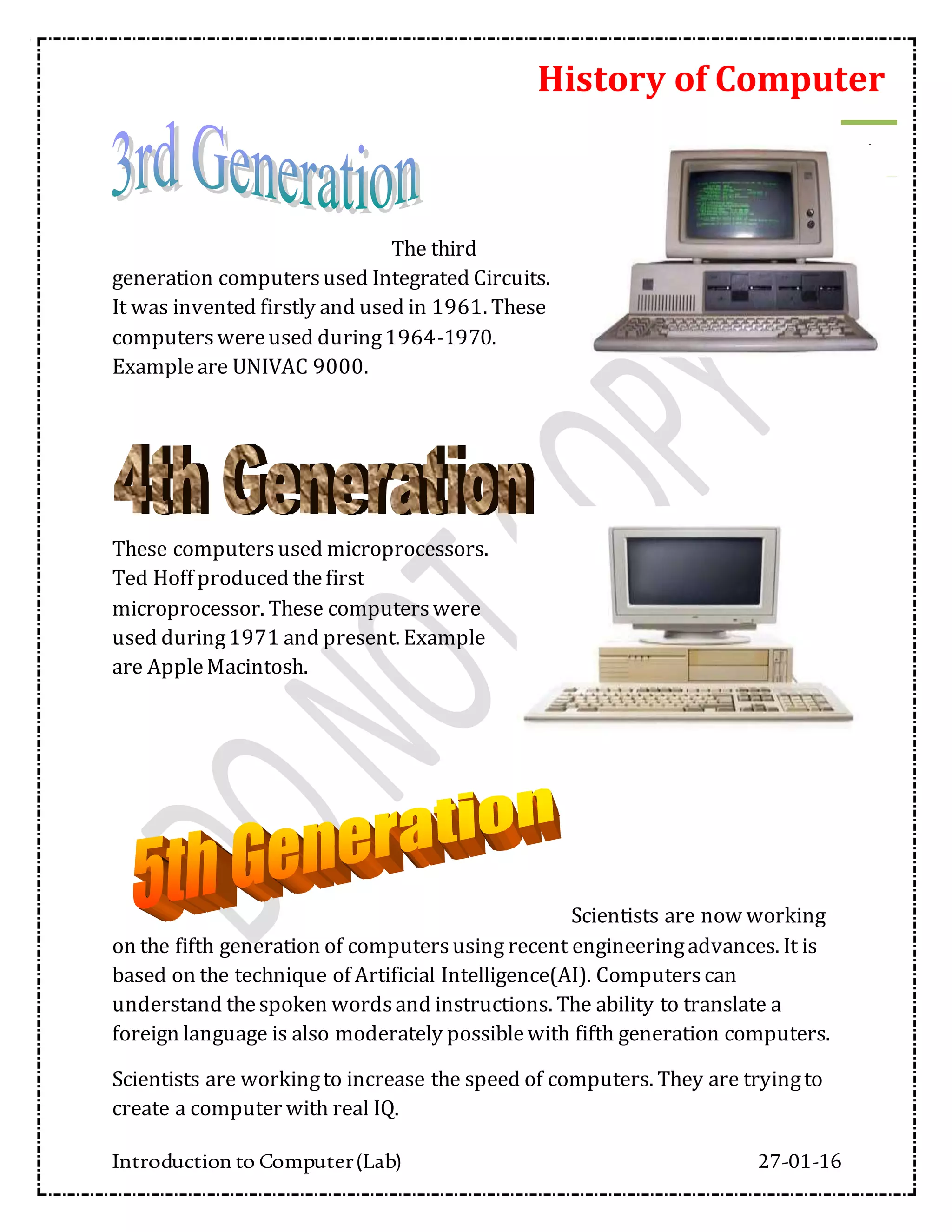
In 1822, amathematician Charles Babbage
invented a “ DifferenceEngine” for mathematical calculations. In 1842, he
developed AnalyticalEnginethat was
automatic. This enginecould perform 60
addition per minute.
History of Computer
Introduction to Computer(Lab) 27-01-16
3
The developmentof
electronic computerscan be divided into differentgenerations depending
upon the technology used. The differentgenerations are as follow:
The first
generation computer” UNIVAC” was
developed by two scientists MAUCHLY and
ECHERTin 1947. They werebased on
vacuum tubes. These computerswereused
during1946-1957.
The 2nd
generation computersused transistors. The
transistor was developed by BELL
LABORATORIES. These computerswereused
during1958-1963. Theexampleare IBM
1400 series.
History of Computer
Introduction to Computer(Lab) 27-01-16
4
The third
generation computersused Integrated Circuits.
It was invented firstly and used in 1961. These
computerswereused during1964-1970.
Exampleare UNIVAC 9000.
These computersused microprocessors.
Ted Hoff produced thefirst
microprocessor. These computerswere
used during1971 and present. Example
are AppleMacintosh.
Scientists are now working
on the fifth generation of computersusing recent engineeringadvances. It is
based on the technique of Artificial Intelligence(AI). Computerscan
understand thespoken wordsand instructions. The ability to translate a
foreign language is also moderately possiblewith fifth generation computers.
Scientists are workingto increase the speed of computers. They are tryingto
create a computer with real IQ.
History of Computer
Introduction to Computer(Lab) 27-01-16
5
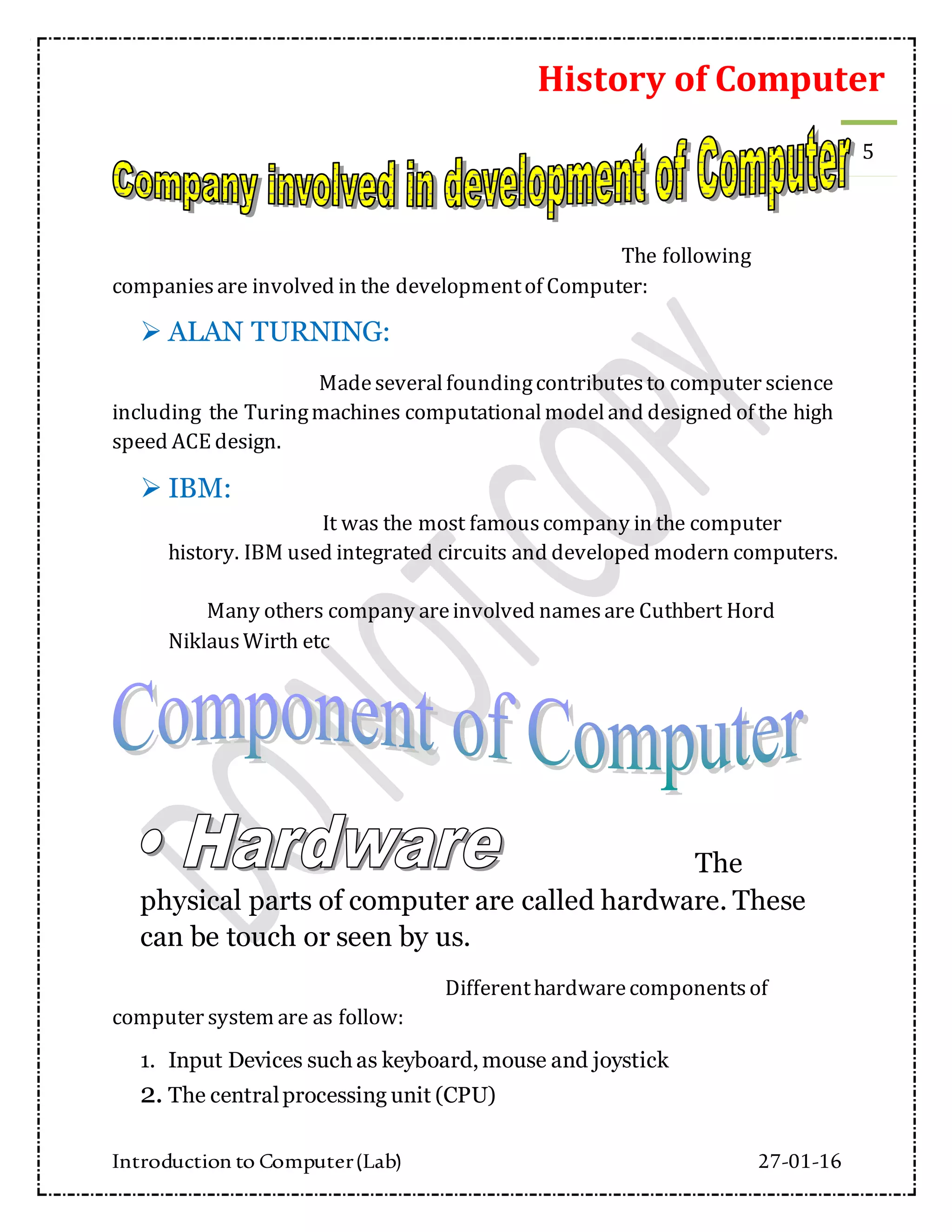
The following
companiesare involved in the developmentof Computer:
 ALAN TURNING:
Madeseveralfoundingcontributesto computer science
including the Turingmachines computationalmodeland designed of the high
speed ACE design.
 IBM:
It was the most famouscompany in the computer
history. IBM used integrated circuits and developed modern computers.
Many others company areinvolved namesare Cuthbert Hord
NiklausWirth etc
The
physical parts of computer are called hardware. These
can be touch or seen by us.
Differenthardwarecomponentsof
computer system are as follow:
1. Input Devices such as keyboard, mouse and joystick
2. The centralprocessing unit (CPU)
History of Computer
Introduction to Computer(Lab) 27-01-16
6
3. Output devicessuch as printer, monitor etc.
4.Storagedevicessuch as disk drive, hard drive etc.
5. Memorychipssuch as RAM, ROM etc
A set of instructions
given to computer to solve a problem is called Software.
Types of Software:
The main typesof softwareare:
System Software:
The type of softwareto control and manage the actual operationsof a
computer hardware. For e.g operatingsystem, windows. It controlsthe
basic operationsas follow:
 Saving data on disk
 Makingcomputer for us
 Printinga documentetc
Application Software:
It is used to perform variousapplicationson computer. It helps
the computer user to perform specifictasks. Peoplesuse application software
according to their needs. It is also known asapplication Package. For example
Microsoftoffice, adobe etc.
Computer hasmadea very vital impact on our
society. It has changed the way of life. Peopleuse the computer for different
History of Computer
Introduction to Computer(Lab) 27-01-16
7
tasks easily. It used in homes, offices, schools, colleges and universities. Many
organizationsare using computer for keepingthe record of their customers.
Banksare usingcomputersfor maintain the accountsand managing financial
transactions. Peopleare usingcomputersfor payingtheir bills. Computersare
can be used in education field to improveteaching and learning process.
Moreover, the computer is being used in every field of life such as medical,
business, industry, airlineand weather forecasting.
Computershavea great effect on the way we live our lives today. From
writing documentsto banking, computersareintegrating themselves into our
daily tasks moreand moreevery day. There are severalimportantaspects of
the computer age, includingthe internet, bankingand communications.
The internet is the fastest growingeconomy in
the world, mostly because of its ease of use, and its vast audience. Computers
have some negative effect on our lives. For exampleunemploymentincreases,
wastage of time and energy, data security and computer crime.
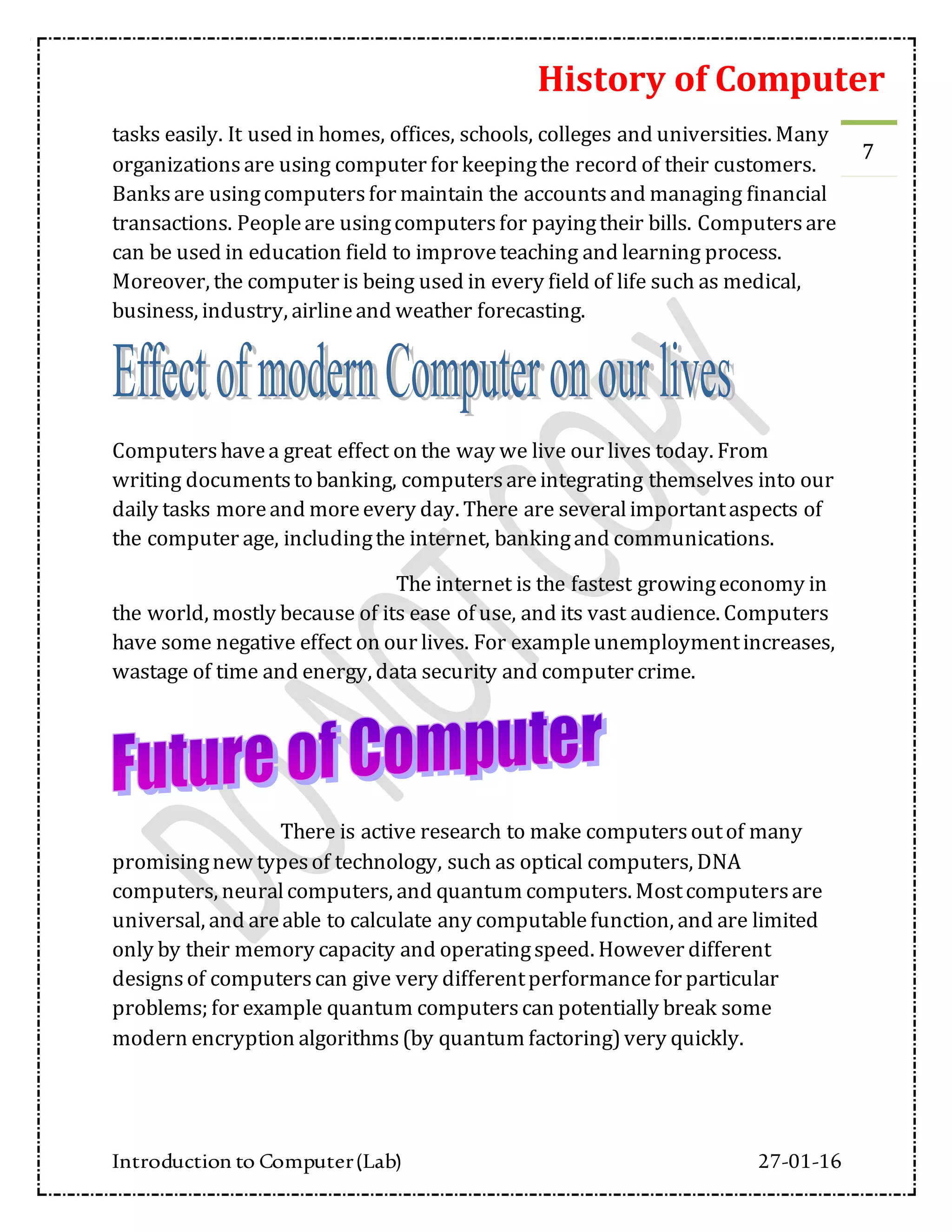
There is active research to make computersoutof many
promisingnew typesof technology, such as optical computers, DNA
computers, neuralcomputers, and quantum computers. Mostcomputersare
universal, and areable to calculate any computablefunction, and are limited
only by their memory capacity and operatingspeed. However different
designsof computerscan give very differentperformancefor particular
problems; for example quantum computerscan potentially break some
modern encryption algorithms(by quantum factoring)very quickly.
History of Computer
Introduction to Computer(Lab) 27-01-16
8
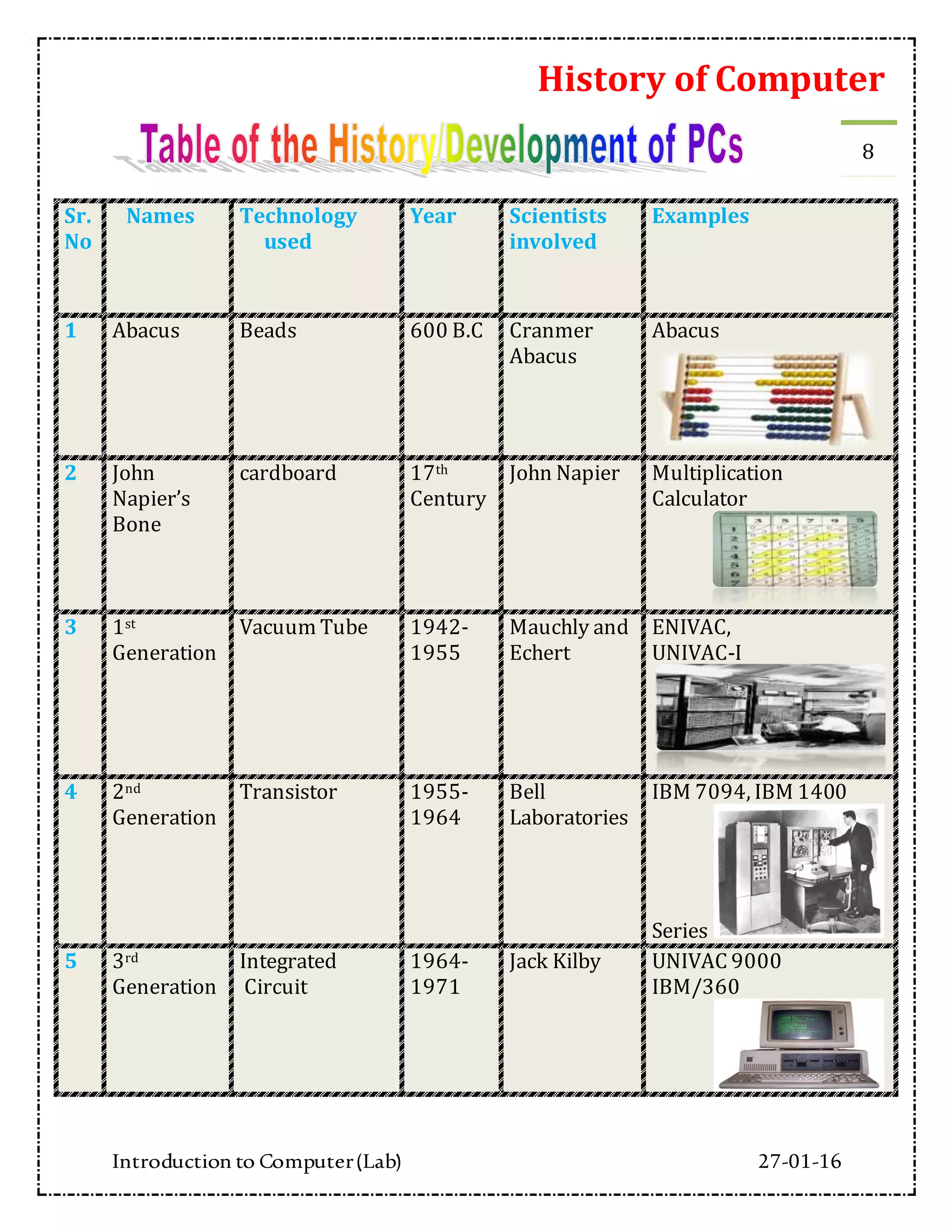
Sr.
No
Names Technology
used
Year Scientists
involved
Examples
1 Abacus Beads 600 B.C Cranmer
Abacus
Abacus
2 John
Napier’s
Bone
cardboard 17th
Century
John Napier Multiplication
Calculator
3 1st
Generation
Vacuum Tube 1942-
1955
Mauchly and
Echert
ENIVAC,
UNIVAC-I
4 2nd
Generation
Transistor 1955-
1964
Bell
Laboratories
IBM 7094, IBM 1400
Series
5 3rd
Generation
Integrated
Circuit
1964-
1971
Jack Kilby UNIVAC 9000
IBM/360
History of Computer
Introduction to Computer(Lab) 27-01-16
9
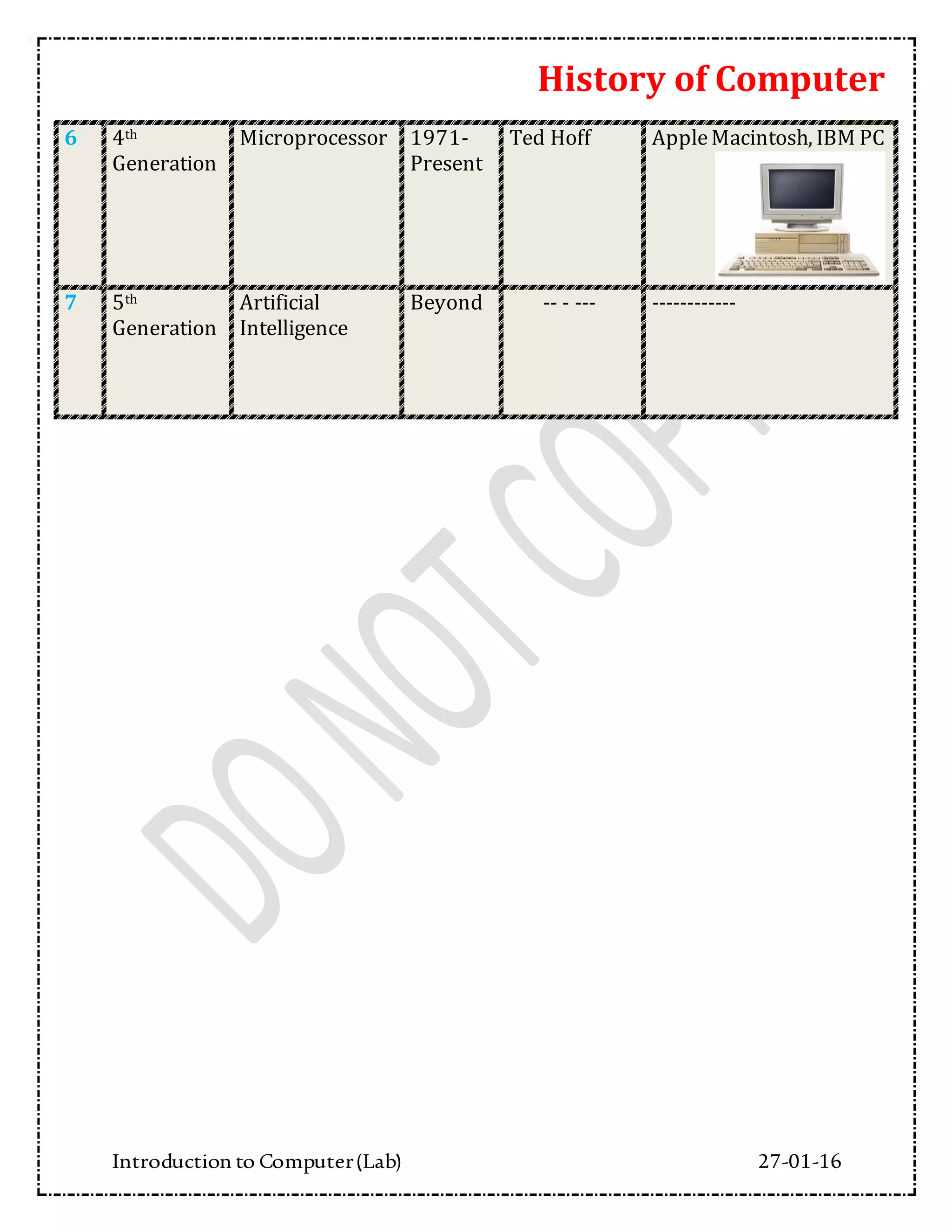
6 4th
Generation
Microprocessor 1971-
Present
Ted Hoff AppleMacintosh, IBM PC
7 5th
Generation
Artificial
Intelligence
Beyond -- - --- ------------

history of computer

  • 1.
    History of Computer Introductionto Computer(Lab) 27-01-16 1  The word Computer derivedfrom “Compute” meansto calculate. Computer is an electronic device used to solve variousproblem accordingto given set of instructions. A computer can accept data, processdata into usefulinformation and store it for later use. Computer isinvented because the “necessity is the mother of invention”. Man alwayssearched for a fast calculating device. It took to a long time to invent the digital computer. A brief history behind the invention of computer is as follow: The first computingdevice was ABACUS. It was developed in 600 B.C. itwas used to perform simpleaddition and subtraction. It consist of wooden beads. The beads could be moveeasily. Calculation were performed by movingthese beads properly. Another manualcalculating device was John Napier’s bone. It was a cardboard
  • 2.
    History of Computer Introductionto Computer(Lab) 27-01-16 2 multiplication calculator. It was designed in the early 17th century. The first mechanical adding machine was invented by Blaise Pascal in 1642. It could only add and subract numbers. Division and multiplication was doneby repeated addition and subtraction. A French engineer Josephdeveloped punched board system for power looms. It was used to create specific weavingpattern on clothes. Later on, it wasused in computingdevices. In 1822, amathematician Charles Babbage invented a “ DifferenceEngine” for mathematical calculations. In 1842, he developed AnalyticalEnginethat was automatic. This enginecould perform 60 addition per minute.
  • 3.
    History of Computer Introductionto Computer(Lab) 27-01-16 3 The developmentof electronic computerscan be divided into differentgenerations depending upon the technology used. The differentgenerations are as follow: The first generation computer” UNIVAC” was developed by two scientists MAUCHLY and ECHERTin 1947. They werebased on vacuum tubes. These computerswereused during1946-1957. The 2nd generation computersused transistors. The transistor was developed by BELL LABORATORIES. These computerswereused during1958-1963. Theexampleare IBM 1400 series.
  • 4.
    History of Computer Introductionto Computer(Lab) 27-01-16 4 The third generation computersused Integrated Circuits. It was invented firstly and used in 1961. These computerswereused during1964-1970. Exampleare UNIVAC 9000. These computersused microprocessors. Ted Hoff produced thefirst microprocessor. These computerswere used during1971 and present. Example are AppleMacintosh. Scientists are now working on the fifth generation of computersusing recent engineeringadvances. It is based on the technique of Artificial Intelligence(AI). Computerscan understand thespoken wordsand instructions. The ability to translate a foreign language is also moderately possiblewith fifth generation computers. Scientists are workingto increase the speed of computers. They are tryingto create a computer with real IQ.
  • 5.
    History of Computer Introductionto Computer(Lab) 27-01-16 5 The following companiesare involved in the developmentof Computer:  ALAN TURNING: Madeseveralfoundingcontributesto computer science including the Turingmachines computationalmodeland designed of the high speed ACE design.  IBM: It was the most famouscompany in the computer history. IBM used integrated circuits and developed modern computers. Many others company areinvolved namesare Cuthbert Hord NiklausWirth etc The physical parts of computer are called hardware. These can be touch or seen by us. Differenthardwarecomponentsof computer system are as follow: 1. Input Devices such as keyboard, mouse and joystick 2. The centralprocessing unit (CPU)
  • 6.
    History of Computer Introductionto Computer(Lab) 27-01-16 6 3. Output devicessuch as printer, monitor etc. 4.Storagedevicessuch as disk drive, hard drive etc. 5. Memorychipssuch as RAM, ROM etc A set of instructions given to computer to solve a problem is called Software. Types of Software: The main typesof softwareare: System Software: The type of softwareto control and manage the actual operationsof a computer hardware. For e.g operatingsystem, windows. It controlsthe basic operationsas follow:  Saving data on disk  Makingcomputer for us  Printinga documentetc Application Software: It is used to perform variousapplicationson computer. It helps the computer user to perform specifictasks. Peoplesuse application software according to their needs. It is also known asapplication Package. For example Microsoftoffice, adobe etc. Computer hasmadea very vital impact on our society. It has changed the way of life. Peopleuse the computer for different
  • 7.
    History of Computer Introductionto Computer(Lab) 27-01-16 7 tasks easily. It used in homes, offices, schools, colleges and universities. Many organizationsare using computer for keepingthe record of their customers. Banksare usingcomputersfor maintain the accountsand managing financial transactions. Peopleare usingcomputersfor payingtheir bills. Computersare can be used in education field to improveteaching and learning process. Moreover, the computer is being used in every field of life such as medical, business, industry, airlineand weather forecasting. Computershavea great effect on the way we live our lives today. From writing documentsto banking, computersareintegrating themselves into our daily tasks moreand moreevery day. There are severalimportantaspects of the computer age, includingthe internet, bankingand communications. The internet is the fastest growingeconomy in the world, mostly because of its ease of use, and its vast audience. Computers have some negative effect on our lives. For exampleunemploymentincreases, wastage of time and energy, data security and computer crime. There is active research to make computersoutof many promisingnew typesof technology, such as optical computers, DNA computers, neuralcomputers, and quantum computers. Mostcomputersare universal, and areable to calculate any computablefunction, and are limited only by their memory capacity and operatingspeed. However different designsof computerscan give very differentperformancefor particular problems; for example quantum computerscan potentially break some modern encryption algorithms(by quantum factoring)very quickly.
  • 8.
    History of Computer Introductionto Computer(Lab) 27-01-16 8 Sr. No Names Technology used Year Scientists involved Examples 1 Abacus Beads 600 B.C Cranmer Abacus Abacus 2 John Napier’s Bone cardboard 17th Century John Napier Multiplication Calculator 3 1st Generation Vacuum Tube 1942- 1955 Mauchly and Echert ENIVAC, UNIVAC-I 4 2nd Generation Transistor 1955- 1964 Bell Laboratories IBM 7094, IBM 1400 Series 5 3rd Generation Integrated Circuit 1964- 1971 Jack Kilby UNIVAC 9000 IBM/360
  • 9.
    History of Computer Introductionto Computer(Lab) 27-01-16 9 6 4th Generation Microprocessor 1971- Present Ted Hoff AppleMacintosh, IBM PC 7 5th Generation Artificial Intelligence Beyond -- - --- ------------