COMPUTER AND MOBILE DEVICES:
EVALUATING OPTIONS FOR HOME
AND WORK
Objectives Overview
Describe the characteristics
and uses of desktops,
laptops, tablets, and all-in-
ones
Describe the characteristics
and types of servers
Differentiate among POS
terminals, ATMs, and self-
service kiosks
Describe cloud computing
and identify its uses
Describe the characteristics
and uses of smartphones,
digital cameras, portable
and digital media players, e-
book readers, and wearable
devices
Objectives Overview
Describe the characteristics
of and ways to interact with
game devices
Identify uses of embedded
computers
Differentiate a port from a
connector, identify various
ports and connectors, and
differentiate among
Bluetooth, Wi-Fi, and NFC
wireless device connections
Identify safeguards against
hardware theft and
vandalism and hardware
failure
Discuss ways to prevent
health-related injuries and
disorders caused from
technology use, and
describe ways to design a
workplace ergonomically
Computers and Mobile Devices
Desktop and mobile
computers
Servers and terminals
Smartphones, digital
cameras, e-book
readers and portable
media players
Game devices Embedded computers
Desktops and Mobile
Computers
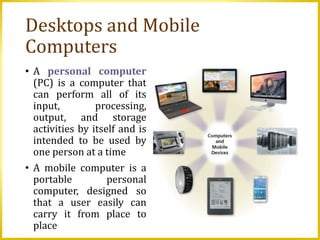
• A personal computer
(PC) is a computer that
can perform all of its
input, processing,
output, and storage
activities by itself and is
intended to be used by
one person at a time
• A mobile computer is a
portable personal
computer, designed so
that a user easily can
carry it from place to
place
Desktops and Mobile
Computers
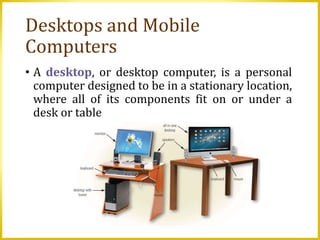
• A desktop, or desktop computer, is a personal
computer designed to be in a stationary location,
where all of its components fit on or under a
desk or table
Desktops and Mobile
Computers
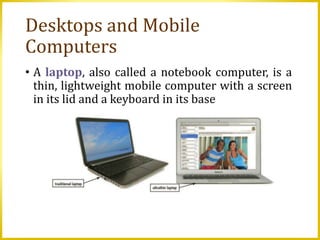
• A laptop, also called a notebook computer, is a
thin, lightweight mobile computer with a screen
in its lid and a keyboard in its base
Desktops and Mobile
Computers
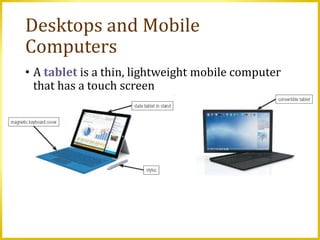
• A tablet is a thin, lightweight mobile computer
that has a touch screen
Desktops and Mobile
Computers
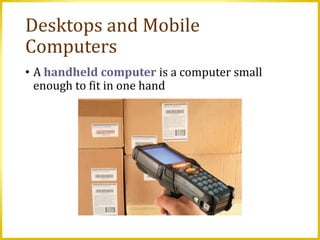
• A handheld computer is a computer small
enough to fit in one hand
Servers
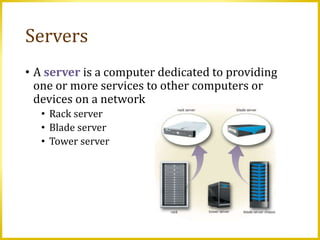
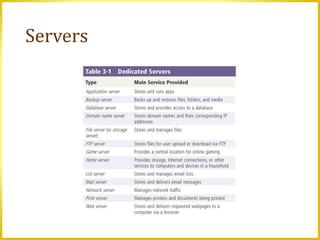
• A server is a computer dedicated to providing
one or more services to other computers or
devices on a network
• Rack server
• Blade server
• Tower server
Servers
Servers
• A mainframe is a large, expensive, powerful
server that can handle hundreds or thousands of
connected users simultaneously
Supercomputers
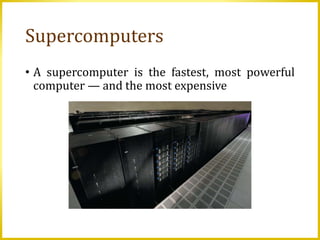
• A supercomputer is the fastest, most powerful
computer — and the most expensive
Terminals
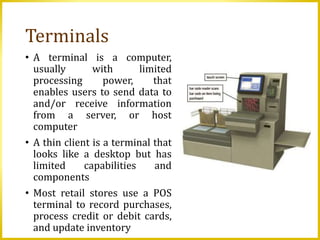
• A terminal is a computer,
usually with limited
processing power, that
enables users to send data to
and/or receive information
from a server, or host
computer
• A thin client is a terminal that
looks like a desktop but has
limited capabilities and
components
• Most retail stores use a POS
terminal to record purchases,
process credit or debit cards,
and update inventory
Terminals
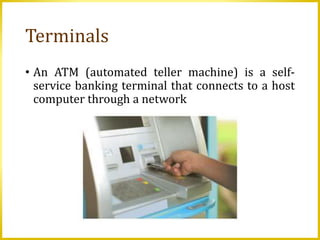
• An ATM (automated teller machine) is a self-
service banking terminal that connects to a host
computer through a network
Terminals
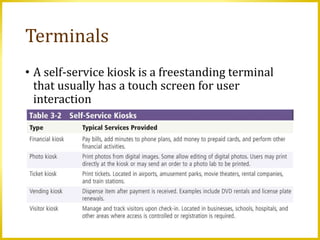
• A self-service kiosk is a freestanding terminal
that usually has a touch screen for user
interaction
Cloud Computing
• Cloud computing refers to an environment of
servers that house and provide access to
resources users access through the Internet
Mobile Devices
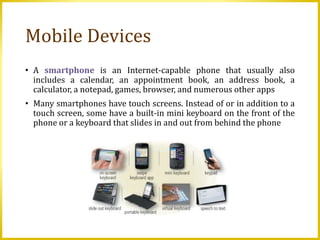
• A smartphone is an Internet-capable phone that usually also
includes a calendar, an appointment book, an address book, a
calculator, a notepad, games, browser, and numerous other apps
• Many smartphones have touch screens. Instead of or in addition to a
touch screen, some have a built-in mini keyboard on the front of the
phone or a keyboard that slides in and out from behind the phone
Mobile Devices
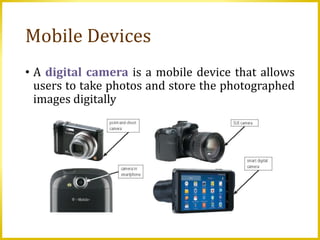
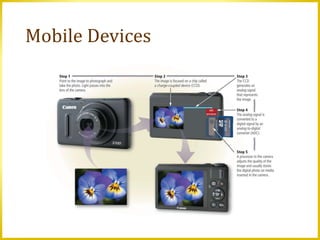
• A digital camera is a mobile device that allows
users to take photos and store the photographed
images digitally
Mobile Devices
Mobile Devices
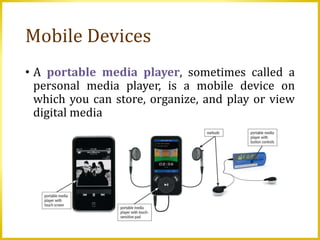
• A portable media player, sometimes called a
personal media player, is a mobile device on
which you can store, organize, and play or view
digital media
Mobile Devices
• A digital media player or streaming media
player is a device, typically used in a home, that
streams digital media from a computer or
network to a television, projector, or some other
entertainment device.
Mobile Devices
• An e-book reader
(short for electronic
book reader), or e-
reader, is a mobile
device that is used
primarily for reading e-
books and other digital
publications
Mobile Devices
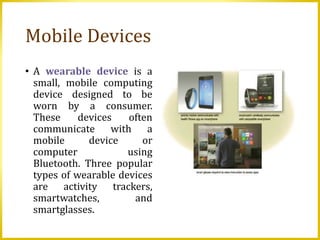
• A wearable device is a
small, mobile computing
device designed to be
worn by a consumer.
These devices often
communicate with a
mobile device or
computer using
Bluetooth. Three popular
types of wearable devices
are activity trackers,
smartwatches, and
smartglasses.
Game Devices
• A game console is a mobile computing device
designed for single-player or multiplayer video
games
• A handheld game device is a small mobile
device that contains a screen, speakers, controls,
and game console all in one unit
• Game controllers include gamepads, joysticks
and wheels, dance pads, and a variety of motion-
sensing controllers
Game Devices
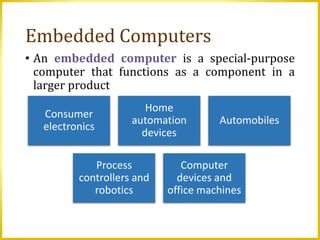
Embedded Computers
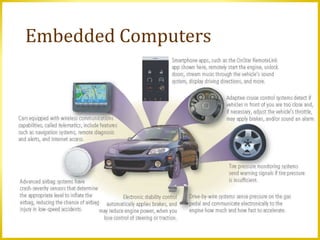
• An embedded computer is a special-purpose
computer that functions as a component in a
larger product
Consumer
electronics
Home
automation
devices
Automobiles
Process
controllers and
robotics
Computer
devices and
office machines
Embedded Computers
Putting It All Together
Ports and Connections
• A port is the point at which a
peripheral device attaches to
or communicates with a
computer or mobile device so
that the peripheral device can
send data to or receive
information from the computer
or mobile device
• A connector joins a cable to a
port. A connector at one end of
a cable attaches to a port on
the computer or mobile device,
and a connector at the other
end of the cable attaches to a
port on the peripheral device
Ports and Connections
• A USB port, short for universal serial bus port,
can connect up to 127 different peripheral
devices together with a single connector
• Instead of connecting peripheral devices directly
to ports on a mobile computer, some mobile
users prefer the flexibility of port replicators and
docking stations
Ports and Connections
• Instead of connecting computers and mobile
devices to peripheral devices with a cable, some
peripheral devices use wireless communications
technologies
Bluetooth Wi-Fi NFC
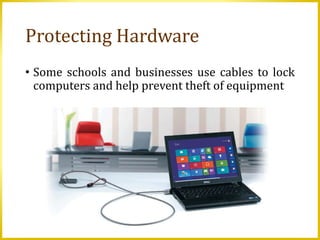
Protecting Hardware
• Some schools and businesses use cables to lock
computers and help prevent theft of equipment
Protecting Hardware
• Some mobile computers
and devices include
fingerprint readers, which
can be used to verify a
user’s identity.
Protecting Hardware
• Hardware can fail for a variety of
reasons: aging hardware; random
events such as electrical power
problems; and even errors in
programs or apps
• Undervoltage
• Overvoltage or power surge
• A surge protector, also called a surge
suppressor, uses electrical
components to provide a stable
current flow and minimize the
chances of an overvoltage reaching
the computer and other electronic
equipment
Protecting Hardware
• An uninterruptible power supply (UPS) is a
device that contains surge protection circuits
and one or more batteries that can provide
power during a temporary or permanent loss of
power
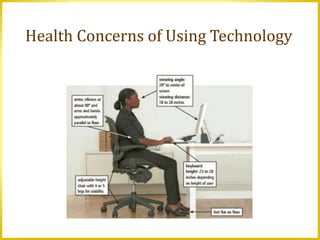
Health Concerns of Using Technology
• A repetitive strain injury (RSI) is an injury or
disorder of the muscles, nerves, tendons,
ligaments, and joints
• Computer vision syndrome (CVS) is a
technology-related health condition that affects
eyesight
• Ergonomics is an applied science devoted to
incorporating comfort, efficiency, and safety into
the design of items in the workplace
• Technology addiction occurs when the
technology consumes someone’s entire social life
Health Concerns of Using Technology
Summary
Characteristics of and
purchasing guidelines for
desktops, laptops, tablets,
smartphone, digital cameras,
and portable media players
Handheld computers,
servers, supercomputers,
point-of-sale terminals,
ATMs, self-service kiosks, e-
book readers, game devices,
embedded computers, and
cloud computing
Ports and connections
Ways to protect hardware
Health concerns of using
technology and preventative
measures
Chapter 3 - Computer , Mobile Devices.pptx

Chapter 3 - Computer , Mobile Devices.pptx

  • 1.
    COMPUTER AND MOBILEDEVICES: EVALUATING OPTIONS FOR HOME AND WORK
  • 2.
    Objectives Overview Describe thecharacteristics and uses of desktops, laptops, tablets, and all-in- ones Describe the characteristics and types of servers Differentiate among POS terminals, ATMs, and self- service kiosks Describe cloud computing and identify its uses Describe the characteristics and uses of smartphones, digital cameras, portable and digital media players, e- book readers, and wearable devices
  • 3.
    Objectives Overview Describe thecharacteristics of and ways to interact with game devices Identify uses of embedded computers Differentiate a port from a connector, identify various ports and connectors, and differentiate among Bluetooth, Wi-Fi, and NFC wireless device connections Identify safeguards against hardware theft and vandalism and hardware failure Discuss ways to prevent health-related injuries and disorders caused from technology use, and describe ways to design a workplace ergonomically
  • 4.
    Computers and MobileDevices Desktop and mobile computers Servers and terminals Smartphones, digital cameras, e-book readers and portable media players Game devices Embedded computers
  • 5.
    Desktops and Mobile Computers •A personal computer (PC) is a computer that can perform all of its input, processing, output, and storage activities by itself and is intended to be used by one person at a time • A mobile computer is a portable personal computer, designed so that a user easily can carry it from place to place
  • 6.
    Desktops and Mobile Computers •A desktop, or desktop computer, is a personal computer designed to be in a stationary location, where all of its components fit on or under a desk or table
  • 7.
    Desktops and Mobile Computers •A laptop, also called a notebook computer, is a thin, lightweight mobile computer with a screen in its lid and a keyboard in its base
  • 8.
    Desktops and Mobile Computers •A tablet is a thin, lightweight mobile computer that has a touch screen
  • 9.
    Desktops and Mobile Computers •A handheld computer is a computer small enough to fit in one hand
  • 10.
    Servers • A serveris a computer dedicated to providing one or more services to other computers or devices on a network • Rack server • Blade server • Tower server
  • 11.
  • 12.
    Servers • A mainframeis a large, expensive, powerful server that can handle hundreds or thousands of connected users simultaneously
  • 13.
    Supercomputers • A supercomputeris the fastest, most powerful computer — and the most expensive
  • 14.
    Terminals • A terminalis a computer, usually with limited processing power, that enables users to send data to and/or receive information from a server, or host computer • A thin client is a terminal that looks like a desktop but has limited capabilities and components • Most retail stores use a POS terminal to record purchases, process credit or debit cards, and update inventory
  • 15.
    Terminals • An ATM(automated teller machine) is a self- service banking terminal that connects to a host computer through a network
  • 16.
    Terminals • A self-servicekiosk is a freestanding terminal that usually has a touch screen for user interaction
  • 17.
    Cloud Computing • Cloudcomputing refers to an environment of servers that house and provide access to resources users access through the Internet
  • 18.
    Mobile Devices • Asmartphone is an Internet-capable phone that usually also includes a calendar, an appointment book, an address book, a calculator, a notepad, games, browser, and numerous other apps • Many smartphones have touch screens. Instead of or in addition to a touch screen, some have a built-in mini keyboard on the front of the phone or a keyboard that slides in and out from behind the phone
  • 19.
    Mobile Devices • Adigital camera is a mobile device that allows users to take photos and store the photographed images digitally
  • 20.
  • 21.
    Mobile Devices • Aportable media player, sometimes called a personal media player, is a mobile device on which you can store, organize, and play or view digital media
  • 22.
    Mobile Devices • Adigital media player or streaming media player is a device, typically used in a home, that streams digital media from a computer or network to a television, projector, or some other entertainment device.
  • 23.
    Mobile Devices • Ane-book reader (short for electronic book reader), or e- reader, is a mobile device that is used primarily for reading e- books and other digital publications
  • 24.
    Mobile Devices • Awearable device is a small, mobile computing device designed to be worn by a consumer. These devices often communicate with a mobile device or computer using Bluetooth. Three popular types of wearable devices are activity trackers, smartwatches, and smartglasses.
  • 25.
    Game Devices • Agame console is a mobile computing device designed for single-player or multiplayer video games • A handheld game device is a small mobile device that contains a screen, speakers, controls, and game console all in one unit • Game controllers include gamepads, joysticks and wheels, dance pads, and a variety of motion- sensing controllers
  • 26.
  • 27.
    Embedded Computers • Anembedded computer is a special-purpose computer that functions as a component in a larger product Consumer electronics Home automation devices Automobiles Process controllers and robotics Computer devices and office machines
  • 28.
  • 29.
  • 30.
    Ports and Connections •A port is the point at which a peripheral device attaches to or communicates with a computer or mobile device so that the peripheral device can send data to or receive information from the computer or mobile device • A connector joins a cable to a port. A connector at one end of a cable attaches to a port on the computer or mobile device, and a connector at the other end of the cable attaches to a port on the peripheral device
  • 31.
  • 32.
    Ports and Connections •A USB port, short for universal serial bus port, can connect up to 127 different peripheral devices together with a single connector • Instead of connecting peripheral devices directly to ports on a mobile computer, some mobile users prefer the flexibility of port replicators and docking stations
  • 33.
  • 34.
    Ports and Connections •Instead of connecting computers and mobile devices to peripheral devices with a cable, some peripheral devices use wireless communications technologies Bluetooth Wi-Fi NFC
  • 35.
    Protecting Hardware • Someschools and businesses use cables to lock computers and help prevent theft of equipment
  • 36.
    Protecting Hardware • Somemobile computers and devices include fingerprint readers, which can be used to verify a user’s identity.
  • 37.
    Protecting Hardware • Hardwarecan fail for a variety of reasons: aging hardware; random events such as electrical power problems; and even errors in programs or apps • Undervoltage • Overvoltage or power surge • A surge protector, also called a surge suppressor, uses electrical components to provide a stable current flow and minimize the chances of an overvoltage reaching the computer and other electronic equipment
  • 38.
    Protecting Hardware • Anuninterruptible power supply (UPS) is a device that contains surge protection circuits and one or more batteries that can provide power during a temporary or permanent loss of power
  • 39.
    Health Concerns ofUsing Technology • A repetitive strain injury (RSI) is an injury or disorder of the muscles, nerves, tendons, ligaments, and joints • Computer vision syndrome (CVS) is a technology-related health condition that affects eyesight • Ergonomics is an applied science devoted to incorporating comfort, efficiency, and safety into the design of items in the workplace • Technology addiction occurs when the technology consumes someone’s entire social life
  • 40.
    Health Concerns ofUsing Technology
  • 41.
    Summary Characteristics of and purchasingguidelines for desktops, laptops, tablets, smartphone, digital cameras, and portable media players Handheld computers, servers, supercomputers, point-of-sale terminals, ATMs, self-service kiosks, e- book readers, game devices, embedded computers, and cloud computing Ports and connections Ways to protect hardware Health concerns of using technology and preventative measures