First Voyage
Around TheWorld
By Antonio Pigafetta
This lesson entails the account of Antonio
Pigafetta during Ferdinand Magellan’s voyage in
1519 to 1521 in the Philippines which was
published in Italy in 1536.
The account further highlighted their
experiences particularly the culture of the
natives.
3.
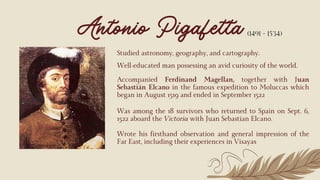
Well-educated man possessingan avid curiosity of the world.
Antonio Pigafetta
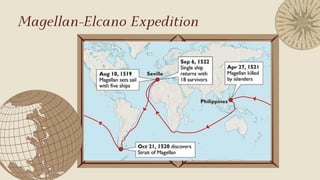
Accompanied Ferdinand Magellan, together with Juan
Sebastián Elcano in the famous expedition to Moluccas which
began in August 1519 and ended in September 1522
Was among the 18 survivors who returned to Spain on Sept. 6,
1522 aboard the Victoria with Juan Sebastian Elcano.
(1491 - 1534)
Studied astronomy, geography, and cartography.
Wrote his firsthand observation and general impression of the
Far East, including their experiences in Visayas
4.
Historical Context
The Magellan-Elcanoexpedition
Exploration of economic options outside the Iberian Peninsula
Fair share in the spice trade
Discovery of territories
Discovery of foreign resources (spices, porcelain, and
other oriental products)
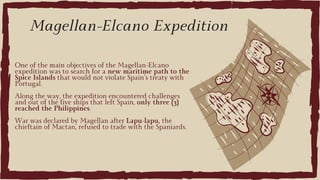
One of themain objectives of the Magellan-Elcano
expedition was to search for a new maritime path to the
Spice Islands that would not violate Spain’s treaty with
Portugal.
Along the way, the expedition encountered challenges
and out of the five ships that left Spain, only three (3)
reached the Philippines.
War was declared by Magellan after Lapu-lapu, the
chieftain of Mactan, refused to trade with the Spaniards.
Magellan-Elcano Expedition
7.
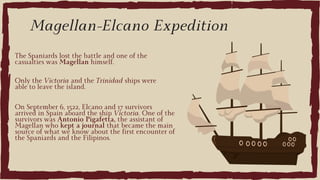
On September 6,1522, Elcano and 17 survivors
arrived in Spain aboard the ship Victoria. One of the
survivors was Antonio Pigafetta, the assistant of
Magellan who kept a journal that became the main
source of what we know about the first encounter of
the Spaniards and the Filipinos.
Magellan-Elcano Expedition
The Spaniards lost the battle and one of the
casualties was Magellan himself.
Only the Victoria and the Trinidad ships were
able to leave the island.
“These people haveno arms, but use sticks, which have a
fish bone at the end. They are poor, but ingenious, and
great thieves, and for the sake of that we called these
three islands the Ladrones Islands."
Antonio Pigafetta
10.
Pigafetta reported thatthey reached the island of
Zamal (now Samar), but Magellan decided to land in
another uninhabited island for greater security
where they could rest for a few days.
After two days, several native men came to them
and welcomed them with food, drinks, and gifts. The
natives gave them fish, palm, wine, figs, cochos, Rice,
etc. •Pigafetta described what seemed like a coconut.
First Voyage Around the World
11.
Pigafetta characterized thepeople as "very familiar
and friendly" and willingly showed them different
islands and the names of these islands.
They went to Humunu Island (Homonhon) where
they found the first signs of gold in the island
First Voyage Around the World
12.
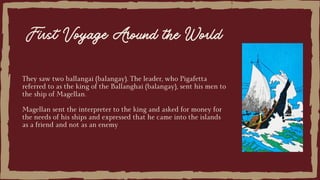
They saw twoballangai (balangay). The leader, who Pigafetta
referred to as the king of the Ballanghai (balangay), sent his men to
the ship of Magellan.
Magellan sent the interpreter to the king and asked for money for
the needs of his ships and expressed that he came into the islands
as a friend and not as an enemy
First Voyage Around the World
13.
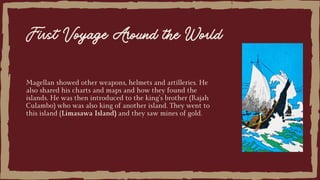
Magellan showed otherweapons, helmets and artilleries. He
also shared his charts and maps and how they found the
islands. He was then introduced to the king’s brother (Rajah
Culambo) who was also king of another island. They went to
this island (Limasawa Island) and they saw mines of gold.
First Voyage Around the World
14.
On March 31,1521, (Easter Sunday), Magellan
ordered the chaplain to preside a Mass by the
shore. The king sent two dead pigs and attended
the Mass with the other king.
First Voyage Around the World
•“…when the offertory of the mass came, the two
kings, went to kiss the cross like us, but they
offered nothing, and at the elevation of the body
of our Lord they were kneeling like us, and
adored our Lord with joined hands.”
First Mass at Limasawa
15.
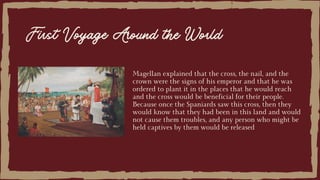
Magellan explained thatthe cross, the nail, and the
crown were the signs of his emperor and that he was
ordered to plant it in the places that he would reach
and the cross would be beneficial for their people.
Because once the Spaniards saw this cross, then they
would know that they had been in this land and would
not cause them troubles, and any person who might be
held captives by them would be released
First Voyage Around the World
16.
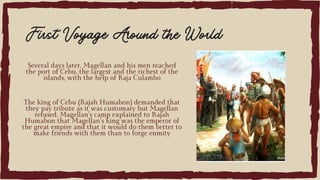
Several days later,Magellan and his men reached
the port of Cebu, the largest and the richest of the
islands, with the help of Raja Culambo
First Voyage Around the World
The king of Cebu (Rajah Humabon) demanded that
they pay tribute as it was customary but Magellan
refused. Magellan’s camp explained to Rajah
Humabon that Magellan’s king was the emperor of
the great empire and that it would do them better to
make friends with them than to forge enmity
17.
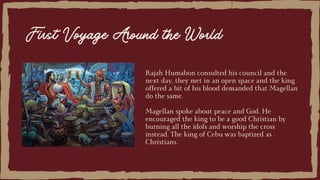
Rajah Humabon consultedhis council and the
next day, they met in an open space and the king
offered a bit of his blood demanded that Magellan
do the same.
Magellan spoke about peace and God. He
encouraged the king to be a good Christian by
burning all the idols and worship the cross
instead. The king of Cebu was baptized as
Christians.
First Voyage Around the World
18.
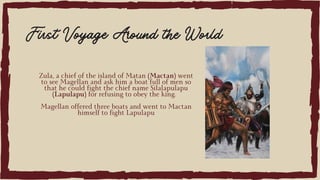
Zula, a chiefof the island of Matan (Mactan) went
to see Magellan and ask him a boat full of men so
that he could fight the chief name Silalapulapu
(Lapulapu) for refusing to obey the king.
Magellan offered three boats and went to Mactan
himself to fight Lapulapu
First Voyage Around the World
19.
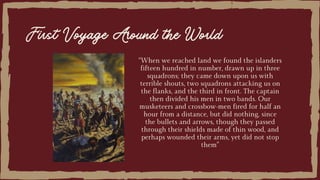
“When we reachedland we found the islanders
fifteen hundred in number, drawn up in three
squadrons; they came down upon us with
terrible shouts, two squadrons attacking us on
the flanks, and the third in front. The captain
then divided his men in two bands. Our
musketeers and crossbow-men fired for half an
hour from a distance, but did nothing, since
the bullets and arrows, though they passed
through their shields made of thin wood, and
perhaps wounded their arms, yet did not stop
them”
First Voyage Around the World
20.
Magellan died inbattle. He was specifically targeted
because the native knew he was the captain general
“Whilst the Indians were thus overpowering him,
several times he turned round towards us to see if
we were all in safety, as though his obstinate fight
had no other object than to give an opportunity for
the retreat of his men.”
First Voyage Around the World
21.
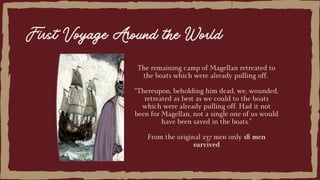
The remaining campof Magellan retreated to
the boats which were already pulling off.
“Thereupon, beholding him dead, we, wounded,
retreated as best as we could to the boats
which were already pulling off. Had it not
been for Magellan, not a single one of us would
have been saved in the boats.”
From the original 237 men only 18 men
survived
First Voyage Around the World
22.
The account’s keythemes and surrounding
circumstances
Geographical discoveries
Cultural encounters
Maritime exploration
Credible source of Magellan’s expedition
Primary or Secondary?
Analysis of Pigafetta’s Account
23.
Philippine historiography
Pigafetta’s accountprovided details about the
conditions of the Visayan Islands in the 16th
Century (prominent leaders, economic activities,
social and cultural practices, and religious beliefs).
Cultural Exchange
The First Voyage contributed to the exchange of
ideas, goods, and cultures between Europe and the
rest of the world. It helped to shape the course of
history and laid the foundation for future
exploration and colonization.
Relevance of the text
24.
Assessment
Who is AntonioPigafetta? What was his role in the Magellan-
Elcano expedition?
Based on Pigafetta’s account, what led to the Battle of Mactan?
According to Pigafetta, how did the locals of the island welcome
Magellan and his crew?
What are the challenges and limitations of Pigafetta’s account?
25.
References
Candelaria, et.al. 2018.Readings in the Philippine History. Rex Printing
Company, Inc. Manila, Philippines.
Torres, J. V.,2018. BATIS: Sources in Philippine History. Rex Printing Company,
Inc
•Ligan, et.al., 2018. Readings in the Philippine History. Mutya Publishing
House, Inc. Malabon