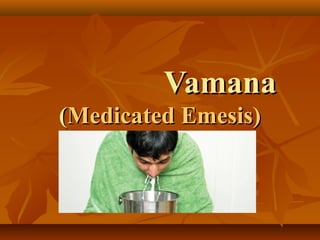
VamanaVamana
((Medicated Emesis)Medicated Emesis)
GlimpsesGlimpses
 PHYSIOLOGY OF GUTPHYSIOLOGY OF GUT
 VOMITING –CausesVOMITING –Causes
MechanismMechanism
 VAMANA DefinitionVAMANA Definition
 Factors influencing VamanaFactors influencing Vamana
 Mode of actionMode of action
Physiology of gutPhysiology of gut
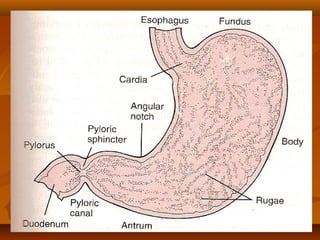
 Function of stomachFunction of stomach
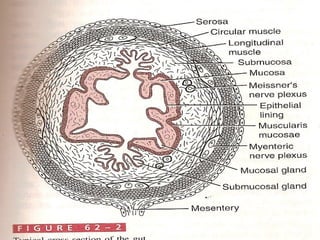
 Neural control GI functionNeural control GI function
 Mechanism of secretionMechanism of secretion
Function of stomachFunction of stomach
 StorageStorage
 Mixing of food with gastric juiceMixing of food with gastric juice
 Slow emptying of the chymeSlow emptying of the chyme
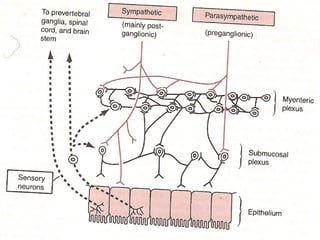
Neural control GI functionNeural control GI function
 Myenteric plexus (auerbachs plexus- outer)Myenteric plexus (auerbachs plexus- outer)
control G I movementscontrol G I movements
 Inner sub mucosal –meissners plexusInner sub mucosal –meissners plexus
control G I secretion and local blood flowcontrol G I secretion and local blood flow
 Both are connected with 1) sympathetic and 2)Both are connected with 1) sympathetic and 2)
parasympethetic fibers- even though ENS canparasympethetic fibers- even though ENS can
function its own, 1&2 can further activate orfunction its own, 1&2 can further activate or
inhibit GI functioninhibit GI function
Contd.Contd.
 Sensory nerve endings in gut wall sendSensory nerve endings in gut wall send
afferent fibers to these gut plexus ofafferent fibers to these gut plexus of
ENS as well toENS as well to
1.1. Prevertebral ganglia of sympatheticPrevertebral ganglia of sympathetic
nervous systemnervous system
2.2. To the spinal chordTo the spinal chord
3.3. Through vagus nerves- brainstemThrough vagus nerves- brainstem
Contd….Contd….
 Myenteric plexus run along the way down GI &Myenteric plexus run along the way down GI &
1.1. Increase tonic contractionIncrease tonic contraction
2.2. Rate of rhythm of contractionRate of rhythm of contraction
3.3. Increased peristaltic movementIncreased peristaltic movement
Autonomic nervous systemAutonomic nervous system
 Spinal cordSpinal cord
 Brain stemBrain stem
 HypothalamusHypothalamus
 Cerebral cortexCerebral cortex
 Limbic cortexLimbic cortex
Can transmit impulses to lower centers andCan transmit impulses to lower centers and
influence function ,& also reversely operates byinfluence function ,& also reversely operates by
visceral reflexes (subconscious stimulus)visceral reflexes (subconscious stimulus)
 Parasympathetic nervous system – fibers leave the CNS byParasympathetic nervous system – fibers leave the CNS by
3,7,9,103,7,9,10thth
cranial nerves and additional lower most part of thecranial nerves and additional lower most part of the
spinal cord (S-2, S-3)spinal cord (S-2, S-3)
 75 % of the parasympathetic nerves are from vagus nerve –75 % of the parasympathetic nerves are from vagus nerve –
supplying heart, lungs oesophagus, stomach etc.80% of vagus aresupplying heart, lungs oesophagus, stomach etc.80% of vagus are
afferent (gut to brain, sensory)afferent (gut to brain, sensory)
 S-2,3 – descending colon, rectum, bladderS-2,3 – descending colon, rectum, bladder
 Parasympathetic stimulation increases peristalsis and relaxesParasympathetic stimulation increases peristalsis and relaxes
sphincterssphincters
 Sympathetic – strong stimulus inhibits peristalsis, increasesSympathetic – strong stimulus inhibits peristalsis, increases
sphincter tone, can cause severe constipationsphincter tone, can cause severe constipation
Mechanism of secretionMechanism of secretion
 Food – tactile stimulation, chemical irritation –Food – tactile stimulation, chemical irritation –
by stimulating ENSby stimulating ENS
 Distention of gut wallDistention of gut wall
 Autonomic stimulation – alimentary glandularAutonomic stimulation – alimentary glandular
secretion like salivary, oesophageal, gastricsecretion like salivary, oesophageal, gastric
glands, pancreas etc. increases by theglands, pancreas etc. increases by the
stimulation of parasympathetic nerves –stimulation of parasympathetic nerves –
glossopharyngeal, vagusglossopharyngeal, vagus
VOMITING - DEFINITIONVOMITING - DEFINITION
 Vomiting is the means by which the upper GI tractVomiting is the means by which the upper GI tract
rids itself of its contents when almost any part of therids itself of its contents when almost any part of the
upper tract becomes excessively irritated, overupper tract becomes excessively irritated, over
distended or even over excited _(Guyton & Hall)distended or even over excited _(Guyton & Hall)
 Nausea is the subjective feeling of a need to vomitNausea is the subjective feeling of a need to vomit
Causes of vomitingCauses of vomiting
 Gastric causesGastric causes
 Neurological causes – raised intra cranialNeurological causes – raised intra cranial
tension, migraine, cerebral bleedingtension, migraine, cerebral bleeding
 Metabolic causes- uremiaMetabolic causes- uremia
 Endocrine causes – hypo adrenal crisisEndocrine causes – hypo adrenal crisis
 Reflex causes – motion sickness, ocularReflex causes – motion sickness, ocular
 Psychogenic – anxietyPsychogenic – anxiety
 PregnancyPregnancy
Activators of the emesisActivators of the emesis
 Cerebral cortex – noxious thoughts, smellCerebral cortex – noxious thoughts, smell
-Gag reflex activation mediated by – cranial-Gag reflex activation mediated by – cranial
nervesnerves
 Labrynthine apparatus – motion sicknessLabrynthine apparatus – motion sickness
 Gastro duodenal vagal afferent nerves – gastricGastro duodenal vagal afferent nerves – gastric
irritants, anti cancer agentsirritants, anti cancer agents
Cont…..Cont…..
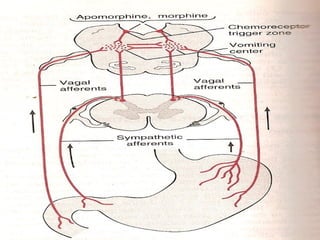
 Non gastric visceral afferents – intestinalNon gastric visceral afferents – intestinal
obstruction, mesenteric ischemiaobstruction, mesenteric ischemia
 Chemoreceptor trigger zone – bilaterallyChemoreceptor trigger zone – bilaterally
on the floor of 4on the floor of 4thth
ventricle near areaventricle near area
postremapostrema
1.1. direct stimulation – electrical, drugsdirect stimulation – electrical, drugs
2.2. Vestibular stimuli – cerebellum – CTZVestibular stimuli – cerebellum – CTZ
3.3. Cerebral excitation – noxious scenes,Cerebral excitation – noxious scenes,
odoursodours
Prelude to vomitingPrelude to vomiting
 Anti peristalsis due to excessive GI irritationAnti peristalsis due to excessive GI irritation
or over distention – from ileum at a rate 2-3or over distention – from ileum at a rate 2-3
cm/s with in 3-5 minutescm/s with in 3-5 minutes
 Duodenum – over distended – actual vomitingDuodenum – over distended – actual vomiting
actact
MECHANISMMECHANISM
 Vagal and sympathetic afferents –bilateralVagal and sympathetic afferents –bilateral
vomiting centre (tractus solitarius near vagusvomiting centre (tractus solitarius near vagus
nucleus)nucleus)
 Automatic motor impulses – Transmitted byAutomatic motor impulses – Transmitted by
5,7,9,10,125,7,9,10,12thth
cranial nerves to upper GIT andcranial nerves to upper GIT and
through spinal nerves to diaphragm andthrough spinal nerves to diaphragm and
abdominal musclesabdominal muscles
Contd…Contd…
 Vomiting is coordinated by the brain stem – effectedVomiting is coordinated by the brain stem – effected
by neuromuscular responses in the gut, pharynx andby neuromuscular responses in the gut, pharynx and
thoraco abdominal wallthoraco abdominal wall
 Somatic and visceral muscles – stereotypic responsesSomatic and visceral muscles – stereotypic responses
 Inspiratory thoracic and abdominal wall musclesInspiratory thoracic and abdominal wall muscles
contract – raised intra thoracic intra abdominalcontract – raised intra thoracic intra abdominal
pressurepressure
 Larynx moves up, reduced gastric tone and peristalsisLarynx moves up, reduced gastric tone and peristalsis
along with increased tone of duodenum – conditionsalong with increased tone of duodenum – conditions
that inhibit gastric emptying, promote vomitingthat inhibit gastric emptying, promote vomiting
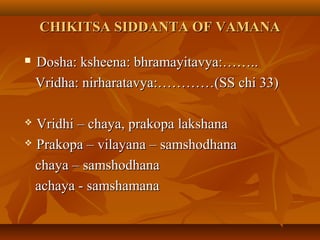
CHIKITSA SIDDANTA OF VAMANACHIKITSA SIDDANTA OF VAMANA
 Dosha: ksheena: bhramayitavya:……..Dosha: ksheena: bhramayitavya:……..
Vridha: nirharatavya:…………(SS chi 33)Vridha: nirharatavya:…………(SS chi 33)
 Vridhi – chaya, prakopa lakshanaVridhi – chaya, prakopa lakshana
 Prakopa – vilayana – samshodhanaPrakopa – vilayana – samshodhana
chaya – samshodhanachaya – samshodhana
achaya - samshamanaachaya - samshamana
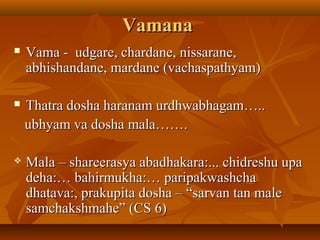
VamanaVamana
 Vama - udgare, chardane, nissarane,Vama - udgare, chardane, nissarane,
abhishandane, mardane (vachaspathyam)abhishandane, mardane (vachaspathyam)
 Thatra dosha haranam urdhwabhagam…..Thatra dosha haranam urdhwabhagam…..
ubhyam va dosha mala…….ubhyam va dosha mala…….
 Mala – shareerasya abadhakara:... chidreshu upaMala – shareerasya abadhakara:... chidreshu upa
deha:… bahirmukha:… paripakwashchadeha:… bahirmukha:… paripakwashcha
dhatava:, prakupita dosha – “sarvan tan maledhatava:, prakupita dosha – “sarvan tan male
samchakshmahe” (CS 6)samchakshmahe” (CS 6)
 Apakwam pitta…… (sharng-p)Apakwam pitta…… (sharng-p)
Deepika – yat dravyam apakwam…..Deepika – yat dravyam apakwam…..
apakwam pittasya…… like in amlapittaapakwam pittasya…… like in amlapitta
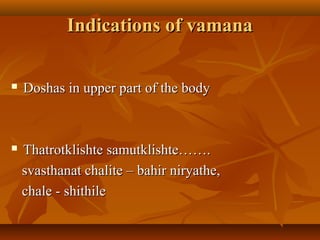
Indications of vamanaIndications of vamana
 Doshas in upper part of the bodyDoshas in upper part of the body
 Thatrotklishte samutklishte…….Thatrotklishte samutklishte…….
svasthanat chalite – bahir niryathe,svasthanat chalite – bahir niryathe,
chale - shithilechale - shithile
Factors influencing vamanaFactors influencing vamana
 Shleshmottara chardayathi hi adukham….Shleshmottara chardayathi hi adukham….
adha: kaphe alpe vamanam virechayet….adha: kaphe alpe vamanam virechayet….
(C Si-1)(C Si-1)
 samutkleshita shleshmanam….(C Ka-1)samutkleshita shleshmanam….(C Ka-1)
 Utkleshanam pittasyeva bhavathi ithi nanuvarthataUtkleshanam pittasyeva bhavathi ithi nanuvarthata
(chakra C Si-1)(chakra C Si-1)
Contd….Contd….
 Dravya –Dravya –
ushna – pachana, svedanaushna – pachana, svedana
teekshna – dahapakakara, sheegrateekshna – dahapakakara, sheegra
vyavayi, vikashivyavayi, vikashi
• Agni vayvatmakaAgni vayvatmaka
• Urdhwa bhaga prabhavat (na tuUrdhwa bhaga prabhavat (na tu
vayvagniatmakatvam svatantro vamana hetu:)vayvagniatmakatvam svatantro vamana hetu:)
• Asatmya, bheebhatsa, durdarsha-gandhaAsatmya, bheebhatsa, durdarsha-gandha
(AS Su 27)(AS Su 27)
Contd…Contd…
 Virudha veerya – pradhana abhadhakamVirudha veerya – pradhana abhadhakam
 Tulya veerya – kriya samarthyamTulya veerya – kriya samarthyam
 Ishta varna rasa sparsha gandharthamIshta varna rasa sparsha gandhartham
 Amayam prathiAmayam prathi
 Subhavitham – bahukarmaSubhavitham – bahukarma
 Alpasyapi maharthtvam…..Alpasyapi maharthtvam…..
samyoga vishlesha kala samskarayukti…samyoga vishlesha kala samskarayukti…
MechanismMechanism
 Thatra ushna……..Thatra ushna……..
veerya – chintya, achintyaveerya – chintya, achintya
udana pranunna:,anupravana bhavatudana pranunna:,anupravana bhavat
 Peetho muhurtham anupalayetPeetho muhurtham anupalayet thanmanathanmana (AH Su 18)(AH Su 18)
vamananugata manaso (AS Su)vamananugata manaso (AS Su)
 Social inhibition prevented by keeping privacySocial inhibition prevented by keeping privacy
 Ghreya yoga – sukumara, utklishta pitta kapha, oushadhaGhreya yoga – sukumara, utklishta pitta kapha, oushadha
dveshi(Manasika factors)dveshi(Manasika factors)
 Pristamardana-Prathiloma – vimargagam, lomabhimukhamPristamardana-Prathiloma – vimargagam, lomabhimukham
Contextual analysis of word HRIDAYAContextual analysis of word HRIDAYA
hri – abhiharathi, da – dadhati, ya – yethihri – abhiharathi, da – dadhati, ya – yethi
swarga means harana – receiving dana –swarga means harana – receiving dana –
giving ayana – moving or maintaining agiving ayana – moving or maintaining a
continues activity of two earlier functioncontinues activity of two earlier function
• It signifies functional aspect of an anatomicalIt signifies functional aspect of an anatomical
organ – like heart, lungs, CNS, cellorgan – like heart, lungs, CNS, cell
• Shows importance of the site likeShows importance of the site like
Talahridaya.Talahridaya.
Contd..Contd..
 Hridaya & Nabhi are main seats of Prana VataHridaya & Nabhi are main seats of Prana Vata
( Sharn. Sam)( Sharn. Sam)
 Prano atra moordaga:Prano atra moordaga:
 Buddernivasam hridayam pradooshya ..Buddernivasam hridayam pradooshya ..
 Hridaya may be a part within shiras and may be itsHridaya may be a part within shiras and may be its
expressive part is anatomical heart which Sushrutaexpressive part is anatomical heart which Sushruta
explainsexplains Pundareekana sadrisham …Pundareekana sadrisham …
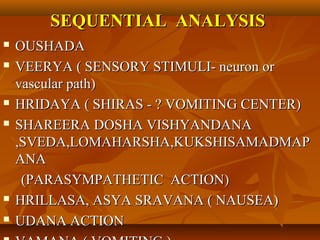
SEQUENTIAL ANALYSISSEQUENTIAL ANALYSIS
 OUSHADAOUSHADA
 VEERYA ( SENSORY STIMULI- neuron orVEERYA ( SENSORY STIMULI- neuron or
vascular path)vascular path)
 HRIDAYA ( SHIRAS - ? VOMITING CENTER)HRIDAYA ( SHIRAS - ? VOMITING CENTER)
 SHAREERA DOSHA VISHYANDANASHAREERA DOSHA VISHYANDANA
,SVEDA,LOMAHARSHA,KUKSHISAMADMAP,SVEDA,LOMAHARSHA,KUKSHISAMADMAP
ANAANA
(PARASYMPATHETIC ACTION)(PARASYMPATHETIC ACTION)
 HRILLASA, ASYA SRAVANA ( NAUSEA)HRILLASA, ASYA SRAVANA ( NAUSEA)
 UDANA ACTIONUDANA ACTION
Vamana

Vamana

  • 1.
  • 2.
    GlimpsesGlimpses  PHYSIOLOGY OFGUTPHYSIOLOGY OF GUT  VOMITING –CausesVOMITING –Causes MechanismMechanism  VAMANA DefinitionVAMANA Definition  Factors influencing VamanaFactors influencing Vamana  Mode of actionMode of action
  • 3.
    Physiology of gutPhysiologyof gut  Function of stomachFunction of stomach  Neural control GI functionNeural control GI function  Mechanism of secretionMechanism of secretion
  • 4.
    Function of stomachFunctionof stomach  StorageStorage  Mixing of food with gastric juiceMixing of food with gastric juice  Slow emptying of the chymeSlow emptying of the chyme
  • 6.
    Neural control GIfunctionNeural control GI function  Myenteric plexus (auerbachs plexus- outer)Myenteric plexus (auerbachs plexus- outer) control G I movementscontrol G I movements  Inner sub mucosal –meissners plexusInner sub mucosal –meissners plexus control G I secretion and local blood flowcontrol G I secretion and local blood flow  Both are connected with 1) sympathetic and 2)Both are connected with 1) sympathetic and 2) parasympethetic fibers- even though ENS canparasympethetic fibers- even though ENS can function its own, 1&2 can further activate orfunction its own, 1&2 can further activate or inhibit GI functioninhibit GI function
  • 7.
    Contd.Contd.  Sensory nerveendings in gut wall sendSensory nerve endings in gut wall send afferent fibers to these gut plexus ofafferent fibers to these gut plexus of ENS as well toENS as well to 1.1. Prevertebral ganglia of sympatheticPrevertebral ganglia of sympathetic nervous systemnervous system 2.2. To the spinal chordTo the spinal chord 3.3. Through vagus nerves- brainstemThrough vagus nerves- brainstem
  • 8.
    Contd….Contd….  Myenteric plexusrun along the way down GI &Myenteric plexus run along the way down GI & 1.1. Increase tonic contractionIncrease tonic contraction 2.2. Rate of rhythm of contractionRate of rhythm of contraction 3.3. Increased peristaltic movementIncreased peristaltic movement
  • 11.
    Autonomic nervous systemAutonomicnervous system  Spinal cordSpinal cord  Brain stemBrain stem  HypothalamusHypothalamus  Cerebral cortexCerebral cortex  Limbic cortexLimbic cortex Can transmit impulses to lower centers andCan transmit impulses to lower centers and influence function ,& also reversely operates byinfluence function ,& also reversely operates by visceral reflexes (subconscious stimulus)visceral reflexes (subconscious stimulus)
  • 12.
     Parasympathetic nervoussystem – fibers leave the CNS byParasympathetic nervous system – fibers leave the CNS by 3,7,9,103,7,9,10thth cranial nerves and additional lower most part of thecranial nerves and additional lower most part of the spinal cord (S-2, S-3)spinal cord (S-2, S-3)  75 % of the parasympathetic nerves are from vagus nerve –75 % of the parasympathetic nerves are from vagus nerve – supplying heart, lungs oesophagus, stomach etc.80% of vagus aresupplying heart, lungs oesophagus, stomach etc.80% of vagus are afferent (gut to brain, sensory)afferent (gut to brain, sensory)  S-2,3 – descending colon, rectum, bladderS-2,3 – descending colon, rectum, bladder  Parasympathetic stimulation increases peristalsis and relaxesParasympathetic stimulation increases peristalsis and relaxes sphincterssphincters  Sympathetic – strong stimulus inhibits peristalsis, increasesSympathetic – strong stimulus inhibits peristalsis, increases sphincter tone, can cause severe constipationsphincter tone, can cause severe constipation
  • 15.
    Mechanism of secretionMechanismof secretion  Food – tactile stimulation, chemical irritation –Food – tactile stimulation, chemical irritation – by stimulating ENSby stimulating ENS  Distention of gut wallDistention of gut wall  Autonomic stimulation – alimentary glandularAutonomic stimulation – alimentary glandular secretion like salivary, oesophageal, gastricsecretion like salivary, oesophageal, gastric glands, pancreas etc. increases by theglands, pancreas etc. increases by the stimulation of parasympathetic nerves –stimulation of parasympathetic nerves – glossopharyngeal, vagusglossopharyngeal, vagus
  • 16.
    VOMITING - DEFINITIONVOMITING- DEFINITION  Vomiting is the means by which the upper GI tractVomiting is the means by which the upper GI tract rids itself of its contents when almost any part of therids itself of its contents when almost any part of the upper tract becomes excessively irritated, overupper tract becomes excessively irritated, over distended or even over excited _(Guyton & Hall)distended or even over excited _(Guyton & Hall)  Nausea is the subjective feeling of a need to vomitNausea is the subjective feeling of a need to vomit
  • 17.
    Causes of vomitingCausesof vomiting  Gastric causesGastric causes  Neurological causes – raised intra cranialNeurological causes – raised intra cranial tension, migraine, cerebral bleedingtension, migraine, cerebral bleeding  Metabolic causes- uremiaMetabolic causes- uremia  Endocrine causes – hypo adrenal crisisEndocrine causes – hypo adrenal crisis  Reflex causes – motion sickness, ocularReflex causes – motion sickness, ocular  Psychogenic – anxietyPsychogenic – anxiety  PregnancyPregnancy
  • 18.
    Activators of theemesisActivators of the emesis  Cerebral cortex – noxious thoughts, smellCerebral cortex – noxious thoughts, smell -Gag reflex activation mediated by – cranial-Gag reflex activation mediated by – cranial nervesnerves  Labrynthine apparatus – motion sicknessLabrynthine apparatus – motion sickness  Gastro duodenal vagal afferent nerves – gastricGastro duodenal vagal afferent nerves – gastric irritants, anti cancer agentsirritants, anti cancer agents
  • 19.
    Cont…..Cont…..  Non gastricvisceral afferents – intestinalNon gastric visceral afferents – intestinal obstruction, mesenteric ischemiaobstruction, mesenteric ischemia  Chemoreceptor trigger zone – bilaterallyChemoreceptor trigger zone – bilaterally on the floor of 4on the floor of 4thth ventricle near areaventricle near area postremapostrema 1.1. direct stimulation – electrical, drugsdirect stimulation – electrical, drugs 2.2. Vestibular stimuli – cerebellum – CTZVestibular stimuli – cerebellum – CTZ 3.3. Cerebral excitation – noxious scenes,Cerebral excitation – noxious scenes, odoursodours
  • 20.
    Prelude to vomitingPreludeto vomiting  Anti peristalsis due to excessive GI irritationAnti peristalsis due to excessive GI irritation or over distention – from ileum at a rate 2-3or over distention – from ileum at a rate 2-3 cm/s with in 3-5 minutescm/s with in 3-5 minutes  Duodenum – over distended – actual vomitingDuodenum – over distended – actual vomiting actact
  • 21.
    MECHANISMMECHANISM  Vagal andsympathetic afferents –bilateralVagal and sympathetic afferents –bilateral vomiting centre (tractus solitarius near vagusvomiting centre (tractus solitarius near vagus nucleus)nucleus)  Automatic motor impulses – Transmitted byAutomatic motor impulses – Transmitted by 5,7,9,10,125,7,9,10,12thth cranial nerves to upper GIT andcranial nerves to upper GIT and through spinal nerves to diaphragm andthrough spinal nerves to diaphragm and abdominal musclesabdominal muscles
  • 22.
    Contd…Contd…  Vomiting iscoordinated by the brain stem – effectedVomiting is coordinated by the brain stem – effected by neuromuscular responses in the gut, pharynx andby neuromuscular responses in the gut, pharynx and thoraco abdominal wallthoraco abdominal wall  Somatic and visceral muscles – stereotypic responsesSomatic and visceral muscles – stereotypic responses  Inspiratory thoracic and abdominal wall musclesInspiratory thoracic and abdominal wall muscles contract – raised intra thoracic intra abdominalcontract – raised intra thoracic intra abdominal pressurepressure  Larynx moves up, reduced gastric tone and peristalsisLarynx moves up, reduced gastric tone and peristalsis along with increased tone of duodenum – conditionsalong with increased tone of duodenum – conditions that inhibit gastric emptying, promote vomitingthat inhibit gastric emptying, promote vomiting
  • 24.
    CHIKITSA SIDDANTA OFVAMANACHIKITSA SIDDANTA OF VAMANA  Dosha: ksheena: bhramayitavya:……..Dosha: ksheena: bhramayitavya:…….. Vridha: nirharatavya:…………(SS chi 33)Vridha: nirharatavya:…………(SS chi 33)  Vridhi – chaya, prakopa lakshanaVridhi – chaya, prakopa lakshana  Prakopa – vilayana – samshodhanaPrakopa – vilayana – samshodhana chaya – samshodhanachaya – samshodhana achaya - samshamanaachaya - samshamana
  • 25.
    VamanaVamana  Vama -udgare, chardane, nissarane,Vama - udgare, chardane, nissarane, abhishandane, mardane (vachaspathyam)abhishandane, mardane (vachaspathyam)  Thatra dosha haranam urdhwabhagam…..Thatra dosha haranam urdhwabhagam….. ubhyam va dosha mala…….ubhyam va dosha mala…….  Mala – shareerasya abadhakara:... chidreshu upaMala – shareerasya abadhakara:... chidreshu upa deha:… bahirmukha:… paripakwashchadeha:… bahirmukha:… paripakwashcha dhatava:, prakupita dosha – “sarvan tan maledhatava:, prakupita dosha – “sarvan tan male samchakshmahe” (CS 6)samchakshmahe” (CS 6)
  • 26.
     Apakwam pitta……(sharng-p)Apakwam pitta…… (sharng-p) Deepika – yat dravyam apakwam…..Deepika – yat dravyam apakwam….. apakwam pittasya…… like in amlapittaapakwam pittasya…… like in amlapitta
  • 27.
    Indications of vamanaIndicationsof vamana  Doshas in upper part of the bodyDoshas in upper part of the body  Thatrotklishte samutklishte…….Thatrotklishte samutklishte……. svasthanat chalite – bahir niryathe,svasthanat chalite – bahir niryathe, chale - shithilechale - shithile
  • 28.
    Factors influencing vamanaFactorsinfluencing vamana  Shleshmottara chardayathi hi adukham….Shleshmottara chardayathi hi adukham…. adha: kaphe alpe vamanam virechayet….adha: kaphe alpe vamanam virechayet…. (C Si-1)(C Si-1)  samutkleshita shleshmanam….(C Ka-1)samutkleshita shleshmanam….(C Ka-1)  Utkleshanam pittasyeva bhavathi ithi nanuvarthataUtkleshanam pittasyeva bhavathi ithi nanuvarthata (chakra C Si-1)(chakra C Si-1)
  • 29.
    Contd….Contd….  Dravya –Dravya– ushna – pachana, svedanaushna – pachana, svedana teekshna – dahapakakara, sheegrateekshna – dahapakakara, sheegra vyavayi, vikashivyavayi, vikashi • Agni vayvatmakaAgni vayvatmaka • Urdhwa bhaga prabhavat (na tuUrdhwa bhaga prabhavat (na tu vayvagniatmakatvam svatantro vamana hetu:)vayvagniatmakatvam svatantro vamana hetu:) • Asatmya, bheebhatsa, durdarsha-gandhaAsatmya, bheebhatsa, durdarsha-gandha (AS Su 27)(AS Su 27)
  • 30.
    Contd…Contd…  Virudha veerya– pradhana abhadhakamVirudha veerya – pradhana abhadhakam  Tulya veerya – kriya samarthyamTulya veerya – kriya samarthyam  Ishta varna rasa sparsha gandharthamIshta varna rasa sparsha gandhartham  Amayam prathiAmayam prathi  Subhavitham – bahukarmaSubhavitham – bahukarma  Alpasyapi maharthtvam…..Alpasyapi maharthtvam….. samyoga vishlesha kala samskarayukti…samyoga vishlesha kala samskarayukti…
  • 31.
    MechanismMechanism  Thatra ushna……..Thatraushna…….. veerya – chintya, achintyaveerya – chintya, achintya udana pranunna:,anupravana bhavatudana pranunna:,anupravana bhavat  Peetho muhurtham anupalayetPeetho muhurtham anupalayet thanmanathanmana (AH Su 18)(AH Su 18) vamananugata manaso (AS Su)vamananugata manaso (AS Su)  Social inhibition prevented by keeping privacySocial inhibition prevented by keeping privacy  Ghreya yoga – sukumara, utklishta pitta kapha, oushadhaGhreya yoga – sukumara, utklishta pitta kapha, oushadha dveshi(Manasika factors)dveshi(Manasika factors)  Pristamardana-Prathiloma – vimargagam, lomabhimukhamPristamardana-Prathiloma – vimargagam, lomabhimukham
  • 32.
    Contextual analysis ofword HRIDAYAContextual analysis of word HRIDAYA hri – abhiharathi, da – dadhati, ya – yethihri – abhiharathi, da – dadhati, ya – yethi swarga means harana – receiving dana –swarga means harana – receiving dana – giving ayana – moving or maintaining agiving ayana – moving or maintaining a continues activity of two earlier functioncontinues activity of two earlier function • It signifies functional aspect of an anatomicalIt signifies functional aspect of an anatomical organ – like heart, lungs, CNS, cellorgan – like heart, lungs, CNS, cell • Shows importance of the site likeShows importance of the site like Talahridaya.Talahridaya.
  • 33.
    Contd..Contd..  Hridaya &Nabhi are main seats of Prana VataHridaya & Nabhi are main seats of Prana Vata ( Sharn. Sam)( Sharn. Sam)  Prano atra moordaga:Prano atra moordaga:  Buddernivasam hridayam pradooshya ..Buddernivasam hridayam pradooshya ..  Hridaya may be a part within shiras and may be itsHridaya may be a part within shiras and may be its expressive part is anatomical heart which Sushrutaexpressive part is anatomical heart which Sushruta explainsexplains Pundareekana sadrisham …Pundareekana sadrisham …
  • 34.
    SEQUENTIAL ANALYSISSEQUENTIAL ANALYSIS OUSHADAOUSHADA  VEERYA ( SENSORY STIMULI- neuron orVEERYA ( SENSORY STIMULI- neuron or vascular path)vascular path)  HRIDAYA ( SHIRAS - ? VOMITING CENTER)HRIDAYA ( SHIRAS - ? VOMITING CENTER)  SHAREERA DOSHA VISHYANDANASHAREERA DOSHA VISHYANDANA ,SVEDA,LOMAHARSHA,KUKSHISAMADMAP,SVEDA,LOMAHARSHA,KUKSHISAMADMAP ANAANA (PARASYMPATHETIC ACTION)(PARASYMPATHETIC ACTION)  HRILLASA, ASYA SRAVANA ( NAUSEA)HRILLASA, ASYA SRAVANA ( NAUSEA)  UDANA ACTIONUDANA ACTION