7/5/2023 9:08 AM 1
INTRODUCTION TO HISTOPATHOLOGY
CHAPTER ONE
2
7/5/2023 9:08 AM
1. INTRODUCTION
1.1 Histopathology
 A branch of pathology that deals with tissue
changes associated with disease or toxic
effects.
 Specializes in the histologic study of
diseased tissue.
 It is important tool of anatomical pathology.
 It is used for accurate diagnosis of cancer
and other diseases.
3
7/5/2023 9:08 AM
1.2 Pathology
 Pathology is literally the study (logos) of
suffering (pathos).
 More specifically; it is bridging dicipline
involving both basic science and clinical
practice.
 Is devoted to study of the structural and
functional changes in cells, tissues, and
organs that underlie disease by the use of
molecular, microbiologic, immunologic
techniques.
4
7/5/2023 9:08 AM
Pathology…cont’d…
 Pathology is a discipline involving both
basic science and clinical practice.
 It is the study of the structural and
functional changes in cells, tissues, and
organs that cause disease.
 The term pathology is used when one
refers to the “scientific study of disease”
or the alterations that occur when
abnormal influences (bacteria, viruses,
etc.) affect cells, tissues, or body systems
5
7/5/2023 9:08 AM
 Pathology provides a logical means of
relating the knowledge of normal
structure and function to abnormal
structure and function in as encountered
in a diseased individual.
 Anatomy and histology are the study of
the normal body, gross and microscopic.
 Physiology is the study of functions of
cells, tissues, and organs of healthy
individual
Pathology…cont’d…
6
7/5/2023 9:08 AM
 So, pathology is the study of the structure
and the function of the body in disease.
 A basic knowledge of normal anatomy
(structure) and physiology (function) is
needed to understand pathology.
 Pathology deals with knowledge of what
causes disease, how disease starts,
progresses.
 It explains the reason for signs and
symptoms of patient
Pathology…cont’d…
7
7/5/2023 9:08 AM
There are 4 aspects of a disease process
that form the core of pathology.
 Pathology of a disease is formally
studied under four subdivisions
1. Etiology
2. Morphologic changes
3. Pathogenesis
4. Manifestation
8
7/5/2023 9:08 AM
A. Etiology
 This is the “cause” of disease.
 There are many different cause of
disease. This can be broadly categorized
in to the following groups.
1. Predisposing causes of diseases
 Refer to those factors which make an
individual more susceptible to a disease
(damp weather, poor ventilation, etc.)
9
7/5/2023 9:08 AM
Etiology
 Predisposing causes of diseases may be
divided into intrinsic and extrinsic
causes
a. Genetic or internal (intrinsic) factors
e.g. Genus, race, breed, family, age, sex,
color, etc.
b. Environmental or external factors e.g.
nutritional deficiencies, chilling,
dampness, poor ventilation, etc.
10
7/5/2023 9:08 AM
Etiology
2. Exciting causes of disease
 Refer to those factors which are directly
responsible for a disease (bacteria,
viruses, hypoxia, chemical agents, etc.)
 Disease which present since birth are
called CONGENITAL DISEASE and
all other diseases are known as
ACQUIRED DISEASE.
11
7/5/2023 9:08 AM
CONGENITAL DISEASE-
Congenital (born with)
 Genetic (mutational or chromosomal
abnormalities) and these are not
necessarily manifest during early life.
 Nongenetic causes damages during
intrauterine life which causes structural
damages
 Diseases which occur in families are
known as Familial diseases.
12
7/5/2023 9:08 AM
ACQUIRED DISEASE
 Non genetic causes of disease acquired in life.
 Nutritional deficiency e.g. rickets, scurvy, etc
 Over nutrition e.g. obesity, atherosclerosis,
 Physical; traumatic, radiation (actinic, Dx, Rx)
 Heat extremes – heat stroke or frost bit
 Chemical (drugs, households environmental)
 Microorganisms – bacteria, virus, etc.
 Immunologic deficiency e.g HS, Autoimmunity
13
7/5/2023 9:08 AM
Nosology
 Systematic classification of disease
 Greek “nosos - disease
 Latin “logia” – study
 Major groups of disease are inflammatory,
degenerative developmental and neoplastic.
 Inflammatory disorder are due to damage to tissue by various
injuries (physical, chemical, infections etc.)
 Degenerative disorder are due to lack of growth or ageing.
 Neoplastic disorders are due to excess cell division forming
tumors
14
7/5/2023 9:08 AM
B. Morphology
 Structural and functional changes in cell,
tissue, and organs that is characteristic of the
disease or condition.
 Signs and symptoms, course and prognosis of
disease depend on the morphology
C. Pathogenesis
 Sequence of events in the response of cells
and tissues to stimulus/pathogen “starting
from the initial stimulus to the ultimate
expression of disease”.
15
7/5/2023 9:08 AM
D. Manifestation
 The altered anatomic structure or
physiologic functions due to different
disease can present as specific or
nonspecific sign and symptoms.
 Syndrome e.g. Cushing syndrome
 Functional arrangements and its clinical
manifestations resulting from the
morphologic changes.
16
7/5/2023 9:08 AM
Pathological manifestation
 Traditionally the study of pathology is
divided into general pathology and
special or systemic pathology.
 The former is concerned with the basic
reactions of cells and tissues to abnormal
stimuli that underlie all diseases.
 The later examines the specific response
of specialized organs and tissue to more
or less well defined stimuli.
17
7/5/2023 9:08 AM
1.2.1 Branches of pathology
 Histopathology/Anatomic pathology
Microscopic study of architectural
organization alterations of tissue due to
different causes.
Specializing in anatomical changes in tissue
usually using a tissue biopsy by direct visual
observation, with or without a microscope.
18
7/5/2023 9:08 AM
Cytopathology
Deals with the examination of individual
cells from body fluids, scrapings of body
surfaces, or aspirations of deep body
tissues using a long needle.
 Is the study of individual cell feature
changes due to different causes.
19
7/5/2023 9:08 AM
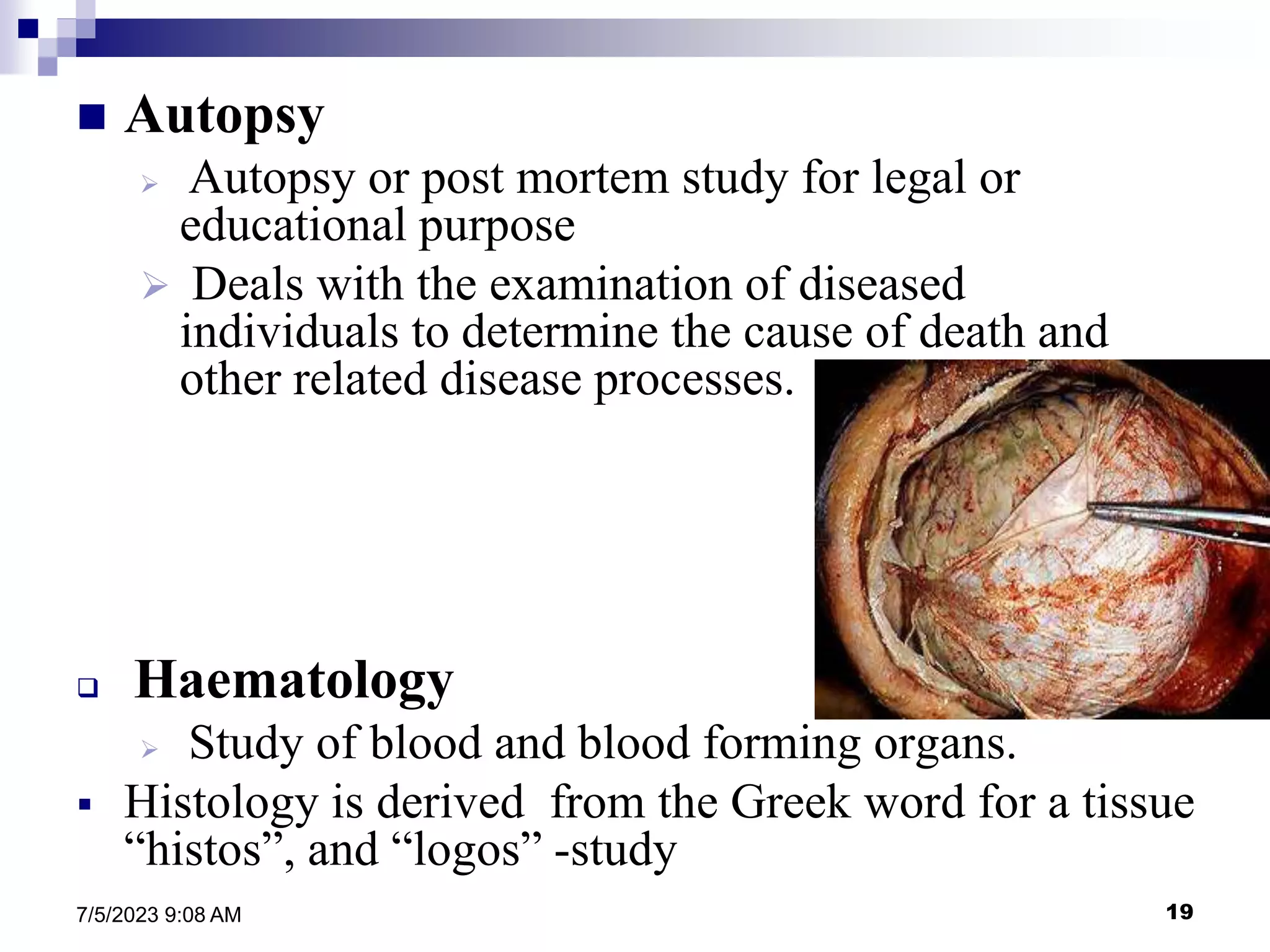
 Autopsy
 Autopsy or post mortem study for legal or
educational purpose
 Deals with the examination of diseased
individuals to determine the cause of death and
other related disease processes.
 Haematology
 Study of blood and blood forming organs.
 Histology is derived from the Greek word for a tissue
“histos”, and “logos” -study
20
7/5/2023 9:08 AM
1.2.2 Histological aspects of pathology
 The Greek culture had a profound effect on
the scientific approach to medicine.
 Greek physicians elucidate/explain;show/
the principles of exact and careful clinical
observations.
 However, they did not deal with the nature
or the changes that occurred subsequent to
disease.
21
7/5/2023 9:08 AM
Hippocrates (460 – 375)
 A Greek physisian introduced the humoral
theory of disease. He recognized 4 humors
or fluids in the body
1. Blood which came from the heart;
2. Phlegm which came from the brain;
3. Yellow bile which came from the liver; and
4. Black bile which came from the spleen.
 Hippocrates is considered to be the father
of medicine.
22
7/5/2023 9:08 AM
Aristotle (384 – 323)
 A Greek philosopher was the originator of
modern anatomy and physiology. Also, he
is considered to be the father of Zoology.
 Aristotle dissected many animals, carried
out experiments in physiology, and studied
the growth and development of animal life
(human autopsy examinations were
forbidden during this period).
23
7/5/2023 9:08 AM
ANTONY VAN LEEUWENHOEK
(1632 -1723)
 He received no higher education or
university degrees and knew no language
other than his native Dutch.
 He was the first to show that the
microscope had practical importance in the
study of tissues and other small objects.
 He is not credited with discovering the
microscope.
24
7/5/2023 9:08 AM
GIOVANNI MORGAGNI
(1682-1771)
 An Italian recognized as one of the
earliest pathologists and the originator of
modern pathology.
 He was the first to correlate pathologic
changes in the dead individual with
clinical signs and symptoms shown by
the individual during life.
25
7/5/2023 9:08 AM
MARIE FRANCOIS XAVIER BICHAT
(1771-1801)
 A Frenchman, is credited with establishing the
foundation for the study of histology, even
though most of his work was done by physical
and chemical methods (he did not possess a
microscope).
 Bichat presented a new concept of anatomy and
showed that the body was composed of twenty-
one tissues (vascular, osseous, muscular, etc).
 He is considered to be the Father of Histology
26
7/5/2023 9:08 AM
RUDOLPH VIRCHOW
(1821- 1902)
 A known as the Father of cellular Pathology.
 He invented and explained many of the terms and
concepts used today in pathology.(amyloidosis,
fatty degeneration, etc.)
 In addition, he started publication of “virchow’s
Archives,” a journal that has been in continuous
publication since1847.
 This is considered to be one of the most complete
works of pathology in existence.
27
7/5/2023 9:08 AM
1.2.3 BASIC LANGUAGE OF PATHOLOGY
 Listed of few basic terms used repeatedly in pathology.
Disease (dis+ease)
 Discomfort due to structural or functional
abnormality.
 Disease occur when there is variation in normal
structure or function.
 A disease may be defined as a “state in which an
individual exhibits an anatomical, physiological
or biochemical deviation from the normal”.
 As generally used, the term “disease” is
employed to describe a state in which there is
sufficient departure from the normal for clinical
signs or symptoms to be produced.

28
7/5/2023 9:08 AM
 Although often used to mean disease, can also refer to
a person’s perception of their health, regardless of
whether they in fact have a disease. A person without
any disease may feel unhealthy and simply have the
perception of having a disease.
Health
 As generally used, the term “health” refers to the “state
in which an individual is living in complete harmony
with his environment”.
 It should be remembered that the transitional zone
between health and disease is difficult to define.
 We must also recognize that in addition to disease
entities, each with its specific cause there are
syndromes.
Illness
29
7/5/2023 9:08 AM
Syndrome
 A syndrome(From the Greek meaning “running
together”
 Is aggregate of symptoms not due to interference at
any point with a chain of physiological processes.
 Medical usage some times distinguishes a disease,
which has a known specific cause or causes.(called its
etiology), from a syndrome, which is a collection of
signs or symptoms that occur together.
 How ever, many conditions have been identified, yet
continue to be referred to as “syndrome”.
 Furthermore, numerous conditions of unknown
etiology are referred to as “disease” in many context.
30
7/5/2023 9:08 AM
Clinical signs
 “Clinical signs” refer to any functional evidence
of disease which can be determined objectively
or by the observer. E.g. lameness, salivation,
increased respiratory efforts, etc.
Clinical symptoms
 The term clinical symptoms should be reserved
for any “functional evidence of disease that can
be determined subjectively or by the patient”.
E.g. feeling or abnormal discomfort,etc.)
31
7/5/2023 9:08 AM
Lesion
 The term lesion is generally used to refer to
“structural or morphological alterations associated
with a diseased state in an individual.”
 Lesion may be recognized with the naked-eye (gross
lesions), with the aid of a light microscope
(microscopic lesions), with the aid of electron
microscope (ultra structural lesions).
 Biochemical or functional lesions are recognized as
changes which result from disturbed function.
32
7/5/2023 9:08 AM
Prognosis
 Prognosis refers to the probably outcome of a
disease in a living individual.
 It is the clinician’ estimate of the severity and
possible result of a disease. E.g. death, lung
cancer, disability
Diagnosis
 Greek, dia “through”+ gnosis “knowledge”
 Diagnosis refers to the “determination of the
nature of a disease expressed in a concise
manner.”
33
7/5/2023 9:08 AM
1.2.4 Samples for pathology laboratory
 Biopsy
Specimen from patients taken by the
clinicians, usually surgeons and gynecologists.
These can be lesions, which are easily
accessible and thus completely removed
(excisional biopsy) or incompletely removed
(incisional biopsy).
If the lesion is inaccessible directly it can be
done as endoscopic biopsy.
34
7/5/2023 9:08 AM
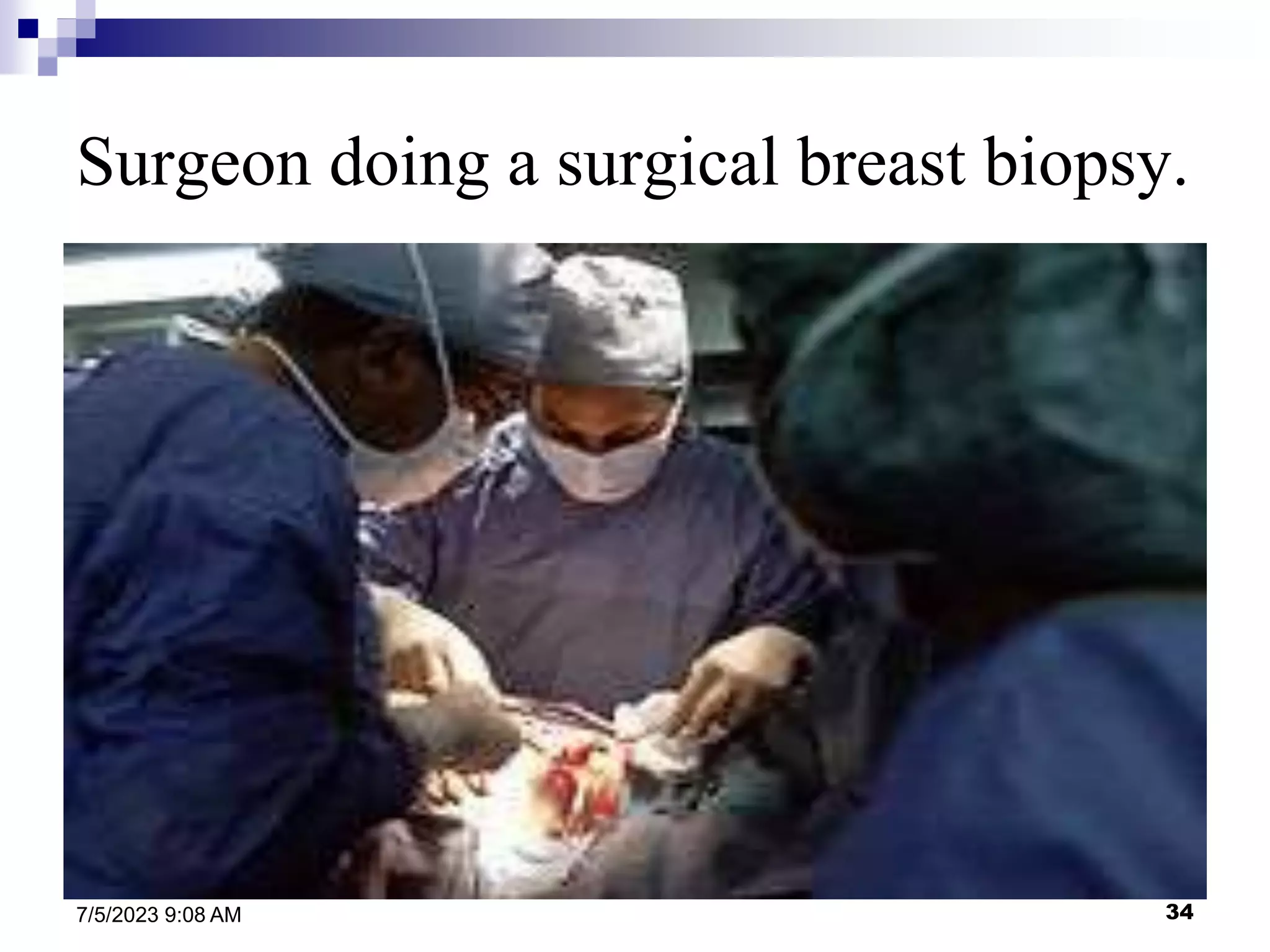
Surgeon doing a surgical breast biopsy.
.
35
7/5/2023 9:08 AM
 Necropsy
 Lesion representation from post mortem
examination.
 Curettage
 Sampling from small anatomic spaces (e.g.
endometrium) or from pathologic spaces e.g. bone
cysts.
 Scrapes
 Sampling easily from approachable body surfaces
by spatulas. E.g. uterine cervix, conjunctiva and
oral mucosa.
36
7/5/2023 9:08 AM
 Brushing
Delicately from approachable body surfaces such as
bronchial and similar sites as scrapings.
 Washings
This is rinsing, using physiologic solutions, and
collecting from far body surfaces. E.g. bronchial, gastric.
 Aspiration
Sampling from solid organs using needle (fine needle or
core needle biopsy). E.g. lymph nodes, tumors, bone
marrow or renal biopsy.
 Body fluids
Collection of exfoliated cells from body spaces. E.g.
CSF, pleural, peritoneal, joint spaces, cysts etc.
Thank you !
37
7/5/2023 9:08 AM

Histopathology Chapter 1 - Introduction.ppt

  • 1.
    7/5/2023 9:08 AM1 INTRODUCTION TO HISTOPATHOLOGY CHAPTER ONE
  • 2.
    2 7/5/2023 9:08 AM 1.INTRODUCTION 1.1 Histopathology  A branch of pathology that deals with tissue changes associated with disease or toxic effects.  Specializes in the histologic study of diseased tissue.  It is important tool of anatomical pathology.  It is used for accurate diagnosis of cancer and other diseases.
  • 3.
    3 7/5/2023 9:08 AM 1.2Pathology  Pathology is literally the study (logos) of suffering (pathos).  More specifically; it is bridging dicipline involving both basic science and clinical practice.  Is devoted to study of the structural and functional changes in cells, tissues, and organs that underlie disease by the use of molecular, microbiologic, immunologic techniques.
  • 4.
    4 7/5/2023 9:08 AM Pathology…cont’d… Pathology is a discipline involving both basic science and clinical practice.  It is the study of the structural and functional changes in cells, tissues, and organs that cause disease.  The term pathology is used when one refers to the “scientific study of disease” or the alterations that occur when abnormal influences (bacteria, viruses, etc.) affect cells, tissues, or body systems
  • 5.
    5 7/5/2023 9:08 AM Pathology provides a logical means of relating the knowledge of normal structure and function to abnormal structure and function in as encountered in a diseased individual.  Anatomy and histology are the study of the normal body, gross and microscopic.  Physiology is the study of functions of cells, tissues, and organs of healthy individual Pathology…cont’d…
  • 6.
    6 7/5/2023 9:08 AM So, pathology is the study of the structure and the function of the body in disease.  A basic knowledge of normal anatomy (structure) and physiology (function) is needed to understand pathology.  Pathology deals with knowledge of what causes disease, how disease starts, progresses.  It explains the reason for signs and symptoms of patient Pathology…cont’d…
  • 7.
    7 7/5/2023 9:08 AM Thereare 4 aspects of a disease process that form the core of pathology.  Pathology of a disease is formally studied under four subdivisions 1. Etiology 2. Morphologic changes 3. Pathogenesis 4. Manifestation
  • 8.
    8 7/5/2023 9:08 AM A.Etiology  This is the “cause” of disease.  There are many different cause of disease. This can be broadly categorized in to the following groups. 1. Predisposing causes of diseases  Refer to those factors which make an individual more susceptible to a disease (damp weather, poor ventilation, etc.)
  • 9.
    9 7/5/2023 9:08 AM Etiology Predisposing causes of diseases may be divided into intrinsic and extrinsic causes a. Genetic or internal (intrinsic) factors e.g. Genus, race, breed, family, age, sex, color, etc. b. Environmental or external factors e.g. nutritional deficiencies, chilling, dampness, poor ventilation, etc.
  • 10.
    10 7/5/2023 9:08 AM Etiology 2.Exciting causes of disease  Refer to those factors which are directly responsible for a disease (bacteria, viruses, hypoxia, chemical agents, etc.)  Disease which present since birth are called CONGENITAL DISEASE and all other diseases are known as ACQUIRED DISEASE.
  • 11.
    11 7/5/2023 9:08 AM CONGENITALDISEASE- Congenital (born with)  Genetic (mutational or chromosomal abnormalities) and these are not necessarily manifest during early life.  Nongenetic causes damages during intrauterine life which causes structural damages  Diseases which occur in families are known as Familial diseases.
  • 12.
    12 7/5/2023 9:08 AM ACQUIREDDISEASE  Non genetic causes of disease acquired in life.  Nutritional deficiency e.g. rickets, scurvy, etc  Over nutrition e.g. obesity, atherosclerosis,  Physical; traumatic, radiation (actinic, Dx, Rx)  Heat extremes – heat stroke or frost bit  Chemical (drugs, households environmental)  Microorganisms – bacteria, virus, etc.  Immunologic deficiency e.g HS, Autoimmunity
  • 13.
    13 7/5/2023 9:08 AM Nosology Systematic classification of disease  Greek “nosos - disease  Latin “logia” – study  Major groups of disease are inflammatory, degenerative developmental and neoplastic.  Inflammatory disorder are due to damage to tissue by various injuries (physical, chemical, infections etc.)  Degenerative disorder are due to lack of growth or ageing.  Neoplastic disorders are due to excess cell division forming tumors
  • 14.
    14 7/5/2023 9:08 AM B.Morphology  Structural and functional changes in cell, tissue, and organs that is characteristic of the disease or condition.  Signs and symptoms, course and prognosis of disease depend on the morphology C. Pathogenesis  Sequence of events in the response of cells and tissues to stimulus/pathogen “starting from the initial stimulus to the ultimate expression of disease”.
  • 15.
    15 7/5/2023 9:08 AM D.Manifestation  The altered anatomic structure or physiologic functions due to different disease can present as specific or nonspecific sign and symptoms.  Syndrome e.g. Cushing syndrome  Functional arrangements and its clinical manifestations resulting from the morphologic changes.
  • 16.
    16 7/5/2023 9:08 AM Pathologicalmanifestation  Traditionally the study of pathology is divided into general pathology and special or systemic pathology.  The former is concerned with the basic reactions of cells and tissues to abnormal stimuli that underlie all diseases.  The later examines the specific response of specialized organs and tissue to more or less well defined stimuli.
  • 17.
    17 7/5/2023 9:08 AM 1.2.1Branches of pathology  Histopathology/Anatomic pathology Microscopic study of architectural organization alterations of tissue due to different causes. Specializing in anatomical changes in tissue usually using a tissue biopsy by direct visual observation, with or without a microscope.
  • 18.
    18 7/5/2023 9:08 AM Cytopathology Dealswith the examination of individual cells from body fluids, scrapings of body surfaces, or aspirations of deep body tissues using a long needle.  Is the study of individual cell feature changes due to different causes.
  • 19.
    19 7/5/2023 9:08 AM Autopsy  Autopsy or post mortem study for legal or educational purpose  Deals with the examination of diseased individuals to determine the cause of death and other related disease processes.  Haematology  Study of blood and blood forming organs.  Histology is derived from the Greek word for a tissue “histos”, and “logos” -study
  • 20.
    20 7/5/2023 9:08 AM 1.2.2Histological aspects of pathology  The Greek culture had a profound effect on the scientific approach to medicine.  Greek physicians elucidate/explain;show/ the principles of exact and careful clinical observations.  However, they did not deal with the nature or the changes that occurred subsequent to disease.
  • 21.
    21 7/5/2023 9:08 AM Hippocrates(460 – 375)  A Greek physisian introduced the humoral theory of disease. He recognized 4 humors or fluids in the body 1. Blood which came from the heart; 2. Phlegm which came from the brain; 3. Yellow bile which came from the liver; and 4. Black bile which came from the spleen.  Hippocrates is considered to be the father of medicine.
  • 22.
    22 7/5/2023 9:08 AM Aristotle(384 – 323)  A Greek philosopher was the originator of modern anatomy and physiology. Also, he is considered to be the father of Zoology.  Aristotle dissected many animals, carried out experiments in physiology, and studied the growth and development of animal life (human autopsy examinations were forbidden during this period).
  • 23.
    23 7/5/2023 9:08 AM ANTONYVAN LEEUWENHOEK (1632 -1723)  He received no higher education or university degrees and knew no language other than his native Dutch.  He was the first to show that the microscope had practical importance in the study of tissues and other small objects.  He is not credited with discovering the microscope.
  • 24.
    24 7/5/2023 9:08 AM GIOVANNIMORGAGNI (1682-1771)  An Italian recognized as one of the earliest pathologists and the originator of modern pathology.  He was the first to correlate pathologic changes in the dead individual with clinical signs and symptoms shown by the individual during life.
  • 25.
    25 7/5/2023 9:08 AM MARIEFRANCOIS XAVIER BICHAT (1771-1801)  A Frenchman, is credited with establishing the foundation for the study of histology, even though most of his work was done by physical and chemical methods (he did not possess a microscope).  Bichat presented a new concept of anatomy and showed that the body was composed of twenty- one tissues (vascular, osseous, muscular, etc).  He is considered to be the Father of Histology
  • 26.
    26 7/5/2023 9:08 AM RUDOLPHVIRCHOW (1821- 1902)  A known as the Father of cellular Pathology.  He invented and explained many of the terms and concepts used today in pathology.(amyloidosis, fatty degeneration, etc.)  In addition, he started publication of “virchow’s Archives,” a journal that has been in continuous publication since1847.  This is considered to be one of the most complete works of pathology in existence.
  • 27.
    27 7/5/2023 9:08 AM 1.2.3BASIC LANGUAGE OF PATHOLOGY  Listed of few basic terms used repeatedly in pathology. Disease (dis+ease)  Discomfort due to structural or functional abnormality.  Disease occur when there is variation in normal structure or function.  A disease may be defined as a “state in which an individual exhibits an anatomical, physiological or biochemical deviation from the normal”.  As generally used, the term “disease” is employed to describe a state in which there is sufficient departure from the normal for clinical signs or symptoms to be produced.
  • 28.
    28 7/5/2023 9:08 AM Although often used to mean disease, can also refer to a person’s perception of their health, regardless of whether they in fact have a disease. A person without any disease may feel unhealthy and simply have the perception of having a disease. Health  As generally used, the term “health” refers to the “state in which an individual is living in complete harmony with his environment”.  It should be remembered that the transitional zone between health and disease is difficult to define.  We must also recognize that in addition to disease entities, each with its specific cause there are syndromes. Illness
  • 29.
    29 7/5/2023 9:08 AM Syndrome A syndrome(From the Greek meaning “running together”  Is aggregate of symptoms not due to interference at any point with a chain of physiological processes.  Medical usage some times distinguishes a disease, which has a known specific cause or causes.(called its etiology), from a syndrome, which is a collection of signs or symptoms that occur together.  How ever, many conditions have been identified, yet continue to be referred to as “syndrome”.  Furthermore, numerous conditions of unknown etiology are referred to as “disease” in many context.
  • 30.
    30 7/5/2023 9:08 AM Clinicalsigns  “Clinical signs” refer to any functional evidence of disease which can be determined objectively or by the observer. E.g. lameness, salivation, increased respiratory efforts, etc. Clinical symptoms  The term clinical symptoms should be reserved for any “functional evidence of disease that can be determined subjectively or by the patient”. E.g. feeling or abnormal discomfort,etc.)
  • 31.
    31 7/5/2023 9:08 AM Lesion The term lesion is generally used to refer to “structural or morphological alterations associated with a diseased state in an individual.”  Lesion may be recognized with the naked-eye (gross lesions), with the aid of a light microscope (microscopic lesions), with the aid of electron microscope (ultra structural lesions).  Biochemical or functional lesions are recognized as changes which result from disturbed function.
  • 32.
    32 7/5/2023 9:08 AM Prognosis Prognosis refers to the probably outcome of a disease in a living individual.  It is the clinician’ estimate of the severity and possible result of a disease. E.g. death, lung cancer, disability Diagnosis  Greek, dia “through”+ gnosis “knowledge”  Diagnosis refers to the “determination of the nature of a disease expressed in a concise manner.”
  • 33.
    33 7/5/2023 9:08 AM 1.2.4Samples for pathology laboratory  Biopsy Specimen from patients taken by the clinicians, usually surgeons and gynecologists. These can be lesions, which are easily accessible and thus completely removed (excisional biopsy) or incompletely removed (incisional biopsy). If the lesion is inaccessible directly it can be done as endoscopic biopsy.
  • 34.
    34 7/5/2023 9:08 AM Surgeondoing a surgical breast biopsy. .
  • 35.
    35 7/5/2023 9:08 AM Necropsy  Lesion representation from post mortem examination.  Curettage  Sampling from small anatomic spaces (e.g. endometrium) or from pathologic spaces e.g. bone cysts.  Scrapes  Sampling easily from approachable body surfaces by spatulas. E.g. uterine cervix, conjunctiva and oral mucosa.
  • 36.
    36 7/5/2023 9:08 AM Brushing Delicately from approachable body surfaces such as bronchial and similar sites as scrapings.  Washings This is rinsing, using physiologic solutions, and collecting from far body surfaces. E.g. bronchial, gastric.  Aspiration Sampling from solid organs using needle (fine needle or core needle biopsy). E.g. lymph nodes, tumors, bone marrow or renal biopsy.  Body fluids Collection of exfoliated cells from body spaces. E.g. CSF, pleural, peritoneal, joint spaces, cysts etc.
  • 37.

Editor's Notes

  • #2 July 5, 2023
  • #3 July 5, 2023
  • #4 July 5, 2023
  • #10 July 5, 2023
  • #24 July 5, 2023
  • #31 Lameness= disability of the limb due to accidents e.g The accident left him lame for life.