B. Scott TuckerHIS 140Big history
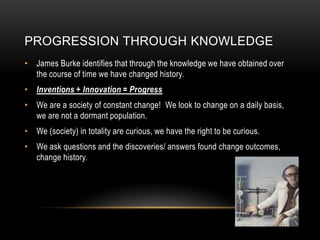
Progression Through knowledgeJames Burke identifies that through the knowledge we have obtained over  the course of time we have changed history.Inventions + Innovation = ProgressWe are a society of constant change! We look to change on a daily basis, we are not a dormant population.We (society) in totality are curious, we have the right to be curious.We ask questions and the discoveries/ answers found change outcomes, change history.
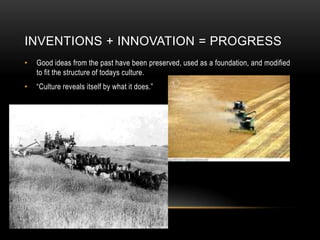
Inventions + Innovation = ProgressGood ideas from the past have been preserved, used as a foundation, and modified to fit the structure of todays culture.“Culture reveals itself by what it does.”
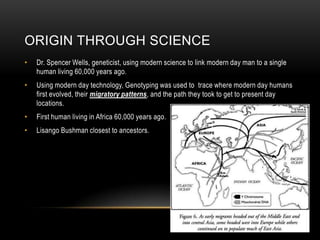
Origin through scienceDr. Spencer Wells, geneticist, using modern science to link modern day man to a single human living 60,000 years ago.Using modern day technology, Genotyping was used to  trace where modern day humans first evolved, their migratory patterns, and the path they took to get to present day locations.First human living in Africa 60,000 years ago.Lisango Bushman closest to ancestors.
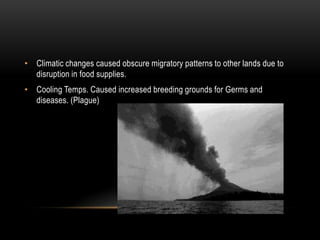
Natural Disasters changing historyA scientific hypothesis was generated that in the mid 6th Century a natural disaster occurred that changed the course of history. Believed that it was an eruption of the Volcano, Krakatoa.Multiple Scientists, of different disciplines,  throughout the world utilized different methods to help support this theory. (Scientists and Historians used methods from Tree Ring samples to collecting samples from the Volcano)This event drastically changed climate conditions around the world which had a large chain reaction.  Decreased temperatures, Decreased strength of the sun to heat and evaporate the ocean surfaces, Decreased moisture in the atmosphere, decreased rainfall, increased droughts.
Climatic changes caused obscure migratory patterns to other lands due to disruption in food supplies.Cooling Temps. Caused increased breeding grounds for Germs and diseases. (Plague)
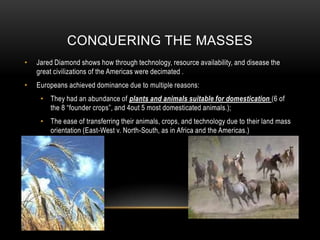
Conquering the massesJared Diamond shows how through technology, resource availability, and disease the great civilizations of the Americas were decimated . Europeans achieved dominance due to multiple reasons:They had an abundance of plants and animals suitable for domestication (6 of the 8 “founder crops”, and 4out 5 most domesticated animals.);The ease of transferring their animals, crops, and technology due to their land mass orientation (East-West v. North-South, as in Africa and the Americas.)
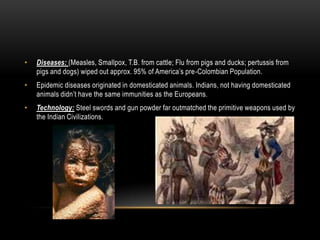
Diseases: (Measles, Smallpox, T.B. from cattle; Flu from pigs and ducks; pertussis from pigs and dogs) wiped out approx. 95% of America’s pre-Colombian Population.Epidemic diseases originated in domesticated animals. Indians, not having domesticated animals didn’t have the same immunities as the Europeans.Technology: Steel swords and gun powder far outmatched the primitive weapons used by the Indian Civilizations.
The Great DiscoveryChristopher Columbus’s voyage that led to the “discovery” of a new continent changed history forever.
With Great Discovery came Great Destruction!

His 140

  • 1.
    B. Scott TuckerHIS140Big history
  • 2.
    Progression Through knowledgeJamesBurke identifies that through the knowledge we have obtained over the course of time we have changed history.Inventions + Innovation = ProgressWe are a society of constant change! We look to change on a daily basis, we are not a dormant population.We (society) in totality are curious, we have the right to be curious.We ask questions and the discoveries/ answers found change outcomes, change history.
  • 3.
    Inventions + Innovation= ProgressGood ideas from the past have been preserved, used as a foundation, and modified to fit the structure of todays culture.“Culture reveals itself by what it does.”
  • 4.
    Origin through scienceDr.Spencer Wells, geneticist, using modern science to link modern day man to a single human living 60,000 years ago.Using modern day technology, Genotyping was used to trace where modern day humans first evolved, their migratory patterns, and the path they took to get to present day locations.First human living in Africa 60,000 years ago.Lisango Bushman closest to ancestors.
  • 5.
    Natural Disasters changinghistoryA scientific hypothesis was generated that in the mid 6th Century a natural disaster occurred that changed the course of history. Believed that it was an eruption of the Volcano, Krakatoa.Multiple Scientists, of different disciplines, throughout the world utilized different methods to help support this theory. (Scientists and Historians used methods from Tree Ring samples to collecting samples from the Volcano)This event drastically changed climate conditions around the world which had a large chain reaction. Decreased temperatures, Decreased strength of the sun to heat and evaporate the ocean surfaces, Decreased moisture in the atmosphere, decreased rainfall, increased droughts.
  • 6.
    Climatic changes causedobscure migratory patterns to other lands due to disruption in food supplies.Cooling Temps. Caused increased breeding grounds for Germs and diseases. (Plague)
  • 7.
    Conquering the massesJaredDiamond shows how through technology, resource availability, and disease the great civilizations of the Americas were decimated . Europeans achieved dominance due to multiple reasons:They had an abundance of plants and animals suitable for domestication (6 of the 8 “founder crops”, and 4out 5 most domesticated animals.);The ease of transferring their animals, crops, and technology due to their land mass orientation (East-West v. North-South, as in Africa and the Americas.)
  • 8.
    Diseases: (Measles, Smallpox,T.B. from cattle; Flu from pigs and ducks; pertussis from pigs and dogs) wiped out approx. 95% of America’s pre-Colombian Population.Epidemic diseases originated in domesticated animals. Indians, not having domesticated animals didn’t have the same immunities as the Europeans.Technology: Steel swords and gun powder far outmatched the primitive weapons used by the Indian Civilizations.
  • 9.
    The Great DiscoveryChristopherColumbus’s voyage that led to the “discovery” of a new continent changed history forever.
  • 10.
    With Great Discoverycame Great Destruction!
  • 11.
    This discovery openedglobal paths to help cultures and civilizations grow in many ways to help them develop into what they are today.
  • 12.
  • 13.
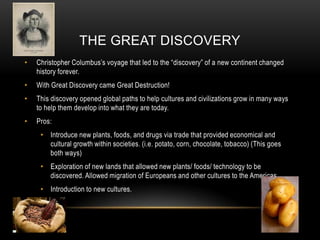
    Introduce new plants,foods, and drugs via trade that provided economical and cultural growth within societies. (i.e. potato, corn, chocolate, tobacco) (This goes both ways)
  • 14.
    Exploration of newlands that allowed new plants/ foods/ technology to be discovered. Allowed migration of Europeans and other cultures to the Americas.
  • 15.
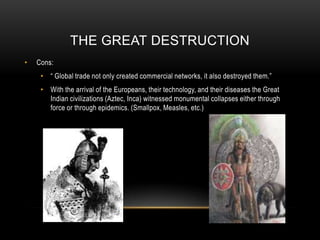
    Introduction to newcultures.The Great DestructionCons:“ Global trade not only created commercial networks, it also destroyed them.”With the arrival of the Europeans, their technology, and their diseases the Great Indian civilizations (Aztec, Inca) witnessed monumental collapses either through force or through epidemics. (Smallpox, Measles, etc.)

Editor's Notes

  • #3 James Burke: The Way We Are
  • #5 The Journey of Man: Video/ National Geographic article
  • #6 Catastrophe: Video/ Companion Web site.
  • #7 Catastrophe:
  • #8 Guns, Germs, and Steel (Videos/ Companion Web sites.); The Third Culture
  • #9 Guns, Germs, and Steel (Videos/ Companion Web sites.); The Third Culture
  • #10 The World That Trade Created; The World in 1492
  • #11 The World That trade Created; The World in 1492