Survival During the Paleolithic Era
Nicole Garner
Blueprint of Human Nature
As a human we were born with natural morals and human nature. Modern day
humans hunt, follow instincts, societal roles, and have natural urges to socialize. It
is believed this behavior has evolved far back to the Paleolithic era because
during this time, these traits were extremely important in the survival of their tribes
and humanity as a whole.
Hunting
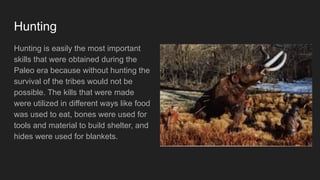
Hunting is easily the most important
skills that were obtained during the
Paleo era because without hunting the
survival of the tribes would not be
possible. The kills that were made
were utilized in different ways like food
was used to eat, bones were used for
tools and material to build shelter, and
hides were used for blankets.
Gathering
Gathering consisted of searching and
harvesting different plants, fruits, and nuts to
provide food and even material for tribes.
During different seasons this would be difficult
due to the weather changes and many plants
could not survive under harsh condition during
the winter. Though hunting was important, the
body needs nutrients and essential vitamins
that are provided through nuts, fruits, and
vegetables.
Housing
During the era, the importance of housing goes further than just survival and
having a roof over the tribes head at the end of night. It began with finding shelter
through nature by finding caves, this was a problem because some caves were
already providing shelter for animals like bears and wild cats. Which led to huts
and tents that were built and created small communities for tribes, creating the first
social structure for humans. Huts and tents were typically made from
“manipulating nature” by using bones and hides from their kills. These homes
were also considered mobile since humans mostly had to travel and track herds of
animals in order to keep a steady food supply.
Huts and Tents
Traveling
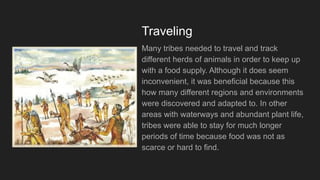
Many tribes needed to travel and track
different herds of animals in order to keep up
with a food supply. Although it does seem
inconvenient, it was beneficial because this
how many different regions and environments
were discovered and adapted to. In other
areas with waterways and abundant plant life,
tribes were able to stay for much longer
periods of time because food was not as
scarce or hard to find.
Technology
Although the technology seems so simple during this time, it
set the foundation of makes up about 99% of the human
technological history. Paleo technology included fire, tools
for building, gathering, and hunting which was a very
important success to their efficiency and survival. Cooking
skills began during this time because they were able to cook
the meat of their rather than risk eating raw food and getting
sick. Using stones and bones, tools were made and used to
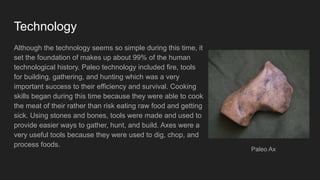
provide easier ways to gather, hunt, and build. Axes were a
very useful tools because they were used to dig, chop, and
process foods.
Paleo Ax
Societal Ideologies
Gender roles go back are far as the beginning of time that was historically
recorded. Although the evolution of gender roles is starting to change in modern
time, paleolithic communities assigned different jobs depending on the person's
gender. Men typically were the hunters because they had more strength and
stamina which led to more successful hunting trips that would help provide for the
community. Women usually stayed with the children and infants because they
were breastfeeding and gathering was much less of a risk than hunting.
Works Cited
Fiero, Gloria. First Civilizations and the Classical Legacy. Mcgraw-Hill Education, 2015.
García-Diez, M., & Vaquero, M. (2015, December 2). Looking at the Camp: Paleolithic Depiction of a Hunter-Gatherer
Campsite. Retrieved October 06, 2020, from https://journals.plos.org/plosone/article?id=10.1371%2Fjournal.pone.0143002
Groeneveld, E. (2020, October 05). Prehistoric Hunter-Gatherer Societies. Retrieved October 06, 2020, from
https://www.ancient.eu/article/991/prehistoric-hunter-gatherer-societies/
Liu, L., Bestel, S., Shi, J., Song, Y., & Chen, X. (2013, April 2). Paleolithic human exploitation of plant foods during the last
glacial maximum in North China. Retrieved October 06, 2020, from https://www.ncbi.nlm.nih.gov/pmc/articles/PMC3619325/
Mannino, M., Catalano, G., Talamo, S., Mannino, G., Di Salvo, R., Schimmenti, V., . . . Sineo, L. (2012). Origin and diet of
the prehistoric hunter-gatherers on the mediterranean island of Favignana (Ègadi Islands, Sicily). Retrieved October 06,
2020, from https://www.ncbi.nlm.nih.gov/pmc/articles/PMC3509116/

Extra credit

  • 1.
    Survival During thePaleolithic Era Nicole Garner
  • 2.
    Blueprint of HumanNature As a human we were born with natural morals and human nature. Modern day humans hunt, follow instincts, societal roles, and have natural urges to socialize. It is believed this behavior has evolved far back to the Paleolithic era because during this time, these traits were extremely important in the survival of their tribes and humanity as a whole.
  • 3.
    Hunting Hunting is easilythe most important skills that were obtained during the Paleo era because without hunting the survival of the tribes would not be possible. The kills that were made were utilized in different ways like food was used to eat, bones were used for tools and material to build shelter, and hides were used for blankets.
  • 4.
    Gathering Gathering consisted ofsearching and harvesting different plants, fruits, and nuts to provide food and even material for tribes. During different seasons this would be difficult due to the weather changes and many plants could not survive under harsh condition during the winter. Though hunting was important, the body needs nutrients and essential vitamins that are provided through nuts, fruits, and vegetables.
  • 5.
    Housing During the era,the importance of housing goes further than just survival and having a roof over the tribes head at the end of night. It began with finding shelter through nature by finding caves, this was a problem because some caves were already providing shelter for animals like bears and wild cats. Which led to huts and tents that were built and created small communities for tribes, creating the first social structure for humans. Huts and tents were typically made from “manipulating nature” by using bones and hides from their kills. These homes were also considered mobile since humans mostly had to travel and track herds of animals in order to keep a steady food supply.
  • 6.
  • 7.
    Traveling Many tribes neededto travel and track different herds of animals in order to keep up with a food supply. Although it does seem inconvenient, it was beneficial because this how many different regions and environments were discovered and adapted to. In other areas with waterways and abundant plant life, tribes were able to stay for much longer periods of time because food was not as scarce or hard to find.
  • 8.
    Technology Although the technologyseems so simple during this time, it set the foundation of makes up about 99% of the human technological history. Paleo technology included fire, tools for building, gathering, and hunting which was a very important success to their efficiency and survival. Cooking skills began during this time because they were able to cook the meat of their rather than risk eating raw food and getting sick. Using stones and bones, tools were made and used to provide easier ways to gather, hunt, and build. Axes were a very useful tools because they were used to dig, chop, and process foods. Paleo Ax
  • 9.
    Societal Ideologies Gender rolesgo back are far as the beginning of time that was historically recorded. Although the evolution of gender roles is starting to change in modern time, paleolithic communities assigned different jobs depending on the person's gender. Men typically were the hunters because they had more strength and stamina which led to more successful hunting trips that would help provide for the community. Women usually stayed with the children and infants because they were breastfeeding and gathering was much less of a risk than hunting.
  • 10.
    Works Cited Fiero, Gloria.First Civilizations and the Classical Legacy. Mcgraw-Hill Education, 2015. García-Diez, M., & Vaquero, M. (2015, December 2). Looking at the Camp: Paleolithic Depiction of a Hunter-Gatherer Campsite. Retrieved October 06, 2020, from https://journals.plos.org/plosone/article?id=10.1371%2Fjournal.pone.0143002 Groeneveld, E. (2020, October 05). Prehistoric Hunter-Gatherer Societies. Retrieved October 06, 2020, from https://www.ancient.eu/article/991/prehistoric-hunter-gatherer-societies/ Liu, L., Bestel, S., Shi, J., Song, Y., & Chen, X. (2013, April 2). Paleolithic human exploitation of plant foods during the last glacial maximum in North China. Retrieved October 06, 2020, from https://www.ncbi.nlm.nih.gov/pmc/articles/PMC3619325/ Mannino, M., Catalano, G., Talamo, S., Mannino, G., Di Salvo, R., Schimmenti, V., . . . Sineo, L. (2012). Origin and diet of the prehistoric hunter-gatherers on the mediterranean island of Favignana (Ègadi Islands, Sicily). Retrieved October 06, 2020, from https://www.ncbi.nlm.nih.gov/pmc/articles/PMC3509116/