History, Science, and TradeBy Sarah Gnad
What is History?History is an ever-changing end product of answers from the past.The answers we receive are perceived by each culture differently, then the belief of truth is certain.The information from the past is so good we hang onto it, and will go far to defend what we believe is true.We have every right to be curious. Asking questions and delving into the past allows us to create our truth."History is the witness that testifies to the passing of time; it illuminates reality, vitalizes memory, provides guidance in daily life, and brings us tidings of antiquity." Cicero
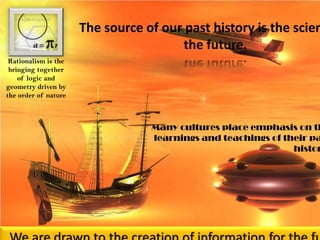
The source of our past history is the science of the future. Rationalism is the bringing together of logic and geometry driven by the order of natureMany cultures place emphasis on the learnings and teachings of their past history.We are drawn to the creation of information for the future, but are continuously pulled back into yesterday’s past.
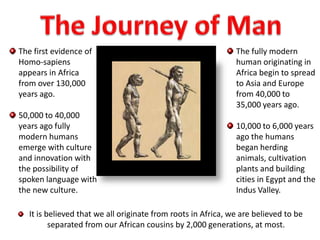
The Journey of ManThe first evidence of Homo-sapiens appears in Africa from over 130,000 years ago.50,000 to 40,000 years ago fully modern humans emerge with culture and innovation with the possibility of spoken language with the new culture.The fully modern human originating in Africa begin to spread to Asia and Europe from 40,000 to 35,000 years ago.10,000 to 6,000 years ago the humans began herding animals, cultivation plants and building cities in Egypt and the Indus Valley.It is believed that we all originate from roots in Africa, we are believed to be separated from our African cousins by 2,000 generations, at most.
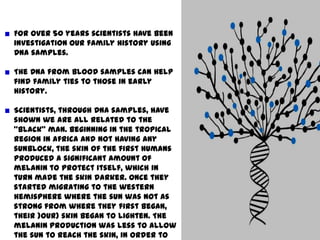
For over 50 years scientists have been investigation our family history using DNA samples.The DNA from blood samples can help find family ties to those in early history.Scientists, through DNA samples, have shown we are all related to the “black” man. Beginning in the tropical region in Africa and not having any sunblock, the skin of the first humans produced a significant amount of melanin to protect itself, which in turn made the skin darker. Once they started migrating to the western hemisphere where the sun was not as strong from where they first began, their )our) skin began to lighten. The melanin production was less to allow the sun to reach the skin, in order to produce vitamin D.
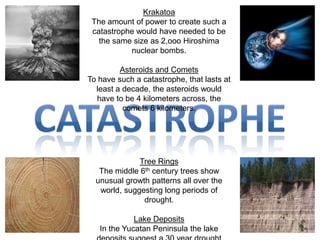
KrakatoaThe amount of power to create such a catastrophe would have needed to be the same size as 2,ooo Hiroshima  nuclear bombs.Asteroids and CometsTo have such a catastrophe, that lasts at least a decade, the asteroids would have to be 4 kilometers across, the comets 6 kilometers. catastropheTree RingsThe middle 6th century trees show unusual growth patterns all over the world, suggesting long periods of drought. Lake DepositsIn the Yucatan Peninsula the lake deposits suggest a 30 year drought starting in the middle 6th century.
The earth elements and science discoveries suggest the earth and it’s inhabitants were enveloped by a major catastrophe in the middle sixth century.Over 15,000 years ago it is suggested that:The sun went darkRain poureddownClouds of dust surrounded the earthCold inhabited the earthThese events exposed the in habitants to drought, famine, plague, and lastly death.  Outbreak of the plague is strongly related to climate. Cooling of the earth and the large amounts of rainfall, in effect, spread the plague amongst the earth’s inhabitants. The cooler temperatures then allowed the bacteria to flourish.It is also suggested by scientists that the Avars, a large group of barbarians and very advanced horseman, in the Mongolian and Siberian region, were once the strongest but after the earth’s changes, they were defeated. Tree ring evidence suggest the Mongolian step was crippled by cold and drought for over ten years, which weakened the Avarnation. This allowed the Turks to overturn the Avars. Scientists believe the climate and lack of food and water for the Avar’s horses allowed the Turks to overtake that Avars, being so dependent on their horses.
CHANGING INTERPRETATIONS OF AMERICA’S PASTAs scientists continue to uncover our past and the difference between what we perceive happened and the scientific “facts” of what may have really happened the world’s story continues to change. Some of the many scientific discoveries have suggested:
Many societies were far more advanced that previously thought, with the inhabitance of islands and the advanced and complex society.
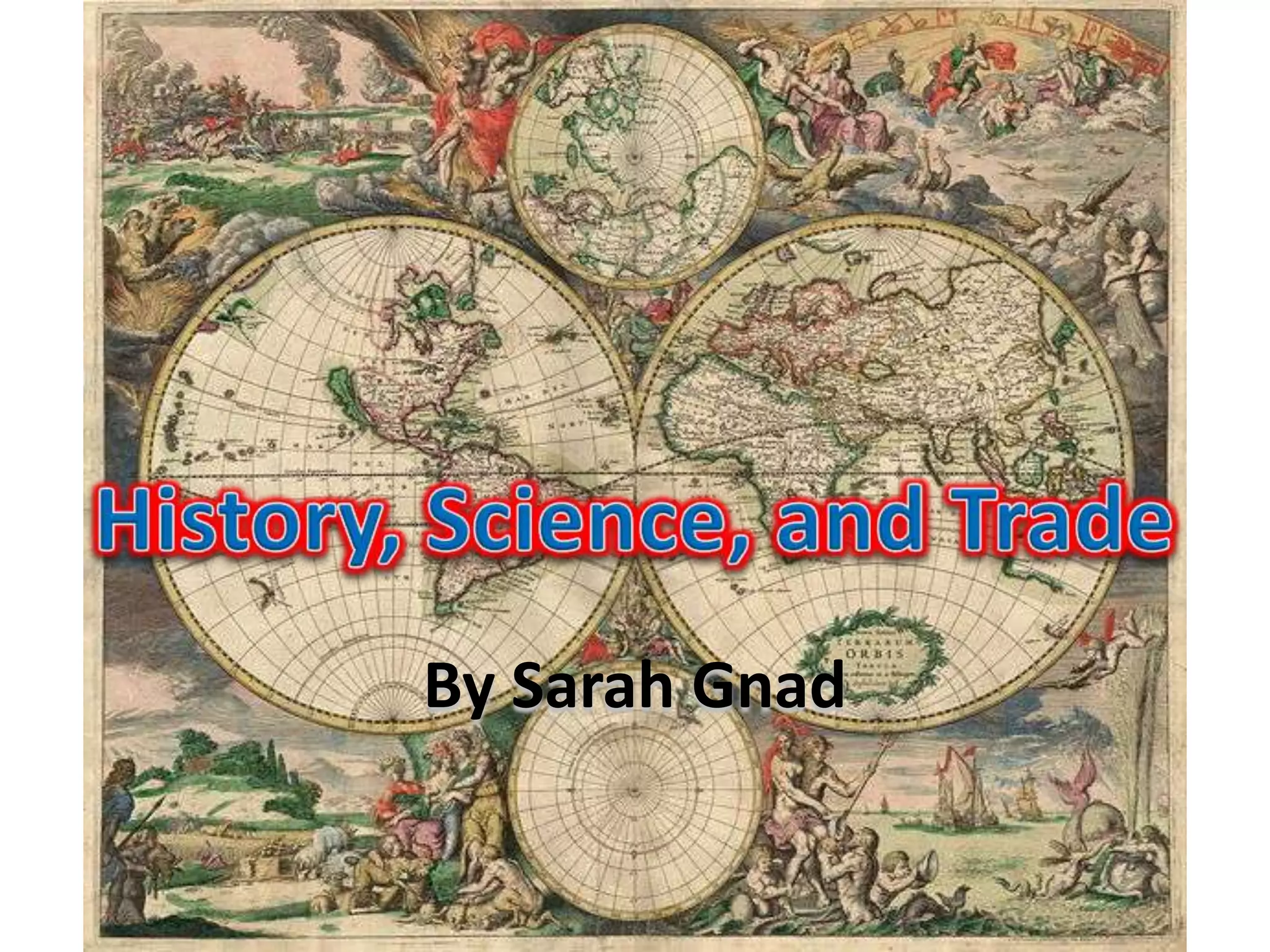
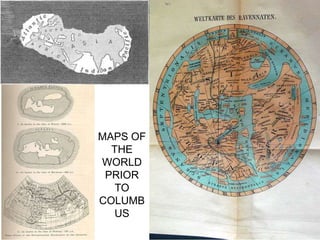
Inhabitants of the earth created habitations that were far more sophisticated, and advanced. MAPS OF THE WORLD PRIOR TO COLUMBUS
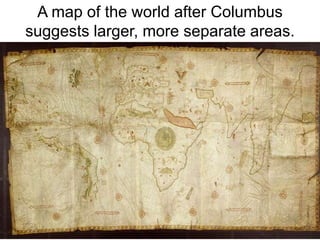
A map of the world after Columbus suggests larger, more separate areas.

Theme 1 History 140

  • 1.
    History, Science, andTradeBy Sarah Gnad
  • 2.
    What is History?Historyis an ever-changing end product of answers from the past.The answers we receive are perceived by each culture differently, then the belief of truth is certain.The information from the past is so good we hang onto it, and will go far to defend what we believe is true.We have every right to be curious. Asking questions and delving into the past allows us to create our truth."History is the witness that testifies to the passing of time; it illuminates reality, vitalizes memory, provides guidance in daily life, and brings us tidings of antiquity." Cicero
  • 3.
    The source ofour past history is the science of the future. Rationalism is the bringing together of logic and geometry driven by the order of natureMany cultures place emphasis on the learnings and teachings of their past history.We are drawn to the creation of information for the future, but are continuously pulled back into yesterday’s past.
  • 4.
    The Journey ofManThe first evidence of Homo-sapiens appears in Africa from over 130,000 years ago.50,000 to 40,000 years ago fully modern humans emerge with culture and innovation with the possibility of spoken language with the new culture.The fully modern human originating in Africa begin to spread to Asia and Europe from 40,000 to 35,000 years ago.10,000 to 6,000 years ago the humans began herding animals, cultivation plants and building cities in Egypt and the Indus Valley.It is believed that we all originate from roots in Africa, we are believed to be separated from our African cousins by 2,000 generations, at most.
  • 5.
    For over 50years scientists have been investigation our family history using DNA samples.The DNA from blood samples can help find family ties to those in early history.Scientists, through DNA samples, have shown we are all related to the “black” man. Beginning in the tropical region in Africa and not having any sunblock, the skin of the first humans produced a significant amount of melanin to protect itself, which in turn made the skin darker. Once they started migrating to the western hemisphere where the sun was not as strong from where they first began, their )our) skin began to lighten. The melanin production was less to allow the sun to reach the skin, in order to produce vitamin D.
  • 6.
    KrakatoaThe amount ofpower to create such a catastrophe would have needed to be the same size as 2,ooo Hiroshima nuclear bombs.Asteroids and CometsTo have such a catastrophe, that lasts at least a decade, the asteroids would have to be 4 kilometers across, the comets 6 kilometers. catastropheTree RingsThe middle 6th century trees show unusual growth patterns all over the world, suggesting long periods of drought. Lake DepositsIn the Yucatan Peninsula the lake deposits suggest a 30 year drought starting in the middle 6th century.
  • 7.
    The earth elementsand science discoveries suggest the earth and it’s inhabitants were enveloped by a major catastrophe in the middle sixth century.Over 15,000 years ago it is suggested that:The sun went darkRain poureddownClouds of dust surrounded the earthCold inhabited the earthThese events exposed the in habitants to drought, famine, plague, and lastly death. Outbreak of the plague is strongly related to climate. Cooling of the earth and the large amounts of rainfall, in effect, spread the plague amongst the earth’s inhabitants. The cooler temperatures then allowed the bacteria to flourish.It is also suggested by scientists that the Avars, a large group of barbarians and very advanced horseman, in the Mongolian and Siberian region, were once the strongest but after the earth’s changes, they were defeated. Tree ring evidence suggest the Mongolian step was crippled by cold and drought for over ten years, which weakened the Avarnation. This allowed the Turks to overturn the Avars. Scientists believe the climate and lack of food and water for the Avar’s horses allowed the Turks to overtake that Avars, being so dependent on their horses.
  • 8.
    CHANGING INTERPRETATIONS OFAMERICA’S PASTAs scientists continue to uncover our past and the difference between what we perceive happened and the scientific “facts” of what may have really happened the world’s story continues to change. Some of the many scientific discoveries have suggested:
  • 9.
    Many societies werefar more advanced that previously thought, with the inhabitance of islands and the advanced and complex society.
  • 10.
    Inhabitants of theearth created habitations that were far more sophisticated, and advanced. MAPS OF THE WORLD PRIOR TO COLUMBUS
  • 11.
    A map ofthe world after Columbus suggests larger, more separate areas.
  • 12.
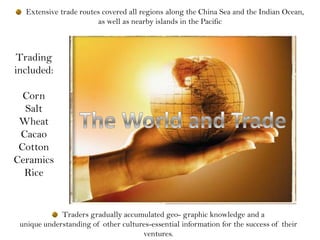
    Extensive trade routescovered all regions along the China Sea and the Indian Ocean,as well as nearby islands in the PacificTrading included:CornSaltWheatCacaoCottonCeramicsRiceThe World and TradeTraders gradually accumulated geo- graphic knowledge and aunique understanding of other cultures-essential information for the success of theirventures.