DR SALINI MANDAL B.G.
ASST PROFESSOR
DEPT OF OBG
FMHMC
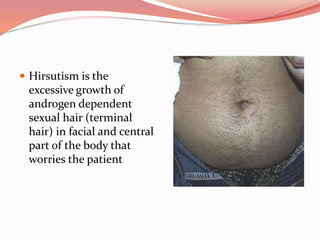
 Hirsutism is the
excessive growth of
androgen dependent
sexual hair (terminal
hair) in facial and central
part of the body that
worries the patient
 Virilism is defined as the presence
of any one or more of the following
features—deepening of the voice,
temporal balding, amenorrhea,
enlargement of clitoris
(clitoromegaly) and breast atrophy.
 It is a more severe form of androgen
excess.
 Virilism may be due to adrenal
hyperplasia or tumors of adrenal or
ovary.
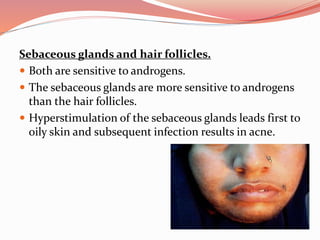
Sebaceous glands and hair follicles.
 Both are sensitive to androgens.
 The sebaceous glands are more sensitive to androgens
than the hair follicles.
 Hyperstimulation of the sebaceous glands leads first to
oily skin and subsequent infection results in acne.
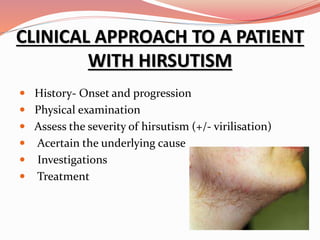
 History- Onset and progression
 Physical examination
 Assess the severity of hirsutism (+/- virilisation)
 Acertain the underlying cause
 Investigations
 Treatment
CLINICAL APPROACH TO A PATIENT
WITH HIRSUTISM
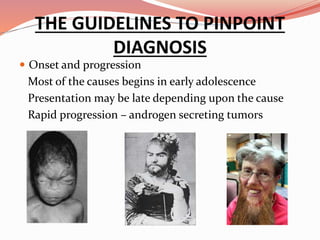
 Onset and progression
Most of the causes begins in early adolescence
Presentation may be late depending upon the cause
Rapid progression – androgen secreting tumors
THE GUIDELINES TO PINPOINT
DIAGNOSIS
Principles of management
 To remove excess hair
 To suppress or neutralise the action of androgen
 To remove the source of excess androgen
MANAGEMENT
PRINCIPLES OF TREATMENT OF
HIRSUTISM
 Best results are achieved by combination treatment
including antiandrogens, suppression.
 Goal should be to reduce the time spent mechanically
removing unwanted hair.
 The choice of drug depends mainly on its tolerability by
each individual patient.
Drugs- ( depending upon the site of production of
excess androgens)
 OCPS
 Progestrogens
 Antiandrogens
 Spironolactone
 Dexamethasone
 GnRH Analogues
 Combined approach
TO SUPPRESS THE EXCESS
ANDROGEN ACTION
COSMETIC TREATMENT
 Bleaching - can cause irritation, purities, skin discoloration
 Shaving - Shaving does not lead to worsening of hirsutism and
is a good short-term solution for facial hair.
- Does not affect the rate or duration of anagen phase,
or diameter of hair
- But yields a blunt tip – illusion of thicker hair
 Plucking, Waxing - scarring, folliculitis, hyperpigmentation
 Depilatory creams - Irritant dermatitis
 Electrolysis - painful, erythema, inflammation, scarring
 Laser
Removal of the source
Adrenal or ovarian tumour – surgically treated
Cushing disease – Adrenalectomy
Radiation to pituitary
Removal of ACTH producing tumor
Iatrogenic cases – Offending drug to be stopped

Hirsutism

  • 1.
    DR SALINI MANDALB.G. ASST PROFESSOR DEPT OF OBG FMHMC
  • 2.
     Hirsutism isthe excessive growth of androgen dependent sexual hair (terminal hair) in facial and central part of the body that worries the patient
  • 3.
     Virilism isdefined as the presence of any one or more of the following features—deepening of the voice, temporal balding, amenorrhea, enlargement of clitoris (clitoromegaly) and breast atrophy.  It is a more severe form of androgen excess.  Virilism may be due to adrenal hyperplasia or tumors of adrenal or ovary.
  • 4.
    Sebaceous glands andhair follicles.  Both are sensitive to androgens.  The sebaceous glands are more sensitive to androgens than the hair follicles.  Hyperstimulation of the sebaceous glands leads first to oily skin and subsequent infection results in acne.
  • 7.
     History- Onsetand progression  Physical examination  Assess the severity of hirsutism (+/- virilisation)  Acertain the underlying cause  Investigations  Treatment CLINICAL APPROACH TO A PATIENT WITH HIRSUTISM
  • 8.
     Onset andprogression Most of the causes begins in early adolescence Presentation may be late depending upon the cause Rapid progression – androgen secreting tumors THE GUIDELINES TO PINPOINT DIAGNOSIS
  • 9.
    Principles of management To remove excess hair  To suppress or neutralise the action of androgen  To remove the source of excess androgen MANAGEMENT
  • 10.
    PRINCIPLES OF TREATMENTOF HIRSUTISM  Best results are achieved by combination treatment including antiandrogens, suppression.  Goal should be to reduce the time spent mechanically removing unwanted hair.  The choice of drug depends mainly on its tolerability by each individual patient.
  • 11.
    Drugs- ( dependingupon the site of production of excess androgens)  OCPS  Progestrogens  Antiandrogens  Spironolactone  Dexamethasone  GnRH Analogues  Combined approach TO SUPPRESS THE EXCESS ANDROGEN ACTION
  • 12.
    COSMETIC TREATMENT  Bleaching- can cause irritation, purities, skin discoloration  Shaving - Shaving does not lead to worsening of hirsutism and is a good short-term solution for facial hair. - Does not affect the rate or duration of anagen phase, or diameter of hair - But yields a blunt tip – illusion of thicker hair  Plucking, Waxing - scarring, folliculitis, hyperpigmentation  Depilatory creams - Irritant dermatitis  Electrolysis - painful, erythema, inflammation, scarring  Laser
  • 13.
    Removal of thesource Adrenal or ovarian tumour – surgically treated Cushing disease – Adrenalectomy Radiation to pituitary Removal of ACTH producing tumor Iatrogenic cases – Offending drug to be stopped