Approach to
Hirsutism1
P. Krishna Bharadwaj
Moderators
Dr. T. Muneeswar reddy MD
Associate professor
Dr. N. Padmaja MD
Assistant professor
Definitions
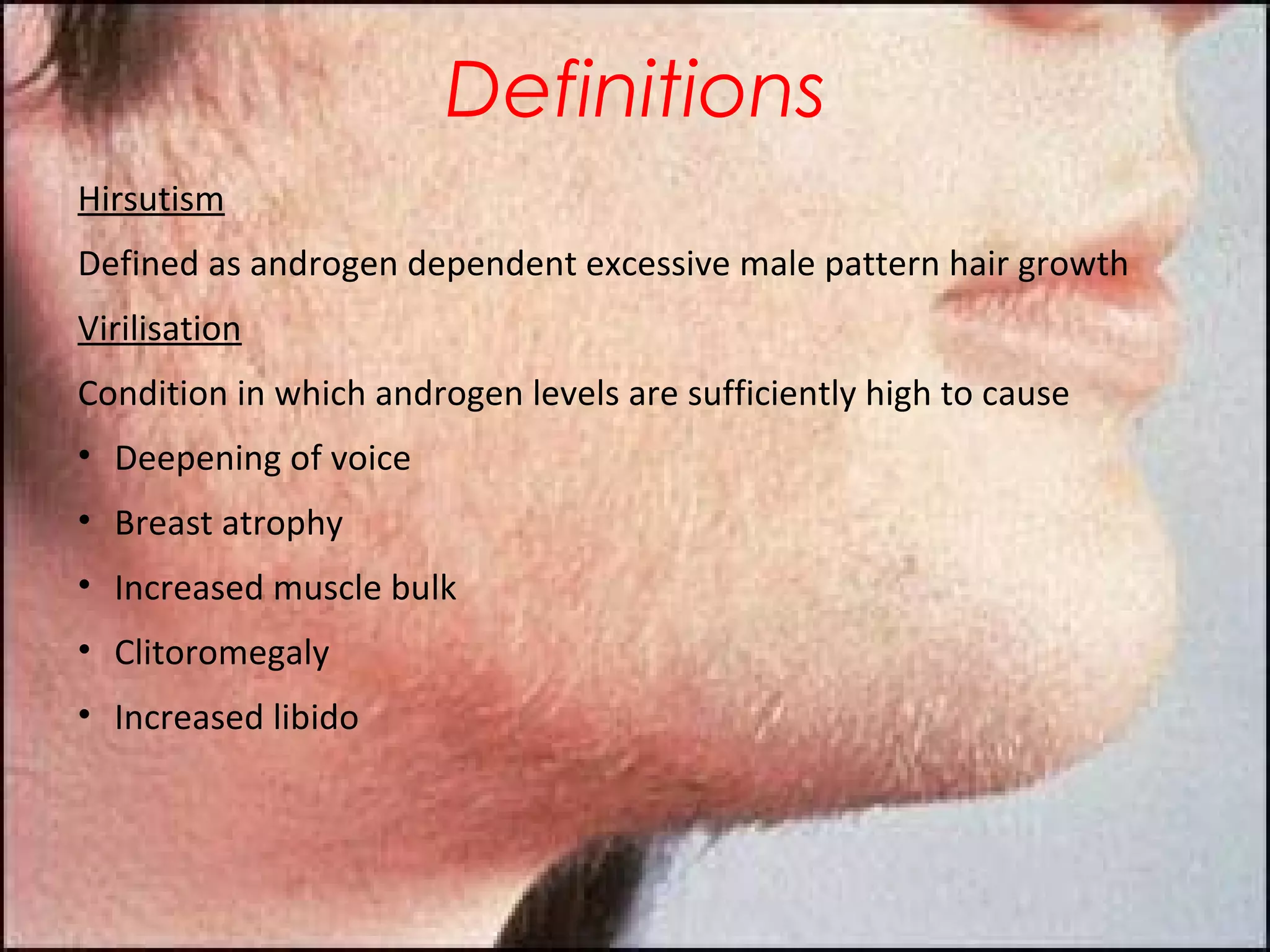
Hirsutism
Defined as androgen dependent excessive male pattern hair growth
Virilisation
Condition in which androgen levels are sufficiently high to cause
• Deepening of voice
• Breast atrophy
• Increased muscle bulk
• Clitoromegaly
• Increased libido
Definitions
Hypertrichosis
refers to hair density or length beyond the
accepted limits of the normal for the particular
age, race or sex.
Androgen independent excess hair growth
Hair follicle growth and differentiation
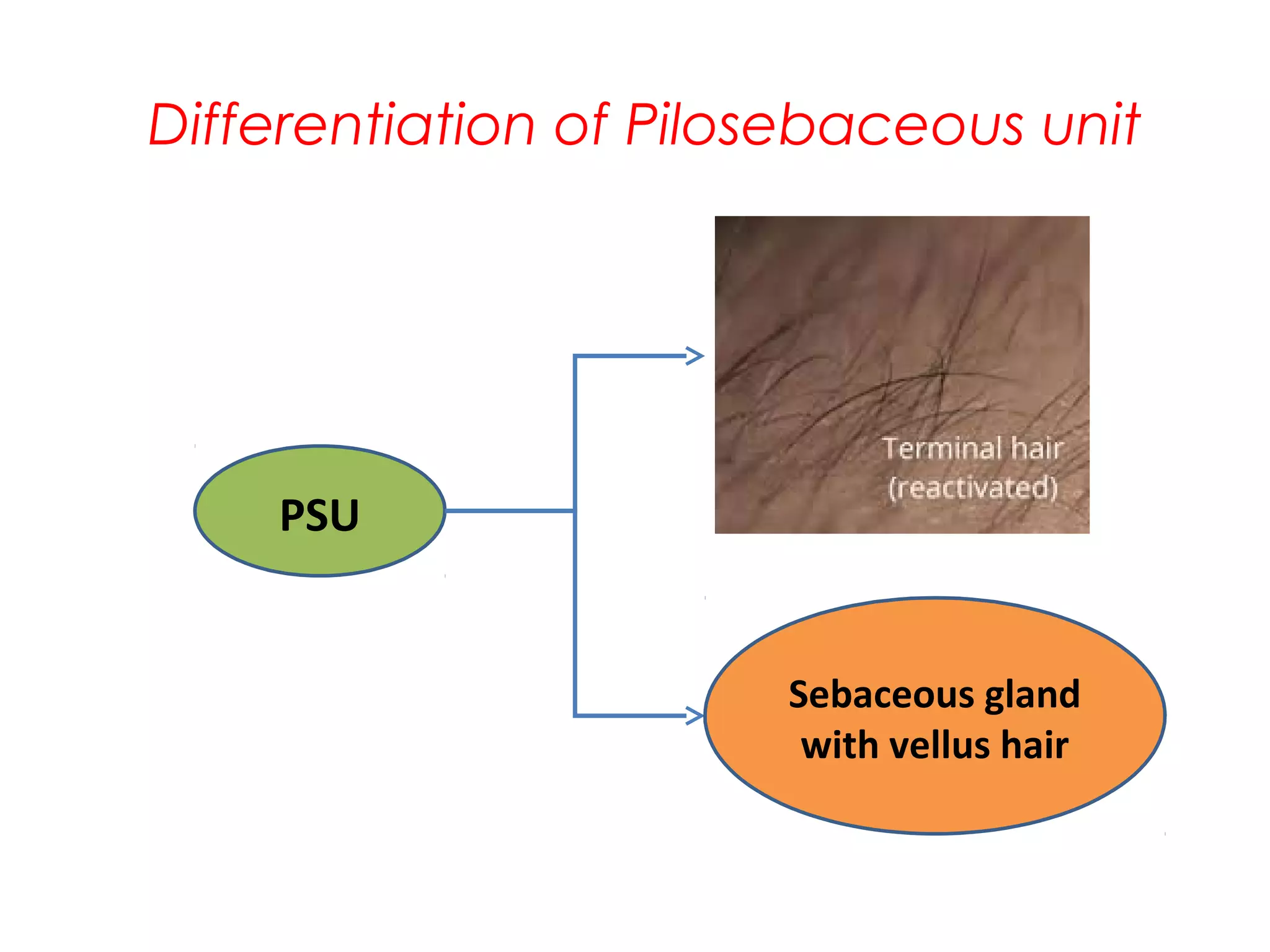
• Vellus : fine, soft, not pigmented
• Terminal : long, coarse, pigmented
Differentiation of Pilosebaceous unit
PSU
Sebaceous gland
with vellus hair
Cycle of hair growth
Hormone regulation in hair growth
cycle
• Androgen insensitive:
• Less sensitive: axillary and pubic hair
• Highly sensitive: chest, upper
abdomen and back
Androgens on scalp hair???
Hair loss occurs in scalp
as androgens cause scalp hair
spend less time in the anagen
phase.
Correlation between androgens and
hair growth
• Only modest correlation
• Reason: hair growth on follicles depend on
local growth factors and end organ variability
in sensitivity to androgens
Genetic and ethnic factors
• Dark haired individuals tend to be more
hirsute than fair skinned.
• Asians and native Americans have less hair in
androgen sensitive regions.
• Mediterranean people have more in the
same.
Causes of Hirsutism
Clinical assessment
History:
• Age at onset
• Rate of progression
• Associated signs and symptoms like acne and galactorrhea
• Age of onset of menstrual cycles
• Pattern of cycle
• Features of Cushing's syndrome
• Use of any medications
• Family history
Physical examination
• BMI
• Blood pressure measurement
• Cutaneous signs like acanthosis nigricans and
skin tags
• Body fat distribution
Objective assessment
• Modified scale of FERRIMAN and GALLWEY
• 9 androgen sensitive sites graded from 0 to 4
• Usually 95% of women have score less than 8
• Scores > 8 suggests excessive androgen mediated
hair growth
• Limitations are ethnic considerations where other
features like acne and thinning of scalp hair should
be sought
Hirsutism scoring scale of FERRIMAN
AND GALLWEY1
Hirsutism scoring scale of FERRIMAN
AND GALLWEY1
Hirsutism scoring scale of FERRIMAN
AND GALLWEY1
Hormonal evaluation
OVARIE
S
ANDROGENS
LH
ACTH
Principal hormones
• Testosterone
• Androstenedione
• Dihydroandrostenedione DHEA
• Sulfated DHEA [DHEA-S]
Mechanism
Testosterone Dihydrotestosterone
Isoenzymes of 5 α reductase:
Type 1 sebaceous glands
Type 2 hair follicles and prostate gland
5 α reductase
PSU
Lab evaluation
• Testosterone
• DHEAS
• Free testosterone
Plasma testosterone level
>12nmol/l = virilizing tumour
>7nmol/l = suggestive
DHEAS level >18.5µmol/l = adrenal tumour
Other investigations
• CT or MRI for localising adrenal mass
• Trans vaginal USG for determing increased
stroma and enlarged ovaries in PCOS
• Measurement of AMH levels
• Dexamethasone suppression test
• Overnight dexamethasone suppresion test
• Measurement of 17(OH) progesterone levels
Clinical evaluation of hirsutism
Treatment
• Pharmacological
• Non pharmacological
Non pharmacological means must be considered
in all patients either as only treatment or as an
adjunct to drug therapy
Non pharmacological treatment
• Bleaching
• Depilatory
• Epilatory
“Shaving does not increase the rate or density of
hair growth”
Pharmacological therapy
Interrupting steps in androgen synthesis and action:
• Suppression of adrenal and/or ovarian androgen
production
• Enhancement of androgen binding to plasma proteins
esp. SHBG
• Impairment of peripheral conversion to active
androgen
• Inhibition of androgen action at target tissue level
Pharmacological therapy
Combined OCPs are first lie endocrine treatment
for hirsutism and acne, after cosmetic and
dermatologic treatment
• Estrogen component is ethinyl estradiol or
mestranol
• Progestin component predicts the choice of
OCP
Effect of OCPs
• May not be evident for 6months
• Maximum effect may require 9-12 month
depending on length of the hair growth cycle
Suppression of adrenal androgens
• Adrenal androgens are more sensitive than
cortisol to suppressive effect of
glucocorticoids.
• Dexamethasone or prednisone should be
taken at night time to prevent the nocturnal
surge of ACTH.
Anti androgens
• Competitive inhibition of binding of testosterone
and DHT to the androgen receptor.
• Cyproterone acetate is a prototype
• Given on day 1 to day 15 and ethinyl estradiol on
day 5 to day 26 of menstrual cycle.
• Spironolactone is a weak antiandrogen
• As effective as cypro when used at high doses
Anti androgens
• Flutamide is a potent non steriodal anti
androgen
• Its hepatocellular toxicity limits use.
Enzyme inhibitors
• Finasteride is a 5 α reductase type 2 inhibitor
• Predominance of 5 α reductase type 1 in PSU
limits its efficacy
Others
• Eflornithine cream has been approved as
novel treatment for removal of unwanted
facial hair in women
• Overall, choice of any specific agent must be
tailored to the unique needs of the patient
being treated.
References
1. Kasper DL et al, Harrison’s principles of
internal medicine. 19th edition. New York:
McGraw-Hill; 2015. p. 331-5.
2. Ehrmann DA et al: Hyperandrogenism,
hirsutism, and polycystic ovary syndrome, in LJ
DeGroot and JL Jameson [eds], Endocrinology,
5th ed. Philadelphia, Saunders, 2006
Approach to hirsutism

Approach to hirsutism

  • 1.
    Approach to Hirsutism1 P. KrishnaBharadwaj Moderators Dr. T. Muneeswar reddy MD Associate professor Dr. N. Padmaja MD Assistant professor
  • 2.
    Definitions Hirsutism Defined as androgendependent excessive male pattern hair growth Virilisation Condition in which androgen levels are sufficiently high to cause • Deepening of voice • Breast atrophy • Increased muscle bulk • Clitoromegaly • Increased libido
  • 3.
    Definitions Hypertrichosis refers to hairdensity or length beyond the accepted limits of the normal for the particular age, race or sex. Androgen independent excess hair growth
  • 4.
    Hair follicle growthand differentiation • Vellus : fine, soft, not pigmented • Terminal : long, coarse, pigmented
  • 5.
    Differentiation of Pilosebaceousunit PSU Sebaceous gland with vellus hair
  • 6.
  • 7.
    Hormone regulation inhair growth cycle • Androgen insensitive: • Less sensitive: axillary and pubic hair • Highly sensitive: chest, upper abdomen and back
  • 8.
    Androgens on scalphair??? Hair loss occurs in scalp as androgens cause scalp hair spend less time in the anagen phase.
  • 9.
    Correlation between androgensand hair growth • Only modest correlation • Reason: hair growth on follicles depend on local growth factors and end organ variability in sensitivity to androgens
  • 10.
    Genetic and ethnicfactors • Dark haired individuals tend to be more hirsute than fair skinned. • Asians and native Americans have less hair in androgen sensitive regions. • Mediterranean people have more in the same.
  • 11.
  • 12.
    Clinical assessment History: • Ageat onset • Rate of progression • Associated signs and symptoms like acne and galactorrhea • Age of onset of menstrual cycles • Pattern of cycle • Features of Cushing's syndrome • Use of any medications • Family history
  • 13.
    Physical examination • BMI •Blood pressure measurement • Cutaneous signs like acanthosis nigricans and skin tags • Body fat distribution
  • 14.
    Objective assessment • Modifiedscale of FERRIMAN and GALLWEY • 9 androgen sensitive sites graded from 0 to 4 • Usually 95% of women have score less than 8 • Scores > 8 suggests excessive androgen mediated hair growth • Limitations are ethnic considerations where other features like acne and thinning of scalp hair should be sought
  • 15.
    Hirsutism scoring scaleof FERRIMAN AND GALLWEY1
  • 16.
    Hirsutism scoring scaleof FERRIMAN AND GALLWEY1
  • 17.
    Hirsutism scoring scaleof FERRIMAN AND GALLWEY1
  • 18.
  • 19.
    Principal hormones • Testosterone •Androstenedione • Dihydroandrostenedione DHEA • Sulfated DHEA [DHEA-S]
  • 20.
    Mechanism Testosterone Dihydrotestosterone Isoenzymes of5 α reductase: Type 1 sebaceous glands Type 2 hair follicles and prostate gland 5 α reductase PSU
  • 21.
    Lab evaluation • Testosterone •DHEAS • Free testosterone Plasma testosterone level >12nmol/l = virilizing tumour >7nmol/l = suggestive DHEAS level >18.5µmol/l = adrenal tumour
  • 22.
    Other investigations • CTor MRI for localising adrenal mass • Trans vaginal USG for determing increased stroma and enlarged ovaries in PCOS • Measurement of AMH levels • Dexamethasone suppression test • Overnight dexamethasone suppresion test • Measurement of 17(OH) progesterone levels
  • 23.
  • 24.
    Treatment • Pharmacological • Nonpharmacological Non pharmacological means must be considered in all patients either as only treatment or as an adjunct to drug therapy
  • 25.
    Non pharmacological treatment •Bleaching • Depilatory • Epilatory “Shaving does not increase the rate or density of hair growth”
  • 26.
    Pharmacological therapy Interrupting stepsin androgen synthesis and action: • Suppression of adrenal and/or ovarian androgen production • Enhancement of androgen binding to plasma proteins esp. SHBG • Impairment of peripheral conversion to active androgen • Inhibition of androgen action at target tissue level
  • 27.
    Pharmacological therapy Combined OCPsare first lie endocrine treatment for hirsutism and acne, after cosmetic and dermatologic treatment • Estrogen component is ethinyl estradiol or mestranol • Progestin component predicts the choice of OCP
  • 28.
    Effect of OCPs •May not be evident for 6months • Maximum effect may require 9-12 month depending on length of the hair growth cycle
  • 29.
    Suppression of adrenalandrogens • Adrenal androgens are more sensitive than cortisol to suppressive effect of glucocorticoids. • Dexamethasone or prednisone should be taken at night time to prevent the nocturnal surge of ACTH.
  • 30.
    Anti androgens • Competitiveinhibition of binding of testosterone and DHT to the androgen receptor. • Cyproterone acetate is a prototype • Given on day 1 to day 15 and ethinyl estradiol on day 5 to day 26 of menstrual cycle. • Spironolactone is a weak antiandrogen • As effective as cypro when used at high doses
  • 31.
    Anti androgens • Flutamideis a potent non steriodal anti androgen • Its hepatocellular toxicity limits use.
  • 32.
    Enzyme inhibitors • Finasterideis a 5 α reductase type 2 inhibitor • Predominance of 5 α reductase type 1 in PSU limits its efficacy
  • 33.
    Others • Eflornithine creamhas been approved as novel treatment for removal of unwanted facial hair in women • Overall, choice of any specific agent must be tailored to the unique needs of the patient being treated.
  • 34.
    References 1. Kasper DLet al, Harrison’s principles of internal medicine. 19th edition. New York: McGraw-Hill; 2015. p. 331-5. 2. Ehrmann DA et al: Hyperandrogenism, hirsutism, and polycystic ovary syndrome, in LJ DeGroot and JL Jameson [eds], Endocrinology, 5th ed. Philadelphia, Saunders, 2006