Hilbert’s 23 Problems
Math 350
Allison Simmons
Goals:
   Give a little background on Hilbert.

   Explain the creation and purpose of
    his 23 problems

   Investigate a couple of the problems

   Check in on the problems’ current
    status.
David Hilbert (1862-1943)
The Problems:
   Hilbert presented 10 of the
    problems in 1900 at the
    “International Congress of
    Mathematicians” in Paris. This
    talk was entitled “The Problems of
    Mathematics”.

   The complete list of 23 problems
    appeared in a later talk, which
    was translated into English in
    1902.
An Obvious Question:
   Why did Hilbert chose to focus on
    unsolved problems rather than
    the new methods or results of
    the time?
His Intention:
“If we would obtain an idea of the probable
  development of mathematical knowledge in
  the immediate future, we must let the
  unsettled questions pass before our minds
  and look over the problems which the
  science of today sets and whose solution
  we expect from the future. To such a
  review of problems the present day, lying at
  the meeting of the centuries, seems to me
  well adapted. For the close of a great epoch
  not only invites us to look back into the past
  but also directs our thoughts to the unknown
  future.” – Hilbert (1900, The Problems of
  Mathematics speech).
His Intention:
Hilbert’s problems were designed to be
 Simple
 Easily understood
 Inspiring
 A way of gauging mathematical
  progress
 The first step in simplifying
  mathematics as a system of axioms
The 24th Problem:
In 2000, it was discovered that
 Hilbert had originally planned for
 a 24th problem.

 This problem was not in his
  lecture notes or any published
  texts.
 His close friends and
  proofreaders were also not aware
  of this problem.
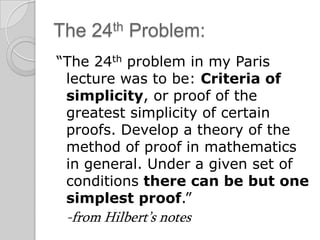
The 24th Problem:
“The 24th problem in my Paris
 lecture was to be: Criteria of
 simplicity, or proof of the
 greatest simplicity of certain
 proofs. Develop a theory of the
 method of proof in mathematics
 in general. Under a given set of
 conditions there can be but one
 simplest proof.”
 -from Hilbert’s notes
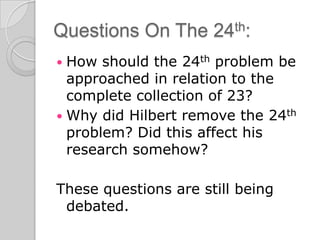
Questions On The 24th:
 How should the 24th problem be
  approached in relation to the
  complete collection of 23?
 Why did Hilbert remove the 24th
  problem? Did this affect his
  research somehow?

These questions are still being
 debated.
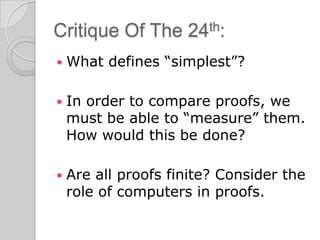
Critique Of The 24th:
   What defines “simplest”?

   In order to compare proofs, we
    must be able to “measure” them.
    How would this be done?

   Are all proofs finite? Consider the
    role of computers in proofs.
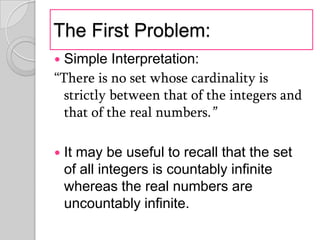
The First Problem:
 Simple Interpretation:
“There is no set whose cardinality is
  strictly between that of the integers and
  that of the real numbers.”

   It may be useful to recall that the set
    of all integers is countably infinite
    whereas the real numbers are
    uncountably infinite.
The First Problem:
 Or, put differently:
  “Prove Cantor's problem of the cardinal
         number of the continuum.”
 This is also known as the Cantor’s
  Continuum hypothesis: “…there is no
  infinite set with a cardinal number
  between that of the "small" infinite set
  of integers and the "large" infinite set of
  real numbers (the "continuum").”
http://mathworld.wolfram.com/ContinuumHypothesis.html
http://mathworld.wolfram.com/CardinalNumber.html
Status The First Problem:
   There is no consensus as to if the
    problem has been “solved”.

   “Instead of working out a solution of the
    continuum problem, we falsified one of the
    premises upon which Hilbert based it, proving
    and verifying the proposition that there exist no
    infinities beyond the infinity of the natural
    numbers.”
    http://bado-shanai.net/Platonic%20Dream/pdHilbertsFirst.htm


Significant contributors:
 1940: Kurt Gödel
 1963: Paul Cohen
First Problem’s Importance:
   Hilbert was very aware of the
    mathematical community during his
    lifetime. The first problem reflects this.
    Hilbert was a friend of the problem’s
     formulator, Cantor.
    Cantor was discredited during his life for his
     radical views on infinity and his later mental
     illness.
    At the time of the problem’s proposal
     (1900), the tools to “solve” it did not exist.
The Other Problems:
•   The handout attempts to group
    Hilbert’s problems based on their
    current status.

•   Some information on notable
    contributions is also given.


 Note: I  accidentally put problem 16 as
    both “open” and “too vague”. …..Oops.
The Other Problems:
9 problems have a generally
 accepted solution
8 problems have a controversial
 solution
3 problems are open
3 problems are too vauge. (4 if
 the canceled 24th is included…)
Final Thoughts:
Hilbert’s problems
1. continue to fascinate
   mathematicians from all over
   the world.
2. allow us to easily track
   mathematical progress over
   time.
3. reveal the difficulty in achieving
   consensus on a proof or result.
End.

Thanks for listening.

Hilbert’s 23 problems

  • 1.
    Hilbert’s 23 Problems Math350 Allison Simmons
  • 2.
    Goals:  Give a little background on Hilbert.  Explain the creation and purpose of his 23 problems  Investigate a couple of the problems  Check in on the problems’ current status.
  • 3.
  • 4.
    The Problems:  Hilbert presented 10 of the problems in 1900 at the “International Congress of Mathematicians” in Paris. This talk was entitled “The Problems of Mathematics”.  The complete list of 23 problems appeared in a later talk, which was translated into English in 1902.
  • 5.
    An Obvious Question:  Why did Hilbert chose to focus on unsolved problems rather than the new methods or results of the time?
  • 6.
    His Intention: “If wewould obtain an idea of the probable development of mathematical knowledge in the immediate future, we must let the unsettled questions pass before our minds and look over the problems which the science of today sets and whose solution we expect from the future. To such a review of problems the present day, lying at the meeting of the centuries, seems to me well adapted. For the close of a great epoch not only invites us to look back into the past but also directs our thoughts to the unknown future.” – Hilbert (1900, The Problems of Mathematics speech).
  • 7.
    His Intention: Hilbert’s problemswere designed to be  Simple  Easily understood  Inspiring  A way of gauging mathematical progress  The first step in simplifying mathematics as a system of axioms
  • 8.
    The 24th Problem: In2000, it was discovered that Hilbert had originally planned for a 24th problem.  This problem was not in his lecture notes or any published texts.  His close friends and proofreaders were also not aware of this problem.
  • 9.
    The 24th Problem: “The24th problem in my Paris lecture was to be: Criteria of simplicity, or proof of the greatest simplicity of certain proofs. Develop a theory of the method of proof in mathematics in general. Under a given set of conditions there can be but one simplest proof.” -from Hilbert’s notes
  • 10.
    Questions On The24th:  How should the 24th problem be approached in relation to the complete collection of 23?  Why did Hilbert remove the 24th problem? Did this affect his research somehow? These questions are still being debated.
  • 11.
    Critique Of The24th:  What defines “simplest”?  In order to compare proofs, we must be able to “measure” them. How would this be done?  Are all proofs finite? Consider the role of computers in proofs.
  • 12.
    The First Problem: Simple Interpretation: “There is no set whose cardinality is strictly between that of the integers and that of the real numbers.”  It may be useful to recall that the set of all integers is countably infinite whereas the real numbers are uncountably infinite.
  • 13.
    The First Problem: Or, put differently: “Prove Cantor's problem of the cardinal number of the continuum.”  This is also known as the Cantor’s Continuum hypothesis: “…there is no infinite set with a cardinal number between that of the "small" infinite set of integers and the "large" infinite set of real numbers (the "continuum").” http://mathworld.wolfram.com/ContinuumHypothesis.html http://mathworld.wolfram.com/CardinalNumber.html
  • 14.
    Status The FirstProblem:  There is no consensus as to if the problem has been “solved”.  “Instead of working out a solution of the continuum problem, we falsified one of the premises upon which Hilbert based it, proving and verifying the proposition that there exist no infinities beyond the infinity of the natural numbers.” http://bado-shanai.net/Platonic%20Dream/pdHilbertsFirst.htm Significant contributors:  1940: Kurt Gödel  1963: Paul Cohen
  • 15.
    First Problem’s Importance:  Hilbert was very aware of the mathematical community during his lifetime. The first problem reflects this. Hilbert was a friend of the problem’s formulator, Cantor. Cantor was discredited during his life for his radical views on infinity and his later mental illness. At the time of the problem’s proposal (1900), the tools to “solve” it did not exist.
  • 16.
    The Other Problems: • The handout attempts to group Hilbert’s problems based on their current status. • Some information on notable contributions is also given.  Note: I accidentally put problem 16 as both “open” and “too vague”. …..Oops.
  • 17.
    The Other Problems: 9problems have a generally accepted solution 8 problems have a controversial solution 3 problems are open 3 problems are too vauge. (4 if the canceled 24th is included…)
  • 18.
    Final Thoughts: Hilbert’s problems 1.continue to fascinate mathematicians from all over the world. 2. allow us to easily track mathematical progress over time. 3. reveal the difficulty in achieving consensus on a proof or result.
  • 19.