Problem Solving and Creative
Thinking
Problem Solving
What is a Problem?
A problem arises when a living creature has a goal but
does not know how this goal is to be reached.
[A problem exists] whenever one cannot go from the given
situation to the desired situation simply by action. [K.
Dunker, On Problem Solving, (1945) p. 1]
What is Problem Solving?
Problem Solving is the process of working out or
discovering how to reach such a goal.
What is creative thinking?
Creative thinking is the process of generating novel ideas and
alternative courses of action, no matter how good those ideas
and alternatives might be.
Creative thinking should not be seen as an alternative to critical
thinking
When you have recognised a problem, then you should employ
creative thinking to produce some options for solving the
problem, then you should employ critical thinking
If you haven’t come up with enough options to begin with, then
your critical thinking decision procedure might produce the
wrong result… a dangerous result!
Creative Thinking, Critical Thinking, and Problem
Solving
Creative thinking supports critical thinking … While critical
thinking focuses on step-by-step, linear processes aimed at arriving
at a correct answer, creative thinking begins with possibility,
multiple ideas, and suspended judgement. It might be said that
creative thinking supports the ideas with which critical thinking
works. Thus, even though these two kinds of thinking work in
different ways, they actually support one another and aim at the
same ultimate goal, which is to solve a problem … At the
beginning of the process, creative methods are used to examine the
problem environment, generate ideas, and make associations. Then
the analysis and judgment faculties are brought into play, and the
possibilities are analyzed for a possible solution. [Robert Harris,
CB pp. 115-6]
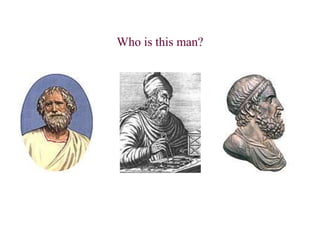
Who is this man?
Archimedes
Great inventor, mathematician etc.
The Screw 
The Lever
Archimedes
Helped protect Syracuse from the Romans in the siege of 213BC
The Mirror
The Claw
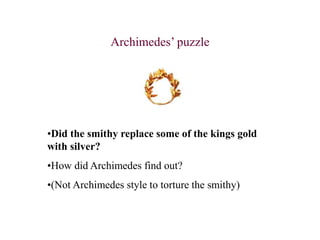
Archimedes’ puzzle
•Did the smithy replace some of the kings gold
with silver?
•How did Archimedes find out?
•(Not Archimedes style to torture the smithy)
Solution to Archimedes’ puzzle.
• The solution, which occurred when he stepped into a
public bath and caused it to overflow, was to put a
weight of gold equal to the crown, and known to be
pure, into a bowl which was filled with water to the
brim. Then the gold would be removed and the king’s
crown put in, in its place. An alloy of lighter silver
would increase the bulk of the crown and cause the
bowl to overflow. [Vitruvius, De Architectura]
• And the wreath was impure!
Creative thinking!
• It was very useful to Archimedes
– He was well respected and treated in Syracuse
– Marcellus, the Roman general, ordered his life
to be spared when Syracuse finally fell
– But his obsession with maths was ultimately his
downfall!
• Can we be like Archimedes?
• Can we learn to be creative thinkers?
4 Methods for Generating Ideas
1. Associative Techniques
2. Analytic Techniques
3. Brainstorming
4. Role Playing
Associative Techniques
1. Compare something familiar to something
unfamiliar.
a) Close analogy e.g. apples and pears
b) Remote analogy e.g. Pringles
c) Forced analogy…
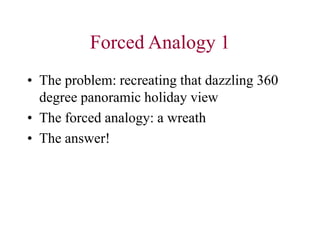
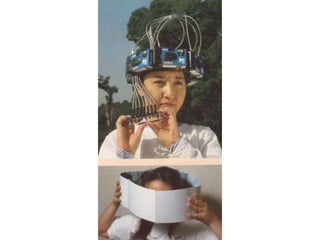
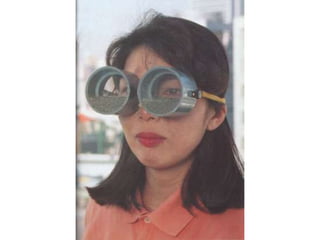
Forced Analogy 1
• The problem: recreating that dazzling 360
degree panoramic holiday view
• The forced analogy: a wreath
• The answer!
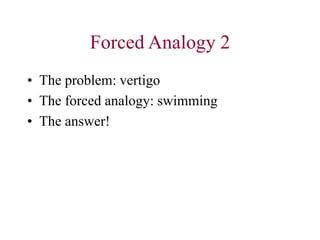
Forced Analogy 2
• The problem: vertigo
• The forced analogy: swimming
• The answer!
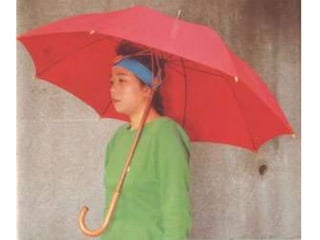
Forced Analogy 3
• The problem: Carrying lots of shopping
when its raining
• The forced analogy: a tennis player
• The answer!
Analytic Techniques
2. Breaking a problem down into smaller parts
• E.g. How can I make the All Blacks win the
Rugby World Cup?
• Vital components of the problem:
• Henry: Just one: ensuring the ABs perform to
their capacity
• Hence the 4 Rs of Henry’s regime
– Rest
– Rotation
– Relationships within team are friendly
– Really discreet signaling during matches
Analytic Techniques
• Unfortunately (as we know), Henry didn’t
analyse the problem thoroughly.
• He missed a vital component of the
problem:
• The Barnes Factor
Analytic Techniques
• Good analytic techniques will help to
ensure that all of the important components
of the problem are addressed
Brainstorming
3. Deliberately set about coming up with
alternatives, and write them all down, no
matter what.
• No idea is a bad idea (at least just yet)
• Edward de Bono 6 hats – green hat time
• One company generated 2,200 ideas in
one day!
Roleplaying
4. Roleplaying. Attempt to simulate aspects of the
problem and proposed solutions. Try to imagine
details of the relevant outcomes after your
choice has been made, and attempt to put
yourself in the shoes of other people.
• A good method for gathering information and
gaining perspective
• E.g. Theoretical vs. practical lecturing
• E.g. Customers-eye-view of displays
• E.g. Hand-out-of-the-car-window aerodynamics
But Archimedes was not just a creative
thinker...
•He was also a prolific problem solver
•So, how can we harness these 4 idea creation
techniques to help us solve problems?
•Ideas should be generated after the problem has
been properly understood and represented
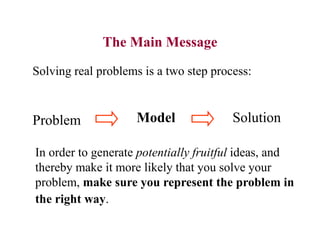
Solving real problems is a two step process:
Problem Model Solution
The Main Message
In order to generate potentially fruitful ideas, and
thereby make it more likely that you solve your
problem, make sure you represent the problem in
the right way.
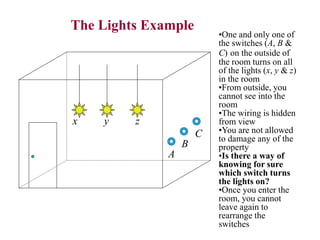
C
B
A
•One and only one of
the switches (A, B &
C) on the outside of
the room turns on all
of the lights (x, y & z)
in the room
•From outside, you
cannot see into the
room
•The wiring is hidden
from view
•You are not allowed
to damage any of the
property
•Is there a way of
knowing for sure
which switch turns
the lights on?
•Once you enter the
room, you cannot
leave again to
rearrange the
switches
x y z
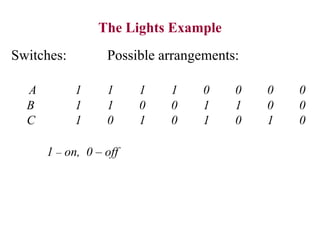
The Lights Example
Switches: Possible arrangements:
A 1 1 1 1 0 0 0 0
B 1 1 0 0 1 1 0 0
C 1 0 1 0 1 0 1 0
1 – on, 0 – off
The Lights Example
Solving real problems is a two step process:
Problem Model Solution
The Main Message
In order to generate potentially fruitful ideas, and
thereby make it more likely that you solve your
problem, make sure you represent the problem in
the right way.
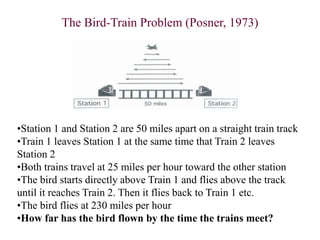
The Bird-Train Problem (Posner, 1973)
•Station 1 and Station 2 are 50 miles apart on a straight train track
•Train 1 leaves Station 1 at the same time that Train 2 leaves
Station 2
•Both trains travel at 25 miles per hour toward the other station
•The bird starts directly above Train 1 and flies above the track
until it reaches Train 2. Then it flies back to Train 1 etc.
•The bird flies at 230 miles per hour
•How far has the bird flown by the time the trains meet?
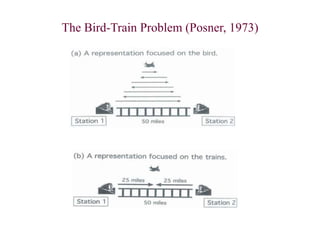
The Bird-Train Problem (Posner, 1973)
Solving real problems is a two step process:
Problem Model Solution
The Main Message
In order to generate potentially fruitful ideas, and
thereby make it more likely that you solve your
problem, make sure you represent the problem in
the right way.
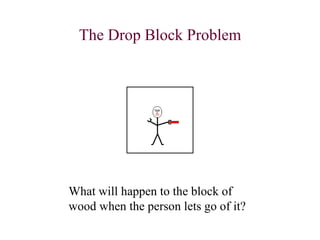
The Drop Block Problem
What will happen to the block of
wood when the person lets go of it?
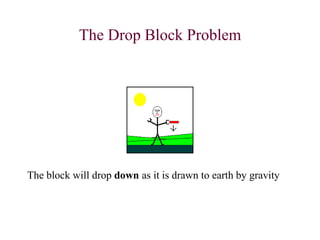
The Drop Block Problem
The block will drop down as it is drawn to earth by gravity
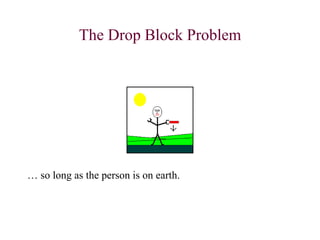
The Drop Block Problem
… so long as the person is on earth.
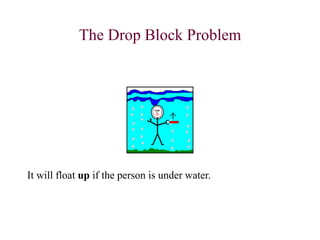
The Drop Block Problem
It will float up if the person is under water.
The Drop Block Problem
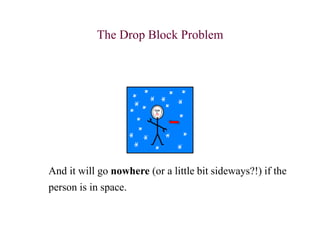
And it will go nowhere (or a little bit sideways?!) if the
person is in space.
Solving real problems is a two step process:
Problem Model Solution
The Main Message
In order to generate potentially fruitful ideas, and
thereby make it more likely that you solve your
problem, make sure you represent the problem in
the right way.
So, how can I best represent a problem?
Suggestion 1: Drop presuppositions that aren’t explicit
in the original statement of the problem
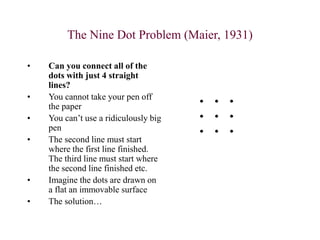
The Nine Dot Problem (Maier, 1931)
• Can you connect all of the
dots with just 4 straight
lines?
• You cannot take your pen off
the paper
• You can’t use a ridiculously big
pen
• The second line must start
where the first line finished.
The third line must start where
the second line finished etc.
• Imagine the dots are drawn on
a flat an immovable surface
• The solution…
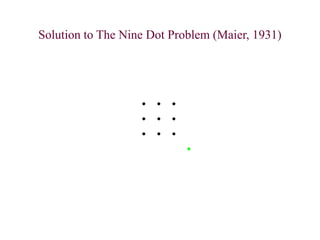
Solution to The Nine Dot Problem (Maier, 1931)
How can I best represent a problem?
Suggestion 1: Drop presuppositions that aren’t explicit
in the original statement of the problem.
A Terrible Accident
• There was a terrible accident on the motorway coming
into Wellington
• A man was killed on impact and his son was rushed to
hospital with life-threatening injuries
• At the hospital, the surgeon saw the boy and said: “I
can’t operate, that’s my son”
• What is going on here?
• Many of us assume that surgeons have to be male,
making us come up with crazy answers for a simple
question
How can I best represent a problem?
Suggestion 1: Drop presuppositions that aren’t explicit
in the original statement of the problem.
How can I best represent a problem?
Suggestion 1: Drop presuppositions that aren’t explicit
in the original statement of the problem.
Suggestion 2: Make sure you represent everything
explicit in the original statement of the problem.
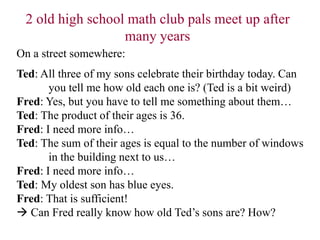
On a street somewhere:
Ted: All three of my sons celebrate their birthday today. Can
you tell me how old each one is? (Ted is a bit weird)
Fred: Yes, but you have to tell me something about them…
Ted: The product of their ages is 36.
Fred: I need more info…
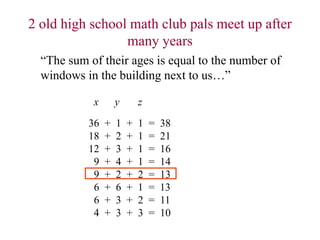
Ted: The sum of their ages is equal to the number of windows
in the building next to us…
Fred: I need more info…
Ted: My oldest son has blue eyes.
Fred: That is sufficient!
 Can Fred really know how old Ted’s sons are? How?
2 old high school math club pals meet up after
many years
2 old high school math club pals meet up after
many years
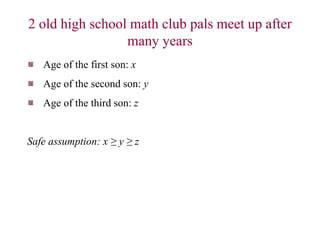
Age of the first son: x
Age of the second son: y
Age of the third son: z
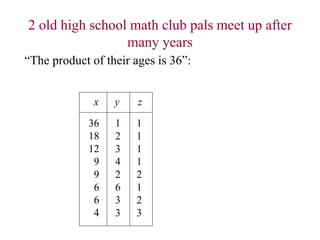
Safe assumption: x ≥ y ≥ z
36 1 1
18 2 1
12 3 1
9 4 1
9 2 2
6 6 1
6 3 2
4 3 3
“The product of their ages is 36”:
x y z
2 old high school math club pals meet up after
many years
36 + 1 + 1 = 38
18 + 2 + 1 = 21
12 + 3 + 1 = 16
9 + 4 + 1 = 14
9 + 2 + 2 = 13
6 + 6 + 1 = 13
6 + 3 + 2 = 11
4 + 3 + 3 = 10
“The sum of their ages is equal to the number of
windows in the building next to us…”
x y z
2 old high school math club pals meet up after
many years
How can I best represent a problem?
Suggestion 2: Make sure you represent everything
explicit in the original statement of the problem.
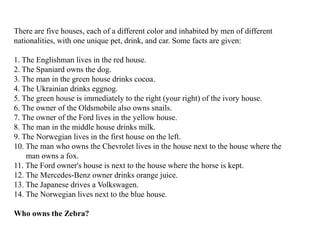
There are five houses, each of a different color and inhabited by men of different
nationalities, with one unique pet, drink, and car. Some facts are given:
1. The Englishman lives in the red house.
2. The Spaniard owns the dog.
3. The man in the green house drinks cocoa.
4. The Ukrainian drinks eggnog.
5. The green house is immediately to the right (your right) of the ivory house.
6. The owner of the Oldsmobile also owns snails.
7. The owner of the Ford lives in the yellow house.
8. The man in the middle house drinks milk.
9. The Norwegian lives in the first house on the left.
10. The man who owns the Chevrolet lives in the house next to the house where the
man owns a fox.
11. The Ford owner's house is next to the house where the horse is kept.
12. The Mercedes-Benz owner drinks orange juice.
13. The Japanese drives a Volkswagen.
14. The Norwegian lives next to the blue house.
Who owns the Zebra?
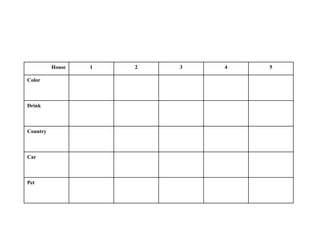
House 1 2 3 4 5
Color
Drink
Country
Car
Pet
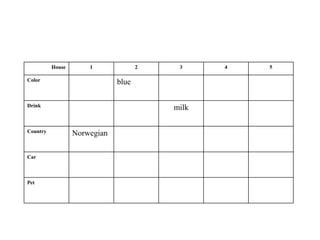
House 1 2 3 4 5
Color blue
Drink milk
Country Norwegian
Car
Pet
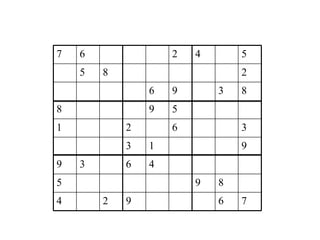
7 6 2 4 5
5 8 2
6 9 3 8
8 9 5
1 2 6 3
3 1 9
9 3 6 4
5 9 8
4 2 9 6 7
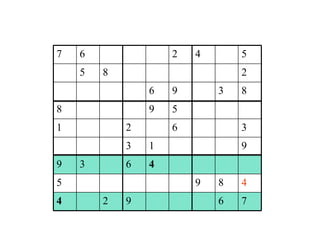
7 6 2 4 5
5 8 2
6 9 3 8
8 9 5
1 2 6 3
3 1 9
9 3 6 4
5 9 8 4
4 2 9 6 7
How can I best represent a problem?
Suggestion 2: Make sure you represent everything
explicit in the original statement of the problem.
How can I best represent a problem?
Suggestion 1: Drop presuppositions that aren’t explicit
in the original statement of the problem.
Suggestion 2: Make sure you represent everything
explicit in the original statement of the problem.
Suggestion 3: When thinking about how you could
represent a problem, look for structural similarities
between this problem and one you know the answer to..
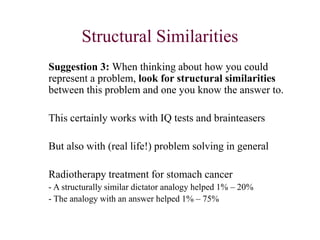
Structural Similarities
Suggestion 3: When thinking about how you could
represent a problem, look for structural similarities
between this problem and one you know the answer to.
This certainly works with IQ tests and brainteasers
But also with (real life!) problem solving in general
Radiotherapy treatment for stomach cancer
- A structurally similar dictator analogy helped 1% – 20%
- The analogy with an answer helped 1% – 75%
Why should solving logic puzzles be
relevant or important to me?
An ability to solve logic puzzles is thought to be
positively correlated with an ability to think creatively
and solve problems of any kind.
Whether or not such a correlation really exist, it is
commonly believed to exist.
Employers care more about creative thinking and
problem solving abilities in the workforce more than any
other general skill..
Creative thinking and problem solving abilities are
among the most important skills sought after by
universities..
Hence, universities and employers will screen candidates
on the basis of their ability to solve logic puzzles.
ACTUAL MICROSOFT INTERVIEW QUESTIONS
Interview Questions with a Determinate Answer
1. You have twenty blue socks, twenty brown socks, and two black
sock in a drawer in your room. If it is night time, and the room is
completely dark, how many would you have to take out to be sure
you have 2 of the same colour?
2. A mother sent her child to the lake and told him to bring back
exactly 7 litres of water. She gave him a 5 litre bucket and a 3 litre
bucket. How can the child measure out exactly 7 litres of water
using nothing but the two buckets.
3. You've got someone working for you for seven days and a gold bar
to pay them. The gold bar is segmented into seven connected pieces.
You must give them a piece of gold at the end of every day. If you
are only allowed to make two breaks in the gold bar, how do you
pay your worker?
ACTUAL MICROSOFT INTERVIEW QUESTIONS
Impossible Interview Questions
An Impossible Interview Question is one that has no single
acceptable answer.
1. How many piano tuners are there in the world?
2. How long would it take to move Mount Fuji?
• Strategy:
– Don’t freak out!
– Don’t give a joke answer (e.g. depends if we get Chuck Norris to help)
– Suggest a potential approach
– Ask them questions
How to solve problems creatively:
• Make sure you represent the problem in the right way!
i. Don’t assume restrictions that aren’t stipulated
ii. Do represent everything explicit in the question
iii. Do compare the structure of the problem with similar
ones
• Then generate lots of creative ideas with:
i. Associative techniques
ii. Analytic techniques
iii. Brainstorming
iv. Roleplaying
Summary

PHIL123 2007 Creative Thinking Dan Turton.ppt

  • 1.
    Problem Solving andCreative Thinking
  • 2.
    Problem Solving What isa Problem? A problem arises when a living creature has a goal but does not know how this goal is to be reached. [A problem exists] whenever one cannot go from the given situation to the desired situation simply by action. [K. Dunker, On Problem Solving, (1945) p. 1] What is Problem Solving? Problem Solving is the process of working out or discovering how to reach such a goal.
  • 3.
    What is creativethinking? Creative thinking is the process of generating novel ideas and alternative courses of action, no matter how good those ideas and alternatives might be. Creative thinking should not be seen as an alternative to critical thinking When you have recognised a problem, then you should employ creative thinking to produce some options for solving the problem, then you should employ critical thinking If you haven’t come up with enough options to begin with, then your critical thinking decision procedure might produce the wrong result… a dangerous result!
  • 4.
    Creative Thinking, CriticalThinking, and Problem Solving Creative thinking supports critical thinking … While critical thinking focuses on step-by-step, linear processes aimed at arriving at a correct answer, creative thinking begins with possibility, multiple ideas, and suspended judgement. It might be said that creative thinking supports the ideas with which critical thinking works. Thus, even though these two kinds of thinking work in different ways, they actually support one another and aim at the same ultimate goal, which is to solve a problem … At the beginning of the process, creative methods are used to examine the problem environment, generate ideas, and make associations. Then the analysis and judgment faculties are brought into play, and the possibilities are analyzed for a possible solution. [Robert Harris, CB pp. 115-6]
  • 5.
  • 6.
    Archimedes Great inventor, mathematicianetc. The Screw  The Lever
  • 7.
    Archimedes Helped protect Syracusefrom the Romans in the siege of 213BC The Mirror The Claw
  • 8.
    Archimedes’ puzzle •Did thesmithy replace some of the kings gold with silver? •How did Archimedes find out? •(Not Archimedes style to torture the smithy)
  • 9.
    Solution to Archimedes’puzzle. • The solution, which occurred when he stepped into a public bath and caused it to overflow, was to put a weight of gold equal to the crown, and known to be pure, into a bowl which was filled with water to the brim. Then the gold would be removed and the king’s crown put in, in its place. An alloy of lighter silver would increase the bulk of the crown and cause the bowl to overflow. [Vitruvius, De Architectura] • And the wreath was impure!
  • 10.
    Creative thinking! • Itwas very useful to Archimedes – He was well respected and treated in Syracuse – Marcellus, the Roman general, ordered his life to be spared when Syracuse finally fell – But his obsession with maths was ultimately his downfall! • Can we be like Archimedes? • Can we learn to be creative thinkers?
  • 11.
    4 Methods forGenerating Ideas 1. Associative Techniques 2. Analytic Techniques 3. Brainstorming 4. Role Playing
  • 12.
    Associative Techniques 1. Comparesomething familiar to something unfamiliar. a) Close analogy e.g. apples and pears b) Remote analogy e.g. Pringles c) Forced analogy…
  • 13.
    Forced Analogy 1 •The problem: recreating that dazzling 360 degree panoramic holiday view • The forced analogy: a wreath • The answer!
  • 15.
    Forced Analogy 2 •The problem: vertigo • The forced analogy: swimming • The answer!
  • 17.
    Forced Analogy 3 •The problem: Carrying lots of shopping when its raining • The forced analogy: a tennis player • The answer!
  • 19.
    Analytic Techniques 2. Breakinga problem down into smaller parts • E.g. How can I make the All Blacks win the Rugby World Cup? • Vital components of the problem: • Henry: Just one: ensuring the ABs perform to their capacity • Hence the 4 Rs of Henry’s regime – Rest – Rotation – Relationships within team are friendly – Really discreet signaling during matches
  • 20.
    Analytic Techniques • Unfortunately(as we know), Henry didn’t analyse the problem thoroughly. • He missed a vital component of the problem: • The Barnes Factor
  • 21.
    Analytic Techniques • Goodanalytic techniques will help to ensure that all of the important components of the problem are addressed
  • 22.
    Brainstorming 3. Deliberately setabout coming up with alternatives, and write them all down, no matter what. • No idea is a bad idea (at least just yet) • Edward de Bono 6 hats – green hat time • One company generated 2,200 ideas in one day!
  • 23.
    Roleplaying 4. Roleplaying. Attemptto simulate aspects of the problem and proposed solutions. Try to imagine details of the relevant outcomes after your choice has been made, and attempt to put yourself in the shoes of other people. • A good method for gathering information and gaining perspective • E.g. Theoretical vs. practical lecturing • E.g. Customers-eye-view of displays • E.g. Hand-out-of-the-car-window aerodynamics
  • 24.
    But Archimedes wasnot just a creative thinker... •He was also a prolific problem solver •So, how can we harness these 4 idea creation techniques to help us solve problems? •Ideas should be generated after the problem has been properly understood and represented
  • 25.
    Solving real problemsis a two step process: Problem Model Solution The Main Message In order to generate potentially fruitful ideas, and thereby make it more likely that you solve your problem, make sure you represent the problem in the right way.
  • 26.
    C B A •One and onlyone of the switches (A, B & C) on the outside of the room turns on all of the lights (x, y & z) in the room •From outside, you cannot see into the room •The wiring is hidden from view •You are not allowed to damage any of the property •Is there a way of knowing for sure which switch turns the lights on? •Once you enter the room, you cannot leave again to rearrange the switches x y z The Lights Example
  • 27.
    Switches: Possible arrangements: A1 1 1 1 0 0 0 0 B 1 1 0 0 1 1 0 0 C 1 0 1 0 1 0 1 0 1 – on, 0 – off The Lights Example
  • 28.
    Solving real problemsis a two step process: Problem Model Solution The Main Message In order to generate potentially fruitful ideas, and thereby make it more likely that you solve your problem, make sure you represent the problem in the right way.
  • 29.
    The Bird-Train Problem(Posner, 1973) •Station 1 and Station 2 are 50 miles apart on a straight train track •Train 1 leaves Station 1 at the same time that Train 2 leaves Station 2 •Both trains travel at 25 miles per hour toward the other station •The bird starts directly above Train 1 and flies above the track until it reaches Train 2. Then it flies back to Train 1 etc. •The bird flies at 230 miles per hour •How far has the bird flown by the time the trains meet?
  • 30.
    The Bird-Train Problem(Posner, 1973)
  • 31.
    Solving real problemsis a two step process: Problem Model Solution The Main Message In order to generate potentially fruitful ideas, and thereby make it more likely that you solve your problem, make sure you represent the problem in the right way.
  • 32.
    The Drop BlockProblem What will happen to the block of wood when the person lets go of it?
  • 33.
    The Drop BlockProblem The block will drop down as it is drawn to earth by gravity
  • 34.
    The Drop BlockProblem … so long as the person is on earth.
  • 35.
    The Drop BlockProblem It will float up if the person is under water.
  • 36.
    The Drop BlockProblem And it will go nowhere (or a little bit sideways?!) if the person is in space.
  • 37.
    Solving real problemsis a two step process: Problem Model Solution The Main Message In order to generate potentially fruitful ideas, and thereby make it more likely that you solve your problem, make sure you represent the problem in the right way.
  • 38.
    So, how canI best represent a problem? Suggestion 1: Drop presuppositions that aren’t explicit in the original statement of the problem
  • 39.
    The Nine DotProblem (Maier, 1931) • Can you connect all of the dots with just 4 straight lines? • You cannot take your pen off the paper • You can’t use a ridiculously big pen • The second line must start where the first line finished. The third line must start where the second line finished etc. • Imagine the dots are drawn on a flat an immovable surface • The solution…
  • 40.
    Solution to TheNine Dot Problem (Maier, 1931)
  • 41.
    How can Ibest represent a problem? Suggestion 1: Drop presuppositions that aren’t explicit in the original statement of the problem.
  • 42.
    A Terrible Accident •There was a terrible accident on the motorway coming into Wellington • A man was killed on impact and his son was rushed to hospital with life-threatening injuries • At the hospital, the surgeon saw the boy and said: “I can’t operate, that’s my son” • What is going on here? • Many of us assume that surgeons have to be male, making us come up with crazy answers for a simple question
  • 43.
    How can Ibest represent a problem? Suggestion 1: Drop presuppositions that aren’t explicit in the original statement of the problem.
  • 44.
    How can Ibest represent a problem? Suggestion 1: Drop presuppositions that aren’t explicit in the original statement of the problem. Suggestion 2: Make sure you represent everything explicit in the original statement of the problem.
  • 45.
    On a streetsomewhere: Ted: All three of my sons celebrate their birthday today. Can you tell me how old each one is? (Ted is a bit weird) Fred: Yes, but you have to tell me something about them… Ted: The product of their ages is 36. Fred: I need more info… Ted: The sum of their ages is equal to the number of windows in the building next to us… Fred: I need more info… Ted: My oldest son has blue eyes. Fred: That is sufficient!  Can Fred really know how old Ted’s sons are? How? 2 old high school math club pals meet up after many years
  • 46.
    2 old highschool math club pals meet up after many years Age of the first son: x Age of the second son: y Age of the third son: z Safe assumption: x ≥ y ≥ z
  • 47.
    36 1 1 182 1 12 3 1 9 4 1 9 2 2 6 6 1 6 3 2 4 3 3 “The product of their ages is 36”: x y z 2 old high school math club pals meet up after many years
  • 48.
    36 + 1+ 1 = 38 18 + 2 + 1 = 21 12 + 3 + 1 = 16 9 + 4 + 1 = 14 9 + 2 + 2 = 13 6 + 6 + 1 = 13 6 + 3 + 2 = 11 4 + 3 + 3 = 10 “The sum of their ages is equal to the number of windows in the building next to us…” x y z 2 old high school math club pals meet up after many years
  • 49.
    How can Ibest represent a problem? Suggestion 2: Make sure you represent everything explicit in the original statement of the problem.
  • 50.
    There are fivehouses, each of a different color and inhabited by men of different nationalities, with one unique pet, drink, and car. Some facts are given: 1. The Englishman lives in the red house. 2. The Spaniard owns the dog. 3. The man in the green house drinks cocoa. 4. The Ukrainian drinks eggnog. 5. The green house is immediately to the right (your right) of the ivory house. 6. The owner of the Oldsmobile also owns snails. 7. The owner of the Ford lives in the yellow house. 8. The man in the middle house drinks milk. 9. The Norwegian lives in the first house on the left. 10. The man who owns the Chevrolet lives in the house next to the house where the man owns a fox. 11. The Ford owner's house is next to the house where the horse is kept. 12. The Mercedes-Benz owner drinks orange juice. 13. The Japanese drives a Volkswagen. 14. The Norwegian lives next to the blue house. Who owns the Zebra?
  • 51.
    House 1 23 4 5 Color Drink Country Car Pet
  • 52.
    House 1 23 4 5 Color blue Drink milk Country Norwegian Car Pet
  • 53.
    7 6 24 5 5 8 2 6 9 3 8 8 9 5 1 2 6 3 3 1 9 9 3 6 4 5 9 8 4 2 9 6 7
  • 54.
    7 6 24 5 5 8 2 6 9 3 8 8 9 5 1 2 6 3 3 1 9 9 3 6 4 5 9 8 4 4 2 9 6 7
  • 55.
    How can Ibest represent a problem? Suggestion 2: Make sure you represent everything explicit in the original statement of the problem.
  • 56.
    How can Ibest represent a problem? Suggestion 1: Drop presuppositions that aren’t explicit in the original statement of the problem. Suggestion 2: Make sure you represent everything explicit in the original statement of the problem. Suggestion 3: When thinking about how you could represent a problem, look for structural similarities between this problem and one you know the answer to..
  • 57.
    Structural Similarities Suggestion 3:When thinking about how you could represent a problem, look for structural similarities between this problem and one you know the answer to. This certainly works with IQ tests and brainteasers But also with (real life!) problem solving in general Radiotherapy treatment for stomach cancer - A structurally similar dictator analogy helped 1% – 20% - The analogy with an answer helped 1% – 75%
  • 58.
    Why should solvinglogic puzzles be relevant or important to me? An ability to solve logic puzzles is thought to be positively correlated with an ability to think creatively and solve problems of any kind. Whether or not such a correlation really exist, it is commonly believed to exist. Employers care more about creative thinking and problem solving abilities in the workforce more than any other general skill.. Creative thinking and problem solving abilities are among the most important skills sought after by universities.. Hence, universities and employers will screen candidates on the basis of their ability to solve logic puzzles.
  • 59.
    ACTUAL MICROSOFT INTERVIEWQUESTIONS Interview Questions with a Determinate Answer 1. You have twenty blue socks, twenty brown socks, and two black sock in a drawer in your room. If it is night time, and the room is completely dark, how many would you have to take out to be sure you have 2 of the same colour? 2. A mother sent her child to the lake and told him to bring back exactly 7 litres of water. She gave him a 5 litre bucket and a 3 litre bucket. How can the child measure out exactly 7 litres of water using nothing but the two buckets. 3. You've got someone working for you for seven days and a gold bar to pay them. The gold bar is segmented into seven connected pieces. You must give them a piece of gold at the end of every day. If you are only allowed to make two breaks in the gold bar, how do you pay your worker?
  • 60.
    ACTUAL MICROSOFT INTERVIEWQUESTIONS Impossible Interview Questions An Impossible Interview Question is one that has no single acceptable answer. 1. How many piano tuners are there in the world? 2. How long would it take to move Mount Fuji? • Strategy: – Don’t freak out! – Don’t give a joke answer (e.g. depends if we get Chuck Norris to help) – Suggest a potential approach – Ask them questions
  • 61.
    How to solveproblems creatively: • Make sure you represent the problem in the right way! i. Don’t assume restrictions that aren’t stipulated ii. Do represent everything explicit in the question iii. Do compare the structure of the problem with similar ones • Then generate lots of creative ideas with: i. Associative techniques ii. Analytic techniques iii. Brainstorming iv. Roleplaying Summary