DATA AND
INFORMATION
Fundamentals of InformationTechnology
by: Miss BermieTagtag
DATATECHNOLOGIES
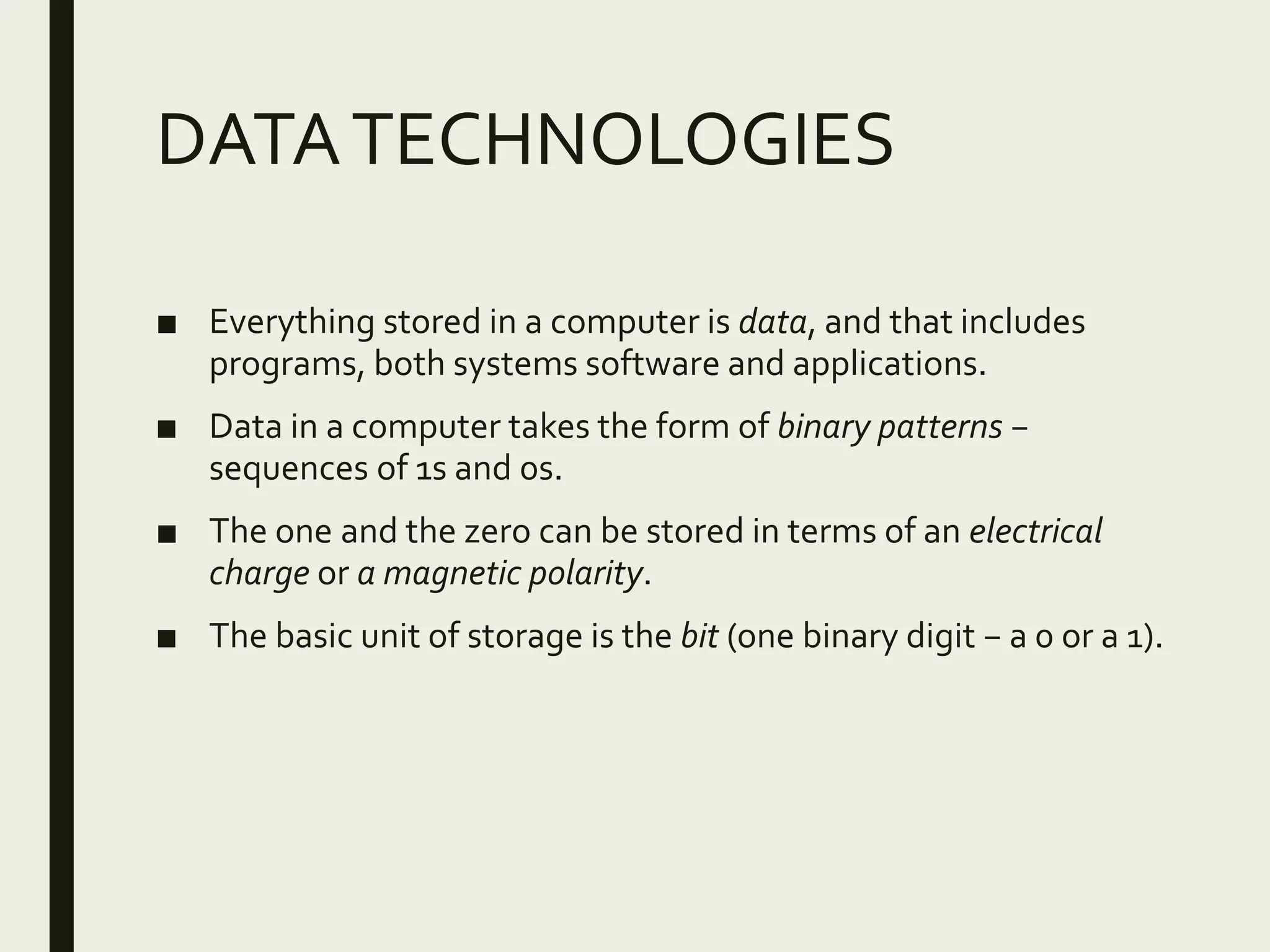
■ Everything stored in a computer is data, and that includes
programs, both systems software and applications.
■ Data in a computer takes the form of binary patterns −
sequences of 1s and 0s.
■ The one and the zero can be stored in terms of an electrical
charge or a magnetic polarity.
■ The basic unit of storage is the bit (one binary digit − a 0 or a 1).
DATATECHNOLOGIES
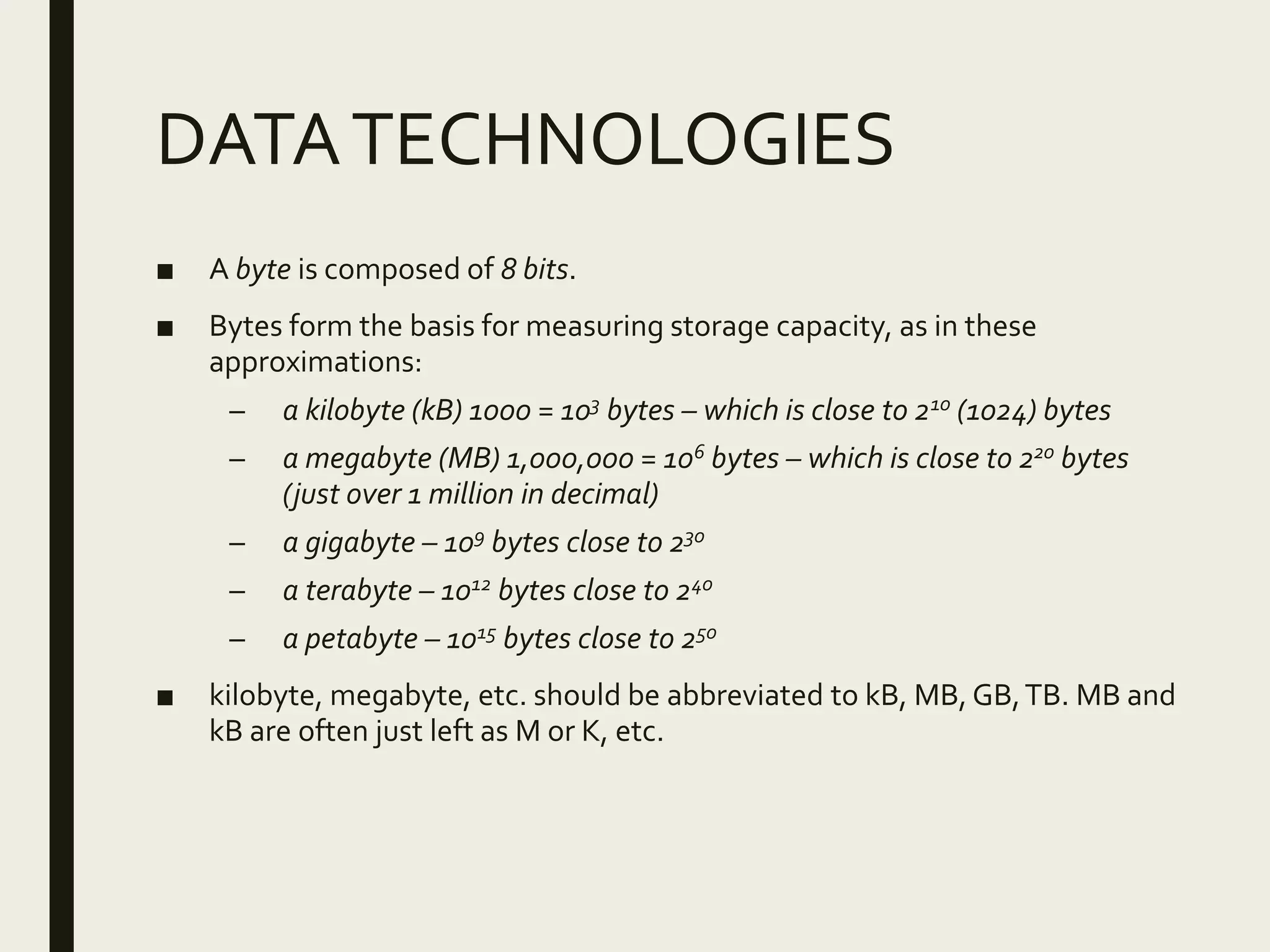
■ A byte is composed of 8 bits.
■ Bytes form the basis for measuring storage capacity, as in these
approximations:
– a kilobyte (kB) 1000 = 103 bytes – which is close to 210 (1024) bytes
– a megabyte (MB) 1,000,000 = 106 bytes – which is close to 220 bytes
(just over 1 million in decimal)
– a gigabyte – 109 bytes close to 230
– a terabyte – 1012 bytes close to 240
– a petabyte – 1015 bytes close to 250
■ kilobyte, megabyte, etc. should be abbreviated to kB, MB, GB,TB. MB and
kB are often just left as M or K, etc.
DATATECHNOLOGIES
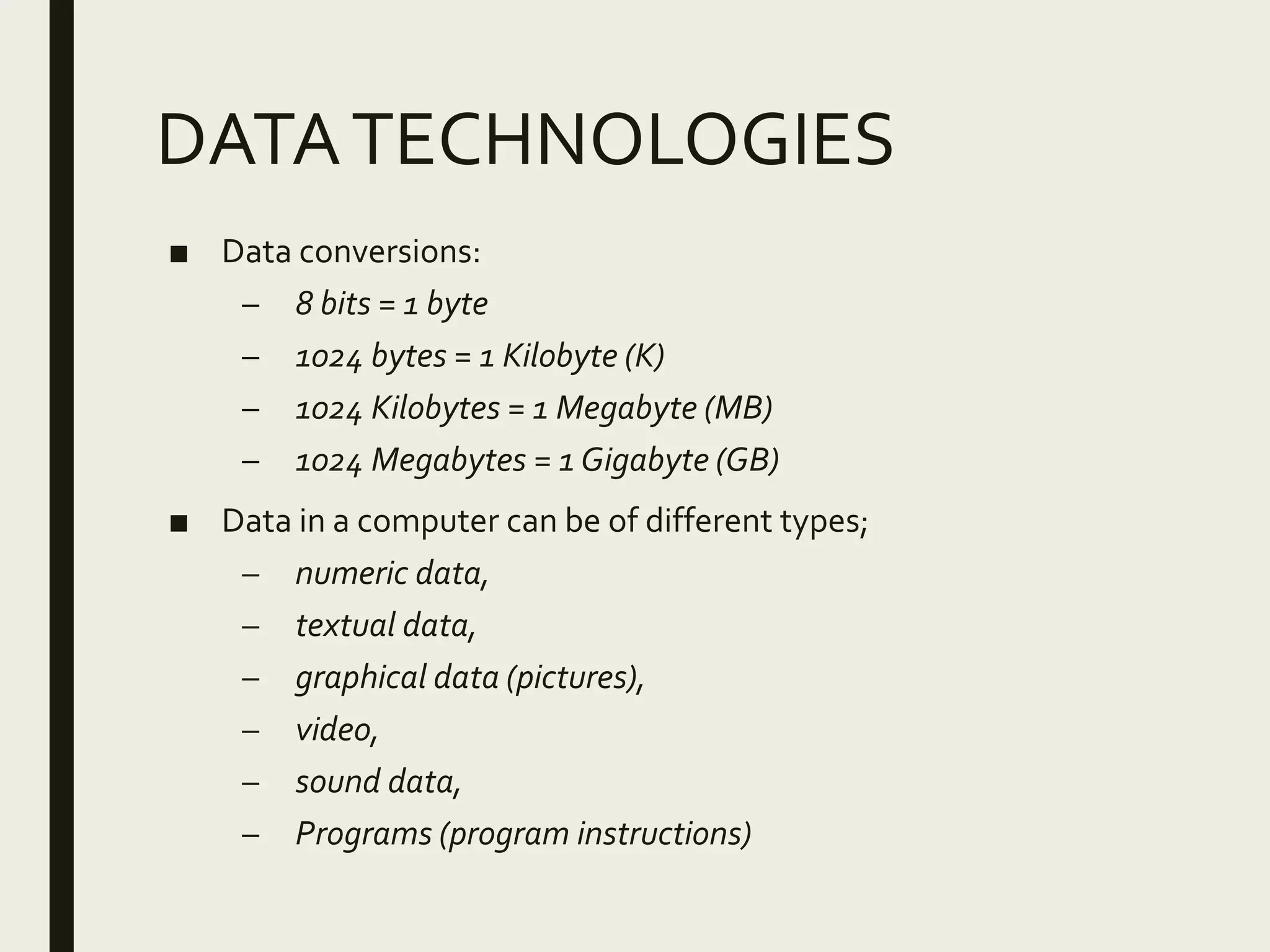
■ Data conversions:
– 8 bits = 1 byte
– 1024 bytes = 1 Kilobyte (K)
– 1024 Kilobytes = 1 Megabyte (MB)
– 1024 Megabytes = 1 Gigabyte (GB)
■ Data in a computer can be of different types;
– numeric data,
– textual data,
– graphical data (pictures),
– video,
– sound data,
– Programs (program instructions)
DATATECHNOLOGIES
■ Each form of data has its own way of using the raw storage
capability (RAM or secondary storage).
– Just by looking at a pattern of 1s and 0s, it is not possible
to tell what type of data is being stored, but once the
type is known, then the pattern can be decoded.
■ For example, the pattern 01001011 represents the letter ‘K’
in the ASCII code for representing text; but it represents the
decimal number 75 if this binary code is interpreted as a
binary number. It might also represent the machine code
instruction ‘add’.
DATATECHNOLOGIES
■ Text is stored in a computer according to standard systems
of encoding – usually some version of the ASCII code.
■ Each character is stored in one byte (made up of eight
individual bits). Thus, a name and address of 80 characters
will use 80 bytes of storage.
■ All the printing characters that you can generate from your
keyboard have an equivalent representation in the ASCII
code; in addition, there are some non-printing codes – such
as end of line, backspace, line feed, etc.
Activity
■ A warehouse stores information on 3,000 products.
Each product description comprises about 500
characters of data plus a photo of half a megabyte.
How much disc space is needed to store this
information? Express your answer in megabytes and
kilobytes.
INFORMATION
■ General definition:
– “Information is knowledge about the
world that is sought by people in order
to satisfy their psychological needs
and on the basis of which they can take
action or make decisions. “
INFORMATION
■ This candidate definition has a number of
important themes:
• It suggests that people value information, because
they actively seek it.
• It suggests that information tells us something
about the world – that is, it communicates to us
some state of affairs.
• It also suggests that people seek information
because they will use it.
The value and cost of information
■ Reliable and accurate
■ Accessible
■ Up-to-date or timely
■ Conveniently presented
■ At an appropriate level of detail
■ Reduces our uncertainty
■ Exclusive
■ Pleasing (for example, in the sense of a story, a cartoon
or a song that evokes a direct response from the
receiver)
■ enables some other valued task.
CHARACTERISTICS OF
INFORMATION
■ intellectual property (IP) or intellectual property rights (IPR
– Copyrights
– Patents
■ descriptive or probabilistic
– Descriptive information can be traced back to some real
world thing or phenomenon, but probabilistic
information can only be traced back to an abstract
model that may use some descriptive data.
■ high or low quality
– good information is exactly the right information, with
no wastage; not too much, not too little
– an excess of ill-organized information is often described
as information overload
DATAVS INFORMATION
■ Data is just symbols stored or processed in a
computer.
■ Another way to describe data is as a medium for
conveying information.
■ Data can be the basis for information – but only if
someone seeks it out and interprets it.This may
require the person to specify what data is to be
sought and then to apply some form of processing
to the data, perhaps summarizing it.
■ If the data is in a computer system, it will then have
to be extracted and displayed in an appropriate
manner.
DATA, INFORMATION,
KNOWLEDGE
■ Data: Numbers, characters or images that
designate an attribute of a phenomenon.
■ Information: Data becomes Information when
they are combined together in ways that have
the potential to reveal patterns in the
phenomenon.
■ Knowledge: Information yields knowledge when
it supports non-trivial, true claims about a
phenomenon.
Activity (Recitation)
■ Look at a selection of information
presentations that you use in your
everyday life. For example, a Facebook
page. Are these sources of information
are well presented and useful to you as
they could be? Suggest some
improvements.

Data and information

  • 1.
    DATA AND INFORMATION Fundamentals ofInformationTechnology by: Miss BermieTagtag
  • 2.
    DATATECHNOLOGIES ■ Everything storedin a computer is data, and that includes programs, both systems software and applications. ■ Data in a computer takes the form of binary patterns − sequences of 1s and 0s. ■ The one and the zero can be stored in terms of an electrical charge or a magnetic polarity. ■ The basic unit of storage is the bit (one binary digit − a 0 or a 1).
  • 3.
    DATATECHNOLOGIES ■ A byteis composed of 8 bits. ■ Bytes form the basis for measuring storage capacity, as in these approximations: – a kilobyte (kB) 1000 = 103 bytes – which is close to 210 (1024) bytes – a megabyte (MB) 1,000,000 = 106 bytes – which is close to 220 bytes (just over 1 million in decimal) – a gigabyte – 109 bytes close to 230 – a terabyte – 1012 bytes close to 240 – a petabyte – 1015 bytes close to 250 ■ kilobyte, megabyte, etc. should be abbreviated to kB, MB, GB,TB. MB and kB are often just left as M or K, etc.
  • 4.
    DATATECHNOLOGIES ■ Data conversions: –8 bits = 1 byte – 1024 bytes = 1 Kilobyte (K) – 1024 Kilobytes = 1 Megabyte (MB) – 1024 Megabytes = 1 Gigabyte (GB) ■ Data in a computer can be of different types; – numeric data, – textual data, – graphical data (pictures), – video, – sound data, – Programs (program instructions)
  • 5.
    DATATECHNOLOGIES ■ Each formof data has its own way of using the raw storage capability (RAM or secondary storage). – Just by looking at a pattern of 1s and 0s, it is not possible to tell what type of data is being stored, but once the type is known, then the pattern can be decoded. ■ For example, the pattern 01001011 represents the letter ‘K’ in the ASCII code for representing text; but it represents the decimal number 75 if this binary code is interpreted as a binary number. It might also represent the machine code instruction ‘add’.
  • 6.
    DATATECHNOLOGIES ■ Text isstored in a computer according to standard systems of encoding – usually some version of the ASCII code. ■ Each character is stored in one byte (made up of eight individual bits). Thus, a name and address of 80 characters will use 80 bytes of storage. ■ All the printing characters that you can generate from your keyboard have an equivalent representation in the ASCII code; in addition, there are some non-printing codes – such as end of line, backspace, line feed, etc.
  • 7.
    Activity ■ A warehousestores information on 3,000 products. Each product description comprises about 500 characters of data plus a photo of half a megabyte. How much disc space is needed to store this information? Express your answer in megabytes and kilobytes.
  • 8.
    INFORMATION ■ General definition: –“Information is knowledge about the world that is sought by people in order to satisfy their psychological needs and on the basis of which they can take action or make decisions. “
  • 9.
    INFORMATION ■ This candidatedefinition has a number of important themes: • It suggests that people value information, because they actively seek it. • It suggests that information tells us something about the world – that is, it communicates to us some state of affairs. • It also suggests that people seek information because they will use it.
  • 10.
    The value andcost of information ■ Reliable and accurate ■ Accessible ■ Up-to-date or timely ■ Conveniently presented ■ At an appropriate level of detail ■ Reduces our uncertainty ■ Exclusive ■ Pleasing (for example, in the sense of a story, a cartoon or a song that evokes a direct response from the receiver) ■ enables some other valued task.
  • 11.
    CHARACTERISTICS OF INFORMATION ■ intellectualproperty (IP) or intellectual property rights (IPR – Copyrights – Patents ■ descriptive or probabilistic – Descriptive information can be traced back to some real world thing or phenomenon, but probabilistic information can only be traced back to an abstract model that may use some descriptive data. ■ high or low quality – good information is exactly the right information, with no wastage; not too much, not too little – an excess of ill-organized information is often described as information overload
  • 12.
    DATAVS INFORMATION ■ Datais just symbols stored or processed in a computer. ■ Another way to describe data is as a medium for conveying information. ■ Data can be the basis for information – but only if someone seeks it out and interprets it.This may require the person to specify what data is to be sought and then to apply some form of processing to the data, perhaps summarizing it. ■ If the data is in a computer system, it will then have to be extracted and displayed in an appropriate manner.
  • 13.
    DATA, INFORMATION, KNOWLEDGE ■ Data:Numbers, characters or images that designate an attribute of a phenomenon. ■ Information: Data becomes Information when they are combined together in ways that have the potential to reveal patterns in the phenomenon. ■ Knowledge: Information yields knowledge when it supports non-trivial, true claims about a phenomenon.
  • 14.
    Activity (Recitation) ■ Lookat a selection of information presentations that you use in your everyday life. For example, a Facebook page. Are these sources of information are well presented and useful to you as they could be? Suggest some improvements.