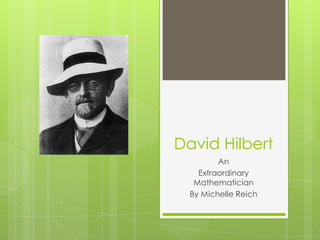
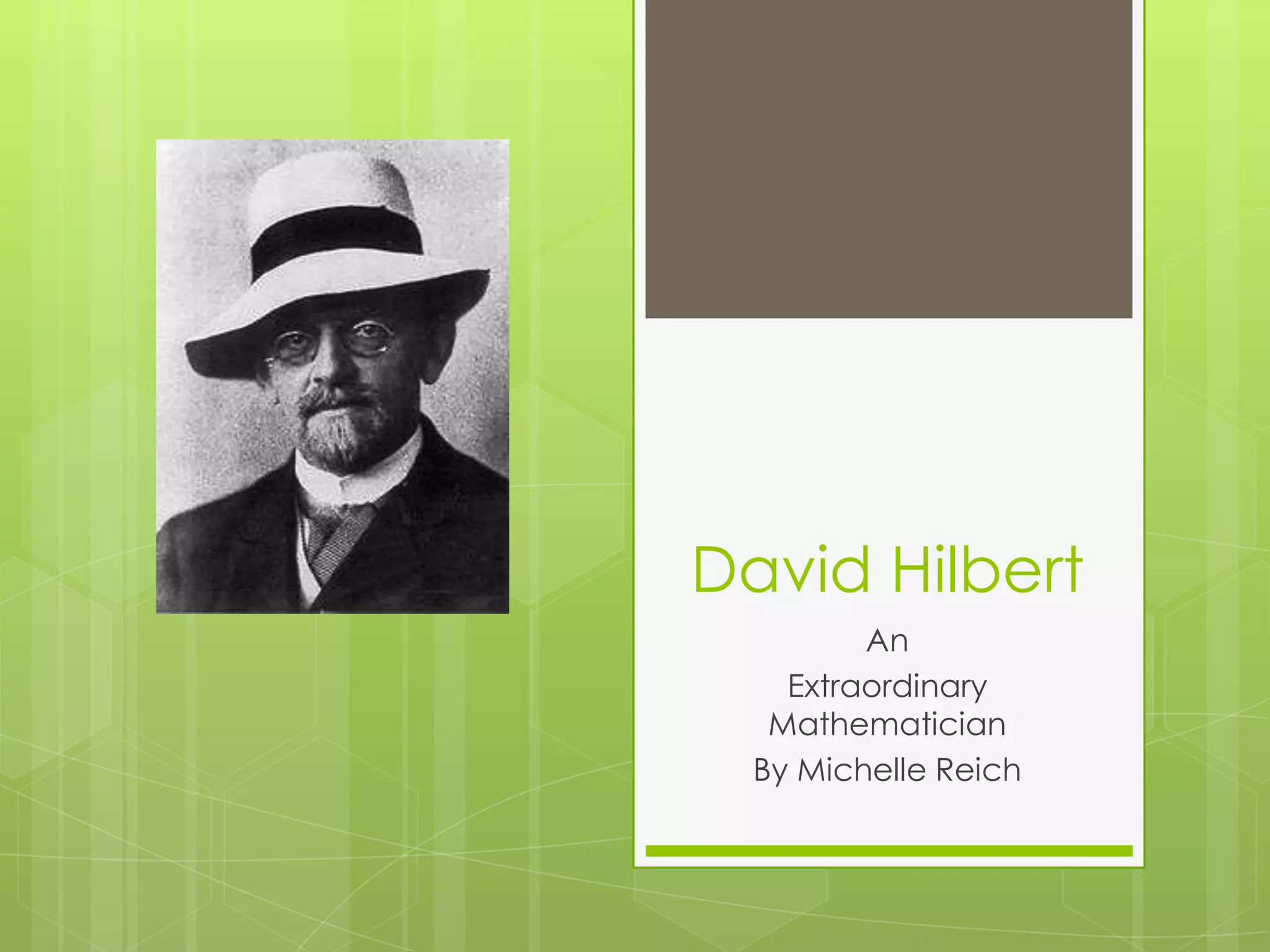
David Hilbert
An
Extraordinary
Mathematician
By Michelle Reich
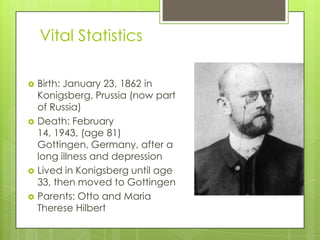
Vital Statistics
 Birth: January 23, 1862 in
Konigsberg, Prussia (now part
of Russia)
 Death: February
14, 1943, (age 81)
Gottingen, Germany, after a
long illness and depression
 Lived in Konigsberg until age
33, then moved to Gottingen
 Parents: Otto and Maria
Therese Hilbert
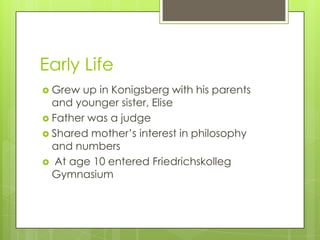
Early Life
 Grew up in Konigsberg with his parents
and younger sister, Elise
 Father was a judge
 Shared mother’s interest in philosophy
and numbers
 At age 10 entered Friedrichskolleg
Gymnasium
Adult Life
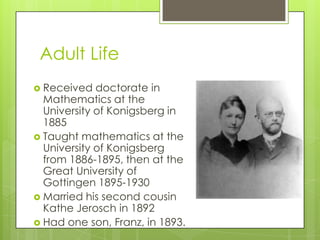
 Received doctorate in
Mathematics at the
University of Konigsberg in
1885
 Taught mathematics at the
University of Konigsberg
from 1886-1895, then at the
Great University of
Gottingen 1895-1930
 Married his second cousin
Kathe Jerosch in 1892
 Had one son, Franz, in 1893.
Credits and Achievements
 His work was an important part of
mathematics including;
geometry, logic, number theory, and
mathematical physics.
 Introduced his influential list of 23 unsolved
problems at the International Congress of
Mathematicians in Paris in 1900.
 Mathematicians are still working on
solving some of these problems to this
day. The most important one being the
Riemann hypothesis.
More Credits and
Achievements
 In 1905 was awarded the Wolfgang Bolyai
Prize. Recognized as being one of the
world’s greatest mathematicians.
 Became a member of the Royal Society
of London.
 Was made and honorary citizen of
Konigsberg in 1930
Other Subjects
 Insulted physicists when he said: “Physics is
much too difficult for physicists.”
 Wanted to “axiomatize” physics or create
laws that were accepted as truth in
physics.
 Also studied kinetic gas theory, radiation
and molecular theory of matter.
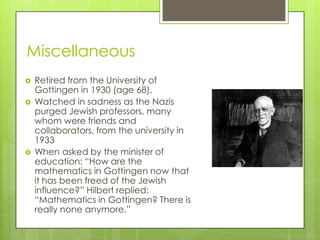
Miscellaneous
 Retired from the University of
Gottingen in 1930 (age 68).
 Watched in sadness as the Nazis
purged Jewish professors, many
whom were friends and
collaborators, from the university in
1933
 When asked by the minister of
education: “How are the
mathematics in Gottingen now that
it has been freed of the Jewish
influence?” Hilbert replied:
“Mathematics in Gottingen? There is
really none anymore.”
Timeline
 1862 Birth on January 23 in Konigsberg
 1872 Entered Friedrichskolleg Gymnasium
 1885 Received Doctorate from University
of Konigsberg. Visited Europe to meet and
learn from famous mathematicians
 1886-1895 Professor of mathematics at
University of Konigsberg
Timeline (Continued)
 1890 Developed proof of theorem of
invariants which made modern algebraic
geometry possible
 1892 Married Kathe Jarosch
 1893 Son Franz was born
 1897 Developed algebraic number theory
 1897 Moved to Gottingen to teach at the
university
Timeline (Continued)
 1900 Presented his famous paper of 23
unsolved research problems at the
International Mathematical Congress in
Paris
 1905 Received the Bolyai Prize.
Recognized as one of the world’s greatest
mathematicians
 1930 Forced to retire from teaching under
Nazi rules.
 1933 Made honorary citizen of Konigsberg
 1943 Dies in Gottingen at age 81

David hilbert presentation

  • 1.
  • 2.
    Vital Statistics  Birth:January 23, 1862 in Konigsberg, Prussia (now part of Russia)  Death: February 14, 1943, (age 81) Gottingen, Germany, after a long illness and depression  Lived in Konigsberg until age 33, then moved to Gottingen  Parents: Otto and Maria Therese Hilbert
  • 3.
    Early Life  Grewup in Konigsberg with his parents and younger sister, Elise  Father was a judge  Shared mother’s interest in philosophy and numbers  At age 10 entered Friedrichskolleg Gymnasium
  • 4.
    Adult Life  Receiveddoctorate in Mathematics at the University of Konigsberg in 1885  Taught mathematics at the University of Konigsberg from 1886-1895, then at the Great University of Gottingen 1895-1930  Married his second cousin Kathe Jerosch in 1892  Had one son, Franz, in 1893.
  • 5.
    Credits and Achievements His work was an important part of mathematics including; geometry, logic, number theory, and mathematical physics.  Introduced his influential list of 23 unsolved problems at the International Congress of Mathematicians in Paris in 1900.  Mathematicians are still working on solving some of these problems to this day. The most important one being the Riemann hypothesis.
  • 6.
    More Credits and Achievements In 1905 was awarded the Wolfgang Bolyai Prize. Recognized as being one of the world’s greatest mathematicians.  Became a member of the Royal Society of London.  Was made and honorary citizen of Konigsberg in 1930
  • 7.
    Other Subjects  Insultedphysicists when he said: “Physics is much too difficult for physicists.”  Wanted to “axiomatize” physics or create laws that were accepted as truth in physics.  Also studied kinetic gas theory, radiation and molecular theory of matter.
  • 8.
    Miscellaneous  Retired fromthe University of Gottingen in 1930 (age 68).  Watched in sadness as the Nazis purged Jewish professors, many whom were friends and collaborators, from the university in 1933  When asked by the minister of education: “How are the mathematics in Gottingen now that it has been freed of the Jewish influence?” Hilbert replied: “Mathematics in Gottingen? There is really none anymore.”
  • 9.
    Timeline  1862 Birthon January 23 in Konigsberg  1872 Entered Friedrichskolleg Gymnasium  1885 Received Doctorate from University of Konigsberg. Visited Europe to meet and learn from famous mathematicians  1886-1895 Professor of mathematics at University of Konigsberg
  • 10.
    Timeline (Continued)  1890Developed proof of theorem of invariants which made modern algebraic geometry possible  1892 Married Kathe Jarosch  1893 Son Franz was born  1897 Developed algebraic number theory  1897 Moved to Gottingen to teach at the university
  • 11.
    Timeline (Continued)  1900Presented his famous paper of 23 unsolved research problems at the International Mathematical Congress in Paris  1905 Received the Bolyai Prize. Recognized as one of the world’s greatest mathematicians  1930 Forced to retire from teaching under Nazi rules.  1933 Made honorary citizen of Konigsberg  1943 Dies in Gottingen at age 81

Editor's Notes

  • #3 David Hilbertwas born January 23, 1862 in Konigsberg, Prussia. Hilbert died on February 14, 1943, in Gottingen, Germany of after a long illness and depression. Hilbert had lived in Konigsberg until the age of 33, then moved to Gottingen. Hilbert’s parents were Otto and Maria Therese Hilbert.
  • #4 Hilbert grew up in Konigsberg with his parents, and younger sister, Elise. Hilbert’s father was a lawyer and a judge. Konigsberg was in the heart of a big trade network. The city was close to the Pregel river and the Baltic sea. The city’s citizens worked hard and led a no frills type of lifestyle rooted in the Protestant work ethic. Hilbert had also shared his mothers interest in philosophy and numbers. Hilbert had entered Friedrichskolleg Gymnasium at the age of 10.
  • #5 As an adult, Hilbert received a doctorate in mathematics at the university of Konigsberg in 1885. In 1886, Hilbert took an unpaid position as mathematics teacher at the University of Konigsberg until 1892. He then began receiving pay. Then in 1895, Hilbert went to teach at the University of Gottingen, replacing his former teacher, Heinrich Weber. Hilbert taught there until he was forced to retire in 1930. Hilbert’s brilliance, sarcastic wit and self confidence made him a popular and sought after professor. He attracted talented students from all over the world. The University of Gottingen was one of the most modern in the 19th century because of its strong philosophy department which was not dominated by religion. In 1892, Hilbert married his second cousin KatheJerosch. His wife was a very bright and independent thinker. They had one son, Franz, in 1893.
  • #6 Hilbert’s work was an important part of mathematics including; geometry, logic, number theory, and mathematical physics. Hilbert introduced his influential list of 23 unsolved problems at the international congress of mathematicians in Paris in the year 1900. Mathematicians today are still working on some of these 23 problems today, the most important problem being the Riemann hypothesis.
  • #7 In 1905 was awarded the Wolfgang Bolyai Prize for being one of the world’s greatest mathematicians. He became a member of the royal society of London. Its full name is the royal society of London for improving natural knowledge. Being a member of the society was a big deal back then. He was very happy when he was made and honorary citizen of Konigsberg in 1930. He always loved the city where he grew up.
  • #8 Hilbert insulted physicists when he said: “Physics is much to difficult fro physicists” Hilbert had wanted to “Axiomatize” physics, or create laws that were accepted as truth in physics. He had also studied kintetic gas theory, radiation, and molecular theory of matter.
  • #9 Hilbert retired from the University of Gottingen in 1930 at the age of 68. Hilbert watched as the Nazis purged Jewish professors, many whom were friends and collaborators from the university in 1933. When Hilbert was asked by the minister of education “How are the mathematics in Gottingen now that it has been freed of Jewish influence?” Hilbert replied: “Mathematics in Gottingen? There is really none anymore.”