NĀ PAPANI: Pronouns HAW 101
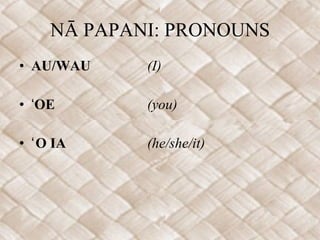
NĀ PAPANI: PRONOUNS AU/WAU (I)   ʻ OE (you) ʻO IA  (he/she/it)
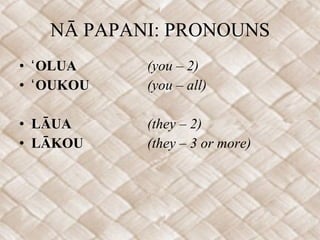
NĀ PAPANI: PRONOUNS ʻOLUA (you – 2)  ʻOUKOU (you – all) LĀUA (they – 2) LĀKOU (they – 3 or more)
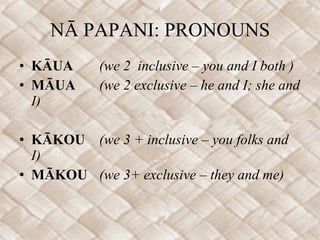
NĀ PAPANI: PRONOUNS KĀUA (we 2  inclusive – you and I both ) MĀUA (we 2 exclusive – he and I; she and I) KĀKOU  (we 3 + inclusive – you folks and I) MĀKOU (we 3+ exclusive – they and me)
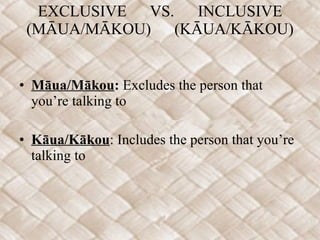
EXCLUSIVE VS.  INCLUSIVE (MĀUA/MĀKOU)  (KĀUA/KĀKOU) Māua/Mākou :  Excludes the person that you’re talking to Kāua/Kākou : Includes the person that you’re talking to
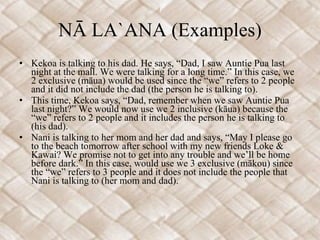
NĀ LA`ANA (Examples) Kekoa is talking to his dad. He says, “Dad, I saw Auntie Pua last night at the mall. We were talking for a long time.” In this case, we 2 exclusive (māua) would be used since the “we” refers to 2 people and it did not include the dad (the person he is talking to). This time, Kekoa says, “Dad, remember when we saw Auntie Pua last night?” We would now use we 2 inclusive (kāua) because the “we” refers to 2 people and it includes the person he is talking to (his dad). Nani is talking to her mom and her dad and says, “May I please go to the beach tomorrow after school with my new friends Loke & Kawai? We promise not to get into any trouble and we’ll be home before dark.” In this case, would use we 3 exclusive (mākou) since the “we” refers to 3 people and it does not include the people that Nani is talking to (her mom and dad).
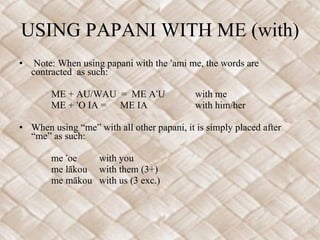
USING PAPANI WITH ME (with)   Note: When using papani with the ʻami me, the words are contracted  as such:   ME + AU/WAU  =  ME AʻU with me ME + ʻO IA =    ME IA with him/her   When using “me” with all other papani, it is simply placed after “me” as such:   me ʻoe  with you me lākou with them (3+) me mākou with us (3 exc.)
 

Papani

  • 1.
  • 2.
    NĀ PAPANI: PRONOUNSAU/WAU (I)   ʻ OE (you) ʻO IA (he/she/it)
  • 3.
    NĀ PAPANI: PRONOUNSʻOLUA (you – 2) ʻOUKOU (you – all) LĀUA (they – 2) LĀKOU (they – 3 or more)
  • 4.
    NĀ PAPANI: PRONOUNSKĀUA (we 2 inclusive – you and I both ) MĀUA (we 2 exclusive – he and I; she and I) KĀKOU (we 3 + inclusive – you folks and I) MĀKOU (we 3+ exclusive – they and me)
  • 5.
    EXCLUSIVE VS. INCLUSIVE (MĀUA/MĀKOU) (KĀUA/KĀKOU) Māua/Mākou : Excludes the person that you’re talking to Kāua/Kākou : Includes the person that you’re talking to
  • 6.
    NĀ LA`ANA (Examples)Kekoa is talking to his dad. He says, “Dad, I saw Auntie Pua last night at the mall. We were talking for a long time.” In this case, we 2 exclusive (māua) would be used since the “we” refers to 2 people and it did not include the dad (the person he is talking to). This time, Kekoa says, “Dad, remember when we saw Auntie Pua last night?” We would now use we 2 inclusive (kāua) because the “we” refers to 2 people and it includes the person he is talking to (his dad). Nani is talking to her mom and her dad and says, “May I please go to the beach tomorrow after school with my new friends Loke & Kawai? We promise not to get into any trouble and we’ll be home before dark.” In this case, would use we 3 exclusive (mākou) since the “we” refers to 3 people and it does not include the people that Nani is talking to (her mom and dad).
  • 7.
    USING PAPANI WITHME (with)   Note: When using papani with the ʻami me, the words are contracted as such:   ME + AU/WAU = ME AʻU with me ME + ʻO IA = ME IA with him/her   When using “me” with all other papani, it is simply placed after “me” as such:   me ʻoe with you me lākou with them (3+) me mākou with us (3 exc.)
  • 8.