
















Reflect, Repurpose,
  Restructure, Re-energize
Or... Everything I know I learned from marching band and McDonald’s


                  Rachel Reuben, MBA
             @rachelreuben   rachelreuben.com
* disclaimers
Quick Background

Auto Dealership Catch All      Marketing Assistant x2

Web Editor         Web Coordinator

Director of Web Communication & Strategic Projects

Associate Vice President for Marketing Communications

B.S. Organizational Communication & Marketing

MBA, Marketing and Management
Everything I needed to know I
learned from marching band and
           McDonald’s.
On Being A Drum Major
• leadership

• playing   off the same page

• playing   to the same tune (message consistency, brand identity)

• team   work

• passion

• dedication

• always    something new to learn
Reflection
Where We Came From


• ~mid    90s: webmaster (“web mistress”)

• early   2000s moved to coordinators & editors

• mid 2000s: web teams growing, shifts begin to include web
 earlier in planning, emergence of Web 2.0
Where We Came From

• late   2000s

  • social   media

  • IA   focus to manage rapid growth & Google dumps

  • Flip
       cams (RIP), Kodak Zi6s, YouTube - made
    “unprofessional” videos “cool” & accessible
Where We Came From


• late   2000s (cont.)

  • need     for quality, yet authentic videos re-emerges

  • social   media emergence (a home page callout? Gasp!)

  •   strategies, policies, guidelines
Repurpose
Repurpose
• Local   journalists being regionalized or laid off

  • access   to talented writers, reporters, storytellers

• Librarians   often overlooked

  • categorization, information    architecture

• Content    Strategists

  • “new” hotness  -- marketing strategists with journalism and
   copywriting skills
Repurpose

• Media relations staff, crisis communicators, student affairs
 professionals need be social media savvy

 • similar   skills, new tools

• Web   coordinators

 • depending     on specialization
Skills For Tomorrow’s Web &
Marketing Professionals In Higher Ed
                   in addition to web speciality(ies)

• Customer      service

• Patience

• Diplomacy

• Political   savviness

• Common        sense
Skills For Tomorrow’s Web &
Marketing Professionals In Higher Ed
                 in addition to web speciality(ies)

• knowing    when to pull in experts vs. DIY (& politics)

• set   realistic, unemotional expectations

• persistence

• intergenerational   workplace

  • new Young     Guns
Skills For Tomorrow’s Web &
Marketing Professionals In Higher Ed
                in addition to web speciality(ies)


• Community    managers/wranglers

 • making strategic decisions based on goals & audience, not
   the O.S.S.

• Data   crunchers, trend analyzers
Skills For Tomorrow’s Web &
Marketing Professionals In Higher Ed

• know    your speciality and branch out, find ways to stay current

 • blog

 • side   work

 • read

 • professional   development

 • network
Restructure
GASP!
KILL THE ORG CHART
 Long live cross-functional project teams
MANTRA:
I AM A CHANGE AGENT.
         Change is my middle name.
               Change is good.
         Change is forward-thinking.
    Change is building a solid foundation.
 Change is adapting to current & future needs.
              Change is needed.
               Change is good.
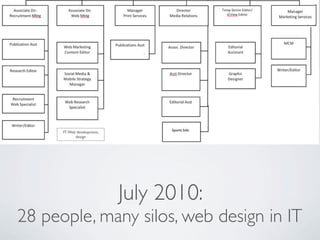
IT: Web development,
             design


                             July 2010:
28 people, many silos, web design in IT
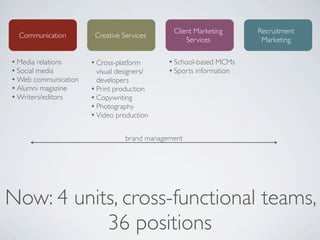
Client Marketing   Recruitment
    Communication         Creative Services
                                                        Services        Marketing

✦ Media relations     ✦ Cross-platform          ✦ School-based MCMs
✦ Social media          visual designers/       ✦ Sports information

✦ Web communication     developers
✦ Alumni magazine     ✦ Print production
✦ Writers/editors     ✦ Copywriting

                      ✦ Photography

                      ✦ Video production


                                    brand management


Now: 4 units, cross-functional teams,
           36 positions
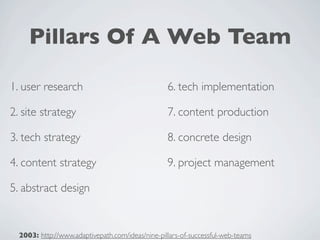
Pillars Of A Web Team

1. user research                                  6. tech implementation

2. site strategy                                  7. content production

3. tech strategy                                  8. concrete design

4. content strategy                               9. project management

5. abstract design


  2003: http://www.adaptivepath.com/ideas/nine-pillars-of-successful-web-teams
Challenges
Challenges (sampling)

• Which     tools? (What’s your strategy? Who is your audience?)

• CMS: Many      vendors/options, no one-size fits all

• Digital   repositories

• OSS

• Resources     (budget + human)
Challenges (sampling)


• Decisions   grounded in research knowledge

• Brand   protection (trademark, licensing, etc.)

• Time
Hot topics
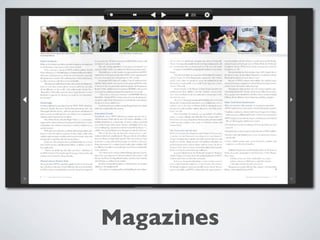
Magazines
Magazines
• To   flip or not to flip (issuu.com, etc.)

 • Hint: Stop     flipping for primary online purpose/access!

 • Think    first: goals & audience

 • Not     mobile friendly (especially iOS devices)

 • Not     508 compliant (accessible)

 • Print   experience doesn’t translate to web environment

 • Not     deeply searchable, not good for SEO

 • “But    I don’t have the resources to build a site...”
Magazines

Read this: http://tinyurl.com/stopflipping


And this: http://tinyurl.com/stopflipping2
Magazines

• PDFs

• iPad   app

• Web    exclusive content referenced from print

• Web    exclusive content between issues

• Community
Magazines

• What   do you do?

• What would you recommend with your existing resources
 that matches your publication’s goal(s)? Do you have a case for
 more resources?
Who Should Manage
  Social Media
Who Should Manage
         Social Media?
• What’s   it like on your campus?

 •1   person?

 • Central   office?

 • Wild Wild West     Show?

 • Team?
Who Should Manage
        Social Media?
• Managing  social media is a team sport
 http://tinyurl.com/smteamsport

• Mid/Late   1990s redux

• Questions/Factors

 • size   of institution & culture

 • size   of team

 • strategic   communication plan
Who Should Manage
  Social Media?
Who Should Manage
        Social Media?
• Ditch   the organizational chart. Build a team.
Who Should Manage
         Social Media?
• Ditch   the organizational chart. Build a team.

• Listen, assess, evolve
Who Should Manage
          Social Media?
• Ditch   the organizational chart. Build a team.

• Listen, assess, evolve

• Not   everything and everyone needs to use social media

  • website   is foundation, sm is about community & engagement
Who Should Manage
          Social Media?
• Ditch   the organizational chart. Build a team.

• Listen, assess, evolve

• Not   everything and everyone needs to use social media

  • website   is foundation, sm is about community & engagement

• Students   are good

  • recent   grads are better :)
Re-energize
Re-energize

• Find   your niche

• Find   opportunities (low hanging fruit)

• Be   helpful

• Stay   up-to-date

• Network     within and outside our industry
Find Zen
• High   demands on our time

• Things   suggested to me:

  • wine

  • breathing

  • positive   mantra

  • meditation

  • mental   health days (spas work too)
Re-energize
 What works best for me?
Re-energize
 What works best for me?
Re-energize
 What works best for me?
Re-energize
 What works best for me?
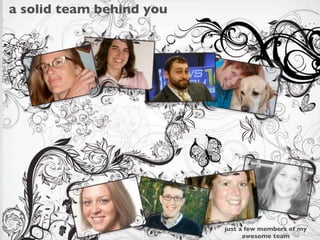
a solid team behind you


                          just a few members of my
                                awesome team
YMMV
Rachel Reuben
       @rachelreuben
      rachelreuben.com
linkedin.com/in/rachelreuben

HighEdWeb Rochester Regional Keynote

  • 1.
    Reflect, Repurpose, Restructure, Re-energize Or... Everything I know I learned from marching band and McDonald’s Rachel Reuben, MBA @rachelreuben rachelreuben.com
  • 2.
  • 3.
    Quick Background Auto DealershipCatch All Marketing Assistant x2 Web Editor Web Coordinator Director of Web Communication & Strategic Projects Associate Vice President for Marketing Communications B.S. Organizational Communication & Marketing MBA, Marketing and Management
  • 5.
    Everything I neededto know I learned from marching band and McDonald’s.
  • 7.
    On Being ADrum Major • leadership • playing off the same page • playing to the same tune (message consistency, brand identity) • team work • passion • dedication • always something new to learn
  • 9.
  • 10.
    Where We CameFrom • ~mid 90s: webmaster (“web mistress”) • early 2000s moved to coordinators & editors • mid 2000s: web teams growing, shifts begin to include web earlier in planning, emergence of Web 2.0
  • 11.
    Where We CameFrom • late 2000s • social media • IA focus to manage rapid growth & Google dumps • Flip cams (RIP), Kodak Zi6s, YouTube - made “unprofessional” videos “cool” & accessible
  • 12.
    Where We CameFrom • late 2000s (cont.) • need for quality, yet authentic videos re-emerges • social media emergence (a home page callout? Gasp!) • strategies, policies, guidelines
  • 13.
  • 14.
    Repurpose • Local journalists being regionalized or laid off • access to talented writers, reporters, storytellers • Librarians often overlooked • categorization, information architecture • Content Strategists • “new” hotness -- marketing strategists with journalism and copywriting skills
  • 15.
    Repurpose • Media relationsstaff, crisis communicators, student affairs professionals need be social media savvy • similar skills, new tools • Web coordinators • depending on specialization
  • 16.
    Skills For Tomorrow’sWeb & Marketing Professionals In Higher Ed in addition to web speciality(ies) • Customer service • Patience • Diplomacy • Political savviness • Common sense
  • 17.
    Skills For Tomorrow’sWeb & Marketing Professionals In Higher Ed in addition to web speciality(ies) • knowing when to pull in experts vs. DIY (& politics) • set realistic, unemotional expectations • persistence • intergenerational workplace • new Young Guns
  • 18.
    Skills For Tomorrow’sWeb & Marketing Professionals In Higher Ed in addition to web speciality(ies) • Community managers/wranglers • making strategic decisions based on goals & audience, not the O.S.S. • Data crunchers, trend analyzers
  • 19.
    Skills For Tomorrow’sWeb & Marketing Professionals In Higher Ed • know your speciality and branch out, find ways to stay current • blog • side work • read • professional development • network
  • 20.
  • 21.
  • 22.
    KILL THE ORGCHART Long live cross-functional project teams
  • 23.
    MANTRA: I AM ACHANGE AGENT. Change is my middle name. Change is good. Change is forward-thinking. Change is building a solid foundation. Change is adapting to current & future needs. Change is needed. Change is good.
  • 24.
    IT: Web development, design July 2010: 28 people, many silos, web design in IT
  • 25.
    Client Marketing Recruitment Communication Creative Services Services Marketing ✦ Media relations ✦ Cross-platform ✦ School-based MCMs ✦ Social media visual designers/ ✦ Sports information ✦ Web communication developers ✦ Alumni magazine ✦ Print production ✦ Writers/editors ✦ Copywriting ✦ Photography ✦ Video production brand management Now: 4 units, cross-functional teams, 36 positions
  • 26.
    Pillars Of AWeb Team 1. user research 6. tech implementation 2. site strategy 7. content production 3. tech strategy 8. concrete design 4. content strategy 9. project management 5. abstract design 2003: http://www.adaptivepath.com/ideas/nine-pillars-of-successful-web-teams
  • 27.
  • 28.
    Challenges (sampling) • Which tools? (What’s your strategy? Who is your audience?) • CMS: Many vendors/options, no one-size fits all • Digital repositories • OSS • Resources (budget + human)
  • 29.
    Challenges (sampling) • Decisions grounded in research knowledge • Brand protection (trademark, licensing, etc.) • Time
  • 30.
  • 31.
  • 32.
    Magazines • To flip or not to flip (issuu.com, etc.) • Hint: Stop flipping for primary online purpose/access! • Think first: goals & audience • Not mobile friendly (especially iOS devices) • Not 508 compliant (accessible) • Print experience doesn’t translate to web environment • Not deeply searchable, not good for SEO • “But I don’t have the resources to build a site...”
  • 33.
    Magazines Read this: http://tinyurl.com/stopflipping Andthis: http://tinyurl.com/stopflipping2
  • 34.
    Magazines • PDFs • iPad app • Web exclusive content referenced from print • Web exclusive content between issues • Community
  • 35.
    Magazines • What do you do? • What would you recommend with your existing resources that matches your publication’s goal(s)? Do you have a case for more resources?
  • 36.
    Who Should Manage Social Media
  • 37.
    Who Should Manage Social Media? • What’s it like on your campus? •1 person? • Central office? • Wild Wild West Show? • Team?
  • 38.
    Who Should Manage Social Media? • Managing social media is a team sport http://tinyurl.com/smteamsport • Mid/Late 1990s redux • Questions/Factors • size of institution & culture • size of team • strategic communication plan
  • 39.
    Who Should Manage Social Media?
  • 40.
    Who Should Manage Social Media? • Ditch the organizational chart. Build a team.
  • 41.
    Who Should Manage Social Media? • Ditch the organizational chart. Build a team. • Listen, assess, evolve
  • 42.
    Who Should Manage Social Media? • Ditch the organizational chart. Build a team. • Listen, assess, evolve • Not everything and everyone needs to use social media • website is foundation, sm is about community & engagement
  • 43.
    Who Should Manage Social Media? • Ditch the organizational chart. Build a team. • Listen, assess, evolve • Not everything and everyone needs to use social media • website is foundation, sm is about community & engagement • Students are good • recent grads are better :)
  • 44.
  • 45.
    Re-energize • Find your niche • Find opportunities (low hanging fruit) • Be helpful • Stay up-to-date • Network within and outside our industry
  • 46.
    Find Zen • High demands on our time • Things suggested to me: • wine • breathing • positive mantra • meditation • mental health days (spas work too)
  • 47.
  • 48.
  • 49.
  • 50.
  • 51.
    a solid teambehind you just a few members of my awesome team
  • 52.
  • 54.
    Rachel Reuben @rachelreuben rachelreuben.com linkedin.com/in/rachelreuben

Editor's Notes

  • #2 \n
  • #3 - this is my first keynote speech\n- this is my first conference presentation in 15 months (did 20 in year prior)\n- I spent 14 years in various capacities at SUNY New Paltz\n- I’ve been at IC for the past year with a far broader scope, far larger team, and far greater resources\n- I know we have mixes of people here today, and things I say, suggest or have implemented may not work for you and your shop. This is not a one-size fits all presentation.\n
  • #4 - Auto: file, MV clerk, accounting clerk, cashier, asst. finance manager, built company’s first website in 1994 because I was the only one that knew how to turn on a PC\n- Marketing Asst. for manufacturing company - designed ads and trade show displays\n- Marketing Asst. for Campus Auxiliary Services - designed their first website\n- Web Editor: repurpose print publications for college’s first substantial website (inherited at 12 pages)\n- Web Coordinator: continue repurposing print pubs for web, but coordinate web efforts with departments college-wide\n- Dir. Web Comm & SP: led Creative Services team, instrumental in re-branding initiative, founded & managed Welcome Center, built & ran Distinguished Speaker Series, led social media efforts, etc.\n- AVP: Now lead 4 primary units & 35 staff in Client Marketing Services, Communication, Creative Services, & Recruitment Marketing\n
  • #5 \n
  • #6 - In high school I was a drum major my junior year and head drum major my senior year. It’s where I feel I learned my best leadership skills, learned how to conduct a band - getting everyone in sync together on the same page.\n
  • #7 Analogy\n
  • #8 Crew team leader: 2 key skills -- training and customer service\n\nSocial media, media relations, recruitment, marketing -- it’s all built on the foundation of excellent customer service.\n\nWelcome Center @NP built on McD’s customer service foundational training.\n
  • #9 \n
  • #10 Mid 90s: one person shop doing coding, server management, design, pulling content from pubs, IA, polling server logs for hits; worried about dial-up modem connection speeds\n\nEarly 2000s: writers started writing for the web (repurposing print), web still afterthought\nmore specialized positions emerge\n
  • #11 \n
  • #12 BlueFuego says: nearly complete saturation of HPCO’s compared to ~9% two years ago.\n
  • #13 \n
  • #14 visionaries - there’s a lot of copying going on in higher ed. Find balance between re-inventing the wheel and being a visionary. \n
  • #15 Specialization: content strategy, info architecture, technical architect, visual designer/developer, web marketing (SEO), analytics (watch trends to inform decisions, make recommendations)\n
  • #16 \n
  • #17 Young Guns: today’s newest web professionals are the first to grow up with the web, especially the social web, perhaps have bolder intuitions and guts for tackling new challenges.\n
  • #18 O.S.S. = Oooh shiny syndrome. Why use tumblr? Why use posterous? Should we engage in Foursquare? WIIFM (us+them)?\n\nData becomes even more critical as we deal with ramifications from the Federal government’s Net Price Calculator, commoditization of higher education, fewer college-bound aged students, larger discount rates\n
  • #19 \n
  • #20 \n
  • #21 \n
  • #22 \n
  • #23 \n
  • #24 \n
  • #25 units, project teams, standing committees/workgroups\nbetter partnerships and relationships with deans, helpful with branding initiative buy-in\n
  • #26 team members can have multiple competencies\n
  • #27 \n
  • #28 DR: content leads, content, content uses, assets, project management\nOSS: so many new tools with such frequency, which are worth it, which will stick around, which will further our strategic goals\n\n
  • #29 Time: need time for strategic planning - hard to find & shooting from the hip becomes too often accepted\n\nDecisions: Need to be able to make data-driven decisions from web analytics, cost, resources, market research\n
  • #30 \n
  • #31 \n
  • #32 Easy way out for you does not think about the user\n
  • #33 \n
  • #34 \n
  • #35 \n
  • #36 \n
  • #37 \n
  • #38 Redux: The current debate is reminiscent of the late 1990s, when higher education communications and marketing professionals were having conversations about who should be responsible for an institution’s website. Then, as now, people were calling for policies, guidelines, and rules. We’re in the same boat all over again. Facebook and other social networking sites were so easy to set up and launch that before we knew it, most colleges and universities already had a presence—official or not. While institutions’ use of social media has matured, we’re still working out how to best use our current social media platforms. And now we have to begin thinking about how to incorporate the various location-based social networks into the mix.\n\n
  • #39 Team: Alumni affairs, admissions, student affairs, marcom \n\n
  • #40 Team: Alumni affairs, admissions, student affairs, marcom \n\n
  • #41 Team: Alumni affairs, admissions, student affairs, marcom \n\n
  • #42 Team: Alumni affairs, admissions, student affairs, marcom \n\n
  • #43 \n
  • #44 \n
  • #45 \n
  • #46 \n
  • #47 \n
  • #48 \n
  • #49 \n
  • #50 \n
  • #51 \n
  • #52 \n
  • #53 \n