Topics
High Voltage Direct current (HVDC)
presented by
Anand Kishore Azad
M.Tech,Power system and Automation
Dept. of EECE, GITAM
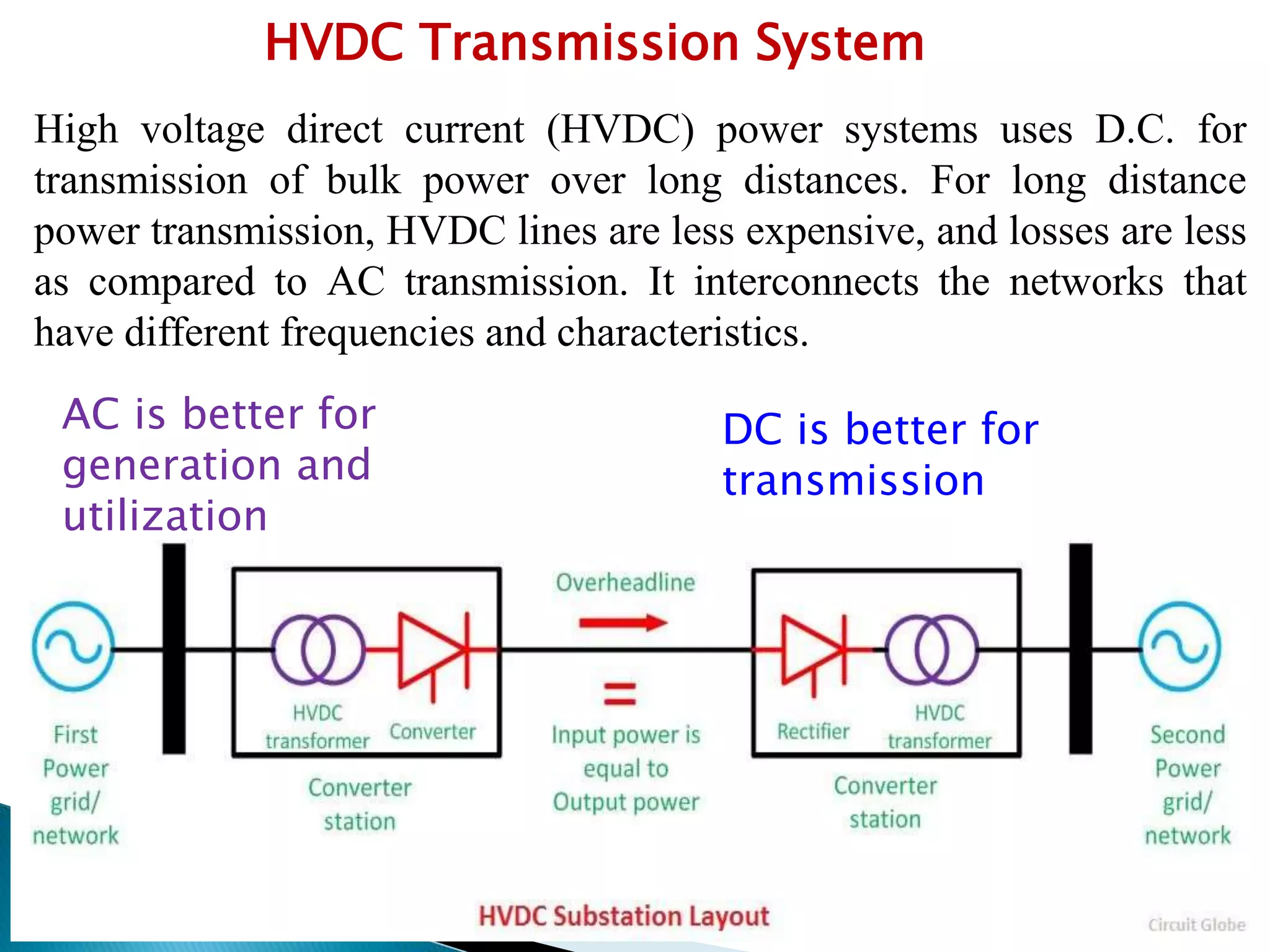
High voltage direct current (HVDC) power systems uses D.C. for
transmission of bulk power over long distances. For long distance
power transmission, HVDC lines are less expensive, and losses are less
as compared to AC transmission. It interconnects the networks that
have different frequencies and characteristics.
HVDC Transmission System
AC is better for
generation and
utilization
DC is better for
transmission
Classification of HVDC transmission
system
The classification of HVDC systems depends upon the
arrangement of the pole and the earth return.
They are as follows:
(i) Monopolar link
(ii) Bipolar link
(iii) Homopolar link
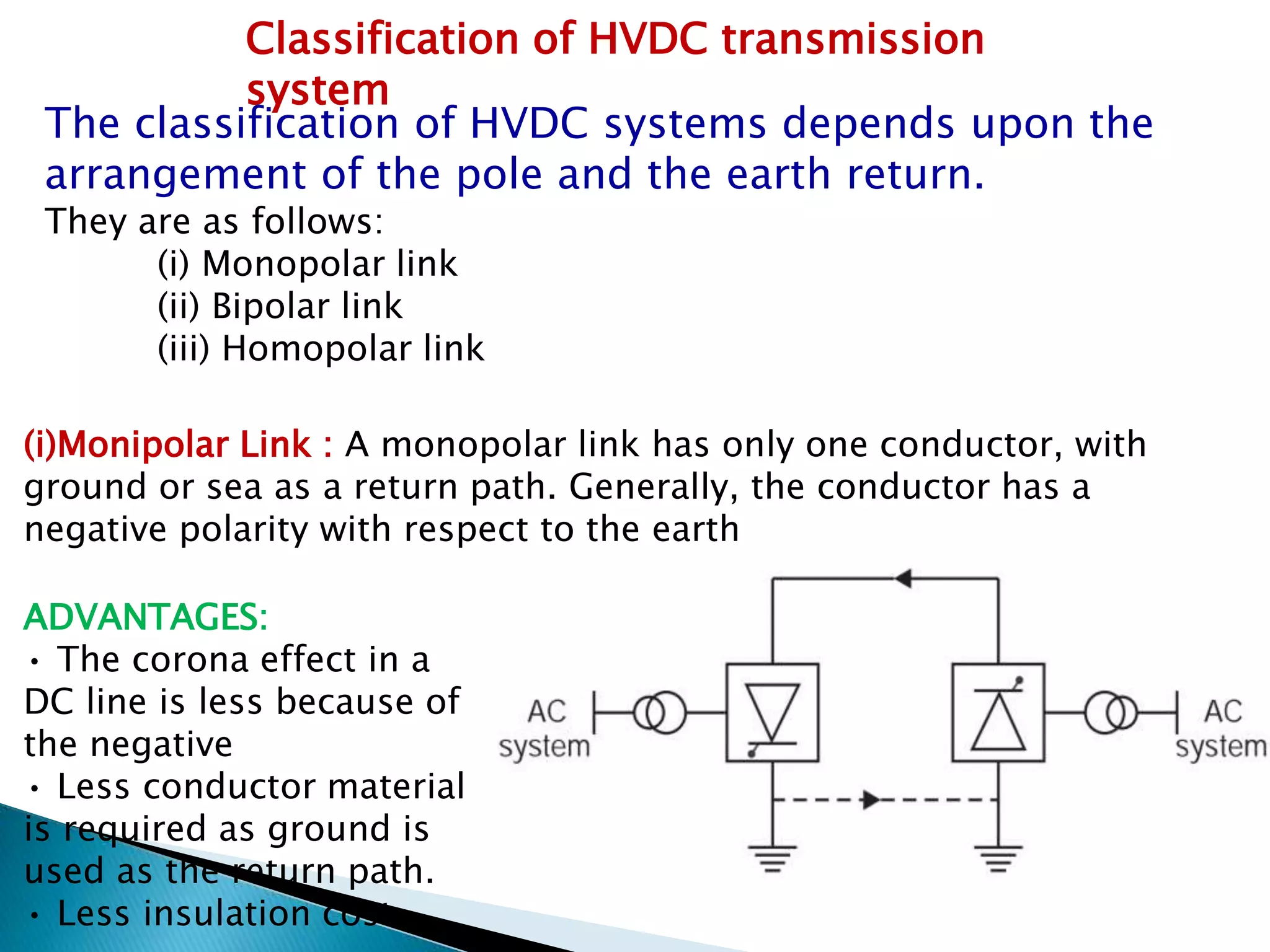
(i)Monipolar Link : A monopolar link has only one conductor, with
ground or sea as a return path. Generally, the conductor has a
negative polarity with respect to the earth
ADVANTAGES:
• The corona effect in a
DC line is less because of
the negative
• Less conductor material
is required as ground is
used as the return path.
• Less insulation cost.
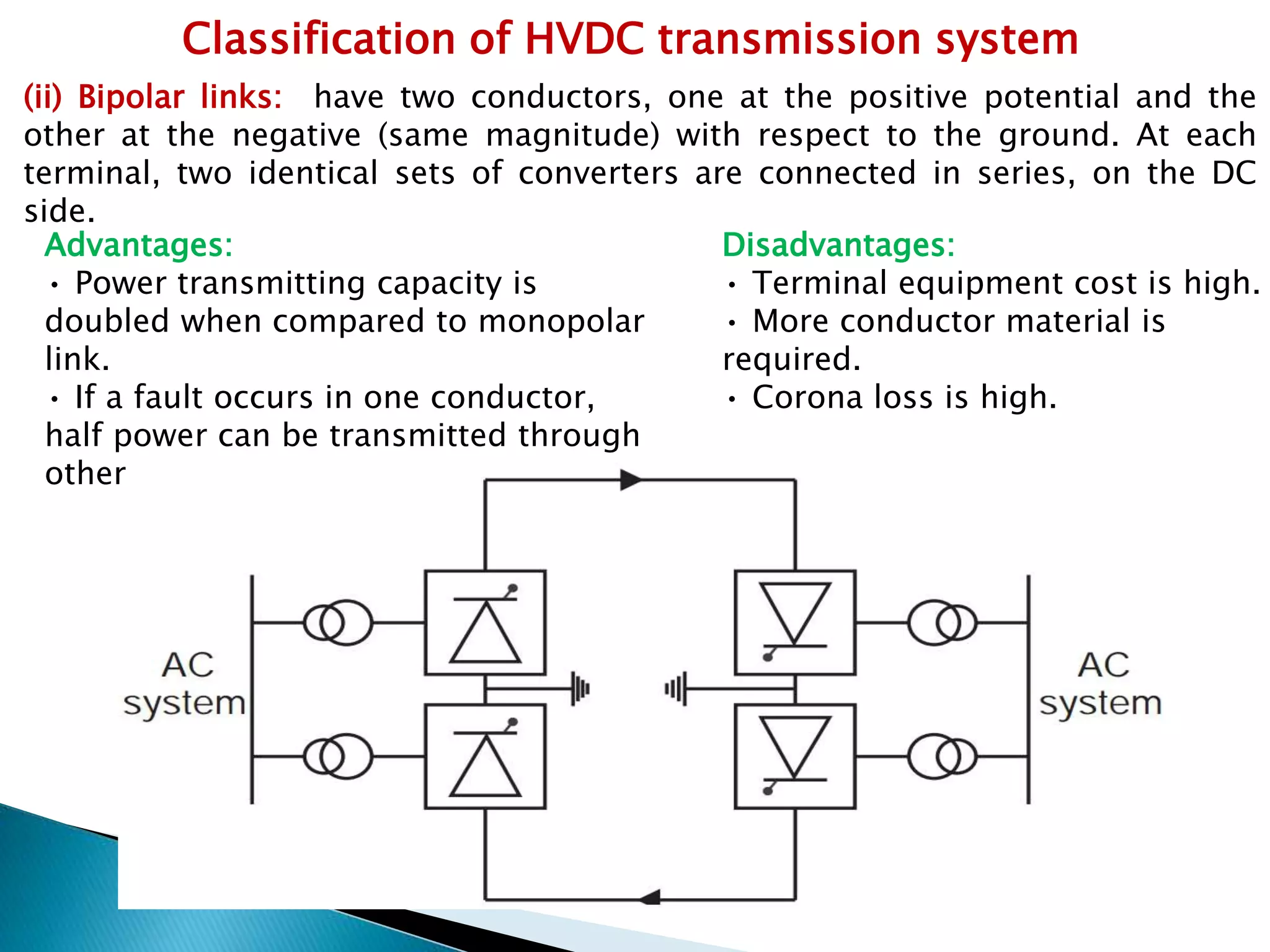
(ii) Bipolar links: have two conductors, one at the positive potential and the
other at the negative (same magnitude) with respect to the ground. At each
terminal, two identical sets of converters are connected in series, on the DC
side.
Advantages:
• Power transmitting capacity is
doubled when compared to monopolar
link.
• If a fault occurs in one conductor,
half power can be transmitted through
other
Disadvantages:
• Terminal equipment cost is high.
• More conductor material is
required.
• Corona loss is high.
Classification of HVDC transmission system
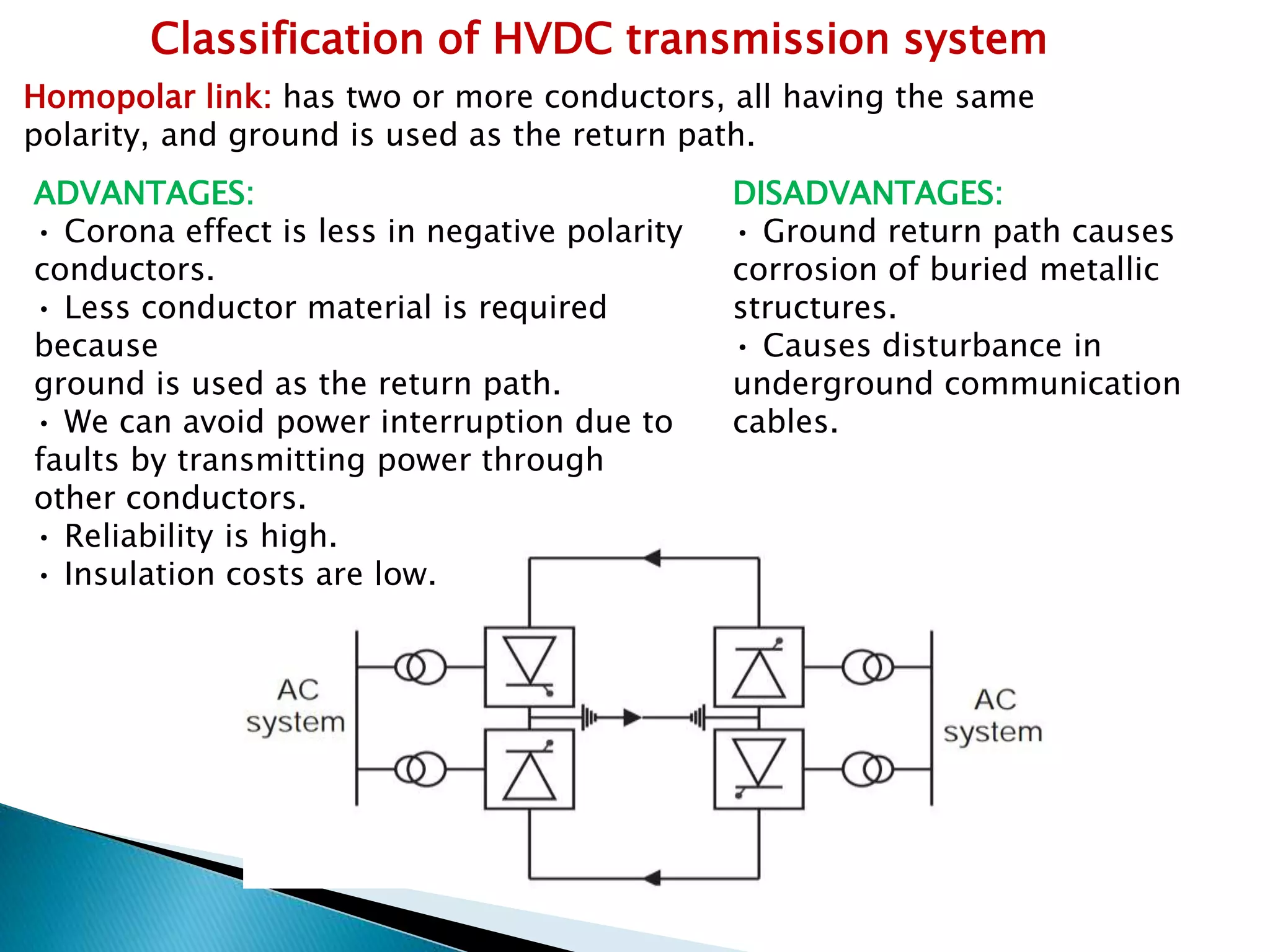
Homopolar link: has two or more conductors, all having the same
polarity, and ground is used as the return path.
ADVANTAGES:
• Corona effect is less in negative polarity
conductors.
• Less conductor material is required
because
ground is used as the return path.
• We can avoid power interruption due to
faults by transmitting power through
other conductors.
• Reliability is high.
• Insulation costs are low.
DISADVANTAGES:
• Ground return path causes
corrosion of buried metallic
structures.
• Causes disturbance in
underground communication
cables.
Classification of HVDC transmission system
1. Interconnection:
AC interconnection: Two AC systems are connected by
an AC link. Frequency of these two system should be very close. It
is also known as synchronous tie
Disadvantages of AC interconnection:
 Frequency disturbance in one system is transferred to
other system
 Power swing in one system may affect the other system.
Major fault in one system may lead to the complete
failure of the system.
Between AC and DC transmission which one will we
use?
We will decide based on:
(i) Technical Performance and
(ii) Economic consideration
Technical Performance
 Increase in fault level.
Advantages of DC interconnection:
A DC interconnection provides loose tie between two AC system.
 Can interconnect two AC system of different frequency.
 Fast and reliable control of magnitude and direction of
power flow by controlling firing angle.
02. Stability limit: In AC system
 Reactance of the line increases with the
length of the line
 It leads the reactive power drop
 So reactive power to be injected at regular
interval to stabilize the AC system
But DC system is free of this limitation due to
absence of reactance. Thus power transfer capability
is unaffected by the distance.
Economic Comparison
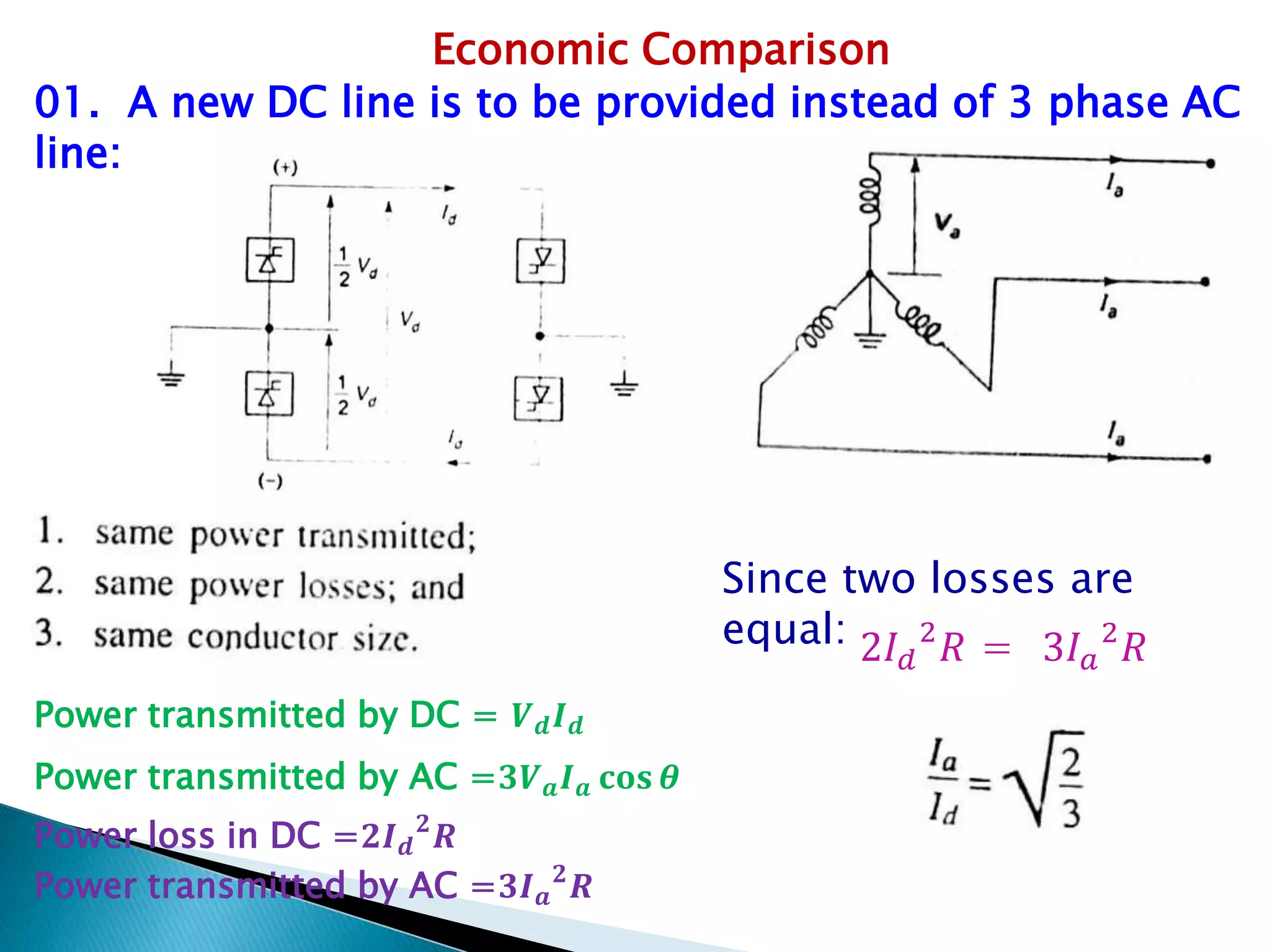
01. A new DC line is to be provided instead of 3 phase AC
line:
Power transmitted by DC = 𝑽 𝒅 𝑰 𝒅
Power transmitted by AC =𝟑𝑽 𝒂 𝑰 𝒂 𝐜𝐨𝐬 𝜽
Power loss in DC =𝟐𝑰 𝒅
𝟐
𝑹
Power transmitted by AC =𝟑𝑰 𝒂
𝟐
𝑹
Since two losses are
equal: 2𝐼 𝑑
2
𝑅 = 3𝐼 𝑎
2
𝑅
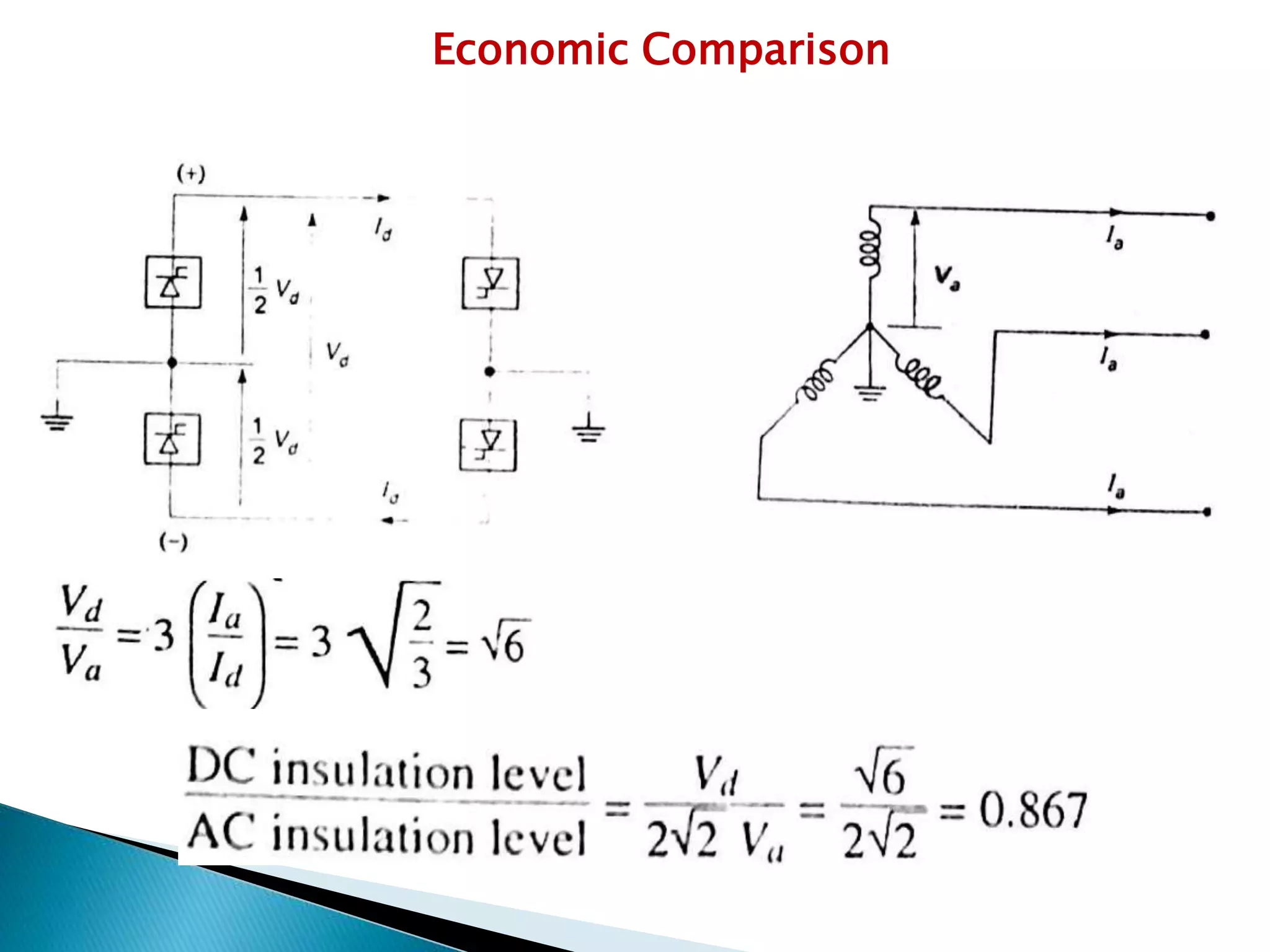
For same power to be transmitted
on both side
Economic Comparison
Economic Comparison
02. Converting a three phase double circuit line to a
three circuit DC line
Power transfer in 3 phase double circuit AC
line =
Power transfer in 3 circuit DC line =
Economic Comparison
Economic Comparison
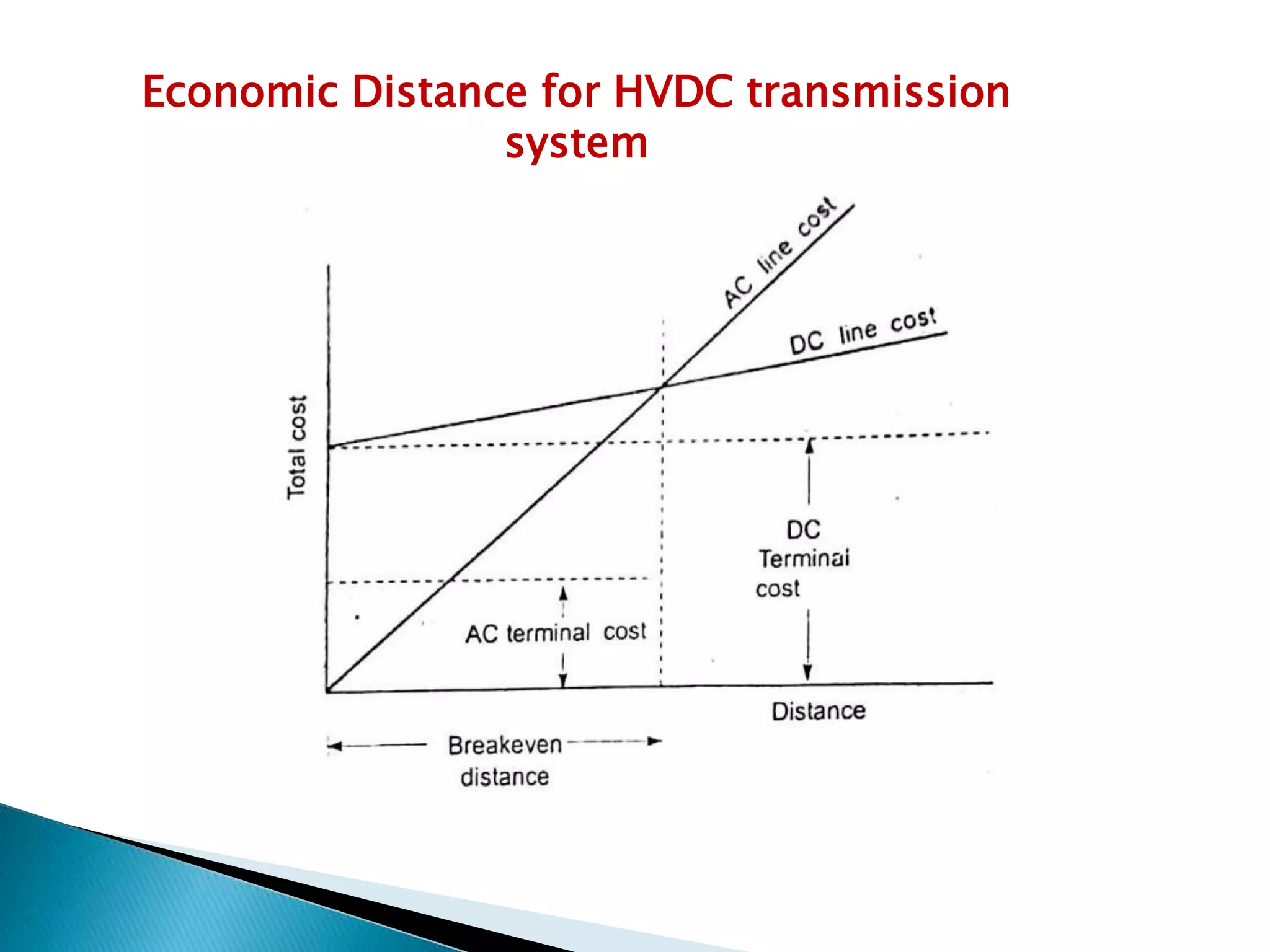
Economic Distance for HVDC transmission
system
Advantages of HVDC transmission system:
1. Lesser no. of conductor and insulator and therefore reduced conductor
and insulator costs.
2. lesser phase to phase clearance and lesser phase to ground clearance.
3. Lighter and cheaper towers.
4. Lesser corona loss and reduced radio and television interference.
5. The Power Loss also reduced with DC.
6. Earth return can be used in HVDC Transmission. If some Fault occurs in
the pole in an HVDC Bipolar line, then the other pole with earth used as
independent connection and continuous to supply power.
7. There is no stability problems in HVDC Line.
8. There is no skin effect. Due to Absence of frequency factor.
9. Higher Dielectric Stresses are permissible in HVDC cables due to lesser
Temperature Rise.
10. The power Flow through a DC link can be controlled Rapidly and
accurately under Steady-state and as well as transient condition.

High voltage direct current (hvdc)

  • 1.
    Topics High Voltage Directcurrent (HVDC) presented by Anand Kishore Azad M.Tech,Power system and Automation Dept. of EECE, GITAM
  • 2.
    High voltage directcurrent (HVDC) power systems uses D.C. for transmission of bulk power over long distances. For long distance power transmission, HVDC lines are less expensive, and losses are less as compared to AC transmission. It interconnects the networks that have different frequencies and characteristics. HVDC Transmission System AC is better for generation and utilization DC is better for transmission
  • 3.
    Classification of HVDCtransmission system The classification of HVDC systems depends upon the arrangement of the pole and the earth return. They are as follows: (i) Monopolar link (ii) Bipolar link (iii) Homopolar link (i)Monipolar Link : A monopolar link has only one conductor, with ground or sea as a return path. Generally, the conductor has a negative polarity with respect to the earth ADVANTAGES: • The corona effect in a DC line is less because of the negative • Less conductor material is required as ground is used as the return path. • Less insulation cost.
  • 4.
    (ii) Bipolar links:have two conductors, one at the positive potential and the other at the negative (same magnitude) with respect to the ground. At each terminal, two identical sets of converters are connected in series, on the DC side. Advantages: • Power transmitting capacity is doubled when compared to monopolar link. • If a fault occurs in one conductor, half power can be transmitted through other Disadvantages: • Terminal equipment cost is high. • More conductor material is required. • Corona loss is high. Classification of HVDC transmission system
  • 5.
    Homopolar link: hastwo or more conductors, all having the same polarity, and ground is used as the return path. ADVANTAGES: • Corona effect is less in negative polarity conductors. • Less conductor material is required because ground is used as the return path. • We can avoid power interruption due to faults by transmitting power through other conductors. • Reliability is high. • Insulation costs are low. DISADVANTAGES: • Ground return path causes corrosion of buried metallic structures. • Causes disturbance in underground communication cables. Classification of HVDC transmission system
  • 6.
    1. Interconnection: AC interconnection:Two AC systems are connected by an AC link. Frequency of these two system should be very close. It is also known as synchronous tie Disadvantages of AC interconnection:  Frequency disturbance in one system is transferred to other system  Power swing in one system may affect the other system. Major fault in one system may lead to the complete failure of the system. Between AC and DC transmission which one will we use? We will decide based on: (i) Technical Performance and (ii) Economic consideration Technical Performance
  • 7.
     Increase infault level. Advantages of DC interconnection: A DC interconnection provides loose tie between two AC system.  Can interconnect two AC system of different frequency.  Fast and reliable control of magnitude and direction of power flow by controlling firing angle. 02. Stability limit: In AC system  Reactance of the line increases with the length of the line  It leads the reactive power drop  So reactive power to be injected at regular interval to stabilize the AC system But DC system is free of this limitation due to absence of reactance. Thus power transfer capability is unaffected by the distance.
  • 8.
    Economic Comparison 01. Anew DC line is to be provided instead of 3 phase AC line: Power transmitted by DC = 𝑽 𝒅 𝑰 𝒅 Power transmitted by AC =𝟑𝑽 𝒂 𝑰 𝒂 𝐜𝐨𝐬 𝜽 Power loss in DC =𝟐𝑰 𝒅 𝟐 𝑹 Power transmitted by AC =𝟑𝑰 𝒂 𝟐 𝑹 Since two losses are equal: 2𝐼 𝑑 2 𝑅 = 3𝐼 𝑎 2 𝑅
  • 9.
    For same powerto be transmitted on both side Economic Comparison
  • 10.
  • 11.
    02. Converting athree phase double circuit line to a three circuit DC line Power transfer in 3 phase double circuit AC line = Power transfer in 3 circuit DC line = Economic Comparison
  • 12.
  • 13.
    Economic Distance forHVDC transmission system
  • 14.
    Advantages of HVDCtransmission system: 1. Lesser no. of conductor and insulator and therefore reduced conductor and insulator costs. 2. lesser phase to phase clearance and lesser phase to ground clearance. 3. Lighter and cheaper towers. 4. Lesser corona loss and reduced radio and television interference. 5. The Power Loss also reduced with DC. 6. Earth return can be used in HVDC Transmission. If some Fault occurs in the pole in an HVDC Bipolar line, then the other pole with earth used as independent connection and continuous to supply power. 7. There is no stability problems in HVDC Line. 8. There is no skin effect. Due to Absence of frequency factor. 9. Higher Dielectric Stresses are permissible in HVDC cables due to lesser Temperature Rise. 10. The power Flow through a DC link can be controlled Rapidly and accurately under Steady-state and as well as transient condition.