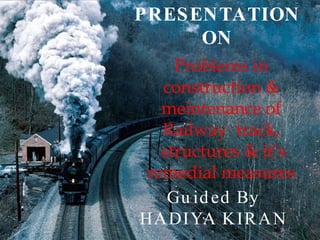

PRESENTATION
ON
Gu ided By
HADIYA KIRAN
Problems in
construction &
meintenance of
Railway track,
structures & it’s
remedial measures
Indian Railways is an Indian state-owned
enterprise, owned and operated by the
government of India through the Ministry
of Railways. It is one of the world's largest
railway networks comprising 115,000 km
(71,000 mi) of track over a route of
65,000 km (40,000 mi) and 7,500 stations.
ABOUT INDIAN
RAILWAY
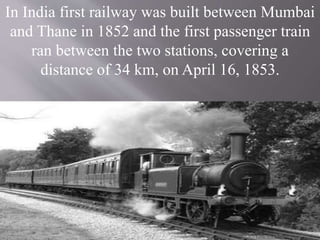
In India first railway was built between Mumbai
and Thane in 1852 and the first passenger train
ran between the two stations, covering a
distance of 34 km, on April 16, 1853.
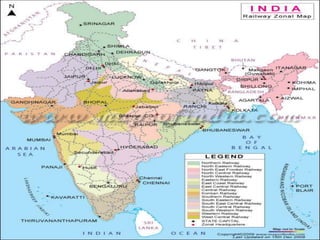
ZONES OF INDIAN RAILWAY
1. EASTERN RAILWAY
2. SOUTH CENTRAL RAIWAY
3. NORTHEN RAILWAY
4. NORTH EASTERN RAILWAY
5. SOUTHERN RAILWAY
6. CENTRAL RAILWAY
7. WESTERN RAILWAY
8. NORTH EAST FRONTIER
RAILWAY
9. SOUTH CENTRAL RAILWAY
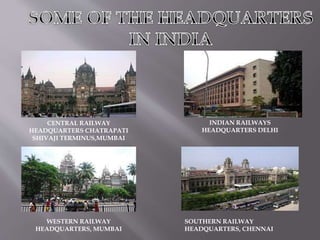
CENTRAL RAILWAY
HEADQUARTERS CHATRAPATI
SHIVAJI TERMINUS,MUMBAI
INDIAN RAILWAYS
HEADQUARTERS DELHI
WESTERN RAILWAY
HEADQUARTERS, MUMBAI
SOUTHERN RAILWAY
HEADQUARTERS, CHENNAI
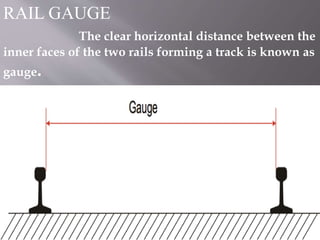
RAIL GAUGE
The clear horizontal distance between the
inner faces of the two rails forming a track is known as
gauge.
TYPES OF GAUGES PREVALENT IN
INDIA
1. Broad gauge (1676 mm)
When the clear horizontal distance between the
inner faces of two parallel rails forming a track is 1676 mm ,
the gauge is called as broad gauge.
2. Meter gauge (1000 mm)
When the clear horizontal distance between
the inner faces of two parallel rails forming a track is 1000
mm , the gauge is called as meter gauge.
3. Narrow gauge (762 mm or 610 mm)
When the clear horizontal distance between
the inner faces of two parallel rails forming a track is 762 mm
, the gauge is called as narrow gauge.
 The components parts of a permanent way
(railway track) are:
1. Rails
2. Sleepers
3. Ballast
4. Sub ballast
5. Embankment
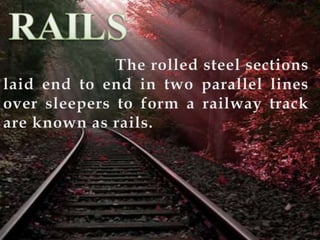
 Rails are made of steel. They are rolled I sections.
 They are fixed to the sleepers by various
fastening and rest on sleepers.
 To provide a hard, smooth and continuous level
surface for the movement of trains.
 To serve as lateral guide to the running wheels.
 To transmit moving loads to the sleepers.
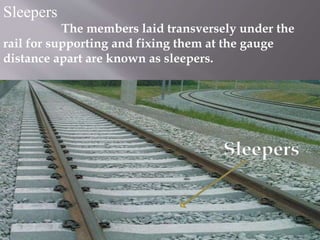
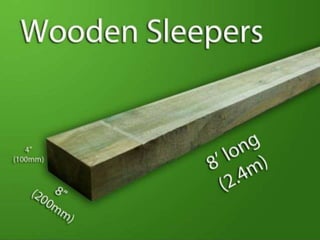
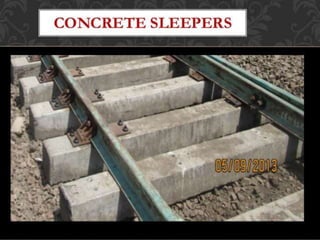
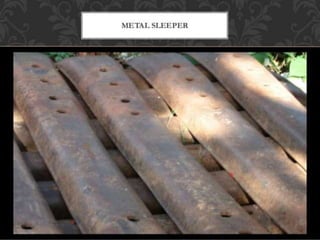
Sleepers
The members laid transversely under the
rail for supporting and fixing them at the gauge
distance apart are known as sleepers.
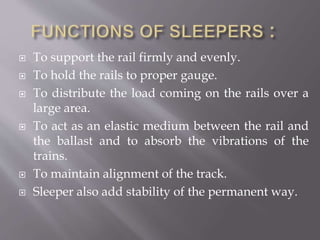
Sleepers
 To support the rail firmly and evenly.
 To hold the rails to proper gauge.
 To distribute the load coming on the rails over a
large area.
 To act as an elastic medium between the rail and
the ballast and to absorb the vibrations of the
trains.
 To maintain alignment of the track.
 Sleeper also add stability of the permanent way.
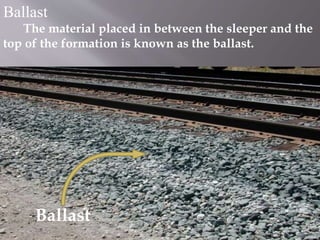
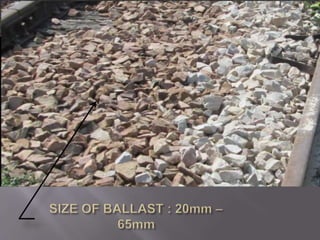
Ballast
The material placed in between the sleeper and the
top of the formation is known as the ballast.
Ballast
 To provide hard and level base for the sleepers
to rest on.
 To hold the sleeper in place during the passage
of trains.
 To transmit and distribute the load from the
sleepers to the formation.
 To drain the rain water quickly.
 To import some degree of elasticity to the tack.
 A layer of moorum, gravel or small
aggregates is provided between the ballast and
earth embankment to drain off the water
immediately. It is sub ballast.
 Embankment is also known as the formation. It
is prepared by levelling the ground and necessary
cutting or filling. The Embankment is provided
side slopes of 1:2.
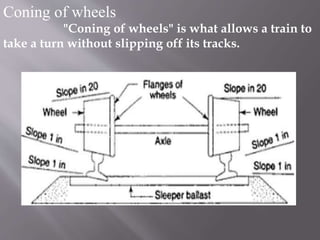
Coning of wheels
"Coning of wheels" is what allows a train to
take a turn without slipping off its tracks.
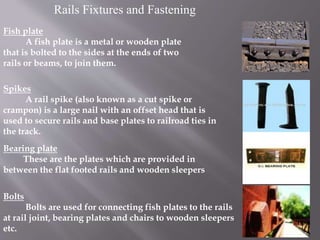
Fish plate
A fish plate is a metal or wooden plate
that is bolted to the sides at the ends of two
rails or beams, to join them.
Spikes
A rail spike (also known as a cut spike or
crampon) is a large nail with an offset head that is
used to secure rails and base plates to railroad ties in
the track.
Rails Fixtures and Fastening
Bearing plate
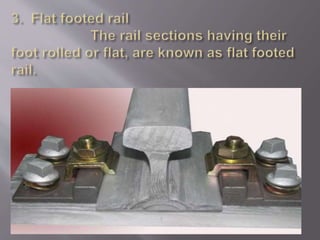
These are the plates which are provided in
between the flat footed rails and wooden sleepers
Bolts
Bolts are used for connecting fish plates to the rails
at rail joint, bearing plates and chairs to wooden sleepers
etc.
1. Railway Bridges
2. Railway Stations
3. Railway Tunnels
4. Railway Culvert
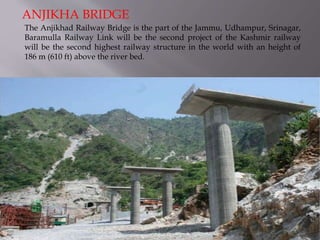
The Anjikhad Railway Bridge is the part of the Jammu, Udhampur, Srinagar,
Baramulla Railway Link will be the second project of the Kashmir railway
will be the second highest railway structure in the world with an height of
186 m (610 ft) above the river bed.
ANJIKHA BRIDGE
.
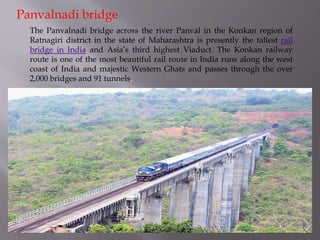
The Panvalnadi bridge across the river Panval in the Konkan region of
Ratnagiri district in the state of Maharashtra is presently the tallest rail
bridge in India and Asia’s third highest Viaduct. The Konkan railway
route is one of the most beautiful rail route in India runs along the west
coast of India and majestic Western Ghats and passes through the over
2,000 bridges and 91 tunnels.
Panvalnadi bridge
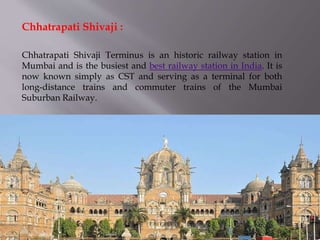
Chhatrapati Shivaji Terminus is an historic railway station in
Mumbai and is the busiest and best railway station in India. It is
now known simply as CST and serving as a terminal for both
long-distance trains and commuter trains of the Mumbai
Suburban Railway.
Chhatrapati Shivaji :
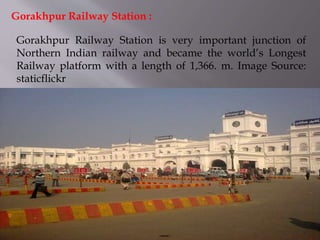
Gorakhpur Railway Station is very important junction of
Northern Indian railway and became the world’s Longest
Railway platform with a length of 1,366. m. Image Source:
staticflickr
Gorakhpur Railway Station :
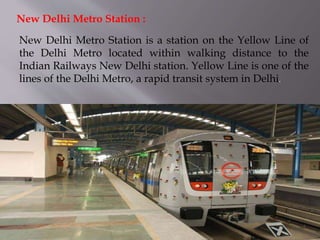
New Delhi Metro Station is a station on the Yellow Line of
the Delhi Metro located within walking distance to the
Indian Railways New Delhi station. Yellow Line is one of the
lines of the Delhi Metro, a rapid transit system in Delhi.
New Delhi Metro Station :
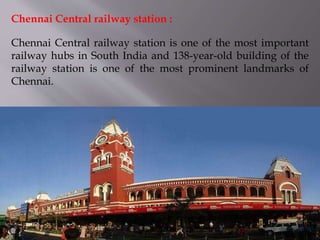
Chennai Central railway station is one of the most important
railway hubs in South India and 138-year-old building of the
railway station is one of the most prominent landmarks of
Chennai.
Chennai Central railway station :
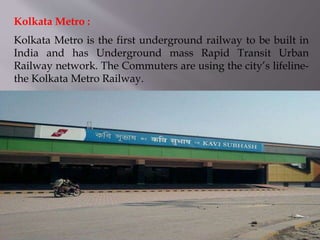
Kolkata Metro is the first underground railway to be built in
India and has Underground mass Rapid Transit Urban
Railway network. The Commuters are using the city’s lifeline-
the Kolkata Metro Railway.
Kolkata Metro :
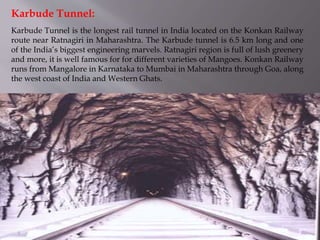
Karbude Tunnel is the longest rail tunnel in India located on the Konkan Railway
route near Ratnagiri in Maharashtra. The Karbude tunnel is 6.5 km long and one
of the India’s biggest engineering marvels. Ratnagiri region is full of lush greenery
and more, it is well famous for for different varieties of Mangoes. Konkan Railway
runs from Mangalore in Karnataka to Mumbai in Maharashtra through Goa, along
the west coast of India and Western Ghats.
Karbude Tunnel:
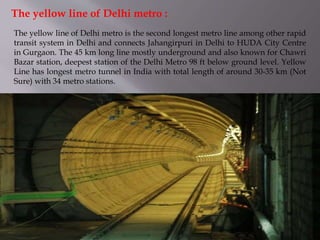
The yellow line of Delhi metro is the second longest metro line among other rapid
transit system in Delhi and connects Jahangirpuri in Delhi to HUDA City Centre
in Gurgaon. The 45 km long line mostly underground and also known for Chawri
Bazar station, deepest station of the Delhi Metro 98 ft below ground level. Yellow
Line has longest metro tunnel in India with total length of around 30-35 km (Not
Sure) with 34 metro stations.
The yellow line of Delhi metro :
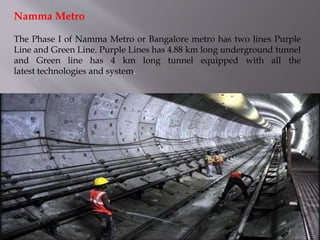
The Phase I of Namma Metro or Bangalore metro has two lines Purple
Line and Green Line. Purple Lines has 4.88 km long underground tunnel
and Green line has 4 km long tunnel equipped with all the
latest technologies and system.
Namma Metro
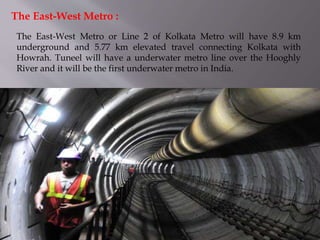
The East-West Metro or Line 2 of Kolkata Metro will have 8.9 km
underground and 5.77 km elevated travel connecting Kolkata with
Howrah. Tuneel will have a underwater metro line over the Hooghly
River and it will be the first underwater metro in India.
The East-West Metro :
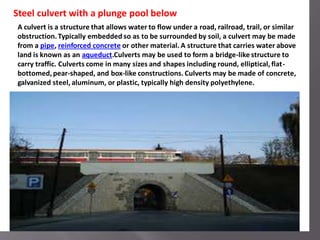
A culvert is a structure that allows water to flow under a road, railroad, trail, or similar
obstruction.Typically embedded so as to be surrounded by soil, a culvert may be made
from a pipe, reinforced concrete or other material. A structure that carries water above
land is known as an aqueduct.Culverts may be used to form a bridge-like structure to
carry traffic. Culverts come in many sizes and shapes including round, elliptical, flat-
bottomed,pear-shaped, and box-like constructions. Culverts may be made of concrete,
galvanized steel, aluminum, or plastic, typically high density polyethylene.
Steel culvert with a plunge pool below
Safe and stable stream crossings can accommodate wildlife and protect stream health
while reducing expensive erosion and structural damage.Undersized and poorly placed
culverts can cause problems for water quality and aquatic organisms. Poorly designed
culverts can degrade water quality via scour and erosion and also restrict aquatic
organisms from being able to move freely between upstream and downstream habitat.
Fish are a common victim in the loss of habitat due to poorly designed crossing
structures. Culverts that offer adequate aquatic organism passage reduce impediments
to movement of fish, wildlife and other aquatic life that require instream passage. These
structures are less likely to fail in medium to large scale rain and snow melt events.[citation
needed]
Environmental impacts
In the coastal plains of Queensland (north-east Australia), torrentialrains during the
wet season place a heavy demand on culverts. The naturalslope of the flood plains is
often very small and little fall (or head loss) is permissible in the culverts. Professors
Gordon R. McKay and Colin J. Apelt developed and patented the design procedure of
minimum energy loss culverts waterways which yield small afflux. Colin J. Apelt,
(emeritus) professor of civil engineeringat the University of Queensland, presented an
authoritativereview of the topic (1983)[2] and a well-documenteddocumentary
(1994).[3]
.
Minimum energy loss culverts
 Defects
1.High joint or Riding joint.
2.Variation in rail tilt.
3.Blowing joints.
4.Pumping joints.
5.Hogging of joints.
6.Center bound track.
7.Heaved track.
8.Non-squared sleeper.
CAUSES
1. Over packing of sleepers at joint.
2. Sinking of sleeper in between the joints.
3. Over tightening of fish plate bolts.
4. Improper gap between two rails.
5. Loose and dusty ballast.
6. Thin layer of ballast.
7. Weak sleepers.
8. Poor drainage.
9. Dirty ballast.
10. Excess gap between two rails.
11. Loose bolts of fish plate.
12. Inadequate packing of ballast below sleepers.
13. More packing of ballast, below sleepers at their centre.
14. Inadequate drainage.
15. Improper an inadequate drainage system.
16. Creep along the rails.
CONCLUSION:-
In This Semester We studied Different
Type Of Structures Related To Railway & Find Out
Problem In Construction & Maintenance Of Railway Tracks.
In Next Semester We Will Find Out
Problem Related To Construction & Maintenance Of Railway
Bridges,Railway Tunnels,Railway station &Culverts &Try To
Find out Solution For The Same.
Railway project

Railway project

  • 1.
    PRESENTATION ON Gu ided By HADIYAKIRAN Problems in construction & meintenance of Railway track, structures & it’s remedial measures
  • 2.
    Indian Railways isan Indian state-owned enterprise, owned and operated by the government of India through the Ministry of Railways. It is one of the world's largest railway networks comprising 115,000 km (71,000 mi) of track over a route of 65,000 km (40,000 mi) and 7,500 stations. ABOUT INDIAN RAILWAY
  • 3.
    In India firstrailway was built between Mumbai and Thane in 1852 and the first passenger train ran between the two stations, covering a distance of 34 km, on April 16, 1853.
  • 4.
    ZONES OF INDIANRAILWAY 1. EASTERN RAILWAY 2. SOUTH CENTRAL RAIWAY 3. NORTHEN RAILWAY 4. NORTH EASTERN RAILWAY 5. SOUTHERN RAILWAY 6. CENTRAL RAILWAY 7. WESTERN RAILWAY 8. NORTH EAST FRONTIER RAILWAY 9. SOUTH CENTRAL RAILWAY
  • 6.
    CENTRAL RAILWAY HEADQUARTERS CHATRAPATI SHIVAJITERMINUS,MUMBAI INDIAN RAILWAYS HEADQUARTERS DELHI WESTERN RAILWAY HEADQUARTERS, MUMBAI SOUTHERN RAILWAY HEADQUARTERS, CHENNAI
  • 7.
    RAIL GAUGE The clearhorizontal distance between the inner faces of the two rails forming a track is known as gauge.
  • 8.
    TYPES OF GAUGESPREVALENT IN INDIA 1. Broad gauge (1676 mm) When the clear horizontal distance between the inner faces of two parallel rails forming a track is 1676 mm , the gauge is called as broad gauge. 2. Meter gauge (1000 mm) When the clear horizontal distance between the inner faces of two parallel rails forming a track is 1000 mm , the gauge is called as meter gauge. 3. Narrow gauge (762 mm or 610 mm) When the clear horizontal distance between the inner faces of two parallel rails forming a track is 762 mm , the gauge is called as narrow gauge.
  • 9.
     The componentsparts of a permanent way (railway track) are: 1. Rails 2. Sleepers 3. Ballast 4. Sub ballast 5. Embankment
  • 15.
     Rails aremade of steel. They are rolled I sections.  They are fixed to the sleepers by various fastening and rest on sleepers.  To provide a hard, smooth and continuous level surface for the movement of trains.  To serve as lateral guide to the running wheels.  To transmit moving loads to the sleepers.
  • 16.
    Sleepers The members laidtransversely under the rail for supporting and fixing them at the gauge distance apart are known as sleepers. Sleepers
  • 21.
     To supportthe rail firmly and evenly.  To hold the rails to proper gauge.  To distribute the load coming on the rails over a large area.  To act as an elastic medium between the rail and the ballast and to absorb the vibrations of the trains.  To maintain alignment of the track.  Sleeper also add stability of the permanent way.
  • 22.
    Ballast The material placedin between the sleeper and the top of the formation is known as the ballast. Ballast
  • 24.
     To providehard and level base for the sleepers to rest on.  To hold the sleeper in place during the passage of trains.  To transmit and distribute the load from the sleepers to the formation.  To drain the rain water quickly.  To import some degree of elasticity to the tack.
  • 25.
     A layerof moorum, gravel or small aggregates is provided between the ballast and earth embankment to drain off the water immediately. It is sub ballast.
  • 26.
     Embankment isalso known as the formation. It is prepared by levelling the ground and necessary cutting or filling. The Embankment is provided side slopes of 1:2.
  • 27.
    Coning of wheels "Coningof wheels" is what allows a train to take a turn without slipping off its tracks.
  • 28.
    Fish plate A fishplate is a metal or wooden plate that is bolted to the sides at the ends of two rails or beams, to join them. Spikes A rail spike (also known as a cut spike or crampon) is a large nail with an offset head that is used to secure rails and base plates to railroad ties in the track. Rails Fixtures and Fastening Bearing plate These are the plates which are provided in between the flat footed rails and wooden sleepers Bolts Bolts are used for connecting fish plates to the rails at rail joint, bearing plates and chairs to wooden sleepers etc.
  • 36.
    1. Railway Bridges 2.Railway Stations 3. Railway Tunnels 4. Railway Culvert
  • 38.
    The Anjikhad RailwayBridge is the part of the Jammu, Udhampur, Srinagar, Baramulla Railway Link will be the second project of the Kashmir railway will be the second highest railway structure in the world with an height of 186 m (610 ft) above the river bed. ANJIKHA BRIDGE
  • 39.
  • 41.
    The Panvalnadi bridgeacross the river Panval in the Konkan region of Ratnagiri district in the state of Maharashtra is presently the tallest rail bridge in India and Asia’s third highest Viaduct. The Konkan railway route is one of the most beautiful rail route in India runs along the west coast of India and majestic Western Ghats and passes through the over 2,000 bridges and 91 tunnels. Panvalnadi bridge
  • 45.
    Chhatrapati Shivaji Terminusis an historic railway station in Mumbai and is the busiest and best railway station in India. It is now known simply as CST and serving as a terminal for both long-distance trains and commuter trains of the Mumbai Suburban Railway. Chhatrapati Shivaji :
  • 46.
    Gorakhpur Railway Stationis very important junction of Northern Indian railway and became the world’s Longest Railway platform with a length of 1,366. m. Image Source: staticflickr Gorakhpur Railway Station :
  • 47.
    New Delhi MetroStation is a station on the Yellow Line of the Delhi Metro located within walking distance to the Indian Railways New Delhi station. Yellow Line is one of the lines of the Delhi Metro, a rapid transit system in Delhi. New Delhi Metro Station :
  • 48.
    Chennai Central railwaystation is one of the most important railway hubs in South India and 138-year-old building of the railway station is one of the most prominent landmarks of Chennai. Chennai Central railway station :
  • 49.
    Kolkata Metro isthe first underground railway to be built in India and has Underground mass Rapid Transit Urban Railway network. The Commuters are using the city’s lifeline- the Kolkata Metro Railway. Kolkata Metro :
  • 51.
    Karbude Tunnel isthe longest rail tunnel in India located on the Konkan Railway route near Ratnagiri in Maharashtra. The Karbude tunnel is 6.5 km long and one of the India’s biggest engineering marvels. Ratnagiri region is full of lush greenery and more, it is well famous for for different varieties of Mangoes. Konkan Railway runs from Mangalore in Karnataka to Mumbai in Maharashtra through Goa, along the west coast of India and Western Ghats. Karbude Tunnel:
  • 52.
    The yellow lineof Delhi metro is the second longest metro line among other rapid transit system in Delhi and connects Jahangirpuri in Delhi to HUDA City Centre in Gurgaon. The 45 km long line mostly underground and also known for Chawri Bazar station, deepest station of the Delhi Metro 98 ft below ground level. Yellow Line has longest metro tunnel in India with total length of around 30-35 km (Not Sure) with 34 metro stations. The yellow line of Delhi metro :
  • 53.
    The Phase Iof Namma Metro or Bangalore metro has two lines Purple Line and Green Line. Purple Lines has 4.88 km long underground tunnel and Green line has 4 km long tunnel equipped with all the latest technologies and system. Namma Metro
  • 54.
    The East-West Metroor Line 2 of Kolkata Metro will have 8.9 km underground and 5.77 km elevated travel connecting Kolkata with Howrah. Tuneel will have a underwater metro line over the Hooghly River and it will be the first underwater metro in India. The East-West Metro :
  • 56.
    A culvert isa structure that allows water to flow under a road, railroad, trail, or similar obstruction.Typically embedded so as to be surrounded by soil, a culvert may be made from a pipe, reinforced concrete or other material. A structure that carries water above land is known as an aqueduct.Culverts may be used to form a bridge-like structure to carry traffic. Culverts come in many sizes and shapes including round, elliptical, flat- bottomed,pear-shaped, and box-like constructions. Culverts may be made of concrete, galvanized steel, aluminum, or plastic, typically high density polyethylene. Steel culvert with a plunge pool below
  • 57.
    Safe and stablestream crossings can accommodate wildlife and protect stream health while reducing expensive erosion and structural damage.Undersized and poorly placed culverts can cause problems for water quality and aquatic organisms. Poorly designed culverts can degrade water quality via scour and erosion and also restrict aquatic organisms from being able to move freely between upstream and downstream habitat. Fish are a common victim in the loss of habitat due to poorly designed crossing structures. Culverts that offer adequate aquatic organism passage reduce impediments to movement of fish, wildlife and other aquatic life that require instream passage. These structures are less likely to fail in medium to large scale rain and snow melt events.[citation needed] Environmental impacts
  • 58.
    In the coastalplains of Queensland (north-east Australia), torrentialrains during the wet season place a heavy demand on culverts. The naturalslope of the flood plains is often very small and little fall (or head loss) is permissible in the culverts. Professors Gordon R. McKay and Colin J. Apelt developed and patented the design procedure of minimum energy loss culverts waterways which yield small afflux. Colin J. Apelt, (emeritus) professor of civil engineeringat the University of Queensland, presented an authoritativereview of the topic (1983)[2] and a well-documenteddocumentary (1994).[3] . Minimum energy loss culverts
  • 59.
     Defects 1.High jointor Riding joint. 2.Variation in rail tilt. 3.Blowing joints. 4.Pumping joints. 5.Hogging of joints. 6.Center bound track. 7.Heaved track. 8.Non-squared sleeper.
  • 60.
    CAUSES 1. Over packingof sleepers at joint. 2. Sinking of sleeper in between the joints. 3. Over tightening of fish plate bolts. 4. Improper gap between two rails. 5. Loose and dusty ballast. 6. Thin layer of ballast. 7. Weak sleepers. 8. Poor drainage. 9. Dirty ballast. 10. Excess gap between two rails. 11. Loose bolts of fish plate. 12. Inadequate packing of ballast below sleepers. 13. More packing of ballast, below sleepers at their centre. 14. Inadequate drainage. 15. Improper an inadequate drainage system. 16. Creep along the rails.
  • 61.
    CONCLUSION:- In This SemesterWe studied Different Type Of Structures Related To Railway & Find Out Problem In Construction & Maintenance Of Railway Tracks. In Next Semester We Will Find Out Problem Related To Construction & Maintenance Of Railway Bridges,Railway Tunnels,Railway station &Culverts &Try To Find out Solution For The Same.

Editor's Notes

  • #60 CONCLUSION:- In This Semester We studied Different Type Of Structures Related To Railway & Find Out Problem In Construction & Maintenance Of Railway Tracks. In Next Semester We Will Find Out Problem Related To Construction & Maintenance Of Railway Bridges,Railway Tunnels,Railway station &Culverts &Try To Find out Solution For The Same.