HIGH PERFORMANCE LIQUID
CHROMATOGRAPHY
INSTRUMENTATION AND
WORKING
BINDU KSHTRIYA
Dept. of Pharmaceutical sciences,
Maharishi Dayanand University, Rohtak
LIQUID
CHROMATOGRAPHY
· 1906 - Mikhail Semenovich Tswett used Calcium Carbonate and Petroleum Ether to separate plant chlorophylls
The separation was named Chromatography from the Greek word chromos for color and to write (graphy)
In the 1940’s, Martin and Synge introduced the concept of Partition Chromatography.
In the1950’s Gradient elution was introduced by Tiselius and theory of separation was described by VanDeemter.
Finally ,in the 1960’s the first commercial liquid chromatography was introduced.
SEPARATION MECHANISM
Chromatographic processes can be defined as separation techniques involving mass-transfer between stationary and mobile
phases.
Separation in based upon differential migration between the stationary (packing material) and mobile phases (solvent). Mobile phase
elutes components while Packing materials retain components in the column
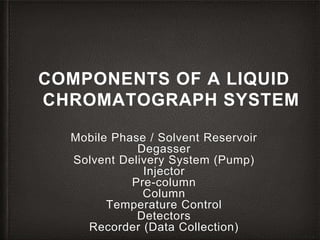
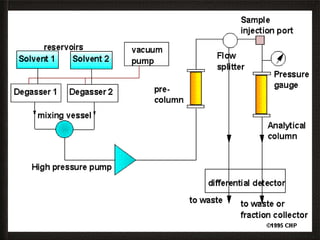
COMPONENTS OF A LIQUID
CHROMATOGRAPH SYSTEM
Mobile Phase / Solvent Reservoir
Degasser
Solvent Delivery System (Pump)
Injector
Pre-column
Column
Temperature Control
Detectors
Recorder (Data Collection)
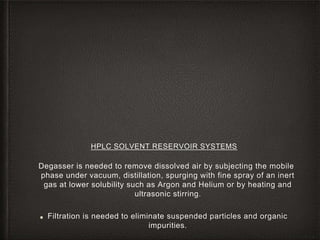
HPLC SOLVENT RESERVOIR SYSTEMS
Degasser is needed to remove dissolved air by subjecting the mobile
phase under vacuum, distillation, spurging with fine spray of an inert
gas at lower solubility such as Argon and Helium or by heating and
ultrasonic stirring.
■ Filtration is needed to eliminate suspended particles and organic
impurities.
DEGASSER
Problems caused by dissolved air(O2, N2)in mobile phase
Unstable delivery in pump
Bigger noise and large baseline-drift in detector cell
▪ In order to avoid causing the problems,
mobile phase should be degassed.
vacuum pumping systems
distillation system
a system for heating and stirring the solvents
PUMPS
■ Pass mobile phase through column at high pressure and at controlled flow rate.
■ Performance of pump directly affects the Rt, reproducibility, detector sensitivity
IDEAL CHARCETRISTIC OF A PUMP
■ Non corrosive and compatible with solvent.
■ Provide High pressure to push mobile phase
■ Provide constant flow rate to mobile phase.
■ Easy to change for one mobile phase to another.
■ Should have reproducible flow rate and independent of column back pressure
■ Should not leak and should be easy to dismantle and repair
TYPE OF PUMP USED IN
HPLC
■ Reciprocating pump
■ Displacement pump
■ Pneumatic pump
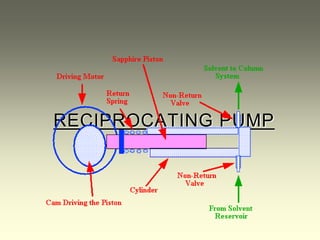
RECIPROCATING PUMP
RECIPROCATING PUMP
WORKING
■ Contains reciprocating piston that moves back and forth in hydraulic chamber.
■ By the movement of piston solvent flow into the column under high pressure.
■ When piston moves backward inlet valve open while exit valve closes. This result in mobile phase being drawn into the main
chamber (cylinder).
RECIPROCATING PUMP
■ When the piston moves to the front the inlet valve closes and the exit valve opens.
■ The reduction in volume in main chamber due to forward motion of piston result in mobile phase moving out of the exit valve u nder
high pressure.
DISADVENTAGE
■ Pulsed flow which must be damped as they produce a base line noise on the chromatogram

RECIPROCATING PUMP
ADVANTAGES
■ Generate high output pressure (upto10000 psi).
■ Ready adaptability to gradient elusion.
■ Provide constant flow rate.
■ Pressure generated is so high that any back pressure generated in the column due to higher viscosity of stationary phase can be
easily overcome.
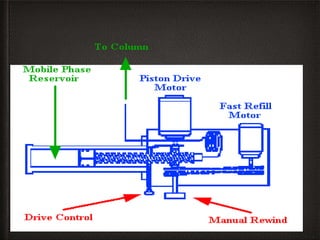
DISPLACEMENT PUMP / SYRINGE
PUMP
DISPLACEMENT PUMP / SYRINGE PUMP
WORKING
■ Works on the principle of positive solvent pressure.
■ Consist of screw or plunger which revolves continuously driven by motor.
■ Rotatory motion provides continuous movement of the mobile phase which is propelled by the revolving screw at greater speed
and pushes solvent through small needle like outlet.
■ Consist of large syringe like chamber of capacity 250 – 500 ml.
DISPLACEMENT PUMP / SYRINGE PUMP
ADVANTAGES
■ Flow is pulse free.
■ Provide high pressure upto 200 – 475 atm.
■ Independent of column back pressure and viscosity of solvent.
■ Simple operation.
DISADVENTAGE
■ Limited solvent capacity
■ Gradient elution is not easy.
PNEUMATIC PUMP
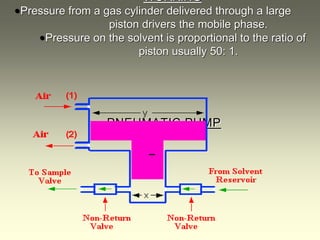
WORKING
•Pressure from a gas cylinder delivered through a large
piston drivers the mobile phase.
•Pressure on the solvent is proportional to the ratio of
piston usually 50: 1.
PNEUMATIC PUMP
■ The driving air is applied, piston moves, inlet closes & outlet open pushing mobile phase to the column.
■ A lower pressure gas source of 1- 10 atm can be used to generate high liquid pressure .( 1 – 400 atm )
■ About 70 ml of the mobile phase is pumped from every stroke.
PNEUMATIC PUMP
ADVENTAGES
■ Pulse free flow.
■ Generates high pressure.
DISADVANTAGES
■ Limited volume capacity (70 ml )
■ Pressure output and flow rate depends on the viscosity and column back pressure.
■ Gradient elusion is not possible.
PULSE DAMPER
Important damping methods include
■ A triple headed pump: - two heads in different stages of filling as the third is pumping.
■ A tube with an air space or a flexible bellows or tube: - where a gas (air space) or a flexible metal vessel takes up some of the
solution energy. When pump refills, this energy is released and a smooth pressure pulsation result.
■ A restrictor: - I this method, a 25 cm length of 4 mm bore .stainless steel tubing. Packed with 20µm glass beds, is placed between
the pump and the column.
SAMPLE INJECTION SYSTEM
■ Septum injectors
■ Stop flow septumless injection.
■ Rheodyne injector / loop valve type.
SAMPLE INJECTION SYSTEM
Septum injection port.
■ Syringe is used to inject the sample through a self sealing inert septum directly into the mobile phase.
■ Drawback: - leaching effect of the mobile phase with the septum resulting in the formation of ghost peaks.
Stop flow septumless injection.
■ Flow of mobile phase through the column is stopped for a while.
■ Syringe is used to inject the sample.
■ Drawback: formation of ghost peak.
SAMPLE INJECTION SYSTEM
Rheodyne injector / loop valve type.
■ Sophisticated modern method with good precision.
■ Sample is introduced in the column without causing interruption to mobile phase flow.
■ Volume of sample ranges between 2 µl to over 100 µl.
SAMPLE INJECTION SYSTEM
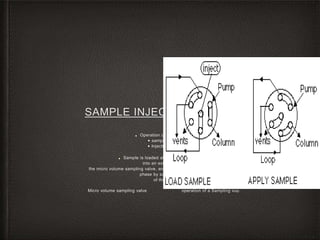
■ Operation of sample loop.
• sampling mode
• Injection mode.
■ Sample is loaded at atmospheric pressure
into an external loop in
the micro volume sampling valve, and subsequently injected into the mobile
phase by suitable rotation
of the valve.
Micro volume sampling valve operation of a Sampling loop.
COLUMN
■ Made up of stainless steel or heavy glass to withstand the pressure.
■ The columns are usually long (10 – 30 cm) narrow tubes. Contains stationary phase at particle diameters of 25 µm or less.
■ The interior of column should be smooth and uniform.
■ Column end fitting are designed to have a zero void volume.
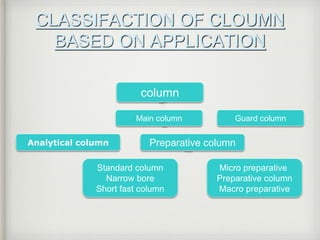
CLASSIFACTION OF CLOUMN
BASED ON APPLICATION
column
Main column Guard column
Analytical column Preparative column
Standard column
Narrow bore
Short fast column
Micro preparative
Preparative column
Macro preparative
CLASSIFACTION OF COLUMN ON THE
BASES OF COMPONENTS
■ BONDED PHASE COLUMN
■ COLUMN WHERE LIQUID IS INPERMAGNETED ON SOLID INERT SUPPORT
STANDARD COLUMN
• Internal diameter 4 – 5 mm and length 10 – 30 cm.
• Size of stationary phase is 3 – 5 µm in diameter.
• Used for the estimation of drugs, metabolites, pharmaceutical preparation and body fluids like plasma.
NARROW BORE COLUMN
■ Internal diameter is 2 – 4 mm. ( signal is increased 4 times )
■ Require high pressure to propel mobile phase.
■ Used for the high resolution analytical work of compounds with very high Rt.
SHORT FAST COLUMN
■ Length of column is 3 – 6 cm.
■ Used for the substances which have good affinity towards the stationery phase.
■ Analysis time is also less (1- 4 min for gradient elusion & 15 – 120 sec for isocratic elusion).
PREPARATIVE COLUMN
■ Used for analytical separation i.e. to isolate or purify sample in the range of 10-100 mg form complex mixture.
• Length – 25- 100 cm
• Internal diameter – 6 mm or more.
Preparative column are of three type :
• Micro preparative or semi preparative column
■ Modified version of analytical column
■ Uses same packaging and meant for purifying sample less then 100 mg.
• Preparative column
■ Inner diameter – 25 mm .
■ Stationary phase diameter – 15- 100 µm
• Macro Preparative Column
■ Column length – 20 – 30 cm
■ Inner diameter – 600 mm
GUARD COLUMN
• They are placed anterior to the separating column.
• Serve as a protective factor that prolongs the life and usefulness of the column.
• They are dependable column designed to filter or remove
■ Particles that clog the separation column.
■ Compounds and ions that could ultimately cause baseline drift, decrease resolution , decrease sensitivity and create false pe aks.
BONDED PHASE COLUMN
■ Here the molecules, comprising the stationary phase i.e. the surface of the silica particles, are covalently bonded to a silica based
support particles.
■ The most popular bonded phase ,siloxanes , are formed by heating the silica particles in dilute acid for the day so as to gen erate
the reactive Silonal group.
- OH OH OH
‫ו‬‫ו‬‫ו‬
- Si – O – Si - O - Si -
‫ו‬‫ו‬‫ו‬‫ו‬
■ Silonal group is the treated with organochlorosilane.
CH3 CH3
‫ו‬‫ו‬Si – OH + Cl – Si – R →- Si – O – Si – R + HCl
│ │
CH3 CH3
• These bonded phases are stable between the pH range 2 – 9 and upto temperature of 80º C.
■ Bonded phase is made with a linear C 18 hydrocarbon, also know as ODS (octadecyl silane) bonded phase. Used in
pharmaceutical analysis or separation of less polar components.
■ An alkyl nitrile column or cyano column which has 12 carbon atoms with the last atom appearing as a nitrile group (CN)
.moderately polar column.
■ Amino alkyl bonded phase column which is normally C 8, last C atom bearing NH2 group. Polar column. Use full in separation of
CHO, peptides, amino acids.
Advantages
• Can withstand high pressure exerted by mobile phase.
• Life of column is more.
• No bleeding effect
Disadvantages
■ Very expensive
■ Manually can not be fabricated
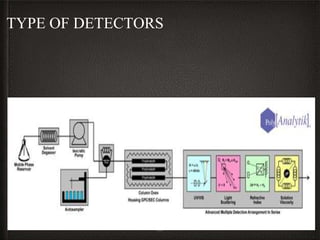
TYPE OF DETECTORS
Bulk property detectors
Solute property detectors
38
TYPE OF DETECTORS
■ BULK PROPERTY DETECTORS
• Compare an over all change in physical property of mobile phase with or without an eluting solute.
• These types of detectors tend to be relatively insensitive and require temperature control.
e.g. Refractive index detector.
SOLUTE PROPERTY DETECTORS
• They respond to a physical property of the solute that is not exhibited by the pure mobile phase.
• These detectors are more sensitive, detect the sample in nanograms quantity.
e.g. uv visible detector , electrochemical detector, fluorescence detector.
TYPES OF DETECTOR
UV/Visible
- Fixed wavelength
- variable wavelength
Photo Diode Array
Refractive index
Fluorescence
Evaporative light scattering
Conductivity
Electrochemical
THANK YOU

HIGH PERFORMANCE LIQUID CHROMATOGRAPHY

  • 1.
    HIGH PERFORMANCE LIQUID CHROMATOGRAPHY INSTRUMENTATIONAND WORKING BINDU KSHTRIYA Dept. of Pharmaceutical sciences, Maharishi Dayanand University, Rohtak
  • 2.
    LIQUID CHROMATOGRAPHY · 1906 -Mikhail Semenovich Tswett used Calcium Carbonate and Petroleum Ether to separate plant chlorophylls The separation was named Chromatography from the Greek word chromos for color and to write (graphy) In the 1940’s, Martin and Synge introduced the concept of Partition Chromatography. In the1950’s Gradient elution was introduced by Tiselius and theory of separation was described by VanDeemter. Finally ,in the 1960’s the first commercial liquid chromatography was introduced.
  • 3.
    SEPARATION MECHANISM Chromatographic processescan be defined as separation techniques involving mass-transfer between stationary and mobile phases. Separation in based upon differential migration between the stationary (packing material) and mobile phases (solvent). Mobile phase elutes components while Packing materials retain components in the column
  • 4.
    COMPONENTS OF ALIQUID CHROMATOGRAPH SYSTEM Mobile Phase / Solvent Reservoir Degasser Solvent Delivery System (Pump) Injector Pre-column Column Temperature Control Detectors Recorder (Data Collection)
  • 5.
    HPLC SOLVENT RESERVOIRSYSTEMS Degasser is needed to remove dissolved air by subjecting the mobile phase under vacuum, distillation, spurging with fine spray of an inert gas at lower solubility such as Argon and Helium or by heating and ultrasonic stirring. ■ Filtration is needed to eliminate suspended particles and organic impurities.

  • 7.
    DEGASSER Problems caused bydissolved air(O2, N2)in mobile phase Unstable delivery in pump Bigger noise and large baseline-drift in detector cell ▪ In order to avoid causing the problems, mobile phase should be degassed. vacuum pumping systems distillation system a system for heating and stirring the solvents
  • 8.
    PUMPS ■ Pass mobilephase through column at high pressure and at controlled flow rate. ■ Performance of pump directly affects the Rt, reproducibility, detector sensitivity
  • 9.
    IDEAL CHARCETRISTIC OFA PUMP ■ Non corrosive and compatible with solvent. ■ Provide High pressure to push mobile phase ■ Provide constant flow rate to mobile phase. ■ Easy to change for one mobile phase to another. ■ Should have reproducible flow rate and independent of column back pressure ■ Should not leak and should be easy to dismantle and repair
  • 10.
    TYPE OF PUMPUSED IN HPLC ■ Reciprocating pump ■ Displacement pump ■ Pneumatic pump
  • 11.
  • 12.
    RECIPROCATING PUMP WORKING ■ Containsreciprocating piston that moves back and forth in hydraulic chamber. ■ By the movement of piston solvent flow into the column under high pressure. ■ When piston moves backward inlet valve open while exit valve closes. This result in mobile phase being drawn into the main chamber (cylinder).
  • 13.
    RECIPROCATING PUMP ■ Whenthe piston moves to the front the inlet valve closes and the exit valve opens. ■ The reduction in volume in main chamber due to forward motion of piston result in mobile phase moving out of the exit valve u nder high pressure. DISADVENTAGE ■ Pulsed flow which must be damped as they produce a base line noise on the chromatogram
  • 14.
    RECIPROCATING PUMP ADVANTAGES ■ Generatehigh output pressure (upto10000 psi). ■ Ready adaptability to gradient elusion. ■ Provide constant flow rate. ■ Pressure generated is so high that any back pressure generated in the column due to higher viscosity of stationary phase can be easily overcome.
  • 15.
    DISPLACEMENT PUMP /SYRINGE PUMP
  • 16.
    DISPLACEMENT PUMP /SYRINGE PUMP WORKING ■ Works on the principle of positive solvent pressure. ■ Consist of screw or plunger which revolves continuously driven by motor. ■ Rotatory motion provides continuous movement of the mobile phase which is propelled by the revolving screw at greater speed and pushes solvent through small needle like outlet. ■ Consist of large syringe like chamber of capacity 250 – 500 ml.
  • 17.
    DISPLACEMENT PUMP /SYRINGE PUMP ADVANTAGES ■ Flow is pulse free. ■ Provide high pressure upto 200 – 475 atm. ■ Independent of column back pressure and viscosity of solvent. ■ Simple operation. DISADVENTAGE ■ Limited solvent capacity ■ Gradient elution is not easy.
  • 18.
    PNEUMATIC PUMP WORKING •Pressure froma gas cylinder delivered through a large piston drivers the mobile phase. •Pressure on the solvent is proportional to the ratio of piston usually 50: 1.
  • 19.
    PNEUMATIC PUMP ■ Thedriving air is applied, piston moves, inlet closes & outlet open pushing mobile phase to the column. ■ A lower pressure gas source of 1- 10 atm can be used to generate high liquid pressure .( 1 – 400 atm ) ■ About 70 ml of the mobile phase is pumped from every stroke.
  • 20.
    PNEUMATIC PUMP ADVENTAGES ■ Pulsefree flow. ■ Generates high pressure. DISADVANTAGES ■ Limited volume capacity (70 ml ) ■ Pressure output and flow rate depends on the viscosity and column back pressure. ■ Gradient elusion is not possible.
  • 21.
    PULSE DAMPER Important dampingmethods include ■ A triple headed pump: - two heads in different stages of filling as the third is pumping. ■ A tube with an air space or a flexible bellows or tube: - where a gas (air space) or a flexible metal vessel takes up some of the solution energy. When pump refills, this energy is released and a smooth pressure pulsation result. ■ A restrictor: - I this method, a 25 cm length of 4 mm bore .stainless steel tubing. Packed with 20µm glass beds, is placed between the pump and the column.
  • 22.
    SAMPLE INJECTION SYSTEM ■Septum injectors ■ Stop flow septumless injection. ■ Rheodyne injector / loop valve type.
  • 23.
    SAMPLE INJECTION SYSTEM Septuminjection port. ■ Syringe is used to inject the sample through a self sealing inert septum directly into the mobile phase. ■ Drawback: - leaching effect of the mobile phase with the septum resulting in the formation of ghost peaks. Stop flow septumless injection. ■ Flow of mobile phase through the column is stopped for a while. ■ Syringe is used to inject the sample. ■ Drawback: formation of ghost peak.
  • 24.
    SAMPLE INJECTION SYSTEM Rheodyneinjector / loop valve type. ■ Sophisticated modern method with good precision. ■ Sample is introduced in the column without causing interruption to mobile phase flow. ■ Volume of sample ranges between 2 µl to over 100 µl.
  • 25.
    SAMPLE INJECTION SYSTEM ■Operation of sample loop. • sampling mode • Injection mode. ■ Sample is loaded at atmospheric pressure into an external loop in the micro volume sampling valve, and subsequently injected into the mobile phase by suitable rotation of the valve. Micro volume sampling valve operation of a Sampling loop.
  • 26.
    COLUMN ■ Made upof stainless steel or heavy glass to withstand the pressure. ■ The columns are usually long (10 – 30 cm) narrow tubes. Contains stationary phase at particle diameters of 25 µm or less. ■ The interior of column should be smooth and uniform. ■ Column end fitting are designed to have a zero void volume.
  • 27.
    CLASSIFACTION OF CLOUMN BASEDON APPLICATION column Main column Guard column Analytical column Preparative column Standard column Narrow bore Short fast column Micro preparative Preparative column Macro preparative
  • 28.
    CLASSIFACTION OF COLUMNON THE BASES OF COMPONENTS ■ BONDED PHASE COLUMN ■ COLUMN WHERE LIQUID IS INPERMAGNETED ON SOLID INERT SUPPORT
  • 29.
    STANDARD COLUMN • Internaldiameter 4 – 5 mm and length 10 – 30 cm. • Size of stationary phase is 3 – 5 µm in diameter. • Used for the estimation of drugs, metabolites, pharmaceutical preparation and body fluids like plasma. NARROW BORE COLUMN ■ Internal diameter is 2 – 4 mm. ( signal is increased 4 times ) ■ Require high pressure to propel mobile phase. ■ Used for the high resolution analytical work of compounds with very high Rt.
  • 30.
    SHORT FAST COLUMN ■Length of column is 3 – 6 cm. ■ Used for the substances which have good affinity towards the stationery phase. ■ Analysis time is also less (1- 4 min for gradient elusion & 15 – 120 sec for isocratic elusion). PREPARATIVE COLUMN ■ Used for analytical separation i.e. to isolate or purify sample in the range of 10-100 mg form complex mixture. • Length – 25- 100 cm • Internal diameter – 6 mm or more.
  • 31.
    Preparative column areof three type : • Micro preparative or semi preparative column ■ Modified version of analytical column ■ Uses same packaging and meant for purifying sample less then 100 mg. • Preparative column ■ Inner diameter – 25 mm . ■ Stationary phase diameter – 15- 100 µm • Macro Preparative Column ■ Column length – 20 – 30 cm ■ Inner diameter – 600 mm
  • 32.
    GUARD COLUMN • Theyare placed anterior to the separating column. • Serve as a protective factor that prolongs the life and usefulness of the column. • They are dependable column designed to filter or remove ■ Particles that clog the separation column. ■ Compounds and ions that could ultimately cause baseline drift, decrease resolution , decrease sensitivity and create false pe aks.
  • 33.
    BONDED PHASE COLUMN ■Here the molecules, comprising the stationary phase i.e. the surface of the silica particles, are covalently bonded to a silica based support particles. ■ The most popular bonded phase ,siloxanes , are formed by heating the silica particles in dilute acid for the day so as to gen erate the reactive Silonal group. - OH OH OH ‫ו‬‫ו‬‫ו‬ - Si – O – Si - O - Si - ‫ו‬‫ו‬‫ו‬‫ו‬
  • 34.
    ■ Silonal groupis the treated with organochlorosilane. CH3 CH3 ‫ו‬‫ו‬Si – OH + Cl – Si – R →- Si – O – Si – R + HCl │ │ CH3 CH3 • These bonded phases are stable between the pH range 2 – 9 and upto temperature of 80º C. ■ Bonded phase is made with a linear C 18 hydrocarbon, also know as ODS (octadecyl silane) bonded phase. Used in pharmaceutical analysis or separation of less polar components.
  • 35.
    ■ An alkylnitrile column or cyano column which has 12 carbon atoms with the last atom appearing as a nitrile group (CN) .moderately polar column. ■ Amino alkyl bonded phase column which is normally C 8, last C atom bearing NH2 group. Polar column. Use full in separation of CHO, peptides, amino acids. Advantages • Can withstand high pressure exerted by mobile phase. • Life of column is more. • No bleeding effect Disadvantages ■ Very expensive ■ Manually can not be fabricated
  • 36.
    TYPE OF DETECTORS Bulkproperty detectors Solute property detectors 38 TYPE OF DETECTORS
  • 37.
    ■ BULK PROPERTYDETECTORS • Compare an over all change in physical property of mobile phase with or without an eluting solute. • These types of detectors tend to be relatively insensitive and require temperature control. e.g. Refractive index detector. SOLUTE PROPERTY DETECTORS • They respond to a physical property of the solute that is not exhibited by the pure mobile phase. • These detectors are more sensitive, detect the sample in nanograms quantity. e.g. uv visible detector , electrochemical detector, fluorescence detector.
  • 38.
    TYPES OF DETECTOR UV/Visible -Fixed wavelength - variable wavelength Photo Diode Array Refractive index Fluorescence Evaporative light scattering Conductivity Electrochemical
  • 39.