
ENVIRONMENTAL
PROTECTION ACT
BINDU KSHTRIYA
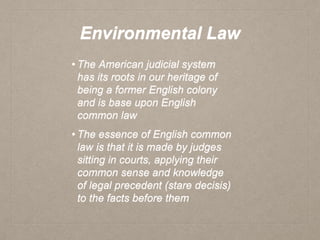
Environmental Law
• The American judicial system
has its roots in our heritage of
being a former English colony
and is base upon English
common law
• The essence of English common
law is that it is made by judges
sitting in courts, applying their
common sense and knowledge
of legal precedent (stare decisis)
to the facts before them
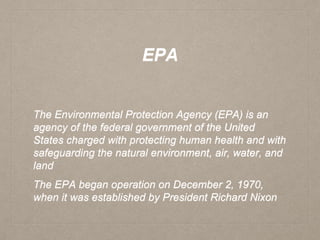
EPA
The Environmental Protection Agency (EPA) is an
agency of the federal government of the United
States charged with protecting human health and with
safeguarding the natural environment, air, water, and
land
The EPA began operation on December 2, 1970,
when it was established by President Richard Nixon
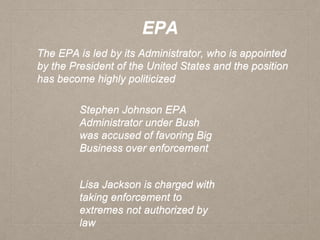
EPA
The EPA is led by its Administrator, who is appointed
by the President of the United States and the position
has become highly politicized
Stephen Johnson EPA
Administrator under Bush
was accused of favoring Big
Business over enforcement
Lisa Jackson is charged with
taking enforcement to
extremes not authorized by
law
INTRODUCTION
• Prior to the existence of environmental laws, the
environment was severely degraded.
• The need for regulation was seen necessary after
the tort law failed to protect the environment.
• Tragedy of the commons: Freedom in the commons
brings ruin to all.
• Free Rider: A profiting polluter and everyone else
pays to clean the environment.
ENVIRONMENTAL ETHICS
• Humans are the dominant species in the ecosystem,
with knowledge and power.
• It is our ethical obligation to consider the long-term
impact of our behavior.
1970’S
• The creation of the Environmental Protection
Agency, EPA
• The passage of the National Environmental Policy
Act, NEPA.
• The passage of 27 laws designed to protect the
environment.
1980’S
❑ Cutting EPA personnel by 20%, and EPA budget by
more than 33%
• Much of the administrative burden associated with
environmental policy was shifted to the states.
• Decimated CEQ by drastic cuts in its budget.
• At the end of the decade, congress faced public
pressure to oppose Reagan’s environmental policies.
• Voluntary Programs: ISO 14000.
1990’S
• Passage of the CLEAN AIR ACT in 1990.
• Greater use market forces, make the polluter pay.
• 1994 House of Representatives were committed to
weaken environmental regulations.
• Clinton maintained that he would veto any bill that
would undermine existing environmental protection.
2001
• Bush’s first acts as president was to order agencies
to suspend implementation of Clinton’s
environmental executive orders.
• Bush’s and his appointees Gale Norton, Christine
Whitman, Spencer Abraham, and others are
committed to weaken environmental regulations.
• More than 80% of the public oppose drilling for oil in
the Arctic National Wildlife Refuge.
NATIONAL ENVIRONMENTAL
POLICY ACT OF 1970
• Establishes the Council on Environmental Quality,
CEQ; the federal watchdog.
• Requires federal agencies to take environmental
consequences into account when making certain
decisions.
• Requires an Environmental Impact Statement, EIS,
for every major legislative proposal or action having
a significant impact on the environment.
COUNCIL ON ENVIRONMENTAL
QUALITY (CEQ)
• Made up of 3 persons, one is the chair, and staff to
serve them.
• Advise the president about environmental matters.
• Gathers data, and publishes the President’s Annual
Report on Environmental Quality, a public report.
POLLUTION PREVENTION ACT
OF 1990
• Remedies earlier end-of-pipe regulations, finds ways
to prevent the creation of pollution at the source.
• 1993; Clinton issued executive order to improve
pollution prevention in the federal government.
• The PPA was very effective, and saved producers
money by source reduction and better engineering
designs.
AIR QUALITY CONTROL
• The 1970 Clean Air Act targeted Auto and Smokestacks
Emissions, it significantly improved air quality.
• The major air pollutants are:
• 1. Sulfur Dioxide SO2; sources are volcanic emissions,
and the burning of high-sulfur containing coal. It is highly
corrosive and can damage the respiratory tract
• 2. Nitrogen Oxides; sources are lightning, and auto and
industrial emissions. It can damage the respiratory tract
and deplete the ozone layer
CONTINUE; MAJOR AIR
POLLUTANTS
• 3. Carbon Monoxide; sources are natural and also from
incomplete burning of fossil fuels, mainly auto
emissions, it contributes to the global warming and to
the formation of ozone at low altitudes
• 4. Ozone; Is the primary ingredient of smog, causes
eye irritation, nasal congestion, asthma, damage to
lung and immune system. (The Ozone layer is ozone at
high altitude and protects life by blocking ultraviolet
radiation)
GLOBAL AIR-QUALITY
PROBLEMS
• Acid rain; primary cause is SO2 and NOx emissions.
SO2 and NOx gases can be carried in the
atmosphere.
• Lakes on alkaline foundations like limestone will
buffer the harm of acid rain, lakes on granite
foundations will not buffer the acidity, and aquatic
life may die
GLOBAL AIR-QUALITY
PROBLEMS
• Depletion of the Ozone Layer; the primary cause is
the use of chlorofluorocarbons, in refrigeration and
air conditioning. The Ozone layer blocks most of the
UV rays, which are harmful to all living organisms
including humans
• Global Warming; Effects can be a rise in sea levels,
increasing frequency of floods, and the extinction of
plant and animal species.
INTERNATIONAL
AGREEMENTS/COMMITTEE
S
• Montreal Protocol
• 1987 international agreement, initiated by UNEP to phase
out use of ozone-depleting chemicals by 2000/2005
• Very successful with CFC’s, but new ozone-depleting
chemicals are constantly being discovered
Kyoto Protocol
A 1997 international agreement to reduce the emission
of greenhouse gases by 5% by 2012
Not signed by the USA
IPCC
Intergovernmental Panel on Climate Change (1998)
Thousands of scientists monitor, share and publish
reports on atmospheric change
HISTORICAL APPROACH
• Earlier attempts to improve air quality started in the
1880’s
• Clean Air Act of 1963 did not mandate standards or
define air pollution
• 1967 Air Quality Act; created 10 regions within
which pollution could be regulated, was ineffective
• The 1970 Clean Air Act was a success
US ENVIRONMENTAL
LAWS
• Clean Air Act
• 1962 (revised 1970)
• Law requires the EPA to protect the public from exposure to
“criteria” and “hazardous” airborne pollutants
• Clean Water Act
• 1972/1977/1988 act to restore all of America’s surface
waterways so that they are navigable, swimmable & fishable
NEPA
National Enviro. Policy Act
1962 requirement for all federal agencies to produce
E.I. statements
Wilderness Act
1964 law defining and protecting wilderness (minimally
altered by humans)
FIFRA
Federal Insecticide, Fungicide and Rodenticide Act
1972 law to regulate the use of agricultural and
domestic pesticides
US ENVIRONMENTAL
LAWS
• Marine Protection Act
• 1972 law to regulate the disposal of municipal, solid or
hazardous waste at sea or into the sea
• Endangered Species Act
• 1973 law to protect endangered species from extinction, and
protect the ecosystems on which they depend
• Penalizes ownership of any organism’s body part or
damage to its habitat
Safe Drinking Water Act
1974 law to ensure safe drinking water for the public
Establishes National Primary Drinking Water
Standards
TSCA
Toxic Substances Control Act
1976 law that inventories all chemicals in use in the US
Resource Conservation and Recovery Act
1976 law that regulates solid and hazardous waste
disposal
“cradle to grave” monitoring
US ENVIRONMENTAL
LAWS
• Surface Mining Control And Reclamation Act
• 1979 law regulating coal mining, and enforces reclamation
of altered land
• CERCLA/”Superfund”
• Comprehensive Enviro. Response, Compensation and
Liability Act
• 1980 law requiring polluters to clean up abandoned sites
(“brownfields”) that are contaminated with hazardous
substances
■ Food Quality Protection Act
■ 1996 law that enforces safe
pesticide levels in food
■ HFI
■ Healthy Forests Initiative
■ 2003 law to help prevent
damaging forest fires
■ Mandatory thinning of trees
and clearing of understory
■ Energy Policy Act
■ 2005 law providing big tax
incentives for research and
use of alternative energies
Food Quality Protection Act
1996 law that enforces safe pesticide levels in food
HFI
Healthy Forests Initiative
2003 law to help prevent damaging forest fires
Mandatory thinning of trees and clearing of understory
Energy Policy Act
2005 law providing big tax incentives for research and
use of alternative energies
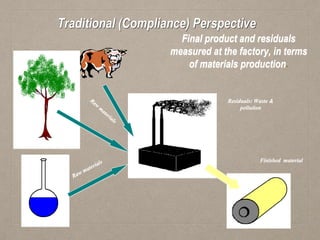
Final product and residuals
measured at the factory, in terms
of materials production.
Traditional (Compliance) Perspective
Residuals: Waste &
pollution
Finished material
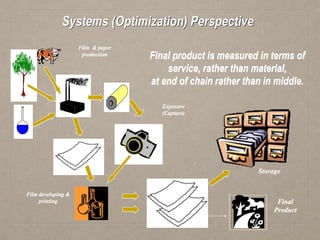
Systems (Optimization) Perspective
Final product is measured in terms of
service, rather than material,
at end of chain rather than in middle.
Film & paper
production
Film developing &
printing
Exposure
(Capture)
Storage
Final
Product
THANK YOU
BINDU KSHTRIYA

US EPA

  • 1.
  • 2.
    Environmental Law • TheAmerican judicial system has its roots in our heritage of being a former English colony and is base upon English common law • The essence of English common law is that it is made by judges sitting in courts, applying their common sense and knowledge of legal precedent (stare decisis) to the facts before them
  • 3.
    EPA The Environmental ProtectionAgency (EPA) is an agency of the federal government of the United States charged with protecting human health and with safeguarding the natural environment, air, water, and land The EPA began operation on December 2, 1970, when it was established by President Richard Nixon
  • 4.
    EPA The EPA isled by its Administrator, who is appointed by the President of the United States and the position has become highly politicized Stephen Johnson EPA Administrator under Bush was accused of favoring Big Business over enforcement Lisa Jackson is charged with taking enforcement to extremes not authorized by law
  • 5.
    INTRODUCTION • Prior tothe existence of environmental laws, the environment was severely degraded. • The need for regulation was seen necessary after the tort law failed to protect the environment. • Tragedy of the commons: Freedom in the commons brings ruin to all. • Free Rider: A profiting polluter and everyone else pays to clean the environment.
  • 6.
    ENVIRONMENTAL ETHICS • Humansare the dominant species in the ecosystem, with knowledge and power. • It is our ethical obligation to consider the long-term impact of our behavior.
  • 7.
    1970’S • The creationof the Environmental Protection Agency, EPA • The passage of the National Environmental Policy Act, NEPA. • The passage of 27 laws designed to protect the environment.
  • 8.
    1980’S ❑ Cutting EPApersonnel by 20%, and EPA budget by more than 33% • Much of the administrative burden associated with environmental policy was shifted to the states. • Decimated CEQ by drastic cuts in its budget. • At the end of the decade, congress faced public pressure to oppose Reagan’s environmental policies. • Voluntary Programs: ISO 14000.
  • 9.
    1990’S • Passage ofthe CLEAN AIR ACT in 1990. • Greater use market forces, make the polluter pay. • 1994 House of Representatives were committed to weaken environmental regulations. • Clinton maintained that he would veto any bill that would undermine existing environmental protection.
  • 10.
    2001 • Bush’s firstacts as president was to order agencies to suspend implementation of Clinton’s environmental executive orders. • Bush’s and his appointees Gale Norton, Christine Whitman, Spencer Abraham, and others are committed to weaken environmental regulations. • More than 80% of the public oppose drilling for oil in the Arctic National Wildlife Refuge.
  • 11.
    NATIONAL ENVIRONMENTAL POLICY ACTOF 1970 • Establishes the Council on Environmental Quality, CEQ; the federal watchdog. • Requires federal agencies to take environmental consequences into account when making certain decisions. • Requires an Environmental Impact Statement, EIS, for every major legislative proposal or action having a significant impact on the environment.
  • 12.
    COUNCIL ON ENVIRONMENTAL QUALITY(CEQ) • Made up of 3 persons, one is the chair, and staff to serve them. • Advise the president about environmental matters. • Gathers data, and publishes the President’s Annual Report on Environmental Quality, a public report.
  • 13.
    POLLUTION PREVENTION ACT OF1990 • Remedies earlier end-of-pipe regulations, finds ways to prevent the creation of pollution at the source. • 1993; Clinton issued executive order to improve pollution prevention in the federal government. • The PPA was very effective, and saved producers money by source reduction and better engineering designs.
  • 14.
    AIR QUALITY CONTROL •The 1970 Clean Air Act targeted Auto and Smokestacks Emissions, it significantly improved air quality. • The major air pollutants are: • 1. Sulfur Dioxide SO2; sources are volcanic emissions, and the burning of high-sulfur containing coal. It is highly corrosive and can damage the respiratory tract • 2. Nitrogen Oxides; sources are lightning, and auto and industrial emissions. It can damage the respiratory tract and deplete the ozone layer
  • 15.
    CONTINUE; MAJOR AIR POLLUTANTS •3. Carbon Monoxide; sources are natural and also from incomplete burning of fossil fuels, mainly auto emissions, it contributes to the global warming and to the formation of ozone at low altitudes • 4. Ozone; Is the primary ingredient of smog, causes eye irritation, nasal congestion, asthma, damage to lung and immune system. (The Ozone layer is ozone at high altitude and protects life by blocking ultraviolet radiation)
  • 16.
    GLOBAL AIR-QUALITY PROBLEMS • Acidrain; primary cause is SO2 and NOx emissions. SO2 and NOx gases can be carried in the atmosphere. • Lakes on alkaline foundations like limestone will buffer the harm of acid rain, lakes on granite foundations will not buffer the acidity, and aquatic life may die
  • 17.
    GLOBAL AIR-QUALITY PROBLEMS • Depletionof the Ozone Layer; the primary cause is the use of chlorofluorocarbons, in refrigeration and air conditioning. The Ozone layer blocks most of the UV rays, which are harmful to all living organisms including humans • Global Warming; Effects can be a rise in sea levels, increasing frequency of floods, and the extinction of plant and animal species.
  • 18.
    INTERNATIONAL AGREEMENTS/COMMITTEE S • Montreal Protocol •1987 international agreement, initiated by UNEP to phase out use of ozone-depleting chemicals by 2000/2005 • Very successful with CFC’s, but new ozone-depleting chemicals are constantly being discovered
  • 19.
    Kyoto Protocol A 1997international agreement to reduce the emission of greenhouse gases by 5% by 2012 Not signed by the USA IPCC Intergovernmental Panel on Climate Change (1998) Thousands of scientists monitor, share and publish reports on atmospheric change
  • 20.
    HISTORICAL APPROACH • Earlierattempts to improve air quality started in the 1880’s • Clean Air Act of 1963 did not mandate standards or define air pollution • 1967 Air Quality Act; created 10 regions within which pollution could be regulated, was ineffective • The 1970 Clean Air Act was a success
  • 21.
    US ENVIRONMENTAL LAWS • CleanAir Act • 1962 (revised 1970) • Law requires the EPA to protect the public from exposure to “criteria” and “hazardous” airborne pollutants • Clean Water Act • 1972/1977/1988 act to restore all of America’s surface waterways so that they are navigable, swimmable & fishable
  • 22.
    NEPA National Enviro. PolicyAct 1962 requirement for all federal agencies to produce E.I. statements Wilderness Act 1964 law defining and protecting wilderness (minimally altered by humans) FIFRA Federal Insecticide, Fungicide and Rodenticide Act 1972 law to regulate the use of agricultural and domestic pesticides
  • 23.
    US ENVIRONMENTAL LAWS • MarineProtection Act • 1972 law to regulate the disposal of municipal, solid or hazardous waste at sea or into the sea • Endangered Species Act • 1973 law to protect endangered species from extinction, and protect the ecosystems on which they depend • Penalizes ownership of any organism’s body part or damage to its habitat
  • 24.
    Safe Drinking WaterAct 1974 law to ensure safe drinking water for the public Establishes National Primary Drinking Water Standards TSCA Toxic Substances Control Act 1976 law that inventories all chemicals in use in the US Resource Conservation and Recovery Act 1976 law that regulates solid and hazardous waste disposal “cradle to grave” monitoring
  • 25.
    US ENVIRONMENTAL LAWS • SurfaceMining Control And Reclamation Act • 1979 law regulating coal mining, and enforces reclamation of altered land • CERCLA/”Superfund” • Comprehensive Enviro. Response, Compensation and Liability Act • 1980 law requiring polluters to clean up abandoned sites (“brownfields”) that are contaminated with hazardous substances ■ Food Quality Protection Act ■ 1996 law that enforces safe pesticide levels in food ■ HFI ■ Healthy Forests Initiative ■ 2003 law to help prevent damaging forest fires ■ Mandatory thinning of trees and clearing of understory ■ Energy Policy Act ■ 2005 law providing big tax incentives for research and use of alternative energies
  • 26.
    Food Quality ProtectionAct 1996 law that enforces safe pesticide levels in food HFI Healthy Forests Initiative 2003 law to help prevent damaging forest fires Mandatory thinning of trees and clearing of understory Energy Policy Act 2005 law providing big tax incentives for research and use of alternative energies
  • 27.
    Final product andresiduals measured at the factory, in terms of materials production. Traditional (Compliance) Perspective Residuals: Waste & pollution Finished material
  • 28.
    Systems (Optimization) Perspective Finalproduct is measured in terms of service, rather than material, at end of chain rather than in middle. Film & paper production Film developing & printing Exposure (Capture) Storage Final Product
  • 29.